Showing posts with label curse. Show all posts

October 25, 2023

Black Agnes: Montpelier's Death-Cursed Statue

As I mentioned before, Tony and I recently traveled up to Montpelier, Vermont to see our old friend Brian. He showed us around Vermont's charming capital, and also showed us some of its spooky sights, including the infamous Black Agnes statue. 

When we reached Montpelier, Brian immediately took us on a tour of Green Mount Cemetery. He is a Montpelier native, and had a lot of gossip and stories about the different folks buried in Green Mount. For example, he showed us a funerary statue of a young girl called "Little Margaret." Little Margaret's family commissioned a local sculptor to carve the statue after she died (apparently of spinal meningitis), but refused to pay because one of the statue's shoes only had five buttons instead of six. The sculptor was about to apologize when he looked again at the photo of Little Margaret the family had given him to work from. One of her shoes was missing a button in the photo. The sculptor stormed back to Little Margaret's family, showed them the photo, and angrily collected his payment.  

Brian also told us that the road leading to Green Mount Cemetery has been the site of many deadly auto accidents. "When I was young, this road was routinely covered in human viscera," he said, morbidly joking. At least I hope he was joking. 
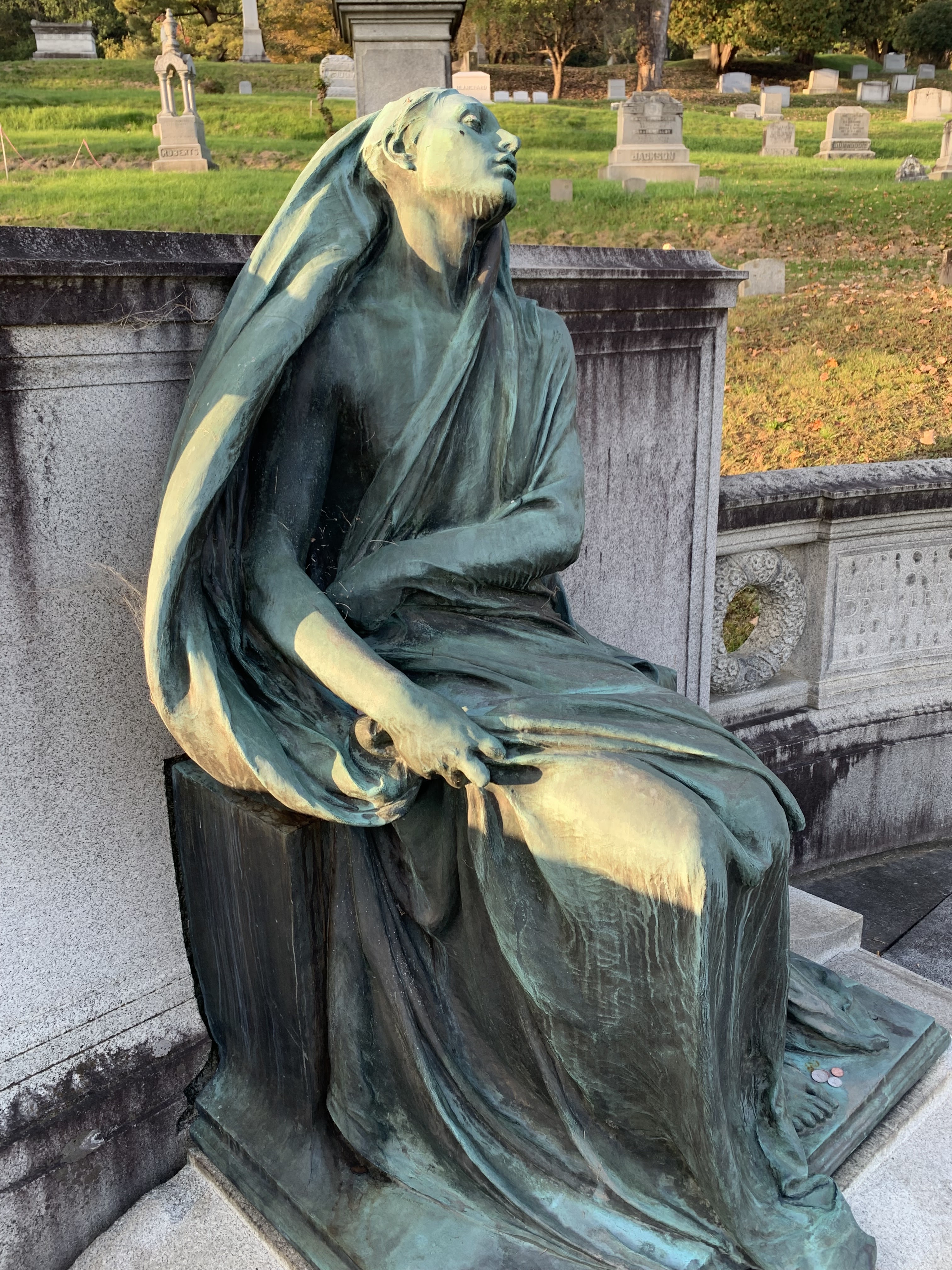
The Black Agnes statue

Towards the end of the tour, we reached the grave of John Erastus Hubbard (1847 - 1899), a wealthy Vermont businessman. Hubbard's grave features a spectacular bronze sculpture of a robed figure titled Thanatos. This statue is more popularly known as Black Agnes. 

According to legend, terrible luck comes to anyone who sits on Black Agnes's lap. Accounts differ as to what form the bad luck will take. Some say three unlucky things will occur to the person who sits on her lap, others say it will be an uncountable amount of bad luck. That doesn't sound good. Still another legend claims that anyone who sits on Black Agnes's lap will die within seven days, which is perhaps the worst luck of all. 

Many years ago, three teenage boys went to Green Mount Cemetery during a full moon. They dared each other to sit on the statue's lap. Not wanting to look cowardly, each boy took a turn sitting on Black Agnes. They all laughed. It was just a dumb statue, after all. Nothing to be afraid of. But within a week, one fell and broke his arm, one was in a serious car accident, and the third boy drowned while canoeing on the Winooski River. Some people said these misfortunes were just coincidences, but others said it was the curse of Black Agnes. 

Well, at least that's one legend. All the legends vary slightly, with some saying, for example, that you only suffer Black Agnes's wrath if you sit on her when the moon is full. Personally, I say why take the risk? Just don't sit on the statue, regardless of the moon phase. I don't recommend sitting or climbing on any cemetery statue. It is disrespectful to the dead, even if there isn't a death curse. 

Brian told us that the Black Agnes legend didn't exist when he was a kid, and that it must be relatively recent. That could very well be the case - new legends arise and old ones disappear all the time. There are in fact other allegedly cursed statues named Black Agnes around the United States. There is one in Washington, DC, which was originally a grave marker in Baltimore for a dead Civil War general in the Union Army named Felix Angus. It was apparently moved from Baltimore because too many fraternity and sorority pledges kept sitting on it as part of their rush process, daring each other to risk the death curse. It seems likely the Black Agnes legend traveled from the DC area to Montpelier, but I'm not sure how. 

Some folks, apparently in an attempt to debunk the Montpelier version of the legend, have pointed out that the statue is clearly of a male, so therefore the legend cannot be true. This argument doesn't hold up for me. It's 2023, and we all know that gender is a social construct. A statue of a male can easily be named Black Agnes. 

John Erastus Hubbard (1847 - 1899)

John Erastus Hubbard, upon whose grave Black Agnes sits, generated some controversy while he was alive. Hubbard came from a prominent Vermont family, and his wealthy aunt left a significant amount of money in her will to the city of Montpelier to build a library. Hubbard was unhappy about this, and managed to get his aunt's will overturned and inherit the money himself. Montpelier officials took him to court, and he eventually agreed to pay for the library. Upon his death, he left the majority of his fortune to Montpelier as well. However, this late generosity did not necessarily win him many fans among the city's citizens, some of whom noted that a terrible thunderstorm raged through Montpelier the night Hubbard died, which they took as an omen indicating the state of his soul. 

April 09, 2022

Wilmot Redd, the Witch of Marblehead

This is my second post about Marblehead. As I mentioned in my last one, Marblehead is incredibly charming and beautiful. It's the archetypal old New England seaside town. And as we all know, old New England towns often have some weird legends attached to them...

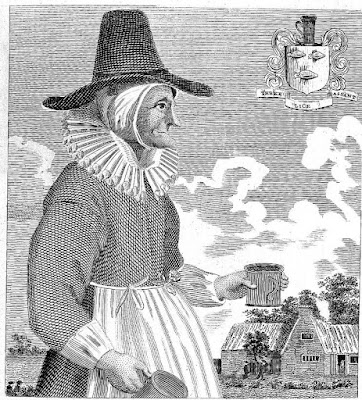
Engraving of a witch by James Caulfield, courtesy the Wellcome Collection

In Marblehead, that weird legend is about Mammy Redd, a fearsome witch who lived in the 17th century. According to various 19th century sources, Mammy Redd was a hideous old woman who terrorized the people of Marblehead. In New England Legends and Folklore (1883), Samuel Adams Drake wrote the following about her:

This woman was believed to possess the power of malignant touch and sight, and she was able, so it was whispered, to cast a spell over those whom she might in her malevolence wish to injure. To some she sent sickness and death, by merely wishing that a 'bloody cleaver' might be found in the cradle of their infant children.

A popular rhyme about Mammy Redd from the 19th century described another of her evil powers:

Old Mammy Redd

Of Marblehead

Sweet milk could turn

To mould in churn

Other versions of the rhyme specify that the mold looked like "blue wool," which sounds pretty gross. Ruining dairy products (milk, cream, or butter) is a classic New England witch's hex. 

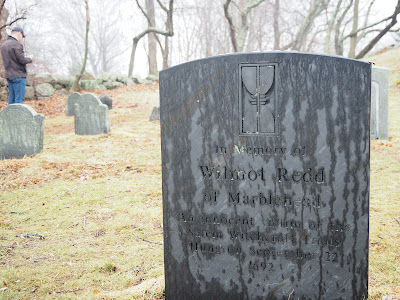
Photo by my friend Onix Marrero

The legend of Mammy Redd is based, quite loosely, on Wilmot Redd (or Read, depending on the source), a Marblehead woman who was executed during the Salem witch trials. She was the wife of a fisherman and, like many of the woman accused of witchcraft by the Puritans, was older and cantankerous. Some sources describe her as "grouty," which means rude or ill-tempered. She was not a witch, but was simply unpopular. 

Most records from her trial are lost, but those that remain describe an argument Redd had with a neighbor, Mrs. Syms. Syms believed Redd's maid had stolen some bed linens, and  exchanged harsh words with Redd. At the end of the argument, Redd supposedly cursed Syms, telling her she would never defecate or urinate again. Soon after, Syms began to suffer from constipation and had difficulty urinating. These problems only ended once she moved away from Marblehead. 

This is an absurd thing to be executed for, but the Salem judges accepted even the most ridiculous accusations at face value. During her questioning, the afflicted Salem girls (the driving force behind the witch hunt) claimed they saw Wilmot Redd's spirit offering them the Devil's black book to sign. This alleged vision sent the girls into convulsions. While most people in the courtroom took them seriously, Wilmot Redd did not. When a judge asked her opinion of the girls' convulsions, she said "My opinion is they are in a sad condition." Grouty to the end, Wilmot Redd was hanged on September 22, 1692 at Gallows Hill in Salem. 

Photo by Onix Marrero

Like everyone executed for witchcraft in Salem, Redd's body was discarded in an unmarked grave somewhere near Gallow's Hill. Perhaps her family retrieved it and secretly reburied her, perhaps not. Many years later, the town of Marblehead erected a monument to her in Old Burial Hill graveyard. As you can see from the photo, people leave coins at her grave to honor her memory. 

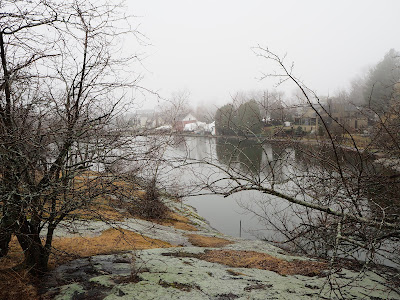
The town also named this small behind pond behind Old Burial Hill Redd's Pond in her honor. She and her husband lived next to the pond in the 17th century, and although her house is long gone her memory and legend still survives to this day. 

Photo of Redd's Pond by Onix Marrero

*****

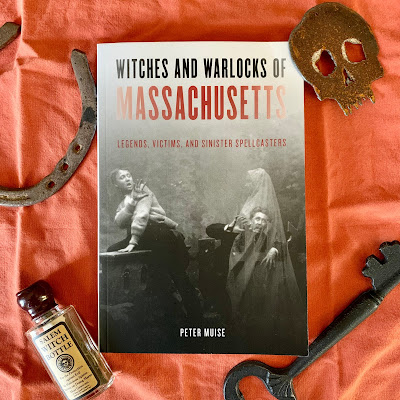
If you like witch legends and the history behind them, you might like my newest book, Witches and Warlocks of Massachusetts, which is available wherever you buy books online. 


February 27, 2022

Visiting the Devil's Den

There are at least 110 places in New England that have the word “Devil” in their name, and forty-three of them are in Massachusetts. Hmmm. What does that say about the Bay State? There's Devil’s Hollow in Marshfield, the Devil’s Landslide in Wellesley, Devil’s Garden in Amherst, etc. And in Newbury, there is... the Devil's Den. 

Last weekend Tony and I took a trip up to Newbury to visit the Devil's Den. The Den is actually a small cave located in an old, abandoned limestone quarry. There are a lot of old quarries in New England, but this one is really old. It was first quarried in 1697 and finally shut down in 1830. The quarry is not large but is very dramatic looking, which is why is probably why it got its devilish reputation.

Long after these quarries had ceased to have a commercial value, pleasure parties were accustomed, during the summer months, to seek rest and recreation there, beguiling the time with marvelous stories in which the Prince of Darkness was given a conspicuous place. In later years, the young and credulous found traces of his Satanic Majesty's footsteps in the solid rock, and discovered other unmistakable signs of his presence in that locality; and ever since the Devil's Den, the Devil's Basin, and the Devil's Pulpit have been objects of peculiar interest to every native of old Newbury. (Ould Newbury. Historical and Biographical Sketches, John James Currier, 1896)

That passage mentions several devilish places. The Devil's Basin was another nearby limestone quarry, filled with water, which I believe was about a half mile away from the Devil's Den (according to Volume 3 of Contributions to the Geology of Eastern Massachusetts, 1880). I'm not sure if the Basin still exists, but according to this site it was located south of the Devil's Den. That area now seems to be mostly landfill which is why I think the Devil's Basin is gone. The Devil's Pulpit was a large boulder nearby but we couldn't locate that either. 


The Devi's Den still exists, and in the early 19th century young boys who lived nearby would perform a strange initiation ritual at it. They believed that a certain magic word had been written on the floor of the cave which would kill anyone who entered it. Certain precautions had to be taken before entering the cave to nullify this curse.

I suppose that no boy ever went to that place alone, and a sort of solemn ceremony attended his first visit with his older playmates, to a scene bearing an appellation ominous enough to call up every vague dread of his youthful heart. The approach on these occasions was rather circuitous, through the pastures, until an elevated mass of stone, standing quite solitary, was reached, designated as “Pulpit Rock.” To the summit of this, the neophyte was required to climb, and there to repeat some accustomed formula, I fear not very reverent, by way of initiation, and supposed to be of power to avert any malign influences to which the unprepared intruder upon the premises of the nominal lord of the domain might otherwise be subjected. (George Lunt, Old New England Traits, 1873)

In other words, after repeating the irreverent phrases from Pulpit Rock, (aka the Devil's Pulpit), it was safe to enter the Devil's Den. However, even then it was only safe to enter the cave with companions - never alone.

Old graffiti at the Devil's Den

Other than this curse and ritual, the Devil's Den had one other interesting feature. The Devil’s Den was made of limestone, but also had deposits of a mineral called chrysotile, a naturally occurring form of asbestos. Chrysotile is soft and chewy, and in the 19th century boys going into the cave would supposedly chew it. Hopefully, they avoided any dangerous side effects. Ingesting asbestos is probably scarier than than a Devil's curse!

I first learned about the Devil's Den while writing my first book, Legends and Lore of the North Shore. Back then, the Devil's Den was on private property, but it is now part of the 28-acre Jennie Lagoulis Reservation. It's worth a visit if you're in the area. Despite it's scary name and legend, you shouldn't be too spooked if you visit. The reservation is the site of a children's nature camp. If little kids can brave the terrors of the Devil's Den you can too.

*****

If you like New England legends, you might like my newest book, Witches and Warlocks of Massachusetts. It's available now wherever you buy books online!


September 23, 2021

The Barren Circle: A Maine Witch's Cursed Grave

As this blog's readers know, I love stories about witches. I also love cemeteries. So I really, really love this story from Bowdoin, Maine since it involves a cemetery and a witch.

First, a little clarification. Bowdoin, Maine is a small town in Sagadahoc County, Maine, and is pronounced "bow-din." It shouldn't be confused with well-known Bowdoin College (also pronounced "bow-din"), which is nearby in Brunswick, Maine. Both are named after the Bowdoin family, who played important roles in Maine's 18th century history, but they are not the same place. 

Bowdoin, Maine looks like a charming small town, but small towns often hide terrifying secrets, as every Stephen King fan knows. According to a local legend, Bowdoin's terrifying secret is inside North Cemetery on Litchfield Road. Here, a circle of cedar trees grows around a barren patch of earth at the back of the cemetery. This, people say, marks the grave of a witch.

Or, perhaps more likely the grave of an innocent person labeled a witch. Many years ago, a woman named Elizabeth was accused by her Bowdoin neighbors of witchcraft. An angry mob dragged her into the cemetery and hanged her from a tree. After she was dead, they cut her down and buried her. Since that time, the trees have grown up in a circle around her grave, but nothing grows on the grave itself. The earth remains barren.

This barren circle is said to be cursed. Anyone who steps on the ground there will meet a grim death. According to one story, one night three teenage boys dared each other to step onto Elizabeth's grave. They all took the dare, and all soon regretted it. The three of them died soon afterwards, each succumbing to a gruesome fate. 

Image of the barren circle by Dori Upham on Find A Grave

Some accounts say Elizabeth was hanged in the 1800s, which makes me suspect the story is probably purely legend. The Salem trials were the last time anyone was executed for witchcraft in New England, and they ended in 1692. I suppose Elizabeth could have been murdered by a mob, but other details of the story (like Elizabeth's lack of a last name) make me think it's just a legend. 

Of course, saying it is "just" a legend sounds dismissive, which I don't intend. Legends and myths have power, whether or not they're based on fact. If I visited North Cemetery I wouldn't step onto that barren circle, would you? I'm skeptical when I'm sitting here at home, but put me in a lonely cemetery and I get a lot more superstitious. Why take the risk? That's the power a legend has. 

Photos on this site show that people have left coins and flowers on the barren circle. Are they literal offerings to Elizabeth's restless spirit, or do people just feel compelled to leave an acknowledgment of the legend? 

I first learned about this legend from the Jumping Frenchmen podcast. I've never been to Bowdoin, Maine but would like to visit someday. In the meantime, I did enjoy this video from the Maine Ghost Hunters that documents their visit to Elizabeth's grave. A misty day, a country road, an old cemetery - very evocative!


If you like witch stories, please consider buying my new book, Witches and Warlocks of Massachusetts, which just came out this month. It's available wherever you buy books. Lots of spooky stories and accounts of historical witchcraft!


August 14, 2021

The Sweet Milk of Satan: A Cape Cod Witch Story

Tony and I were down in Truro on Cape Cod recently, and we found a gravestone I've wanted to see for a long time. It belongs to Sylvanus Rich, who was born in 1720 and died on July 3rd, 1755. There's an interesting legend about Rich and a local witch. It goes something like this. 

*****

Sylvanus Rich was a sea captain. Not much is known about him, but something strange happened to him once during a routine sea voyage carrying carrying corn from North Carolina to Boston. As his ship was sailing north along Truro's Atlantic coast he told his crew to drop anchor. He had seen a small hut nestled among the dunes.

"I want some fresh milk," Rich told his men. "I'm tired of brackish water and rum. I bet whoever lives there has a cow that that gives milk." The crew watched as he rowed himself to shore (alone) and made his way to the hut. When he rowed back to the ship he had a jug of milk with him. "I was right," he said. "The old woman there had some milk for me. But she was the ugliest hag I've ever seen!" Rich retired to his cabin with the creamy beverage, but as soon as he did a fierce gale arose that shredded the ship's sails. The crewmen pounded on his cabin door for guidance, but he did not emerge until the next morning.

Sylvanus Rich's grave in North Truro Cemetery

"What's that?" Sylvanus Rich said groggily to his crew. "The sails are shredded and we're drifting? That's not my concern... Last night the hideous hag came to my cabin. She threw a magic bridle over my head and rode me like a horse up and down the Cape until sunrise. See?" He lifted his shirt, and his crew gasped at the red marks on his torso. They looked like they were made by a woman's shoe. 

"She will come again tonight," Captain Rich said. "I must prepare for her." His crew wasn't sure if he grimaced or smiled as he returned to his cabin and locked the door. 

For several days the ship drifted aimlessly off the Truro coast. Each night the dune-dwelling old witch came and used the captain as her steed, riding him up and down the Cape. Sylvanus Rich was under her spell and helpless to resist her. He spent his days and nights locked in his cabin. 

The crew was feeling desperate (and thinking mutinous thoughts), when they saw another ship approaching from the distance. By a strange coincidence, it was captained by Sylvanus Rich's son. When the crew told him his father was bewitched, Sylvanus's son went down to his cabin. The crew could hear the two men talking inside but were unable to make out what was said. 

Finally, Sylvanus Rich emerged onto the deck. "What are you all looking at?" he said. "My son's ship has materials to repair our sails. Get to work! We need to bring this grain to Boston."

The sails were repaired, and the ship finally arrived in Boston. The merchant waiting for the shipment of corn asked why it was so late. Sylvanus Rich simply said, "Blame it on the sweet milk of Satan."

That's the end of the legend. His gravestone is in Old North Truro Cemetery, but I couldn't find much information about Sylvanus Rich's life. He was born in Eastham, Massachusetts in 1720, and had at least two children with his wife Mary. His son Isaiah was born in 1744, and would only have been 11 years old when Sylvanus died. It seems unlikely that Isaiah was captaining a ship at the age of eleven, so I'm not sure how much of this legend is based on fact. 

There are a lot of New England legends about witches using magic bridles to ride men like horses. There are at least two others from Cape Cod specifically about witches riding sailors! I guess it was an occupational hazard of the time, like scurvy or getting seasick. New England witch stories aren't usually erotic, but I think the sexual undertones in these witch bridle stories are pretty obvious. Milk, usually associated with motherhood and sustenance, has a more sinister and unwholesome role in this tale. 

We never learn what transpired in the witch's hut, or what Sylvanus's son says to him that finally breaks the spell. I like that mystery. I also like that the witch is not killed or harmed at the end of this story. Instead, she is free to seduce and torment more sailors with the SWEET MILK OF SATAN. 

I included this story in my new book, Witches and Warlocks of Massachusetts, which is available now for pre-ordering and will mail on September 1. You can purchase it all your favorite online book vendors. 


*****

My main source for this story was Elizabeth Renard's book The Narrow Land (1934), and she got the story from Shebnah Rich's Truro, Cape Cod, or Landmarks and Seamarks (1884), with additional details from oral tradition.  

June 13, 2021

A Vermont Black Cat Death Curse

 Many years ago, a farmer was walking home through the countryside late at night. He felt a little spooked because the road was dark and lonely.

After walking for a while he saw a strange procession walking towards him in the gloom. Nine black cats were carrying a tiny black coffin draped in velvet. It was a funeral procession. 

As the cats walked past him, one turned to the farmer and said, "Tell Tom Tildrum that Tim Toldrum is dead." The farmer was too shocked to reply and the cats processed off into the darkness.

The farmer was relieved to get home. The fireplace cast a cheery glow, and his wife greeted him with a bowl of warm soup. Their cat lay sleeping by the fire, as it did most nights. Everything seemed normal. 

As he ate his soup, he told his wife what he had seen. "And then," he said, "one of the cats turned and spoke to me. It said, 'Tell Tom Tildrum that Tim Toldrum is dead.' What do you think that means? Who is Tom Tildrum or Tim Toldrum?"

Upon hearing this, the farmer's cat opened its eyes and stood on its hind legs. It seemed to grow in size and importance. The cat said, "Tim Toldrum's dead? Then I'm the King of the Cats!" It howled triumphantly and flew up the chimney, never to be seen again. 

*****

You may have heard that story before. It's an old folk tale called, appropriately enough, the King of the Cats. There are many versions of it, mainly from England, Scotland, and Ireland, but there are some from continental Europe as well. The gist of the stories is usually the same, although the cat names vary: Dildrum and Doldrum, or Madam Momfort and Mally Dixon, or Dan Ratcliffe and Peggy Poison. At the end, though, the humans always discover their humble domestic pet was secretly a special supernatural being. 


A strange New England version of King of the Cats was printed in The Journal of American Folklore in 1908. Author Clara Kern Bayliss noted the following:

WITCHCRAFT - At Shaftsbury, Vermont, eighty years ago, the belief in witches was quite general, and even the children knew the rhyme which brought disaster into the family circle; for it often happened that a witch would come down the chimney in the form of a black cat, and say, - 

"I, Tattaru,  

Tell you

To tell Tatterrier

That sits by the fire

That Tatterags is dead."

And soon after that some of those sitting around the fireplace would sicken and die. (Journal of American Folklore, Vol. 21, No. 82 (Oct - Dec., 1908), p. 363)

The similarities with the King of the Cats story are obvious. The black cat which speaks, the cryptic names and announcement of a death, and even the fireplace - all of these are shared with other versions of the story. But rather than ending in a surprise revelation, the Vermont version ends in death. 

It's kind of strange to see a playful story transformed in this way, but it's totally understandable given New England's history and culture. England, Scotland, and Ireland have lots of lore about fairies and other magical beings. A story whose ending reveals that a common house cat is magical nobility fits in well with fairy lore, and some version of the King of Cats are explicitly about fairies.

When the Puritans colonized New England they did not bring their mother country's fairy lore with them. However, they did bring lore about witches. Lots and lots of it! 

It was believed that witches could transform themselves into animals, and sometimes even speak in animal form. So in the Puritan worldview, a talking cat would not be feline nobility or a fairy, but would instead be a malevolent witch. And what do witches do? Cause misery and death. The core for the story remains, but the ending is quite different and reflects old New England's grim culture. 

One thing I really like about Bayliss's account is this:

...for it often happened that a witch would come down the chimney in the form of a black cat...

I have so many questions about that word "often." Was this a weekly occurrence? Monthly? Life in 19th century Vermont sounds really dangerous. It makes me glad I don't have a fireplace. 

August 25, 2020

Cursed Movie Filmed in Abandoned Insane Asylum

A new X-Men movie is being released this week. The New Mutants comes out on the 28th, and is notable for two reasons. First, it's actually being released in theaters, so if you dare to to the movies you can see it on the big screen. Second, it was filmed in Massachusetts in 2017, but its release was delayed for several years. The director has hinted that the movie is "cursed."

The New Mutants tells the tale of five young folks who are imprisoned in a spooky hospital because their mutant powers are considered dangerous. Much of the movie was shot at Medfield State Hospital, an abandoned 100-year old insane asylum in Medfield. It sounds like an appropriately spooky setting.

Medfield State Hospital. Photo by Ghostfacesouthshore on Wikipedia.

The movie was originally supposed to be released in 2018, but was delayed due to studio mergers and conflicting opinion's over the final tone of the film. The director, Josh Boone, has suggested the movie is cursed and that perhaps filming at Medfield State caused it.

It was during the press push for the first trailer that Boone first spoke of “weird” things happening to crew members at Medfield State Hospital during filming. 
“Literally every single person on my crew — all my grips — all those people had weird things happen to them while they were there,” Boone told IGN of the abandoned state hospital, which also served as a filming location for “Shutter Island” in 2009. “I even told the behind-the-scenes crew to go interview everyone who had weird stuff happen to them for an extra on the Blu-ray.” (from Boston.com, "The story of ‘The New Mutants,’ the ‘cursed’ Marvel movie filmed in Mass.")

I was of course intrigued by the idea of a haunted insane asylum nearby, so I did a little research. Here's what I found. Medfield State Hospital opened in 1896 and was composed of dozens of buildings spread out over 900 acres of land. The hospital was designed on a "cottage plan," with many small buildings intended to create a homey atmosphere. It closed in 2003, and is now open to the public as a park. You can walk on the grounds (it looks like a college campus) but can't enter any of the buildings for safety reasons.

Here's what I didn't find: any stories about ghosts, hauntings, or a curse. I was a little surprised, given it's an abandoned insane asylum, but most visitors say Medfield State is very peaceful.
The citizens of Medfield really seem to enjoy the park-like atmosphere, and several articles I've read online have recommended visiting. 

The cast of The New Mutants

There are probably a few reasons why no spooky stories are attached to Medfield State. It's hard to think of a place as scary when people are walking dogs, playing frisbee, and having picnics there. By opening it up to the public the town has effectively made it wholesome and inherently unspooky. Fencing it off and putting up "No Trespassing" signs would have done the opposite.

Also, the hospital only closed in 2003, which isn't that long ago. It's probably not long enough for any really good local legends to arise or gain traction. Maybe they'll show up in a few years.

It's quite possible The New Mutants will kick off some new legends. Maybe locals will say, "Oooh! Medfield State is so creepy. I heard they filmed a movie there and it was cursed!" It certainly sounds like the start of a good urban legend, doesn't it? The only problem is that you have to buy the Blu-ray to learn about the creepy stuff. Hopefully someone at Marvel will release those interviews on YouTube or another format so the legend can spread. 

April 09, 2020

Molly Bridget and the Bewitched Pigs: A New Hampshire Witchcraft Story


Molly Bridget lived in Portsmouth, New Hampshire during the 1700s. Molly made her living telling fortunes for sailors and young lovers (as fortune tellers do) but over time she developed a reputation for being a witch. People in Portsmouth grew to fear and hate her.

Molly was never wealthy to begin with, and as she grew older she slipped into poverty. Sometime around the Revolutionary War she wound up living in Portsmouth's almshouse (or poorhouse). This was not to her liking so she decided to move south to Boston for a fresh start.

Unfortunately her reputation preceded her and when she arrived in Boston the following occurred:

Finding her way to Boston, the police gave her warning to leave the city forthwith.
"Why?" she asked.
"Is not your name Molly Bridget?"
"No, sir," she replied. "Do you think I am such a despicable creature as Molly?"
(Charles W. Brewster, Rambles About Portsmouth. Second Series. 1869)

The police weren't fooled. Molly realized that she wouldn't be able to leave her old identity behind so with a heavy heart she returned to Portsmouth and the almshouse.

An English woodcut of a witch from 1643
The almshouse was managed by a man named Clement March. One day in 1782 Mr. March noticed that the almshouse's pigs were acting strangely. His thoughts immediately turned to his resident witch, Molly Bridget. Had she bewitched the pigs?

There was only one way to find out. Like many people at that time, Mr. March believed that when a witch cursed something (or someone) they created a magical connection with the object of their curse. If Molly had cursed the pigs there was a connection between her and the animals. Molly's evil magic flowed from her into the pigs through this connection, but Mr. March thought he could use the connection to his advantage. He could make pain flow from the pigs back into Molly. If Molly felt enough pain she would stop cursing the animals.

Putting his plan into action, Mr. March took a knife out to the stye and cut off the pigs' ears and tails. He thought that this would be enough pain to cure the pigs of their strange behavior, but that was not the case.* He then decided to up the ante and burn their severed ears and tails, but when he went to gather them up the ears and tails were missing. Clearly this was more witchcraft! He surmised that Molly had made them disappear somehow.

Not willing to give up, Mr. March gathered the dead leaves and wood chips that were in the pig stye. These were soaked in the pigs' urine, feces, and blood, and therefore still had a connection to the animals and to the witch who had theoretically cursed them. He then burned the chips and leaves in the almshouse's various fireplaces.

The fires had a sudden and violent effect on Molly Bridget:

After the fires were kindled, Molly hastened from room to room in a frenzied manner. She soon went to her own room, and as the flames began to subside her sands of life began to run out, and before the ashes were cold, she was actually a corpse. (Brewster, Rambles About Portsmouth, 1869)

Mr. March and the residents of the Portsmouth almshouse took this as proof that Molly had indeed cursed the pigs. On the day of her funeral a violent storm struck Portsmouth, which was taken as further evidence that she was a witch.

*****

Like last week's post about the witch of Pepperell, this story shows how the belief in witchcraft lingered in New England well past the witch trials of the 1600s. Also like last week's legend, there's no official documentation about Molly Bridget and her witchcraft. The only account I've found is in Charles W. Brewster's Rambles About Portsmouth (1869). 

So is this story true or just a legend? Brewster has the following to say on the matter:

These are facts - how far the results were induced by the superstitious feelings of that day, the reader is left to judge. The poor creature might have believed herself a witch, and the expectation expressed that the burning of the pigs' tails would kill the witch, might have so wrought upon her mind as to produce the result.

I might also suggest that stories like these tend to become more legend-like over time. Perhaps Molly Bridget just died from natural causes and people in Portsmouth created the legend about her death over the years. By the time Brewster wrote down the story 80 years later it had become the traditional witch legend it is now. 

* I don't think cutting off an animal's ears and tail will ever improve its behavior. Be kind to animals!

April 01, 2020

The Cursed Village: The Witch of North Pepperell

North Pepperell is a village that no longer exists. Centuries ago it was a prosperous part of the Massachusetts town of Pepperell. But now it's just a memory and a few ruins hidden in the woods. The village became a ghost town after it was cursed by a local witch. Well, at least that's what the legends say.

Pepperell was settled in 1702 and incorporated as a town in 1775. Pepperell was known for its farmlands and orchards, but the village of North Pepperell was a center of industrial activity. Located along the Nissitissit River, the village (which was also called North Village) supported a sawmill, a gristmill and a cloth mill, as well as a blacksmith and a cigar manufacturer. It also had a school and a tavern.

Sometime in the early 1800s a strange woman moved to the village. Some sources don't name her, while others claim her name was Mrs. Lovejoy. New Englanders can be standoffish even today, but back then the region's Puritan influence was still strong and newcomers who didn't fit in were viewed with great suspicion. And Mrs. Lovejoy definitely did not fit in with the industrious folks of North Pepperell.


She lived alone in a rundown shack near the schoolhouse, and she let her pigs and cows wander into her neighbors' fields. She dressed strangely and wore a handkerchief over her head. She also never talked with her neighbors. None of this behavior is particularly criminal or really even that strange, but it was enough to make Mrs. Lovejoy's neighbors eye her with suspicion.

I'm sure you can see where this is going. People in North Pepperell soon began to mutter that Mrs. Lovejoy was a witch, and eventually three men decided to do something about the "witch" in their midst. In 1820 they went to Mrs. Lovejoy's shack and dragged out the elderly woman. Then they branded her in the middle of her forehead with a hot iron rod.

She shrieked in pain, but when she regained her composure she cursed her assailants. "This village will die. Flames will devour your businesses! The river will dry up! Death will visit each house!" And with that she fled into the woods, never to be seen again.

At first the people of North Pepperell congratulated themselves on getting rid of Mrs. Lovejoy, but their attitude changed as misfortune repeatedly struck the village. First the sawmill burned in a mysterious fire, then the gristmill. Over time the village's other businesses burned as well. The town's industry was decimated. People tried to rebuild, but the village's dam burst and the river's water level sank to a level that couldn't support any mills. 

Of course, the river was still deep enough to drown a four-year old boy who fell in. His accidental death was just one of many that haunted North Pepperell. One man tripped over a chair, instantly breaking his neck, while another died when he fell from his wagon after the horses became startled by something unseen. A respected community member choked to death in front of his family during dinner. A young woman went to milk the cows in the barn and disappeared. Her body was never found.

Those villagers who didn't die under mysterious circumstances began to move away, driven by economic desperation and fear of the witch's curse. The last of the curse's victims may have been two elderly sisters who died in 1900. One night they saw a fire in the woods near their house and tried to extinguish it. The fire overwhelmed them both, but only one body was ever found.

They were the last inhabitants of North Pepperell. Now the village has been taken over by the trees and birds. A few rock walls are the only signs that anything was ever there at all.

*****

This legend appears in a few different places, but the most comprehensive account I've seen is in Joseph Citro's 2004 book Cursed In New England: Stories of Damned Yankees. Joe is a great storyteller and I always enjoy reading his books.

There are lots of stories in New England about witches' curses, and most follow the same  basic pattern. Suspicious townspeople harass someone they suspect is a witch. The harassment turns violent or even deadly. The suspected witch curses their abusers. The curse happens and the townspeople regret what they did.

The story about North Pepperell fits this pattern, but it's interesting that it supposedly happened in 1820. Certainly witchcraft beliefs lingered in New England well after the 17th century witch trials ended, but it's surprising to read about people attacking an alleged witch in the 19th century. Of course, the story may not be true and could just be a legend to explain the misfortunes that ruined North Pepperell. I don't think there are any legal documents or town records corroborating the legend of Mrs. Lovejoy.

On the other hand, according to Cursed In New England, some people speculate that Mrs. Lovejoy may have actually been a Quaker who was persecuted for her religious belief. I suppose that's possible, since the Massachusetts Puritans executed several Quakers in the 1600s. The anti-Quaker laws were repealed in the early 1660s, though, so it seems strange that the North Pepperell villagers would still be branding a Quaker 120 years later. Maybe I just underestimate how bigoted and violent people can be.

Regardless of its truth, the lesson behind this legend is ambiguous, as it is with many of these witch's curse stories. Mrs. Lovejoy is presented as an innocent old eccentric who is not a witch. On the Yet, she has the ability to curse an entire village, causing destruction and many deaths. What agency is responsible for the curse coming true? Is it God? Karma? Or perhaps it's witchcraft after all?

January 06, 2020

Aunt Mose, the Rocks Village Witch

Aunt Mose was reputed to be a witch and the people of Rocks Village (a rural part of Haverhill, Massachusetts) blamed their misfortunes on her. If the butter didn't churn properly they blamed Aunt Mose. If the lamps flickered and went out at a party they blamed her too. One of her neighbors, Captain Peaslee, covered his house and barn with horse shoes to deflect her evil magic. 

Once a group of neighbors who had gathered together for a corn-husking were troubled by a junebug that kept flying around their heads. The insect was quite persistent and wouldn't leave. Finally someone swatted it to the ground with a stick. The next day Aunt Mose was seen limping around the Village. She said she had fallen down the stairs but no one believed her. Clearly, people whispered, she had assumed the form of a junebug and been injured when it was swatted. Clearly she was a witch.

Like many people accused of witchcraft, Aunt Mose did not have much money. She lived for many years in a small house but was forced to sell it. On the day of the sale she angrily told the family who bought it that they would never be happy there. She was right. The family's spinning wheel stopped working as soon as they moved in and only worked properly when Aunt Mose borrowed it. When she returned it to them it stopped working again. Even worse, the mother of the family sickened and died eighteen months after moving in. At her funeral everyone remembered Aunt Mose's angry words...

Of course, the rumors infuriated Aunt Mose and she always denied she was a witch. In an effort to preserve her reputation she went to the local Justice of the Peace and asked him to draft and notarize a document declaring she was not a witch. The JP didn't have any such document, but he wrote one and signed it just to humor the elderly woman.

A 19th century daguerreotype
A young man once fell in love with Aunt Mose's daughter. His friends warned him that her mother was a witch but he just laughed at them. When he told them he was going to Aunt Mose's house that night to announce his intentions they decided to play a prank. They arranged big old chains above the door of her house that would fall when he opened it and scare him off. But things didn't quite work the way they planned. As the young man approached the house a strange light illuminated the doorway and he saw the chains. The prank didn't go off the way they wanted, but the young man was frightened by the strange light and decided not to court Aunt Mose's daughter. 

When Aunt Mose finally died no one could find her will but it was believed to be held by the local wealthy squire. The squire, however, had plenty of other things on his mind and was in no rush to find the document. 

A few months later the squire was sitting next to his fireplace when he got the strange impression he was not alone. Looking up he saw Aunt Mose sitting next to him. He was frightened since she had seen her put into the ground. They sat there in silence, Aunt Mose puffing ferociously on her pipe, until the squire finally spoke:

"Aunt Mose," he said at length, "for the Lord's sake, get right back to the burying-ground! What on earth are you here for?" 
The apparition took her pipe deliberately from her mouth and informed him that she came to see justice done with her will; and that nobody need think of cheating her, dead or alive." (quoted in William Sloane Kennedy, John G. Whittier, the Poet of Freedom, 1892. Note: Kennedy's text calls her "Aunt Morse.")

Aunt Mose then stepped out in the dark night. The squire made sure the will was executed according to her dying wishes the following day. 

*****

I think most small New England towns had their "witches," usually eccentric elderly women that were convenient scapegoats for life's misfortunes. Most of them have been forgotten now but the legends about Aunt Mose have survived thanks to John Greenleaf Whittier (1807 - 1892), the famous poet who was born in Haverhill, Massachusetts. Aunt Mose lived on Corliss Hill behind Whittier's childhood home and he mentioned her in his poems and other writings. Other local residents added their remembrances to Whittier's, giving us the colorful stories we have today. 

John Greenleaf Whittier
Aunt Mose was a real person but it's not entirely clear who she was. In some stories she is called Aunt Mose and in others she is called Aunt Morse, which makes things complicated. The Rocks Village Historical Society suggests that she was Sarah Flanders Chase, who was born in 1762 and was the wife of Moses Chase. Perhaps she was called Aunt Mose because his name was Moses, or perhaps because she was called Aunt Morse because she was related to the Morse family. The Society also suggests that another woman named Chase may have been involved in the sales of the cursed house, not Aunt Mose, so several legends might be conflated. 

In the 17th century being accused of witchcraft was a serious matter, but by the early 19th century being called the town witch was much less dangerous. It was still inconvenient and unpleasant though. I find the stories about Aunt Mose charming (and maybe a little spooky) but I suspect her life was not an easy one. I like reading these old witch tales but have no desire to live in the past. 

*****
My other main source for this post was Rebecca Ingersoll Davis's Gleanings from Merrimac Valley, Sheaf Number Two, 1886.

December 18, 2019

The Witch with Twenty Cats: A Classic New England Curse

Today was very dark and gloomy, with a snowy morning turning into a rainy afternoon. There was barely any sun at all. I suppose I should write about some cheery holiday topic, but I want to write about witches instead. Sometimes a spooky story can lighten up a gloomy day just as easily as a shiny Christmas tree!

The story comes from Robert Ellis Cahill's little book Olde New England's Strange Superstitions (1990, third edition) and takes place in Sutton, Massachusetts. Sutton is a small town in Worcester County and is perhaps most famous for the geologic formation Purgatory Chasm. It seems it also was once the home of at least one witch. Or maybe she was just an innocent old woman?

The story, as Cahill relates it, goes something like this. Many years ago an elderly widow named Goody Wakefield resided in Sutton. She was something of a curmudgeon and lived by herself near the river. Well, to clarify, she lived without human companionship but she did live with a lot cats. Twenty of them, to be exact.

Goody Wakefield was quite poor but never went hungry. Her cats kept her fed. Every day they would troop down to the river and catch pickerel. They'd then bring the fish home to Goody Wakefield. She kept the pickerel in the pockets of the wool coat that she wore all year long. People in Sutton would see her wandering through town with fish in her pockets, and in the summer heat they would smell her as well.

A daguerrotype from the 1860s
As an eccentric elderly woman with a lot of cats she developed a reputation as a witch. Most townspeople avoided her. They feared the evil eye and the malodorous smell that emitted from her coat pockets. But two young men decided to do something about this eccentric woman who disturbed people in Sutton. They devised a plan to kill Goody Wakefield's cats.

The two men hid in the bushes by the river, and as Goody Wakefield's cats paraded down to catch fish they killed them one by one. Seventeen of the felines met their doom that day - only three escaped. When the men were done they piled the bodies on a stone in front of Goody Wakefield's house and shouted until she came outside.

Goody Wakefield emerged from her house and was horrified to see her cats had been slaughtered. As she wept the two men laughed and laughed, mocking the old woman's tears. They continued laughing even as she pointed a trembling finger at them and shrieked:

"GOD, CURSE THESE KILLERS! CURSE THEM!"

Several neighbors were drawn by the commotion and witnessed Goody Wakefield's curse. The two young men laughed at the old woman but the neighbors didn't. They were filled with dread. And one year later they remembered her curse when one of the young cat killers drowned in the river. They remembered again when the second young man caught a strange disease that left him a babbling maniac for the rest of his life.

The neighbors didn't know if the two men were punished by God or cursed by the Devil, but they remembered Goody Wakefield's curse.


Well, that's the story. I hope it cleared up your winter gloom! There are a few things about it that I find interesting. First, I have only seen it in Cahill's Olde New England's Strange Superstitions.  It doesn't appear in History of the town of Sutton, Massachusetts, from 1704 to 1876 : including Grafton until 1735; Millbury until 1813; and parts of Northbridge, Upton and Auburn so I'm not sure where Robert Cahill heard the story.

It certainly follows the format for a classic New England witch's curse story. In these stories, an innocent person (like Goody Wakefield) curses the people who are persecuting them as a witch. The curse then comes true. These stories are a kind of ambiguous about why the curse work, but I think it is usually implied that God himself is punishing the people who persecuted the witch. I mentioned one of these last week (Sarah Good's dying curse on Samuel Noyes), but others include this curse on Colonel Buck, or this one cast by an alleged witch named Aunt Rachel. 

Robert Ellis Cahill claimed that he himself was the object of a dying witch's curse, one that was centuries old. During the Salem witch trials an elderly farmer named Giles Corey was accused of being a witch. He refused to speak to the judges so Salem sheriff George Corwin staked Giles to the ground and piled rocks upon his chest. The sheriff thought this form of torture would make Giles talk but it didn't. The sheriff piled on more and more rocks, but according to tradition Giles's only words were: "More weight." He died without speaking. 

According to legend, every sheriff of Essex County since that time was cursed with heart problems and blood disease. George Corwin died of a heart attack at a young age as did many of his successors. One of those successors, centuries later, was Robert Ellis Cahill who served as sheriff from 1974 until 1978. Cahill suffered a heart attack and stroke in 1978 at the age of 44. The curse was only broken when the Essex County sheriff's office was moved from Salem to its current location in Middleton. 

After he retired as sheriff Cahill devoted his time to writing books about local New England folklore. He wrote more than thirty books (I have several of them), so I guess something good came out of Giles Corey's curse in the end. 

November 13, 2019

Folklore and Pagan Gods in The Lighthouse

My work schedule has been very busy the last few weeks, but I did manage to see The Lighthouse, the new film by Robert Eggers, the New Hampshire-born director who gave us The Witch a few years ago. My review is a little delayed but I wanted to post it anyway because The Lighthouse has some interesting New England folklore in it. Be warned: my review has a few (but not many) SPOILERS.

THE PLOT

The plot is relatively simple. In the late 1800s, two lighthouse keepers (or wickies as they're called) arrive for duty at a lighthouse located on a small rocky island off the coast of Maine. The older wickie, Thomas Wake (Willem Dafoe) has served on the island many times before. His new assistant, Ephraim Winslow (Robert Pattinson) is a former lumberjack reporting for his first stint in a lighthouse. When asked what happened to his previous assistant, Wake replies that he went insane and became convinced the lighthouse was enchanted and that merfolk haunted the island. Oh, and by the way Wake adds, never kill a seabird because they contain the souls of dead sailors.


After this ominous set-up the two men settle into a monotonous routine. As the senior lighthouse keeper Wake tends to the actual light itself, a role he guards jealously. He forbids Winslow from even entering the chamber at the top of the lighthouse and instead assigns to him all the manual labor: hauling coal, cleaning their tiny living quarters, and emptying bedpans. Winslow grows to resent his poor treatment, and his unhappiness is only compounded by a one-eyed seagull that regularly torments him. Winslow's sole pleasure is a scrimshaw mermaid he finds hidden in his mattress which fuels his sexual fantasies.

Over the course of their four-week stint the two men gradually come to an understanding, but things become complicated when the ship that is supposed to bring their replacements is delayed by a powerful storm. The men are stuck on the island. The storm lasts for weeks, and when their liquor runs out Wake and Winslow start to drink kerosene sweetened with honey. And that's when things start to get really weird...

DIALECT AND KILLING A SEABIRD

As he did with The Witch, Robert Eggers incorporates local folklore into his film to make it feel authentic. Much of the dialogue was influenced by 19th-century writers including Sarah Orne Jewett, whose novels and stories were drawn from her experience living in Maine. I've read that Eggers used Jewett's work to craft the two distinct dialects the lighthouse keepers speak: Wake's nautical one and Winslow's inland Maine dialect. I think Willem Dafoe has the easier job, since he basically gets to talk like a pirate or Mr. Crabs from Spongebob Squarepants. Robert Pattinson, on the other hand, has to speak with an accent somewhere between a classic Boston accent and the "Yah cahn't theyah from heyah" Mainer accent. He does a good job though, and I enjoyed hearing him deliver his dialogue.


One of the key plot points is Wake's admonition to never kill a seabird. This is an actual piece of nautical folklore although I think it is particularly local. Many people are familiar with it from Samuel Taylor Coleridge's poem The Rime of the Ancient Mariner, where a ship becomes cursed after a sailor kills an albatross. According to this article the belief was still extant as late as 1959, when sailors transporting an albatross in a cage blamed various malfunctions on the bird's accidental death.

However, there is one possible link to Maine's folklore. Maine lumberjacks believed that is was bad luck to kill gray jays (also known as gorbeys), which were small birds that frequented lumber camps. They were said to be the souls of dead lumberjacks, and hurting a gray jay would bring grave misfortune. In one tale a brutish lumberjack plucks the feathers from a gray jay on a cold winter night, thinking it is the soul of a deceased colleague that he despised. When he awakes in the morning he finds he finds himself bald, weak, and constantly pursued by stormy weather. He had plucked the feathers from his own soul.

MERFOLK

The island in The Lighthouse may be haunted by a mermaid. I won't give away too much, but if it is she's definitely not the happy Little Mermaid variety. There are quite a few mermaid and merman stories from New England, and none of them are happy. They're much closer to horror stories than fairy tales.


One of the earliest comes from John Josselyn's 1674 book An Account of Two Voyages to New England. Josselyn, an Englishman, visited New England in 1633 and 1638. While visiting Maine some of the settlers told him about strange things that had happened to them.
One Mr. Mittin related of a triton or merman which he saw in Casco Bay. This gentleman was a great fowler, and used to go out with a small boat or canoe, and fetching a compass about a small island (there being many small islands in the bay), for the advantage of a shot, was encountered with a triton, who laying his hands upon the side of the canoe, had one of them chopt off with a hatchet by Mr. Mittin, which was in all respects like the hand of a man. The triton presently sunk, dyeing the water with his purple blood, and was no more seen.
Gruesome. Merfolk were generally believed to be aggressive, and an almost identical encounter with a violent merman supposedly happened in Gloucester Harbor in Massachusetts, according to author Edward Rowe Snow. 

Snow also claims that in 1900 a lighthouse keeper at Nantucket's Great Point saw something humanoid emerge from the ocean and crawl into the woods near the beach. Other people who lived nearby saw signs that something large had crawled through the underbrush and made a nest. It's kind of creepy. The plot of The Lighthouse might not be that far from reality (or at least folklore). 

PAGAN GODS

There are several references to classical Greek and Roman gods in The Lighthouse. The myth of Prometheus, the Titan who was punished for stealing fire from Mount Olympus, is alluded to throughout the movie, as is the myth of Proteus, the shapeshifting Old Man of the Sea. I was also struck by this curse that Wake hurls at Winslow when the younger man complains about Wake's cooking:

WAKE: Hark, Triton, Hark! Bellow, and bid our father, the sea king, rise up from the depths, full-foul in his fury, black waves teeming with salt-foam, to smother this young mouth with pungent slime... 
(addressed directly to Winslow)... to choke ye, engorging yer organs till ye turn blue and bloated with bilge and brine and can scream no more... only when, he, crowned in cockle shells with slithering tentacled tail and steaming beard, takes up his fell, be-finnèd arm -– his coral-tined trident screeches banshee-like in the tempest and runs you through the gullet, bursting ye, a bulging bladder no more, but a blasted bloody film now -- a nothing for the Harpies and the souls of dead sailors to peck and claw and feed upon, only to be lapped up and swallowed by the infinite waters of the dread emperor himself, forgotten to any man, to any time, forgotten to any god or devil, forgotten even to the sea... for any stuff or part of Winslow, even any scantling of your soul, is Winslow no more, but is now itself the sea.

Triton was the son and herald of the sea-god Poseidon and mermen were sometimes called 'tritons' after him (as in Josselyn's account). Wake seems to be invoking Poseidon but the 'slithering tentacled tail' also makes me think of H.P. Lovecraft's squid-like deity Cthulhu, and Eggers has said that Lovecraft's weird fiction was one of the film's inspirations.


The references to classical mythology are more prominent than the nods to Lovecraft, though, and I don't think they are out of place in a film set in New England. Many of the original English colonists were well-versed in classical mythology. For example, Thomas Morton invoked a variety of pagan gods (including Neptune, Triton, Priapus and Ganymede) at his 1628 May Day celebration in what is now Quincy, Massachusetts. Of course, the Pilgrims at Plymouth weren't too happy about this and burned down his settlement, but even the die-hard Puritans of Boston and Connecticut knew their ancient gods. For example John Winthrop Jr., the son of Massachusetts's first governor, was so skilled in alchemy and medicine that his peers dubbed him the Christian Hermes. 

In 1776, four captive British sailors carved a statue of Bacchus, the god of wine, for an innkeeper in Windham, Connecticut, while in 1820 Ephraim Lyon of Eastford, Connecticut started a church of Bacchus and declared himself its priest. Perhaps Lyon was just really the town drunk, but in the 1800s many large New England towns also built athenaeums, libraries named after the Greek goddess of wisdom. Many athenaeums were decorated with statues of her. In downtown Boston there are also several large mercantile buildings from the late 19th century decorated with statues of Poseidon and Hermes as well. New England was founded by Puritan Christians but they brought the gods of their ancestors with them as well. We can try to escape the past but it usually catches up with us, which is one of the film's themes.


MY THOUGHTS 

I'm the perfect audience member for The Lighthouse. I like horror movies, I like art films, and I love weird old New England stuff. I enjoyed The Lighthouse and will probably see it again. It had good actors, beautiful cinematography, sea shanties, writhing tentacles, a sinister seagull, and something gruesome in a lobster trap. 

I'm curious how audiences will react to the movie. When I saw The Witch some audience members were puzzled and angry after it ended because it was not the straightforward horror film they expected. The Lighthouse is much weirder than The Witch and even harder to categorize. Is is a dark slapstick comedy? A mythopoetic meditation on the price we pay to tell the truth? A 19th century nautical version of The Odd Couple with repressed erotic undertones? If you see it let me know what you think.