Showing posts with label Salem. Show all posts

February 29, 2024

Cotton Mather and the Connecticut Triton

Many of you are probably familiar with Cotton Mather, the 17th century Puritan minister. Mather was born in Boston in 1663, and was the son of Increase Mather, the city’s leading minister. Cotton attended Harvard, entering at age eleven and a half, making him the youngest person to attend the university. (Thanks for that tidbit, Wikipedia!) Clearly, he was a smart person. After graduating, he followed in his father’s footsteps and became a minister, serving with him as co-pastor of Boston’s most prominent church. 

During the 1692 Salem witch trials, the colony’s political leaders asked Cotton Mather for his opinion on witchcraft. They wanted some guidance on what types of evidence were acceptable, and to know if witchcraft was even real. Mather replied that witchcraft was indeed real, and that execution was an appropriate punishment for the most dangerous witches. He did tell the judges to proceed with caution and be careful with the types of evidence they accepted, but he otherwise said the Salem trials were valid. He maintained this position even after most other people in Massachusetts realized no witches were being executed, just innocent people. 

Ultimately, nineteen people were executed during the Salem trials, one man was crushed to death during questioning, and several people died in jail. Some, or maybe many, of those deaths might have been avoided if Cotton Mather had given the magistrates a different opinion.

Cotton Mather was twenty-nine in 1692. I had a lot to learn about life when I was twenty-nine, and it's pretty obvious that Cotton Mather did too. Luckily, no one was asking me to make life-or-death decisions, or maybe I would have screwed up like he did. Mather's misjudgment about the Salem trials tainted his reputation for the rest of his life. He expected to become president of Harvard, like his father was, but that didn't happen. A shadow hung over him until he died, and still hangs over our memory of him today. 

Despite Mather’s superstitious and ignorant beliefs about witches, he was also one of the best-educated people in Massachusetts and was very interested in science. In 1721, he even helped to start an inoculation campaign in Boston against smallpox, one of the first in the Western world. Most of Boston's physicians violently opposed the campaign, but it turned out to be a resounding success. It's odd to think of Mather as the voice of scientific reason, but in that situation he was.

Mather also wrote dozens of letters to the Royal Society, England’s national academy of sciences, describing interesting phenomena in New England. Some of his letters discussed topics that today we might think of as appropriately scientific, like local New England wildlife (snakes, muskrats, moose), people suffering from unusual medical conditions, and earthquakes. Other letters covered somewhat stranger topics, such as prophetic dreams, ghosts, and a calf born with a human face. The boundaries between science, religion, and magic were poorly delineated at the time, and Cotton Mather was not alone in mixing these topics together. 


One letter, which he wrote in July of 1716, describes a triton, or what we might call a merman. In the letter, Mather writes that he doubted the existence of merfolks until learning about three men who had seen a triton off the coast of Connecticut. On February 22, 1716, the men had been sailing from Milford to Branford when they saw a “creature that seemed a man, lying on the top of a rock” close to the Branford shore. 

“… his head, and face, and neck, and shoulders, and arms, and elbows, and breast and back, all of a human shape, only his arms were little more than half the length of a man’s. He wanted not for hair, which was of a grayish color. However – desinit in piscem (Latin – “it ends in a fish”); his lower parts were those of a fish, and colored like a mackerel. His tail was forked, and he had two fins about a half foot above the tail. The whole animal was about five or six feet in length.” 

That's a very vivid and specific description. Was this a hoax played on Cotton Mather, or did the men actually see something strange on that rock? Or maybe they misidentified a large seal or some other creature? My mind tries to find a rational explanation, but here in the 21st century we're more skeptical about the existence of mermen and mermaids. People were still learning how the physical world worked back in the 17th century and were more willing to believe strange, half-human creatures lurked in the ocean.

It’s interesting that Cotton Mather considered the triton an animal, rather than a mythical being, a monster, or some kind of sea-demon. I suppose he was trying to be scientific, and not superstitious. I’m sure he would have liked to study the triton, but he did not get the opportunity. The men who saw the triton attempted to capture it, but it jumped off the rock and quickly swam away. 

The truth about the Connecticut triton will never be known. Was there a scientific explanation, or a supernatural one? It's fun to speculate there might supernatural creatures like tritons. That type of speculation is less fun when those "supernatural" creatures are innocent people being accused of witchcraft. 

April 09, 2022

Wilmot Redd, the Witch of Marblehead

This is my second post about Marblehead. As I mentioned in my last one, Marblehead is incredibly charming and beautiful. It's the archetypal old New England seaside town. And as we all know, old New England towns often have some weird legends attached to them...

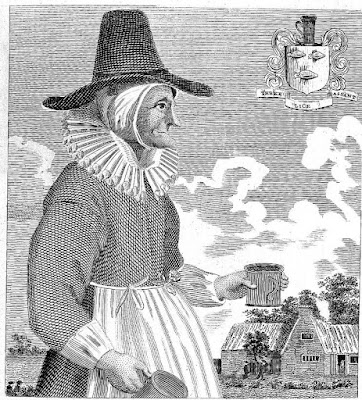
Engraving of a witch by James Caulfield, courtesy the Wellcome Collection

In Marblehead, that weird legend is about Mammy Redd, a fearsome witch who lived in the 17th century. According to various 19th century sources, Mammy Redd was a hideous old woman who terrorized the people of Marblehead. In New England Legends and Folklore (1883), Samuel Adams Drake wrote the following about her:

This woman was believed to possess the power of malignant touch and sight, and she was able, so it was whispered, to cast a spell over those whom she might in her malevolence wish to injure. To some she sent sickness and death, by merely wishing that a 'bloody cleaver' might be found in the cradle of their infant children.

A popular rhyme about Mammy Redd from the 19th century described another of her evil powers:

Old Mammy Redd

Of Marblehead

Sweet milk could turn

To mould in churn

Other versions of the rhyme specify that the mold looked like "blue wool," which sounds pretty gross. Ruining dairy products (milk, cream, or butter) is a classic New England witch's hex. 

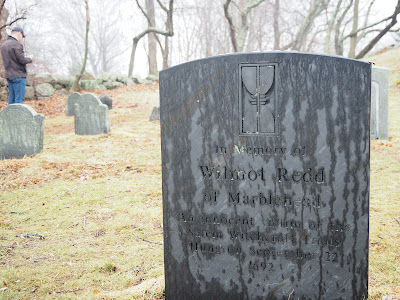
Photo by my friend Onix Marrero

The legend of Mammy Redd is based, quite loosely, on Wilmot Redd (or Read, depending on the source), a Marblehead woman who was executed during the Salem witch trials. She was the wife of a fisherman and, like many of the woman accused of witchcraft by the Puritans, was older and cantankerous. Some sources describe her as "grouty," which means rude or ill-tempered. She was not a witch, but was simply unpopular. 

Most records from her trial are lost, but those that remain describe an argument Redd had with a neighbor, Mrs. Syms. Syms believed Redd's maid had stolen some bed linens, and  exchanged harsh words with Redd. At the end of the argument, Redd supposedly cursed Syms, telling her she would never defecate or urinate again. Soon after, Syms began to suffer from constipation and had difficulty urinating. These problems only ended once she moved away from Marblehead. 

This is an absurd thing to be executed for, but the Salem judges accepted even the most ridiculous accusations at face value. During her questioning, the afflicted Salem girls (the driving force behind the witch hunt) claimed they saw Wilmot Redd's spirit offering them the Devil's black book to sign. This alleged vision sent the girls into convulsions. While most people in the courtroom took them seriously, Wilmot Redd did not. When a judge asked her opinion of the girls' convulsions, she said "My opinion is they are in a sad condition." Grouty to the end, Wilmot Redd was hanged on September 22, 1692 at Gallows Hill in Salem. 

Photo by Onix Marrero

Like everyone executed for witchcraft in Salem, Redd's body was discarded in an unmarked grave somewhere near Gallow's Hill. Perhaps her family retrieved it and secretly reburied her, perhaps not. Many years later, the town of Marblehead erected a monument to her in Old Burial Hill graveyard. As you can see from the photo, people leave coins at her grave to honor her memory. 

The town also named this small behind pond behind Old Burial Hill Redd's Pond in her honor. She and her husband lived next to the pond in the 17th century, and although her house is long gone her memory and legend still survives to this day. 

Photo of Redd's Pond by Onix Marrero

*****

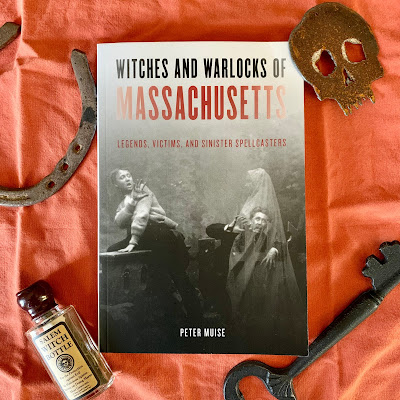
If you like witch legends and the history behind them, you might like my newest book, Witches and Warlocks of Massachusetts, which is available wherever you buy books online. 


October 31, 2021

The Devil and Elizabeth Knapp: Demonic Possession and Witchcraft in 1671

Have you ever been to Groton, Massachusetts? It's a really beautiful old town, with historic houses, quaint churches, and some bucolic farmland. And one October night 350 years ago, teenager Elizabeth Knapp met the Devil in Groton. 

Knapp worked as a servant girl for Reverend Samuel Willard. In October 1671, Reverend Willard noticed that Knapp was acting strangely. Sometimes she would shriek loudly for no apparent reason. Sometimes she would laugh hysterically at nothing. When asked why, she just shrugged and continued with her chores. 

Her behavior became stranger as the month wore on. On October 30, Knapp acted as if she were being attacked by an invisible assailant. The following night, October 31, she fearfully told the household that she had seen two strange people lurking in the cellar. Reverend Willard and others searched, but found no intruders. Willard wondered if perhaps she was pulling a prank on him.

Eugene Delacroix, “Mephistopheles Flying over the City” (1828)

It was no prank, however. On November 2, Elizabeth Knapp told the reverend that the Devil had approached her repeatedly, asking her to sign her name in his book with her blood. He said he'd give her fine silk clothes, money, and a life of idleness if she did. In return, all she had to do was kill her parents, her neighbors, and Reverend Willard’s family. The Devil was quite specific in his instructions regarding Willard's family. Knapp was to throw his youngest child into the fire and kill Reverend Willard with a hook as he slept. 

Yikes.

If I were Reverend Willard, I would have removed Knapp from my house ASAP and had her locked up. But Willard was a kinder, braver, and more tolerant person. He was concerned for Elizabeth Knapp's soul and thought there was still hope. After all, Knapp told him she had not yet signed the Devil’s book. She just liked to walk with the Devil at night and listen to his sweet promises. And perhaps she was not really even talking with Satan - a local physician said her behavior was the result of a sour stomach and corrupted blood. 

The physician prescribed lots of bed rest, and at first Knapp's symptoms improved, but then they worsened as November progressed. She barked like a dog, bleated like a calf, and skipped around uncontrollably. Knapp also said she still had not yet signed the Devil’s book, but only because she couldn’t find a knife to draw her blood with. Upon hearing this the physician changed his diagnosis to diabolical possession. 

On December 2, Knapp screamed out in terror. She had seen a dog with a human head entering the house. Other members of the household saw a large, doglike footprint in the fireplace's ashes. Knapp also claimed that a local Groton woman was bewitching her, but Reverend Willard and others ignored this claim. The woman was not arrested or charged with witchcraft. 

By December 8, Elizabeth Knapp confessed that she had indeed signed the Devil’s book but refused to practice witchcraft or kill the reverend’s family. It was for these reasons the Devil tormented her. Several ministers were called in to pray over her, and as they did Knapp shouted obscenities in a voice that was not her own. Reverend Willard said the voice could be heard even though Knapp’s mouth did not move. He believed it was the Devil himself speaking through her. 

And then... it all stopped at some point in January of 1672. Most of what we know about Elizabeth Knapp's possession comes from a letter Samuel Willard wrote to Reverend Cotton Mather in Boston. Unfortunately, he didn't explain why the possession ended, just that it did. Happily, it didn't seem to have any long-term effects on Elizabeth Knapp. She later got married and had several children. She didn't throw them - or anyone else - into the fire. 

A portrait of Samuel Willard (1640 - 1707)

I have a few thoughts on this incident from Groton's past. First of all, it is spooky. Every time I read about the Devil telling her to kill Samuel Willard with a hook and throw his child into the fire I get creeped out. It's like something out of a very gory horror movie. 

The story is true, but was Elizabeth Knapp really possessed by the Devil? I suppose it's possible, if you believe in a literal Devil who possesses people, but it's important to also think about some of the sociological aspects of Puritan society. Most possession cases from 17th century Massachusetts involved young women or girls. Sadly, young women and girls were usually at the bottom of the Puritan social hierarchy because they were female and unmarried. They had little power or influence. 

Elizabeth Knapp said the Devil promised her wealth, nice clothes, and free time - all things she didn't have. He also told her to kill the people she spent her days working for. Maybe this wasn't demonic possession, but just Knapp expressing her repressed hopes and anger? If she said these things herself she would have been punished, but when she said the Devil was saying them she got the sympathy and support of her community. Maybe it was a way for her to vent her anger and frustration.

It's also interesting how her symptoms worsened as fall turned into winter. The Puritans didn't celebrate Halloween, but I was definitely struck by the October 31 date. Late fall and early winter was the time during the agricultural cycle when people had the most leisure time and the most fresh food. This is why so many major Western holidays (Halloween, Thanksgiving, Christmas) happen during the period, and I also wonder if that's why Knapp experienced her possession then. She had more leisure time to express herself, and her community had more time to pay pay attention to her. I suppose it could also have been some time of seasonal affective disorder? Groton would have been very dark and very cold in 1671.

Lastly, I will point out there were many ways this situation could have been much worse. The people in Groton could have jailed or physically punished Elizabeth Knapp. They could have accused the local woman she named for witchcraft. But they didn't do any of those things. Instead, they took care of Knapp until her possession (whatever it was) ended. The Massachusetts Puritans have a bad reputation, which is perhaps justified, but in this case they responded calmly to a situation that must have been very unsettling. 

Samuel Willard may have remembered his experiences with Elizabeth Knapp when he opposed the Salem witch trials 20 years later, writing that it was hard to prove the existence of the Devil in a courtroom.

*****

I write about Elizabeth Knapp and several other cases of alleged demonic possession in my new book Witches and Warlocks of Massachusetts. It's available wherever you buy books online. Happy Halloween!


December 10, 2019

Is The House of The Seven Gables A True Story?

I just recently finished re-reading Nathaniel Hawthorne’s classic 1851 novel The House of The Seven Gables. This New England Gothic tale is full of murder, ghosts, witchcraft, curses and hidden secrets. And although it is fiction much of the plot is based on actual events. 

THE PLOT

The House of the Seven Gables
begins in 17th century Salem, Massachusetts. Wealthy and powerful Colonel Pyncheon wants to build his family estate on land owned by Matthew Maule, a poor farmer, but Maule refuses to sell. Pyncheon acquires the land after he accuses Maule of witchcraft. Before Maule is executed he curses Pyncheon, saying “God will give him blood to drink!” The colonel is unphased by the curse and builds his dream house, an enormous wooden structure with seven gables. 


The Turner-Ingersoll Mansion in Salem
He never gets to enjoy it. On the day the house is finished he is found dead inside a locked room. It appears the Colonel has choked to death on his own blood. Everyone in Salem assumes this is Maule's curse in action.

Generations later, the House of Seven Gables is still owned by the Pyncheon family but has fallen into disrepair. The house’s only inhabitants are Hepzibah Pyncheon, an elderly eccentric, and young Mr. Holgrave, a boarder who earns his living making daguerrotypes (an early type of photograph) and practicing hypnosis. They are soon joined by Phoebe, Hepzibah’s young cousin from the countryside, and also by Clifford, Hepzibah’s brother who has recently been released from decades of imprisonment for murdering his wealthy uncle. The house is also said to haunted by multiple ghosts. Meanwhile Judge Pyncheon, a wealthy and powerful cousin, has secret plans for the family and house...

HAWTHORNE'S INSPIRATIONS

In some ways The House of The Seven Gables is a classic Gothic novel. It features a crumbling old house, dark family secrets, murder, and eerie happenings. But unlike many Gothic writers who opted for exotic settings Hawthorne instead set the novel in his own hometown and based many of the plot points on actual occurrences.


A youthful Nathaniel Hawthorne
For example, the House of the Seven Gables is a real building, although technically it is called the Turner-Ingersoll Mansion. It was erected in 1668 and during Hawthorne’s youth was owned by his cousin Susannah Ingersoll. Hawthorne often visited and learned the history of the house, which by the 1840s had lost some of its gables. In 1908 the house was renovated became a museum. Although the full number of gables were restored some renovations were not historically accurate. A small store inspired by one in the novel was added, and a secret passage was also constructed. 

Matthew Maule and his curse were also inspired by real people and events. Matthew Maule is fictional, but the Maules were an actual family involved with the Salem witch trials. The most famous of them was Thomas Maule (1645 – 1724), a Quaker who initially accused Bridget Bishop of witchcraft but later changed his views. After the trials ended Thomas Maule was arrested for publishing pamphlets critical of the witch trials.

Hawthorne based Matthew Maule’s fictional curse on the actual one hurled by Sarah Good (1653 – 1692) at the Reverend Samuel Noyes during her trial for witchcraft. Good shouted, "I'm no more a witch than you are a wizard, and if you take away my life God will give you blood to drink!" Sarah Good was executed by hanging. Twenty-five years later Noyes died when he choked to death on his own blood, much like Colonel Pyncheon does in the novel. Locals believed it was Sarah Good's curse coming home to roost. Hawthorne felt a personal connection to the Salem trials because one of his ancestors was Judge John Hathorne; Hawthorne may have added the "w" to his surname to distance himself from this notorious hanging judge.

Hawthorne claimed the Pyncheon family was fictional, and that he had chosen the name to reflect their greedy, grasping nature. However, shortly after the novel’s publication members of an actual Pynchon family contacted him asking if the novel's family in the novel was based on them. Ooops! 

Did Hawthorne really not know there was a Pynchon family? I’m not sure. They were early colonists of the Massachusetts Bay Colony and one of them, William Pynchon, served as a magistrate in the witchcraft trials of Mary Bliss Parsons of Springfield in the 1670s. The most famous modern Pynchon is novelist Thomas Pynchon, author of classics like Gravity's Rainbow and The Crying of Lot 49. 
A portrait of Captain Joseph White
Finally, the murder of Clifford's uncle was probably inspired by a similar murder that happened in Salem in 1830. Captain Joseph White, a wealthy older bachelor, was found bludgeoned to death in his bedroom. Various relatives were suspected, and ultimately two of them, Joseph and Frank Knapp, were convicted and hanged. Their friend Richard Crowninshield, who actually did the bludgeoning, hanged himself in his jail cell. 

Although Nathaniel Hawthorne incorporated many true events into The House of The Seven Gables there's also a lot in the novel that's purely imaginary, like a wizard who can enter people's dreams, a flock of small misshapen chickens, and a ghost who plays the harpsichord. It's definitely fiction. I'd forgotten how weird and clever nineteenth century novels can be and I really enjoyed reading it. I recommend it if you're in the mood for something Gothic and unusual. 

October 15, 2019

Bunhgole Liquors: Salem's Haunted Liquor Store

A few weeks ago we went up to Salem on a pre-Halloween excursion. We did a lot of our usual things. We drank cocktails made with pumpkin vodka. We visited witchcraft stores. We bought candy at Ye Olde Pepper Company. We visited a cheesy haunted house where we had to wear 3-D glasses.

You get the idea. We also took photos of Bunghole Liquors on Derby Street. It's a popular photo stop because it has a cool retro sign and "bunghole" sounds like a dirty word. Of course a bunhgole is actually the hole cut into a wooden cask so liquor can flow out, but the owners of Bunhole Liquors still play up the raunchy innuendo of the name. Their website has the motto "We're not #1 butt we're right up there," and you can buy t-shirts with slogans like "I Got It In the Bunghole."


Like many places in Salem, Bunghole Liquors is surrounded by some strange legends and weird history. According to their website the building on Derby Street was originally a funeral home where embalming was performed in the basement. During Prohibition the funeral home operated as a speakeasy. Guests would drink contraband alcohol in the basement surrounded by corpses and embalming equipment. It sounds creepy to me but I guess some people will do anything for a drink! The secret password to get in was "See you in the bunghole."

There are persistent rumors that a network of tunnels once ran between various buildings in Salem, and according to Sam Baltrusis's book Wicked Salem the bootlegging morticians smuggled in their illicit booze using a tunnel that ran from the basement of the funeral home down to the harbor. Is that true or just a rumor? I don't know but you can read more about Salem's tunnels in Christopher Jon Luke Dowgin's 2012 book Salem Secret Underground: The History of the Tunnels in the City.


After Prohibition the owner of funeral home gave up on embalming and went into the liquor business legally. In 1933 Bunghole Liquors became the second liquor store to open in Salem after Prohibition.  The tunnel (if it existed) was sealed up and the embalming equipment was sealed in the walls behind plaster. So let that sink in for a minute. Bunghole Liquors used to be a funeral home. Corpses were embalmed in the basement. The equipment was just shoved into the walls and hidden away. And there may have been a secret tunnel.

That sounds like the setup for a horror film to me, and unsurprisingly some staff at Bunghole Liquors have reported some strange things when working late. According to Baltrusis's Wicked Salem workers at the Bunghole tend to avoid the basement, a location where security cameras have recorded unexplained lights. Several have reported seeing a woman disappear after walking into the store. Perhaps strangest of all are the accounts of an unseen phantom cat that rubs against the legs of people working there. 

It's all kind of spooky, but what do you expect from a store that sells wine, beer and spirits? Get it? Spirits? I know, a bad pun. 

October 16, 2018

Peabody's Witch Rock: Occult Symbols Connected to The Salem Witches?

Do you have an extra $600,000 sitting around? Are you interested in New England history or witchcraft? If so you might want to purchase the house at 348 Lowell Street in Peabody, Massachusetts, which recently went on the market. The house was the home of John Proctor, one of the people executed during the Salem witch trials.

Proctor, who was immortalized in Arthur Miller's play The Crucible, was a farmer in Salem Village. One of his servants, a young woman named Mary Warren, was one of the afflicted girls who accused dozens of innocent people of witchcraft. Perhaps if Proctor had played along he would have escaped the gallows, but he didn't. Instead he told Warren that she was faking her symptoms and if she didn't stop he'd beat her. He also threatened to beat John Indian, a slave and the husband of Tituba, when he accused Proctor's wife of being a witch. Needless to say, Proctor's doubtful and threatening attitude didn't sit well with the afflicted girls and they soon accused him of being a witch too.

Proctor was executed on August 19, 1692. His wife escaped the gallows because she was pregnant at the time and did not give birth until after the trials had ended.

The real estate listing for the Proctor house claims it dates to 1638, but the Peabody Historical Society says it is unclear how old most of the current structure is. It's likely that multiple additions and renovations have been made over the property's 300+ years of occupation. It does have six bedrooms, which is nice, and has a dining room "which can accommodate your largest holiday gathering." There's also an inground pool.

Image from Historical Archaeology, Vol. 15, No. 1.
This weekend as I was taking the train to Salem for Halloween festivities two friends reminded me of something I had forgotten: there is a large mysterious boulder near the Proctor House called Witch Rock. I wrote about it a few years ago in my book Legends and Lore of The North Shore (2014). The boulder is covered with occult symbols that may (or may not) be connected with the Salem witch trials.

The boulder was first discovered in 1978 by a group of archaeologists surveying Peabody. They were intrigued by the stone's faintly visible sigils which were done in black paint. (The photo above has been retouched to highlight them.) To quote one of the archaeologists who found the boulder:
The central symbol, which is over a meter in diameter, is a pentacle or five-pointed star with point downward surrounded by concentric circles. The appearance of the star has been heightened by infilling. Between the circles at the points of the star are poorly preserved cabalistic designs. The lesser symbols are a caduceus and a composite figure made from the sign for Aries (reversed) and the Cross of Lorraine or the Archiepiscopal Cross. (Richard Michael Gramly, "Witchcraft Pictographs from Near Salem, Massachusetts." Historical Archaeology, Vol. 15, no. 1(1981), pp. 113 - 116.)
When I first heard about Witch Rock I thought "Oh, that has got to be a fake." The archaeologists considered this a possibility too, but they tested the paint and discovered that it was not modern paint. It was made from hematite and either milk or egg whites. In other words, not something that you can buy at Home Depot and was probably not applied to the rock by teenagers who liked Black Sabbath. It was probably quite old and had survived the harsh winters and summers only because the rock faces south and had a very rough surface which held the paint.

But just how old are those sigils really? Archaeologist Richard Michael Gramly conjectured in 1981 that the boulder was the work of 17th century Salem Villagers who were afraid of witches. Although the reverse pentagram is often a symbol of the Devil, Gramly notes that it has also been used to avert the evil eye.
The entire composition would appear to be a warning against witches. Freshly painted and exposed to view the granite block with its pictographs would have drawn the attention of every passerby. If it were painted in the late seventeenth century, the composition would have sheltered nearby residents from all sorts of evil. The pictographs are not likely to be the work of witches but rather of people mortally afraid of their powers. (Richard Michael Gramly, "Witchcraft Pictographs from Near Salem, Massachusetts." Historical Archaeology, Vol. 15, no. 1(1981), pp. 113 - 116.)
There is one problem with this theory: there's no evidence that the people of 17th century Salem Village used these symbols for defensive magic or even used them at all. There's lots of documentation about the types of defensive magic Puritans did use, including witch bottles, horseshoes hung over entrances, daisy wheel carvings, and iron implements hidden in walls. Inverse pentagrams and the caduceus aren't mentioned in those documents. The Puritan clergy hated all magic, even the benign kind, so it seems likely a giant sigil-covered boulder at the epicenter of the Salem witch trials would have drawn their attention and ire. But it didn't, so perhaps the symbols didn't exist in 1692.

Gramly does briefly also consider the possibility that people may have painted Witch Rock in 1892 as parts of the bicentennial observances of the Salem trials. Lectures were held in the area at that time and witch trial souvenirs were sold so perhaps someone created the sigils as part of the commemorative events. He thinks the paint used is older than the 1890s though. 

Jeff Belanger points out in his book Weird Massachusetts that the symbols resemble some in Francis Barrett's 1801 book The Magus. Perhaps occultists painted the symbols on the boulder in the 19th century. But then again, Barrett used lots of older grimoires to compose The Magus - he was not the first person to use these symbols. They existed before the book's publication.

I don't think the mystery of Witch Rock will be resolved given the current information we have. It's just one of those weird and interesting things about New England. I have never been to Witch Rock, but my friends who have been say it is on private property and is surrounded by poison ivy. Salvatore Trento includes a map in his 1997 book Field Guide to the Mysterious Places of Eastern North America, but I do not know if it is accurate. Trento also notes that Witch Rock is in Danvers. It's an easy mistake to make and is one that I unfortunately included in my book Legends and Lore of the North Shore

There are several other boulders in New England named Witch Rock, including one in Rochester, Massachusetts and another (well, technically Witches Rock) in Bristol, Connecticut. Perhaps destinations for autumn road trips?

October 02, 2018

Cat Folklore, Part II: Black Cats at Halloween

Despite New England's rich history of witchcraft and ghosts, Halloween has only been celebrated here since the mid-19th century. The first English settlers were Puritan and abstained from celebrating holidays like Christmas and Halloween. The Algonquians who lived here before them of course did not observe Halloween, which is of European origin.

Things changed in the 19th century when large numbers of Irish and Scottish immigrants began arriving in New England. They brought their observance of Halloween with them. Although there were tensions between these newer Gaelic arrivals and the Puritan's Yankee descendants, the Yankees did slowly adopt Halloween as a holiday. By the early 20th century it was widely celebrated among both children and adults in New England and other parts of North America. 
An early 20th century black cat doorstop.

 Now, onto the cats. The black cat was a popular Halloween symbol and appears in many descriptions of the holiday from that time. For example, the November 1, 1912 edition of The Vermont Phoenix describes the following party held by the Brattleboro Baptist Bible school:
... about 200 persons were present. Halloween games were played. The junior department held a party in the chapel, which was decorated with jack o'lanterns and black cats, the children making the decorations. Halloween stunts were performed. 
According to November 4, 1909 issue of The Republican, black cats were also popular in Belfast, Maine:
The Halloween Whist party under the direction of the Universalist Social Aid in Memorial Hall last Friday evening was a social and financial success.... The main hall was decorated with pine trees, Halloween crepe paper, black cats and jack-o-lanterns...
The Belfast socialites were quite busy that Halloween; there were multiple parties to attend:
Last Monday night the young ladies of the Biliken club entertained the young gentlemen at a Halloween supper at Pensobscot cottage on the Allyn shore, with Miss Katherine E. Brier as hostess, assisted by Mrs. Luville J. Pottle.... The table decorations and place cards were in the form of sunflowers. The fortune cards were decorated with cupids, witches, black cats, etc. 
And the October 29, 1910 issue of The Norwich Bulletin gave the following advice to Connecticut Halloween party hostesses:
The candle shades to give the effect of ghosts and witches should be of red and black coloring. Quaint little ones with the heads of black cats on them may be purchased at any store, but clever fingers can easily make them at home.
But why stop at candle shades? Why not have real live black cats in your party?
A pumpkin as centerpiece might hold a bowl of yellow chrysanthemums and if the hostess owns or can borrow a couple of live black cats it would give a most realistic effect to have these in the dining room rubbing against the guests. 
Let's just hope your guests aren't allergic to cats. Newspapers at this time were also filled with ads for Halloween decorations, many of them black cat themed. For example, here is one in the October 29, 1912 issue of The Bridgeport Daily Farmer from Radford's department store in Connecticut:


Using black cats as party decor probably doesn't seem strange to readers of this blog. Witches, ghosts and black cats are all just part of Halloween's festive ambience, right? But for our New England ancestors, Halloween represented a big shift in how they viewed the supernatural. Things that are now just considered spooky fun were once a very serious matter.

Cats, often black in color, appear in the 17th century witch trial accounts, and witch trials were very, very serious matters. For example, in 1692 a Boston serving girl named Mercy Short was tormented by demons after she taunted Sarah Good, who had been jailed for witchcraft. Short's demonic possession drew the attention of Boston's leading ministers, including Cotton Mather, and even of the colony's governor. During one of her fits, Mercy revealed that the Devil's "Book of Death" had been hidden in the attic of a neighbor's house. If someone could retrieve it her torments would stop. The governor commanded a servant to search the attic:
When the Servant was Examining the place directed, a great Black Cat, never before known to bee in the House, jumping over him, threw him into such a Fright and Sweat, that altho' hee were one otherwise of Courage enough, he desisted at that Time from looking any further (from Cotton Mather's A Brand Pluck'd out of the Burning).
Clearly, that black cat was not a laughing matter. Around the same time, Stephen Johnson of Andover, Massachusetts, age 14, confessed to the judges in Salem that the Devil had invited him at midsummer to become a witch. The Devil appeared first as a bird, then a black cat, and finally as a man before Stephen sold his soul to him. Mercy Wardwell, another Andover teenager, confessed that the Devil appeared to her as two cats.

The Devil was not the only one who took feline form. Witches often appeared as cats as well. The Cape Cod witch Liza Tower Hill took the form of a cat to terrorize a family who mistreated her daughter. John Godfrey, a witch from Haverhill, Massachusetts, took the form of a black cat and threatened Isabelle Holdred in her sleep after they argued over money.

Stories like these persisted in New England long after the witch trials ended. Sallie Somers, the alleged witch of Southwest Harbor, Maine, would spy on her neighbors in the shape of black cat. She died in 1832 when someone shot her in feline form with a silver bullet. In 1892, Clifton Johnson recorded a story in Western Massachusetts about a black cat whose paw got caught under a millstone. When the miller got home he found his wife with a damaged hand and knew she was a witch.

In the 1930s, people in New Hampshire also told a story about a witch in the shape of a black cat to Eva Speare for her book New Hampshire Folk Tales. And even in the 2000s, Christopher Balzano was told a story about a witch's ghost appearing as a black cat that walked on its hind legs for his book Dark Woods: Cults, Crime, and the Paranormal in the Freetown State Forest.

I don't cite all those stories to scare you, but just to show there is a very persistent tradition linking black cats with witchcraft and the Devil in New England. Given that tradition, it is amazing New Englanders were willing to abandon their superstitions and embrace the witches and black cats of Halloween. Clearly, cultural events like the Enlightenment and the Industrial Revolution played a big role in changing their minds, but it's still inspiring to read about New Englanders celebrating witches and black cats rather than hanging and shooting them. Things that once were frightening have become fun. Sometimes there is such a thing as progress. 

March 22, 2018

I Was A Teenage Witch: Stories from the Salem Witch Trials

When most people think of a witch, they picture an elderly, disheveled woman wearing rags. This is the archetypal witch in Western culture, but when you read through witch trial accounts you'll see that all kinds of people were accused of being witches. For example, while many people accused in the Salem witch trials were indeed elderly women, many others didn't fit that profile. Women of all ages were accused, as were men. In fact, even teenagers and children were accused of and confessed to being witches.

For example, fourteen-year old Will Barker Jr. told the judges that one night while he was bringing the cows home from grazing the Devil appeared in the form of a dog. Barker ignored the Devil's enticements, but after a sleepless night the Devil appeared to him again in the form of a "black man." This is an ambiguous term that has several meanings in the witch trials. In some cases it means a man in black clothing, sometimes it means a man with dark skin, and in other cases it means a man with coal black skin. It's not entirely clear which Barker intended, but apparently he found the Devil more persuasive as a human than as a canine. Baker agreed to serve the Devil and flew with him on a pole to Five Mile Pond in Andover where he was baptized as a witch. In return for his services Barker was promised a new set of clothes, but he told the judges the Devil never honored his end of the bargain.


From Wikipedia
Stephen Johnson, also age 14, was out planting corn at midsummer when the Devil came to him in the shape of a small talking “speckled bird.” The next day he came again as a black cat. Johnson ignored the Devil those first two times. It was only when he came in the shape of a man that Johnson put his fingerprint on a sheet of paper and promised to serve the Devil. (In return for selling his soul he was supposed to receive some new boots, but he never got them.) Shortly afterwards, while swimming alone in the Shawsheen River, the Devil appeared with two men and two women and baptized him by tossing him in the water.

Can you see the pattern here?

Mercy Wardwell, age 15, said the Devil came to her first in the shape of a dog, but later looking like a man whose romantic attentions she had rejected. Wardwell did not get the luxury of a baptism in a pond or river. Instead, the Devil simply dunked her head into a bucket of water. On the other hand, Betty Johnson, who was 21 but described by her parents as "simplish at best," confessed that the Devil first came to her in the shape of a man, but then later appeared as two cats. She was baptized as a witch in a neighbor's well. The Devil said he'd give her a shilling but never did.


From the Public Domain Review
Richard Carrier, age 18 and son of accused witch Martha Carrier, told the judges that one night while walking home he encountered a well-dressed man with a high-crowned hat. The man claimed he was Jesus Christ, so the teen signed his name in the man's book. Big mistake. The man in the hat was of course really the Devil, who promised he'd give Carrier a horse and some new clothes. As you can guess, neither one ever materialized. The Devil later appeared to him as a little yellow bird.

Mary Lacy Jr., age 15, confessed that the Devil initially appeared to her as a horse, but later looked like a "round gray thing." She refused his offer of baptism and didn't sign his book, but still agreed to serve him. The Devil told her she would want for nothing in the world. He encouraged Lacy to misbehave and run away from home, which she did.

The repetitive elements are pretty apparent in these accounts. The Devil approaches the potential witch several times in different forms. Sometime he is an animal, sometimes he is a man. The Devil makes a deal with the witch, but ultimately never keeps his side of the bargain. The witch signs a document and agrees to serve the Devil. The Devil baptizes the witch.

Of course, not all these stories are exactly the same. Mary Lacy didn't agree to baptism or make a bargain, or specifically mention the Devil appearing as a man. Mercy Wardwell saw the Devil first as a man, and then as two cats; the others said they saw the Devil in a different order, first as an animal and then as a human.

These teenagers were all from Andover, Massachusetts, and were all interrogated in Salem on July 21, 1692. On the one hand, they probably all were imitating each other when they made their confessions. By July it had become widely known that no one who confessed had been executed, so many defendants from Andover were told by their relatives to confess to save their lives. Richard Carrier was at first hesitant to confess, but after the judges tortured him by tying his neck to ankles (!) he told them what they wanted to hear. These stories of the Devil in many shapes were told to avoid torture and death.

On the other hand, the judges and spectators that were present found these stories convincing. They didn't think of them as lies told by scared young adults but as true accounts of how the Devil operates in the world. The Andover teens created these stories using elements from their culture's view of the spiritual world. These stories give us insight into the older mental world that used to be prevalent in New England. It's terrifying to think they were elicited by threat or application of torture but still fascinating to learn how our local ancestors thought people became witches.


*****
There are lots of sources for information about the Salem trials, but one of my favorites is Marilynne Roach's The Salem Witch Trials: A Day-By-Day Chronicle of A Community Under Siege. It's very thorough!

March 04, 2018

Did Moldy Grain Cause The Salem Witch Trials?

I think most people agree on the facts of the Salem witch trials. In 1692, nineteen people were executed for witchcraft, one died while being tortured, and several died in prison. More than 150 people from Massachusetts and Maine were accused. The trials ended as soon as they began, and were the last major witchcraft trials in New England.

There had been other witchcraft trials in 17th century New England, but none as large and deadly as the Salem trials. Historians have argued for years over what caused this terrifying social anomaly. Proposed explanations include mass hysteria, greed, Puritan misogyny, discord among neighbors, and stress caused by Indian attacks. There is probably some truth in all of these, but what if the cause was not social but biological? What if the Salem witch trials were caused by a fungus that grows on moldy grain?

The moldy grain theory first appeared in the April 2, 1976 issue of Science magazine in an article by Linnda R. Caporael titled "Ergotism: The Satan Loosed in Salem?" Caporael was a biology grad student at UC Santa Barbara, and she hypothesized that the Salem trials had been caused by ergot, a fungus that grows on grains, particularly rye.

Caporael's article explains that ergot (claviceps purpura) often grows on rye (and sometimes other grains) when the weather is warm and wet. Rye was the most widely planted Old World grain among the Puritans, and the spring and summer of 1691 were hot and humid in Massachusetts. The rye harvested that year would have been consumed in 1692. She theorizes that it was infected with ergot.

Barley infected with ergot, from Wikipedia
People who eat ergot-infected grains can develop a disease called ergotism. It comes in two varieties. Gangrenous ergotism causes an infected person's extremities to die and rot away. Fingers, toes and ears develop gangrene and fall off. Picture leprosy, but caused by grain. Scary! The second variety is called convulsive ergotism, which has very different symptoms, including the following:

  • Tingling sensations in the skin and fingers
  • Vertigo
  • Headaches
  • Ringing in the ears
  • Vomiting and diarrhea
  • Hallucinations
  • Bodily convulsions

Ergot contains the alkaloid isoergine, aka lysergic acid amine, a molecule similar to that found in LSD, which can cause hallucinations. Perhaps all those Puritans were just having a really bad trip?


Caporael's article goes on to explain how some of the behaviors seen in the Salem witch trials might be caused by convulsive ergotism.
Accusations of choking, pinching, pricking with pins, and biting by the specter of the accused formed the standard testimony of the afflicted in almost all the examinations and trials. The choking suggests the involvement of the involuntary muscular fibers that is typical of ergot poisoning; the biting, pinching, and pricking may allude to the crawling and tingling sensations under the skin experienced by ergotism victims. Complaints of vomiting and "bowels pulled out" are common in the deposition of the accusers. The physical symptoms of the afflicted and many of the other accusers are those induced by convulsive ergot poisoning. (Linnda R. Caporael, "Ergotism: The Satan Loosed in Salem?", Science, vol. 192, April 2, 1976) 
The article also suggests that the demons people saw were just hallucinations, such as the thing with a monkey's body and bird's feet that choked John Londer while he slept, as were the spectral witches that people saw inside their homes or roaming the landscape. The Puritans didn't have a scientific understanding of ergotism so they explained away the strange symptoms as evil magic sent by witches.

Caporael's article really struck a chord when it was published. It received quite a bit of publicity, and even made the front page of The New York Times in an article titled "Salem Witch Hunts in 1692 Linked to LSD-Like Agent." LSD was a widely used drug in the 1970s and the link with contemporary drug culture made sense to a society dealing with its own hallucinating kids.

The ergot theory still remains popular, even though most people now don't know where it came from. I often see commenters online mention ergotism when discussing the Salem trials, and it comes up sometimes when I talk with people about New England witchcraft. Just a few weeks ago I was leading a tour in Boston and when I mentioned witchcraft someone asked about ergotism.


People still remember Caporaels' theory, but they don't remember the rebuttal that two psychologists published a few months later. Nicholas Spanos and Jack Gottlieb published an article titled "Ergotism and the Salem Village Witch Trials" in the December 24, 1976 issue of Science. The two authors outline some compelling reasons why ergotism did not cause the Salem trials.

First, only people suffering from Vitamin A deficiency contract convulsive ergotism; people with healthy vitamin A intake get the gangrenous variety. Vitamin A is found in dairy products and fish. Salem Village was a successful farming community with lots of cows and Salem Town was a seaport with lots of fishing activity. It seems unlikely that anyone had a Vitamin A deficiency.

Further, ergotism usually strikes entire families (since everyone is eating the same grain). That did not happen in Salem, where only a few members of families were afflicted by witchcraft. The afflicted girls also did not report diarrhea or vomiting, and more importantly they did not die or develop permanent dementia, which happens in severe cases of ergotism. Their skin also did not turn a livid color, which is another symptom of the disease.

The afflicted girls did not actually suffer convulsions or pain in a way that was consistent with ergotism. They would suffer fits and convulsions when a suspected witch was brought into the courtroom for them to see, but their symptoms would subside when the suspect confessed, when passages were read from the Bible, or when the suspect touched them. Their convulsion were clearly not the symptoms of a disease. As Spanos and Gottlieb write:

The afflicted girls were responsive to social cues from each other as well as from the accused and were therefor able to predict the occurrence of each other's fits. In such cases one of the girls would cry out that she saw the specter of an accused witch about to attack another of the afflicted. The other girl would then immediately fall into a fit.... 
... Taken together, these facts indicate that the afflicted girls were enacting the role demoniacs as that role was commonly understood in their day. (Nicholas Spanos and Jack Gottlieb, "Ergotism and the Salem Village Witch Trials, " Science, December 24, 1976)

Spanos and Gottlieb also point out that the afflicted girls were only a small subset of all the witnesses in the Salem witch trials. Dozens of people testified against the accused witches, and most of them showed no symptoms of ergotism at all.

So it seems extremely unlikely that ergotism caused the Salem witch trials or even played any role at all. It's too bad, because modern science is great at treating physical disease, but not so great at dealing with psycho-social eruptions. We can probably prevent outbreaks of ergotism, but that won't help us prevent future witch hunts. Witch hunts still occur around the world, and we've even seen seen similar phenomena within the last few decades in the United States, like the Satanic panic of the 1980s or the evil clown scare of 2016. If only they were as easy to treat as a troublesome fungus.

November 30, 2017

John Godfrey: Witch and Troublemaker

When I was a kid in Haverhill, Massachusetts I wasn't that interested in local history. I knew about the city's heroine Hannah Duston, but that was about all I knew. Other stories from my hometown's past remained unknown to me. Perhaps if I had known about John Godfrey, a trouble-making witch who lived in the mid-1600s, I would have been more excited about Haverhill history.

Was Godfrey really a witch? Probably not, but he was definitely a trouble-maker. Most of what we know about him comes from court records in Essex County, where he was involved in dozens of legal cases. Sometimes he was the defendant, sometimes he was the accused. Most of these court cases involved disputes over small amounts of money or property; in others Godfrey sued neighbors for slander. At other times Godrey appeared in court to face charges of drunkenness, theft and cursing.

As historian John Demos writes, "Taken as a whole, the records depict a man continually at odds with his peers..." And as we know, people at odds with their peers in 17th century New England were often accused of witchcraft.

It appears that John Godfrey emigrated to the Massachusetts Bay Colony sometime around 1635 and found employment as a herdsman in the town of Newbury with wealthy settler John Spencer. Godfrey was most likely a teenager at this time. Young Godfrey was kind of odd, and even then some folks thought he might be a witch. For example, in 1640 he talked with a Newbury man named William Osgood about finding a new employer. Osgood at the time was building a barn for Godfrey's current employer, John Spencer.

John Godfrey, being then Mr. Spencer's herdsman, he on an evening came to the frame where diverse men were at work; and said that he had gotten a new master against the time he had done keeping cows. 
The said William Osgood asked him who it was; he answered he knew not. He again asked him what his name was; he answered he knew not. He then said to him, "How wilt thou go to him when thy time is out?" He said, "The man will come and fetch me." Then William Osgood asked him "Hast thou made an absolute bargain?" He answered that a covenant was made and he had set his hand to it... 
William Osgood then answered "I am persuaded thou has made a covenant with the Devil. He (Godfrey) then skipped about and said, "I profess, I profess." (from David Hall's Witch-Hunting in Seventeenth-Century New England (1991). I added modern punctuation for clarity.)

Osgood may have lied about this conversation, but its also possible Godfrey was actively cultivating an image as a witch. As a young man with no family and a lowly job, he may having a reputation as a witch was a way to gain some influence and intimidate people. That's just speculation on my part, but it seems some people in 17th century New England did knowingly cultivate witchy personas. Further supporting my hunch, Godfrey later explained to one Charles Brown of Rowley how the Devil took care of his witches:

...Godfrey spoke that if witches were not kindly entertained the Devil will appear unto them and ask them if they were grieved or vexed with anybody and ask them what he should do for them and if they would not give them beer or victuals they might let all the beer run out of the cellar and if they looked steadfastly upon upon any creature it would die... (Hall, Witch-Hunting in Seventeenth-Century New England (1991).)

It's easy to picture Godfrey explaining this to Brown, and then asking him for food and drink in a vaguely threatening tone. Hand it over, friend, because I might just be a witch!


Godfrey left Newbury and became an itinerant herdsman, finding employment with a variety of landowners and farmers across Essex County in Massachusetts. Godfrey lived and worked in many towns, including Ipswich, Andover, Haverhill and Salem. He never married and had no children.

This made Godfrey an anomaly among the local Puritans, who generally were rooted in one location and had networks of close kin to support them. Historian John Demos speculates that Godfrey may have been homosexual, noting his unmarried status and his use of the term "c*ck-eating boy" to insult someone who got a herding Godfrey wanted for himself. This is just speculation, but it's not impossible. Legal documents clearly describe homosexual men living in the Massachusetts Bay Colony around this time.

By 1658 Godfrey's argumentative personality, unusual lifestyle and talk about witchcraft caught up with him. He was accused of witchcraft. Other witchcraft accusations followed in 1659, 1666 and 1669. Amazingly, Godfrey was never found guilty, but documents from his trials give a fascinating glimpse into 17th century witchcraft beliefs in New England.

For example, witnesses talk about familiar spirits, the small demons that did a witch's bidding. It was believed that witches had small teats hidden on their bodies from which their familiar spirits sucked blood for sustenance, and Charles Brown testified that he once saw Godfrey yawn in church and saw a strange teat under his tongue. Further, Job Tyler later testified that one night John Godfrey came to visit the Tyler family's house. When he entered the house a large black bird flew in the door with him. Godfrey tried to catch the bird, which finally escaped through a hole in the wall. When Job Tyler asked Godfrey why the bird came in the house, Godfrey answered: "It came to suck your wife." Maybe Godfrey was perhaps joking, but maybe he was implying that Goodwife Tyler was herself a witch. Either way he demonstrated his knowledge about familiar spirits. (Godfrey's comment reminds me of that really gruesome scene from The Witch with the crow!)


John Remington Jr., a fifteen-year old boy from Haverhill, also testified about a large black bird. Remington was riding a horse back to his family's home when the dog accompanying him began to whine and whimper. Remington also suddenly something strange that reminded him of apple cider. At this point a large crow appeared. Remington's horse abruptly fell on its side, injuring Remington's leg. When he recovered he mounted the horse again and rode towards home, but the crow followed, swooping down and biting the dog. Godfrey had argued with Remington's father earlier about working for him as a herdsman, but had not been hired. Godfrey was later heard to say that had Remington Jr. been a full-grown man something much worse would have happened to him. Remington's testimony implies that the crow was somehow controlled by Godfrey, but it's not clear if it was supposed to his familiar spirit, Godfrey transformed into a crow, or an animal he was controlling.

Strange animals appear in several other witnesses' testimony. Isabelle Holdred and her husband argued with Godfrey over money, and after the argument Holdred was assaulted by a progression of  animals that appeared to her over the course of several nights. Holdred was first attacked by a bumblebee, followed by a bear that growled and asked her if she was afraid. The next night a snake appeared, which frightened Holdred so much she couldn't talk for thirty minutes. A spectral horse also appeared in her bedchamber, as did a large black cat that lay on her as she slept and stroked her face. Holdred was the only one who saw those animals, but her son was with her when a neighbor's ox attacked her after looking at her with "great eyes."

Witnesses also claimed that Godfrey could send his spirit double (or specter, to use the Puritan terminology) to cause trouble. John Singletary, who had argued with Godfrey over money, claimed that he was visited by Godfrey's specter while in jail. The specter said that if Singletary paid Godfrey what he was owed he would free him. Singletary refused Godfrey's offer and tried to strike him with a stone, but "there was nothing to strike and how he went away I know not." Elizabeth Button claimed that Godfrey appeared in her bedchamber several times one night, even though the door was firmly bolted, implying that it was his spirit that had visited her.

A man named John Griffing even testified that Godfrey could travel over great distances quickly or appear in two places at once. For example, he once saw Godfrey on the road to Newbury at the same time Godfrey was confined to jail in Boston. Griffing also said he and Godfrey once set out together for the Rust family's house in Andover. It was a cold day and snow covered the ground. Griffing was on horseback and easily outpaced Godfrey, but when he go the Rust home he found Godfrey already inside, warming himself by the fire. Clearly he could only have gotten there by witchcraft.

Despite all this testimony against him, Godfrey was never found guilty of witchcraft. Perhaps the judges knew he was just a troublemaker who fought with all his neighbors. They certainly saw him in court often enough to be familiar with him! John Godfrey died in 1675, probably in Boston or Charlestown. Not much is known about his death, but fittingly there was a trial to decide who would receive his modest estate. Even in death Godfrey couldn't stay out of court.

******
In addition to David Hall's book, I found John Demos's "John Godfrey and His Neighbors" in The William and Mary Quarterly, Vol. 33, No. 2 (Apr., 1976) to be really valuable

November 15, 2017

Bewitched Dogs Killed in Salem and Other Strange Animal Stories

There are lots of weird little stories buried in the accounts of the Salem trials. For instance, did you know that two dogs were killed because people thought they were bewitched?

In October of 1692, a dog in Salem was killed after it began to act strangely. The afflicted Salem girls claimed it was being ridden and tortured by the invisible spirit of John Bradstreet. John was the brother of Dudley Bradstreet, a Justice of the Peace from Andover who had refused to issue any more warrants to arrest alleged witches. After his refusal the afflicted girls accused Dudley himself of witchcraft. He and his family fled Essex County, as did his brother John, who fled north to Maine after the "bewitched" dog was killed.

A dog was also killed that month in Andover when an Andover girl claimed it was actually a demon in canine form. After the dog was shot Reverend Increase Mather, one of the colony's leading ministers, pointed out the absurdity of trying to kill a demon with a bullet. Clearly, he said, the dog could not have been an evil spirit since spirits cannot be killed. Sadly for the dog his protestations were a bit too late.


Animals of many kinds appear in local stories about witchcraft, usually acting strangely if not downright sinisterly. After ruling out natural causes, the early New Englanders had three explanations for why animals might act strangely.

The most common explanation was that they were bewitched. Witch trial documents and local folklore are full of stories about bewitched animals. Sometimes they sicken and die, but more often they just do weird things. Pigs jump high up in the air. Calves make unnatural noises and contort their bodies in strange positions. Oxen refuse to pull their wagon. Stories like these are found from the 1600s until the early 20th century, so its clear they were deeply embedded in the local culture.

Unfortunately, folklore says the best way to unwitch your animal is to physically harm it, whether by beating it or cutting off part of its body, like an ear or tail. Yikes! This is inhumane, but was grounded in the theory that witches cause mischief by sending their souls out of their bodies. A bewitched animal misbehaved because a witch's soul was temporarily inside it, causing an otherwise mundane farm animal to act strangely. Hurting the animal was supposed to also hurt the witch and cause their soul to leave the animal. I don't believe witches can send their soul into animals, but if you do hold that unusual belief please do not beat your animal. Or cut off its ear. Just sprinkle it with some salt or wave a sage bundle around it instead. You could even try holy water, but if it is a cat, don't bother trying because cats just don't change.

A witch's soul didn't always maintain human form when it was out causing trouble. It could take the shape of an animal as well. For example, in 1662 Rebecca Greensmith of Hartford, Connecticut confessed that when she attended the witches Sabbath one of her fellow witches flew there in the shape of a crow. In 1692 Katherine Branch, a serving girl from Stamford, Connecticut, claimed she was approached by a group of cats who briefly turned into women before resuming feline form. The cats were of course witches who were trying to recruit her to their devilish cause. According to a story from 1893, a Cape Cod witch named Moll Ellis could send out her soul in the shape of a bee, which emerged from her mouth when she slept.

Cats, birds, dogs, bees - their forms were many, but they all were intent on working evil. Unfortunately for the witch, their souls were vulnerable to physical harm when in animal form. A story from Clifton Johnson's What They Say In New England (1896) illustrates this. One night a miller from western Massachusetts left home to grind corn at his mill, despite urging from his wife to keep her warm in bed. While he worked at the mill a frisky black cat appeared, purring and rubbing against him. As he shooed the cat away it fell into the grindstone, which ripped off one of its paws. The cat disappeared with an unearthly howl. When the miller got home he found his wife in bed, moaning and looking pale. When he pulled down the coverlet he saw that one of her hands had been torn off, revealing her to be a witch.


Animals that acted strangely might be controlled by a witch's soul or might even be a witch's soul in animal form, but the third explanation was the most terrifying. The Devil and his demons could assume animal form. That weird pig or twitchy dog might just be a spirit come from Hell to torment and trick the good Puritans of New England.

One of Salem's most famous accused witches, the slave Tituba, claimed that the Devil appeared to her both as a dog and a monstrous hog. The Devil must have liked pigs, because the citizens of Topsfield, Massachusetts claimed the Devil in the shape of a hog haunted a bridge over the Ipswich River until he was banished by a Puritan minister. Rebecca Greensmith saw the Devil in the shape of a deer, while in Salisbury, New Hampshire, ministers praying over a woman who sold her soul to the Devil were menaced by a large black cat that leapt at them from a tree. As Increase Mather noted, the Devil and his demons could not be killed in any form, but they could be expelled or banished.

Happily, we've made a lot of progress in understanding animal behavior. Be sure to love your animals, no matter how weirdly they act.

*****
I found the information about the bewitched dogs in Marilynne Roach's epic The Salem Witch Trials: A Day-By-Day Chronicle of A Community Under Siege (2002). It's an amazing if dense book that I recommend to anyone who wants all the details of the Salem witch trials. The other animal stories can found here on my blog.