Showing posts with label milk. Show all posts

April 09, 2022

Wilmot Redd, the Witch of Marblehead

This is my second post about Marblehead. As I mentioned in my last one, Marblehead is incredibly charming and beautiful. It's the archetypal old New England seaside town. And as we all know, old New England towns often have some weird legends attached to them...

Engraving of a witch by James Caulfield, courtesy the Wellcome Collection
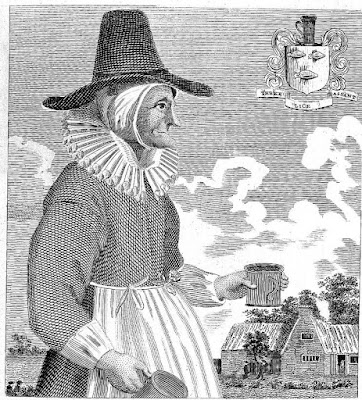
In Marblehead, that weird legend is about Mammy Redd, a fearsome witch who lived in the 17th century. According to various 19th century sources, Mammy Redd was a hideous old woman who terrorized the people of Marblehead. In New England Legends and Folklore (1883), Samuel Adams Drake wrote the following about her:

This woman was believed to possess the power of malignant touch and sight, and she was able, so it was whispered, to cast a spell over those whom she might in her malevolence wish to injure. To some she sent sickness and death, by merely wishing that a 'bloody cleaver' might be found in the cradle of their infant children.

A popular rhyme about Mammy Redd from the 19th century described another of her evil powers:

Old Mammy Redd

Of Marblehead

Sweet milk could turn

To mould in churn

Other versions of the rhyme specify that the mold looked like "blue wool," which sounds pretty gross. Ruining dairy products (milk, cream, or butter) is a classic New England witch's hex. 

Photo by my friend Onix Marrero
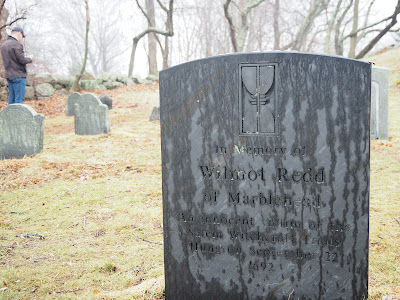
The legend of Mammy Redd is based, quite loosely, on Wilmot Redd (or Read, depending on the source), a Marblehead woman who was executed during the Salem witch trials. She was the wife of a fisherman and, like many of the woman accused of witchcraft by the Puritans, was older and cantankerous. Some sources describe her as "grouty," which means rude or ill-tempered. She was not a witch, but was simply unpopular. 

Most records from her trial are lost, but those that remain describe an argument Redd had with a neighbor, Mrs. Syms. Syms believed Redd's maid had stolen some bed linens, and  exchanged harsh words with Redd. At the end of the argument, Redd supposedly cursed Syms, telling her she would never defecate or urinate again. Soon after, Syms began to suffer from constipation and had difficulty urinating. These problems only ended once she moved away from Marblehead. 

This is an absurd thing to be executed for, but the Salem judges accepted even the most ridiculous accusations at face value. During her questioning, the afflicted Salem girls (the driving force behind the witch hunt) claimed they saw Wilmot Redd's spirit offering them the Devil's black book to sign. This alleged vision sent the girls into convulsions. While most people in the courtroom took them seriously, Wilmot Redd did not. When a judge asked her opinion of the girls' convulsions, she said "My opinion is they are in a sad condition." Grouty to the end, Wilmot Redd was hanged on September 22, 1692 at Gallows Hill in Salem. 

Photo by Onix Marrero

Like everyone executed for witchcraft in Salem, Redd's body was discarded in an unmarked grave somewhere near Gallow's Hill. Perhaps her family retrieved it and secretly reburied her, perhaps not. Many years later, the town of Marblehead erected a monument to her in Old Burial Hill graveyard. As you can see from the photo, people leave coins at her grave to honor her memory. 

The town also named this small behind pond behind Old Burial Hill Redd's Pond in her honor. She and her husband lived next to the pond in the 17th century, and although her house is long gone her memory and legend still survives to this day. 

Photo of Redd's Pond by Onix Marrero

*****

If you like witch legends and the history behind them, you might like my newest book, Witches and Warlocks of Massachusetts, which is available wherever you buy books online. 


August 14, 2021

The Sweet Milk of Satan: A Cape Cod Witch Story

Tony and I were down in Truro on Cape Cod recently, and we found a gravestone I've wanted to see for a long time. It belongs to Sylvanus Rich, who was born in 1720 and died on July 3rd, 1755. There's an interesting legend about Rich and a local witch. It goes something like this. 

*****

Sylvanus Rich was a sea captain. Not much is known about him, but something strange happened to him once during a routine sea voyage carrying carrying corn from North Carolina to Boston. As his ship was sailing north along Truro's Atlantic coast he told his crew to drop anchor. He had seen a small hut nestled among the dunes.

"I want some fresh milk," Rich told his men. "I'm tired of brackish water and rum. I bet whoever lives there has a cow that that gives milk." The crew watched as he rowed himself to shore (alone) and made his way to the hut. When he rowed back to the ship he had a jug of milk with him. "I was right," he said. "The old woman there had some milk for me. But she was the ugliest hag I've ever seen!" Rich retired to his cabin with the creamy beverage, but as soon as he did a fierce gale arose that shredded the ship's sails. The crewmen pounded on his cabin door for guidance, but he did not emerge until the next morning.

Sylvanus Rich's grave in North Truro Cemetery

"What's that?" Sylvanus Rich said groggily to his crew. "The sails are shredded and we're drifting? That's not my concern... Last night the hideous hag came to my cabin. She threw a magic bridle over my head and rode me like a horse up and down the Cape until sunrise. See?" He lifted his shirt, and his crew gasped at the red marks on his torso. They looked like they were made by a woman's shoe. 

"She will come again tonight," Captain Rich said. "I must prepare for her." His crew wasn't sure if he grimaced or smiled as he returned to his cabin and locked the door. 

For several days the ship drifted aimlessly off the Truro coast. Each night the dune-dwelling old witch came and used the captain as her steed, riding him up and down the Cape. Sylvanus Rich was under her spell and helpless to resist her. He spent his days and nights locked in his cabin. 

The crew was feeling desperate (and thinking mutinous thoughts), when they saw another ship approaching from the distance. By a strange coincidence, it was captained by Sylvanus Rich's son. When the crew told him his father was bewitched, Sylvanus's son went down to his cabin. The crew could hear the two men talking inside but were unable to make out what was said. 

Finally, Sylvanus Rich emerged onto the deck. "What are you all looking at?" he said. "My son's ship has materials to repair our sails. Get to work! We need to bring this grain to Boston."

The sails were repaired, and the ship finally arrived in Boston. The merchant waiting for the shipment of corn asked why it was so late. Sylvanus Rich simply said, "Blame it on the sweet milk of Satan."

That's the end of the legend. His gravestone is in Old North Truro Cemetery, but I couldn't find much information about Sylvanus Rich's life. He was born in Eastham, Massachusetts in 1720, and had at least two children with his wife Mary. His son Isaiah was born in 1744, and would only have been 11 years old when Sylvanus died. It seems unlikely that Isaiah was captaining a ship at the age of eleven, so I'm not sure how much of this legend is based on fact. 

There are a lot of New England legends about witches using magic bridles to ride men like horses. There are at least two others from Cape Cod specifically about witches riding sailors! I guess it was an occupational hazard of the time, like scurvy or getting seasick. New England witch stories aren't usually erotic, but I think the sexual undertones in these witch bridle stories are pretty obvious. Milk, usually associated with motherhood and sustenance, has a more sinister and unwholesome role in this tale. 

We never learn what transpired in the witch's hut, or what Sylvanus's son says to him that finally breaks the spell. I like that mystery. I also like that the witch is not killed or harmed at the end of this story. Instead, she is free to seduce and torment more sailors with the SWEET MILK OF SATAN. 

I included this story in my new book, Witches and Warlocks of Massachusetts, which is available now for pre-ordering and will mail on September 1. You can purchase it all your favorite online book vendors. 


*****

My main source for this story was Elizabeth Renard's book The Narrow Land (1934), and she got the story from Shebnah Rich's Truro, Cape Cod, or Landmarks and Seamarks (1884), with additional details from oral tradition.  

October 15, 2012

Sylvanus Rich and the Witch of Truro

For Halloween season, here's a nice witchy story from Elizabeth Reynard's 1934 collection of Cape Cod folklore, The Narrow Land.

***

Sylvanus Rich was an elderly yet highly skilled sea captain. He came from a long line of seafaring men (and had fathered several more himself), so he thought nothing of captaining a ship carrying grain from North Carolina to Boston. It would be easy! Yes, the ship's crew was inexperienced, but Sylvanus was not worried. He had made the journey many times. 

On the last leg of their journey, just as the ship was about to round Cape Cod and enter Massachusetts Bay, Captain Sylvanus dropped anchor off the Atlantic shore of Truro. He could tell the weather was bad up ahead at Provincetown's Race Point, and he didn't want to risk his cargo or crew.

As he walked the deck, Captain Sylvanus sighted a small house nestled in the Truro dunes.

"Boys," he said, "I'm tired of dried pork and hardtack for dinner. I'm going to row ashore and see if I can purchase myself some milk from that farm. Lower a boat!"

The crew watched as their captain rowed himself towards Truro. After about an hour he returned with a wooden bucket full of milk.

A view of Longnook Beach in Truro.

When his crew asked about the farm Captain Sylvanus laughed. "There was no farm! Just an old hag in a filthy hut. And she wore shoes with red heels! Ha! But still, she sold me some milk. I guess I've still got my charm."

The weather by this time had cleared, and while the crew prepared to set sail for Boston Sylvanus retired to his cabin to enjoy his milk.

However, as soon as the crew raised anchor a strong gale came in from nowhere. Dark clouds filled the sky, a howling wind raised huge waves, and the ship's sails were blown to tatters as it was pushed out to sea. In a panic, the crew pounded on the door to the captain's cabin, but he didn't answer. Was Captain Sylvanus dead? Had he been poisoned by the milk?

The storm dissipated by morning, and the crew evaluated the damage. It was serious - the sails and rudder had been both seriously damaged, and the ship was adrift far from land.

Around noon Captain Sylvanus emerged from his cabin, hollow-eyed and pale. He said quietly, "The milk was bewitched. After I drank it I fell into a deep sleep. And then ... she came. The Truro hag. The witch! She threw a bridle over my head and climbed onto my back. She rode me up and down Cape Cod like a racehorse. Over the dunes, through the woods, across the swamps and rivers. If I slowed my pace, she dug her red shoes into my sides."

The captain lifted his shirt. The crew gasped! His sides were covered in bruises shaped like heelmarks.

The first mate said, "But captain, we're adrift and the sails..."

The captain wearily raised his hand and silenced the mate. "In due time. But first, I must prepare. Tonight she will visit me again. I must be ready!" He entered his cabin and shut the door, grimacing.

Or, the crew wondered, had he really been smiling? Was he actually looking forward to another visit from the witch of Truro?

The ship drifted aimlessly in the cold Atlantic for days. Each night, Captain Sylvanus locked himself in his cabin and the witch made him her steed. Each day, Captain Sylvanus sat hollow-eyed and exhausted as his crew begged him for guidance. Food and water were low. Starvation seemed imminent.

Just when all seemed lost, a sail was spotted on the horizon. It was a merchant vessel, and was captained by one of Sylvanus Rich's own sons! When he heard about his father's bewitchment he dragged Sylvanus into the cabin and shut the door after them. What transpired within is not recorded, but somehow he broke the witch's spell over his father. Repairs were made to Sylvanus's ship, and it arrived safely in Boston.

When asked by the ship's owners to explain the damage and the delay, Captain Sylvanus Rich blamed them on the "sweet milk of Satan."

***

Elizabeth Reynard mentions red shoes or heels in a lot of her Cape Cod witch stories, but I haven't seen this in other sources. Perhaps it's a Cape Cod thing, or maybe I just haven't read enough.

Sea captains and sailors are often ridden by land-based witches in folktales. It seems to be a hazard of the profession! There are definitely some pre-Industrial gender role issues at play here. It's nice to see that nothing bad happens to the witch in this story. 


Like the majority of New England witch stories, this one is about a woman, but next week I'm going to post about a male witch. Stay tuned!