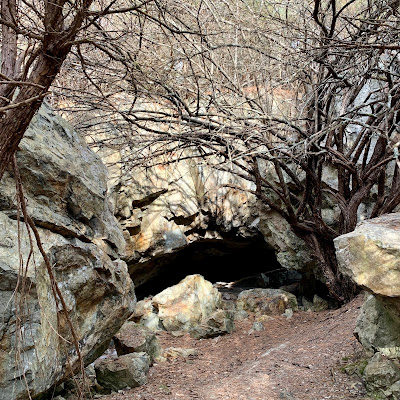
Just across, on the Needham Shore, is the old rocky grotto known as the Devil's Den. This is, of course, to be expected; for poor must be the New-England town that has not its bit of a cavern, consecrated to his Plutonian Majesty.
April 26, 2026
The Devil's Den in Hemlock Gorge
February 27, 2022
Visiting the Devil's Den
There are at least 110 places in New England that have the word “Devil” in their name, and forty-three of them are in Massachusetts. Hmmm. What does that say about the Bay State? There's Devil’s Hollow in Marshfield, the Devil’s Landslide in Wellesley, Devil’s Garden in Amherst, etc. And in Newbury, there is... the Devil's Den.
Last weekend Tony and I took a trip up to Newbury to visit the Devil's Den. The Den is actually a small cave located in an old, abandoned limestone quarry. There are a lot of old quarries in New England, but this one is really old. It was first quarried in 1697 and finally shut down in 1830. The quarry is not large but is very dramatic looking, which is why is probably why it got its devilish reputation.
Long after these quarries had ceased to have a commercial value, pleasure parties were accustomed, during the summer months, to seek rest and recreation there, beguiling the time with marvelous stories in which the Prince of Darkness was given a conspicuous place. In later years, the young and credulous found traces of his Satanic Majesty's footsteps in the solid rock, and discovered other unmistakable signs of his presence in that locality; and ever since the Devil's Den, the Devil's Basin, and the Devil's Pulpit have been objects of peculiar interest to every native of old Newbury. (Ould Newbury. Historical and Biographical Sketches, John James Currier, 1896)
That passage mentions several devilish places. The Devil's Basin was another nearby limestone quarry, filled with water, which I believe was about a half mile away from the Devil's Den (according to Volume 3 of Contributions to the Geology of Eastern Massachusetts, 1880). I'm not sure if the Basin still exists, but according to this site it was located south of the Devil's Den. That area now seems to be mostly landfill which is why I think the Devil's Basin is gone. The Devil's Pulpit was a large boulder nearby but we couldn't locate that either.
The Devi's Den still exists, and in the early 19th century young boys who lived nearby would perform a strange initiation ritual at it. They believed that a certain magic word had been written on the floor of the cave which would kill anyone who entered it. Certain precautions had to be taken before entering the cave to nullify this curse.
I suppose that no boy ever went to that place alone, and a sort of solemn ceremony attended his first visit with his older playmates, to a scene bearing an appellation ominous enough to call up every vague dread of his youthful heart. The approach on these occasions was rather circuitous, through the pastures, until an elevated mass of stone, standing quite solitary, was reached, designated as “Pulpit Rock.” To the summit of this, the neophyte was required to climb, and there to repeat some accustomed formula, I fear not very reverent, by way of initiation, and supposed to be of power to avert any malign influences to which the unprepared intruder upon the premises of the nominal lord of the domain might otherwise be subjected. (George Lunt, Old New England Traits, 1873)
In other words, after repeating the irreverent phrases from Pulpit Rock, (aka the Devil's Pulpit), it was safe to enter the Devil's Den. However, even then it was only safe to enter the cave with companions - never alone.
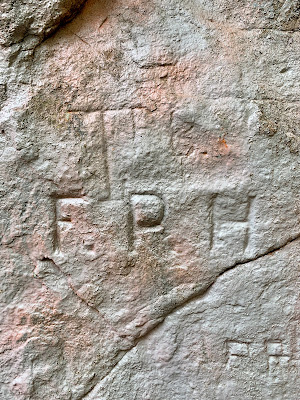
| Old graffiti at the Devil's Den |
Other than this curse and ritual, the Devil's Den had one other interesting feature. The Devil’s Den was made of limestone, but also had deposits of a mineral called chrysotile, a naturally occurring form of asbestos. Chrysotile is soft and chewy, and in the 19th century boys going into the cave would supposedly chew it. Hopefully, they avoided any dangerous side effects. Ingesting asbestos is probably scarier than than a Devil's curse!
I first learned about the Devil's Den while writing my first book, Legends and Lore of the North Shore. Back then, the Devil's Den was on private property, but it is now part of the 28-acre Jennie Lagoulis Reservation. It's worth a visit if you're in the area. Despite it's scary name and legend, you shouldn't be too spooked if you visit. The reservation is the site of a children's nature camp. If little kids can brave the terrors of the Devil's Den you can too.
*****
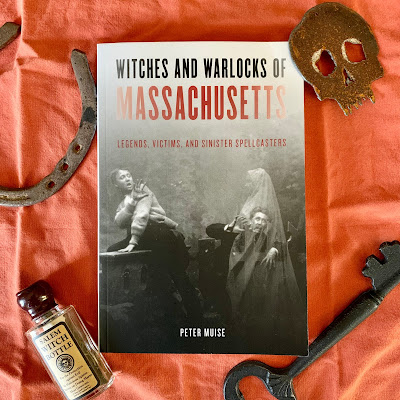
If you like New England legends, you might like my newest book, Witches and Warlocks of Massachusetts. It's available now wherever you buy books online!
December 05, 2021
Meeting the Devil on Christmas Day
Ho ho ho! It's December, and Christmas madness is once again upon us. We just decorated our tree, I've had my first glass of eggnog, and I made fruitcake yesterday. Bring on the holidays.
Christmas is so widely celebrated in modern New England that you might not believe it was once viewed as a dangerous and possibly even Satanic holiday. But it's true! The following post (which I first published in 2017) explains more...
*****
In 1662, Rebecca Greensmith of Hartford, Connecticut was arrested and charged with witchcraft. She confessed to meeting the Devil, but she denied having signed a contract with him. Well, at least she hadn't signed one at the time of her arrest. Rebecca and the Devil were waiting for a special day to sign it: Christmas.
The Reverend John Whiting of Hartford wrote the following in a letter:But that the devil told her, that at Christmas they would have a merry meeting, and then the covenant should be drawn and subscribed. ... Mr. Stone (being then in court) with much weight and earnestness laid forth the exceeding heinousness and hazard of that dreadful sin, and therewith solemnly took notice (upon the occasion given) of the devil's loving Christmas. (quoted in David Hall's Witch-Hunting in Seventeenth-Century New England.)That sounds a little strange to modern readers. Why would the Devil love Christmas? Isn't it a holiday about hope, love and charity?
![]() |
| Merry Christmas? |
Four-hundred years ago, Christmas was a very different holiday than it is today. It wasn't focused on family, gift-giving, and children. Instead, it was characterized by heavy drinking and public rituals that inverted the social order. Europe and its colonies were agricultural societies then, and food and alcohol were most plentiful during the late autumn and early winter. Crops had been harvested, herd animals slaughtered, and beer brewed. There was no more farm-work to be done.
In short, it was a great time to have a huge party. Wealthy people would feast themselves and their friends at home. People from the lower social classes, usually groups of young men, roamed around at night in disguise. The young men (called mummers) would usually target the homes of the wealthy, where they would perform a skit or song in return for food or beer. This is the origin of the wandering Christmas carolers so often portrayed in Christmas stories or movies. If they were denied entry or not given gifts for their performance, the mummers would retaliate with violence or by vandalizing property.
Some hints of this older-style Christmas can still be heard in the lyrics of Christmas carols. For example, "The Gloucestershire Wassail" describes men threatening a butler to give them good strong beer and demanding entry to a wealthy person's home:
Come butler, come fill us a bowl of the best
Then we hope that your soul in heaven may rest
But if you do draw us a bowl of the small
Then down shall go butler, bowl and all.
Be here any maids? I suppose here be some;The lyrics of "We Wish You A Merry Christmas" describe something similar:
Sure they will not let young men stand on the cold stone!
Sing hey O, maids! come trole back the pin,
And the fairest maid in the house let us all in.
Oh, bring us a figgy pudding;Christmas was raucous, drunken, socially disruptive, and occasionally violent. The Puritans valued order, sobriety, and hard work. They didn't want anything to do with Christmas.
Oh, bring us a figgy pudding;
Oh, bring us a figgy pudding and a cup of good cheer
We won't go until we get some;
We won't go until we get some, so bring some out here
During their brief tenure ruling old England the Puritans tried to suppress Christmas celebrations. The Puritans who colonized New England did the same. It was even illegal to celebrate Christmas in Massachusetts between 1659 and 1681. Anyone found doing so could be fined five shillings.
Puritan ministers in New England wrote sermons against Christmas. The Reverend Increase Mather wrote the following, equating Christmas with pagan deities and Satan:
The Feast of Christ's nativity is attended with such profaneness, as that it deserve the name of Saturn's Mass, or of Bacchus his Mass, or if you will, the Devil's Mass, rather than have the holy name of Christ put upon it. (A Testimony Against Several Prophane and Superstitious Customs, Now Practiced by Some in New-England, 1687).Mather mentions Saturn for a very specific reason. The Bible doesn't provide a date for Christ's birth, and the early Christian church fathers decided to place it on December 25 to coincide with pagan Roman winter holidays like Saturnalia, which venerated the harvest god Saturn. This compromise between Christianity and paganism was another argument the Puritans used for hating Christmas.
So there you have it. That's why the Puritans thought the Devil loved Christmas. Their efforts to suppress Christmas were modestly successful. Christmas wasn't widely celebrated in New England until the mid-nineteenth century. Christmas is now the biggest holiday in the United States. The Puritans would have blamed Satan, but I think it's just because people like to have fun.
August 14, 2021
The Sweet Milk of Satan: A Cape Cod Witch Story
Tony and I were down in Truro on Cape Cod recently, and we found a gravestone I've wanted to see for a long time. It belongs to Sylvanus Rich, who was born in 1720 and died on July 3rd, 1755. There's an interesting legend about Rich and a local witch. It goes something like this.
*****
Sylvanus Rich was a sea captain. Not much is known about him, but something strange happened to him once during a routine sea voyage carrying carrying corn from North Carolina to Boston. As his ship was sailing north along Truro's Atlantic coast he told his crew to drop anchor. He had seen a small hut nestled among the dunes.
"I want some fresh milk," Rich told his men. "I'm tired of brackish water and rum. I bet whoever lives there has a cow that that gives milk." The crew watched as he rowed himself to shore (alone) and made his way to the hut. When he rowed back to the ship he had a jug of milk with him. "I was right," he said. "The old woman there had some milk for me. But she was the ugliest hag I've ever seen!" Rich retired to his cabin with the creamy beverage, but as soon as he did a fierce gale arose that shredded the ship's sails. The crewmen pounded on his cabin door for guidance, but he did not emerge until the next morning.
![]() |
| Sylvanus Rich's grave in North Truro Cemetery |
"What's that?" Sylvanus Rich said groggily to his crew. "The sails are shredded and we're drifting? That's not my concern... Last night the hideous hag came to my cabin. She threw a magic bridle over my head and rode me like a horse up and down the Cape until sunrise. See?" He lifted his shirt, and his crew gasped at the red marks on his torso. They looked like they were made by a woman's shoe.
"She will come again tonight," Captain Rich said. "I must prepare for her." His crew wasn't sure if he grimaced or smiled as he returned to his cabin and locked the door.
For several days the ship drifted aimlessly off the Truro coast. Each night the dune-dwelling old witch came and used the captain as her steed, riding him up and down the Cape. Sylvanus Rich was under her spell and helpless to resist her. He spent his days and nights locked in his cabin.
The crew was feeling desperate (and thinking mutinous thoughts), when they saw another ship approaching from the distance. By a strange coincidence, it was captained by Sylvanus Rich's son. When the crew told him his father was bewitched, Sylvanus's son went down to his cabin. The crew could hear the two men talking inside but were unable to make out what was said.
Finally, Sylvanus Rich emerged onto the deck. "What are you all looking at?" he said. "My son's ship has materials to repair our sails. Get to work! We need to bring this grain to Boston."
The sails were repaired, and the ship finally arrived in Boston. The merchant waiting for the shipment of corn asked why it was so late. Sylvanus Rich simply said, "Blame it on the sweet milk of Satan."
That's the end of the legend. His gravestone is in Old North Truro Cemetery, but I couldn't find much information about Sylvanus Rich's life. He was born in Eastham, Massachusetts in 1720, and had at least two children with his wife Mary. His son Isaiah was born in 1744, and would only have been 11 years old when Sylvanus died. It seems unlikely that Isaiah was captaining a ship at the age of eleven, so I'm not sure how much of this legend is based on fact.
There are a lot of New England legends about witches using magic bridles to ride men like horses. There are at least two others from Cape Cod specifically about witches riding sailors! I guess it was an occupational hazard of the time, like scurvy or getting seasick. New England witch stories aren't usually erotic, but I think the sexual undertones in these witch bridle stories are pretty obvious. Milk, usually associated with motherhood and sustenance, has a more sinister and unwholesome role in this tale.
We never learn what transpired in the witch's hut, or what Sylvanus's son says to him that finally breaks the spell. I like that mystery. I also like that the witch is not killed or harmed at the end of this story. Instead, she is free to seduce and torment more sailors with the SWEET MILK OF SATAN.
I included this story in my new book, Witches and Warlocks of Massachusetts, which is available now for pre-ordering and will mail on September 1. You can purchase it all your favorite online book vendors.
*****
My main source for this story was Elizabeth Renard's book The Narrow Land (1934), and she got the story from Shebnah Rich's Truro, Cape Cod, or Landmarks and Seamarks (1884), with additional details from oral tradition.
November 19, 2018
Folklore and History in Chilling Adventures of Sabrina
The show has received significant media attention, whether for its accurate portrayal of certain occult practices or because Salem's Satanic Temple is suing Netflix for copying the Temple's Baphomet statue. I'm enjoying the show for a few different reasons: good acting, amazing set design, and because I'm just a sucker for shows about witchcraft. I've also been pleasantly surprised to see how the writers and producers have incorporated pieces of New England's history and witch lore, in both subtle and unsubtle ways.
The show isn't explicitly set in New England. Chilling Adventures takes place in Greendale, a vaguely all-American small town located near Riverdale, the setting for the other current show (Riverdale) based on Archie comics. It's a foggy, creepy small town where it always feels like Halloween. It's not clear where exactly Greendale is, and the setting is unmoored in time as well as space. Characters drive vintage American cars, use phones with cords, and watch black and white movies at the cinema downtown. On the other hand, some of them use laptops, the high school students talk about gender and intersectionality, and Greendale is racially integrated in a way that small towns never were in the 1950s.
Given the vagueness of the setting, I was pleasantly surprised to see what looks like an early Colonial New England home in Greendale. It's the Spellman Mortuary, where Sabrina lives in it with her aunts Hilda and Zelda and cousin Ambrose. Here's a photo:
![]() |
| Spellman Mortuary from Chilling Adventure of Sabrina. |
![]() |
| The House of Seven Gables (photo from Wikipedia) |
![]() |
| The Witch House (photo from TripAdvisor) |
Daniel Webster: A Greendale lawyer with a mysterious past, Webster is obviously inspired by the historical Daniel Webster (1782 - 1852), a lawyer from New England who served as a U.S. senator and as secretary of state for three presidents. Webster was the subject of Stephen Vincent Benet's popular 1936 short story "The Devil and Daniel Webster," where he argues with Satan in court for a New Hampshire farmer's soul.
![]() |
| The Greendale Thirteen |
In addition to the names, the show's writers have given Greendale a fictional town history with a definite New England vibe. A key incident in Greendale's past was the execution of the Greendale Thirteen, a coven of witches who were hanged by the townspeople. Although there were a few witch trials in other American colonies, the only large scale executions happened in New England. This means that Greendale probably isn't in the Midwest or the South.
Finally, I'll mention Sabrina's "dark baptism." In this rite, Sabrina is supposed to sign her name in blood into the Book of the Beast, thereby giving her soul over to Satan. The ceremony takes place in the woods at night. In many 17th century New England witchcraft accounts, the alleged witch confessed to signing the Devil's book in blood. In other cases, they confessed that the Devil had baptized them, using a pond, river, or even a bucket of water.
![]() |
| Sabrina's Dark Baptism |
Although Hawthorne's story is set in the Puritan era it's not really about Puritans history or witch lore. He uses those subjects to craft an allegory about the evil we all harbor in our hearts and what that realization can mean to someone. And despite drawing from New England history and folklore, The Chilling Adventures of Sabrina isn't about those things either. It's about patriarchy, misogyny,and gender roles. It's also about young people rebelling against their elders, a perpetually fresh theme in pop culture. The writers and producers are just using New England history as a material to create their fictional world and add some spooky atmosphere. So, while I'll keep my eyes peeled for more shoutouts to New England, I'll mostly just continue to enjoy the show for the teen drama and supernatural shenanigans.
June 12, 2018
The Lumberjack and the Devil-Fish: A Story from Maine
Back in the 19th century, a lumberjack named Jack Johnston lived in Millinocket, Maine. Johnston came from a local family but was unpopular. This was partly because he was curmudgeonly and didn't like to follow rules but it was mainly because he hated going to church and made fun of anyone who did. Johnston didn't believe in God and didn't care who knew. (You can probably guess this story isn't going to end well.)
Johnston liked to go fishing on Sundays while everyone else was in church. Unfortunately he was not a patient person, and one Sunday as he stood on the lake's shore he became frustrated because the fish weren't biting. He cursed the lake, he cursed the fish, he cursed his fishing rod. Being an irreligious person he cursed God, and finally for good measure he even cursed Satan.
![]() |
| Found on Pinterest. |
As soon as he invoked the Devil's name he felt a tug on his line. "Finally," he thought, "I've got a bite." Whatever was on the other end was big and it nearly pulled Jack into the lake, but with a lot of work he reeled in the fish. When he saw it he gasped in horror.
The fish was hideous. It was longer than a man's arm and had huge bulging red eyes. Sharp fangs filled its mouth, and its sinuous black body exuded a noxiously smelly slime. It was a monster.
Jack briefly thought of bringing the creature home to cook, but it was too revolting even for a surly lumberjack to eat. Instead Jack tossed the Devil-fish into a farmer's well as he walked by. "Good riddance!" said Jack without a backward glance.
Jack thought that was the end of the story, but it was not. Shortly after Jack disposed of the fish people in Millinocket began to notice that livestock was going missing at night. At first it was small animals like chickens or piglets, but soon calves and goats began to disappear. People thought it might be a feral dog or even a wolf that had crept down from Canada but those theories were soon put to rest. Several people said they had seen a hideous snake-like fish crawl out a well every night to seek out prey. Fearing for their livelihoods, local farmers tried to propitiate the Devil-fish by throwing food down the well. It didn't work. The creature just grew larger and hungrier, and it continued its nighttime hunting. At some point there wouldn't be any livestock left in town and the creature would began eating humans...
![]() |
| Photo of a wolf eel from Pinterest. |
Fearing for his safety Jack agreed to kill the fish. But how was he supposed to kill a supernatural demon fish? He couldn't go to the local minister for advice, so instead he went to an old woman who had a reputation for being a witch.
The woman didn't even bat an eye as Jack told his story. When he was finished she dug around in a big trunk and pulled out a strange-looking sword. "That fish is no ordinary fish," she said. "It was sent by the Prince of Darkness himself when you cursed him on the Sabbath day. But this is no ordinary sword! It can dispatch even the most ferocious of demons, but..."
"Sounds good lady," Jack said, reaching for the sword.
"But, "she continued, "there's a catch. After you kill the demon you must kill the next thing you see. If you don't the Devil will drag you down to Hell."
Jack took the sword and headed to the well. On his way he bought a chicken from a local farmer. When reached the well he tied the chicken to a nearby tree. His plan was to kill the chicken after he slew the Devil-fish, thereby keeping his soul from the Devil's clutches.
The Devil-fish emerged from the well shortly after sunset. It was ten times larger than it had been when Jack caught it. When it saw Jack it emitted a hideous roar and rushed towards him. Jack raised the sword and with a single blow chopped off the monster's head. The creature emitted ichorous bile as its body twitched on the ground. It was dead.
Before he could turn to kill the chicken Jack hear a familiar voice. "Jack, my son! You killed the monster!" Jack turned reflexively and saw his father, coming to congratulate him for saving the town.
Jack groaned. Unless he killed his father his soul would be dragged to Hell. Jack was not a nice person, but he was not a murderer. With a sigh he put down the sword, fell to his knees, and then collapsed on the ground lifeless. The Devil had taken his soul.
May 13, 2018
The Devil and Elizabeth Knapp: Demonic Possession in Groton
In October of 1671, a teenage girl named Elizabeth Knapp began to show symptoms of a strange disorder. At first they were minor. Knapp would emit sudden shrieks with no apparent cause, and shrug when anyone asked her about them. At other times she would laugh uncontrollably as if at a private joke, sometimes to the point of falling to the ground in hysterics. She didn't tell anyone what she laughed at.
Her behavior got even stranger as the month continued. On October 30 Knapp was siting by the fireplace when she began to scream that she was being tormented:
In the evening, a little before she went to bed, sitting by the fire, she cried out, oh my legs! and clapped her hands on them, immediately, oh, my breast! and removed her hand thither: and forthwith, oh I am strangled, and put her hands on her throat; those that observed her could see what to make of it; whether she was earnest or dissembled...
Knapp was a maidservant in the home of Groton's minister Samuel Willard, and he scrupulously documented her situation in a long letter sent to Reverend Cotton Mather in Boston. Willard wrote that on the night of October 31 Knapp went into the cellar to fetch something. She screamed and ran back up, claiming she had seen two people down in the cellar. Other members of the household searched but saw nothing and wondered if Knapp had merely played a prank on them.
On November 2nd, Knapp delivered a shocking confession to Reverend Willard and other assembled neighbors: she was being tormented by Satan. Knapp claimed that over the last three years the Devil had frequently visited her, urging her to sign a covenant with him. The Devil promised to give her money, silk clothes, and release from the hard work she had to perform. In return for these things, the Devil simply asked her to sign her name (in blood) in a book. Oh, and also to murder her parents, her neighbors, and Reverend Willard's children. The Devil had even suggested she toss the Willards' youngest child into the oven and kill the reverend with a hook while he slept. Knapp denied signing the Devil's book, but did confess that she had often delayed leaving the Willard household until after sunset so the Devil could walk with her in the dark. She was drawn to the Devil even though she knew it was wrong.
Willard and other local ministers received her confession with concern but also some skepticism. Was her story true?
Her symptoms increased in the early days of November. A physician was called in, "who judged a main part of her distemper to be natural, arising from the foulness of her stomach and corruptness of her blood, occasioning fumes in her brain, and strange fantasies." You have to love that seventeenth century medicine! Knapp was briefly relieved from her duties at Reverend Willard's home and sent to rest at her parents' house.
Her fits lessened and she returned to the Willards, but as the month went on and the days grew darker her symptoms became worse. At times her tongue was stuck to the roof of her mouth, at other times she barked like a dog or bleated like a calf. She ran around the house yelling and skipping and no one was able to restrain her. Reverend Willard wrote that the physician changed his diagnosis and "consented that the distemper was diabolical, refused further to administer, and advised to extraordinary fasting." Multiple ministers were called in to pray for her. Knapp still claimed she had not signed the Devil's book, but did say she had been sorely tempted to but was foiled because she couldn't find a knife to cut her finger.
On December 2, Knapp became highly agitated and said she saw a dog with a woman's head outside the house. It was a witch and was trying to get in. The Willards did not see the creature, but did see a strange canine paw-print in their fireplace. Knapp claimed that if the witch were apprehended her fits would stop. She identified the witch as a local woman, but after investigating the authorities dismissed her claim.
On December 8, Knapp finally confessed to what the Reverend Willard had secretly suspected: she had signed her name in the Devil's book. She said that one day shortly after coming to work for the Willards she had looked out the window and seen the Devil in the shape of an old man walking across a meadow towards her. He carried a large book in his hands. She heard his terms and then...
...with a knife cut her finger, he caught the blood in his hand, and then told her she must write her name in his book, she answered that she could not write, but he told her that he would direct her hand, and then took a little sharpened stick and dipped in the blood and put it into her hand, and guided it, and she wrote her name with his help.She agreed to serve the Devil for seven years, but balked at working witchcraft for him. This was why the Devil tormented her so violently with fits.
On December 17th the Devil took complete control of her body. He began to speak through her, insulting her family and the ministers who gathered around her. He insulted God and threatened violence agains the people who were praying over Knapp. Willard believed that it was truly the Devil speaking through her, claiming that Knapp's mouth and lips were immobilized even though words came out.
During January Knapp was silent for long periods of time, although she now claimed that her confession of signing the Devil's book was false and that she had never been tempted to murder the Willard family. She said that although the Devil controlled her body she prayed that he would not take her soul.
And then...
Willard's letter ends there, at mid-January, 1672. He closes his letter with some arguments why, despite the claims of skeptics, he thinks Knapp's possession was authentic. His key arguments are that he thought the strength she displayed during her fits was beyond what was natural, and that her mouth did not move when the Devil spoke. She also used words and phrases while possessed that she had never used before.
Still, Willard writes that he found her multiple contradictory stories about signing the Devil's book puzzling, and admits that other explanations for her behavior may be possible.
Although this information is not included in his letter, it seems that Knapp was eventually cured of her demonic possession (whatever it may have been). Historian David Hall notes that Knapp married in 1674 and had at least six children. Let's hope she wasn't tempted to throw any of them in the oven.
It's interesting that Knapp's symptoms appeared in the dark months of the year. In England, the months of October through mid-January would have been celebrated with harvest festivals, dances and the lavish feasting and misrule of Christmas. Those holidays were suppressed in Puritan New England but it seems like the Devil still wanted to have a little fun.
It's also fascinating to compare this case with the Salem witch trials. Groton's leaders dismissed Elizabeth Knapp's claim that another member of the community had bewitched her. The town might have had a full-blown witch hunt, like Salem, if they hadn't.
Samuel Willard's letter is a fascinating document. I found a copy of it in David Hall's fantastic book Witch-Hunting in Seventeenth-Century New England. The letter is about fifteen pages long and really goes into detail about the case and what Willard and others thought of it. It's a window into the lives and minds of people who lived here over three centuries ago.
February 01, 2018
The Devil Revealed by His Foot: A Witch Trial and A Folk Story
One day while she was walking down the street a young man began talking with her. She didn't know him, but she liked him almost immediately. He was handsome. He was well-dressed. He was a smooth-talker. He flattered her. The young woman found herself falling just a little bit in love with him.
"It's been lovely talking with you," he finally said. "I need to be on my way, but perhaps I can meet you here again tomorrow?"
The young woman agreed. How could she refuse such a handsome young man? But as she walked away she glanced down at his feet. She gasped softly. One foot was normal, but one foot was a cloven hoof. She had been flirting the Devil.
She had no intention of marrying the Devil. The next day she did not go the appointed meeting place, but instead hid nearby. She watched as the Devil arrived, and watched as he grew more and more impatient as he waited. When the Devil realized she was not going to show up he grew enraged. The young woman watched in horror as he angrily ripped down a heavy iron gate and stalked off with it in his hands.
![]() |
| From this site about trimming goat hooves! |
Like so many accused witches, Goody Ayres was an unpopular person in Hartford. Her husband William was a well-known thief and had been convicted of stealing pigs, cows, horses and even iron bars and his bad reputation rubbed off on her. When a young woman named Elizabeth Kelly grew ill she accused Goody Ayres of bewitching her, and after Kelly died her parents charged Ayres with witchcraft.
I think it's obvious to a modern reader that Goody Ayres's story is just a folktale. The revealed foot is an old motif that shows up in lots of stories. For example, a Biblical legend claims that King Solomon was suspicious of the Queen of Sheba when she arrived in Jerusalem. He had heard that she had one human foot and one goose foot, but her long skirts hid her feet. Thinking of a way to trick her, the wise king led her over a stream while touring the kingdom, and as she lifted her skirts he caught a glimpse of a webbed bird foot.
The Queen of Sheba is not the only queen with a strange foot - a very similar story is told about Emperor Charlemagne's mother, Queen Bertha. The German folk-goddess Perchta is said to have one goose foot, and many European fairies are also believed to have animal feet. For example, the erdluitle, small humanoid fairies found in Switzerland, wear long robes and skirts to hid their goose like feet, which are either hooved or goose feet. The fees of France look like beautiful humans, but each has one flaw, like a bird or animal foot. The Manx sleigh beggy look human but leave crow's foot prints in the dirt when they walk.
I think you get the picture. Goody Ayres's story about the Devil was just the latest iteration of a recurring story, but she gave herself the starring role. Not much is known about Ayres (including her first name), and I wonder why she told this tale about meeting the Devil. Did she think it was entertaining? Did she do it to impress her neighbors? Did it make her human husband look better in her mind? "Hey, he might be a thief but it could be worse. I almost dated Satan!"
Sadly, we'll never know. The Hartford judges found Goody Ayres guilty of witchcraft. I don't think the story about the Devil's foot was the conclusive piece of evidence, but it certainly didn't help her case.
Sources: David Hall's Witch-Hunting in Seventeenth Century New England (one of my new favorite books), Nancy Arrowsmith and George Moorse's A Field Guide to The Little People, and R.G. Tomlinson's Witchcraft Trials of Connecticut.
December 13, 2017
Why The Devil Loves Christmas
The Reverend John Whiting of Hartford wrote the following in a letter:
But that the devil told her, that at Christmas they would have a merry meeting, and then the covenant should be drawn and subscribed. ... Mr. Stone (being then in court) with much weight and earnestness laid forth the exceeding heinousness and hazard of that dreadful sin, and therewith solemnly took notice (upon the occasion given) of the devil's loving Christmas. (quoted in David Hall's Witch-Hunting in Seventeenth-Century New England.)
That sounds a little strange to modern readers. Why would the Devil love Christmas? Isn't it a holiday about hope, love and charity?
![]() |
| Merry Christmas? |
Four-hundred years ago, Christmas was a very different holiday than it is today. It wasn't focused on family, gift-giving, and children. Instead, it was characterized by heavy drinking and public rituals that inverted the social order. Europe and its colonies were agricultural societies then, and food and alcohol were most plentiful during the late autumn and early winter. Crops had been harvested, herd animals slaughtered, and beer brewed. There was no more farm-work to be done.
In short, it was a great time to have a huge party. Wealthy people would feast themselves and their friends at home. People from the lower social classes, usually groups of young men, roamed around at night in disguise. The young men (called mummers) would usually target the homes of the wealthy, where they would perform a skit or song in return for food or beer. This is the origin of the wandering Christmas carolers so often portrayed in Christmas stories or movies. If they were denied entry or not given gifts for their performance, the mummers would retaliate with violence or by vandalizing property.
Some hints of this older-style Christmas can still be heard in the lyrics of Christmas carols. For example, "The Gloucestershire Wassail" describes men threatening a butler to give them good strong beer and demanding entry to a wealthy person's home:
Come butler, come fill us a bowl of the best
Then we hope that your soul in heaven may rest
But if you do draw us a bowl of the small
Then down shall go butler, bowl and all.
Be here any maids? I suppose here be some;
Sure they will not let young men stand on the cold stone!
Sing hey O, maids! come trole back the pin,
And the fairest maid in the house let us all in.
The lyrics of "We Wish You A Merry Christmas" describe something similar:
Oh, bring us a figgy pudding;
Oh, bring us a figgy pudding and a cup of good cheer
We won't go until we get some;
We won't go until we get some, so bring some out here
Christmas was raucous, drunken, socially disruptive, and occasionally violent. The Puritans valued order, sobriety, and hard work. They didn't want anything to do with Christmas.
During their brief tenure ruling old England the Puritans tried to suppress Christmas celebrations. The Puritans who colonized New England did the same. It was even illegal to celebrate Christmas in Massachusetts between 1659 and 1681. Anyone found doing so could be fined five shillings.
Puritan ministers in New England wrote sermons against Christmas. The Reverend Increase Mather wrote the following, equating Christmas with pagan deities and Satan:
The Feast of Christ's nativity is attended with such profaneness, as that it deserve the name of Saturn's Mass, or of Bacchus his Mass, or if you will, the Devil's Mass, rather than have the holiday name of Christ put upon it. (A Testimony Against Several Prophane and Superstitious Customs, Now Practiced by Some in New-England, 1687).Mather mentions Saturn for a very specific reason. The Bible doesn't provide a date for Christ's birth, and the early Christian church fathers decided to place it on December 25 to coincide with pagan Roman winter holidays like Saturnalia, which venerated the harvest god Saturn. This compromise between Christianity and paganism was another argument the Puritans used for hating Christmas.
So there you have it. That's why the Puritans thought the Devil loved Christmas. Their efforts to suppress Christmas were modestly successful. Christmas wasn't widely celebrated in New England until the mid-nineteenth century. Christmas is now the biggest holiday in the United States. The Puritans would have blamed Satan, but I think it's just because people like to have fun.
September 25, 2017
Lumberjacks and the Devil: Two Stories from Maine
Many years ago a lumberjack named Robert Cartier lived and worked in Millinocket, Maine. I suppose "worked" is an exaggeration. Cartier was a lazy drunkard and a trouble-maker. He preferred drinking in the bars or starting fights over cutting down trees.
One day the Devil appeared to Cartier. The Devil said, "Robert, I'd like to make a deal with you. It's a shame you need to spend so much time working as a lumberjack. You're doing an excellent job spreading evil by drinking and picking fights. I'd rather you spent your time doing that. What do you think?"
Cartier agreed.
"Well," said the Devil, "Here's the deal. I'll give you a magic axe. It can cut down trees all by itself. You won't need to lift a finger. You just need to whistle to make it happen. In return, I get your should when you die."
Cartier wasn't very smart, so a few years of easy living in exchange for eternal damnation sounded like a bargain to him. He agreed to the Devil's deal.
The next day Cartier went into the woods with the Devil's axe. He sat in the shade eating, drinking whisky, and whistling while the axe cut down tree after tree. When he was done in he went into town to drink more and pick fights. He had plenty of energy for mischief because he had done so little all day.
For many years Cartier spread misery at night while the Devil's axe chopped down trees all day. But one night in a bar Cartier had a moment of drunken clarity: he had spent his life doing evil and was doomed to Hell. Cartier staggered out of the bar into the night, eager to find atonement.
The next morning some lumberjacks found Cartier's body in the woods. His head been chopped clean off with one blow of an axe. The murder weapon was never found, but some people say the Devil's magic axe is still out there, ready for some unwary soul to start whistling in the woods.
After this the other lumberjacks began to notice strange things about Jack. For example, when he was out chopping wood the sound of two axes could be heard, even though he was at the only person visible. Jack also was often heard talking to someone that no one else could see. Maybe it was just an imaginary friend, but people knew that Jack had gone to the Devil's meeting place. They stared to call him Jack-the-Ripper because his strange behavior scared them.
Once Jack drove his axe into a tree so hard the handle split in two. But when Jack pulled it out the handle was strangely once again whole. The lumberjacks who witnessed this avoided him like the plague.
One day the boss walked with Jack to a clearing in the woods. It was full of brush and logs. "Clean this mess up," the boss said and walked off. The boss was spooked by Jack and thought it would take him several days to clean the clearing. Jack came back to camp in just a few hours. All the brush and logs had been neatly stacked in a pile. It would have taken dozens of men to do what Jack did alone in just a short time. The other men at camp whispered that he had supernatural help.
After that all the lumberjacks refused to work with Jack-the-Ripper. He left Dyer Brook and was never seen again.
March 14, 2017
Becoming A Witch, New England Style
Dear New England Folklore,
Thank you for writing such an awesome blog. I really love reading your posts about witches and witchcraft. I have some annoying neighbors and would like to ruin their butter, sicken their livestock and cause their crops to fail. How can I become a witch? It sounds like fun.
Your faithful reader,
Darlene in Dunwich
Gee Darlene! Thanks for the wonderful letter. Personally I don't think you should use malevolent magic to revenge yourself on your neighbors, but you do ask a good question. How does one become a witch? There are several different opinions on the matter.
For many modern spiritual witches (Wiccans and others who follow witchcraft as a religious path*), becoming a witch involves being initiated by someone who already is one. These initiations usually involve sacred oaths, nudity, some good-natured torture, and the imparting of secret knowledge. This initiatory model was started by Gerald Gardner (1884 - 1964), the father of modern witchcraft and the first person to declare himself a Wiccan. Gardner claimed that he himself was initiated by a pre-existing coven, but the rituals he created include many elements from other sources, including Freemasonry and the works of Aleister Crowley.
This type of initiation would be quite foreign to a traditional New England witch. All those candles and chants and incense - why, it's downright Popish! The stories about Puritan witchcraft initiations describe something simpler and much more bare-bones. The Puritans sought to strip away all extraneous elements from Christianity, and this impulse is also reflected in their stories about witchcraft, which they viewed as Christianity's evil twin.
![]() |
| A modern witchcraft initiation. Nothing this exciting happens in traditional New England folklore! |
Most stories simply involve someone signing their name in the Devil's big black book. Often it is implied that they are signing in blood. A lot of these stories come from confessions collected during the witch trials. Puritan magistrates thought the Devil was behind all witchcraft, and they would get people to confess the Evil One's involvement any way they could. I mentioned that there may be some good-natured torture in a Wiccan initiation. The torture used by the Puritans was not in any way good-natured.
For example, during the Salem trials teenaged witch suspect Richard Carrier and his brother Andrew were bent over backwards and tied head to ankle. They had initially plead innocent but - no surprise - after this painful torture they confessed to signing the Devil's book in an apple orchard in their own blood. They also said the Devil had baptized them in a waterfall in Newbury. Several other Salem suspects also claimed the Devil baptized them.
The Satanic baptism is obviously an inversion of the Christian baptism, while the Devil's black book is the dark twin of the book that Puritans signed when becoming members of their local Puritan congregation. The classic New England witchcraft initiation is basically a distorted reflection of Puritan religion. Interestingly, some suspects confessed that the Devil only wanted their service for a set number of years. This is also a reflection of New England Puritan society, where many people were indentured servants who sold themselves to masters for a set period of time.
I realize this may sound a little tame to you, Darlene. Like eating at a Dunkin' Donuts, New England witchcraft is effective but doesn't have a lot of sex appeal. Well, if you want something a little more sexy, I'd suggest reading Vance Randolph's Ozark Magic and Folklore (1947), which contains folklore he gathered in the 1930s and 1940s. There are some interesting parallels between Ozark and New England folklore, but the stories about witchcraft initiations are much different.
Well, that's how you can become a witch. But don't rush into it, because you may already be one! Some modern witches think that witches are born, not made. A few go so far as to claim that some people carry "witch-blood" inside them and are descended from the Nephelim, the fallen angels from the Book of Genesis. I suspect the idea of witch-blood was popularized in the modern era by Jack Williamson's 1948 pulp novel Darker Than You Think, but it does have deep roots in European folklore. For example, Merlin is often said to be the half-human offspring of a human woman and a demon.
Some European cultures claim that children born in strange ways or at strange times are destined to become magical beings, regardless of their parentage. For example, in Renaissance Italy children born feet-first were said to mature into either witches or witch-fighters, while in Greece babies born on Christmas day grew up to be kallikantzaroi, hideous evil monsters. So perhaps you are already a witch! (More details on this idea can be found in Carlo Ginzburg's Ecstasies: Deciphering The Witches' Sabbath (1993)).
I haven't found any comparable lore from New England, but many stories from this region don't really indicate how people become witches. They tend to focus instead on how to detect and defeat them. The Puritan leaders were convinced that all witches got their power from Satan, but this opinion wasn't shared by everyone. The average person didn't really care where witches came from. For many people they were not part of a demonic conspiracy but were instead, like March blizzards or stony soil, just part of New England they had to deal with.
*Mandatory disclaimer - Unlike the witches from folklore, modern spiritual witches are mostly nice people and don't go around cursing livestock or ruining your butter. Don't confuse modern witches with the witches from folklore!