Showing posts with label history. Show all posts

January 30, 2023

Haunted Houses and Terrifying Specters: Ghost (?) Stories from Weare, New Hampshire

There are a lot of ghost stories from New England, and one of my favorite types is what I call the "Scooby-Doo" ghost story. In these stories, the ghost is rationally explained away at the end. There is nothing supernatural in these stories, although people in them initially think there is. I call them Scooby-Doo stories because each episode of the Scooby-Doo ended with the ghostly terror being revealed as someone impersonating a ghost, not something supernatural. These stories are similar, but without all the greedy real estate developers and smugglers.

You can find these Scooby-Doo ghost stories in a lot of the local town history books which were written in the 19th century. I found a bunch of them recently in William Little's The History of Weare, New Hampshire, 1735 - 1888 (1888). In one story, an early settler named John Hodgdon was riding home to Weare on horseback one night when he saw something creepy in his cornfield. As the hair on his neck stood up, he saw a large white object appear on a small knoll in the field. It disappeared with an uncanny sound, only to reappear again. Hodgdon dismounted and walked through the dark field to the knoll, determined to discover what this ghostly object (or entity) was. He learned it was not a ghost, but was instead a large basket some of his workers had left in the cornfield. When the wind blew it rolled up the hill, and when the wind subsided it rolled back down. Mystery solved!

William Little, author of The History of Weare, New Hampshire

In another tale, David and Betsy Purington lived in an old shanty, and "one winter were terribly troubled with ghosts." David Purington thought it was the spirit of his deceased father-in-law. One night, a neighbor came to visit the Puringtons. As they sat talking a strange rapping sound was heard from the attic loft above them. It grew louder and louder and louder. David screamed out for the ghost to desist, but the infernal rapping grew louder! Their neighbor was the only one brave enough to climb into the attic to confront the ghost. After climbing the rickety ladder, she saw a chicken whose legs and been frozen by the cold. It was unable to walk, and made a rapping sound as it tried to stand. "The hen was carried to the room below, and the ghost was laid." Mystery solved! Hopefully the hen recovered from being frozen. 

In East Weare, there was another house that was supposedly haunted. A minister had once lived there, but after he moved away the house stood abandoned. People reported hearing strange noises and even seeing strange lights at night. Some brave schoolboys once approached the house during the day, but fled when they heard an eerie noise and heard the doorknob rattle. Eventually the apparitions stopped. When someone finally went into the haunted house, they saw a dead cat lying on the middle of the floor. Apparently the minister had left it behind when he moved and it had caused all the noise. Mystery solved! 

Or is it? A cat doesn't create ghostly lights. And clearly people didn't take very good care of their animals then...

William Little does include at least one ghost story in The History of Weare that's slightly ambiguous. A man name Mr. Eaton was out hunting raccoons one misty autumn night with some friends. Mr. Eaton paused to rest, when out of the mists emerged a terrifying ghost. "He could see the sunken eye-balls, the worm-eaten face, the shriveled hands, and he shook with terror." One of his friend arrived and Mr. Eaton explained what he had seen. The ghost was not visible to the friend. Many people in Weare believed Mr. Eaton had truly seen a ghost, but others suspected that he had just been drunk. So that mystery was perhaps not completely solved. 

There are a lot of books like The History of Weare out there, histories of New England towns written in the mid-to-late 19th century by people who lived in these places. New England had become a modern industrial area by this time, and you can sense the pride the authors feel in the progress their towns had made. At the same time, they're fascinated by the earlier, pre-industrialized way of life that is vanishing and the supernatural worldview that went with it. Maybe these rationalized ghost stories are the authors' way of straddling both worlds, of indulging the wonders and terrors of the past but also explaining them away with the light of reason. 

December 17, 2022

Christmas Chaos: Puritans, Saturnalia, and Lords of Misrule

On December 25, 1621, some young men in Plymouth, Massachusetts wanted to celebrate Christmas. Their celebration sounds pretty meager by modern standards – just playing a few ball games in the street. However, when William Bradford, Plymouth’s governor, saw what was happening he shut their little party down. He told them they shouldn't be celebrating Christmas, but he was willing to let them observe the day by praying piously indoors. They could not have any fun, however, particularly not in public.

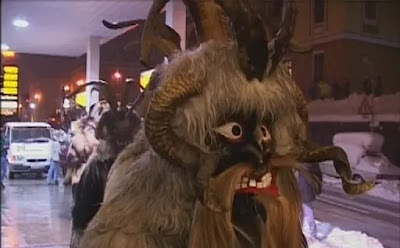
A still from Kranky Klaus (2003), a film by Cameron Jamie.

This sounds like a Grinchy move, and it was. Unlike Governor Bradford and many other Plymouth colonists, the game-players weren’t Puritans. They hadn’t realized how strongly the Puritans hated and feared Christmas. In 1659, the Massachusetts legislature even passed a bill banning Christmas - that's how much they hated the holiday. The bill was repealed in 1681 by Sir Edmund Andros, a much-despised governor appointed by the English king, but Christmas was still not widely celebrated in Massachusetts, or New England in general, until the mid-19th century. Schools and business remained open, and churches did not hold religious services on Christmas. A few  people on the margins of New England society celebrated Christmas, but most didn't.

Puritans hated Christmas for two reasons. First, they thought it was just a pagan holiday that had become thinly Christianized. There’s probably some truth in that. The Bible does not indicate the date of Christ’s birth, so the early Church fathers decided it should be celebrated on December 25, a time when people across the Roman Empire were already celebrating various winter holidays like the Saturnalia and the birthday of Sol Invictus, the sun god. It made good political sense for the new religion to piggyback on already popular holidays.

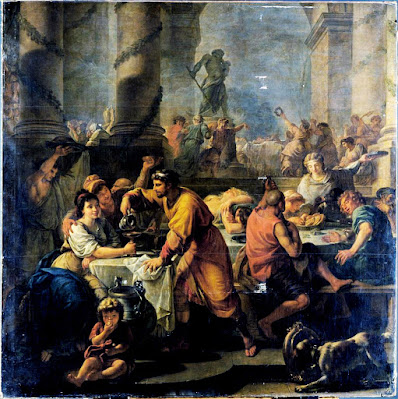
Saturnalia by Antoine Callet

Puritans also hated Christmas because it was celebrated very differently in the 17th century than it is now. Christmas was a raucous and chaotic holiday that featured lots of drunken public revelry and social disorder. There is still some heavy drinking at Christmas these days, but in the 17th century Christmas was associated with large, drunken, disorderly mobs roaming through the streets and countryside. This can be traced back to the Roman Saturnalia, which celebrated the god Saturn, who had supposedly ruled over Earth’s Golden Age. During Saturn’s reign, everyone had been equal. There were no slaves and no masters, no kings and no subjects, no bosses and no employees. It was blissful and idyllic anarchy, with the Earth providing bountiful food so no one needed to work. These beliefs about the Golden Age were reflected in the Saturnalian celebrations holiday, with masters waiting on their slaves, men dressing as women, and much public drinking and ribaldry. All boundaries were dissolved. 

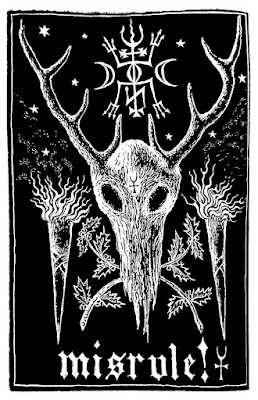
Saturnalia was a season of misrule, a time when society’s rules were temporarily inverted or suspended. It was a release valve, a way for the lower classes to temporarily let off some steam and a way for the upper classes to buy some good will. After the Roman Empire collapsed, this pattern continued in Europe through the Middle Ages and into the Renaissance, but Christmas became the holiday of misrule, not Saturnalia. In many European towns and cities, prominent lower class men were appointed the Lord of Misrule by their fellows to preside over the holiday debauchery, leading crowds that mocked priests, noblemen, and the wealthy with impudence. Carolers, often drunk and in costume, demanded food and drink at wealthy homes. Once the celebrations ended, the Lord of Misrule stepped down and the old hierarchical relationships reasserted themselves until Christmas came around again. 

Illustration from Masks of Misrule (1996) by Nigel Aldcroft Jackson

The misrule of Christmas was antithetical to the Puritan values of hard-work, moderation, and self-control, but some modern Americans have recently have shown interest in bringing back a little of the old Christmas chaos. Some contemporary witches and occultists acknowledge a Lord of Misrule in their winter solstice rituals, and the Krampus, a monstrous Yule creature associated with misrule from northern Europe, has become increasingly popular, appearing on t-shirts, tree ornaments, and in movies. Krampus celebrations are a long-standing tradition in Germany and Austria, and some Americans are trying to bring it here.

Idyllic holiday anarchy sounds like fun, but there was definitely a dark side to Christmas misrule. The threat of violence lurked beneath the surface, and vandalism sometimes occurred, even in Puritan New England. For example, a group of young men in Salem, Massachusetts harassed 72-year-old John Rowden on Christmas night in 1679. The men forcibly entered Rowden's home, caroled, and then demanded wine as payment for their performance. Rowden refused, and in retaliation the young men pelted his house with stones and branches for 90 minutes, knocked down a stone wall, and stole six pecks of apple from his cellar. Something similar happened in Deerfield, Massachusetts in 1794, when shopkeeper John Birge was awoken at 2:00 am on December 22 by a group of drunken men demanding entrance to his home. He refused, and the men broke his windows.

Perhaps if Rowden and Birge had played along, their property wouldn't have been damaged. Much like Halloween's trick-or-treat, if you gave out food, liquor or money at Christmas you and your home would escape unharmed. The threat of violent retaliation was an integral part of the holiday.

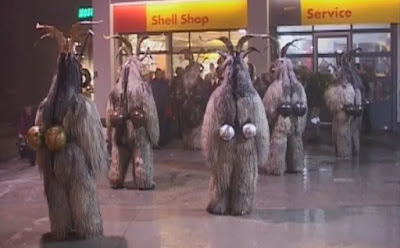
A still from Kranky Klaus (2003), a film by Cameron Jamie.

Back in 2007, I saw a short documentary by Cameron Jamie called Kranky Klaus, which follows a group of Krampuses as they roam around an Austrian town in a pre-Christmas celebration. The movie is unsettling. The Krampuses are aggressive and violent. They try to break into a pizza shop, and when a female employee stops them they push her into a snow bank. They enter a nightclub, where they knock over tables, wrestle patrons to the floor, and whip people. The Krampuses terrify a group of children, and then shove snow into pedestrians' faces in the street. No one stops them because it's a holiday tradition, but a lot of folks seem unhappy and terrified. You can watch Kranky Klaus on YouTube for yourself. What are your thoughts? Misrule and Christmas chaos sound like fun on paper, but the reality looks pretty scary.

I love weird old traditions, but I'm happy with the tamer, milder Christmas we now celebrate. The Puritan's anti-Christmas attitude wasn't defeated by misrule, but by 19th-century capitalism and a kinder, gentle approach to raising children. The prospect of happy children opening presents under a tree won out over the Puritan's "bah humbug" attitude, and over Christmas misrule as well. Feel free to celebrate Christmas (or not) as you see fit, but I'll be sitting by the tree, drinking eggnog, and listening to Mariah Carey, trying to find that happy medium between grumpy Puritan and kranky Krampus. 

*****

My favorite book about the history of Christmas is Stephen Nissenbaum's The Battle for Christmas: A Cultural History of America's Most Cherished Holiday. I got much of this post's information from it. 

October 03, 2022

Dreams in the Witch House: Lore, Familiars, and the Devil's Book

This week I've been reading "The Dreams in the Witch House," H.P. Lovecraft's classic 1932 tale of witches, creepy little monsters, and non-Euclidean calculus. This is one of those Lovecraft stories I come back to repeatedly, and re-reading it this time I was struck by how Lovecraft incorporates real New England folklore and history into it. Much of the story is focused on how one becomes a witch, something that was central to the 17th century Puritan witch trials. There is also a particularly creepy familiar spirit in it. 

Here's a basic plot summary, but you can also read the story yourself here. Walter Gilman is a college student at Miskatonic University in Arkham, Massachusetts, where he is studying mathematics and folklore. Gilman is convinced there is a connection between advanced mathematics and the old New England witch stories, and his research leads him to rent a room in a squalid boarding house that was built in 1600s known as the Witch House.

Gilman's room was once the abode of Keziah Mason, who was arrested for witchcraft during the Salem witch trials. Under questioning, Mason told Judge John Hathorne that certain lines and angles could be used to move "through the walls of space to other spaces beyond," and then later disappeared from her locked jail cell. Strange geometric curves and angles were found drawn on the cell's walls with "some red, sticky fluid." Centuries later, Keziah Mason is said to haunt the Witch House where she once lived, appearing there at night with Brown Jenkin, a human-faced rat that serves as her familiar spirit. 
Gilman thinks Mason knew the secret of traveling through other dimensions. Soon in his sleep he dreams that he can too, inspired by his study of mathematics and the strange angles of the walls and ceiling in his room. In his dreams, he flies through "limitless abysses of inexplicably coloured twilight and bafflingly disordered sound; abysses whose material and gravitational properties, and whose relation to his own entity, he could not even begin to explain." He dreams that he visits other planets, including a world whose heavy gravity almost crushes him, and one where he sees a vast city and strange non-humanoid beings. In his journeys he also sees Keziah Mason and Brown Jenkin, who seem to be following him around the universe in his dreams. 

Spoiler alert: Walter Gilman is not dreaming. He really is traveling through the universe and other dimensions, and Mason and Brown Jenkin really are following him. Since he has intuitively and unconsciously mastered the art of extra-dimensional travel, they recognize him as a fellow witch, and want him to be fully initiated into the dark mysteries of witchcraft: 
He must meet the Black Man, and go with them all to the throne of Azathoth at the centre of ultimate Chaos. That was what she said. He must sign in his own blood the book of Azathoth and take a new secret name now that his independent delvings had gone so far. What kept him from going with her and Brown Jenkin and the other to the throne of Chaos where the thin flutes pipe mindlessly was the fact that he had seen the name “Azathoth” in the Necronomicon, and knew it stood for a primal evil too horrible for description.
Oh, and they want him to sacrifice a human infant as well. I won't give away the ending, but it's one of the gorier and gruesome endings to a Lovecraft story. 

H.P. Lovecraft loved New England and its history, and incorporates lots of local references into "The Dreams in the Witch House." John Hathorne (mentioned above) was a real Salem witch trials judge and an ancestor of Nathaniel Hawthorne; the infamous Cotton Mather is mentioned as well. Walter Gilman's hometown is Haverhill, Massachusetts, the same as me! One of his mathematics instructors at Miskatonic University is Professor Upham, a name possibly inspired by Charles Upham, the historian who wrote Salem Witchcraft (1867), one of the first important studies of the Salem trials. And there actually are several buildings in Massachusetts called the Witch House, including the most famous one in Salem

Original 1933 illustration from Weird Tales

The crux of the story is whether Gilman will become fully initiated into witchcraft. Will he sign his name into the Black Man's book using his own blood? Lovecraft pulled this concept directly from records of the New England witchcraft trials. The Black Man was a Puritan term for the Devil, and he and his book were mentioned in many witchcraft trials. The book was a Satanic parody of the Bible and of the covenants that Puritans signed when they joined churches. According to the Puritans, signing your name in the Black Man's book made you a witch. Lovecraft made up the part about sacrificing an infant, though. That does not appear in any New England witch trials, although certainly witches were accused of harming babies and children. The Puritans also believed that the Devil would baptize his witches after they signed the book, which doesn't appear in Lovecraft's story. It's probably just too tame for a horror story. 

Brown Jenkin, Keziah Mason's familiar spirit, is very similar to the familiars found in New England witch trials. The Puritan's claimed that the Devil gave witches small demons, called familiar spirits, to do their bidding. In return, the witches just had to feed them with their blood. The trials of the Salem witch trials mention familiar spirits who appeared in a variety of forms, including birds, cats, and wolves. Like Brown Jenkin, some appeared as monstrous hybrids. For example, Bridget Bishop was accused of having a familiar that looked like a monkey with rooster feet and a human face, and Sarah Osborne's familiar was supposedly a small humanoid covered in hair. Lovecraft's Brown Jenkin would fit right in with these two.

One interesting thing I noticed on re-reading "The Dreams in the Witch House" is that Keziah Mason and Brown Jenkin are trying to help and protect Walter Gilman during his trips through space and time, even though he doesn't realize it. For example, when he finds himself on a planet with heavy gravity they show him how to travel back to Earth. It's only when he refuses to sign the book that they become hostile towards him. He's not acting the way a witch should!

"The Dreams in the Witch House" has been filmed at least three times, once in 2005 as part of the Masters of Horror anthology TV series, and also as a low-budget movie earlier this year, at last according to Amazon Prime. A version of "The Dreams in the Witch House" will also air later this month as an episode of Guillermo del Toro's new anthology Netflix show Cabinet of Curiosities. I hope they include all the weird New England witch references in it!

*****

If you want to read more about New England witches, please check out my book, Witches and Warlocks of Massachusetts. It's available wherever books are sold online and is perfect October reading!


July 31, 2022

Hiding Shoes to Bring Luck and Avert Evil

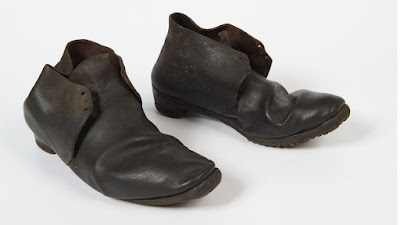
I’m always excited when some local folklore appears in the news, as it did this week. Several Boston-area news outlets reported that archaeologists working at the historic Tilden House in Canton, Massachusetts unearthed some shoes buried underneath the kitchen floor. Why all the excitement over some shoes? Because they could possibly be a form of protective magic. 

The Tilden House was built in 1725 by David and Abigail Tilden in what was then part of Dorchester, Massachusetts. That part of Dorchester ultimately became a separate town, Canton, in 1797. A strange and interesting fact: it was named Canton because Elijah Dunbar, one of the town’s leading citizens, thought it was on the exact opposite side of the planet from Canton, China. This is not the case, but the name stuck. 

A photo of hidden shoes from England. 

For those of you not from the Boston area, please note the names of the two cities are not pronounced the same. The town in Massachusetts is said CANT-in, or more often CAN’-in, with some kind of glottal stop instead of the “t”. The city in China is often pronounced can-TAWN, but it’s true Chinese name is Guangzhou. It’s also important to note that Cantonese cuisine originates from Guangzhou, not the Massachusetts town. 

The Tilden House is currently owned by the town of Canton, and leased to the Canton Historical Society, who are restoring and modernizing it so it can be used as a history center. After archaeologists removed the kitchen floor, they found several pairs of shoes, along with bottles, plates, and other items, all of which seemed to date from the mid-19th century. All these items could just be trash that past residents discarded, but it’s also possible the shoes were placed there to protect the house from witches or evil spirits. 

Hidden shoes are often found in the walls, ceilings, or under the floors of old buildings in England and North America, and historians suspect it was a form of protective magic. For example, back in 2013 archeologists found shoes hidden under the floor of the Old Colony House in Newport, Rhode Island. But why did our New England ancestors think hiding shoes would defend against evil magic? Historians  Matthew Cochran and Jeanne Ward explain it this way:

This well-documented practice dates from the l5th to the early 20th century. The underlying premise of using concealed shoes as a means of personal or household protection lies both in the shoe’s shape as well as the personal qualities imbued in a shoe by the wearer. Shoes take on the literal shape of the wearer and therefore can act as a form of proxy for the wearer. If a malicious entity is presumed to be haunting you, the concealment of the shoe in a relatively inaccessible space, such as the cellar or the attic, may draw the malicious entity to the shoe instead of you. And, if luck holds, the malicious entity may become trapped in the shoe (from the Maryland Archeology Newsletter, quoted here.)

This explanation makes sense to me, since it matches another important type of protective magic in New England: the witch bottle. I've written about witch bottles before. When someone thought they were being cursed by a witch, they would fill a bottle with their own urine, and then add nails, broken glass, and other sharp items to it. The urine acted as a substitute or proxy for the victim. The witch's evil magic would be drawn to the urine, which came from their victim, rather than to the actual intended target. To make things worse for the witch, the sharps objects would send pain and physical harm back to the witch. 

I suppose you should always have some old shoes, a bottle and some nails on hand just in case things start getting weird? It's like a supernatural form of recycling. But please, don't go around accusing your neighbors of witchcraft.

October 17, 2021

Jack-O-Lanterns: Demons, Gemstones, and New England Origins

The jack-o-lantern is a ubiquitous symbol of Halloween. All across America, people carve faces into pumpkins, placing them on doorsteps and windowsills as part of the holiday celebrations. Despite New England's modern connection with Halloween because of Salem's annual October festivities, Halloween really only became popular in New England in the latter half of the 19th century as more Irish and Scottish immigrants arrived here. The English Puritans and their descendants did not celebrate before then. 

Still, despite this, the jack-o-lantern has deep roots in New England. It seems likely that people were carving jack-o-lanterns well before Halloween was even celebrated here, and that pumpkin carving became associated with the holiday only later. Read on if you dare...

Nathaniel Hawthorne: Giant Gems and Enchanted Scarecrows

Massachusetts author Nathaniel Hawthorne was apparently the first person to ever use the term "jack-o-lantern" in print. His 1835 story "The Great Carbuncle" is about a group of adventurers searching for a giant, glowing gemstone in the White Mountains. One of the adventurers tells his companions he will hide the gem inside his tattered cloak if he finds it.

‘Well said, Master Poet!’ cried he of the spectacles. ‘Hide it under thy cloak, sayest thou? Why, it will gleam through the holes, and make thee look like a jack-o’-lantern!’

It's not entirely clear what Hawthorne means by jack-o-lantern here. It sounds like it could be our familiar carved pumpkin lit by a candle, but the term jack-o-lantern also was used to mean ignis fatus, the glowing swamp gas phenomena also called willow-the-wisp. Either usage makes sense in the story. Halloween is not mentioned at all in "The Great Carbuncle," which was published before the holiday was celebrated in New England.

Nathaniel Hawthorne

However, a carved pumpkin does appear in Hawthorne's 1851 story "Feathertop," when a New England witch named Mother Rigby uses one as a head for her scarecrow:

Thus we have made out the skeleton and entire corporosity of the scarecrow, with the exception of its head; and this was admirably supplied by a somewhat withered and shrivelled pumpkin, in which Mother Rigby cut two holes for the eyes and a slit for the mouth, leaving a bluish-colored knob in the middle to pass for a nose. It was really quite a respectable face.

Mother Rigby is so pleased with her handiwork that she brings the scarecrow to life, and since this is a Hawthorne story the scarecrow learns a lot about human morality. Hawthorne does not use the term jack-o-lantern in the story, though, and Halloween is not mentioned. 

John Greenleaf Whittier: Boyhood Memories?

The Massachusetts poet John Greenleaf Whittier mentions a carved pumpkin in his poem, "The Pumpkin," which was first published in 1846 (according to Cindy Ott's 2012 book The Pumpkin: The Curious History of An American Icon).

Oh, fruit loved of boyhood! the old days recalling, 
When wood-grapes were purpling and brown nuts were falling! 
When wild, ugly faces we carved in its skin, 
Glaring out through the dark with a candle within! 

Whittier was born in 1807. If he really carved faces into pumpkins when he was a boy, it would have been very early in the 19th century, long before Halloween was celebrated in New England. Whittier only refers to Thanksgiving in "The Pumpkin," but not Halloween, and he doesn't call the carved pumpkin a jack-o-lantern.
John Greenleaf Whittier

It's a little confusing, isn't it? The earliest instance historian Cindy Ott found where "jack-o-lantern" refers to a carved pumpkin comes from 1846. It appeared in a South Carolina publication called Tales for Youth, but again with no apparent connection to Halloween. It sounds as though people were carving pumpkins and using the term jack-o-lantern well before Halloween was celebrated, even if not always together.

A Demon and A Pumpkin in Rhode Island

Enough with the history, let's turn to the spooky stories. Many years ago, during the Revolutionary War, two young women named Hannah Maxson and Comfort Cottrell were staying at the Westerly, Rhode Island home of one Esquire Clark. One day while the Esquire was away on business, and his wife was sick in bed, the two young ladies decided to practice a little love magic. 

They took a ball of yarn, and tossed it repeatedly down a well and then pulled it back up. As they did, they chanted some psalms backwards. The goal of this magic spell? To find the men they would marry. 

As the sun set, Hannah and Comfort saw a tall figure walking up the road towards the house. They ran eagerly towards it, but their excitement turned to terror as they saw the figure had an enormous, misshapen head with two glowing, fiery eyes. This was no dream lover, but a demonic monster. 

Hannah and Comfort ran into the Clarkes' house and locked the door, but the hideous creature pounded on it insistently. The young women hid behind Mrs. Clarke's bed in fear, listening with the sick woman as the monster tried to break into the house. The supernatural assault only stopped when Esquire Clark returned home. Seeing a demonic creature clawing at his front door, he said some prayers against evil, which sent the monster slinking off into the woods.

This story first appeared in a November 1860 issue of The Narragansett Weekly, and the author, Deacon William Potter, notes that Mrs. Clarke died from all the excitement. Hannah and Comfort vowed never to use magic again. But Deacon Potter includes a strange epilogue. He claims that the demon was really a hoax played by a young many who lived near the Clarkes. He put a carved pumpkin on his head to scare Hannah and Comfort, not anticipating his joke's deadly results. The neighbor only revealed his role in the story seventy years later. 

It's a good spooky, cautionary tale. Young ladies - don't mess around with the occult. Young men - don't play stupid pranks that kill people. But despite the carved pumpkin, the story doesn't reference Halloween. And it's not called a jack-o-lantern.

The Sea Captain and Satan

Captain Snaggs was a wealthy sea captain who lived in Barnstable on Cape Cod. He had earned his riches the old-fashioned way: by selling his soul to the Devil. He had been young and foolhardy when he signed Satan's contract, but as an old man on his deathbed he was filled with regret. He could hear the Devil's hooves coming up the walkway towards his house, and Captain Snaggs didn't want to go to Hell. So he jumped out of bed, climbed out the window, and ran like... well, he ran like hell. 

He ran down the length of Cape Cod to Orleans, where he hid in a hollow tree. But the Devil was hot on his heels, and could smell Captain Snaggs's soul. So Captain Snaggs ran again, this time to Wellfleet, where he hid in a cemetery. 

The Devil was not far behind, so Captain Snaggs grabbed a pumpkin from a nearby pumpkin patch, carved a face in it, and set it up on a tall, white gravestone. Then he lit a candle inside of it and ran towards Truro.

When the Devil arrived in the cemetery he said to the pumpkin, "Your contract is up, Snaggs. I've come to take your soul." When the pumpkin didn't answer, the Devil poked the gravestone with one talon. "Do you hear me Snaggs? Ouch! You're awfully tough for an old man! Where'd you get those muscles?" He grabbed the gravestone and gave it a mighty shake. The pumpkin fell to the ground and shattered. Realizing he had been tricked, the Devil ran towards Truro with a demonic roar. 

Captain Snaggs, meanwhile, had run all the way to Provincetown. He had reached the end of the Cape. There was no place left to go. When the Devil finally caught up with him, sulfurous smoke billowing from his nose and ears, Captain Snaggs stood there in terror.

With a tremor in his voice, he said, "All right, I'm ready. You can take me to Hell now."

The Devil looked puzzled and said, "Take you to Hell? We're in Provincetown, aren't we? We're already there."

As Elizabeth Renard notes in her 1934 book The Narrow Land, there are many variations on this story. The comedic ending always remains the same, but the name of the captain, the Cape Cod towns he visits, and the number of pumpkins involved all vary. You can listen to an excellent audio version of this tale at New England Legends, where the sea captain is named Jedidy Cole. 

Renard also notes that this story is probably of late origin, so perhaps it was first told after Halloween became a popular holiday here. It's hard to say. Have a happy Halloween!

*****

My new book, Witches and Warlocks of Massachusetts, was just released on Kindle recently. So now you can enjoy it either in paperback or on your device of choice. You can buy it wherever books are sold online


August 23, 2021

Kimball Tavern: Ghosts for Sale

How many haunted taverns are there in New England? A lot, I guess, because this is my second post about a haunted tavern this summer.

Today's tavern in question is the Kimball Tavern in my hometown of Haverhill, Massachusetts. The tavern sits near Bradford Common on the south side of the Merrimack River, and was built around 1690 by Benjamin Kimball. Seven generations of the Kimball lived in it for the next two centuries.


The tavern played an important part in local history, because it was here that a group of local landowners met to create Bradford Academy (later Bradford College) in 1803. In 1921 the building was sold to the Marble family, who operated an antique store there, and it was later bought by Bradford College. 

Sadly, Bradford College shut down in 2000, and Kimball Tavern was then sold to the Wood family, who ran an antiques store from it. The Woods shut down their store a few years ago, and the building is once again for sale. The asking price is $599,000.

In addition to getting a 300+ year old building with six bedrooms and three baths, the buyer may also get some ghosts. According to Roxie Zwicker's Haunted Pubs of New England (2007), a former Bradford College student named Tom experienced strange phenomena in the tavern. 

Your author in front of the tavern.

For example, once when making a presentation the projector became mysteriously unplugged, and photos taken of him during the presentation seem to show a shadowy figure standing between him and the camera. In fact, Tom could not be seen in the photos at all.

Tom also claimed that many people glimpsed shadowy figures through the windows when the building was unoccupied. Tom and a friend visited the tavern one night to take photos, and saw a group of figures looking at them from an attic window. These figures also appeared in the photos. Tom believed they were the spirits of the Kimball family.

Many local children also thought the building was haunted, and according to Christopher and Nancy Obert's Legendary Locals of Haverhill, Massachusetts (2011), people have claimed to hear the sound of a young girl inside, as well as see the shadow of a dog and hear footsteps in empty rooms. So there you go. If you buy this building you might get some ghosts. 

Sadly, I don't have an extra $600K lying around, so I won't get the chance to own this beautiful old (and possibly haunted) building. Hopefully whoever buys it will run it as a business of some kind, or even a museum, so I will get a chance to see the inside. Hopefully the ghosts will stick around as well.

*****

I'll be a guest on Midnight FM this Thursday, 8/25/21, to discuss my book Witches and Warlocks of Massachusetts. I'm excited to talk with host Tim Weisberg about New England's weird and wonderful folklore. The show airs at 10:00 pm Eastern time!

December 15, 2020

The Festival: Christmas with H.P. Lovecraft

You might be surprised to learn that H.P. Lovecraft, Rhode Island's famous master of horror, wrote a Christmas story. "The Festival" was published in Weird Tales in 1925, and like much of Lovecraft's fiction it combines local folklore, horror tropes, and the his own personal obsessions into a weird, unnerving tale. 

The story begins with a man arriving in an old Massachusetts coastal town called Kingsport for the first time. He's also the narrator, and he tells us he's there to join a celebration that his family has kept for centuries. It's an old family tradition he's heard of but never participated in before.

It was the Yuletide, that men call Christmas though they know in their hearts it is older than Bethlehem and Babylon, older than Memphis and mankind. It was the Yuletide, and I had come at last to the ancient sea town where my people had dwelt and kept festival in the elder time when festival was forbidden; where also they had commanded their sons to keep festival once every century, that the memory of primal secrets might not be forgotten. 

Lovecraft was well-versed in New England colonial history, and he's probably referring to the 17th century when he mentions the "elder time when the festival was forbidden." The Puritans did not celebrate Christmas because they didn't think there was any evidence for the holiday in the Bible. In fact, Christmas was not widely celebrated in New England until the 19th century. 

The narrator's ancestors were not English Puritans, though. He claims they "they had come as dark furtive folk from opiate southern gardens of orchids, and spoken another tongue before they learnt the tongue of the blue-eyed fishers." Lovecraft was something of a racist, and you can see some of that in this description, but he may also be alluding to the fact that New England's coastal towns were often more diverse than some of the area's other English settlements. Even if they were dominated by the Puritans, coastal towns did attract sailors and merchants from all over the world. 

A portrait of H.P. Lovecraft as an 18th gentleman by Virgil Finlay.

That was definitely the case in Marblehead, Massachusetts, which inspired Lovecraft's fictional Kingsport. Marblehead is a peninsula that juts out into the Atlantic from Salem, and is difficult to get to even today. It was even harder to reach in the past. Unlike its neighbors, Marblehead was first settled not by East Anglian Puritans but by fishermen from a variety of areas. In its early years Marblehead had a reputation as a rough, unchurched town where old practices lingered. For example, some British fairy folklore was remembered in Marblehead that was not found anywhere else in Massachusetts, brought there by its original colonists. In Lovecraft's story, something even weirder is found in Kingsport.

Marblehead was one of Lovecraft's favorite places. He first visited it in December, 1922, and described it in nearly orgasmic terms as "the most powerful single emotional climax experienced during my nearly forty years of existence." He returned several more times before writing "The Festival." Lovecraft was obsessed with New England's Colonial era, and he loved Marblehead's extensive and well-preserved colonial architecture. When the narrator finally reaches Kingsport and sees it glistening on a snowy night, he is basically describing Marblehead: 

...willow-trees and graveyards; endless labyrinths of steep, narrow, crooked streets, and dizzy church-crowned central park that time durst not touch; ceaseless mazes of colonial houses piled and scattered at all levels like a child's disordered blocks; antiquity hovering on grey wings over winter-whitened gables and gambrel roofs...

It sounds very charming, right? In reality Marblehead is very charming, but since this is an H.P. Lovecraft story and not a Hallmark Christmas movie we know something sinister is lurking under the Currier and Ives scenery of Kingsport. Our narrator will encounter something much more terrifying than eggnog and fruitcake. 

One giveaway is that he is coming to meet family he has never seen before. Many of Lovecraft's stories deal with people coming to bad ends after investigating their family tree. They find out their ancestors were cannibals ("The Rats in the Walls"), albino gorillas ("Facts Concerning the Late Arthur Jermyn..."), or evil, undead, murderous wizards ("The Case of Charles Dexter Ward"). Insanity and death usually ensue. Lovecraft was very concerned with his own heritage. He was obsessed with his role in America's racial hierarchy as white man of English descent, but also keenly aware that both his parents had died in an insane asylum. Ancestry is a double-edged sword.

These issues definitely appear in "The Festival." When the narrator reaches the home of his distant relatives it is a scene right from a history book. The main room has a thick-beamed ceiling and a massive fireplace. Old books line the walls. There's even an old woman spinning at a spinning wheel. What could be more proper and New Englandy? But something seems off. His hosts don't speak and their faces are oddly waxen, like masks. Their gloved hands are unnervingly flabby. And one of the old books is the Necronomicon, a forbidden book of ancient, evil knowledge.

His hosts take it with them when they leave for the big celebration, which is probably a good sign this won't be your average holiday party. The narrator follows them into the street, and they join a throng of hooded and silent people making their way up a hill towards an old church. Oddly, whenever the narrator bumps into someone he notices their body is unusually soft and pulpy. By the way, I also forgot to mention that four of the narrator's ancestors were hanged during the Salem witch trials.

Illustration by Virgil Finally for Colour Out of Space

"The Festival" has a bizarre ending, even for an H.P. Lovecraft story. The narrator and the other celebrants make their way down an enormous secret stairway carved into the bedrock under the church, finally arriving at a huge underground cavern. It's illuminated by a pale green fire that throws no shadows, and an oily black river flows through it. 

Fainting and gasping, I looked at that unhallowed Erebus of titan toadstools, leprous fire, and slimy water, and saw the cloaked throngs forming a semicircle around the blazing pillar. It was the Yule-rite, older than man and fated to survive him; the primal rite of the solstice and of spring’s promise beyond the snows; the rite of fire and evergreen, light and music. And in the Stygian grotto I saw them do the rite, and adore the sick pillar of flame, and throw into the water handfuls gouged out of the viscous vegetation which glittered green in the chlorotic glare.

The narrator joins in the celebration, but cannot maintain his composure when hideous winged monsters arrive to carry the hooded celebrants even further into the underworld. One of his hosts silently tries to convince him by pulling out a watch and signet ring that belonged to the narrator's great-great-great-great grandfather - which were buried with him in 1698. The host's waxen face slips off - it is a mask- revealing something so horrible the narrator throws himself into the river in terror. 

He wakes up in a hospital; the staff tell him he was pulled from the harbor. They diagnose him with 'psychosis' due to his ravings. As part of his treatment they let him read a copy of the Necronomicon, and a  passage in it leads him to believe that the people at the ritual were really long dead sorcerers and witches whose souls had created new bodies to inhabit from the worms and maggots that ate their corpses.

"Great holes secretly are digged where earth's pores ought to suffice, and things have learnt to walk that ought to crawl."

And that is the end of the story. It's one of my favorite Lovecraft stories, and if you haven't read it you can do so online here. It's Christmas but filtered through Lovecraft's various obsessions. 

Speaking of obsessions, I realized when I was almost done writing this post that I had already written about "The Festival" a few years earlier. I guess it's one of those things I return to every year. Maybe it's my new holiday tradition. Happy holidays?

July 20, 2020

Henry Tufts: Wizard, Fortune-Teller, and Criminal

Henry Tufts (1748 - 1831) led what might euphemistically be called a colorful life. Tufts was born in Newmarket, New Hampshire and spent many years as a criminal, earning his living as a thief, con-man, gambler, and counterfeiter across New England. He also was a bigamist, marrying a woman named Lydia Bickford around 1770 and then several other women after that without divorcing any of them. This doesn't include the many, many other women he also slept with as he bamboozled his way across the countryside.

At least that's what he claims in his 1807 autobiography, which is titled A Narrative of the Life, Adventures, Travels and Sufferings of Henry Tufts, Now Residing at Lemington, in the District of Maine. In Substance, As Compiled from His Own Mouth. I think any suffering that Tufts endured came mostly from his own sociopathic nature and chronic lying, but that's me. Your opinion may differ. The book was reprinted in 1930 with the shorter and blunter title The Autobiography of A Criminal. 

Woodcut of an 18th century criminal

I'm not sure it's all 100% true, but Tufts's autobiography is a very entertaining read. It's well-written, quite funny, and consists mostly of how he gets himself into (and then out of) bad situations. What's most interesting though, at least to readers of this blog, was that Henry Tufts often made money as a traveling wizard and fortune-teller. Even though Tufts was a scam artist, A Narrative of the Life etc. provides information into how 18th century New Englanders viewed the occult and magic. 

For example, while tarrying briefly in Norwich, Vermont, Tufts let the locals know he could predict the future. Young people visited him to get their fortunes told, while "sometimes, too, did the elderly approach my levee to enquire for lost goods, so that I had business enough, and was generally received with a hearty good welcome, go whither I would. Indeed I found it in no way difficult to cajole my ignorant followers into the belief of whatever idle tale I was pleased to fabricate..."

His services as a fortune teller were much in demand. Even while he was imprisoned in Exeter, New Hampshire (for desertion from the Continental Army) several young women visited him to get their futures told. Tufts would normally be happy to make money off them, but in this case he had just cut a hole in the wall of the jail and was preparing to escape. Rather than indulge the women, he chased them off with "unseemly language, as caused them to scamper down the stairs with more than customary agility." Spoiler alert: he escaped from jail and embarked on more criminal endeavors. 

Engraving of a lobster
It's not always clear what method Tufts used to tell fortunes, but during one period he used a small lobster claw. 


I had picked up, by chance, the small claw of a lobster, which I informed the people as I passed along, was an enchanted horn; by virtue of which I could predict future events; but that, unfortunately, I had lost another horn, its counterpart, to which had been attached the rare property of enabling its possessor to foretell past events. This ridiculous tale was accredited by many; I therefore gained much celebrity, as a conjuror; sometimes my fee amounting to eight shillings in an evening.

Tufts led people to believe he was a "Salem wizard." Being a wizard was no longer a criminal offense in the 1700s, and by that time it seems Salem already had the reputation for being the source of powerful magic, a reputation it maintains to this day. If Tufts had claimed to be a Salem wizard in the 1690s he would have been hanged; in the 1770s it was a way to market his talents. 

Tufts also let people think he worked with the Devil. Again, this would be a dangerous claim to make in the the 1600s but was good marketing in the 1770s, giving Tufts an aura of mystery and danger. 


In respect to myself, it was the concurrent opinion, that I must be an extraordinary wizard, complete master of the black art, and able to employ the agency of the devil, whenever I saw fit. The belief of those things I endeavored to cultivate, well knowing, that reputation is sometimes of more advantage, in our intercourse with the generality of mankind, than are real requirements, because a fool may possess it. 

The Devil was invoked when Tufts found himself once again in Exeter jail, this time for stealing livestock with an accomplice, James Smith. The jailers put Tufts and Smith in adjacent cells. Friends smuggled tools to Tufts which he used to secretly drill a hole through the wall, and not even Smith knew he had made the hole. 

As Tufts prepared to escape, he whispered to Smith through the wall they shared that he was leaving the jail "by the help of the devil, who is now at my beck and call, whenever I need his assistance." Smith already believed that Tufts was a wizard and begged him to free him using his magic. Tufts agreed, saying that first Smith must throw his clothes out the window of his cell, which he did. 


Tufts then told Smith he must repeat the following spell to escape the jail:
Come in old man,
With that black ram,
And carry me out,
As fast as you can
Smith did as he was told. While he repeatedly recited the spell Tufts escaped through the hole he made and put on Smith's clothes, which were lying on the ground outside. Tufts fled into the countryside wearing Smith's clothing while poor gullible Smith was left naked in jail reciting the spell. 

Henry Tufts eventually gave up his life of crime and settled in Lemington, Maine, where he made a living as a physician. He had learned to be a physician from Molly Ockett, an Abenaki woman whose medical skills he required when he was suffering from a knife wound. Tufts lived among the Abenaki for several years and learned how to use local herbs and roots to treat illnesses. 

Indian doctors (as they were called) were in high demand at the time, much like Salem wizards, but happily the practice of medicine involved much less deception. If Tufts is to be believed, he was an honorable doctor who devoted himself to healing the sick. I'm just not sure we can believe anything he wrote...

December 30, 2019

Ghosts, Treasure and A Scam in Exeter, New Hampshire

Rainsford Rogers arrived in Exeter, New Hampshire in 1798. Exeter was a sleepy rural town back then and Rogers made a big impression when he arrived. Not only was he an outsider, which was exciting in itself, but he also claimed he could command spirits and ghosts. 

This was a big deal in Exeter. According to Charles Henry Bell's History of the Town of Exeter, New Hampshire (1888), Exeter's citizens hadn't had many encounters with the supernatural. There weren't any witchcraft accusations in the town's past, and there weren't even any haunted houses. Well, Bell notes that one house did for a time experience some poltergeist activity ("strange and inexplicable freaks of self-propelling furniture and the like") but "it never received a bad name on that account." Exeter was just a practical-minded place full of hard-working people. So it was quite exciting to hear Rainsford Rogers say he could invoke spirits.

Rogers became an Exeter celebrity and was soon befriended by twelve of the town's wealthiest citizens. Rogers confided to these men a great secret: there was buried treasure hidden somewhere nearby. The spirits would guide Rogers to it but he needed men he could trust to help dig it up. Anyone who helped him would get a share of the treasure. He asked the twelve if they were trustworthy. With visions of treasure in their eyes they said yes.

A woodcut of a ghost from this blog!
Rogers and his followers fell into a pattern. Rogers would consult with the spirits to determine where the treasure was, and then the twelve men would try to unearth it. The digging always took place late at night, usually in desolate locations like swamps or in the woods. Rogers also told the men they needed to wear white caps while digging, and the people in Exeter named the group the White Caps. 

They made frequent night-time trips in search of treasure. One night while they were out digging a ghost appeared to the White Caps. 
On one of the nocturnal excursions there appeared before the eyes of the awe-stricken diggers a figure all in white, representing a spirit, which uttered some words which were not well understood. One of the "white caps" anxious to lose nothing of the weighty communication, responded - "a little louder, Mr. Ghost; I'm rather hard of hearing." (Bell, History of the Town of Exeter, New Hampshire, 1888, p. 413).
But despite many nights spent excavating the White Caps never found any treasure. The spirits finally told Rainsford Rogers why. He needed a special divining rod (or dowsing rod) made from expensive materials. Such an artifact could only be produced in Philadelphia. Rogers asked the White Caps if they could contribute money towards the cost of the divining rod. They agreed, giving him several hundred dollars and a new saddle for his horse. 


A diving rod or dowsing rod.
Rogers rode out of Exeter with the money. The White Caps waited eagerly for his return. And waited. And waited. After several weeks they finally realized they had been duped, something their neighbors had suspected all along. Rogers was in fact a serial con-man, and had tricked people in many states out of their money. Born in Connecticut and originally employed as a schoolteacher there, Rogers changed careers when he learned that fooling gullible people with spiritual hocus-pocus was more profitable than educating children. (Sadly I think that may still be the case.)

He pulled his most notorious scam in Morristown, New Jersey, where he fooled 50 wealthy men into believing ghostly entities would reveal buried gold left behind by the British troops in the Revolutionary War. His antics in Morristown were far more elaborate than those in Exeter. He made his followers stand in magic circles inscribed on the ground in the woods, exploded pyrotechnics hidden under the soil, told people to carry bags containing bone dust for protection, and dressed up like a ghost to lurk outside houses. He also told his wealthy followers to give him large amounts of money. He was eventually arrested, but when a still-faithful follower paid his bail he fled town. 

A book detailing Rogers's criminal exploits (called The Morristown Ghost) was published in 1792.  Some historians speculate that Rogers wrote the book himself, both as a money-making venture and to vengefully humiliate the people in Morristown by revealing their gullibility. Unfortunately no one in Exeter ever read The Morristown Ghost so they were vulnerable to Rogers's scheme.

It's easy for a 21st century person to look back and laugh at how foolish people were, but at the time it was widely believed that America was littered with buried treasure. Legends like this were found across the country, and the treasures were usually thought to be guarded by fearsome spirits that could only be tricked through magical means. Here in Massachusetts several examples immediately come to mind: the alleged pirate treasure at Dungeon Rock in Lynn, the terrifying treasure cats of Ipswich, and the legend of Hannah Screecham of Cape Cod. There are dozens of other examples from across New England alone. Washington Irving wrote several stories on this theme, and some historians even say that treasure hunting (or money-digging as it was known) might have influenced Joseph Smith, the founder of the Mormon religion. 

Although we don't believe in buried treasure these days, sadly there are still unscrupulous people out there who will take advantage of vulnerable people. Our beliefs have changed but human nature hasn't.

November 19, 2018

Folklore and History in Chilling Adventures of Sabrina

In October Netflix released The Chilling Adventures of Sabrina, the newest version of the teen witch from the Archie comics. A far cry from the playful character introduced in the 1960s or the goofy witch of the 1990s sitcom, the current Sabrina struggles with dark impulses and whether she should sign away her soul to Satan. 

The show has received significant media attention, whether for its accurate portrayal of certain occult practices or because Salem's Satanic Temple is suing Netflix for copying the Temple's Baphomet statue. I'm enjoying the show for a few different reasons: good acting, amazing set design, and because I'm just a sucker for shows about witchcraft. I've also been pleasantly surprised to see how the writers and producers have incorporated pieces of New England's history and witch lore, in both subtle and unsubtle ways.

The show isn't explicitly set in New England. Chilling Adventures takes place in Greendale, a vaguely all-American small town located near Riverdale, the setting for the other current show (Riverdale) based on Archie comics. It's a foggy, creepy small town where it always feels like Halloween. It's not clear where exactly Greendale is, and the setting is unmoored in time as well as space. Characters drive vintage American cars, use phones with cords, and watch black and white movies at the cinema downtown. On the other hand, some of them use laptops, the high school students talk about gender and intersectionality, and Greendale is racially integrated in a way that small towns never were in the 1950s.

Given the vagueness of the setting, I was pleasantly surprised to see what looks like an early Colonial New England home in Greendale. It's the Spellman Mortuary, where Sabrina lives in it with her aunts Hilda and Zelda and cousin Ambrose. Here's a photo:

Spellman Mortuary from Chilling Adventure of Sabrina.
Their dramatically gabled home looks an awful lot like a 17th century New England house, just with a porch added and some extra tall chimneys. For example, here is Salem's House of Seven Gables:

The House of Seven Gables (photo from Wikipedia)
As another example, compare Spellman Mortuary to Salem's Witch House, the 17th century home of witch trial judge Joseph Corwin:

The Witch House (photo from TripAdvisor)
It's pretty clear the set designers were inspired by New England's old First Period homes. Large wooden houses, lots of gables, dark paint and big chimneys: the Spellman Mortuary looks like some well-known 17th century Salem houses.

In addition to the designers, the shows writers were also inspired by New England history, particularly that of Salem. Several characters have names that are drawn from Salem history.

Miss Wardwell: Sabrina's possessed teacher shares a last name with Samuel Wardwell, the Andover carpenter and fortune-teller who was executed for witchcraft during the 1692 Salem trials. 

Michelle Gomez as Miss Wardwell
Principal Hawthorne: The principal of Greendale's high school shares a name with iconic New England author and Salem native Nathaniel Hawthorne. Hawthorne was raised in the House of Seven Gables, and his great-great grandfather was John Hathorne, a judge in the Salem trials. Hawthorne probably added the "w" to his name to distance himself from his infamous ancestor. 

The Weird Sisters: The Weird Sisters are three mean-girl witches named Prudence, Dorcas and Agatha. Two of these names hark back to the Puritan era. The Puritans often named their children after desirable moral traits, like Charity, Obedience, and Prudence. Dorcas on the other hand is a Greek name, but was also popular with the Puritans. Several women named Dorcas were involved with the Salem witch trials, including Dorcas Hoar (found guilty but saved by a reprieve) and Dorcas Good, a four-year old child who confessed to being a witch. Agatha isn't a particularly Puritan name, but two out of three isn't bad. 

Susie Putnam: Sabrina's friend navigates high school as a non-binary person, and she also shares a last name with the Putnams, a Salem village family who accused many neighbors of witchcraft. Ann Putnam Jr. was one of the "afflicted girls" who sent many people to the gallows, but after the trials she confessed that she had lied and begged her neighbors for forgiveness.

Salem: This one is so obvious I almost forgot to include it, but Sabrina's black cat familiar is named after the epicenter of New England witchcraft.

Daniel Webster: A Greendale lawyer with a mysterious past, Webster is obviously inspired by the historical Daniel Webster (1782 - 1852), a lawyer from New England who served as a U.S. senator and as secretary of state for three presidents. Webster was the subject of Stephen Vincent Benet's popular 1936 short story "The Devil and Daniel Webster," where he argues with Satan in court for a New Hampshire farmer's soul.

The Greendale Thirteen

In addition to the names, the show's writers have given Greendale a fictional town history with a definite New England vibe. A key incident in Greendale's past was the execution of the Greendale Thirteen, a coven of witches who were hanged by the townspeople. Although there were a few witch trials in other American colonies, the only large scale executions happened in New England. This means that Greendale probably isn't in the Midwest or the South.

Finally, I'll mention Sabrina's "dark baptism." In this rite, Sabrina is supposed to sign her name in blood into the Book of the Beast, thereby giving her soul over to Satan. The ceremony takes place in the woods at night. In many 17th century New England witchcraft accounts, the alleged witch confessed to signing the Devil's book in blood. In other cases, they confessed that the Devil had baptized them, using a pond, river, or even a bucket of water.

Sabrina's Dark Baptism
There's no actual water used on the show, but the ritual is still called a baptism. If anything, this sequence reminded me of Nathaniel Hawthorne's short story "Young Goodman Brown," where a Puritan journeys into the nighttime forest to sign his name in the Devil's book. Goodman Brown has his doubts about his decision, and the story comes to a dramatic conclusion as he wrestles with his conscience in front of the Devil's gathered congregants. I don't want to give away any spoilers, but the writers of Sabrina probably read this story before they wrote their episode.

Although Hawthorne's story is set in the Puritan era it's not really about Puritans history or witch lore. He uses those subjects to craft an allegory about the evil we all harbor in our hearts and what that realization can mean to someone. And despite drawing from New England history and folklore, The Chilling Adventures of Sabrina isn't about those things either. It's about patriarchy, misogyny,and gender roles. It's also about young people rebelling against their elders, a perpetually fresh theme in pop culture. The writers and producers are just using New England history as a material to create their fictional world and add some spooky atmosphere. So, while I'll keep my eyes peeled for more shoutouts to New England, I'll mostly just continue to enjoy the show for the teen drama and supernatural shenanigans.