Showing posts with label Saturnalia. Show all posts

December 17, 2022

Christmas Chaos: Puritans, Saturnalia, and Lords of Misrule

On December 25, 1621, some young men in Plymouth, Massachusetts wanted to celebrate Christmas. Their celebration sounds pretty meager by modern standards – just playing a few ball games in the street. However, when William Bradford, Plymouth’s governor, saw what was happening he shut their little party down. He told them they shouldn't be celebrating Christmas, but he was willing to let them observe the day by praying piously indoors. They could not have any fun, however, particularly not in public.
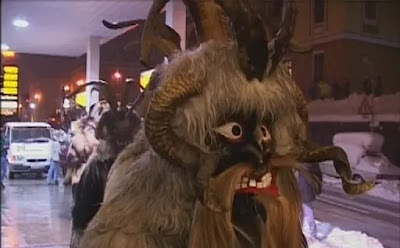
A still from Kranky Klaus (2003), a film by Cameron Jamie.

This sounds like a Grinchy move, and it was. Unlike Governor Bradford and many other Plymouth colonists, the game-players weren’t Puritans. They hadn’t realized how strongly the Puritans hated and feared Christmas. In 1659, the Massachusetts legislature even passed a bill banning Christmas - that's how much they hated the holiday. The bill was repealed in 1681 by Sir Edmund Andros, a much-despised governor appointed by the English king, but Christmas was still not widely celebrated in Massachusetts, or New England in general, until the mid-19th century. Schools and business remained open, and churches did not hold religious services on Christmas. A few  people on the margins of New England society celebrated Christmas, but most didn't.

Puritans hated Christmas for two reasons. First, they thought it was just a pagan holiday that had become thinly Christianized. There’s probably some truth in that. The Bible does not indicate the date of Christ’s birth, so the early Church fathers decided it should be celebrated on December 25, a time when people across the Roman Empire were already celebrating various winter holidays like the Saturnalia and the birthday of Sol Invictus, the sun god. It made good political sense for the new religion to piggyback on already popular holidays.
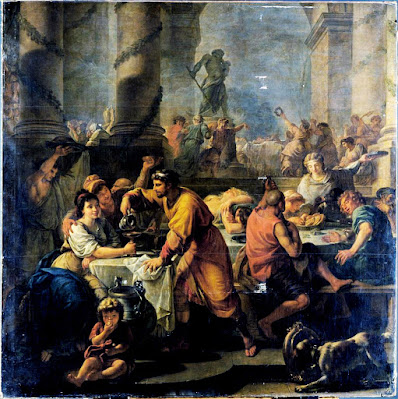
Saturnalia by Antoine Callet

Puritans also hated Christmas because it was celebrated very differently in the 17th century than it is now. Christmas was a raucous and chaotic holiday that featured lots of drunken public revelry and social disorder. There is still some heavy drinking at Christmas these days, but in the 17th century Christmas was associated with large, drunken, disorderly mobs roaming through the streets and countryside. This can be traced back to the Roman Saturnalia, which celebrated the god Saturn, who had supposedly ruled over Earth’s Golden Age. During Saturn’s reign, everyone had been equal. There were no slaves and no masters, no kings and no subjects, no bosses and no employees. It was blissful and idyllic anarchy, with the Earth providing bountiful food so no one needed to work. These beliefs about the Golden Age were reflected in the Saturnalian celebrations holiday, with masters waiting on their slaves, men dressing as women, and much public drinking and ribaldry. All boundaries were dissolved. 

Saturnalia was a season of misrule, a time when society’s rules were temporarily inverted or suspended. It was a release valve, a way for the lower classes to temporarily let off some steam and a way for the upper classes to buy some good will. After the Roman Empire collapsed, this pattern continued in Europe through the Middle Ages and into the Renaissance, but Christmas became the holiday of misrule, not Saturnalia. In many European towns and cities, prominent lower class men were appointed the Lord of Misrule by their fellows to preside over the holiday debauchery, leading crowds that mocked priests, noblemen, and the wealthy with impudence. Carolers, often drunk and in costume, demanded food and drink at wealthy homes. Once the celebrations ended, the Lord of Misrule stepped down and the old hierarchical relationships reasserted themselves until Christmas came around again. 
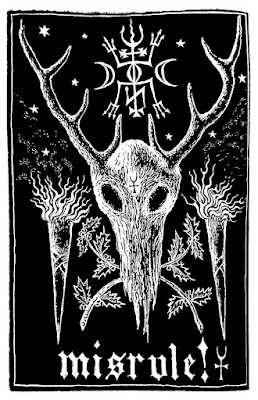
Illustration from Masks of Misrule (1996) by Nigel Aldcroft Jackson

The misrule of Christmas was antithetical to the Puritan values of hard-work, moderation, and self-control, but some modern Americans have recently have shown interest in bringing back a little of the old Christmas chaos. Some contemporary witches and occultists acknowledge a Lord of Misrule in their winter solstice rituals, and the Krampus, a monstrous Yule creature associated with misrule from northern Europe, has become increasingly popular, appearing on t-shirts, tree ornaments, and in movies. Krampus celebrations are a long-standing tradition in Germany and Austria, and some Americans are trying to bring it here.

Idyllic holiday anarchy sounds like fun, but there was definitely a dark side to Christmas misrule. The threat of violence lurked beneath the surface, and vandalism sometimes occurred, even in Puritan New England. For example, a group of young men in Salem, Massachusetts harassed 72-year-old John Rowden on Christmas night in 1679. The men forcibly entered Rowden's home, caroled, and then demanded wine as payment for their performance. Rowden refused, and in retaliation the young men pelted his house with stones and branches for 90 minutes, knocked down a stone wall, and stole six pecks of apple from his cellar. Something similar happened in Deerfield, Massachusetts in 1794, when shopkeeper John Birge was awoken at 2:00 am on December 22 by a group of drunken men demanding entrance to his home. He refused, and the men broke his windows.

Perhaps if Rowden and Birge had played along, their property wouldn't have been damaged. Much like Halloween's trick-or-treat, if you gave out food, liquor or money at Christmas you and your home would escape unharmed. The threat of violent retaliation was an integral part of the holiday.
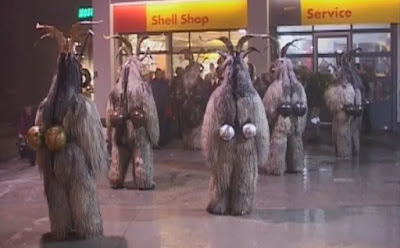
A still from Kranky Klaus (2003), a film by Cameron Jamie.

Back in 2007, I saw a short documentary by Cameron Jamie called Kranky Klaus, which follows a group of Krampuses as they roam around an Austrian town in a pre-Christmas celebration. The movie is unsettling. The Krampuses are aggressive and violent. They try to break into a pizza shop, and when a female employee stops them they push her into a snow bank. They enter a nightclub, where they knock over tables, wrestle patrons to the floor, and whip people. The Krampuses terrify a group of children, and then shove snow into pedestrians' faces in the street. No one stops them because it's a holiday tradition, but a lot of folks seem unhappy and terrified. You can watch Kranky Klaus on YouTube for yourself. What are your thoughts? Misrule and Christmas chaos sound like fun on paper, but the reality looks pretty scary.

I love weird old traditions, but I'm happy with the tamer, milder Christmas we now celebrate. The Puritan's anti-Christmas attitude wasn't defeated by misrule, but by 19th-century capitalism and a kinder, gentle approach to raising children. The prospect of happy children opening presents under a tree won out over the Puritan's "bah humbug" attitude, and over Christmas misrule as well. Feel free to celebrate Christmas (or not) as you see fit, but I'll be sitting by the tree, drinking eggnog, and listening to Mariah Carey, trying to find that happy medium between grumpy Puritan and kranky Krampus. 

*****

My favorite book about the history of Christmas is Stephen Nissenbaum's The Battle for Christmas: A Cultural History of America's Most Cherished Holiday. I got much of this post's information from it. 

December 05, 2021

Meeting the Devil on Christmas Day

Ho ho ho! It's December, and Christmas madness is once again upon us. We just decorated our tree, I've had my first glass of eggnog, and I made fruitcake yesterday. Bring on the holidays. 

Christmas is so widely celebrated in modern New England that you might not believe it was once viewed as a dangerous and possibly even Satanic holiday. But it's true! The following post (which I first published in 2017) explains more...

*****

In 1662, Rebecca Greensmith of Hartford, Connecticut was arrested and charged with witchcraft. She confessed to meeting the Devil, but she denied having signed a contract with him. Well, at least she hadn't signed one at the time of her arrest. Rebecca and the Devil were waiting for a special day to sign it: Christmas.

The Reverend John Whiting of Hartford wrote the following in a letter:
But that the devil told her, that at Christmas they would have a merry meeting, and then the covenant should be drawn and subscribed. ... Mr. Stone (being then in court) with much weight and earnestness laid forth the exceeding heinousness and hazard of that dreadful sin, and therewith solemnly took notice (upon the occasion given) of the devil's loving Christmas. (quoted in David Hall's Witch-Hunting in Seventeenth-Century New England.)
That sounds a little strange to modern readers. Why would the Devil love Christmas? Isn't it a holiday about hope, love and charity?

Merry Christmas?

Four-hundred years ago, Christmas was a very different holiday than it is today. It wasn't focused on family, gift-giving, and children. Instead, it was characterized by heavy drinking and public rituals that inverted the social order. Europe and its colonies were agricultural societies then, and food and alcohol were most plentiful during the late autumn and early winter. Crops had been harvested, herd animals slaughtered, and beer brewed. There was no more farm-work to be done.

In short, it was a great time to have a huge party. Wealthy people would feast themselves and their friends at home. People from the lower social classes, usually groups of young men, roamed around at night in disguise. The young men (called mummers) would usually target the homes of the wealthy, where they would perform a skit or song in return for food or beer. This is the origin of the wandering Christmas carolers so often portrayed in Christmas stories or movies. If they were denied entry or not given gifts for their performance, the mummers would retaliate with violence or by vandalizing property.


Some hints of this older-style Christmas can still be heard in the lyrics of Christmas carols. For example, "The  Gloucestershire Wassail" describes men threatening a butler to give them good strong beer and demanding entry to a wealthy person's home:
Come butler, come fill us a bowl of the best
Then we hope that your soul in heaven may rest
But if you do draw us a bowl of the small
Then down shall go butler, bowl and all. 
Be here any maids? I suppose here be some;
Sure they will not let young men stand on the cold stone!
Sing hey O, maids! come trole back the pin,
And the fairest maid in the house let us all in.
The lyrics of "We Wish You A Merry Christmas" describe something similar:
Oh, bring us a figgy pudding;
Oh, bring us a figgy pudding and a cup of good cheer
We won't go until we get some;
We won't go until we get some, so bring some out here
Christmas was raucous, drunken, socially disruptive, and occasionally violent. The Puritans valued order, sobriety, and hard work. They didn't want anything to do with Christmas.

During their brief tenure ruling old England the Puritans tried to suppress Christmas celebrations. The Puritans who colonized New England did the same. It was even illegal to celebrate Christmas in Massachusetts between 1659 and 1681. Anyone found doing so could be fined five shillings.

Puritan ministers in New England wrote sermons against Christmas. The Reverend Increase Mather wrote the following, equating Christmas with pagan deities and Satan:
The Feast of Christ's nativity is attended with such profaneness, as that it deserve the name of Saturn's Mass, or of Bacchus his Mass, or if you will, the Devil's Mass, rather than have the holy name of Christ put upon it. (A Testimony Against Several Prophane and Superstitious Customs, Now Practiced by Some in New-England, 1687).
Mather mentions Saturn for a very specific reason. The Bible doesn't provide a date for Christ's birth, and the early Christian church fathers decided to place it on December 25 to coincide with pagan Roman winter holidays like Saturnalia, which venerated the harvest god Saturn. This compromise between Christianity and paganism was another argument the Puritans used for hating Christmas. 

So there you have it. That's why the Puritans thought the Devil loved Christmas. Their efforts to suppress Christmas were modestly successful. Christmas wasn't widely celebrated in New England until the mid-nineteenth century. Christmas is now the biggest holiday in the United States. The Puritans would have blamed Satan, but I think it's just because people like to have fun.

*****

My favorite source for information about Puritans and Christmas is Stephen Nissenbaums's fantastic book The Battle for Christmas. It's great for anyone who wants to really understand the weird history of Christmas in America.

If you want to read more about witches, check out my new book Witches and Warlocks of Massachusetts, which is available wherever you buy books online.


December 13, 2017

Why The Devil Loves Christmas

In 1662, Rebecca Greensmith of Hartford, Connecticut was arrested and charged with witchcraft. She confessed to meeting the Devil, but she denied having signed a contract with him. Well, at least she hadn't signed one at the time of her arrest. Rebecca and the Devil were waiting for a special day to sign it: Christmas.

The Reverend John Whiting of Hartford wrote the following in a letter:

But that the devil told her, that at Christmas they would have a merry meeting, and then the covenant should be drawn and subscribed. ... Mr. Stone (being then in court) with much weight and earnestness laid forth the exceeding heinousness and hazard of that dreadful sin, and therewith solemnly took notice (upon the occasion given) of the devil's loving Christmas. (quoted in David Hall's Witch-Hunting in Seventeenth-Century New England.)

That sounds a little strange to modern readers. Why would the Devil love Christmas? Isn't it a holiday about hope, love and charity?

Merry Christmas?

Four-hundred years ago, Christmas was a very different holiday than it is today. It wasn't focused on family, gift-giving, and children. Instead, it was characterized by heavy drinking and public rituals that inverted the social order. Europe and its colonies were agricultural societies then, and food and alcohol were most plentiful during the late autumn and early winter. Crops had been harvested, herd animals slaughtered, and beer brewed. There was no more farm-work to be done.

In short, it was a great time to have a huge party. Wealthy people would feast themselves and their friends at home. People from the lower social classes, usually groups of young men, roamed around at night in disguise. The young men (called mummers) would usually target the homes of the wealthy, where they would perform a skit or song in return for food or beer. This is the origin of the wandering Christmas carolers so often portrayed in Christmas stories or movies. If they were denied entry or not given gifts for their performance, the mummers would retaliate with violence or by vandalizing property.


Some hints of this older-style Christmas can still be heard in the lyrics of Christmas carols. For example, "The  Gloucestershire Wassail" describes men threatening a butler to give them good strong beer and demanding entry to a wealthy person's home:

Come butler, come fill us a bowl of the best
Then we hope that your soul in heaven may rest
But if you do draw us a bowl of the small
Then down shall go butler, bowl and all. 
Be here any maids? I suppose here be some;
Sure they will not let young men stand on the cold stone!
Sing hey O, maids! come trole back the pin,
And the fairest maid in the house let us all in.

The lyrics of "We Wish You A Merry Christmas" describe something similar:

Oh, bring us a figgy pudding;
Oh, bring us a figgy pudding and a cup of good cheer
We won't go until we get some;
We won't go until we get some, so bring some out here

Christmas was raucous, drunken, socially disruptive, and occasionally violent. The Puritans valued order, sobriety, and hard work. They didn't want anything to do with Christmas.

During their brief tenure ruling old England the Puritans tried to suppress Christmas celebrations. The Puritans who colonized New England did the same. It was even illegal to celebrate Christmas in Massachusetts between 1659 and 1681. Anyone found doing so could be fined five shillings.

Puritan ministers in New England wrote sermons against Christmas. The Reverend Increase Mather wrote the following, equating Christmas with pagan deities and Satan:
The Feast of Christ's nativity is attended with such profaneness, as that it deserve the name of Saturn's Mass, or of Bacchus his Mass, or if you will, the Devil's Mass, rather than have the holiday name of Christ put upon it. (A Testimony Against Several Prophane and Superstitious Customs, Now Practiced by Some in New-England, 1687).
Mather mentions Saturn for a very specific reason. The Bible doesn't provide a date for Christ's birth, and the early Christian church fathers decided to place it on December 25 to coincide with pagan Roman winter holidays like Saturnalia, which venerated the harvest god Saturn. This compromise between Christianity and paganism was another argument the Puritans used for hating Christmas.

So there you have it. That's why the Puritans thought the Devil loved Christmas. Their efforts to suppress Christmas were modestly successful. Christmas wasn't widely celebrated in New England until the mid-nineteenth century. Christmas is now the biggest holiday in the United States. The Puritans would have blamed Satan, but I think it's just because people like to have fun.

*****

My favorite source for information about Puritans and Christmas is Stephen Nissenbaums's fantastic book The Battle for Christmas. It's great for anyone who wants to really understand the weird history of Christmas in America.

December 11, 2016

A Sexy Puritan Christmas: Lewd Behavior at Yule in Old New England

The war over Christmas has been going on for centuries. Is the holiday too commercial? Is it too religious? People have been arguing those points for hundreds of years, but you don't hear a lot of people complaining these days that Christmas is too sexual.

Surprisingly, that was a complaint lodged against Christmas in the past. Before Christmas became focused on children, gift-giving, and cozy crafts, it was a raucous public holiday where the lower classes drank heavily and roamed through the streets. They traveled from house to house demanding food and drink from their wealthier neighbors, who themselves were drinking heavily and also feasting on the best foods from the recent late autumn harvests.

All that partying sometimes led to lascivious behavior, as illustrated by the following information from Stephen Nissenbaums' book The Battle for Christmas.

When the Puritans founded New England they banned the holiday outright. Puritan theologians did not believe there was any Biblical justification for celebrating Jesus's birth in December, and they also knew that Christmas was placed on December 25th by early Christians to co-opt the pagan Roman holiday of Saturnalia. They didn't view Christmas as a Christian holiday, but rather as a pagan survival that encouraged disorderly behavior.

Unfortunately for the Puritans, some people in New England continued to celebrate Christmas. These celebrants were originally people on the fringes of Puritan society: servants, the poor, and sailors and fishermen. To help quash the lingering Christmas festivities the leaders of the Massachusetts Bay Colony even passed a law in 1659 levying a five shilling fine against anyone found celebrating the holiday.

This law wasn't successful. People have always loved an excuse for a party, even in 17th century New England, and authors and diarists of the time often disapprovingly noted that their trashy neighbors were enjoying the holiday in the old-fashioned, drunken way. Much to the dismay of the Puritans, Christmas even briefly became legal during the short three-year governorship of the royally-appointed Sir Edmund Andros.

Yule-tide partying continued even after Andros was sent back to England in 1689. In fact, the problem seemed to be worsening. Cotton Mather, Boston's leading minister, wrote the following in his journal in December of 1711:

I hear of a number of young people of both sexes, belonging, many of them, to my flock, who have had on the Christmas-night, this last week, a Frolick, a reveling feast, and Ball...

Uh-oh. Not only were the marginal people celebrating Christmas, but now the children of good upstanding Puritans were too. Note how he is specifically concerned about "young people of both sexes."

Reverend Mather took action and preached against Christmas parties in 1712 and 1713. He preached the following:


The Feast of Christ's Nativity is spent in Reveling, Dicing, Carding, Masking, and in Licentious Liberty... by Mad Mirth, by long Eating, by hard Drinking, by lewd Gaming, by Rude Reveling...

Mather also told his congregation that "Abominable Things" were done in the name of Christmas. What were these unnameable abominations? Pre-marital sex.

Mather wasn't just being alarmist. Historians have analyzed New England birth records from the early 18th century, and they've found that the largest number of children were born in September and October, roughly nine months after Christmas. Even more interesting, many of these children were born only seven months after their parents were married. In other words, they were conceived illegitimately during Christmas, and their parents only married once they realized a child was coming.

The lewd behavior associated with Christmas was finally tamed not by preaching, but by commercialism. In the 19th century the holiday became associated with gift-giving and Santa Claus, and those associations remain with us today. The battle against lascivious Christmas behavior was won, but not with Cotton Mather's weapons of choice.

*****

I highly recommend Stephen Nissenbaum's The Battle for Christmas if you like strange Christmas lore and history. It's a fascinating book!

December 08, 2011

America's Oldest Fruitcake


A good fruitcake can last a long time. The high sugar content in the cake helps it keep, and if you frequently moisten the cake with liquor it can last a very long time.

A very, very long time. America's oldest documented fruitcake was baked in 1878 by Fidelia Bates, and it is still in her family today. In 2003 her great grandson, Morgan Ford of Tecumseh, Michigan, brought the cake on Jay Leno's talk show. Despite possible health risks Jay ate a very small piece of the cake. He said it smelled good but tasted crystallized. That's pretty good praise for a cake that's 125 years old.


Michigan may have the oldest fruitcake, but the first fruitcake recipe written in the United States was published in Connecticut 1n 1798. It's contained in our country's first cookbook, AMERICAN COOKERY,OR THE ART OF DRESSING VIANDS, FISH, POULTRY, AND VEGETABLES, AND THE BEST MODES OF MAKING PASTES, PUFFS, PIES, TARTS, PUDDINGS, CUSTARDS AND PRESERVES, AND ALL KINDS OF CAKES,FROM THE IMPERIAL PLUMB TO PLAIN CAKE. ADAPTED TO THE COUNTRY, AND ALL GRADES OF LIFE. That's quite a title, but at least buyers knew what they were getting! The author is Amelia Simmons, about whom little is known except she was an orphan, a fact stated on the title page.

Simmons mentions something called plumb cake in the title of the book. Although it has a different name, the ingredients are nearly identical to a modern fruitcake. Here's the recipe:

Mix one pound currants, one drachm nutmeg, mace and cinnamon each, a little salt, one pound of citron, orange peal candied, and almonds bleach'd, 6 pound of flour, (well dry'd) beat 21 eggs, and add with 1 quart new ale yeast, half pint of wine, 3 half pints of cream and raisins...

She doesn't tell us how long to bake it or how many pans to fill, but with 21 eggs and 6 pounds of flour she probably had enough cake for the whole state of Connecticut.

The word "plumb" here is actually an older variant spelling of "plum", which centuries ago in England meant raisins or other fruit. So not only are the ingredients the same as a fruitcake, but the name is equivalent as well.

I'm not sure when fruitcake became associated with Christmas, and when it actually became known as fruitcake. Lots of cakes in America's past were really fruitcakes under another name. For example, election cake was a yeasted fruitcake. Lydia Child's 1833 cookbook The American Frugal Housewife has a recipe called wedding cake, but the ingredients are identical to a modern fruitcake. I personally love fruitcake, but I don't think most modern brides want it at their wedding.

Like Christmas itself fruitcake may have its origins in the ancient Greco-Roman world. A writer named Chrysippus claims the Cretans made cakes with nuts, fruit, spices and honey. I'm sure the Romans enjoyed similar treats as the celebrated Saturnalia, the pagan forerunner to Christmas. If a two-thousand year old fruitcake is unearthed I want to see Jay Leno take a bite!