Showing posts with label Yule. Show all posts

December 17, 2023

Spooky Holiday Reading: Merry Christmas, or Scary Christmas?

I'm sure you've heard the 1963 song, "It's the Most Wonderful Time of the Year." Andy Williams croons in his soothing voice,"...there'll be scary ghost stories, and tales of the glory of Christmases long, long ago." Although modern Americans tend to associate ghosts with Halloween, in Victorian England ghosts were associated with Christmas. I suppose this makes sense in some ways. After all, Christmas occurs at the darkest point of the year, which seems like a good time for ghosts to be out haunting. 

In the spirit of a spooky Christmas, here are four things you can read to get you in the holiday spirit. Two of them are even available free online, if you're feeling cash-strapped after holiday shopping. 

1. The Fright Before Christmas: Surviving Krampus and Other Yuletide Monsters by Jeff Belanger

This is the latest book by Jeff Belanger, a local author, paranormal investigator, and host of the New England Legends podcast and TV show on PBS and Amazon Prime. Full confession: the publisher sent me a copy of this book to review, and I've appeared on Jeff's podcast in the past. This is a great book for anyone interested in learning about the spooky folklore of Christmas. 

Me holding my copy of Fright Before Christmas!

I think by now most people are familiar with Krampus, the horned Austrian monster who terrorizes folks at this time of year, but Jeff also writes about many other strange Christmas creatures that are less well-known. For example, have you heard of Hans Von Trapp, the Cannibal Christmas Scarecrow of Alsace, France? Merry Christmas - but sleep with the lights on.

2. NOS4A2 by Joe Hill

The protagonist of this novel by Joe Hill (Stephen King's son) is Vic McQueen, a psychic, ass-kicking, biker mama who grows up in Haverhill, Massachusetts (my hometown). The villain is a creepy vampire named Charles Talent Manx III. Imbecilic yet cunning, child-like yet predatory, Manx travels around the country in an old Rolls Royce. 

Armed with gingerbread-scented laughing gas, Manx abducts small children and brings them to Christmasland, a creepy holiday-themed amusement park that exists just beyond the border of our reality. He and Vic battle it out in this book that will make you gasp out "Merry Christmas..." as you slip into a vampiric, gingerbread slumber.

3."The Festival" by H.P. Lovecraft (free online)

One of my favorite stories by this Rhode Island master of weird horror.  A young man visits his family's ancestral Massachusetts hometown to participate in its traditional winter solstice celebration for the first time. Although he's charmed by the town's Colonial-era architecture, he's unnerved by its residents' silent, expressionless demeanors. 

He's even more unnerved when he follows a crowd of celebrants into a church, then into its crypt, then down ancient stone steps deep into the earth... Is he really entering a subterranean realm, or just his own fetid subconscious? Either way, he discovers a fungus-filled, maggoty hellscape. You'll scream "Merry Christmas!" before losing your sanity. 

4. The Collected Ghost Stories of M.R. James by M.R. James (free online)

If "The Festival" sounds too lurid for you, may I suggest the ghost stories of M.R. James? James was an Englishman and Anglican priest who wrote ghost stories every Christmas to entertain his friends. His stories often feature bookish academics or lonely clergymen visiting old historic sites and encountering supernatural evil. 

It's all very proper and British. But while his stories are subtle and heavy on the atmosphere, they often end with shocking violence and death. Nothing says "Merry Christmas!" like an undead Satanic nobleman devouring your face. 

Enjoy your holidays, and I hope all your horrors are confined to the printed page this December.  

December 17, 2022

Christmas Chaos: Puritans, Saturnalia, and Lords of Misrule

On December 25, 1621, some young men in Plymouth, Massachusetts wanted to celebrate Christmas. Their celebration sounds pretty meager by modern standards – just playing a few ball games in the street. However, when William Bradford, Plymouth’s governor, saw what was happening he shut their little party down. He told them they shouldn't be celebrating Christmas, but he was willing to let them observe the day by praying piously indoors. They could not have any fun, however, particularly not in public.

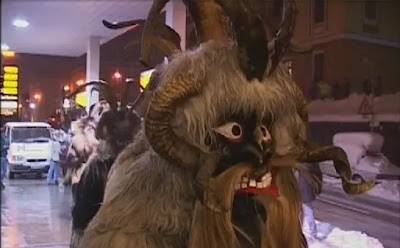
A still from Kranky Klaus (2003), a film by Cameron Jamie.

This sounds like a Grinchy move, and it was. Unlike Governor Bradford and many other Plymouth colonists, the game-players weren’t Puritans. They hadn’t realized how strongly the Puritans hated and feared Christmas. In 1659, the Massachusetts legislature even passed a bill banning Christmas - that's how much they hated the holiday. The bill was repealed in 1681 by Sir Edmund Andros, a much-despised governor appointed by the English king, but Christmas was still not widely celebrated in Massachusetts, or New England in general, until the mid-19th century. Schools and business remained open, and churches did not hold religious services on Christmas. A few  people on the margins of New England society celebrated Christmas, but most didn't.

Puritans hated Christmas for two reasons. First, they thought it was just a pagan holiday that had become thinly Christianized. There’s probably some truth in that. The Bible does not indicate the date of Christ’s birth, so the early Church fathers decided it should be celebrated on December 25, a time when people across the Roman Empire were already celebrating various winter holidays like the Saturnalia and the birthday of Sol Invictus, the sun god. It made good political sense for the new religion to piggyback on already popular holidays.

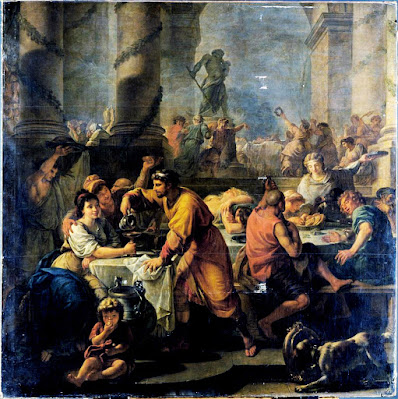
Saturnalia by Antoine Callet

Puritans also hated Christmas because it was celebrated very differently in the 17th century than it is now. Christmas was a raucous and chaotic holiday that featured lots of drunken public revelry and social disorder. There is still some heavy drinking at Christmas these days, but in the 17th century Christmas was associated with large, drunken, disorderly mobs roaming through the streets and countryside. This can be traced back to the Roman Saturnalia, which celebrated the god Saturn, who had supposedly ruled over Earth’s Golden Age. During Saturn’s reign, everyone had been equal. There were no slaves and no masters, no kings and no subjects, no bosses and no employees. It was blissful and idyllic anarchy, with the Earth providing bountiful food so no one needed to work. These beliefs about the Golden Age were reflected in the Saturnalian celebrations holiday, with masters waiting on their slaves, men dressing as women, and much public drinking and ribaldry. All boundaries were dissolved. 

Saturnalia was a season of misrule, a time when society’s rules were temporarily inverted or suspended. It was a release valve, a way for the lower classes to temporarily let off some steam and a way for the upper classes to buy some good will. After the Roman Empire collapsed, this pattern continued in Europe through the Middle Ages and into the Renaissance, but Christmas became the holiday of misrule, not Saturnalia. In many European towns and cities, prominent lower class men were appointed the Lord of Misrule by their fellows to preside over the holiday debauchery, leading crowds that mocked priests, noblemen, and the wealthy with impudence. Carolers, often drunk and in costume, demanded food and drink at wealthy homes. Once the celebrations ended, the Lord of Misrule stepped down and the old hierarchical relationships reasserted themselves until Christmas came around again. 

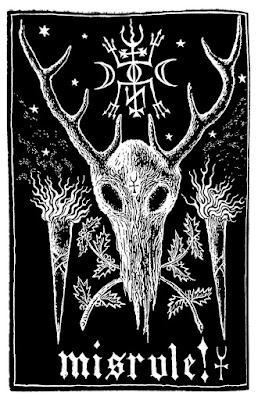
Illustration from Masks of Misrule (1996) by Nigel Aldcroft Jackson

The misrule of Christmas was antithetical to the Puritan values of hard-work, moderation, and self-control, but some modern Americans have recently have shown interest in bringing back a little of the old Christmas chaos. Some contemporary witches and occultists acknowledge a Lord of Misrule in their winter solstice rituals, and the Krampus, a monstrous Yule creature associated with misrule from northern Europe, has become increasingly popular, appearing on t-shirts, tree ornaments, and in movies. Krampus celebrations are a long-standing tradition in Germany and Austria, and some Americans are trying to bring it here.

Idyllic holiday anarchy sounds like fun, but there was definitely a dark side to Christmas misrule. The threat of violence lurked beneath the surface, and vandalism sometimes occurred, even in Puritan New England. For example, a group of young men in Salem, Massachusetts harassed 72-year-old John Rowden on Christmas night in 1679. The men forcibly entered Rowden's home, caroled, and then demanded wine as payment for their performance. Rowden refused, and in retaliation the young men pelted his house with stones and branches for 90 minutes, knocked down a stone wall, and stole six pecks of apple from his cellar. Something similar happened in Deerfield, Massachusetts in 1794, when shopkeeper John Birge was awoken at 2:00 am on December 22 by a group of drunken men demanding entrance to his home. He refused, and the men broke his windows.

Perhaps if Rowden and Birge had played along, their property wouldn't have been damaged. Much like Halloween's trick-or-treat, if you gave out food, liquor or money at Christmas you and your home would escape unharmed. The threat of violent retaliation was an integral part of the holiday.

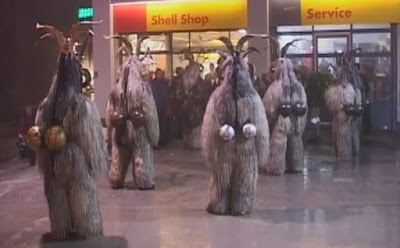
A still from Kranky Klaus (2003), a film by Cameron Jamie.

Back in 2007, I saw a short documentary by Cameron Jamie called Kranky Klaus, which follows a group of Krampuses as they roam around an Austrian town in a pre-Christmas celebration. The movie is unsettling. The Krampuses are aggressive and violent. They try to break into a pizza shop, and when a female employee stops them they push her into a snow bank. They enter a nightclub, where they knock over tables, wrestle patrons to the floor, and whip people. The Krampuses terrify a group of children, and then shove snow into pedestrians' faces in the street. No one stops them because it's a holiday tradition, but a lot of folks seem unhappy and terrified. You can watch Kranky Klaus on YouTube for yourself. What are your thoughts? Misrule and Christmas chaos sound like fun on paper, but the reality looks pretty scary.

I love weird old traditions, but I'm happy with the tamer, milder Christmas we now celebrate. The Puritan's anti-Christmas attitude wasn't defeated by misrule, but by 19th-century capitalism and a kinder, gentle approach to raising children. The prospect of happy children opening presents under a tree won out over the Puritan's "bah humbug" attitude, and over Christmas misrule as well. Feel free to celebrate Christmas (or not) as you see fit, but I'll be sitting by the tree, drinking eggnog, and listening to Mariah Carey, trying to find that happy medium between grumpy Puritan and kranky Krampus. 

*****

My favorite book about the history of Christmas is Stephen Nissenbaum's The Battle for Christmas: A Cultural History of America's Most Cherished Holiday. I got much of this post's information from it. 

December 15, 2020

The Festival: Christmas with H.P. Lovecraft

You might be surprised to learn that H.P. Lovecraft, Rhode Island's famous master of horror, wrote a Christmas story. "The Festival" was published in Weird Tales in 1925, and like much of Lovecraft's fiction it combines local folklore, horror tropes, and the his own personal obsessions into a weird, unnerving tale. 

The story begins with a man arriving in an old Massachusetts coastal town called Kingsport for the first time. He's also the narrator, and he tells us he's there to join a celebration that his family has kept for centuries. It's an old family tradition he's heard of but never participated in before.

It was the Yuletide, that men call Christmas though they know in their hearts it is older than Bethlehem and Babylon, older than Memphis and mankind. It was the Yuletide, and I had come at last to the ancient sea town where my people had dwelt and kept festival in the elder time when festival was forbidden; where also they had commanded their sons to keep festival once every century, that the memory of primal secrets might not be forgotten. 

Lovecraft was well-versed in New England colonial history, and he's probably referring to the 17th century when he mentions the "elder time when the festival was forbidden." The Puritans did not celebrate Christmas because they didn't think there was any evidence for the holiday in the Bible. In fact, Christmas was not widely celebrated in New England until the 19th century. 

The narrator's ancestors were not English Puritans, though. He claims they "they had come as dark furtive folk from opiate southern gardens of orchids, and spoken another tongue before they learnt the tongue of the blue-eyed fishers." Lovecraft was something of a racist, and you can see some of that in this description, but he may also be alluding to the fact that New England's coastal towns were often more diverse than some of the area's other English settlements. Even if they were dominated by the Puritans, coastal towns did attract sailors and merchants from all over the world. 

A portrait of H.P. Lovecraft as an 18th gentleman by Virgil Finlay.

That was definitely the case in Marblehead, Massachusetts, which inspired Lovecraft's fictional Kingsport. Marblehead is a peninsula that juts out into the Atlantic from Salem, and is difficult to get to even today. It was even harder to reach in the past. Unlike its neighbors, Marblehead was first settled not by East Anglian Puritans but by fishermen from a variety of areas. In its early years Marblehead had a reputation as a rough, unchurched town where old practices lingered. For example, some British fairy folklore was remembered in Marblehead that was not found anywhere else in Massachusetts, brought there by its original colonists. In Lovecraft's story, something even weirder is found in Kingsport.

Marblehead was one of Lovecraft's favorite places. He first visited it in December, 1922, and described it in nearly orgasmic terms as "the most powerful single emotional climax experienced during my nearly forty years of existence." He returned several more times before writing "The Festival." Lovecraft was obsessed with New England's Colonial era, and he loved Marblehead's extensive and well-preserved colonial architecture. When the narrator finally reaches Kingsport and sees it glistening on a snowy night, he is basically describing Marblehead: 

...willow-trees and graveyards; endless labyrinths of steep, narrow, crooked streets, and dizzy church-crowned central park that time durst not touch; ceaseless mazes of colonial houses piled and scattered at all levels like a child's disordered blocks; antiquity hovering on grey wings over winter-whitened gables and gambrel roofs...

It sounds very charming, right? In reality Marblehead is very charming, but since this is an H.P. Lovecraft story and not a Hallmark Christmas movie we know something sinister is lurking under the Currier and Ives scenery of Kingsport. Our narrator will encounter something much more terrifying than eggnog and fruitcake. 

One giveaway is that he is coming to meet family he has never seen before. Many of Lovecraft's stories deal with people coming to bad ends after investigating their family tree. They find out their ancestors were cannibals ("The Rats in the Walls"), albino gorillas ("Facts Concerning the Late Arthur Jermyn..."), or evil, undead, murderous wizards ("The Case of Charles Dexter Ward"). Insanity and death usually ensue. Lovecraft was very concerned with his own heritage. He was obsessed with his role in America's racial hierarchy as white man of English descent, but also keenly aware that both his parents had died in an insane asylum. Ancestry is a double-edged sword.

These issues definitely appear in "The Festival." When the narrator reaches the home of his distant relatives it is a scene right from a history book. The main room has a thick-beamed ceiling and a massive fireplace. Old books line the walls. There's even an old woman spinning at a spinning wheel. What could be more proper and New Englandy? But something seems off. His hosts don't speak and their faces are oddly waxen, like masks. Their gloved hands are unnervingly flabby. And one of the old books is the Necronomicon, a forbidden book of ancient, evil knowledge.

His hosts take it with them when they leave for the big celebration, which is probably a good sign this won't be your average holiday party. The narrator follows them into the street, and they join a throng of hooded and silent people making their way up a hill towards an old church. Oddly, whenever the narrator bumps into someone he notices their body is unusually soft and pulpy. By the way, I also forgot to mention that four of the narrator's ancestors were hanged during the Salem witch trials.

Illustration by Virgil Finally for Colour Out of Space

"The Festival" has a bizarre ending, even for an H.P. Lovecraft story. The narrator and the other celebrants make their way down an enormous secret stairway carved into the bedrock under the church, finally arriving at a huge underground cavern. It's illuminated by a pale green fire that throws no shadows, and an oily black river flows through it. 

Fainting and gasping, I looked at that unhallowed Erebus of titan toadstools, leprous fire, and slimy water, and saw the cloaked throngs forming a semicircle around the blazing pillar. It was the Yule-rite, older than man and fated to survive him; the primal rite of the solstice and of spring’s promise beyond the snows; the rite of fire and evergreen, light and music. And in the Stygian grotto I saw them do the rite, and adore the sick pillar of flame, and throw into the water handfuls gouged out of the viscous vegetation which glittered green in the chlorotic glare.

The narrator joins in the celebration, but cannot maintain his composure when hideous winged monsters arrive to carry the hooded celebrants even further into the underworld. One of his hosts silently tries to convince him by pulling out a watch and signet ring that belonged to the narrator's great-great-great-great grandfather - which were buried with him in 1698. The host's waxen face slips off - it is a mask- revealing something so horrible the narrator throws himself into the river in terror. 

He wakes up in a hospital; the staff tell him he was pulled from the harbor. They diagnose him with 'psychosis' due to his ravings. As part of his treatment they let him read a copy of the Necronomicon, and a  passage in it leads him to believe that the people at the ritual were really long dead sorcerers and witches whose souls had created new bodies to inhabit from the worms and maggots that ate their corpses.

"Great holes secretly are digged where earth's pores ought to suffice, and things have learnt to walk that ought to crawl."

And that is the end of the story. It's one of my favorite Lovecraft stories, and if you haven't read it you can do so online here. It's Christmas but filtered through Lovecraft's various obsessions. 

Speaking of obsessions, I realized when I was almost done writing this post that I had already written about "The Festival" a few years earlier. I guess it's one of those things I return to every year. Maybe it's my new holiday tradition. Happy holidays?

December 19, 2017

A Lovecraft Christmas: Fact and Fiction in "The Festival"

Christmas is a holiday about love, hope and charity. Trees are decorated with lights. Parents bake cookies with their kids. Everyone gets excited about Santa's big visit. It's really great, but if all the sweetness and joy is too much for you I suggest reading H. P. Lovecraft's 1923 story "The Festival" This morbid tale of an old-fashioned New England Christmas is full of horror, ancient secrets, and giant maggots. And like much of Lovecraft's work, there's a nugget of truth in it.

You can read "The Festival" here, but if you want to save your sanity I'll summarize. It begins on Christmas Eve with a man visiting Kingsport, an old Massachusetts fishing town that is his family's ancestral home. He has never been there before.

It was the Yuletide, that men call Christmas though they know in their heads it is older than Bethlehem and Babylon, older than Memphis and mankind. It was the Yuletide, and I had come at last to the ancient sea town where my people had dwelt and kept festival in the elder time when festival was forbidden; where they also had commanded their sons to keep festival once every century, that the memory of primal secrets might not be forgotten. (H.P. Lovecraft, "The Festival")

At first the narrator is charmed by the old colonial buildings and narrow, crooked streets of Kingsport. But he is also a little creeped out as he walks through town. There are no people around, or even footprints in the snow, and all the curtains are drawn in the windows. He gets even more creeped out when he arrives at the really, really old house where his distant relatives live.

Inside is an elderly mute man wearing a hooded robe and gloves, while an elderly woman works without speaking at a a spinning wheel by the fire. There may also be someone sitting in a high-backed chair facing the window. Oh, and the elderly couple's faces may be waxen masks...

H.P. Lovecraft (1890 - 1937)

The elderly couple welcome the narrator, who browses the couple's book collection while he waits for the family Yule festival to start. Most of their books are about demonology and witchcraft, and they have a copy of The Necronomicon, a book of unspeakably blasphemous knowledge. Just the usual light holiday reading. As the narrator reads the unseen guest in the chair exits unseen - through the window - with an odd noise. Creepy.

Eventually the elderly couple indicates it is time for the festivities. As they and the narrator walk through the streets towards an old church they are joined by other Kingsport citizens, also hooded and robed. Here is Lovecraft's description of people walking to church on Christmas Eve:

...cowled, cloaked figures that poured endlessly from every doorway and formed monstrous processions up this street and that, past the creaking signs and antediluvian gables, the thatched roofs and diamond-paned windows; threading precipitous lanes where decaying houses overlapped and crumbled together; gliding across open courts and churchyards where the bobbing lanthorns made eldritch drunken constellations.

Once inside the church the throng descends a staircase that spirals down through the earth. Down, down they go until they eventually reach a vast cave. The cave is illuminated by a "belching column of sick greenish flame," allowing the narrator to see they are on the banks of a river feeding into a dark subterranean sea. At this point the actual Yule ritual begins:

It was the Yule-rite, older than man and fated to survive him; the primal rite of the solstice and of spring's promise beyond the snows; the rite of fire and evergreen, light and music. And in the Stygian grotto I saw them do the rite, and adore the sick pillar of of flame, and throw into the water handfuls gouged out of the viscous vegetation which glittered green in the chlorotic glare.

Until this point the narrator has maintained some modicum of composure, but he loses it when the celebrants mount hideous flying monsters that carry them off over the subterranean sea. As the elderly mute man encourages the narrator to mount one too it becomes clear that he is indeed wearing a mask and may not be human. In a panic the narrator hurls himself into the river.

The narrator awakens to find himself in a hospital; the authorities claim he was found floating in the harbor. They commit him to a nearby insane asylum, where they staff helpfully procure a copy of The Necronomicon for him to read. The narrator ponders a passage hinting that dead sorcerers can project their minds into the maggots that eat their bodies in the grave and then cause them to grow to human size. Were the elderly couple and the other celebrants really giant maggot-beings possessed by the minds of undead sorcerers? Merry Christmas!

I will confess I kind of love "The Festival," mainly because it is so fabulously weird but also because it has a nugget of truth in it. And I don't just mean the psychological truth that spending the holidays with family can be hard for some people. I mean some historical truth about coastal New England.

Lovecraft was inspired to write "The Festival" after visiting the Massachusetts town of Marblehead in December of 1922. He was delighted at the town's extensive Colonial-era architecture, and the narrator's walk through fictional Kingsport incorporates many of the sights Lovecraft saw. For example the elderly couple's house was probably inspired by one on Marblehead's Mugford Street, and the church was based on St. Michael's Church on Frog Lane, which is one of the oldest Episcopal churches in New England.

Mugford Street in Marblehead

As you probably know, Massachusetts was mostly colonized by Puritans, but non-Puritans settled here as well, particularly in the fishing towns like Marblehead. The Puritans tended to be farmers and craftspeople from East Anglia, but the fisherfolk who settled in Marblehead were more religiously and ethnically heterogeneous. The town had a reputation in its early years for being rough and a little bit wild. It was a place for hard-drinkers and outsiders. And it was also a place where people celebrated Christmas.

As I wrote last week, the Puritans despised the revelry of Christmas and tried to ban it from New England. They were not successful at tamping down the celebrations in Marblehead, though, and in 1729 Michael Pigot, the pastor of St. Michael's, held a service celebrating Christmas. The local Puritans were outraged, and preached a sermon against the holiday in response. Reverend Pigot responded in turn by publishing a pamphlet titled A vindication of the practice of the antient Christian, as well as the Church of England, and other reformed churches, in the observation of Christmas-Day : in answer to the uncharitable reflections of Thomas de Laune, Mr. Whiston, and Mr. John Barnard of Marblehead: in a sermon preach'd on the 4th. of January, 1729--30. That's a real mouthful of a title! Angry mobs from both groups confronted each other in the streets.

In "The Festival", Lovecraft writes that Kingsport is "where my people had dwelt and kept festival in the elder time when festival was forbidden." Is this an oblique reference to the actual controversy in Marblehead over Christmas? I think it's possible. Lovecraft was a Colonial history buff and loved incorporating historical facts into his story. It's likely he knew the history of the town before he wrote the story. Let's just hope the giant maggot monsters aren't real too.