Showing posts with label Marblehead. Show all posts

April 24, 2022

Edward Dimond, the Wizard of Marblehead

This is my final Marblehead post, at least for now. It's a fascinating town and I hope to write more about it in the future. But today I just want to talk about Edward Dimond, the wizard of Marblehead. 

Witches and magicians of all types were generally viewed with suspicion in early New England. People definitely consulted fortune tellers and herbal healers in times of need (despite their Puritan ministers telling them not to), but those fortune tellers and healers often became scapegoats when things went wrong. Openly practicing magic was a risky business, and you might find yourself hanging by your neck from a tree. 

Edward Dimond of Marblehead seems to be an exception to this rule. He had a reputation in town as a powerful magician, and was known as Wizard Dimond. But unlike many others who practiced magic, he was a well-respected member of the community. 

The Old Brig, Edward Dimond's house. Photo from the Phillips
Library at the Peabody Essex Museum.

Born in 1641, Dimond claimed he came from a long line of famous astrologers and necromancers. Records indicate Wizard Dimond’s profession was “shoreman” and tradition says he was a retired sea captain. Like most Marblehead residents he had a strong connection to the ocean and his house, called the Old Brig, was supposedly constructed from the planks of a ship. It still stands today on Orne Street. 

Unlike most towns in Massachusetts, Marblehead wasn’t founded by Puritans looking to practice their religion but instead by fisherman and sailors who just wanted to earn a living. They were more tolerant of magic and fortune-telling than their Puritan neighbors, particularly if it helped them in their daily lives. In other towns Wizard Dimond would have been accused of witchcraft. In Marblehead, he was a valued member of the community.  

According to legends, Dimond used his magic to help ships off the coast of Marblehead when they encountered trouble. On stormy nights, Wizard Dimond positioned himself in the graveyard on Burial Hill, roaming around the tombstones and shouting orders to ships miles away. The sailors on those ships should have been too far away to hear his voice, but amazingly they did, and they also knew to follow his commands if they wanted to safely reach the harbor. The hungry waves claimed those who didn’t heed the wizard of Marblehead.

Old Burial Hill, Marblehead.

People also came to Wizard Dimond to learn the future, but one of his specialties was finding lost or stolen objects. He once helped an elderly couple locate their stolen money and also identified the man who stole it. 

Another well-known Marblehead legend tells how he helped an elderly widow. The widow, who was quite poor, came to Dimond’s house on a cold winter night. All her firewood had been stolen, she said, and she would freeze to death unless he found the thief. Using his magical abilities, Wizard Dimond first learned the thief’s name. Going further, he then cast a spell on him, cursing him to walk up and down the Marblehead streets until sunrise with a huge, heavy log tied to his back. In the morning the thief, cold and exhausted, confessed to the widow and returned her firewood. He learned his lesson and never stole again. 

Dimond claimed that magical powers ran in his family. His granddaughter was Moll Pitcher, the famous fortune-teller of Lynn, so maybe there is some truth to that claim. 

Edward Dimond died in 1732 at the venerable age of 91. His grave site has been long forgotten, but perhaps his spirit is still roving around Burial Hill on stormy nights, giving orders to ships at sea.

*****

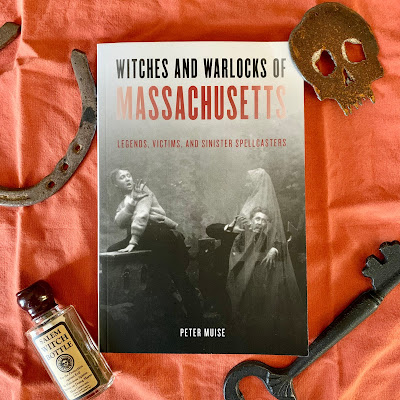
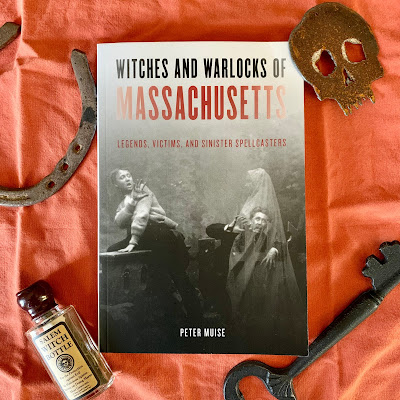
If you like reading about Massachusetts's magical past, you may enjoy my book Witches and Warlocks of Massachusetts, which was published last October. It's available wherever you buy books online. 


April 09, 2022

Wilmot Redd, the Witch of Marblehead

This is my second post about Marblehead. As I mentioned in my last one, Marblehead is incredibly charming and beautiful. It's the archetypal old New England seaside town. And as we all know, old New England towns often have some weird legends attached to them...

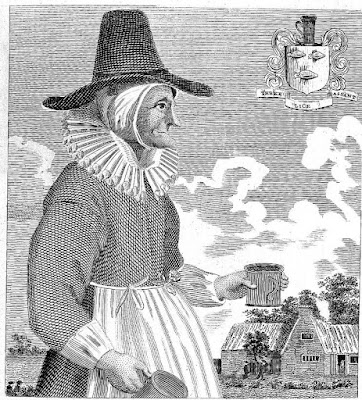
Engraving of a witch by James Caulfield, courtesy the Wellcome Collection

In Marblehead, that weird legend is about Mammy Redd, a fearsome witch who lived in the 17th century. According to various 19th century sources, Mammy Redd was a hideous old woman who terrorized the people of Marblehead. In New England Legends and Folklore (1883), Samuel Adams Drake wrote the following about her:

This woman was believed to possess the power of malignant touch and sight, and she was able, so it was whispered, to cast a spell over those whom she might in her malevolence wish to injure. To some she sent sickness and death, by merely wishing that a 'bloody cleaver' might be found in the cradle of their infant children.

A popular rhyme about Mammy Redd from the 19th century described another of her evil powers:

Old Mammy Redd

Of Marblehead

Sweet milk could turn

To mould in churn

Other versions of the rhyme specify that the mold looked like "blue wool," which sounds pretty gross. Ruining dairy products (milk, cream, or butter) is a classic New England witch's hex. 

Photo by my friend Onix Marrero

The legend of Mammy Redd is based, quite loosely, on Wilmot Redd (or Read, depending on the source), a Marblehead woman who was executed during the Salem witch trials. She was the wife of a fisherman and, like many of the woman accused of witchcraft by the Puritans, was older and cantankerous. Some sources describe her as "grouty," which means rude or ill-tempered. She was not a witch, but was simply unpopular. 

Most records from her trial are lost, but those that remain describe an argument Redd had with a neighbor, Mrs. Syms. Syms believed Redd's maid had stolen some bed linens, and  exchanged harsh words with Redd. At the end of the argument, Redd supposedly cursed Syms, telling her she would never defecate or urinate again. Soon after, Syms began to suffer from constipation and had difficulty urinating. These problems only ended once she moved away from Marblehead. 

This is an absurd thing to be executed for, but the Salem judges accepted even the most ridiculous accusations at face value. During her questioning, the afflicted Salem girls (the driving force behind the witch hunt) claimed they saw Wilmot Redd's spirit offering them the Devil's black book to sign. This alleged vision sent the girls into convulsions. While most people in the courtroom took them seriously, Wilmot Redd did not. When a judge asked her opinion of the girls' convulsions, she said "My opinion is they are in a sad condition." Grouty to the end, Wilmot Redd was hanged on September 22, 1692 at Gallows Hill in Salem. 

Photo by Onix Marrero

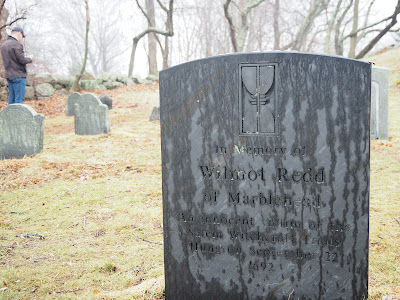
Like everyone executed for witchcraft in Salem, Redd's body was discarded in an unmarked grave somewhere near Gallow's Hill. Perhaps her family retrieved it and secretly reburied her, perhaps not. Many years later, the town of Marblehead erected a monument to her in Old Burial Hill graveyard. As you can see from the photo, people leave coins at her grave to honor her memory. 

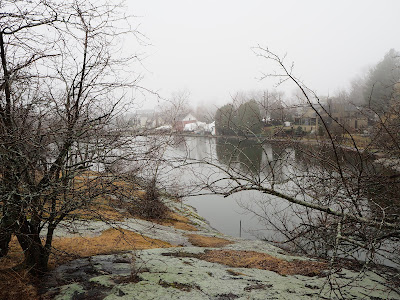
The town also named this small behind pond behind Old Burial Hill Redd's Pond in her honor. She and her husband lived next to the pond in the 17th century, and although her house is long gone her memory and legend still survives to this day. 

Photo of Redd's Pond by Onix Marrero

*****

If you like witch legends and the history behind them, you might like my newest book, Witches and Warlocks of Massachusetts, which is available wherever you buy books online. 


March 26, 2022

The Grave of Susanna Jayne: Bats, Angels and the Grim Reaper

Marblehead is one of the prettiest towns in Massachusetts, with an amazing and historic downtown, dramatic ocean views, and streets full of Colonial-era homes. Lots of people visit it for these reasons, but this past weekend we went for a different one: to see the grave of Susanna Jayne.


Like so many coastal New England towns, Marblehead is quite old. It was founded in 1635 as a fishing village by English colonists, and its first cemetery, Old Burial Hill, was established three years later. Old Burial Hill is located on a rocky outcrop overlooking the town center and the harbor. This was also the site of Marblehead's first meeting house (the Puritan term for a church). The meeting house is long gone, but the cemetery remains. 


We were lucky enough to visit on a rainy, foggy day. Our stroll through Old Burial Hill was really atmospheric due to the mist and wet weather, which also kept a lot of people indoors. We we had the place to ourselves. This was my first time visiting Old Burial Hill, and it's already one of my favorite cemeteries. 


Old Burial Hill was one of the locations for the movie Hocus Pocus, which draws some tourists. Nearly 600 Revolutionary War veterans are buried there, which is another draw, but we had come particularly to see the grave of Susanna Jayne. The wife of Peter Jayne, a local schoolmaster, Susanna died in August of 1776. Her epitaph reads:

Deposited Beneath this Stone the Mortal Part of Mrs. Susanna Jayne, the amiable Wife of Mr. Peter Jayne, who lived Beloved and Died Universally Lamented, on August 8th, 1776, in the 45th Year of her Age.

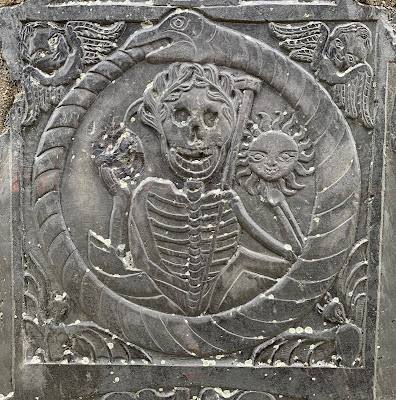
Many of the gravestones I visit have some legend associated with them, but there isn't a legend attached to Susanna Jayne's grave. It's just an incredibly beautiful headstone with lots of symbolism that, to the modern eye, is very gothic. 

Susanna Jayne's headstone is on the right. It's recently been embedded 
in stone to preserve it. 

The headstone was carved by Henry Christian Geyer (1727 - 1785), a Boston artisan who made many other Massachusetts gravestones. Some of Geyer's work follows standard styles popular at the time, while others, like Susanna Jayne's gravestone, are quite creative.  


The centerpiece of Jayne's headstone is this carving of the Grim Reaper, portrayed as a skeleton holding a scythe. The skeleton is crowned with laurel wreaths, and holds the sun in one hand and the moon in the other. (Sadly, the moon has been damaged.) Overall, the message is one of Death triumphant and the passage of time. 

The Grim Reaper is encircled by snake biting its own tail. This image, known as the ouroboros, is a symbol that dates back to the ancient Egyptians and was found on the wall of King Tut's tomb. It's had many meanings over the centuries, but most commonly represents eternity and the cycles of time. More time symbolism appears at the top of Susanna Jayne's headstone, where Geyer carved an hourglass framed by two bones. Time passes, and Death takes us all.


However, the universe is not purely mechanistic and grim. There's a moral aspect, symbolized by the angels and bats that hover around the corners. Good and evil play a role in the eternal drama as well. 


Modern gravestones are quite subdued these days, and very plain. I miss the artistry and symbolism of the older headstones. Susanna Jayne's gravestone is a work of art, and was actually photographed by the well-known artist Ansel Adams. If you'd like to see some beautiful New England art, I'd recommend taking a trip to Old Burial Hill.


You can read more about Susanna Jayne's gravestone here. More details about Henry Christian Geyer can be found here.

December 15, 2020

The Festival: Christmas with H.P. Lovecraft

You might be surprised to learn that H.P. Lovecraft, Rhode Island's famous master of horror, wrote a Christmas story. "The Festival" was published in Weird Tales in 1925, and like much of Lovecraft's fiction it combines local folklore, horror tropes, and the his own personal obsessions into a weird, unnerving tale. 

The story begins with a man arriving in an old Massachusetts coastal town called Kingsport for the first time. He's also the narrator, and he tells us he's there to join a celebration that his family has kept for centuries. It's an old family tradition he's heard of but never participated in before.

It was the Yuletide, that men call Christmas though they know in their hearts it is older than Bethlehem and Babylon, older than Memphis and mankind. It was the Yuletide, and I had come at last to the ancient sea town where my people had dwelt and kept festival in the elder time when festival was forbidden; where also they had commanded their sons to keep festival once every century, that the memory of primal secrets might not be forgotten. 

Lovecraft was well-versed in New England colonial history, and he's probably referring to the 17th century when he mentions the "elder time when the festival was forbidden." The Puritans did not celebrate Christmas because they didn't think there was any evidence for the holiday in the Bible. In fact, Christmas was not widely celebrated in New England until the 19th century. 

The narrator's ancestors were not English Puritans, though. He claims they "they had come as dark furtive folk from opiate southern gardens of orchids, and spoken another tongue before they learnt the tongue of the blue-eyed fishers." Lovecraft was something of a racist, and you can see some of that in this description, but he may also be alluding to the fact that New England's coastal towns were often more diverse than some of the area's other English settlements. Even if they were dominated by the Puritans, coastal towns did attract sailors and merchants from all over the world. 

A portrait of H.P. Lovecraft as an 18th gentleman by Virgil Finlay.

That was definitely the case in Marblehead, Massachusetts, which inspired Lovecraft's fictional Kingsport. Marblehead is a peninsula that juts out into the Atlantic from Salem, and is difficult to get to even today. It was even harder to reach in the past. Unlike its neighbors, Marblehead was first settled not by East Anglian Puritans but by fishermen from a variety of areas. In its early years Marblehead had a reputation as a rough, unchurched town where old practices lingered. For example, some British fairy folklore was remembered in Marblehead that was not found anywhere else in Massachusetts, brought there by its original colonists. In Lovecraft's story, something even weirder is found in Kingsport.

Marblehead was one of Lovecraft's favorite places. He first visited it in December, 1922, and described it in nearly orgasmic terms as "the most powerful single emotional climax experienced during my nearly forty years of existence." He returned several more times before writing "The Festival." Lovecraft was obsessed with New England's Colonial era, and he loved Marblehead's extensive and well-preserved colonial architecture. When the narrator finally reaches Kingsport and sees it glistening on a snowy night, he is basically describing Marblehead: 

...willow-trees and graveyards; endless labyrinths of steep, narrow, crooked streets, and dizzy church-crowned central park that time durst not touch; ceaseless mazes of colonial houses piled and scattered at all levels like a child's disordered blocks; antiquity hovering on grey wings over winter-whitened gables and gambrel roofs...

It sounds very charming, right? In reality Marblehead is very charming, but since this is an H.P. Lovecraft story and not a Hallmark Christmas movie we know something sinister is lurking under the Currier and Ives scenery of Kingsport. Our narrator will encounter something much more terrifying than eggnog and fruitcake. 

One giveaway is that he is coming to meet family he has never seen before. Many of Lovecraft's stories deal with people coming to bad ends after investigating their family tree. They find out their ancestors were cannibals ("The Rats in the Walls"), albino gorillas ("Facts Concerning the Late Arthur Jermyn..."), or evil, undead, murderous wizards ("The Case of Charles Dexter Ward"). Insanity and death usually ensue. Lovecraft was very concerned with his own heritage. He was obsessed with his role in America's racial hierarchy as white man of English descent, but also keenly aware that both his parents had died in an insane asylum. Ancestry is a double-edged sword.

These issues definitely appear in "The Festival." When the narrator reaches the home of his distant relatives it is a scene right from a history book. The main room has a thick-beamed ceiling and a massive fireplace. Old books line the walls. There's even an old woman spinning at a spinning wheel. What could be more proper and New Englandy? But something seems off. His hosts don't speak and their faces are oddly waxen, like masks. Their gloved hands are unnervingly flabby. And one of the old books is the Necronomicon, a forbidden book of ancient, evil knowledge.

His hosts take it with them when they leave for the big celebration, which is probably a good sign this won't be your average holiday party. The narrator follows them into the street, and they join a throng of hooded and silent people making their way up a hill towards an old church. Oddly, whenever the narrator bumps into someone he notices their body is unusually soft and pulpy. By the way, I also forgot to mention that four of the narrator's ancestors were hanged during the Salem witch trials.

Illustration by Virgil Finally for Colour Out of Space

"The Festival" has a bizarre ending, even for an H.P. Lovecraft story. The narrator and the other celebrants make their way down an enormous secret stairway carved into the bedrock under the church, finally arriving at a huge underground cavern. It's illuminated by a pale green fire that throws no shadows, and an oily black river flows through it. 

Fainting and gasping, I looked at that unhallowed Erebus of titan toadstools, leprous fire, and slimy water, and saw the cloaked throngs forming a semicircle around the blazing pillar. It was the Yule-rite, older than man and fated to survive him; the primal rite of the solstice and of spring’s promise beyond the snows; the rite of fire and evergreen, light and music. And in the Stygian grotto I saw them do the rite, and adore the sick pillar of flame, and throw into the water handfuls gouged out of the viscous vegetation which glittered green in the chlorotic glare.

The narrator joins in the celebration, but cannot maintain his composure when hideous winged monsters arrive to carry the hooded celebrants even further into the underworld. One of his hosts silently tries to convince him by pulling out a watch and signet ring that belonged to the narrator's great-great-great-great grandfather - which were buried with him in 1698. The host's waxen face slips off - it is a mask- revealing something so horrible the narrator throws himself into the river in terror. 

He wakes up in a hospital; the staff tell him he was pulled from the harbor. They diagnose him with 'psychosis' due to his ravings. As part of his treatment they let him read a copy of the Necronomicon, and a  passage in it leads him to believe that the people at the ritual were really long dead sorcerers and witches whose souls had created new bodies to inhabit from the worms and maggots that ate their corpses.

"Great holes secretly are digged where earth's pores ought to suffice, and things have learnt to walk that ought to crawl."

And that is the end of the story. It's one of my favorite Lovecraft stories, and if you haven't read it you can do so online here. It's Christmas but filtered through Lovecraft's various obsessions. 

Speaking of obsessions, I realized when I was almost done writing this post that I had already written about "The Festival" a few years earlier. I guess it's one of those things I return to every year. Maybe it's my new holiday tradition. Happy holidays?


September 09, 2018

Malicious Pixies on the North Shore: A Story from Marblehead

What comes to mind when you hear the word 'pixie?' I tend to think of cute things that are boyishly feminine like pixie haircuts or manic pixie dream girls like Zoey Deschanel. I remember from my distant teenage Dungeons and Dragons days that pixies were little flying fairies similar to Tinkerbell. Our culture tends to portray pixies as twee and sparkly. 


I like twee and sparkly, but those may not be the correct words to describe pixies. Like most fairies, older legends often describe them as ambiguous beings whose relationship with humans can be problematic. They like to have fun at the expense of humans. Here, for example, is some fairy folklore from 19th century Marblehead, Massachusetts:

The pixies, on the contrary, were malicious. They, too, were tiny, but of a brown color; they delighted to bewilder people; a person who was "pixilated," as they called it, would wander about for hours. The only remedy for such afflicted persons was to turn their garments. The belief in this was very strong. I knew a woman fairly well educated, as the education of women went sixty years ago, who told me in perfect good faith that she herself had been "pixilated" and had wandered an hour or more unable to find her home, until at last, recognizing that she was in the power of the little brown people, she turned her cloak, when the glamor vanished; in a moment she saw where she was, and was soon in her own house. (Sarah Bridge Farmer, "Folk-Lore of Marblehead, Mass.", The Journal of American Folklore, Vol. 7, No. 26 (July - Sep., 1894), pp. 252 - 253.)

This account probably comes from the 1830s, but in the 19th century fairy folklore was quite rare in New England among those of European descent. Most of the region had been originally colonized by Puritans from England's East Anglia region, which while rich in witch-lore was poor in stories about fairies. The coastal town of Marblehead, on the other hand, was founded by fishermen from many parts of England, including some with rich fairy folklore. In England, stories about pixies are most common in in Devon and Cornwall. 

Turning your garments (i.e. wearing them inside out) is a well-knonw defense against fairy enchantment in English folklore, and is summarized in the rhyme "Turn your cloak/For fairy folk." It was apparently well-known in Marblehead, if this note from Caroline King Howard is any indication:

Judge Story used to tell with great delight, that when he was a boy living in Marblehead, his mother always warned him, when he went to the pasture, to drive home the cows, to turn his jacket inside out for fear of the pixies. (Caroline King Howard, When We Lived in Salem, 1822 - 1866)

It's my understanding, and I could be wrong, that fairies become confused when you wear your clothes inside out. In their confusion they break the spell and set you free. Causing some confusion of any kind will often break a fairy spell. For example, a famous folktale tells how a woman's child has been replaced by a fairy changeling. When the woman brews egg shells in a pot (which is unusual) the changeling becomes amazed and disappears. Her child reappears in its place. Yay! A happy 
ending!


The Native Americans in this region told (and still tell) stories about small magical beings similar to European fairies. Like their European counterparts, these small beings love to mislead travelers and sometimes even kidnap them. Belief in these beings was widespread across the New England tribes and almost certainly predates European colonization. While it is possible that current Native American stories about them show European influences, it is also possible that Europeans and Native Americans encountered similar beings but on different continents. Perhaps there is some truth behind those old folk tales. If you get lost in the woods get ready to turn your coat inside out...

December 19, 2017

A Lovecraft Christmas: Fact and Fiction in "The Festival"

Christmas is a holiday about love, hope and charity. Trees are decorated with lights. Parents bake cookies with their kids. Everyone gets excited about Santa's big visit. It's really great, but if all the sweetness and joy is too much for you I suggest reading H. P. Lovecraft's 1923 story "The Festival" This morbid tale of an old-fashioned New England Christmas is full of horror, ancient secrets, and giant maggots. And like much of Lovecraft's work, there's a nugget of truth in it.

You can read "The Festival" here, but if you want to save your sanity I'll summarize. It begins on Christmas Eve with a man visiting Kingsport, an old Massachusetts fishing town that is his family's ancestral home. He has never been there before.

It was the Yuletide, that men call Christmas though they know in their heads it is older than Bethlehem and Babylon, older than Memphis and mankind. It was the Yuletide, and I had come at last to the ancient sea town where my people had dwelt and kept festival in the elder time when festival was forbidden; where they also had commanded their sons to keep festival once every century, that the memory of primal secrets might not be forgotten. (H.P. Lovecraft, "The Festival")

At first the narrator is charmed by the old colonial buildings and narrow, crooked streets of Kingsport. But he is also a little creeped out as he walks through town. There are no people around, or even footprints in the snow, and all the curtains are drawn in the windows. He gets even more creeped out when he arrives at the really, really old house where his distant relatives live.

Inside is an elderly mute man wearing a hooded robe and gloves, while an elderly woman works without speaking at a a spinning wheel by the fire. There may also be someone sitting in a high-backed chair facing the window. Oh, and the elderly couple's faces may be waxen masks...

H.P. Lovecraft (1890 - 1937)

The elderly couple welcome the narrator, who browses the couple's book collection while he waits for the family Yule festival to start. Most of their books are about demonology and witchcraft, and they have a copy of The Necronomicon, a book of unspeakably blasphemous knowledge. Just the usual light holiday reading. As the narrator reads the unseen guest in the chair exits unseen - through the window - with an odd noise. Creepy.

Eventually the elderly couple indicates it is time for the festivities. As they and the narrator walk through the streets towards an old church they are joined by other Kingsport citizens, also hooded and robed. Here is Lovecraft's description of people walking to church on Christmas Eve:

...cowled, cloaked figures that poured endlessly from every doorway and formed monstrous processions up this street and that, past the creaking signs and antediluvian gables, the thatched roofs and diamond-paned windows; threading precipitous lanes where decaying houses overlapped and crumbled together; gliding across open courts and churchyards where the bobbing lanthorns made eldritch drunken constellations.

Once inside the church the throng descends a staircase that spirals down through the earth. Down, down they go until they eventually reach a vast cave. The cave is illuminated by a "belching column of sick greenish flame," allowing the narrator to see they are on the banks of a river feeding into a dark subterranean sea. At this point the actual Yule ritual begins:

It was the Yule-rite, older than man and fated to survive him; the primal rite of the solstice and of spring's promise beyond the snows; the rite of fire and evergreen, light and music. And in the Stygian grotto I saw them do the rite, and adore the sick pillar of of flame, and throw into the water handfuls gouged out of the viscous vegetation which glittered green in the chlorotic glare.

Until this point the narrator has maintained some modicum of composure, but he loses it when the celebrants mount hideous flying monsters that carry them off over the subterranean sea. As the elderly mute man encourages the narrator to mount one too it becomes clear that he is indeed wearing a mask and may not be human. In a panic the narrator hurls himself into the river.

The narrator awakens to find himself in a hospital; the authorities claim he was found floating in the harbor. They commit him to a nearby insane asylum, where they staff helpfully procure a copy of The Necronomicon for him to read. The narrator ponders a passage hinting that dead sorcerers can project their minds into the maggots that eat their bodies in the grave and then cause them to grow to human size. Were the elderly couple and the other celebrants really giant maggot-beings possessed by the minds of undead sorcerers? Merry Christmas!

I will confess I kind of love "The Festival," mainly because it is so fabulously weird but also because it has a nugget of truth in it. And I don't just mean the psychological truth that spending the holidays with family can be hard for some people. I mean some historical truth about coastal New England.

Lovecraft was inspired to write "The Festival" after visiting the Massachusetts town of Marblehead in December of 1922. He was delighted at the town's extensive Colonial-era architecture, and the narrator's walk through fictional Kingsport incorporates many of the sights Lovecraft saw. For example the elderly couple's house was probably inspired by one on Marblehead's Mugford Street, and the church was based on St. Michael's Church on Frog Lane, which is one of the oldest Episcopal churches in New England.

Mugford Street in Marblehead

As you probably know, Massachusetts was mostly colonized by Puritans, but non-Puritans settled here as well, particularly in the fishing towns like Marblehead. The Puritans tended to be farmers and craftspeople from East Anglia, but the fisherfolk who settled in Marblehead were more religiously and ethnically heterogeneous. The town had a reputation in its early years for being rough and a little bit wild. It was a place for hard-drinkers and outsiders. And it was also a place where people celebrated Christmas.

As I wrote last week, the Puritans despised the revelry of Christmas and tried to ban it from New England. They were not successful at tamping down the celebrations in Marblehead, though, and in 1729 Michael Pigot, the pastor of St. Michael's, held a service celebrating Christmas. The local Puritans were outraged, and preached a sermon against the holiday in response. Reverend Pigot responded in turn by publishing a pamphlet titled A vindication of the practice of the antient Christian, as well as the Church of England, and other reformed churches, in the observation of Christmas-Day : in answer to the uncharitable reflections of Thomas de Laune, Mr. Whiston, and Mr. John Barnard of Marblehead: in a sermon preach'd on the 4th. of January, 1729--30. That's a real mouthful of a title! Angry mobs from both groups confronted each other in the streets.

In "The Festival", Lovecraft writes that Kingsport is "where my people had dwelt and kept festival in the elder time when festival was forbidden." Is this an oblique reference to the actual controversy in Marblehead over Christmas? I think it's possible. Lovecraft was a Colonial history buff and loved incorporating historical facts into his story. It's likely he knew the history of the town before he wrote the story. Let's just hope the giant maggot monsters aren't real too.

July 24, 2016

Weird Marblehead, Part Two: Lee Mansion and Screaming Woman Beach

While Lori and I were in Marblehead we took a tour of the Lee Mansion. While this historic house is not officially haunted it definitely has a few weird things going on. And I mean that in a good way.

Jeremiah Lee (1721 - 1775) was a wealthy Marblehead merchant and ship owner. He built the mansion that bears his name in 1768, but unfortunately Lee and his family only lived there for a few short years before he died in an unusual way.


In addition to being a merchant Lee was a smuggler, and had for several years been smuggling weapons into the American colonies to be used in the uprising against the British. One night Lee and two other Marblehead men were secretly meeting with John Hancock and Paul Revere at a tavern outside of Boston when they got word that a group of British soldiers were approaching. The men ran out of the tavern.

It was a fatal decision. In order to avoid detection Lee spent the night hiding in a nearby field. It was a chilly night and the exposure to the cold air made him ill. He never returned to Marblehead. Instead, he died three days later in Newton from a fever.


We asked the tour guide if Jeremiah Lee's ghost haunted the mansion. The answer was an unequivocal "No." Maybe he didn't live in it long enough to get attached, or maybe his spirit is wandering around somewhere in Newton. But either way he's not haunting the mansion. 

Lee's family went bankrupt and in 1804 the mansion was sold to a local bank. They occupied it until 1909 when the Marblehead Historical Society bought it. Because the mansion has had so few owners the interior has barely changed since the 1700s. It even has the original wallpaper, which was hand painted in England more than 200 years ago. Our tour guide said there was only one other building in the US with equally old wallpaper, which is pretty impressive.


The mansion's walls are also covered with old paintings of merchants, ministers and other historic Marblehead notables. There are also quite a few paintings of children. When asked about the child portraits our tour guide told us they were mostly paintings commissioned by local families to memorialize children that died. Wealthy families would quickly bring in artists to paint portraits of their children's corpses before burial.

I suppose that's why so many of the children look really unhealthy. One painting, of a little girl holding a book, was incredibly spooky and reminded me of something from a horror movie. Lori thought I should take a photo for the blog but I declined. It seemed like asking for trouble. Let sleeping spirits lie.

The other weird thing we saw was this carved wooden figure. It kind of looks like it has fangs, doesn't it? It might just be facial hair, though.


We thought it was a doll, but our guide told us it was actually an implement used to tighten the ropes that supported a bed's mattress. Did you know the phrase "sleep tight" refers to a bed's ropes? I learn something new all the time!

While no strange legends are attached to the Lee Mansion, the same cannot be said of Lovis Cove, which is just a short walk away. Lovis Cove is said to be haunted by a famous ghost known either as the Screeching Lady, Screaming Woman, Shrieking Lady, or some variant therof. Whatever she's called you get the picture. The ghost is loud and very unhappy.


The cove itself is informally known as Screaming Woman Cove or Screeching Lady Beach. When I think of beaches I think of soft white sand, but that's not the case at Lovis Cove. The beach is covered with rocks and there are even more rocks - big sharp ones covered with algae - out in the water. It's not the type of beach you really want to spend a lot of time at.


The ghost doesn't want to spend time there either but apparently has no choice. Samuel Roads includes the story of the Screeching Woman in his 1880 book History and Traditions of Marblehead. According to Roads, way back in the late 1600s an English ship crossing the Atlantic was captured by Spanish pirates. All the passengers and crew of the ship were slaughtered except for one beautiful English woman, whom the pirates kept alive until they reached New England.

When the pirates came ashore at Lovis Cove with the woman they brutally murdered her on the beach. Roads writes:

The few fishermen who inhabited the place were absent, and the women and children who remained could do nothing to prevent the crime. The screams of the victim were loud and dreadful, and her cries of "Lord save me! Mercy! Oh! Lord Jesus, save me!" were distinctly heard. The body was buried where the crime was perpetrated, and for over one hundred and fifty years on the anniversary of that dreadful tragedy the screams of the poor woman were repeated in a voice so shrill and supernatural as to send an indescribable thrill of horror through all who heard them. 

That's pretty gruesome, but Pam Matthias Peterson adds one more gruesome detail in her 2007 book Marblehead Myths, Legends and Lore. The pirates chopped off the woman's fingers while she was still alive to steal her rings. Ugh.


Peterson claims that Marblehead residents avoid the beach at night and that her screams can still sometimes be heard even today. The comments on this site include a few from people who say they have indeed heard her screams in the night. Creepy. Does a ghost like this ever find rest, I wonder?

It took Lori and I a while to find Lovis Cove, but here's a tip if you want to visit: it's located right next to the Barnacle Restaurant, which is at 141 Front Street. The cove doesn't sound like someplace you want to visit at night, though.

July 17, 2016

Weird Marblehead, Part One: Ghosts, Tunnels, and H.P. Lovecraft

This weekend my friend Lori and I took a little tour of Marblehead, Massachusetts.

I don't use the word charming too much, but Marblehead is probably one of the most charming towns I have ever been to. Charming old 18th century homes everywhere, charming narrow streets, and of course a charming location on an isolated peninsula.

This might come as a surprise, but Marblehead was much beloved by the famous horror writer H. P. Lovecraft. Lovecraft was obsessed with the 18th century, and raved to all his friends about the town's historic architecture.


Lovecraft showed his love in a strange way - by setting several of his stories in a thinly fictionalized version of Marblehead that he called Kingsport. Probably the most famous of these is "The Festival," which tells how a young man comes to Kingsport to celebrate the winter solstice with distant relatives he has never met before.

Here's how Lovecraft describes the town:

... Kingsport with its ancient vanes and steeples, ridgepoles and chimneypots, wharves and small bridges, willow-trees and graveyards; endless labyrinths of steep, narrow, crooked streets, and dizzy church-crowned central peak that time durst not touch; ceaseless mazes of colonial houses piled and scattered at all angles and levels like a child's disordered blocks...

It all sounds very quaint on the surface but - surprise! - by the story's end the narrator is descending deep into the earth with a horde of semi-human cultists to celebrate ancient unspeakable rites:

... I saw some side passages or burrows leading from unknown recesses of blackness to this shaft of nighted mystery. Soon they became excessively numerous, like impious catacombs of nameless menace; and their pungent odor of decay grew quite unbearable... I shivered that a town should be so aged and maggoty with subterranean evil. 

And that's how H. P. Lovecraft shows his love for a favorite town!

But all kidding aside, I think this story demonstrates the dual fascination people feel about this part of the country. On the one hand it's old, quaint and charming, but on the other hand some creepy things definitely happened here in the past and many people feel like they have left their imprint on the landscape. It's no accident that so many horror stories are set in New England, or that America's three greatest horror writers (Poe, Lovecraft and King) all were born here.


Marblehead these days is a very posh and charming town, but when it was founded it was a rough-and-tumble fishing town full of unchurched sailors. Some old European folklore survived in Marblehead longer than in other parts of New England, and several famous witches (Mammy Redd, Edward Dimond and Moll Pitcher) were also born in the town. And those tunnels Lovecraft wrote about may not just be fiction...


On our Marblehead trip Lori and I decided to first visit Fort Sewall, which was built on a bluff overlooking the ocean in the 1600s. The fort was expanded and renovated in the 1700s, and played a key role in the War of 1812 when its cannons saved the U.S.S. Constitution from being attacked by British warships. The fort is now a public park and on the National Register of Historic Places.

Something we didn't see on the trip were the caves located in the cliff underneath the fort. According to Pam Matthias Peterson's Marblehead: Myths, Legends and Lore there are caves in the cliff which were used in the past as a hiding place for smugglers. These caves would flood at high tide, and the town sealed them up to prevent people from being trapped inside and drowning. That sounds like a good idea to me.


Peterson also writes that according to local legend a vast network of tunnels runs beneath Marblehead, and even connects the caves to the main town. These tunnels were supposedly used by the smugglers to carry on their business undetected by the British. Peterson claims the tunnels are mostly just a legend, but at least one house in town (the King Hooper mansion) does have a sealed-off doorway in its cellar. Perhaps there is a kernel of truth behind the subterranean tunnels in Lovecraft's story after all?


A group of ghost hunters have investigated Fort Sewall several times. Over the course of six years, Nick Smith of Queens, New York has investigated Fort Sewall using high-tech ghost-hunting technology like an electromagnetic field detector and a microphone that can pick up sounds inaudible to the human ear.

Smith said he has twice captured a voice at the site yelling, “Help!” And another time, when Smith was alone at the fort, he said he recorded a voice asking a question, “as though a person were standing behind him.”

“There’s definitely something going on here,” Smith said as he setup equipment for the night’s investigation. “We just haven’t collected enough data to prove what that something is.”
From this November 2013 WCVB article.  

Smith wasn't sure what's causing the haunting. The fort has a long history, but no particular tragedy is connected to it.

It does have a dungeon, though, so there was undoubtedly a lot of misery associated with it. The dungeon and the other rooms are sealed off with iron bars, but we were able to see inside. They look like a good place for ghosts to hang out.


If you want to watch Nick Smith and some colleagues investigate the fort you can find a video on YouTube. The beginning does feature the voice saying "Help me", which is pretty spooky.

Next week I'll post more about Marblehead, including its most famous ghost. Stay tuned!

January 19, 2014

Turn Your Cloak for the Fairy Folk

There's an old saying from England that goes something like this:

Turn your cloak
For fairy folks
Live in old oaks

It's an instruction and a warning. Fairies are mischievous, if not sometimes maevolent, and often inhabit large, old oak trees. Turning your cloak inside out will prevent them from enchanting you as you pass by their home. I'm not 100%  sure why wearing something inside out will protect you, but I think the belief is that the fairies are just so puzzled by this weird behavior that they don't know what to do.

Not a lot of European fairy lore made it to New England, so I was surprised to read the following in Caroline Howard King's When I Lived in Salem 1822 - 1866:

Judge Story used to tell with great delight, that when he was a boy living in Marblehead, his mother always warned him, when he went to the pasture, to drive home the cows, to turn his jacket inside out for fear of the pixies.

It seems likely that King is talking about Joseph Story, a famous North Shore lawyer who became a Supreme Court Justice. Justice Story was a child in Marblehead during the Revolutionary War and left in 1795 to attend Harvard. The warning against pixies would have been delivered to him by his mother Mehitable Story (maiden name Pedrick).

Joseph Story, 1779 - 1845
Why don't we have more European fairy beliefs in New England? In his new book America Bewitched: Witchcraft After Salem, historian Owen Davies proposes at least one answer. In Great Britain fairies are often associated with certain features of the landscape like ancient burial mounds, streams, or large trees. When the English settlers left their old homes for New England they left behind not only these locations but also their magical inhabitants.

The New World landscape certainly had an abundance of interesting features, but without the weight of oral tradition the fairies didn't become associated with them. Fairies didn't just live in any old tree, but specific trees back in England that had been left behind. In New England, mothers didn't tell their children about fairies living in the oak behind their house here and so the traditions mostly faded away.

New England does have a lot of natural features associated with the Devil, and I wonder if the Devil took the place of the fairies in local folklore. After all, he's not limited to one particular hill or tree, so it was easier for beliefs about the Devil to travel to North America. The various rocks, ponds, etc. named after the Devil aren't so much his home, but have instead been altered by him as he traveled across the region.

The belief about wearing things inside out did persist into the nineteenth century in New England, but without any fairies being associated with it. You were supposed to wear a dress or shirt inside out simply to bring good luck, not to avoid being enchanted by pixies. The practice survived but the fairy association disappeared.

January 15, 2013

Joe Froggers: A Cookie Fit for Pirates

Who made the first pumpkin pie?

Who made the first baked beans?

These are profound and unanswerable questions. The origins of many regional dishes are lost in the murky mists of the past. Even if I had a time machine I probably wouldn't find clear answers - most dishes have just evolved into their present form.

However, there are some recipes that do a have a clear point of origin like Tollhouse Cookies, Boston cream pie, and Joe Froggers.

Most people know the first two desserts but I don't think many people have eaten Joe Froggers, a molasses style cookie that originated in Marblehead, Massachusetts.


The origin story goes something like this. Joe Brown was an African-American resident of Marblehead in the 1700s. With his wife Lucretia (who was 22 years his junior), Joe ran a tavern on Gingerbread Hill. Gingerbread Hill sounds cozy and charming but like most taverns of the era, particularly in seaports, things were a little seedy at Joe's establishment. Gambling and heavy drinking were the norm, and as Marblehead historian Joseph Robinson wrote, "a more uncouth assemblage of ruffians could not be found anywhere." Locals with nicknames like Eagle Beak, Pie Mouth, and Cork Leg were among the regulars. Joe's tavern still stands in Marblehead.

However, Joe is famous not just for running a tavern that attracted the riffraff, but because of the cookie that bears his name: Joe Froggers. Joe's last name was not Frogger, but his tavern was located next to a frog pond. Another story says that the cookies got their name because when Lucretia poured the batter in her frying pan they formed a vaguely froglike shape. Perhaps the cookies should really be called Lucretia Froggers?


The Joe Froggers people make now are probably a little different than the original recipe. For one thing, in the 1700s they were the size of salad plates. That's a big cookie! Sailors and fishermen would buy them by the barrel for long sea voyages because they kept well. I like the idea of sailing around with a barrel full of cookies. Like Gingerbread Hill, it sounds charming but I'm sure the reality was something else entirely.


Besides their size and strange name, Joe Froggers are distinguished from other molasses cookies and gingersnaps by one key ingredient: rum. It's mixed right into the batter with the butter and sugar, and adds a nice bite to the cookie. It's only fitting for a cookie developed in a raucous seaside tavern. Dark rum is best. Luckily some our family gave us a bottle of Cruzan black strap rum at Christmas. It's probably the darkest rum out there. I felt like a pirate making these cookies!

I got the information about Joe Brown from this article in Marblehead Magazine. The actual cookies I made from a recipe in Yankee Magazine's Lost and Vintage Recipes, which is actually on sale at news stands right now. It has some interesting recipes beyond the Joe Froggers and is worth picking up.