Showing posts with label death. Show all posts

July 13, 2022

Dog Days and Dog Lore

The other day while browsing through The Old Farmer's Almanac, I saw this notation for July 3rd: Dog Days Begin. I experienced the dog days quite viscerally today myself. I was out walking around during my lunch and noticed that it was blindingly bright, unpleasantly hot, and extremely humid. I felt a little stupefied. 

The dog days of summer begin on July 3rd and end on August 11th. They are said to be the hottest days of summer in the Northern Hemisphere, and get their name from the star Sirius, which rises in conjunction with the sun during this time. Sirius is part of the constellation Canis Major (Latin for the Greater Dog), which follows Orion through the sky. 

A mosaic of a dog from Pompeii

The ancient Greeks were the first people to call this time of year the dog days. For example, in The Iliad, the poet Homer has the following to say: 

...all radiant as the star which men call Orion's Hound, and whose beams blaze forth in time of harvest more brilliantly than those of any other that shines by night; brightest of them all though he be, he yet bodes ill for mortals, for he brings fire and fever in his train... (Homer, The Iliad, Book 22, translated by Samuel Butler)

Some Greeks tried to appease Sirius the Dog-star (and the heat it brought) with sacrifices, a practice taught to them by Aristaios, the divine son of Apollo. 

The Dog-star Sirius was scorching the Minoan Islands from the sky, and the people could find no permanent cure for the trouble till the Archer-King Apollon put it in their heads to send for Aristaios. So, at his father's command, Aristaios ... left Phthia, and settled in Keos. He raised a great altar to the Rain-god Zeus and made ritual offerings in the hills to the Dog-star and to Zeus himself, the Son of Kronos. In response, Zeus gave his orders - and the Etesian Winds refresh the earth for forty days. The priests of Keos still make yearly sacrifice before the rising of the Dog. (Apollonius Rhodius, Argonautica)

The ancient Romans also believed that Sirius rising created the hottest days of summer. Here is what Pliny the Elder wrote on the matter:

Who is there that does not know that the vapour of the sun is kindled by the rising of the Dog-star? The most powerful effects are felt on the earth from this star. When it rises, the seas are troubled, the wines in our cellars ferment, and stagnant waters are set in motion... There is no doubt that dogs, during the whole of this period, are peculiarly disposed to become rabid. (Pliny the Elder, Natural History, Chapter 40)

An interesting side note about Pliny the Elder: he died while trying to save people from the eruption of Mount Vesuvius that destroyed Pompeii and Herculaneum. His Natural History was only published after his death. 

From the Greeks and Romans, the concept of the dog days has been passed down to us. I think most modern Americans are still familiar with the idea, even if they don't know the exact dates that comprise the dog days. They might also know the song by Florence and the Machine, "Dog Days Are Over." Fire, fever, rabid dogs, troubled seas, and stagnant waters. The dog days don't sound like much fun. No wonder Florence is so glad they're over. 

I can hear someone out there saying, "But I love summer! Summer is awesome! The beach! Cookouts! School vacation! Trips to Europe!" Yes, all those things are amazing parts of the summer season. We don't live in the ancient Mediterranean world, where summers were inescapably hot and hellish. We live in a world with ice cream and air-conditioning. Of course, with climate change, people around the world are once again experiencing the sometimes terrifying power of summer - wildfires, heatwaves, and droughts are increasing every year. And not everyone is fortunate enough to have air-conditioning and ice cream.

An interesting side note about trips to Europe: I read today that an American tourist was injured when he tried to retrieve his phone after dropping it into Mount Vesuvius. Happily, the volcano was not erupting at the time.

Thinking about the dog days made me curious to see if I could find some New England lore about dogs. I found a few intriguing tidbits in What They Say in New England (1896), Clifton Johnson's collection of local folklore. Although Johnson notes that it was considered healthier to have dogs than cats as pets, he does include some sinister lore about dogs. For example, he writes about a dog in Hadley, Massachusetts that howled every night when the 9:00 pm church bell rang. The citizens of Hadley assumed this was an omen of something bad, but they weren't quite sure what. 

They probably thought the dog's howling foretold someone's death, because Johnson also writes that it was believed a dog howling under a window foretold a death in the house. 

There was a dog went and howled under the window of a house up near where I lived. He howled and howled; and they drove him off, but no sooner done it than he was right back again. And in two or three days an old lady that lived there died. (Clifton Johnson, What They Say in New England (1896))

Johnson also writes about a related belief. If a dog howls in the yard, the first person who walks through the front door will soon die. Dogs are man's best friend, but also an omen of doom. I suppose they're like the dog days of summer in that respect. Some people think they're lovable and fun, while others look at them with dread. 

March 26, 2022

The Grave of Susanna Jayne: Bats, Angels and the Grim Reaper

Marblehead is one of the prettiest towns in Massachusetts, with an amazing and historic downtown, dramatic ocean views, and streets full of Colonial-era homes. Lots of people visit it for these reasons, but this past weekend we went for a different one: to see the grave of Susanna Jayne.


Like so many coastal New England towns, Marblehead is quite old. It was founded in 1635 as a fishing village by English colonists, and its first cemetery, Old Burial Hill, was established three years later. Old Burial Hill is located on a rocky outcrop overlooking the town center and the harbor. This was also the site of Marblehead's first meeting house (the Puritan term for a church). The meeting house is long gone, but the cemetery remains. 


We were lucky enough to visit on a rainy, foggy day. Our stroll through Old Burial Hill was really atmospheric due to the mist and wet weather, which also kept a lot of people indoors. We we had the place to ourselves. This was my first time visiting Old Burial Hill, and it's already one of my favorite cemeteries. 


Old Burial Hill was one of the locations for the movie Hocus Pocus, which draws some tourists. Nearly 600 Revolutionary War veterans are buried there, which is another draw, but we had come particularly to see the grave of Susanna Jayne. The wife of Peter Jayne, a local schoolmaster, Susanna died in August of 1776. Her epitaph reads:

Deposited Beneath this Stone the Mortal Part of Mrs. Susanna Jayne, the amiable Wife of Mr. Peter Jayne, who lived Beloved and Died Universally Lamented, on August 8th, 1776, in the 45th Year of her Age.

Many of the gravestones I visit have some legend associated with them, but there isn't a legend attached to Susanna Jayne's grave. It's just an incredibly beautiful headstone with lots of symbolism that, to the modern eye, is very gothic. 

Susanna Jayne's headstone is on the right. It's recently been embedded 
in stone to preserve it. 

The headstone was carved by Henry Christian Geyer (1727 - 1785), a Boston artisan who made many other Massachusetts gravestones. Some of Geyer's work follows standard styles popular at the time, while others, like Susanna Jayne's gravestone, are quite creative.  


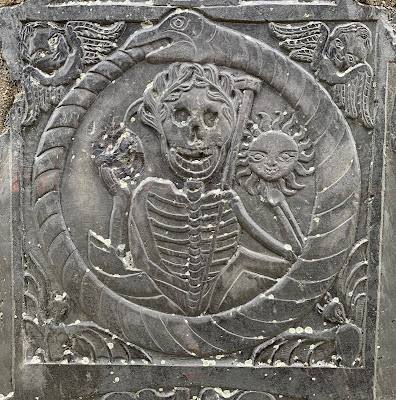
The centerpiece of Jayne's headstone is this carving of the Grim Reaper, portrayed as a skeleton holding a scythe. The skeleton is crowned with laurel wreaths, and holds the sun in one hand and the moon in the other. (Sadly, the moon has been damaged.) Overall, the message is one of Death triumphant and the passage of time. 

The Grim Reaper is encircled by snake biting its own tail. This image, known as the ouroboros, is a symbol that dates back to the ancient Egyptians and was found on the wall of King Tut's tomb. It's had many meanings over the centuries, but most commonly represents eternity and the cycles of time. More time symbolism appears at the top of Susanna Jayne's headstone, where Geyer carved an hourglass framed by two bones. Time passes, and Death takes us all.


However, the universe is not purely mechanistic and grim. There's a moral aspect, symbolized by the angels and bats that hover around the corners. Good and evil play a role in the eternal drama as well. 


Modern gravestones are quite subdued these days, and very plain. I miss the artistry and symbolism of the older headstones. Susanna Jayne's gravestone is a work of art, and was actually photographed by the well-known artist Ansel Adams. If you'd like to see some beautiful New England art, I'd recommend taking a trip to Old Burial Hill.


You can read more about Susanna Jayne's gravestone here. More details about Henry Christian Geyer can be found here.

April 29, 2021

Old New England Cemetery Lore: Watch Your Step

This past Saturday was warm and sunny, and although I'm always happy to stay home with a pile of obscure books I decided to go for a walk. I went to one of my favorite places, Brookline's Old Burying Ground. 

It's a really charming cemetery, well-cared for with just the right amount of decay. Although it's only a few miles from downtown Boston it feels like a rural environment. A few notable folks are buried there, including Zabdiel Boylston, a local physician who inoculated people against smallpox in 1721. It was the first inoculation campaign in North America, and Boylston got the idea from Onesimus, a slave in the household of Cotton Mather, the (in)famous minister associated with the Salem witch trials.


Cotton Mather's stepmother, Anna Mather, is also buried in Old Burying Ground. Her husband Increase Mather (also associated with the Salem trials) is buried at Copp's Hill in Boston, but she outlived him by several years and was buried in Brookline in 1737. Her grave is marked by a beautiful and well-preserved stone. 

As I wandered through Old Burying Ground I thought about some old New England cemetery folklore I've been reading recently. Some of it is probably familiar. For example, if you feel a cold chill for no reason it's probably because someone has walked over the site of your future grave. I think that one is well-known. 


A related piece of lore says that you should never step on anyone's grave when you're in a cemetery. That makes sense to me. If the living get a chill from someone just walking over their future grave, think how annoyed the dead must be when you step on their actual grave. Unfortunately, sometimes this advice is hard to follow, particularly in old cemeteries. The graves are placed really closely together at Brookline's Old Burying Ground, and it is hard not to step on one. There are also lots of unmarked graves, so you're probably unintentionally walking on someone. I think the intent behind this piece of lore is what's really important: treat the dead with respect. 

Many years ago when I was a kid I went for a bike ride with my friend Bobby in a neighborhood cemetery. We were riding pretty fast and goofing around, and I started to worry that we weren't being respectful. I said, perhaps half-jokingly, that we shouldn't be too loud or we'd disturb the dead. 

Bobby laughed and said, "I'm not afraid of any dead people!"

As soon as he said that he skidded, fell off his bike, and scraped his knee up really badly. His pants were torn and there was a lot of blood. We both left the cemetery immediately and went home. We kind of laughed but were also a bit spooked. Perhaps it was just a coincidence, but I've never forgotten it. 


Speaking of forgetting, according to another piece of old lore you shouldn't spend too much time reading gravestone inscriptions. This is bad news for me, since I really like to read old inscriptions. I'm not sure what constitutes too much time and hopefully I am under the limit. I can understand the sentiment, though, because when I read too many gravestones I do feel a little lightheaded from all the dates and names. It's like when I spend too much time on Instagram!

One final piece of advice: you shouldn't walk through a cemetery on your way to see friends. You run the risk of carrying death to their house if you do. Happily, I just went back home after visiting Old Burying Ground. It was a pleasant way to spend a sunny afternoon. 


I got this cemetery lore from Clifton Johnson's What They Say in New England (1896) and Fanny Bergen's Current Superstitions (1896).

April 18, 2021

Rats, Cats, and Death: Horror on Haskell Island

Haskell Island is located off the coast of Harpswell, Maine. It's a small island, and apparently has no full time residents these days, just vacation homes. It looks quite idyllic, but like many quaint New England locales Haskell Island has a strange past. 

According to legend, the island was first colonized by the two Haskell brothers, way back in the 1600s. The Hakells were very industrious and transformed the island into an agricultural paradise. They planted an orchard, plowed the land into fertile fields, and fished in Casco Bay. The brothers prospered in their little Eden. 

Unfortunately, one day they accidentally brought some rats to the island in their boat while transporting supplies. Haskell Island had everything the rats could want: food, water, places to nest, and no predators. The rats multiplied rapidly and soon threatened the brothers' livelihood.

Antique Haskell Island postcard from Amazon. "A pretty place which I visited yesterday..."

To stop the rats, the Haskell brothers brought a couple of cats to their island. The brothers didn't provide any food for the cats and expected them to survive by killing rats. The cats met their expectations. They ate rats, and there were so many rats that the cats thrived and multiplied. Soon there were more cats than rats, and eventually there were no rats left at all, just an island full of hungry cats. 

The cats roved the island, howling with hunger. They climbed the apple trees, roamed the fields, and paced the shore, looking for something to kill and eat. 

The Haskell brothers had to do something about the ravenous felines, but something happened before they could devise a plan: one of them became sick. He fell seriously ill, so his brother took the boat and went to the mainland to get a physician. "Hurry back," the sick brother said weakly as he lay in bed. 

Can you see where this is going? An island full of hungry cats, an incapacitated man lying weak and helpless in bed? When the healthy brother returned to the island, he and the physician were horrified by what they found inside the Haskells' house. The sick brother had been ripped to shreds, and the cats were tearing the last morsels of flesh from his body. At last their hunger was sated. 

*****

It's a simple little story, but really resonates with me. It appears in Horace Beck's 1957 book The Folklore of Maine. The Maine Encyclopedia says Haskell Island was named for a Captain Haskell who purchased, but never lived on, the island, so I don't think the man-eating cat story is true. Still, it has the power of a good horror movie, and reads like an environmentalist fable. The brothers try to master the island, but end up doomed by their own actions and the invasive species they brought to the island. 

It reminds me of "Bart the Mother," a 1998 episode of The Simpsons where Springfield is overrun by ravenous lizards. At first people are happy because the lizards eat all the pigeons, but then realize they'll need to import snakes to eat the lizards, and then gorillas to eat the snakes...


Horace Beck notes that there is a coda to the story. According to some people, the sick brother was not killed by cats, but by pirates. He had seen the pirates burying their treasure on Haskell Island, and they killed him to keep their secret safe. Then they made it look like the cats had done it to deflect attention. I don't find that explanation quite as compelling, though. The story is structured like a version of "I Know an Old Lady Who Swallowed A Spider," and randomly introducing pirates just doesn't make sense. 

December 22, 2020

Fat Graveyards, Hay, and Magic Cows: Folk Magic for Christmas

This is definitely shaping up to be one of the stranger Christmases in recent American history, with most of the traditional festivities being canceled due to the pandemic. So why not cozy up by the Yule log (even if its on your computer screen) and enjoy some old New England folklore about Christmas?

As a lot of you know, for many years Christmas was not celebrated in New England. The Puritans didn't believe there was any basis for it in the Bible - the date of Jesus's birth is not given, after all - and suppressed Christmas celebrations here. New Englanders began to celebrate the holiday more widely in the 19th century as the Puritan influence weakened, and all of the folklore I present to you is from the late 19th century. 

Much of it concerns the weather, since Christmas falls close to the astronomical start of winter. I'm just going to give you the grimmest piece of lore first. Let's get it over with.

 A green Christmas make for a fat graveyard. 

Ugh. That's from Fanny Bergen's 1896 book Current Superstitions. This next one comes from Clifton Johnson's What They Say in New England (1896):  

A green Christmas makes a full churchyard. The foundation for this saying is the fact that open winters with their constant freezings and thawing are very unhealthy.

I don't think there's any medical validity behind that, do you? I hope not, because with climate change we're going to get more "open winters." I'm going to chalk this one up to old time Yankees considering almost everything as an omen of death, which is true. These folklore books have a huge number of death omens. I think those sayings also demonstrate the law of inversion that shows up sometimes in folklore. A green, pleasant Christmas foretells death, or the groundhog seeing his shadow on a sunny day indicates six weeks of bad weather. Something foretells its opposite.

Here's another one from Clifton Johnson, which is less grim:

Half the pork and half the hay

On Christmas Day

Johnson notes that men used to visit their neighbors on Christmas to see how the hay and pork were holding out. It sounds very bucolic and a nice way to see folks, doesn't it? It's also practical. On Christmas there are still three more months of winter to come, so you definitely want to have enough food for your livestock and yourself. There are similar sayings about Candlemas Day on February 2.

To me, the most magical piece of Christmas folklore is the following:

There is a saying that on the night before Christmas when the clock strikes twelve the cows kneel in their stalls. Some young girls in Hadley, years ago, sat up to discover whether this was true or not. At midnight they went out to the barn, and sure enough when the hour struck the cows knelt. At any rate, that was what the girls said. (Johnson, What They Say in New England)
That story is very similar to the European belief that animals can talk at midnight on Christmas Eve. The exact origins of that legend are murky, but are probably tied to the belief that Christ was born in a stable. Some sources say God allowed the animals in the stable to speak so they could praise the newborn messiah, something they have been able to do once a year ever since. 

The New England version of the legend is a little more subdued. It's as if people wanted to believe in Christmas magic, but couldn't fully commit. "Talking cows? No way. Cows that kneel at midnight? Hmm. Well, maybe..." It's interesting that Johnson has the caveat "At any rate, that was what the girls said," as if he or his informant knew people would receive the story with skepticism.

He also includes this version of the legend:

A still older story told in town with the same theme is that at midnight when the Christmas Day begins, all the cattle in the yards and fields might be seen kneeling with their heads turned towards the east in adoration. Two girls of the olden time, who were eager to see for themselves whether this was true or not, sat up on Christmas Eve until the spellbound hour, and then visited the farm cattleyard. But the cattle made no sign that they were at all affected.

So which is it? Do the cattle kneel or not? For now, I am comfortable with the ambiguity and holding both possibilities in my mind. Please let me know if you happen to say up until midnight to see what happens. I'd be curious to know. 

Have a safe and happy Christmas!

November 11, 2020

The Two Voices: A Ghost Story from Maine

It's been a busy few weeks, what with Halloween, the election, and some big projects at work. But now I finally have a moment to breathe and work on the blog. So here's a story that was told to me by a family member. She swears it is true, and I have no reason to doubt her. It's pretty creepy so don't read any further unless you want to be unsettled. 

*****

Laurie is a nurse, and many years ago she was working at a hospital in Maine. She was on the night shift at the ICU when the following strange incident occurred. 

Laurie and one other nurse were the only staff in the ICU that night. The hospital was a small one, and there was only one patient in the unit: a middle-aged man who had been comatose for several weeks. His prognosis was not good and the doctors thought he would soon die.

As Laurie and her co-worker sat at the desk that night they heard something odd coming from down the hall. It was the voice of a small child. "Help me! Help me!" the voice said. "He's coming to get me!" It sounded like it was coming from the comatose patient's room.


Visiting hours were long over - it was after midnight. No children were supposed to be in the ICU. Laurie and her co-worker ran down the hall to the patient's room, but when they went inside there was no one there except the patient. He was lying immobile and unconscious in the same position he had been in for weeks. 

Puzzled, Laurie and her co-worker returned to the nurse's desk. But as soon as they were seated they once again heard the small child's voice. "Help me! Help me! He's here!"

They began to walk down the corridor back to the patient's room. As they drew near to it they heard another voice. Not a soft child's voice, but a deep, hoarse voice. Something about it sounded sinister. "I have you now," it said. "You cannot escape from me." 

Laurie and her colleague ran into the patient's room. There was no one inside except the comatose man and he was still lying in the same position. 

Laurie and the other nurse left the room. By this time they were starting to feel a little spooked. They returned to the nurse's desk and sat down.

Again, they heard the small child's voice coming from down the corridor. "Help me! Help me! He's here to take me away!" They heard the other, deep sinister voice laugh.

Laurie looked at her co-worker and said, "I'm not going into that room again." Her co-worker nodded in agreement. "Me neither."

They sat at the desk for hours, listening fearfully to the two voices coming from the patient's room. At 3:00 a.m. the voices suddenly stopped and a life support alarm went off. Laurie and her colleague ran down to the patient's room. He had died and could not be revived. They never heard those two voices again. 

*****

Was there something supernatural happening in the patient's room? Or were both of the voices coming from him? I suppose that all depends on your worldview. 

October 06, 2020

The Norton Witches: Small Town Legends

Well, it's October. Spooky month, as people say. Every month is spooky on this blog, but I'll try to share some particularly nice stories this October. Let's conjure up those Halloween vibes! 

*****

I don't think I've ever been to Norton, Massachusetts but I may have passed through it. It sounds like a small, quiet New England town. They only got their first traffic light in 1997, so it's very quiet. But small New England towns often harbor strange secrets, as every Stephen King fan knows. 

For example, a rock behind the Norton's elementary school supposedly is imprinted with the Devil's footprint. The Evil One made it in 1716 as he carried off George Leonard, who had sold his soul for material wealth. 

Norton is also located inside the Bridgewater Triangle, an area famous for its paranormal activity. The town certainly has had its share of weird happenings. For example, a couple weeks ago I posted about a lizard man seen in Norton in 2001. More famously, in 1971 a Norton police officer named Thomas Downy saw something with an 8 to 12 foot wingspan flying overhead as he drove home through Easton late one night. Small towns seem to get the best monsters! 

Norton was first settled in 1669, so it's a relatively old town. These days people tend to blame paranormal phenomena on ghosts, aliens or dimensional gateways, but in the past witches were usually blamed for strange events and misfortunes. That was certainly the case in Norton.

The most famous witch in Norton's history is Ann Cobb. Interestingly, very little is known of her witchy exploits but a bridge in town is named after her (Ann Cobb Bridge). It is more commonly known as Witch Bridge or Witch's Bridge. Ann Cobb used to live near the bridge that now bears her name, which was about two miles away from the town center. According to a local legend, one day she set out from her home for the center and arrived there within minutes, much to the consternation of the townspeople. How had she traveled so quickly? People suspected that perhaps she flew, or was transported by some sort of evil spirit. The incident was enough to cement her reputation as a witch and to merit a bridge being named after her. Ann Cobb died in poverty as a ward of the town in 1798.

Dora Leonard was also suspected of being a witch. Farmers blamed Dora and her magic when their animals escaped from the barn or their pens. Two young boys also blamed her for their bad luck hunting squirrels. According to the boys, they had trapped a particularly large squirrel in a tree and shot at it repeatedly. They missed every shot, though, and the squirrel escaped unharmed. As the boys trudged home they saw a strange cat watching them. They told everyone who would listen that the cat was really Dora and she had bewitched their guns. Much like Ann Cobb, Dora Leonard was impoverished in her old age and the town took care of her financially. As she lay dying in 1786 her house was filled with strange noises. The neighbors who were attending her final moments fled in terror. 

Naomi Burt was the third Norton woman believed to be a witch. Like Dora Leonard, Naomi was said to cause mischief and minor mishaps. Wagons lost their wheels if they passed by her house and oxen escaped their yokes thanks to Naomi's witchcraft. Children particularly feared her and held their breath if they passed by her residence. Sadly, Naomi committed suicide on July 4, 1808. Old legends about witches are entertaining and spooky, but being impoverished and a social outcast can be grim and lonely. 

*****

My sources for this week's post are Duane Hamilton Hurd's History of Bristol County, Massachusetts. With Biographical Sketches of Many of Its Pioneers and Prominent Men, Part 2 (1883), and George Faber Clark's  A History of the Town of Norton, Bristol County, Massachusetts, from 1669 – 1859 (1859. This article from Patch.com also had good information about the Norton witches. 

May 05, 2020

Snakes, Children, and the Human Soul: Ancient Folklore in New England

I used to live in a house that had an old cracked cement wall in the front yard. This was a very urban neighborhood - you could hear the subway go by - but the wall was still home to a colony of garter snakes. Every spring I enjoyed seeing them emerge from hibernation to sun themselves on the wall or walkway.

Garter snakes are the official state reptile of Massachusetts, and they're also harmless. Perhaps I would have felt differently each spring if they had been rattlesnakes or cobras. Still, you should probably treat snakes with respect, as the following tale shows. It comes from What They Say in New England, Clifton Johnson's 1896 collection of local folklore.


Image from this site.
Many years ago there was a little girl who always liked to eat her supper outside. Her parents humored her in this, but one evening they became curious and followed her when she left the house with her plate.


...She went along out there by a stone wall and set down, and she rapped on her plate, and out there come a big rattlesnake, and went to eatin' off the plate with her. And when the snake got over on to her side of the plate too much, she'd rap him with her spoon, and push him away, and say, "Keep back, Gray-coat, on your own side."

Needless to say, her parents were quite horrified to see their young daughter sharing her food with a poisonous snake. They sent her off to stay with some relatives and while she was gone they killed the rattlesnake. It did not quite have the effect they expected.


...The little girl come home again, and then she found out her snake was killed. Arter that she kind o' pined away and died. I've hearn 'em tell about that a good many times, and I s'pose that's a pretty true story (Clifton Johnson, What They Say in New England, 1896, p. 66)

Johnson collected the folk stories in his book from people in rural western Massachusetts (where there are indeed rattle snakes), so I was surprised to see a very similar piece of folklore in Vance Randolph's 1946 classic Ozark Magic and Folklore. The Ozark Mountains are geographically and culturally very far from Massachusetts, but here's that same story again:


There are several old tales about an odd relationship between snakes and babies. According to one story, well known in many parts of the Ozark country, a small child is seen to carry his cup of bread and milk out into the shrubbery near the cabin. The mother hears the baby prattling but supposes that he is talking to himself. Finally she approaches the child and is horrified to see him playing with a large serpent - usually a rattlesnake or copperhead.

Randolph goes on to say:


The mother's first instinct is to kill the snake, of course, but the old-timers say that this would be a mistake. They believe that the snake's life is somehow linked with that of the child, and if the reptile is killed the baby will pine away and die a few weeks later. I have heard old men and women declare that they had such cases in their own families and knew that the baby did die shortly after the snake's death (Vance Randolph, Ozark Magic and Folklore, 1946, p. 257)

It seems pretty clear from Randolph's book that people took this belief seriously, as several people claimed it had happened in their own families. It wasn't just a fairy tale.


Imagine my surprise then, when I also found a very similar story in Grimm's Fairy Tales, which was first published around 1812. The Brothers Grimm collected their stories in Germany, but here again is that story about killing a snake. In their version of the story the snake brings precious stones and gold to the child when it eats and the child gently hits the snake with a spoon to encourage it to eat more.  Despite these differences the story has the same sad ending:


The mother, who was standing in the kitchen, heard the child talking to some one, and when she saw that she was striking a snake with her spoon, ran out with a log of wood, and killed the good little creature.
From that time forth, a change came over the child. As long as the snake had eaten with her, she had grown tall and strong, but now she lost her pretty rosy cheeks and wasted away. It was not long before the funeral bird began to cry in the night, and the redbreast to collect little branches and leaves for a funeral garland, and soon afterwards the child lay on her bier (Grimm's Fairy Tales, "Stories About Snakes," 1812).

The belief connecting the health of children to snakes actually seems to go way back. It's much older than even the Brothers Grimm. The Swedish writer Olaus Magnus alludes to it in his 1555 book History of the Northern Peoples, which describes life in Sweden in the 16th century. Magnus wrote that:


There are also pet serpents, which in the farthest tracts of the North have the reputation of protective deities. They are reared on cows' or sheep's milk, play with the children indoors, and are regularly seen sleeping in their cradle, like faithful guardians. To harm these creatures is regarded as sacrilege. However, such practices are survivals from ancient superstition, and since the adoption of the Catholic faith are completely forbidden. (Olaus Magnus, History of the Northern Peoples, Book II, Chapter 48, "On the fight waged by shepherds against snakes")

I suspect that this belief is much older than even the 16th century, and Magnus seems to think it is ancient. It certainly seems to allude to some very old beliefs about the human soul. The French academic Claude Lecouteux suggests that by sharing food with a human the snakes in these stories become the human's guardian spirit, or perhaps even the spiritual double of the human. They are a human soul externalized in animal form. When the snake is killed the human soul dies. 

Illustration from History of the Northern People
Of course, I don't think people in 19th century Massachusetts understood it that way, but for some reason the belief still lingered on. Maybe someday I'll figure out exactly how a belief like this traveled from Medieval Europe all the way to Western Massachusetts. But until I do, please be kind to your local snakes. You never know whose soul it might be!


*****

Claude Lecouteux's excellent book Witches, Werewolves and Fairies: Shapeshifters and Astral Doubles in the Middle Ages has a lot of information on topics similar to this one. 

December 18, 2019

The Witch with Twenty Cats: A Classic New England Curse

Today was very dark and gloomy, with a snowy morning turning into a rainy afternoon. There was barely any sun at all. I suppose I should write about some cheery holiday topic, but I want to write about witches instead. Sometimes a spooky story can lighten up a gloomy day just as easily as a shiny Christmas tree!

The story comes from Robert Ellis Cahill's little book Olde New England's Strange Superstitions (1990, third edition) and takes place in Sutton, Massachusetts. Sutton is a small town in Worcester County and is perhaps most famous for the geologic formation Purgatory Chasm. It seems it also was once the home of at least one witch. Or maybe she was just an innocent old woman?

The story, as Cahill relates it, goes something like this. Many years ago an elderly widow named Goody Wakefield resided in Sutton. She was something of a curmudgeon and lived by herself near the river. Well, to clarify, she lived without human companionship but she did live with a lot cats. Twenty of them, to be exact.

Goody Wakefield was quite poor but never went hungry. Her cats kept her fed. Every day they would troop down to the river and catch pickerel. They'd then bring the fish home to Goody Wakefield. She kept the pickerel in the pockets of the wool coat that she wore all year long. People in Sutton would see her wandering through town with fish in her pockets, and in the summer heat they would smell her as well.

A daguerrotype from the 1860s
As an eccentric elderly woman with a lot of cats she developed a reputation as a witch. Most townspeople avoided her. They feared the evil eye and the malodorous smell that emitted from her coat pockets. But two young men decided to do something about this eccentric woman who disturbed people in Sutton. They devised a plan to kill Goody Wakefield's cats.

The two men hid in the bushes by the river, and as Goody Wakefield's cats paraded down to catch fish they killed them one by one. Seventeen of the felines met their doom that day - only three escaped. When the men were done they piled the bodies on a stone in front of Goody Wakefield's house and shouted until she came outside.

Goody Wakefield emerged from her house and was horrified to see her cats had been slaughtered. As she wept the two men laughed and laughed, mocking the old woman's tears. They continued laughing even as she pointed a trembling finger at them and shrieked:

"GOD, CURSE THESE KILLERS! CURSE THEM!"

Several neighbors were drawn by the commotion and witnessed Goody Wakefield's curse. The two young men laughed at the old woman but the neighbors didn't. They were filled with dread. And one year later they remembered her curse when one of the young cat killers drowned in the river. They remembered again when the second young man caught a strange disease that left him a babbling maniac for the rest of his life.

The neighbors didn't know if the two men were punished by God or cursed by the Devil, but they remembered Goody Wakefield's curse.


Well, that's the story. I hope it cleared up your winter gloom! There are a few things about it that I find interesting. First, I have only seen it in Cahill's Olde New England's Strange Superstitions.  It doesn't appear in History of the town of Sutton, Massachusetts, from 1704 to 1876 : including Grafton until 1735; Millbury until 1813; and parts of Northbridge, Upton and Auburn so I'm not sure where Robert Cahill heard the story.

It certainly follows the format for a classic New England witch's curse story. In these stories, an innocent person (like Goody Wakefield) curses the people who are persecuting them as a witch. The curse then comes true. These stories are a kind of ambiguous about why the curse work, but I think it is usually implied that God himself is punishing the people who persecuted the witch. I mentioned one of these last week (Sarah Good's dying curse on Samuel Noyes), but others include this curse on Colonel Buck, or this one cast by an alleged witch named Aunt Rachel. 

Robert Ellis Cahill claimed that he himself was the object of a dying witch's curse, one that was centuries old. During the Salem witch trials an elderly farmer named Giles Corey was accused of being a witch. He refused to speak to the judges so Salem sheriff George Corwin staked Giles to the ground and piled rocks upon his chest. The sheriff thought this form of torture would make Giles talk but it didn't. The sheriff piled on more and more rocks, but according to tradition Giles's only words were: "More weight." He died without speaking. 

According to legend, every sheriff of Essex County since that time was cursed with heart problems and blood disease. George Corwin died of a heart attack at a young age as did many of his successors. One of those successors, centuries later, was Robert Ellis Cahill who served as sheriff from 1974 until 1978. Cahill suffered a heart attack and stroke in 1978 at the age of 44. The curse was only broken when the Essex County sheriff's office was moved from Salem to its current location in Middleton. 

After he retired as sheriff Cahill devoted his time to writing books about local New England folklore. He wrote more than thirty books (I have several of them), so I guess something good came out of Giles Corey's curse in the end. 

June 04, 2019

Shadrack Ireland and The Immortality Cult

When the Puritans colonized New England in the 1600s they were a young rebellious religious movement. Back in England they were trying to overthrow the established Church of England, and here in North America they were trying to create a theocracy. They were a bunch of radicals. 

Flash forward one hundred years to the 1700s. The Puritans had become the established religion of New England. Their church was conservative and not interested in changing. Sunday sermons were heavy on the theology and light on the emotion. They were, sad to say, boring. The Puritans had become the thing they had once rebelled against. 

In the 1730s and 1740s a new religious movement swept across the colonies. Historians now call it the First Great Awakening, since it was the first of many emotionally charged religious revivals that occurred in America. During the First Great Awakening traveling evangelical ministers crossed the region preaching fire-and-brimstone sermons to large crowds. One famous evangelical of the time, George Whitefield, delivered more than 18,000 sermons. People passed out from overwhelming emotion when he spoke. Whitefield stirred up strong religious feelings wherever he went. 

Shadrack Ireland, a pipemaker in Charlestown, Massachusetts, was one of those people who heard Whitefield speak. It had a strong effect on him, and afterwards Ireland declared that something had changed in his mind and body. He realized that he was now perfect and immortal. He was never going to die. 

Shadrack Ireland's "Square House" in Harvard, Massachusetts. 
Ireland started to preach to anyone who would listen. According to Ireland, people needed to practice celibacy. No sex please! Only those who had achieved perfection could take spouses and have intercourse. And since they were perfect, they could even take second "spiritual" spouses if they were married. Rules about adultery no longer applied to those who were perfect (like Ireland). 

Shadrack Ireland left his wife and six children and moved to Grafton, Massachusetts where he gathered a small group of followers. The authorities in Grafton didn't appreciate his heretical teachings and pressured him to leave. He went to nearby Harvard, where his followers built a large house known as the Square House where they lived communally. It still stands today. Ireland also took a spiritual wife, one Abigail Lougee. He declared himself the Second Messiah, and although he lived a relatively quiet life people came to visit him from other towns for spiritual guidance.

Just a quick aside: Ireland was not unique in his beliefs at this time. He was just one representative of a larger movement. For example, in Easton members of a church also declared themselves immortal and all took new spouses. In Hopkinton, a man named Nat Smith even declared himself God. Smith wore a hat with a sign reading "I am God" and routinely disrupted the town's Sunday meetings by blowing a ram's horn. He eventually became a follower of Shadrack Ireland. 

Ireland lived in the Square House for several decades. Did he really think he was going to live forever? Maybe, but it was not to be. One night in September 1778 his followers noticed that he had somehow changed. Ireland told them that his work was done and God was going to take him. He also instructed them not to bury him, though, since the world would end shortly and he would be resurrected. After telling them this he went up to his bedroom and died. 

His followers took his body and put it in the cellar. Some accounts say it was placed in a plain wooden coffin, others that it was placed on a stone slab. All accounts agree that his body remained in the Square House's cellar for a long time. So long that it started to smell. Still unwilling to bury their leader, Ireland's followers covered his body with lime hoping that it would cover the terrible stench. It didn't. Finally someone took his body and buried it in unmarked grave nearby.

Although Shadrack Ireland's body departed his spirit may have lingered. After his death some of his followers remained in the Square House until eventually Mother Ann Lee, the spiritual leader of the Shakers, came to Harvard. Most of Ireland's followers became Shakers and Mother Ann took up residence in the Square House. Although she liked the building she felt that Ireland's spirit remained as an evil influence in it. It was so bothersome to her that she banished it to Hell.

Did his spirit really linger, or was this just Mother Ann Lee's way of finally claiming the Square House (and the people in it) as hers? Either way, it was the end of Shadrack Ireland. 

*****
Special thanks to Rhonda for pointing me towards an article that mentioned Shadrack Ireland, and thanks to Dave Goudsward for sending me a copy of it!

February 25, 2018

Tales from Granary Burying Ground: James Otis and the Lightning Bolt

I love the term "burying ground," don't you? There's something very raw and primitive about it, but at the same time it's kind of charming because no one really uses the term anymore. Modern people inter their dead in cemeteries, not in burying grounds or even graveyards. I can understand why. Cemetery is a more gracious sounding word that masks what happens to the deceased, while burying ground is quite blunt. Yup, this is where we bury them.

The Granary Burying Ground on Tremont Street is one of Boston's oldest cemeteries. It was originally founded in 1660, and got its current name in 1737 from a granary that stood next to it. In the 1830s some Bostonians tried to rename it to Franklin Cemetery, after Benjamin Franklin's family who are buried inside the graveyard. The name didn't catch on, though, and we still know it by it's older, blunter, primitive name.

Many famous people have their final resting places within the Granary Burying Ground: patriots, Puritans, mariners, politicians and poets. Some of them, like lawyer James Otis, have strange stories surrounding their lives and deaths.

James Otis's grave on a stormy evening.
James Otis (b. 1725, d. 1783) is probably best known for coining the phrase "Taxation without representation is tyranny." It's a phrase many children learn in school while studying the American Revolution. Otis uttered those words during a five-hour (!) speech he made arguing against the "writs of assistance," which were laws that allowed British troops to search any colonist's home without needing a search warrant or even probable cause. Naturally the writs were extremely unpopular in Massachusetts. Otis lost his case agains the writs of assistance but parts of his epic speech were reprinted as a pamphlet and helped rouse ant-British feeling in the colonies.

Surprisingly, Otis had originally been pro-British. He came from a prominent Loyalist family, but he joined the revolutionary cause when his father was denied a promised appointment as Chief Justice of Massachusetts. Perhaps his abrupt transition from Loyalist to Revolutionary helps explain why the British troops despised him so much. In 1769 he got into an argument with several British officers in a coffeehouse. The fight turned physical, and one of the officers struck Otis on the head with a cudgel.

Here comes the strange part of the story. After the attack Otis's mental capacities declined precipitously and he was unable to work further as a lawyer. Some sources say his mental decline began before the fight, while others claim the blow to his head caused it. Whatever the cause, Otis left the Boston area to live at a friend's home in Andover. His sister came to visit often, and whenever she did Otis told her that he wished God would take him from this world with a lightning bolt. I guess he wanted death his to be fast, painless, and just a little dramatic.

James Otis
He got his wish on May 23, 1783. While standing outside the Andover house with some family members, Otis was struck by a bolt of lightning. He died instantly. No one else was injured, and Otis’s body was not burned or damaged in any visible way. Witnesses say the corpse had an expression of calm repose.

Did God hear his wish? Was it just luck? It's hard to say. In Ancient Greece it was considered a holy act to die by lightning, and Otis's contemporaries in Massachusetts seemed to feel the same way. Many years later, in the 19th century, workers who opened his grave discovered the roots of a mighty elm tree growing from his skull. This too was taken as a good omen, as his brain "had been transformed into branch and leaf and blossom, thus breathing itself forth again into the free air and the Universal Flow.”

The elm tree is long gone but you can still visit Otis's grave, which is prominently located in the front of the burying ground near Tremont Street.

November 08, 2017

Omens for A Gloomy November: Horses, Death, and Other Dreams

November is a melancholy month. The gleeful morbidity of Halloween serves as the gateway to November, but this month reveals the actual truth behind the colorful masks and cartoony skeletons: the year is winding down. The trees are becoming bare, the skies are gray, and the days get shorter and colder.

The year is slowly dying, and it makes me want to sleep. A lot. The ancient Greeks claimed that Sleep was the brother of Death, and I can understand the connection, particularly at this time of year. Both involve a loss of consciousness, a dissolving of self into the welcoming darkness, but at least when we sleep we get to dream. Those wise Greeks said that Morpheus, the dream-god, was the son of Sleep.

November in my neighborhood. Gloomy.
I tend to remember my dreams more during this time of year than during others. Upon reflection I can usually figure out what my subconscious is trying to tell me, but some dreams are just puzzling.Why was I carrying a book and cup as I walked down the stairs? What did that turtle mean? Sometimes I could use a guide to interpret my dreams.

New Englanders of past generations had a long list of dream interpretations. One of their key principles to interpreting a dream was the rule of opposites. Things that are bad in real life are good omens when seen in dreams, and vice versa. For example, to dream about a wedding means you will soon be invited to a funeral, but dreaming about a funeral means you'll hear about a wedding. Seeing a dead person in your dream means you'll receive news or a letter from a living one. Dreaming about eating or about picking blackberries is an omen of impending illness. OK, that may not be an exact opposite but you get the idea.

In this dream, recounted to author Clifton Johnson by elderly woman and included in his 1896 book What They Say In New England, an ominous thunderstorm actually was a harbinger of good news:

"It was after midnight, and I was dreaming a dream about a terrible thunder-storm. It grew worse and worse till there was one clap so loud it seemed as if the skies had broken to pieces. Right after it I woke up, and I heard a knock on the outside door of the sitting-room. I knew that instant what my dream meant and who was there. It was Charlie! I went to the door and it was. There he had been gone seven or eight years. He'd been a sailor on the ocean, and we hadn't heard a word from him, and didn't know but he was dead, and that dream came to show me he was alive and near."

But the rule of opposites didn't always apply. Sometimes bad things just mean bad things. Dreaming of lice means illness, and dreaming about snakes foretells making an enemy. Personally I like snakes, but I understand the general symbolism here. I don't think anyone likes lice.


Some of the old New England dream interpretations are cryptic and very specific. Why would dreaming of a white horse be an omen of death? I am not sure, but that was an accepted interpretation. Here is another account from Johnson's book:

"You will have great trouble if you dream of a white horse," said Uncle Timothy. "I've always found that to come true. There was one time in particular I remember. It was winter; and I was at work a good many miles from home in a logging-camp. One night I had a terrible dream about a white horse that got angry with me, and bit me. I knew something would happen in consequence of that dream, and I was afraid I was going to get killed. I wa'n't good for much workin' that day, I felt so gloomy about my dream; but I went out with my axe same as usual. I wa'n't noticing things as I ought to; and when I was cutting a tree, it came down and knocked me senseless. The rest of the fellows carried me to camp. I can't tell you how relieved I was when I come to and found myself alive. I thought myself lucky to get off so easy after such a dream."

Johnson collected that story from Western Massachusetts, but the white horse's ominous reputation may have been widespread. For example, Fanny Bergen notes in Current Superstitions (1896) that people in Maine also said dreaming of a white horse means a family member will die within a year. She found similar beliefs in New York and the Maritime provinces as well.


So what should you do if you dream about a white horse? First of all, don't panic. Other informants told Johnson that a white horse means riches will be coming your way, which is a good thing. So which is it, a good omen or a bad one? I suppose in the end it is really a matter of your perspective. Good things and bad things will happen to all of us. Even the increasing gloom of November is leavened by Thanksgiving, and soon after comes the December holiday season, when we light candles against the encroaching darkness. Nightmares end when we wake up, and hopefully there's a light at the end of the tunnel.

June 07, 2016

Connecticut's Haunted Fairy Village

Here's a nice creepy story. Not every fairy tale has a happy ending...

*****

Once upon a time, in the early 1900s, a woman and her husband built themselves a stone house in Middlebury, Connecticut. They liked peace and quiet, so they built it out in the woods.

Things went well in their new house for a while, but after a few months the wife became strangely agitated whenever she left home.

One day when they were walking back from town she grabbed her husband's arm. "Can you hear them?" she asked her husband.

"Hear what?" he said.

"Them. The little people in the woods," she said. "I think they're talking to me. I've heard them for weeks now..."

"My love, perhaps you need to rest. I only hear leaves blowing in the wind."

His wife rested, but it did nothing to cure her of the idea that fairies in the woods were talking to her. "They want something from me," she said, "but I don't know what it is. I'm scared they'll come into our house..."

Her husband didn't believe in fairies, but he loved his wife, so at her request he put bars on their windows to keep out the fairies.

One night after they had gone to bed the woman turned to her husband and said, "I know what they want from me. They don't want to hurt us, they just want houses like we have. They want a home like we have. They want us to build them a village!"

From Roadtrippers.com.

In the moonlight the man could see the manic gleam in his wife's eyes, but he loved her, so the next day he set to work building small houses in the woods. Under his wife's direction he built dozens of tiny structures out of stone, brick and shingles.

When the last house was finished his wife clapped with delight. "Now the only thing left to make is the throne," she said.

"A throne? For who?"

"For me. Because I'm going to be the Queen of the Fairies!"

The husband rolled his eyes, but he had already put bars on the windows and built a tiny village, so what was one more concession to his wife's madness? After all, he did love her.

Using a pick-axe he carved a gully into one of the rocky hills, and mortared the stones into a throne. It took him all day, and when it was done he called his wife out to see his handiwork.

From this site about haunted Connecticut.

Exhausted, he sat down on the throne. "What do you think, my love?"

A look of rage came over his wife's face. "What do I think?!"she screamed.

Her husband cowered. "My dear, what's wrong..."

"What do I think?!" She grabbed the pick-axe. "I think you need to get off my throne! I'm the Queen of the Fairies, not you!"

And with that she swung the pick-axe and split her husband's head in two.

The fairy voices suddenly went silent. For months they had been whispering, chattering, singing to her, and now they were gone. Aghast at what she had done and howling with grief, she ran to their house and hanged herself.

*****

Isn't that a great, gruesome story? There is also another version where the husband finally can't take it anymore and kills his wife, but either way it doesn't end well for this poor couple.

The story is told to explain one of the weirder places in Connecticut: the Little People's Village in Middlebury.

The Little People's Village consists of remains of multiple stone structures located out in the woods. There's a house-sized building with bars on the windows, there are the remains of many miniature buildings, and there is also something that looks suspiciously like a throne.

According to local folklore, the throne is cursed and anyone who dares sit on it will die within seven years. Either the fairies, the woman's ghost, or her husband's ghost don't want people to sit there. Needless to say, local teenagers of course go to the Village to sit on the throne.

Other legends say that anyone who lingers too long in the Village will begin to hear the fairy voices and go insane.

Historians say the Village was not built at the bidding of a fairy-maddened woman, but was instead simply part of a local amusement park that has long since gone out of business. Visitors would ride a miniature railroad through the village and admire the charming little fairy houses. It's interesting how something charming and twee can quickly become a source of horror.

I also think it's interesting how supernatural stories arise to explain things that seem anomalous or strange. For example, when I was teenager in Haverhill, Massachusetts one of the local cemeteries contained a headstone surrounded by an iron cage. My friends and I had been told the cage was there to keep the grave's undead resident in, but in reality the cage was to keep people away from the stone. The grave was for a countess who was the subject of one of John Greenleaf Whittier's poems, and in the 19th century fans of the poem would chip off pieces of the stone. The cage was built to keep souvenir seekers away, not to keep a vampiric spirit in. 

That's a bit of a digression, but the same principal is at play with the Little People's Village. The origin of something becomes forgotten and legends arise to explain it. Certain patterns repeat in these legends. For example, the throne in Middlebury is not the only lethal site in Connecticut. People who visit Midnight Mary's grave in New Haven are also rumored to die after seven years. Further north in Montpelier, Vermont, anyone foolish enough to sit on the statue of Black Agnes will die in seven days.

A cursed site, death, and the number seven. You can see how the pattern repeats. I think people find great satisfaction in these stories, grim as they are. We all suspect there are secret powers at work in the world, even in our own hometowns. These stories are reflections of the secret order we hope and fear operates behind the mundane world.

Tony and I had hoped to visit the Little People's Village this spring but we didn't make it. If you go don't vandalize anything (many of the houses have been severely damaged) and watch out for ticks, which may be deadlier than evil fairies. If you can't go, you might want to watch this video of the village.


My sources for this post were Damned Connecticut, Roadtrippers.com, and this page about haunted sites in Connecticut. All excellent sources if you want more information.

One last thought: if you do visit, don't sit on the throne. You never know when a legend might be true.