Showing posts with label folk story. Show all posts

January 02, 2023

Eli Wing's Ghostly Arm

 Eli Wing was born in Wayne, Maine sometime in the early 19th century. In the fall of 1837, Eli took a job at a sawmill in Chesterville. He had recently graduated from a nearby Methodist seminary and wanted to earn some money to attend law school. Unfortunately, fate had other plans for Eli.

One day the owner of the mill, Captain Bachelder, asked Eli to go down and clean the water wheel that powered the sawmill. It had been clogged by weeds and was slowing down the mill's work. Always eager to please, Eli did as he was asked. Since he was new at the job, Eli tried to clean the wheel as it was turning, which was a big mistake. His hand got caught in the turning wheel, and the powerful motion of the wheel tore his arm completely off.

Bachelder and the others rushed to the trap door in the floor. Below them they saw Eli lying face down in a pool of bloody water; his arm was going around and around the wheel, spattering the mill with blood. (Helen Caldwell Cushman, Along Thirty Mile River, 2016)

For a while it seemed like Eli would die, but he was taken to a physician and survived. He worked briefly as a portrait painter, and eventually did attend law school and become a lawyer. Despite only having one arm, he lived to the ripe old age of ninety and is buried in the Wing Family Cemetery in Wayne. 

Eli's severed arm was not taken to the physician on that gruesome fall day. Instead, Captain Bachelder buried it by the river bank that after Eli had been carried off. While Eli went on to become a reputable member of the community, his arm did not. Instead, it became a disruptive spectral force. 

A few days after Eli's accident, two of the Bachelder children went to the river to fetch water. They came back in tears, telling their parents that long white arm had emerged from the river and tried to pull them in. Captain Bachelder was skeptical.

But soon other people saw the arm near the river, including a man who said it poured cold water on him as he was trying to drink from the river. Business began to drop off at the sawmill because people were afraid of the ghostly arm, so Captain Bachelder dug it up and buried it in a stone wall, hoping to lay the arm to rest. 

It didn't work. People across the area began to see the ghostly arm. It knocked on windows in the middle of the night, locked people in outhouses (and occasionally tipped them over), rang church bells, and knocked people's hats off their heads. Although some people even believe the arm had strangled a local woman, many others doubted this, and said the Eli's ghostly arm sometimes did good deeds, like punishing a farmer who stole gravestones or helping people who were outcasts. 

Although the arm was allegedly taken from the wall and buried with Eli Wing after he died, there are some people who say it still haunts the woods and backroads. 

*****

I found this story in Helen Caldwell Cushman's book Along Thirty Mile River: Maine Campfire Tales of the Strange and Supernatural (2016). Caldwell Cushman lived most of her life in Maine, and collected local legends for newspaper articles and radio shows. She passed away in 1986. I first learned about her from Chris Packard, author of Mythical Creatures of Maine (2021).

I really like the idea of someone's ghostly arm flying around causing trouble (and possibly doing some good deeds). It's just such a weird and compelling image! I tried to find more information about Eli Wing, but couldn't find any. Caldwell Cushman claims he was buried in the Wing Family Cemetery, but Find-A-Grave does not list an Eli Wing being buried there. Of course, their listing may not be complete, or perhaps Eli was just a nickname and he's buried under a different name. 

In some ways this reads just like a ghost story, but I also wonder if there was a local tradition of blaming pranks on the arm. If some teenagers tipped over an outhouse, did they deflect blame onto the arm? If someone knocked off someone's hat, did they claim the arm did it? It may have been a joke that local people understood, even if they didn't like it. 

September 21, 2022

Rufus Goodrich's Funeral: A Devilish Deal Gone Bad

As I watched the enormous number of mourners at Queen Elizabeth's recent funeral, I found myself wondering how many people will attend mine. I hoped that I would get a big turnout. 

It's kind of a morbid thought but I think it's a common one. And as I had this thought, I was reminded of a weird and grim little tale about a man named Rufus Goodrich. It appears in Catharine Melinda North's 1916 book History of Berlin Connecticut and it will make you think twice about wishing for a big funeral. 

*****

Many years ago, people used to gather at the cider mill in Berlin, Connecticut to enjoy hard cider and good gossip. One day a man named Rufus Goodrich, who lived in nearby Rocky Hill, came into the mill and ordered some cider. He had a big smile on his face and seemed almost giddy with excitement. 

Someone said, "Why so happy Rufus?"

Rufus took a sip from his cider and explained he had just sold his soul to the Devil. Everyone in the cider mill fell silent. 

Rufus went on to say that the Devil promised him he would be famous if he just signed away his soul. Rufus had asked the Devil exactly how famous he would be. 

The Devil replied, "Well, let's just say there will be thousands at your funeral. Thousands." This sounded pretty good to Rufus, so he sold his soul to the Devil. 

Once he finished telling his story, Rufus slammed down his now-empty cider mug and stood up. "See you folks later. I'm off to become famous," he said and strutted out the door. 

No one saw Rufus around Berlin or Rocky Hill for a few days after that. People thought maybe he had gone to Boston or New York to become famous. But they soon learned the terrible truth when a local farmer complained that huge swarms of flies kept buzzing in and out of his barn. And a horrible smell was coming from the back of the barn too...
A group of local men gathered their courage and made their way to the back of the barn. They had to cover their noses and mouths to keep out the flies and the stench. When they reached the back of the barn they found the body of Rufus Goodrich. It was covered with flies. 

The men thought of the Devil's promise when they saw Rufus's corpse. There were thousands of flies crawling on him. Thousands. 

*****

I love these gruesome little New England folk stories. A lot of them are quite grim, but this is one of the grimmest. I haven't seen it anywhere except in North's book, and I wonder where she heard the story. I haven't been able to locate any records of a "Rufus Goodrich" but the Goodriches were a well-known Rocky Hill family, so perhaps it is based on an actual person. It might be quite old too. Earl Chapin May, in his book Century of Silver, 1847 - 1947, claims the story dates back to the 18th century.

To sum up: be careful what you wish for. 

June 13, 2021

A Vermont Black Cat Death Curse

 Many years ago, a farmer was walking home through the countryside late at night. He felt a little spooked because the road was dark and lonely.

After walking for a while he saw a strange procession walking towards him in the gloom. Nine black cats were carrying a tiny black coffin draped in velvet. It was a funeral procession. 

As the cats walked past him, one turned to the farmer and said, "Tell Tom Tildrum that Tim Toldrum is dead." The farmer was too shocked to reply and the cats processed off into the darkness.

The farmer was relieved to get home. The fireplace cast a cheery glow, and his wife greeted him with a bowl of warm soup. Their cat lay sleeping by the fire, as it did most nights. Everything seemed normal. 

As he ate his soup, he told his wife what he had seen. "And then," he said, "one of the cats turned and spoke to me. It said, 'Tell Tom Tildrum that Tim Toldrum is dead.' What do you think that means? Who is Tom Tildrum or Tim Toldrum?"

Upon hearing this, the farmer's cat opened its eyes and stood on its hind legs. It seemed to grow in size and importance. The cat said, "Tim Toldrum's dead? Then I'm the King of the Cats!" It howled triumphantly and flew up the chimney, never to be seen again. 

*****

You may have heard that story before. It's an old folk tale called, appropriately enough, the King of the Cats. There are many versions of it, mainly from England, Scotland, and Ireland, but there are some from continental Europe as well. The gist of the stories is usually the same, although the cat names vary: Dildrum and Doldrum, or Madam Momfort and Mally Dixon, or Dan Ratcliffe and Peggy Poison. At the end, though, the humans always discover their humble domestic pet was secretly a special supernatural being. 


A strange New England version of King of the Cats was printed in The Journal of American Folklore in 1908. Author Clara Kern Bayliss noted the following:

WITCHCRAFT - At Shaftsbury, Vermont, eighty years ago, the belief in witches was quite general, and even the children knew the rhyme which brought disaster into the family circle; for it often happened that a witch would come down the chimney in the form of a black cat, and say, - 

"I, Tattaru,  

Tell you

To tell Tatterrier

That sits by the fire

That Tatterags is dead."

And soon after that some of those sitting around the fireplace would sicken and die. (Journal of American Folklore, Vol. 21, No. 82 (Oct - Dec., 1908), p. 363)

The similarities with the King of the Cats story are obvious. The black cat which speaks, the cryptic names and announcement of a death, and even the fireplace - all of these are shared with other versions of the story. But rather than ending in a surprise revelation, the Vermont version ends in death. 

It's kind of strange to see a playful story transformed in this way, but it's totally understandable given New England's history and culture. England, Scotland, and Ireland have lots of lore about fairies and other magical beings. A story whose ending reveals that a common house cat is magical nobility fits in well with fairy lore, and some version of the King of Cats are explicitly about fairies.

When the Puritans colonized New England they did not bring their mother country's fairy lore with them. However, they did bring lore about witches. Lots and lots of it! 

It was believed that witches could transform themselves into animals, and sometimes even speak in animal form. So in the Puritan worldview, a talking cat would not be feline nobility or a fairy, but would instead be a malevolent witch. And what do witches do? Cause misery and death. The core for the story remains, but the ending is quite different and reflects old New England's grim culture. 

One thing I really like about Bayliss's account is this:

...for it often happened that a witch would come down the chimney in the form of a black cat...

I have so many questions about that word "often." Was this a weekly occurrence? Monthly? Life in 19th century Vermont sounds really dangerous. It makes me glad I don't have a fireplace. 

April 18, 2021

Rats, Cats, and Death: Horror on Haskell Island

Haskell Island is located off the coast of Harpswell, Maine. It's a small island, and apparently has no full time residents these days, just vacation homes. It looks quite idyllic, but like many quaint New England locales Haskell Island has a strange past. 

According to legend, the island was first colonized by the two Haskell brothers, way back in the 1600s. The Hakells were very industrious and transformed the island into an agricultural paradise. They planted an orchard, plowed the land into fertile fields, and fished in Casco Bay. The brothers prospered in their little Eden. 

Unfortunately, one day they accidentally brought some rats to the island in their boat while transporting supplies. Haskell Island had everything the rats could want: food, water, places to nest, and no predators. The rats multiplied rapidly and soon threatened the brothers' livelihood.

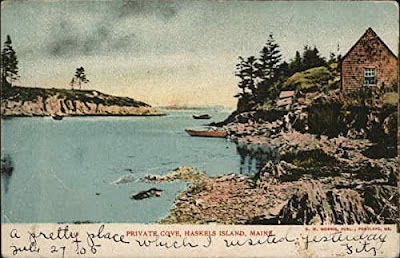
Antique Haskell Island postcard from Amazon. "A pretty place which I visited yesterday..."

To stop the rats, the Haskell brothers brought a couple of cats to their island. The brothers didn't provide any food for the cats and expected them to survive by killing rats. The cats met their expectations. They ate rats, and there were so many rats that the cats thrived and multiplied. Soon there were more cats than rats, and eventually there were no rats left at all, just an island full of hungry cats. 

The cats roved the island, howling with hunger. They climbed the apple trees, roamed the fields, and paced the shore, looking for something to kill and eat. 

The Haskell brothers had to do something about the ravenous felines, but something happened before they could devise a plan: one of them became sick. He fell seriously ill, so his brother took the boat and went to the mainland to get a physician. "Hurry back," the sick brother said weakly as he lay in bed. 

Can you see where this is going? An island full of hungry cats, an incapacitated man lying weak and helpless in bed? When the healthy brother returned to the island, he and the physician were horrified by what they found inside the Haskells' house. The sick brother had been ripped to shreds, and the cats were tearing the last morsels of flesh from his body. At last their hunger was sated. 

*****

It's a simple little story, but really resonates with me. It appears in Horace Beck's 1957 book The Folklore of Maine. The Maine Encyclopedia says Haskell Island was named for a Captain Haskell who purchased, but never lived on, the island, so I don't think the man-eating cat story is true. Still, it has the power of a good horror movie, and reads like an environmentalist fable. The brothers try to master the island, but end up doomed by their own actions and the invasive species they brought to the island. 

It reminds me of "Bart the Mother," a 1998 episode of The Simpsons where Springfield is overrun by ravenous lizards. At first people are happy because the lizards eat all the pigeons, but then realize they'll need to import snakes to eat the lizards, and then gorillas to eat the snakes...


Horace Beck notes that there is a coda to the story. According to some people, the sick brother was not killed by cats, but by pirates. He had seen the pirates burying their treasure on Haskell Island, and they killed him to keep their secret safe. Then they made it look like the cats had done it to deflect attention. I don't find that explanation quite as compelling, though. The story is structured like a version of "I Know an Old Lady Who Swallowed A Spider," and randomly introducing pirates just doesn't make sense. 

January 17, 2018

Cat, Crow and Cream: Perils of Being A Witch

Lots of younger people are interested in traditional forms of witchcraft these days, as a quick search through Tumblr will demonstrate. I think that's fine. Many people dabble in the occult and it's definitely an interesting topic. However, be aware that witchcraft is not all fun and games.  


For example, here is a little folk story about witches from late 19th century Western Massachusetts:

BEWITCHED CREAM
Daniel Smith was churning. He looked into the churn and then to see what progress he was making, but the butter was no nearer to coming the last time he looked than it was the first. The suspicion grew on Mr. Smith that there was something uncanny about this fact. The more he thought about it the more certain he became that there was a witch in the cream. To expel the evil spirit he dipped up a little of the cream, and threw it into the fire. Immediately after that the butter came. That same day it was reported that Widow Brown had burned herself. Then Mr. Smith knew it was the Widow Brown who had bewitched his cream. (Clifton Johnson, What They Say in New England, 1896)

Now compare that with this story collected in the 1930s in Peterborough, New Hampshire about a witch named Mrs. Stinson:

A cat somewhere in town was observed to act strangely; hot water was thrown upon her and straightaway Mrs. Stinson's back was dreadfully afflicted with St. Anthony's (erysipelas). On another occasion a good man near Sharon shot at a crow many times, but the bird only flew around and laughed at him. He at last took off a silver sleeve button and with it broke the crow's wing; immediately Mrs. Stinson was found to have a broken arm. (Eva Speare, New Hampshire Folk Tales, 1932)

Although we tend to think of folk stories about witches as spooky or creepy, most of them are actually instructional tales about how to defeat witches. They usually end with the the wise farmer or clever housewife defeating the witch through a little defensive magic, as the stories above illustrate. The heroine of these tales is not the witch.


Witches were believed to work their mischief by sending their souls out of their bodies and into food, animals, or farm implements. This was a cool magical power, but left the witches very vulnerable because their bodies experienced any harm inflicted on the food or animal. A silver object (a button or a bullet) could injure or kill even the toughest witch. 

So just a word of caution for young people thinking about practicing traditional forms of witchcraft. Watch out! Someone might throw the cream into the fire.

September 25, 2017

Lumberjacks and the Devil: Two Stories from Maine


1. THE DEVIL'S MAGIC AXE

Many years ago a lumberjack named Robert Cartier lived and worked in Millinocket, Maine. I suppose "worked" is an exaggeration. Cartier was a lazy drunkard and a trouble-maker. He preferred drinking in the bars or starting fights over cutting down trees.

One day the Devil appeared to Cartier. The Devil said, "Robert, I'd like to make a deal with you. It's a shame you need to spend so much time working as a lumberjack. You're doing an excellent job spreading evil by drinking and picking fights. I'd rather you spent your time doing that. What do you think?"

Cartier agreed.

"Well," said the Devil, "Here's the deal. I'll give you a magic axe. It can cut down trees all by itself. You won't need to lift a finger. You just need to whistle to make it happen. In return, I get your should when you die."

Cartier wasn't very smart, so a few years of easy living in exchange for eternal damnation sounded like a bargain to him. He agreed to the Devil's deal.


The next day Cartier went into the woods with the Devil's axe. He sat in the shade eating, drinking whisky, and whistling while the axe cut down tree after tree. When he was done in he went into town to drink more and pick fights. He had plenty of energy for mischief because he had done so little all day.

For many years Cartier spread misery at night while the Devil's axe chopped down trees all day. But one night in a bar Cartier had a moment of drunken clarity: he had spent his life doing evil and was doomed to Hell. Cartier staggered out of the bar into the night, eager to find atonement.

The next morning some lumberjacks found Cartier's body in the woods. His head been chopped clean off with one blow of an axe. The murder weapon was never found, but some people say the Devil's magic axe is still out there, ready for some unwary soul to start whistling in the woods.

2. JACK AND THE DEVIL

People in Dyer Brook, Maine say there is a special place in the woods where you can meet the Devil. If you go there seven nights in a row the Devil will appear and speak to you. 

A logger named Jack learned about this place and went there for the required number of nights. On the seventh night the Devil came and talked with Jack. He warned him not to ride the logs in the river next day or he would die. Jack was foolhardy and laughed at the Devil's warning. 

The next day Jack went went to work. A huge number of logs were being driven down the river. Jack jumped from log to log, nudging them with his pole to keep them moving downstream. He was about to leap onto another log when suddenly a flaming pickaxe appeared in front of him. He remembered the Devil's warning and jumped back to shore. Several men died that day in a logjam, but Jack didn't.

After this the other lumberjacks began to notice strange things about Jack. For example, when he was out chopping wood the sound of two axes could be heard, even though he was at the only person visible. Jack also was often heard talking to someone that no one else could see. Maybe it was just an imaginary friend, but people knew that Jack had gone to the Devil's meeting place. They stared to call him Jack-the-Ripper because his strange behavior scared them.

Once Jack drove his axe into a tree so hard the handle split in two. But when Jack pulled it out the handle was strangely once again whole. The lumberjacks who witnessed this avoided him like the plague.

One day the boss walked with Jack to a clearing in the woods. It was full of brush and logs. "Clean this mess up," the boss said and walked off. The boss was spooked by Jack and thought it would take him several days to clean the clearing. Jack came back to camp in just a few hours. All the brush and logs had been neatly stacked in a pile. It would have taken dozens of men to do what Jack did alone in just a short time. The other men at camp whispered that he had supernatural help.

After that all the lumberjacks refused to work with Jack-the-Ripper. He left Dyer Brook and was never seen again.

*****

I really like these two stories. They're short, sweet and spooky. The first one comes from Charles A. Stansfield's Haunted Maine (2007), which is packed with great legends. The other one comes from The WPA Guide to Maine: The Pine Tree State, which was produced in the 1930s by the Federal Writers' Project as a way to employ out-of-work authors. Why doesn't the US government pay people to collect folklore today? That's how I want my tax dollars spent.

November 23, 2015

The Devil and Jonathan Moulton

I was going to write something about Thanksgiving this week, but I found myself inspired to write about something the exact opposite: the Devil. Thanksgiving is about gratitude, sharing and love. The Devil is about greed, hatred, and trickery. 

The Devil is one of the major figures in early New England folklore. It shouldn't really be a surprise, given that this area was colonized by God-fearing Puritans, and the corollary of being God-fearing is being Devil-fearing. He was supposedly always lurking around, waiting to tempt people into evil. The Puritans thought he was the master of the Salem witches, and probably the secret leader of the local Indian tribes as well.

After the witch trials ended the Devil receded a little from the public mindset, but he was still there in the shadows, biding his time. He was surprisingly easy to summon. All one had to do was say the Lord's Prayer backwards and he would appear, ready to make a bargain.

That bargain. There are lots of stories about the Devil's bargains. Probably the most famous is "The Devil and Daniel Webster" by Stephen Vincent Benet, with Washington Irving's "The Devil and Tom Walker" a runner up. Both are set in New England, and both involve the central conundrum of Devil folk stories: if you make a deal with the Evil One, can you get out of it?

Benet's and Irving's stories are both fiction, but they answer that question in different ways. Benet's Daniel Webster is able to wrest his client's soul from the Devil's grasp. In Irving's tale, miserly Tom Walker is dragged off to hell despite his best efforts.

In New England oral folklore, the answer is also split. Some humorous tales tell of crafty New Englanders cheating the Devil, or even hint that the Devil is just a hallucination caused by heavy drinking. Others end more grimly, with proud sinners getting their bloody due.


All of which leads us to the topic of this week's post: General Jonathan Moulton (b.1726 - d. 1787). Moulton was a key figure in the early history of New Hampshire. He led troops at the battle of Louisburg in the French and Indian War, helped defeat the British at Saratoga during the American Revolution, and became a friend of George Washington. In between all the heroism he managed to marry two women, father fifteen children, and start a silversmithing company that survives today as Towle Silver.

And, according to legend, he sold his soul to the Devil.

The story goes something like this. Although Moulton was successful and quite wealthy, he always craved more gold. It was all he thought about, and it haunted his dreams day and night. Sensing this, the Devil came one night to Moulton's house, appearing as a man clad in black velvet.

After some haggling, Moulton and the Devil agreed to the following bargain. One the first day of each month, Moulton would hang his boots by the fireplace as if to dry them. The Devil would then materialize on the roof and pour gold coins down the chimney into the boots. After a set number of years, the Devil would come to take Moulton's soul.

Eager to get the most gold that he could, Moulton purchased an enormous pair of thigh-high boots and hung them by the fireplace. For several years things went well. Each month the Devil poured gold coins into Moulton's over-sized boots. Moulton's wealth grew and grew.

But the more gold he got, the more he wanted. One day as the Devil poured coins down the chimney he noticed that the boots were taking more coins than usual. He poured and poured but still the boots didn't seem to be filling up. Jumping down to the ground, the Devil looked in the window to see that Moulton had cut the soles off his boots. The entire room was filled with gold coins.

Furious at being tricked, the Devil snapped his fingers and cast a ball of fire at Moulton's house, which went up like a pile of dry tinder. Moulton and his family escaped but their home was completely destroyed. When the embers finally cooled Moulton dug through the ruins for the gold. Melted gold was still gold, after all. But he didn't find a single speck. The Devil had taken it all back to Hell with him.

I suspect people told this tale was about Moulton because they were jealous of his wealth. He was a successful silversmith, a successful farmer, and well-connected politically. Claiming his wealth was the result of a Devilish bargain was a clever way to cast aspersions on someone's reputation. It worked, because I think Moulton is better known today for this legend than for anything else he did.

It looks like Moulton was really not popular with his neighbors in Hampton, New Hampshire. For example, during a dispute with another farmer Moulton's barn mysteriously burned down four times. That's right, four times, and no one was ever caught. In 1759, Moulton's house also burned down, which is an interesting parallel with the house fire in the story. (All his family and servants escaped, and Moulton built an even larger mansion.)

People may have had good reason to dislike him. A 1909 article by F.B. Sanborn in The Granite Monthly notes that Moulton was something of a loan shark in Hampton and lent money at high rates to his neighbors. This same article claims that even during his life people in Hampton thought he was in league with the Devil, and at the moment of his death "Lydia Blaisdell, a hag whom I remember in her disgraced old age" saw the Evil One fly off with Moulton's body. The people of Hampton supposedly rejoiced when they learned of his death.

The Devil probably didn't carry Moulton off to Hell, but it's not entirely clear what did happen to his body. Wikipedia states it was stolen by someone after his death. Did bitter neighbors get their final revenge? Maybe, or maybe it was buried in an unmarked grave on his property, as the Hampton library claims.

To wrap this up, I'd like to point out that the Devil basically acts like Santa Claus in this story. Moulton hangs his boots by the fireplace, and the Devil fills them with goodies via the chimney. The legend probably dates back to before Santa Claus was introduced to the United States, but I suspect the folk motif of hanging boots to be filled by magical creatures is very old.

February 01, 2015

New England Folk Horrror a Big Hit at Sundance Film Festival

The Sundance film festival just wrapped up, and one of the surprise hits this year is a horror film based on New England folklore.

The movie is called The Witch, and it sounds like something readers of this blog would really enjoy. Here's the basic premise. The year is 1630, and a farmer named William and his wife have been exiled from their New England settlement for being religious extremists. They've carved out a small farm on the edge of a forest where they and their five children try to eke out a meager existence.

Anya-Taylor Joy in The Witch

Life isn't easy on the farm, and their crops are failing as winter slowly approaches. Things aren't looking good, and tensions within the family increase when their infant son Samuel disappears while under the care of oldest daughter Thomasin. Was it merely negligence or was it something more?

The Witch is being billed as a horror film, so I think it's not just negligence. Accusations fly within the family and things get weird. Why is eldest son Caleb, who likes to hunt alone in the dark woods, suddenly speaking in tongues? Should the parents be concerned that the young twins Mercy and Jonas are spending a lot of time with the family's goat, a large beast named Black Phillip? Who, if anyone, is actually the witch of the title?

Welcome to sunny New England! A still from The Witch.

We'll have to wait a while to get answers. A release date hasn't been set yet, but it looks like The Witch will be shown in theaters and through DirecTV at some point. But some reviews have said the movie's ending is ambiguous, so maybe we won't get any clear answers at all. The Witch has been described as a cross between The Crucible, The Shining and The Exorcist which should give some indication of what type of movie it is.

The director is Robert Eggers, a New Yorker who was born in New Hampshire. He has said the movie was inspired by old New England folk stories, and that he strove for authenticity in the costumes, sets and even the language. Here's a quote from an interview:

"The kind of research I did here was wild and obsessive, almost disgusting,” he says. “I have always been into folktales and fairy tales and New England’s past, so with this film I wanted to create an archetypal New England horror story. Something that would feel like an inherited nightmare of a Puritan family."

It all sounds great to me! I'm excited to see something set so early in our country's history. It might be the art house answer to The Lords of Salem.

Making horror films about New England witchcraft is challenging. After all, there weren't any real witches executed during the witch trials, just innocent victims of gossip and politics. The real witches were lurking where they always have been, barely glimpsed in our dreams and deep in the dark woods of our unconscious. Horror films often ignore these historical and psychological nuances and just go for the gore. I'll be curious to see what path The Witch takes.

January 11, 2014

Encountering a Goatman in Maine

As I've mentioned before, the United States is blessed with an abundance of half-human, half-animal monsters. If you travel to the Midwest you'll encounter dogmen, the Lizard Man lurks in South Carolina, and the Bunny Man haunts parts of Virginia.

Here in New England we of course have the Pigman of Northfield, Vermont, but I recently read about a goat man who was seen in Cherryfield, Maine. Very exciting!

The story goes something like this. Back in the 1950s a Cherryfield man was driving his truck through the woods outside town. He was a local and had spent most of his time hunting, fishing, and logging in the forests of Maine. Those decades of experience didn't prepare him for what he encountered that day.

He had filled up his gas tank before he left home that day, so he was very surprised when his truck came to a gradual stop on a lonely road. His gas gauge read empty.

He got out and checked the tank. It indeed was empty. He checked the bottom of the truck but couldn't see a leak, and he didn't see any sign of gas dripping on the road. He was annoyed and puzzled, but when he got out from beneath those truck those emotions turned to surprise - and maybe a little terror.

Standing in the middle of the road was a man who was half-human and half-goat. His lower body and legs were naked, hairy and shaped like a goat's, while his torso was human-shaped and covered in a flannel shirt. Goat horns grew out of his head and his ears were pointed like an animal's. Other than the flannel shirt, the goatman looked like a mythological satyr or the Greek god Pan.


The half-naked goatman smiled at the Cherryfield man, and then slowly sauntered into the woods. The man got back into his truck and locked the door. He tried to start the truck, hoping desperately that he could drive home just on fumes, and to his surprise the engine started. His gas gauge now read full. He drove home without incident and never saw the goatman again.

There are a lot of interesting things about this story. First, I'm excited to have a goatman seen in New England. Goatmen have been seen in other parts of the nation, including Maryland, Kentucky, and Texas. Apparently a goatman has also been seen in Williamstown, MA but I don't have any more information on those sightings.

Second, I think the empty gas tank is pretty interesting. I was reminded of a lot of alien abduction and UFO sighting stories I've read. Someone is driving down an isolated road, their car mysteriously stops, they see a strange light or strange creatures, and then their car works again and they drive home. This story follows a similar pattern. In all these stories the forces from the other world disrupt our technology (and maybe our technological worldview) in order to make themselves known to us.

Finally, I think the flannel shirt is interesting. Obviously the story happened in chilly Maine and not the sunny Mediterranean so of course the goatman would be wearing a shirt. It's cold up in those woods! However, there have also been sightings around the country of Bigfoot wearing a flannel shirt.

Again, like the goatman, these shirt-wearing Bigfoots are naked from the waist down, but why are they even wearing shirts at all? A Bigfoot is hairy all over. There's something unnerving about the idea of a large male monster roaming around the woods just wearing a shirt. Or maybe it's appealing, depending on what you're into. The shirts Bigfoot wears are usually described as plaid or flannel, which in the US are symbolic of rural masculinity. Bigfoot and the goatman aren't wearing Brooks Brothers oxfords because they inhabit the wild side of the world. Interestingly, the red-headed hitchhiker of Route 44 also wears a plaid shirt.

I found this story in T.M. Gray's New England Graveside Tales. Gray, who is a Mainer, notes that once when she was hiking in the woods alone she heard strange flute music. She called out to the unseen musician, and the music stopped. Then it started again. She tried to follow the music, but as she did she realized it kept coming from different directions. Creeped out, she headed back to her car as fast as she could. As she notes, Pan and his satyrs were famous for playing the flute, so who knows what strange encounter she avoided.