Showing posts with label crow. Show all posts

June 15, 2025

H.P. Lovecraft, Rhode Island Witches, and Weather Magic

H.P. Lovecraft (1890 - 1937) is one of America's best-known horror writers. Born in Providence, Rhode Island, he wrote dozens of stories which appeared in the pulp magazines of the 1920s and 1930s. He was very popular with pulp readers, but didn't make much money from his writing, and died in poverty at the age of forty-seven from stomach cancer. 

His work became better-known after his death, particularly when it started appearing in cheap paperback editions in the 1960s, and he's now quite famous. Novelist Stephen King and director Guillermo del Toro both cite him as an influence, and his stories have been turned into many movies, games, and toys in the years since his death. 

H.P. Lovecraft in 1934

Lovecraft was a big fan of New England folklore, and often incorporated it into his fiction. For example, stories like "The Dunwich Horror," "Dreams in the Witch House," and "The Case of Charles Dexter Ward" all include concepts and imagery borrowed from traditional New England witch-lore. Lovecraft also wrote about New England witch legends in the many letters he wrote. And when I say many letters, I do mean many. It's estimated he wrote 87,000 letters to friends, colleagues, and fans. Around 10,000 of those letters still exist today. 

Recently, I've been reading a collection of some of those letters: A Means to Freedom: The Letters of H.P. Lovecraft and Robert E. Howard: 1930 - 1932. Robert E. Howard, the creator of Conan the Barbarian, was another well-known pulp writer, and A Means to Freedom collects the correspondence he and Lovecraft shared. Most of their letters are about history and politics, but Lovecraft does mention witchcraft in some of them. 

Arnold Schwarzenegger in CONAN THE DESTROYER (1984)

For example, in a letter from October 4, 1930, he discusses witch legends from North Kingstown, Rhode Island. First, he lists several that were allegedly gathering places for witches, including "Hell Hollow, Park Hill, Indian Corner, Kettle Hole, and Goose Neck Spring." At Indian Corner, a large rock supposedly oozed blood when the moonlight shined on it. 

Then Lovecraft tells the following story:

Witch Rock, near Hopkins Hill, is the site of a cabin where a monstrous old witch dwelt in the 1600s, and the ground around it is so accursed that it is impossible to plough it. If anyone traces a furrow, the ploughshare is mysteriously deflected. The old witch, incidentally, still skulks nearby in the form of a black crow or black cat - her present abode being an underground burrow (A Means to Freedom, p. 66). 

That's a nice, spooky New England witch story, and Lovecraft appears excited to share it with Howard, who lived in Texas, where they sadly lack centuries-old witchcraft legends. 

Lovecraft probably found that story in Charles Skinner's 1896 book, Myths and Legends of Our Own Land, where it appears on page 32 of volume two. In turn, Skinner took it from a story that appeared in newspapers around the country in 1886. It's not clear if there ever really was a suspected witch at Hopkins Hill in the 1600s, or if the legend was just created for the newspapers. 

My copy of Myths and Legends, which I bought years ago before it was available online.

Lovecraft also probably found the list of witches' gathering places in Skinner's Myths and Legends, where it appears on page 30 of volume two. Somewhere along the way, though, a few typos were made, either by Lovecraft or the person who transcribed his handwritten letters for publication, because Skinner lists Pork Hill and Goose-Nest Spring, not Park Hill and Goose Neck Spring.  

Lovecraft also tells Robert E. Howard some witch-lore that he heard from a friend. Lovecraft writes:

Rumors and and whispers directed against eccentric characters were common all through the 18th and into the 19th century, and are hardly extinct today in decadent Western Massachusetts. I know an old lady in Wilbraham whose grandmother, about a century ago, was said to be able to raise a wind by muttering at the sky (A Means to Freedom, p.74).

An editor's note in A Means to Freedom indicates the "old lady" was the journalist and author Edith Miniter, who was Lovecraft's good friend. ("The Dunwich Horror" was at least partly inspired by time he spent visiting her in Wilbraham.) When the letter was written, Miniter would have been around 63 years old. I don't know who her weather-witching grandmother was, but that might be a good research project for a Lovecraft fan who is into genealogy. 

Also, please email me if you know how to raise a wind by muttering at the sky. Summer's coming, and it would be a nice skill to have on a hot, humid day. 

February 13, 2022

Hallucinations, Magic Crows, and Witches: Random Thoughts While Making Bread

The other day I made some brown bread. Many of you might be familiar with this delicious loaf, but if you're not here's the scoop. It's a bread made with rye flour, wheat flour, and cornmeal that is usually sweetened with molasses. You usually find it at clambakes these days, but in the past it was just an everyday bread. 

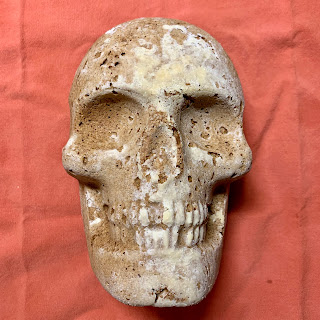
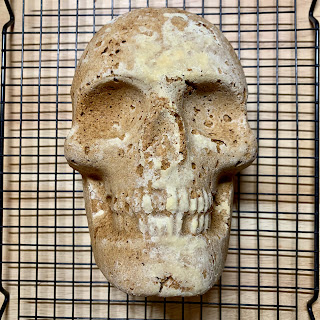
Some people make brown bread by steaming it in cans, but although that results in a very moist loaf it is not really necessary. You can bake it in a regular pan. I was feeling a little bit Goth, so I baked mine in a skull-shaped Halloween pan I have. 

Brown bread has its roots deep in New England's culinary history. It's had different names in the past, like "rye and Indian," which refers to the rye flour and the cornmeal, which was once called Indian meal since it originated with the local indigenous people. Sometimes brown bread was also called "thirds" because the recipe called for one third each of wheat, rye, and cornmeal. Wheat does not grow well in New England and was very expensive here in the 17th and 18th centuries, so the English colonists made their bread by mixing this precious commodity with the other two grains, both of which grow better in this climate.

I oiled and floured my skull-shaped ban so the bread came out looking like this!

As I made my brown bread, interesting stories about rye and cornmeal came to mind, one about the Salem witch trials and one from local Algonquin lore. 

Here is the Salem story. Most historians think the Salem witch hunt was caused by social and psychological factors. But what if there was a simple biological cause? In 1976 Linnda Caporael, a biology grad student at the University of California Santa Barbara, suggested that ergot, a fungus found on grain, might be responsible for the witch trials.

The English colonists grew a lot of rye, and during warm wet weather, ergot grows on rye. Ergot contains a compound similar to the hallucinogen LSD. People who consume rye ergot-infected with ergot can suffer from hallucinations, auditory disturbances, convulsions, strange skin sensations, vomiting, and psychosis. These symptoms sound like the symptoms suffered by the allegedly bewitched Salem girls. Carporeal argued that the spectral visions and strange fits these girls experienced were caused by the fungus.

This theory received a lot of publicity when it was published, even meriting a front-page article in The New York Times. A critique was published a few years later by Nicholas Spanos and Jack Gottlieb, two psychologists from Carleton University. They argued there was not strong evidence connecting ergotism to the Salem witch trials.

Convulsive ergotism, they claim, is only found in people with a Vitamin A deficiency. Someone with sufficient Vitamin A in their body suffers instead from gangrenous ergotism, a different variety of the disease which causes gangrene and rotting flesh. (Yikes.) The farmers in Salem Village consumed lots of dairy products, and the residents of Salem Town ate plenty of fish, both foods rich in Vitamin A. If ergot was present they should have suffered from gangrene, which they didn’t. 

Spanos and Gottlieb also point out that some symptoms of convulsive ergotism weren’t present in Salem, like vomiting and diarrhea. Most importantly, though, the afflicted girls only experienced their torments at specific times, usually in the courtroom when accused witches were brought in. Outside of the courtroom they were usually symptom-free. This strongly suggests their symptoms were not caused by ergotism. Many people who testified during the trials also said they only testified because they feared imprisonment or execution. It would be nice if the witch trials had been caused by something as simple as a fungus, but regrettably it seems that human ignorance and malevolence were more likely to blame.

That's kind of a weird and unpleasant thing to consider while making bread, but the other story is happier. It's connected to cornmeal. Corn was one of the staple foods for the local Algonquin tribes, and many tribes told stories about how it was brought to Earth from heaven by a crow. 

Here's one version of that story from Kitt Little Turtle (1940 - 2004), a Nipmuck medicine man from Webster, Massachusetts. It appears in the book Dawnland Voices: An Anthology of Indigenous Writing From New England (2014), edited by Siobhan Senier.

Many generations in the past, the Nipmuck lived only by hunting and gathering. They depended entirely on wild game and other food they could forage. Because of this they were always on the move and never settled in one place. 

One year food was very scarce and the Nipmuck were close to starvation. During this time a crow appeared in a vision to a young man. The crow told the man about a wonderful plant that would prevent the Nipmuck from starving. 

The man wanted to go find this plant, but the crow told him it was too far for him to ever find. The crow would bring it to him. The crow also told him that the crows would follow the Nipmuck forever if they grew this special plant. It was, after all, the crows' favorite food. 

A few days later the man was wandering through the woods when a crow appeared. It was the same one he saw in his vision. The crow gave the man three seeds: corn, squash, and beans. These are the Three Sisters which grow well together in the same field. The crow told the man how to cultivate and harvest these crops. 

Ever since that time, the crows visit whenever the corn is harvested to get the share that is due them. 

There you have it. Two stories, one delicious loaf of bread!

January 17, 2018

Cat, Crow and Cream: Perils of Being A Witch

Lots of younger people are interested in traditional forms of witchcraft these days, as a quick search through Tumblr will demonstrate. I think that's fine. Many people dabble in the occult and it's definitely an interesting topic. However, be aware that witchcraft is not all fun and games.  


For example, here is a little folk story about witches from late 19th century Western Massachusetts:

BEWITCHED CREAM
Daniel Smith was churning. He looked into the churn and then to see what progress he was making, but the butter was no nearer to coming the last time he looked than it was the first. The suspicion grew on Mr. Smith that there was something uncanny about this fact. The more he thought about it the more certain he became that there was a witch in the cream. To expel the evil spirit he dipped up a little of the cream, and threw it into the fire. Immediately after that the butter came. That same day it was reported that Widow Brown had burned herself. Then Mr. Smith knew it was the Widow Brown who had bewitched his cream. (Clifton Johnson, What They Say in New England, 1896)

Now compare that with this story collected in the 1930s in Peterborough, New Hampshire about a witch named Mrs. Stinson:

A cat somewhere in town was observed to act strangely; hot water was thrown upon her and straightaway Mrs. Stinson's back was dreadfully afflicted with St. Anthony's (erysipelas). On another occasion a good man near Sharon shot at a crow many times, but the bird only flew around and laughed at him. He at last took off a silver sleeve button and with it broke the crow's wing; immediately Mrs. Stinson was found to have a broken arm. (Eva Speare, New Hampshire Folk Tales, 1932)

Although we tend to think of folk stories about witches as spooky or creepy, most of them are actually instructional tales about how to defeat witches. They usually end with the the wise farmer or clever housewife defeating the witch through a little defensive magic, as the stories above illustrate. The heroine of these tales is not the witch.


Witches were believed to work their mischief by sending their souls out of their bodies and into food, animals, or farm implements. This was a cool magical power, but left the witches very vulnerable because their bodies experienced any harm inflicted on the food or animal. A silver object (a button or a bullet) could injure or kill even the toughest witch. 

So just a word of caution for young people thinking about practicing traditional forms of witchcraft. Watch out! Someone might throw the cream into the fire.

November 30, 2017

John Godfrey: Witch and Troublemaker

When I was a kid in Haverhill, Massachusetts I wasn't that interested in local history. I knew about the city's heroine Hannah Duston, but that was about all I knew. Other stories from my hometown's past remained unknown to me. Perhaps if I had known about John Godfrey, a trouble-making witch who lived in the mid-1600s, I would have been more excited about Haverhill history.

Was Godfrey really a witch? Probably not, but he was definitely a trouble-maker. Most of what we know about him comes from court records in Essex County, where he was involved in dozens of legal cases. Sometimes he was the defendant, sometimes he was the accused. Most of these court cases involved disputes over small amounts of money or property; in others Godfrey sued neighbors for slander. At other times Godrey appeared in court to face charges of drunkenness, theft and cursing.

As historian John Demos writes, "Taken as a whole, the records depict a man continually at odds with his peers..." And as we know, people at odds with their peers in 17th century New England were often accused of witchcraft.

It appears that John Godfrey emigrated to the Massachusetts Bay Colony sometime around 1635 and found employment as a herdsman in the town of Newbury with wealthy settler John Spencer. Godfrey was most likely a teenager at this time. Young Godfrey was kind of odd, and even then some folks thought he might be a witch. For example, in 1640 he talked with a Newbury man named William Osgood about finding a new employer. Osgood at the time was building a barn for Godfrey's current employer, John Spencer.

John Godfrey, being then Mr. Spencer's herdsman, he on an evening came to the frame where diverse men were at work; and said that he had gotten a new master against the time he had done keeping cows. 
The said William Osgood asked him who it was; he answered he knew not. He again asked him what his name was; he answered he knew not. He then said to him, "How wilt thou go to him when thy time is out?" He said, "The man will come and fetch me." Then William Osgood asked him "Hast thou made an absolute bargain?" He answered that a covenant was made and he had set his hand to it... 
William Osgood then answered "I am persuaded thou has made a covenant with the Devil. He (Godfrey) then skipped about and said, "I profess, I profess." (from David Hall's Witch-Hunting in Seventeenth-Century New England (1991). I added modern punctuation for clarity.)

Osgood may have lied about this conversation, but its also possible Godfrey was actively cultivating an image as a witch. As a young man with no family and a lowly job, he may having a reputation as a witch was a way to gain some influence and intimidate people. That's just speculation on my part, but it seems some people in 17th century New England did knowingly cultivate witchy personas. Further supporting my hunch, Godfrey later explained to one Charles Brown of Rowley how the Devil took care of his witches:

...Godfrey spoke that if witches were not kindly entertained the Devil will appear unto them and ask them if they were grieved or vexed with anybody and ask them what he should do for them and if they would not give them beer or victuals they might let all the beer run out of the cellar and if they looked steadfastly upon upon any creature it would die... (Hall, Witch-Hunting in Seventeenth-Century New England (1991).)

It's easy to picture Godfrey explaining this to Brown, and then asking him for food and drink in a vaguely threatening tone. Hand it over, friend, because I might just be a witch!


Godfrey left Newbury and became an itinerant herdsman, finding employment with a variety of landowners and farmers across Essex County in Massachusetts. Godfrey lived and worked in many towns, including Ipswich, Andover, Haverhill and Salem. He never married and had no children.

This made Godfrey an anomaly among the local Puritans, who generally were rooted in one location and had networks of close kin to support them. Historian John Demos speculates that Godfrey may have been homosexual, noting his unmarried status and his use of the term "c*ck-eating boy" to insult someone who got a herding Godfrey wanted for himself. This is just speculation, but it's not impossible. Legal documents clearly describe homosexual men living in the Massachusetts Bay Colony around this time.

By 1658 Godfrey's argumentative personality, unusual lifestyle and talk about witchcraft caught up with him. He was accused of witchcraft. Other witchcraft accusations followed in 1659, 1666 and 1669. Amazingly, Godfrey was never found guilty, but documents from his trials give a fascinating glimpse into 17th century witchcraft beliefs in New England.

For example, witnesses talk about familiar spirits, the small demons that did a witch's bidding. It was believed that witches had small teats hidden on their bodies from which their familiar spirits sucked blood for sustenance, and Charles Brown testified that he once saw Godfrey yawn in church and saw a strange teat under his tongue. Further, Job Tyler later testified that one night John Godfrey came to visit the Tyler family's house. When he entered the house a large black bird flew in the door with him. Godfrey tried to catch the bird, which finally escaped through a hole in the wall. When Job Tyler asked Godfrey why the bird came in the house, Godfrey answered: "It came to suck your wife." Maybe Godfrey was perhaps joking, but maybe he was implying that Goodwife Tyler was herself a witch. Either way he demonstrated his knowledge about familiar spirits. (Godfrey's comment reminds me of that really gruesome scene from The Witch with the crow!)


John Remington Jr., a fifteen-year old boy from Haverhill, also testified about a large black bird. Remington was riding a horse back to his family's home when the dog accompanying him began to whine and whimper. Remington also suddenly something strange that reminded him of apple cider. At this point a large crow appeared. Remington's horse abruptly fell on its side, injuring Remington's leg. When he recovered he mounted the horse again and rode towards home, but the crow followed, swooping down and biting the dog. Godfrey had argued with Remington's father earlier about working for him as a herdsman, but had not been hired. Godfrey was later heard to say that had Remington Jr. been a full-grown man something much worse would have happened to him. Remington's testimony implies that the crow was somehow controlled by Godfrey, but it's not clear if it was supposed to his familiar spirit, Godfrey transformed into a crow, or an animal he was controlling.

Strange animals appear in several other witnesses' testimony. Isabelle Holdred and her husband argued with Godfrey over money, and after the argument Holdred was assaulted by a progression of  animals that appeared to her over the course of several nights. Holdred was first attacked by a bumblebee, followed by a bear that growled and asked her if she was afraid. The next night a snake appeared, which frightened Holdred so much she couldn't talk for thirty minutes. A spectral horse also appeared in her bedchamber, as did a large black cat that lay on her as she slept and stroked her face. Holdred was the only one who saw those animals, but her son was with her when a neighbor's ox attacked her after looking at her with "great eyes."

Witnesses also claimed that Godfrey could send his spirit double (or specter, to use the Puritan terminology) to cause trouble. John Singletary, who had argued with Godfrey over money, claimed that he was visited by Godfrey's specter while in jail. The specter said that if Singletary paid Godfrey what he was owed he would free him. Singletary refused Godfrey's offer and tried to strike him with a stone, but "there was nothing to strike and how he went away I know not." Elizabeth Button claimed that Godfrey appeared in her bedchamber several times one night, even though the door was firmly bolted, implying that it was his spirit that had visited her.

A man named John Griffing even testified that Godfrey could travel over great distances quickly or appear in two places at once. For example, he once saw Godfrey on the road to Newbury at the same time Godfrey was confined to jail in Boston. Griffing also said he and Godfrey once set out together for the Rust family's house in Andover. It was a cold day and snow covered the ground. Griffing was on horseback and easily outpaced Godfrey, but when he go the Rust home he found Godfrey already inside, warming himself by the fire. Clearly he could only have gotten there by witchcraft.

Despite all this testimony against him, Godfrey was never found guilty of witchcraft. Perhaps the judges knew he was just a troublemaker who fought with all his neighbors. They certainly saw him in court often enough to be familiar with him! John Godfrey died in 1675, probably in Boston or Charlestown. Not much is known about his death, but fittingly there was a trial to decide who would receive his modest estate. Even in death Godfrey couldn't stay out of court.

******
In addition to David Hall's book, I found John Demos's "John Godfrey and His Neighbors" in The William and Mary Quarterly, Vol. 33, No. 2 (Apr., 1976) to be really valuable

November 15, 2017

Bewitched Dogs Killed in Salem and Other Strange Animal Stories

There are lots of weird little stories buried in the accounts of the Salem trials. For instance, did you know that two dogs were killed because people thought they were bewitched?

In October of 1692, a dog in Salem was killed after it began to act strangely. The afflicted Salem girls claimed it was being ridden and tortured by the invisible spirit of John Bradstreet. John was the brother of Dudley Bradstreet, a Justice of the Peace from Andover who had refused to issue any more warrants to arrest alleged witches. After his refusal the afflicted girls accused Dudley himself of witchcraft. He and his family fled Essex County, as did his brother John, who fled north to Maine after the "bewitched" dog was killed.

A dog was also killed that month in Andover when an Andover girl claimed it was actually a demon in canine form. After the dog was shot Reverend Increase Mather, one of the colony's leading ministers, pointed out the absurdity of trying to kill a demon with a bullet. Clearly, he said, the dog could not have been an evil spirit since spirits cannot be killed. Sadly for the dog his protestations were a bit too late.


Animals of many kinds appear in local stories about witchcraft, usually acting strangely if not downright sinisterly. After ruling out natural causes, the early New Englanders had three explanations for why animals might act strangely.

The most common explanation was that they were bewitched. Witch trial documents and local folklore are full of stories about bewitched animals. Sometimes they sicken and die, but more often they just do weird things. Pigs jump high up in the air. Calves make unnatural noises and contort their bodies in strange positions. Oxen refuse to pull their wagon. Stories like these are found from the 1600s until the early 20th century, so its clear they were deeply embedded in the local culture.

Unfortunately, folklore says the best way to unwitch your animal is to physically harm it, whether by beating it or cutting off part of its body, like an ear or tail. Yikes! This is inhumane, but was grounded in the theory that witches cause mischief by sending their souls out of their bodies. A bewitched animal misbehaved because a witch's soul was temporarily inside it, causing an otherwise mundane farm animal to act strangely. Hurting the animal was supposed to also hurt the witch and cause their soul to leave the animal. I don't believe witches can send their soul into animals, but if you do hold that unusual belief please do not beat your animal. Or cut off its ear. Just sprinkle it with some salt or wave a sage bundle around it instead. You could even try holy water, but if it is a cat, don't bother trying because cats just don't change.

A witch's soul didn't always maintain human form when it was out causing trouble. It could take the shape of an animal as well. For example, in 1662 Rebecca Greensmith of Hartford, Connecticut confessed that when she attended the witches Sabbath one of her fellow witches flew there in the shape of a crow. In 1692 Katherine Branch, a serving girl from Stamford, Connecticut, claimed she was approached by a group of cats who briefly turned into women before resuming feline form. The cats were of course witches who were trying to recruit her to their devilish cause. According to a story from 1893, a Cape Cod witch named Moll Ellis could send out her soul in the shape of a bee, which emerged from her mouth when she slept.

Cats, birds, dogs, bees - their forms were many, but they all were intent on working evil. Unfortunately for the witch, their souls were vulnerable to physical harm when in animal form. A story from Clifton Johnson's What They Say In New England (1896) illustrates this. One night a miller from western Massachusetts left home to grind corn at his mill, despite urging from his wife to keep her warm in bed. While he worked at the mill a frisky black cat appeared, purring and rubbing against him. As he shooed the cat away it fell into the grindstone, which ripped off one of its paws. The cat disappeared with an unearthly howl. When the miller got home he found his wife in bed, moaning and looking pale. When he pulled down the coverlet he saw that one of her hands had been torn off, revealing her to be a witch.


Animals that acted strangely might be controlled by a witch's soul or might even be a witch's soul in animal form, but the third explanation was the most terrifying. The Devil and his demons could assume animal form. That weird pig or twitchy dog might just be a spirit come from Hell to torment and trick the good Puritans of New England.

One of Salem's most famous accused witches, the slave Tituba, claimed that the Devil appeared to her both as a dog and a monstrous hog. The Devil must have liked pigs, because the citizens of Topsfield, Massachusetts claimed the Devil in the shape of a hog haunted a bridge over the Ipswich River until he was banished by a Puritan minister. Rebecca Greensmith saw the Devil in the shape of a deer, while in Salisbury, New Hampshire, ministers praying over a woman who sold her soul to the Devil were menaced by a large black cat that leapt at them from a tree. As Increase Mather noted, the Devil and his demons could not be killed in any form, but they could be expelled or banished.

Happily, we've made a lot of progress in understanding animal behavior. Be sure to love your animals, no matter how weirdly they act.

*****
I found the information about the bewitched dogs in Marilynne Roach's epic The Salem Witch Trials: A Day-By-Day Chronicle of A Community Under Siege (2002). It's an amazing if dense book that I recommend to anyone who wants all the details of the Salem witch trials. The other animal stories can found here on my blog.