Showing posts with label myth. Show all posts

December 03, 2023

Haunted by the Nantucket Mermaid

This post is about a mermaid who has fascinated, and possibly haunted, people for centuries. But I want to start by talking about a human man: Ichabod Paddock. 

Ichabod Paddock was born around 1661 in Yarmouth, Massachusetts, and died around 1750. He's buried in Middleborough, Massachusetts. Paddock is remembered today for two things: his pioneering role in the Nantucket whaling industry, and his alleged extramarital affair with a mermaid. As a whaling pioneer, Ichabod came with his two brothers to Nantucket in 1690 and taught the islanders how to hunt whales. Their actions were instrumental in making Nantucket into the whaling capital of the world. 

Oddly, we have more details about his alleged (and probably legendary) affair with the mermaid than we do about his actual life as a whaler. The legend goes something like this. Once while on a whaling voyage, Ichabod was swallowed alive by a large, seemingly invulnerable whale nicknamed Crookjaw. The local whalers thought Crookjaw was somehow magical, and this was confirmed by what Ichabod found inside the creature's stomach. Rather than digestive fluids and half-eaten fish, Paddock found a cozy ship's cabin with lit lanterns, a luxurious featherbed, and a table. Two people - a beautiful, golden-haired mermaid and the Devil himself - were playing cards at the table when Ichabod arrived. 

Engraving from 1817 by John Paas

The mermaid won the game, and the Devil angrily disappeared in a flash of sulfurous smoke. "What were you playing for?" Ichabod asked. "We were playing for you," the mermaid said, "and I'm glad I won." She took Ichabod by the hand and led him to the bed, where they made passionate love for hours. 

Ichabod eventually emerged from Crookjaw's mouth and swam back to his ship, but the next day he again commanded the crew to sail to the magical whale so he could enjoy more of the mermaid's loving embraces. After several hours he emerged from the whale and returned to his ship, only to sail back to Crookjaw and the mermaid the next day, and the next after that. Ichabod's passion for the beautiful mermaid was insatiable. 

Eventually, news of Ichabod's strange extramarital affair reached his wife, Joanna. Ichabod was a formidable whaler, but Joanna was equally formidable in her own way. Since both Crookjaw and the mermaid were magical creatures, Joanna asked a local silversmith to craft a silver-tipped harpoon. At the time, silver was believed to have the power to harm magical creatures like witches, mermaids, and even invulnerable whales like Crookjaw. Vestiges of this belief still remain today, with the idea that werewolves and vampires can be killed with silver bullets. 

Joanna presented the silver-tipped harpoon to Ichabod as a gift. He accepted it, and although he was a formidable whale-killer and mermaid-lover, he apparently wasn't bright enough to realize that silver  could kill enchanted whales and the lustful mermaids who live in them. At the urging of his crew, Ichabod hurled the silver-tipped harpoon at Crookjaw, expecting it to bounce off the whale's impenetrable hide. Instead, it sunk deep into the body of Crookjaw, who died with a groan and a geyser of blood. 

Ichabod screamed in horror, incredulous at what he had done. What had happened to his beloved mermaid? When the crew butchered the whale's body, nothing was found inside its stomach except some long yellow seaweed that reminded them of a woman's hair. The beautiful mermaid was gone. 

In 1710 Ichabod and his wife left Nantucket and returned to mainland Massachusetts, eventually having nine children. According to author Nathaniel Philbrick, little else is really known about the life of Ichabod Paddock. His legendary encounter with the mermaid has lived on, though, and is still surprisingly resonant with some people today. 

For example, the book The Ghosts of Nantucket: 23 True Accounts (1984) contains the following story which a Nantucket woman told author Blue Balliett. The woman came from an old Nantucket family, and went to visit the Nantucket Whaling Museum with her sister who was visiting the island. While touring the museum, the woman became entranced by a painting of a young man. She had the strange feeling that she somehow knew him, and had been in an intimate relationship with him, similar to a marriage. She said:

"I was held by a magnetism of some kind that was so strong I couldn't move. It wasn't that I was objectively interested in him, or thought I saw a family resemblance of some kind. It was rather that he had an iron grip on me." (Blue Balliett, The Ghosts of Nantucket: 23 True Accounts(1984), p.62)

The woman remained staring at the painting, immobilized, until her sister came and shook her arm, asking if something was wrong. This ended the trance.

 A mermaid illustration from 1687

The woman later went to visit her minister, and told him about her strange encounter with the painting. The minister explained that it was a portrait of Ichabod Paddock, who had fallen in love with a mermaid who was killed by a silver harpoon. The woman felt dizzy as she heard the story, because ever since she was a young child she'd had a weird "recurrent memory" that popped into her head like a daydream:

"It goes like this: I remember being in pitch darkness and having an excruciating pain in my side as I swim back and forth, back and forth, in black water. I also remember phosphorescence around me, the kind you see in the ocean on a dark night. I always thought it was peculiar, and I used to tell myself that maybe it was a memory of being inside the womb or something." (Blue Balliett, The Ghosts of Nantucket: 23 True Accounts(1984), p.62)

Her encounter with Ichabod's portrait seemed eerily meaningful to her as she listened to the minister talk. Were these daydreams memories of a past life? Was she somehow the mermaid, reincarnated in 20th century Nantucket? She wasn't sure, but for months afterward she had a craving (which she resisted) to revisit the museum to see the portrait, and would wake up in the middle of the night seeing Ichabod Paddock's face floating above her bed. 

Perhaps it was just coincidence that this woman's unusual, recurring dream fit so well with the mermaid legend. That's what I thought, until I received an email from a young woman who is a member of the Paddock family, which still exists today. Like the woman in The Ghosts of Nantucket, she also feels a strange connection to the legendary mermaid, writing that "In my mythos, I am the mermaid who was given the opportunity to reincarnate because of winning half of Ichabod's soul." 

About two years later, I received an email from a man who was also a Paddock, telling me that his daughter felt a powerful connection to the mermaid legend, that she had a large mermaid tattoo on her back, and that she often dreamt of being a mermaid. I arranged to talk with him and his daughter, who it turned out was the young woman who had already emailed me. We had a nice conversation over Zoom, and I learned a lot about their family history and connection to the mermaid story. I didn't get the impression that either the young woman or her father literally believed she was the reincarnated mermaid, but rather that the mermaid was a source of family pride and artistic inspiration. 

Unlike the woman quoted in Ghosts of Nantucket, this young woman didn't feel upset or scared by the legend. Neither did her father. They thought the the legend was an interesting part of their family's genealogy. I don't blame them. Many people descended from old New England families have witches in their family tree, but only a few have a mermaid.

Mermaids aren't just cute cartoons, like Ariel in The Little Mermaid, or sexy fantasy figures, like you might see online. Mermaids are the modern iteration of ancient ocean spirits. They are elemental beings personifying the vast and unknowable waters that cover most of our planet. The ancient Greeks knew them as nereids and oceanids, the nymphs who lived in the seas and ocean. Nymphs were powerful godlike beings who were feared and petitioned for their blessings. Mermaids may also partly have their origin in stories about the Sirens, seductive female monsters that lured sailors to their doom. The seductive and possible devilish Nantucket mermaid certainly seems to share some traits with the Sirens. 

You may not believe in mermaids, just like you may not believe in invulnerable magic whales like Crookjaw. But you can't deny the hold mermaids still have on our imagination. They may not be seen in the ocean as often as they once were, but they still haunt our dreams and subconscious. 

February 13, 2022

Hallucinations, Magic Crows, and Witches: Random Thoughts While Making Bread

The other day I made some brown bread. Many of you might be familiar with this delicious loaf, but if you're not here's the scoop. It's a bread made with rye flour, wheat flour, and cornmeal that is usually sweetened with molasses. You usually find it at clambakes these days, but in the past it was just an everyday bread. 

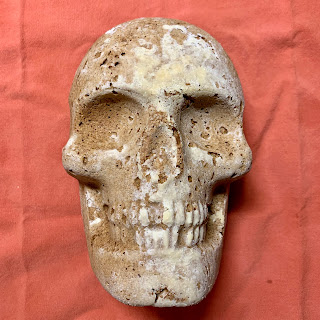
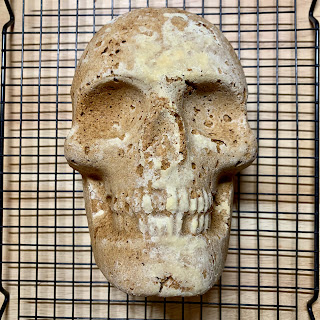
Some people make brown bread by steaming it in cans, but although that results in a very moist loaf it is not really necessary. You can bake it in a regular pan. I was feeling a little bit Goth, so I baked mine in a skull-shaped Halloween pan I have. 

Brown bread has its roots deep in New England's culinary history. It's had different names in the past, like "rye and Indian," which refers to the rye flour and the cornmeal, which was once called Indian meal since it originated with the local indigenous people. Sometimes brown bread was also called "thirds" because the recipe called for one third each of wheat, rye, and cornmeal. Wheat does not grow well in New England and was very expensive here in the 17th and 18th centuries, so the English colonists made their bread by mixing this precious commodity with the other two grains, both of which grow better in this climate.

I oiled and floured my skull-shaped ban so the bread came out looking like this!

As I made my brown bread, interesting stories about rye and cornmeal came to mind, one about the Salem witch trials and one from local Algonquin lore. 

Here is the Salem story. Most historians think the Salem witch hunt was caused by social and psychological factors. But what if there was a simple biological cause? In 1976 Linnda Caporael, a biology grad student at the University of California Santa Barbara, suggested that ergot, a fungus found on grain, might be responsible for the witch trials.

The English colonists grew a lot of rye, and during warm wet weather, ergot grows on rye. Ergot contains a compound similar to the hallucinogen LSD. People who consume rye ergot-infected with ergot can suffer from hallucinations, auditory disturbances, convulsions, strange skin sensations, vomiting, and psychosis. These symptoms sound like the symptoms suffered by the allegedly bewitched Salem girls. Carporeal argued that the spectral visions and strange fits these girls experienced were caused by the fungus.

This theory received a lot of publicity when it was published, even meriting a front-page article in The New York Times. A critique was published a few years later by Nicholas Spanos and Jack Gottlieb, two psychologists from Carleton University. They argued there was not strong evidence connecting ergotism to the Salem witch trials.

Convulsive ergotism, they claim, is only found in people with a Vitamin A deficiency. Someone with sufficient Vitamin A in their body suffers instead from gangrenous ergotism, a different variety of the disease which causes gangrene and rotting flesh. (Yikes.) The farmers in Salem Village consumed lots of dairy products, and the residents of Salem Town ate plenty of fish, both foods rich in Vitamin A. If ergot was present they should have suffered from gangrene, which they didn’t. 

Spanos and Gottlieb also point out that some symptoms of convulsive ergotism weren’t present in Salem, like vomiting and diarrhea. Most importantly, though, the afflicted girls only experienced their torments at specific times, usually in the courtroom when accused witches were brought in. Outside of the courtroom they were usually symptom-free. This strongly suggests their symptoms were not caused by ergotism. Many people who testified during the trials also said they only testified because they feared imprisonment or execution. It would be nice if the witch trials had been caused by something as simple as a fungus, but regrettably it seems that human ignorance and malevolence were more likely to blame.

That's kind of a weird and unpleasant thing to consider while making bread, but the other story is happier. It's connected to cornmeal. Corn was one of the staple foods for the local Algonquin tribes, and many tribes told stories about how it was brought to Earth from heaven by a crow. 

Here's one version of that story from Kitt Little Turtle (1940 - 2004), a Nipmuck medicine man from Webster, Massachusetts. It appears in the book Dawnland Voices: An Anthology of Indigenous Writing From New England (2014), edited by Siobhan Senier.

Many generations in the past, the Nipmuck lived only by hunting and gathering. They depended entirely on wild game and other food they could forage. Because of this they were always on the move and never settled in one place. 

One year food was very scarce and the Nipmuck were close to starvation. During this time a crow appeared in a vision to a young man. The crow told the man about a wonderful plant that would prevent the Nipmuck from starving. 

The man wanted to go find this plant, but the crow told him it was too far for him to ever find. The crow would bring it to him. The crow also told him that the crows would follow the Nipmuck forever if they grew this special plant. It was, after all, the crows' favorite food. 

A few days later the man was wandering through the woods when a crow appeared. It was the same one he saw in his vision. The crow gave the man three seeds: corn, squash, and beans. These are the Three Sisters which grow well together in the same field. The crow told the man how to cultivate and harvest these crops. 

Ever since that time, the crows visit whenever the corn is harvested to get the share that is due them. 

There you have it. Two stories, one delicious loaf of bread!

September 26, 2018

Cat Folklore, Part I: Do Cats Suffocate Babies?

My family had dogs and cats as pets when I was young. I loved them all, but for some reason I always thought of myself as a 'dog person' for many years. Maybe it was because dogs are friendly in such an uncomplicated way, or maybe it was because cats have such sharp claws.

One of our cats was a large Siamese who bit several of my friends and everyone in the family except me. I suppose I should have seen his mercy as a sign that I was actually a 'cat person', but I didn't. I only came to that realization when I finally had a cat as an adult. Unlike a dog, he was clean, quiet, and didn't take up much space. He was like the ideal room mate!

He was also very affectionate. Whenever I would lie on my back, whether napping on a bed or reading on the couch, the cat would crawl on top of my chest. Slowly he would work his way up my torso, purring every inch, until his face was touching my chin and his paws were on my neck. I would scoot him back down, but he would always make his way back up.


I have read that a cat touches your face if they like you. I've also read the theory that cats have scent glands in their paws and by touching your face they mark you as their human. I am not sure if these are theories are true, but they beat the old theory: that cats try to steal your breath, particularly if you are a baby.

This is quite an old piece of folklore, dating back to at least the 16th century England. I suspect it is even older than that. It is also an enduring myth. It was recorded here in New England by several 19th century writers. Although Fanny Bergren doesn't include it in her encyclopedic Current Superstitions, Sarah Bridge Farmer does include it in her short 1894 piece "Folklore of Marblehead, Mass.", stating simply that "Cats sat on the breasts of children and sucked their breath."

Clifton Johnson has more to say about this belief in What They Say in New England (1896):
Many believe that cats will cause the death of babies by sucking their breath. The only reason they suggest for the attraction is that the cats are attracted by the baby's breath because it is sweet. They will tell that cats have been caught in the act, and give much detailed evidence. The story ends with the killing of the cat, and a great commotion to restore the gasping baby's breath. 
I cringe at the thought of the innumerable cats killed due to misunderstanding of their motives. Although his informants, primarily farmers from western Massachusetts, believed cats suffocated babies Johnson explains it is not true:
Physicians do not credit the breath-sucking part of the stories, and I will suggest one or two explanations of the phenomena. Firstly, there might have lingered about the baby's mouth fragments of a recent lunch that the cat was removing when found with it's mouth near the baby's; and secondly, the baby's gasping may have been caused by fear of the cat, or by the alarming commotion on its account among its relatives.
While this myth is obviously not true I still hear people mention it even today. Most of them say it jokingly, but I think the humor hides an uneasiness that many people have around cats. Or who knows, maybe people are acknowledging their own weird and powerful fascination with our feline friends. 

September 12, 2016

The Woman Who Married An Owl

It's starting to feel like fall here in Boston. The days are getting shorter and the temperatures are slowly dropping. This story from the Passamaquoddy of Maine somehow seems appropriate. A little bit creepy, a little bit magical.

Once upon a there was a beautiful young Passamaquoddy woman. Her father was very protective of her and didn't think any man was good enough for her. To keep men away he set up a special challenge that any suitor needed to meet.

"If you want to marry my daughter," he said, "You must do the following: when you spit into a fire, the flames must flare up. Sounds easy, doesn't it?" But he knew it was impossible. Saliva would dampen a fire, not make it burn brighter. Many men tried to win his daughter's hand, and they all failed.

The father didn't know it, but the Horned Owl also wanted to marry his beautiful daughter. He had watched hidden in the trees as all the other men failed, but he was determined to succeed. He went to his aunt, who was a powerful owl witch, for assistance.

"Drink this," she said, pouring a potion into his beak. "You'll definitely win that beautiful girl!"

After swallowing the potion the Horned Owl turned himself into handsome young hunter. Then he went to the Passamaquoddy father's lodge and announced himself. The father laughed at him.

"You can try," he said, "but you'll never win my daughter. Spit into the flames!"

The Horned Owl spit into the flames. His aunt had spoken true. As soon as his saliva hit the fire, it roared upwards towards the ceiling of the lodge, out through the chimney hole, and high into the night sky. The father scowled, but he gave his daughter to the Horned Owl. The beautiful woman was happy, though. This mysterious young hunter was quite handsome after all...

The Horned Owl brought the woman to his lodge, and they consummated their relationship. They both fell asleep afterwards, but in the middle of the night the woman woke up. A feeling of dread overcame her as she gazed at her husband in the firelight. Huge, feathered ears protruded from his hair, and his eyes were half-open even though he was deeply asleep. As she stared at his eyes his pupils shrank to narrow slits. Her new husband had the eyes of an owl.


Realizing that her husband was not human, the woman fled from his lodge in terror, screaming as she ran back to the safety of her father's home.

The Horned Owl was quite angry, but determined to get his wife back. He once again turned himself into a young hunter, but with a different appearance. He killed many moose and deer and brought them to the woman's village.

"Hello!" he said. "I'm a lonely hunter wandering through these woods. I have plenty of game to share. Can I become a member of your village?"

The beautiful woman and her father were suspicious, but the other villagers dismissed their fears. This hunter looked perfectly normal to them, and he seemed very generous. And who doesn't like free food?

The villagers cooked the game and had a big feast. Everyone had a great time, and as the night wore on they took turns telling scary stories. Eventually it was time for the beautiful young woman to tell the story of how she married an owl.

"This story is really scary," she said, "so I don't want to speak too loudly. I need to whisper. Can everyone pull their hair away from their ears so they can hear me better?" She looked pointedly at the young hunter.

Everyone exposed their ears, except for the young hunter, who refused. The villagers teased him and yelled at him  until finally he pulled back his long hair. He had huge, feathered ears that stood up like horns. The villagers fled in panic back to their homes, screaming.

In dejection the Horned Owl flew home. He thought he'd never get to see his wife again. His witchy aunt had other ideas, though.

"Nephew be patient," she said. "In time she will forget her fear, and when that time comes you will lure her to you with music." She handed the Horned Owl a magical flute that played irresistibly beautiful sounds. He took the flute. Then he waited...

The beautiful woman and her father moved their house to the center of the village because they knew the Horned Owl was lurking somewhere out in the forest. But as the weeks passed the woman became less cautious. She hadn't seen any sign of her sinister husband. Perhaps he had moved on to other prey? Over time she slowly began to venture towards the outskirts of the village, until finally one day she went out into the forest itself.

After walking through the forest for a while she stopped to rest under a big tree. As she sat there she thought she heard a flute, softly at first and then louder and louder. It was the loveliest music she had ever heard, although somehow haunting. It seemed to be coming from somewhere high above her.

"I would willingly go with whoever is playing that flute," she said. "It's the most beautiful thing I've ever heard."

As soon as those words passed over her lips she heard the sound of huge wings above her. The Horned Owl flew down and grabbed her gently in his huge talons. He carried her off to the village of the owls, where she lived happily for the rest of her life.

*****

One of the many things I like about American Indian folklore is that animals are fully developed characters. They speak, they have motivations, and they have relationships with each other. They also have relationships with humans. Still, this story is a little creepy. That Horned Owl just won't get the hint. 

I found this story in American Indian Myths and Legends, which my in-laws gave to me recently. (Thanks Guy and Phyllis!) I think it also appears in Charles Godfrey Leland's book of Passamaquoddy stories from the 1800s.

February 08, 2016

The Devil Tries to Kill A Minister, or Why There Are So Many Rocks in New England

Here in New England we are blessed to live in a landscape filled with rocks. If you like giant house-sized boulders, or even just medium sized rocks, you'll find plenty to love in this part of the country.

But where did all these rocks come from?

Maybe I should rephrase that question as "Where the hell did all these rocks come from?," since folklore lays the blame on the Devil.

Not all of New England is rocky. Although the Cape Cod town of Bourne has lots of large rocks, the outer tip of the Cape - Wellfleet, Truro, Provincetown - has almost no boulders at all. Once again, the Devil is to blame.

Boulders!

The story goes something like this. Way back in the 1600s, an English missionary named Richard Bourne was active on the southern part of Cape Cod, helping to found towns and doing God's work in the New World. Naturally, Richard Bourne drew the ire of the Devil. The Devil lived on Cape Cod and didn't like goodie-goodies anywhere near him.

One night while Bourne was sleeping the Devil crept down from the outer Cape to the missionary's hut. He leapt upon the sleeping minister, planning to crush him with his demonic super-strength. To the Evil One's surprise, Bourne successfully fought him off, even though the minister was not particularly large or strong.

"You won this time, Richard Bourne, but I'll be back," the Devil said. "Just you wait!" He stomped away to regain his strength and scheme.

Several nights later he came back to Bourne's dwelling, and once again the minister fought him off.  Once again the Devil stomped off, vowing to return.

This went on for several years, but the Devil was never able to harm Bourne because God was on his side.

Finally, the Devil realized he had to change his plan. He gathered up all the rocks he could find on the Outer Cape and put them in his big leather apron. Then he set off for Richard Bourne's house. He was going to dump all the rocks on the minister while he slept and crush him.
The Province Lands in Provincetown: a lot of sand, but no boulders...

As the Devil slowly waked down the Cape, carrying hundreds of boulders in his apron, a chickadee flew at him from out of the woods. The swift little bird flew around the Devil, mocking his plan to crush the minister.

"Richard Bourne defeated you before, he will defeat you again!" the smarmy little bird sang.

The Devil swatted at the bird, but chickadees are fast and it flew out of his reach. Then from a distant tree branch it sang it's mocking song again.

The Devil does not have a very good temper, and he was furious that such a tiny little bird would mock such a magnificent demon as himself. With a  howl of fury he ran towards the chickadee.

As he ran he tripped over a tree branch and fell. All the boulders he was carrying in his apron spilled out and rolled across the landscape. This area is now the rocky town of Bourne.

With a big sigh the Devil walked back to the boulder-free Outer Cape, where he's remained ever since. Even a fallen angel knows when he's been beaten.

*****
This story appears in Elizabeth Renard's book The Narrow Land (1934) in a section called "Tales of the Praying Indians." Praying Indian was a term that referred to Native Americans in New England who were early converts to Christianity, and the Christian content of this story is quite strong (if you didn't notice). 

It probably has its origins in earlier pre-Christian Wampanoag legends, though. Many stories have survived telling how the Wampanoag deity Maushop, who was gigantic in size and strength, created rock formations and ocean channels. Some of them are even very similar to the one told in Renard's book. For example, in one Wampanoag tale Maushop is building  a bridge to Cuttyhunk when a crab bites his toe. Maushop drops his rocks and storms off angrily. Those rocks now form a sunken reef.

Me and some rocks in the Blue Hills.
However, anthropologist William Simmons notes in his book Spirit of the New England Tribes that Wampanoags on Cape Cod weren't the only ones telling tales about the Devil dropping rocks from his apron. The Reverend William Chaffin of Easton, Massachusetts claimed that the boulders in that town also fell out of the Devil's apron, and I've read something similar in Clifton Johnson's book What They Say in New England. So it seems like Yankees of English descent were also giving supernatural explanations for the rocks that litter the landscape.

Here in the Boston area, we have a type of stone called puddingstone (aka Roxbury conglomerate) that looks like an old-fashioned lumpy pudding with dried fruit in it. In his 1830 poem "The Dorchester Giant" Oliver Wendell Holmes humorously claims it was formed when a family of giants flung their pudding all across the landscape.

They flung it over to Roxbury hills,
They flung it over the plain,
And all over Milton and Dorchester too
Great lumps of pudding the giants threw;
They tumbled as thick as rain.

Giant and mammoth have passed away,
For ages have floated by;
The suet is hard as a marrow bone,
And every plum is turned to a stone,
But there the puddings lie.

He wasn't serious, but it's interesting that he also proposed a supernatural explanation.

We know now that New England's rocks were deposited by melting glaciers, but the old myths and legends are as much part of the landscape as the boulders themselves.

June 17, 2012

God of Wine Part I: The Windham Bacchus

One of the archetypal images of New England is the white steepled church standing next to the town common. These churches can be seen all over the region, and are a testament to early settlers' devotion to Christianity.

Sometimes, though, a little bit of paganism crept in, as this story illustrates. 

On June 10 in the year 1776 the British ship Bombrig was captured by American naval forces in Long Island Sound. Four of the ship's crew were sent to a crude jail in Windham, Connecticut.

The four men were Edward Sneyd, the ship's commander; John Coggin, the ship's Irish boatswain, who supervised the deck crew; John Russell, the ship's carpenter; and a fourth sailor named William Cook. Although the men were not tortured or particularly mistreated, prisons and jails in the 18th century were grim places where prisoners were confined in small, poorly ventilated cells and fed poorly.

Luckily for the sailors, the owner of a tavern on the other side of Windham's Green (the town common) took pity on them and provided them with good food and plenty of alcohol. Very little is known about the owner except her name - Widow Carey. Who Mr. Carey was and how he passed away is unknown. History is also mute about why she acted so charitably towards the prisoners, but it doesn't take much imagination to guess why a lonely woman might be drawn to four needy sailors. Some people just love a man in uniform!

To repay Widow Carey's charity the sailors asked their wardens for a large log, which they were given. Using just their jackknives they carved from it an image of Bacchus, the Roman god of wine.

The Windham Bacchus


Roughly two feet tall, the Windham Bacchus portrays the god as a naked chubby man astride a keg of wine. Bacchus holds a bowl of grapes and apples in front of his unmentionables, and he has chubby cheeks and a big smile. Widow Carey accepted the carving from the sailors and mounted it in front of her tavern.

In November the sailors escaped from Windham's jail and made their way to Norwich, Connecticut, where they stole a canoe. While paddling their way towards Long Island, the canoe capsized and Sneyd, Russell and Cook drowned. John Coggin survived but was recaptured.

The sailors met a grim fate, but their masterpiece lived on. Widow Carey kept it in front of her tavern for many years, until she married another tavern owner and moved it to his establishment. From there Bacchus was sold in 1827 to Lucius Albee, who ran the Staniford House tavern. Albee hung Bacchus from a giant elm tree, where it remained for many years until a large storm blew the sculpture down, breaking one of its arms. After languishing in a woodshed Bacchus was purchased for twenty-five cents, repaired, and celebrated as an iconic image from the Revolutionary War. You can now see it (or should I say him?) in the Windham Free Library.

I like to read about ancient Greco-Roman religion, so this story made my antennas perk up. I don't know much about the history of New England taverns, but it's interesting that tavern owners in Puritan-founded Connecticut would exhibit a statue of a pagan god. It's also interesting how the historical events surrounding the carving parallel ancient Bacchic myths and rituals.

Bacchus is the Roman name for Dionysos, the primordial god of wine and ecstasy. It makes sense for him to be associated with a tavern, but what about those British sailors? Dionysos was associated with water and the sea, and in some Greek rituals a statue of the god was pulled through the streets in a wagon shaped like a ship. In many myths Dionysos seeks refuge in the sea from his oppressors, and also emerges from it to triumph over his enemies. In one famous myth, Dionysos is kidnapped by sailors who want to sell him into slavery. He transforms them into dolphins and they leap into the sea.

Dionysos was also associated with trees and even was addressed as Dionysos Dendrites ("Dionysos of the Trees"). Paintings from Greece show people worshiping his image attached to a tree, and he also guarded orchards. It's only fitting that Lucius Albee hung him from an elm.

Unfortunately there is a dark side to many of Dionysian myths. People who introduced his worship into an area or city often died by drowning, much like the sailors. For example, Dionysos taught Icarius of Athens to make wine, but Icarius was drowned in a well by drunken shepherds who erroneously thought he poisoned them. As an infant Dionysos was nursed by his aunt Ino, but she was driven mad by the jealous goddess Hera and drowned herself and her son Melicertes in the sea. At the god's sanctuary in Lerna a lamb was thrown into an allegedly bottomless lake as an offering to underworld deities. 

Was there some supernatural or divine force at work in 18th century Windham? I don't want to speculate too much. After all I don't want to sound too paranoid. Maybe historic events just sometimes follow ancient mythic patterns.

On the other hand, there was an actual Bacchus cult in Windham County in the 19th century. But that's my post for next week!

************************

I got my information from History of Windham County, Connecticut (1889) by Richard Bayles, and The Story of Bacchus (1876) by Brigham Payne, William Lawton Weaver, and Samuel Peters.


January 29, 2012

Glooskap and the Giant Frog


A few weeks ago I borrowed a copy of John Hanson Mitchell's 1984 book Ceremonial Time from the library. It's a fascinating book that tries to tell the history of one square mile of Littleton, Massachusetts over 15,000 years. 

Let's face it, 15,000 years is a long long time. Littleton probably only has about 300 years of written history, so Mitchell turns to some unusual methods to unearth what happened in the past. For example, at one point he encounters what he thinks may be the spirit of an ancient Paleo-Indian shaman in the woods near his house. To help him understand this experience he enlists the help of some local American Indians.

One of them, a woman named Tonupasqua, tells him several stories about Glooskap, the mighty culture hero of the New England Algonquins. I've written about Glooskap before. He's a gigantic, super-strong, ancient magician who helped make the world safe for mankind. Sometimes he's a little bit dim, but in other stories, including this one from Ceremonial Time, he's a trickster.

A state of Glooskap in Nova Scotia.

According to the story, a long long time ago when the world was young a gigantic frog lived in New England. He was quite greedy, and built a huge dam to contain all the water in one enormous lake. This lake flooded the land where the humans lived, but they were powerless against the gigantic frog.

Unfortunately, the frog wasn't the only monster people had to deal with. There was also a giant bear whose favorite meal was human flesh.

The humans asked Glooskap to help them with these monsters. Glooskap tried several times to fight the frog, but whenever he got near it it would hide in the lake.

One day while it was sitting underwater the frog devised a sinister plan. Glooskap lived nearby in a large cave - why not hide at the back of Glooskap's cave and eat him when he came home? So it hopped out of the lake and hid at the back of the dark cave.


Glooskap came home from hunting, but hesitated outside his cave. He could sense something was wrong.

"Cave, are you glad to see me?" he said.

The frog said nothing.

Glooskap said, "Magic cave, are you glad to see me? Every evening when I return home you greet me. If you don't greet me I'll know something's wrong."

This was, of course, a lie. His cave never said anything, but the frog didn't know this. Pretending to be a magic cave, the frog croaked out, "Welcome home Glooskap!"

His suspicions confirmed, Glooskap quickly rolled a giant boulder across the entrance and trapped the frog inside.


At this point, the monstrously huge man-eating bear came strolling along. It said, "What's in the cave, Glooskap?"

Glooskap said, "Sweet, tasty humans who are hiding from you. I'll roll back this boulder so you can go inside and eat them. Sound good?"

The bear thought this did indeed sound good, so Glooskap rolled back the boulder.

The bear stuck his head in the cave, and the frog immediately shot out his giant sticky tongue and pulled the bear into the darkness. As the two giant animals began to fight Glooskap once again rolled the boulder across the entrance.

The bear and the frog fought for a long time. They fought so hard that the earth shook violently, which caused the frog's dam burst, releasing all the trapped waters. Finally, the two giant animals died, each mortally wounded in the battle.

When Glooskap told the humans what had happened they rejoiced, and the land once covered by water became fertile land where they could garden and hunt without fear of the giant bear.

There are several different versions of this myth, but I like this one. It definitely provides a different perspective on our landscape!