Showing posts with label corn. Show all posts

February 13, 2022

Hallucinations, Magic Crows, and Witches: Random Thoughts While Making Bread

The other day I made some brown bread. Many of you might be familiar with this delicious loaf, but if you're not here's the scoop. It's a bread made with rye flour, wheat flour, and cornmeal that is usually sweetened with molasses. You usually find it at clambakes these days, but in the past it was just an everyday bread. 

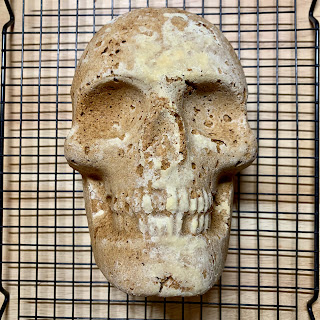
Some people make brown bread by steaming it in cans, but although that results in a very moist loaf it is not really necessary. You can bake it in a regular pan. I was feeling a little bit Goth, so I baked mine in a skull-shaped Halloween pan I have. 

Brown bread has its roots deep in New England's culinary history. It's had different names in the past, like "rye and Indian," which refers to the rye flour and the cornmeal, which was once called Indian meal since it originated with the local indigenous people. Sometimes brown bread was also called "thirds" because the recipe called for one third each of wheat, rye, and cornmeal. Wheat does not grow well in New England and was very expensive here in the 17th and 18th centuries, so the English colonists made their bread by mixing this precious commodity with the other two grains, both of which grow better in this climate.
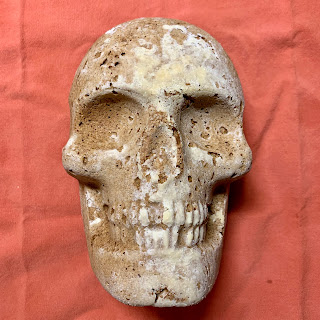
I oiled and floured my skull-shaped ban so the bread came out looking like this!

As I made my brown bread, interesting stories about rye and cornmeal came to mind, one about the Salem witch trials and one from local Algonquin lore. 

Here is the Salem story. Most historians think the Salem witch hunt was caused by social and psychological factors. But what if there was a simple biological cause? In 1976 Linnda Caporael, a biology grad student at the University of California Santa Barbara, suggested that ergot, a fungus found on grain, might be responsible for the witch trials.

The English colonists grew a lot of rye, and during warm wet weather, ergot grows on rye. Ergot contains a compound similar to the hallucinogen LSD. People who consume rye ergot-infected with ergot can suffer from hallucinations, auditory disturbances, convulsions, strange skin sensations, vomiting, and psychosis. These symptoms sound like the symptoms suffered by the allegedly bewitched Salem girls. Carporeal argued that the spectral visions and strange fits these girls experienced were caused by the fungus.

This theory received a lot of publicity when it was published, even meriting a front-page article in The New York Times. A critique was published a few years later by Nicholas Spanos and Jack Gottlieb, two psychologists from Carleton University. They argued there was not strong evidence connecting ergotism to the Salem witch trials.

Convulsive ergotism, they claim, is only found in people with a Vitamin A deficiency. Someone with sufficient Vitamin A in their body suffers instead from gangrenous ergotism, a different variety of the disease which causes gangrene and rotting flesh. (Yikes.) The farmers in Salem Village consumed lots of dairy products, and the residents of Salem Town ate plenty of fish, both foods rich in Vitamin A. If ergot was present they should have suffered from gangrene, which they didn’t. 
Spanos and Gottlieb also point out that some symptoms of convulsive ergotism weren’t present in Salem, like vomiting and diarrhea. Most importantly, though, the afflicted girls only experienced their torments at specific times, usually in the courtroom when accused witches were brought in. Outside of the courtroom they were usually symptom-free. This strongly suggests their symptoms were not caused by ergotism. Many people who testified during the trials also said they only testified because they feared imprisonment or execution. It would be nice if the witch trials had been caused by something as simple as a fungus, but regrettably it seems that human ignorance and malevolence were more likely to blame.

That's kind of a weird and unpleasant thing to consider while making bread, but the other story is happier. It's connected to cornmeal. Corn was one of the staple foods for the local Algonquin tribes, and many tribes told stories about how it was brought to Earth from heaven by a crow. 

Here's one version of that story from Kitt Little Turtle (1940 - 2004), a Nipmuck medicine man from Webster, Massachusetts. It appears in the book Dawnland Voices: An Anthology of Indigenous Writing From New England (2014), edited by Siobhan Senier.

Many generations in the past, the Nipmuck lived only by hunting and gathering. They depended entirely on wild game and other food they could forage. Because of this they were always on the move and never settled in one place. 

One year food was very scarce and the Nipmuck were close to starvation. During this time a crow appeared in a vision to a young man. The crow told the man about a wonderful plant that would prevent the Nipmuck from starving. 

The man wanted to go find this plant, but the crow told him it was too far for him to ever find. The crow would bring it to him. The crow also told him that the crows would follow the Nipmuck forever if they grew this special plant. It was, after all, the crows' favorite food. 

A few days later the man was wandering through the woods when a crow appeared. It was the same one he saw in his vision. The crow gave the man three seeds: corn, squash, and beans. These are the Three Sisters which grow well together in the same field. The crow told the man how to cultivate and harvest these crops. 

Ever since that time, the crows visit whenever the corn is harvested to get the share that is due them. 

There you have it. Two stories, one delicious loaf of bread!

January 20, 2020

Anna and Her Damn Bread: A Legendary Recipe

This past weekend actually felt like winter, by which I mean it was cold and we got some snow. The recent 70 degree weekend was pleasant but a little freakish. Give me a cold snowy weekend instead! I know some of you out there hate snow but it always makes me happy to see it falling. It also makes me want to bake.

I'm still recovering from eating too many cookies and too much candy over Christmas, so I decided to bake some bread rather than a dessert. A wintry New England weekend calls for a classic New England recipe: anadama bread.


Anadama bread is a yeasted bread made with wheat flour, cornmeal, and molasses. Its consistency and taste is somewhere between cornbread and traditional sandwich bread. You can certainly use it to make sandwiches, but I think it's best just toasted and spread with butter. 

The cornmeal and molasses are dead giveaways that anadama bread originated in New England. These two ingredients feature in classic Yankee recipes like Indian pudding and brown bread and have deep roots in New England history. Corn (aka maize or Indian corn) has been part of the local diet for thousands of years. The Pilgrims stopped by Provincetown in 1620 on their way to Cape Cod and stole some corn that the local Wampanoags had stored there. That's how deeply rooted corn is in local history. 


Molasses also has deep roots in New England as part of what's known as the Triangular Trade. In the 1700s distilleries in New England produced rum from molasses, which merchants then traded in Africa for slaves. The slaves were transported to the Caribbean to work on sugar plantations which produced molasses. The molasses was then brought to New England to be distilled into rum which was traded in Africa for more slaves to make more molasses to make more rum... You get the picture and it's pretty grim. I tend to think of molasses as a quaint ingredient used in gingersnaps and molasses cookies but it does have an unhappy history. 

Back to the bread. There are two legends that explain anadama bread's unusual name, and they both center on a woman named Anna. In the first, Anna is the wife of a Cape Ann fisherman and she is a lousy cook. A really lousy cook. Every day she serves her husband the same exact thing for breakfast, lunch and dinner: cornmeal mush sweetened with molasses. Finally he can't take it anymore. He screams "Anna damn her!" and combines the cornmeal mush with flour and yeast to make bread. Thus we have anadama bread. 

In a second, less prevalent legend Anna is the wife of a sea-captain. This Anna is a great cook and provided baked goods for her husband's long ocean voyages that never spoiled or went bad. Still, the captain always referred to her as "Anna damn her" to his ship's crew, and her bread became known as "Anna damn her's bread." Thus we again have anadama bread. When Anna died the captain put the following on her tombstone: "Anna was a lovely bride, but Anna damn her, up and died." 


I don't know if either of these stories are true. They're pretty vague (what was Anna's surname and when did she live?) but the bread's unique name has no good historical explanation. None. Some people have suggested the recipe was created by Finnish fishermen or stonecutters living in Gloucester or Rockport, but I couldn't find anadama in the Finnish dictionary. The stories about Anna and her damned bread are the best explanations we have for the name.

Food historian Joyce White, on her blog A Taste of History, notes that "anadama bread" was filed with the U.S. Patent and Trademark Office in 1850 as a brand of bread and was used in 1876 by a company called Anadma Mixes, Inc. The bread is definitely connected to Cape Ann. A man named Baker Knowlton produced the bread in Rockport by the end of the 19th century and shipping it across New England. 


Me and my bread! My expression's kind of odd...
If you have a hankering for anadama bread, rich in legend and history, you can probably buy some at the supermarket. When Pigs Fly, the bread company from York, Maine, sells a multi-grain version that is widely available. Anadama bread is not that hard to make, though, and you can find lots of recipes online (like this one from Yankee Magazine). Baking bread is great way to spend a cold, wintry day.


*****
My source for the two legends is Morris Dictionary of Word and Phrase Origins, second edition (1988 ) by William, Mary and William Otis Morris. 

February 12, 2012

Indian Pudding: The World's Oldest Recipes


It was kind of cold here yesterday, and we actually had a few snowflakes. Most of this winter has been freakishly mild, but yesterday it finally felt like the temperature matched the season. To celebrate I decided to make Indian pudding.

As a lot of people know, and I've written here before, New England Indian pudding doesn't have anything to do with the flavorful and spicy cuisine of South Asian. Despite its name it's really an old Puritan dish that has been made in this area for hundreds of years.

Stirring together cornmeal and milk.
 When the Puritans came to North America they brought their love of puddings with them. Wheat flour is one of the key ingredients of English style puddings, but unfortunately wheat didn't grow well in New England. Not wishing to be deprived of pudding the Puritans adapted their recipes to incorporate Indian corn (maize) and voila! Indian pudding was born.

The first cookbook in America, Amelia Simmons' 1796 American Cookery, contains three recipes for Indian pudding.

No. 1. 3 pints scalded milk, 7 spoons fine Indian meal, stir well
together while hot, let stand till cooled; add 7 eggs, half pound
raisins, 4 ounces butter, spice and sugar, bake one and half hour.

No. 2. 3 pints scalded milk to one pint meal salted; cool, add 2 eggs,
4 ounces butter, sugar or molasses and spice q. f. it will require two
and half hours baking.

No. 3. Salt a pint meal, wet with one quart milk, sweeten and put into
a strong cloth, brass or bell metal vessel, stone or earthern pot,
secure from wet and boil 12 hours.

I'm amazed to see that number three takes twelve hours to cook! Wow! These are the oldest Indian pudding recipes on record, and obviously come from an era when cooking was much more difficult.

Most modern recipes for Indian pudding have four key ingredients: cornmeal, molasses, milk, and spices. I used this recipe from New York Times writer Mark Bittman. It didn't take 12 hours, but it did take about two and half.

Like a lot of other recipes I have seen, one key step is to pour some milk directly on top of the pudding and then put it in the oven without stirring.

Pour the pudding into a greased pan...


... and then pour milk right on top!


Somehow it all magically works and it gives the pudding a nice texture. Do any foodies out there know why this is?


Two hours later, a humble looking but heavenly dessert!


Indian pudding is not what you would call a glamorous dish. When it comes out of the oven it's brown and kind of goopy looking. It was really delicious though!

July 28, 2011

Conscateous Air


A few weeks ago I went to Kansas City, Missouri for work. Wow, was it hot! The temperatures were well over 100 degrees during the day, and at night they were still in the 80s. It was really humid too. It was thick and sticky.

In New England, we've been lucky to escape the worst of the monster heat wave that's torturing the middle of the country. But although most people hate the heat and humidity, it may have a positive side.

Well, at least according to the Old Farmers Almanac. The almanac's writers claim that the warm, damp air so prevalent in July is good for growing corn. The term "cornscateous air" was supposedly used by early almanac writers to describe hot, humid, corn-promoting weather. Cornscateous. Things in Kansas City were really cornscateous.


I kind of wonder if the people at the almanac's office in Dublin, NH are just pulling our legs with this word. I've never seen the word "cornscateous" anyplace except in their almanac or someplace that references their almanac. I couldn't find it in any dictionary. And who exactly were these early almanac writers anyway?

Maybe I'm being too skeptical. Perhaps if I were a farmer, or liked miserable humid weather, I'd be more familiar with the word. However, I did buy some local corn at the farmers' market, and it was great. Whether I like it or not, I guess we're getting just the right amount of conscateous air in Massachusetts.

January 03, 2010

Anadama Bread


It's been snowing for 36 hours non-stop. The weather forecast says it might stop by midnight, but right now it's snowing harder than ever!

On a snowy day I like to make bread, and today's loaf of choice is Anadama bread. It's very New England!

Some quick facts:

  • Anadama bread supposedly got its name when a Yankee farmer came home from a hard day in the fields to find his wife Anna had once again prepared nothing but boiled cornmeal mush for dinner. "Anna, damn her!" he shouted, and mixed the flavorless mush with molasses, flour, yeast and salt. The result? A delicious bread.
  • Another variation on this legend claims that Anna was actually very good at baking. When she died her husband missed her bread so much he wrote this on her tombstone: "Anna was a lovely bride, but Anna damn her up and died!"
  • Anadama is basically a sandwich style bread, but with cornmeal and molasses. Imagine Indian pudding in a loaf. Yum
  • I'm using a recipe from Baking Illustrated by America's Test Kitchen, but there are plenty of recipes on the Web, like this one. The Old Farmer's Almanac has a slight variation that involves boiled molasses and a story about a fisherman instead of a farmer.
  • The true origins of this bread are murky. For instance, Wikipedia and this site owned by the Smith family of Rockport claim the bread's origins can only be traced back to the 1940s. However, the Food Timeline notes that the U.S. Patent office has a patent from 1850 for Anadama bread, so it was probably being baked since the mid-19th century.


August 30, 2009

Full Corn Moon - with Music


Next week's full moon is the Full Corn Moon, according to the Old Farmer's Almanac. I tend to think of fresh local corn as a summer thing, but the corn season is at it's height now. Some years if we're lucky we can buy local corn until Halloween.

Corn, or maize, is of course native to the Americas, and was probably first grown in New England around 1,000 A.D. It became more integral to the Algonquian's diet in the following centuries, particularly in southern New England where the weather was milder. (This info is from Kathleen Bragdon's Native People of Southern New England 1500-1650). Maize was believed to have been a gift from the gods.

I have a neighbor who is American Indian, and one summer she was growing corn with red, black and yellow kernels in the neighborhood garden. This is often called Indian corn and is used for wreaths and centerpieces in the fall, but as she pointed out "All corn is Indian corn. The correct term is decorative corn." Point taken!

The English settlers coined the term Indian corn. In Britain, the word "corn" refers to any grain. Wheat, oats, barley, whatever - it's all corn to the British. When they arrived in the New World they called maize Indian corn to differentiate it from all the other things they called corn. Gradually the term for maize just became corn, with Americans calling wheat, barley, oats, etc. grain or cereal.

The Algonquians in New England had some interesting recipes for corn. In addition to roasting, boiling and mashing it, they would:

  • According to Roger Williams, "bake bread of Indian corn which they call pagataw; with this and austres (oysters) a kind of snail, they make a dish which is widely used."

  • According to Timothy Alden, "pound mature corn fine, sift it, make it into a dough with water or bear oil, cover the dough with leaves or pat it into little inch-thick cakes, and bake it in the ashes."

Bear oil is hard to find these days at the supermarket, but you can still find oysters. The favorite corn dish for the English was Indian pudding, which I discussed earlier this year. (Recipes are from Indian New England Before the Mayflower by Howard Russell.)

Finally, in an effort to take advantage of the Web's multi-media capacities, here is a link to Vanessa Williams singing "Colors of the Wind" from Pocahontas, Disney's animated take on colonialism and cultural conflict. It has the lyric: "Have you ever heard the wolf cry to the blue corn moon?" The movie may be a little hokey, but at least they didn't tack on a happy ending, and the song is good.