Showing posts with label winter. Show all posts

February 12, 2017

Pot Sasquatch, The Boston Yeti, and The Return of The Wildman

Before I delve into this week's topic, I wanted to let you know I will be speaking at Boskone, New England's longest running science fiction and fantasy convention. Boskone 54 takes place February 17 - 19 at the Westin Boston Waterfront at 245 Summer Street. On Saturday afternoon I'll be moderating a panel titled "New England: The Legend, The Lore, The Mystery," and on Sunday at noon I'll be participating in a panel on how fiction writers use mythology in their work. If you are attending Boskone be sure to say hello! I am sure it will be a great convention.

Now, onto this week's topic. The groundhog saw his shadow, predicting six more weeks of winter, and that certainly seems to be the case in New England. We just had a blizzard last week, and now another storm AND a blizzard are on track for today and tomorrow. Nature's fury has been unleashed, and along with ice and snow our region has been visited by some mysterious creatures.

On February 9, Channel 22 meteorologist Janille Paglie was reporting from Springfield about that day's blizzard when she and her crew noticed something odd behind her. Someone dressed in a Sasquatch costume covered in pot leaves was cavorting around in the snow. At first the "creature" played some hide and seek, and then frolicked openly in the street. Channel 22 dubbed it Pot Sasquatch, and it became an internet sensation.

Pot Sasquatch reminded me of the Boston Yeti, who roamed the deserted streets of Boston during the Snowmageddon blizzards of 2015. Like Pot Sasquatch, Boston Yeti was clearly a human in a cryptid costume who appeared during inclement winter weather. The yeti was eventually revealed to be Someville resident John Campopiano, who said in an interview with The Improper Bostonian that he was always fascinated with UFOs and Bigfoot as a child. The yeti outfit was an old Halloween costume he owned which he felt compelled to don during the 2015 snowstorms. There was very little snow here in 2016, but the Boston yeti did emerge from hibernation for the February 9 blizzard.

OK, so what's going on here? Why did Massachusetts see not one but two cryptid impersonators playing in the same blizzard? Some photos might help explain the situation a little bit.

Boston Yeti (Somerville, Massachusetts)
Pot Sasquatch (Springfield, Massachusetts)
Krampus (Ischgl, Austria)
European winter mummer, photo by Charles Freger
Many regions of Europe have traditions of people in monstrous costumes parading at winter. Krampus is probably the one best known in the United States, but there are other similar traditions across Europe. The costumed celebrants in these processions often represent the cold dark forces of winter, although sometimes they instead represent the powers of spring that ultimately banish winter for another year. These mythical creatures are frightening, magical, and sometimes playful, and they are an important part of local seasonal celebrations.

We don't have those traditions in the United States. Some folklore-minded Americans are trying to create Krampus processions here in the States, but I am not sure if it will ever catch one. Most Americans associate spooky costumes with Halloween, not the winter. But when I see Pot Sasquatch and Boston Yeti, I can't help but wonder if our own indigenous version of these traditions might be forming spontaneously. Krampus needs a lot of explanation, but most Americans know what Sasquatch and the Yeti are.

Even if Sasquatch processions don't become a tradition, I think Pot Sasquatch and Boston Yeti show that some people yearn to dress up like monsters in the winter, and that other people repond to them. It just feels right somehow. Maybe the winter makes us wish we could sprout fur and run wild.

Humans have been dressing up as monsters for thousands of years. The ancient Greeks paraded around in satyr costumes, Medieval Europeans dressed like leaf-covered wildmen, and Austrians still disguise themselves as Krampus. Now someone in Springfield has dressed like Pot Sasquatch. He may just seem like a weirdo looking for attention, but he's really the latest incarnation of an ancient time-honored tradition.

December 03, 2012

Glooskap Encounters Winter, and Why Foxes Are Shy

Although astronomically winter always starts on the solstice, according to meteorologists winter starts here on December 1. In other words, December 21 may be the time when our hemisphere is tilted farthest away from the sun but the wintry weather actually kicks in three weeks earlier. We've already had a little bit of snow in Boston this year, so despite our current warm spell I concur with the weathermen on this one.

In honor of the wintry weather here is a Penobscot folktale about Glooskap, who I've written about a few times in the past. He's the culture hero and trickster god of the Indian tribes of Northern New England and the Maritime Provinces. A being of gigantic size, strength and magical power, Glooskap is the protector of mankind but also sometimes gets involved in comical adventures. Sometimes things don't turn out quite the way Glooskap plans.

A Glooskap (or Glooscap) statue from Parrsboro, Nova Scotia.


The story, which I found in Frank Speck's 1935 collection "Penobscot Tales and Religious Beliefs" in The Journal of American Folklore, goes something like this.

 ****

A long, long time ago Glooskap was living with his grandmother, the Woodchuck. Winter had come and brought with it heavy snow and very cold weather. All around Glooskap the Penobscot were starving and freezing to death.

Glooskap said, "Grandmother this is terrible! I must put a stop to this thing called winter. Where does it come from?"

Grandmother Woodchuck said, "Winter comes from the far, far north. It is so cold that no one can live there. If you went there you would die!"

"I must try," Glooskap said. "Make me six pairs of snowshoes - two made from caribou hide, two from deer hide, and two from moose skin."

Grandmother Woodchuck did as he asked, and Glooskap set out to put an end to winter. He walked north through the snow and ice for many days. He walked for so long that he wore out first the moose snowshoes, then the deerskin ones, and finally even the caribou snowshoes. He walked on for many days even after the final snowshoes had fallen apart, until he finally came upon a house made of ice.

Glooskap entered the house, and the door closed shut tightly behind him. Inside the house was an old man.

Glooskap addressed him using the polite term for an elder. "Grandfather, could you open the door? It is very cold in here."

The old man mimicked Glooskap, saying back to him "Grandfather, could you open the door? It is very cold in here."

Glooskap could feel himself freezing solid. Through chattering teeth he said, "Grandfather, I am nearly frozen to death."

The old man laughed and again repeated Glooskap's words to him. "Grandfather, I am nearly frozen to death."

And then Glooskap froze solid and died. The old man dragged Glooskap's giant body outside of the house and threw it in the snow, but in the spring Glooskap thawed out and came back alive. The ice house had melted away and he started the long walk back home.

****

That's a pretty stark ending. The moral seems to be winter is coming, and there's not much you can do about it. Now of course there is another tale where Glooskap steals summer from some magicians and finally teaches the wintry old man a lesson, but isn't it really more appropriate for the spring? Right now we just need to make peace with winter. I don't want to end this post on a really depressing note though, so here's a raunchy story about what happened to Grandmother Woodchuck while Glooskap was away. It also incidentally explains why foxes are shy.

****

While Glooskap was away up in the north Grandmother Woodchuck sat up in her wigwam every night, waiting for him to come home.


Some mischievous foxes who lived nearby learned of this and decided to play a trick on her. One night they came to her door, and one fox imitated Glooskap, saying, "Grandmother, I am home." When Grandmother Woodchuck opened the door the foxes urinated in her face and then ran off into the dark, laughing.

The foxes thought this was so funny that they did it again the next night. And the next. This went on for several months, until Grandmother Woodchuck was nearly blind from being sprayed with fox urine. You would think she would learn a lesson after the first few times, but she was so concerned about Glooskap that she still opened the door every night.

That spring Glooskap finally made his way back home after thawing out. He stood outside her wigwam and said, "Grandmother, I am home."

Grandmother Woodchuck said, "You damn foxes fooled me all winter, but I won't be fooled again. I've had enough. Go away! I'm not opening the door."

Glooskap said, "No grandmother, it is me!" He stuck his hand in the door, and when Grandmother Woodchuck felt his hand she knew Glooskap was really home.

Glooskap healed his grandmother's eyes, and she explained what had happened. Glooskap was furious. He took his bow and arrows and went hunting, and killed every fox he could find. Then he trapped one fox alive and brought it to his grandmother.

Grandmother Woodchuck tied the fox to a pole whipped it with switches until it apologized. When she set the fox free it ran off into the woods and was never seen again. And because of this, foxes are now shy and avoid people's houses.

**** 

I don't recommend shooting foxes (they're too darn cute!), but I don't recommend pranking elderly grandmas either. Happy meteorological winter!

February 12, 2012

Indian Pudding: The World's Oldest Recipes


It was kind of cold here yesterday, and we actually had a few snowflakes. Most of this winter has been freakishly mild, but yesterday it finally felt like the temperature matched the season. To celebrate I decided to make Indian pudding.

As a lot of people know, and I've written here before, New England Indian pudding doesn't have anything to do with the flavorful and spicy cuisine of South Asian. Despite its name it's really an old Puritan dish that has been made in this area for hundreds of years.

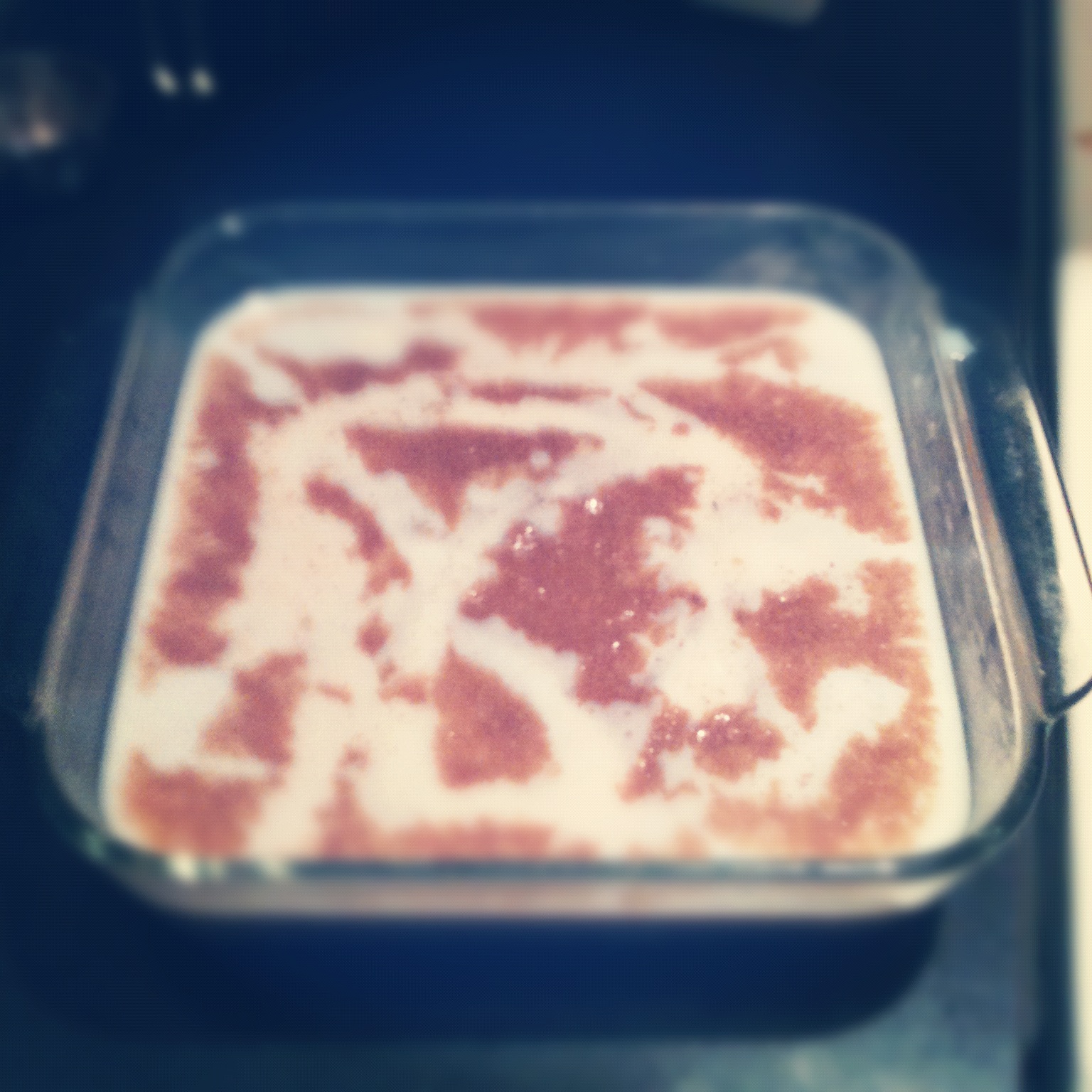
Stirring together cornmeal and milk.
 When the Puritans came to North America they brought their love of puddings with them. Wheat flour is one of the key ingredients of English style puddings, but unfortunately wheat didn't grow well in New England. Not wishing to be deprived of pudding the Puritans adapted their recipes to incorporate Indian corn (maize) and voila! Indian pudding was born.

The first cookbook in America, Amelia Simmons' 1796 American Cookery, contains three recipes for Indian pudding.

No. 1. 3 pints scalded milk, 7 spoons fine Indian meal, stir well
together while hot, let stand till cooled; add 7 eggs, half pound
raisins, 4 ounces butter, spice and sugar, bake one and half hour.

No. 2. 3 pints scalded milk to one pint meal salted; cool, add 2 eggs,
4 ounces butter, sugar or molasses and spice q. f. it will require two
and half hours baking.

No. 3. Salt a pint meal, wet with one quart milk, sweeten and put into
a strong cloth, brass or bell metal vessel, stone or earthern pot,
secure from wet and boil 12 hours.

I'm amazed to see that number three takes twelve hours to cook! Wow! These are the oldest Indian pudding recipes on record, and obviously come from an era when cooking was much more difficult.

Most modern recipes for Indian pudding have four key ingredients: cornmeal, molasses, milk, and spices. I used this recipe from New York Times writer Mark Bittman. It didn't take 12 hours, but it did take about two and half.

Like a lot of other recipes I have seen, one key step is to pour some milk directly on top of the pudding and then put it in the oven without stirring.

Pour the pudding into a greased pan...


... and then pour milk right on top!


Somehow it all magically works and it gives the pudding a nice texture. Do any foodies out there know why this is?


Two hours later, a humble looking but heavenly dessert!


Indian pudding is not what you would call a glamorous dish. When it comes out of the oven it's brown and kind of goopy looking. It was really delicious though!

January 08, 2011

Suspended Animation in Vermont


Once the December holidays are over winter in New England can be tough to get through. Wouldn't it be nice just to sleep through the cold dark months like bears do?

According to an article in the December 21, 1887 edition of Vermont's Argus and Patriot newspaper, some farmers in Calais, Vermont could. They knew the secrets of suspended animation, and used their technique on the old and infirm during those winters when food was in short supply.

To begin the process, the farmers would feed their elderly relatives a special chemical brew (ingredients unknown) which induced a comatose state. After leaving the comatose elders outside overnight in freezing weather, the farmers would build a large wooden box.

When this was completed they placed about two feet of straw in the bottom; then they laid three of the frozen bodies on the straw. Then the faces and upper part of the bodies were covered with a cloth, then more straw was put in the box, and the other three bodies placed on top... Boards were then firmly nailed on the top to protect the bodies from being injured by carnivorous animals that make their home on these mountains.

The box was left outside to be buried in snow. In early May, the farmers would open the box and thaw their relatives out with hot water and hemlock, just in time to help plant the corn.

Sadly, the story doesn't seem to be true. In his book Green Mountains, Dark Tales Joseph Citro explains that Allen Morse, a Calais farmer and teller of tall tales, told this story to his daughter one day to entertain her. She worked at the Argus and Patriot, and arranged to have the story printed as a gift on his 52nd birthday. Its title? "A Strange Tale"!

However, Citro says he isn't 100% certain "A Strange Tale" was a hoax. He claims the University of Vermont still fields questions from scientists asking about the technique. I don't know how they answer.

I guess in closing I'll just say that no matter how tempting this sounds you shouldn't try it at home!

August 25, 2008

Cold Winter Ahead for 2009?


I love the Old Farmer's Almananc! It's full of great information about celestial phenomena, sunrises, full moons, etc. For example, did you know our next full moon on September 15th is called the Harvest Moon? If you didn't, you do now.

The 2009 Farmer's Almanac claims that winter 2009 will be a cold one, according to this article in the Boston Globe:


The editors of the almanac claim an 80 - 85% accuracy rate for their predictions. Their Web site is at: http://www.almanac.com/