Showing posts with label New England folklore. Show all posts

June 11, 2023

Strange and Stranger: Some American Fairy Encounters

I had the day off today, and spent some time organizing my books. As I was moving my musty tomes around I picked up Fairies: Real Encounters with Little People by Janet Bord, something I haven't looked at in a few years. Published in 1997, Fairies gives a nice overview of fairy lore and encounters from around the world. 

Although much of the book deals with the Ireland and Great Britain, Bord does devote a chapter to fairies from other places. The chapter is evocatively titled "Dwarfs, mummies, and little green men: Little People around the world." Bord discusses some interesting fairy encounters from the United States in the chapter. Here are a few of my favorites, in increasing order of strangeness.  

STRANGE: In the 19th century, a young man in Snowhill, Maryland, was wooing a young woman who lived in the nearby town of Pocomoke. One night he discussed marriage with her, but they argued because she was not really keen on the idea. As he rode away from her house in his wagon, the man noticed something strange. A little man wearing a green plaid jacket and yellow necktie stood near the woods. The little man smiled but didn't speak, even when the young man tried to start a conversation. Unnerved, the young man whipped his horses and rode off. Even though the horses were galloping at a good speed, the little man in green ran after the wagon and caught up to it. He ran next to the wagon, smiling maniacally at the young man. The little man disappeared once the wagon left Pocomoke. The young man believed the strange occurrence was an omen, warning him away from the young woman. He stopped seeing her and eventually married someone else. 

STRANGER: In an undated encounter from the Morongo Valley of California, a man was driving his truck when a little green man ran into the road. He braked and came to a sudden stop. As he sat in the truck, trying to figure out what he had just seen, he heard a noise coming from underneath his truck. He got out and saw that the little green man was trying to remove a protective metal plate near the radiator. The man got back in his car, drove to a nearby friend's house, and wired the plate back in place. The next day he found the screws lying in the road where the little green man had removed them. 

STRANGEST: The weirdest story comes from Farmersville, Texas. In 1913, a boy named Silbie Latham and his two brothers were out cutting cotton when their dogs started barking wildly. The boys ran to see what was upsetting the dogs.

What they found was a little man about eighteen inches tall, and dark green in colour. He wasn't wearing any clothes, but his body looked like a rubber suit, including a hat that looked like a 'Mexican hat.' As the boys looked on, the dogs jumped on the little man and tore him to pieces. The boys saw that he had human-looking internal organs, and red blood. Afterwards, the dogs avoided the spot where the remains lay rotting in the sun, and they seemed frightened. Next day, when the boys went to the place again, there was nothing to be found, not even a bloodstain (Janet Bord, Fairies: Real Encounters with Little People (1997), p.71)

Many years later, in 1978, Silbie Latham told his story to a staff person at the Fort Worth Museum of Science and History. The staff person said that Latham clearly believed the story to be true, and rejected the staff person's suggestion that the little green man had just been a large frog. 

That's really an insane story, right? Things must be bigger and weirder down in Texas, because Bord does include a few stories from Massachusetts in the book, but they're not nearly as crazy as that one. For example, she discusses the Dover Demon, the infamous humanoid cryptid seen in Dover, Massachusetts on April 21 and April 22, 1977 by several teenagers. The first person to see the creature was Bill Baxter, age 17, who was driving down a wooded road with two friends. He saw a creature that looked like this:

That drawing is the actual one Bill made that night. He claimed he saw a creature about the size of a baby, with long spindly limbs and fingers that wrapped round the rocks. Its eyes glowed bright orange in the car headlights. His two friends did not see the creature, but three other teenagers did, including John Baxter, age 15, who was walking home from his girlfriend's house. Baxter drew the following picture:

The creature was dubbed "The Dover Demon" by cryptozoologist Loren Coleman, and the name stuck. The Dover Demon has become pretty famous, and is one of those creatures that has never really been pigeon-holed or satisfactorily categorized. Was it one of the Little People, as Janet Bord suggests? Was it an extraterrestrial creature of some kind? Or was it all just a hoax? There's no clear answer, and no one saw the Dover Demon again. 

Janet Bord includes a couple other encounters from Massachusetts, and unlike the Dover Demon they involve beings that are more obviously fairies. In the spring of 1974, teenaged Jane Woodruff was walking to high school in Lexington with a friend when they saw something - or rather someone - sitting in patch of weeds on the side of the road. It was a leprechaun.

'Did you see that?' we exclaimed in unison. Surprisingly enough, we both described the leprechaun the same way: green clothes, a long thin curved golden pipe between his lips and a flopped-over conical cap (Janet Bord, Fairies: Real Encounters with Little People (1997), p.73) 

A year later, Woodruff and a friend named Orin saw hundreds of small fairies dancing in a field of blue wildflowers in the town of Ashby. The fairies were only around 5 inches tall. Although the thought of encountering hundreds of fairies is a little unnerving - what if they swarm you? - Woodruff's stories are very gentle compared to the others.

In Fairies, Bord evaluates the many possible theories about what fairies might be. For example, some people think they are really extraterrestrials, some think they are the remnants of an earlier and smaller human race, and others theorize they could perhaps be the spirits of the dead. Bord reviews all the different theories, and concludes that there's really no strong evidence for any of them. And yet people still continue to encounter them, in stranger and stranger ways. 

November 12, 2022

Mother Carr, the Witch of Weare: Turn Your Clothes Inside Out

A few weekends ago I went to the library and randomly looked through the histories of some New Hampshire towns, hoping to find interesting stories about witchcraft and ghosts. Many 19th century town histories include those local legends, and I was happy to find several stories I had not read before. 

Some of those stories were about Mother Carr. She lived in Weare, New Hampshire in the early 1800s, and many people suspected her of being a witch. There are several accounts of her allegedly bewitching her neighbors, including this one.

Antique postcard of Weare, NH from Wikipedia

One summer day some of Mother Carr's neighbors went berry-picking in the woods. It was a very successful trip. They returned carrying buckets that overflowed with ripe juicy berries. When Mother Carr saw all the delicious berries she asked if she could have some, but her neighbors refused. She stomped off angrily, telling them they would regret their stinginess. (Cue the ominous music...)

A few weeks later, the same group of neighbors went into the woods to pick berries again. And once again, they filled their buckets with plump, juicy berries. But as they began to make their way back to Weare they became lost. They wandered around for hours, unable to find the path that led home. No matter how hard they tried they couldn't find their way out of the woods, even though they had been there many times before. 

Suddenly, one of the berry-pickers remembered Mother Carr's angry words, and realized she had cursed them. They would never find their way home as long as they were under her spell! Someone suggested that if they turned their clothes inside out the spell would be broken. It sounded foolish, but everyone was afraid of being stuck in the woods overnight, so they turned their coats, shirts, pants and skirts inside out. To their amazement, it worked. Although they were tired and bedraggled, they were able to find their way out of the woods.

Antique postcard of Weare, NH from Wikipedia

That is the end of the story. It might sound alien to a modern reader, but turning your clothes inside out is a very old form of folk magic. However, it was most often used to prevent fairies from leading you astray, not witches. As the 17th century English poet Richard Corbet wrote in his poem "Iter Boreale":

As in a conjurers circle, William found

A menes for our deliverance: Turne your cloakes,

Quoth hee, for Puck is busy in these oakes:

If ever yee at Bosworth will be found,

Then turne your cloakes, for this is Fayry-ground.

Special thanks to Beachcombing's Bizarre History Blog for posting this piece of poetry! I am not 100% sure of the metaphysics behind this folklore, but I think turning your clothes inside out is supposed to confuse the fairies, which makes them stop hexing you. 

But why would people in New Hampshire do this when they were lost in the woods? When the English Puritans came to New England they didn't bring much fairy folklore with them, but they did bring a lot of witch lore. Instead of blaming misfortunes on fairies they blamed them on unpopular neighbors (like Mother Carr) they thought were witches. Practices that were once used to protect against fairies were used to protect against witchcraft. 

I found this story in William Little's 1888 book The History of Weare, New Hampshire, 1735 - 1888. These old history books are amazing. You never know what you'll find!

June 26, 2022

Don't Mess with Thankful Buck: Witchcraft, Black Cats, and A Punished Husband

In my last post, I wrote about Nathan Selee, an alleged wizard who lived in Easton, Massachusetts in the 18th century. People in New England believed that witchcraft ran in families, so it's not surprising one of his sisters was also considered a witch. Her name was Thankful Selee Buck.

Once again, I get my information about the Selee family from William L. Chaffin’s History of the Town of Easton (1886). The stories about Thankful are not as outrageous as those told about her brother. There are no demonic imps running sawmills, or mysterious strangers presenting books of evil magic. Instead, we mostly have classic New England tales of witchcraft.

For example, Chaffin writes that "Loads of hay were sometimes stopped in front of her house, and could not move until she gave the signal, when a black cat was seen to come out from under the hay and glide away." This type of legend is associated with many other witches across New England, although not always with a black cat involved. And just what (or who?) was that mysterious feline? 

A neighbor was said to have caught a black cat doing some mischief, and to have given her a severe beating on the head; the next day it was observed that Thankful Buck had lost an eye. (Chaffin, History of Easton)

Stories about mysterious animals and injured witches have been told in New England for hundreds of years, starting with the Puritans. It was widely believed that witches could project their souls out of their bodies in the shape of animals. These animals were still subject to physical harm, though, so if someone hurt the animal the injury would appear on the witch's human body. Ouch! In some stories, the animals are even killed, which causes the witch to die.

Photo courtesy Library of Congress

Chaffin does tell two stories about Thankful Buck that are more unusual. They both relate to her family. First, he writes that she was "said to have performed her incantations at midnight with her daughters, one of whom inherited her name and reputation, by pouring water from one pan into another." As I mentioned, New Englanders believed witchcraft ran in families, so it makes sense people in Easton thought at least one of Thankful's daughters was a witch. The detail about using two pans of water is an interesting one, and I don't think I've seen that one before. If anyone tries this at midnight, let me know the result!

Finally, Chaffin writes that Thankful once sent her husband to buy her a particular type of wool fabric. He returned home empty-handed, and was unable to enter the house due to an angry Thankful's magic. Only when he came home with the fabric was he able to get into the house. This story makes me laugh - do not make a witch angry! - but it also points out how often these stories about the fear of powerful women. Clearly, she was the one in charge of the Buck household. 

William Chaffin claims that even when he was writing in 1886, some of his Easton neighbors still believed these stories were true. Chaffin is skeptical; he wonders, for example, why Thankful Buck didn't use her magic to save her eye, or if perhaps Thankful and her brother Nathan deliberately cultivated reputations as witches to instill fear in their neighbors. 

I suppose that's possible - see for example the Dogtown witches - but I think it's more likely the Selees and Bucks were just unpopular with their neighbors. Perhaps they were demanding, or maybe they were rude and ill-mannered. It didn't take much to get accused of witchcraft in these small New England town. Happily, they lived after the witchcraft trials ended, so they were not brought to court or executed. I appreciate these old witchcraft legends, but I always try to remember they were about real people, not magical witches. 

April 18, 2021

Rats, Cats, and Death: Horror on Haskell Island

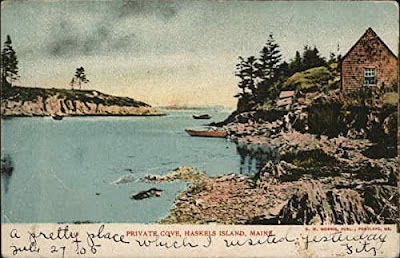
Haskell Island is located off the coast of Harpswell, Maine. It's a small island, and apparently has no full time residents these days, just vacation homes. It looks quite idyllic, but like many quaint New England locales Haskell Island has a strange past. 

According to legend, the island was first colonized by the two Haskell brothers, way back in the 1600s. The Hakells were very industrious and transformed the island into an agricultural paradise. They planted an orchard, plowed the land into fertile fields, and fished in Casco Bay. The brothers prospered in their little Eden. 

Unfortunately, one day they accidentally brought some rats to the island in their boat while transporting supplies. Haskell Island had everything the rats could want: food, water, places to nest, and no predators. The rats multiplied rapidly and soon threatened the brothers' livelihood.

Antique Haskell Island postcard from Amazon. "A pretty place which I visited yesterday..."

To stop the rats, the Haskell brothers brought a couple of cats to their island. The brothers didn't provide any food for the cats and expected them to survive by killing rats. The cats met their expectations. They ate rats, and there were so many rats that the cats thrived and multiplied. Soon there were more cats than rats, and eventually there were no rats left at all, just an island full of hungry cats. 

The cats roved the island, howling with hunger. They climbed the apple trees, roamed the fields, and paced the shore, looking for something to kill and eat. 

The Haskell brothers had to do something about the ravenous felines, but something happened before they could devise a plan: one of them became sick. He fell seriously ill, so his brother took the boat and went to the mainland to get a physician. "Hurry back," the sick brother said weakly as he lay in bed. 

Can you see where this is going? An island full of hungry cats, an incapacitated man lying weak and helpless in bed? When the healthy brother returned to the island, he and the physician were horrified by what they found inside the Haskells' house. The sick brother had been ripped to shreds, and the cats were tearing the last morsels of flesh from his body. At last their hunger was sated. 

*****

It's a simple little story, but really resonates with me. It appears in Horace Beck's 1957 book The Folklore of Maine. The Maine Encyclopedia says Haskell Island was named for a Captain Haskell who purchased, but never lived on, the island, so I don't think the man-eating cat story is true. Still, it has the power of a good horror movie, and reads like an environmentalist fable. The brothers try to master the island, but end up doomed by their own actions and the invasive species they brought to the island. 

It reminds me of "Bart the Mother," a 1998 episode of The Simpsons where Springfield is overrun by ravenous lizards. At first people are happy because the lizards eat all the pigeons, but then realize they'll need to import snakes to eat the lizards, and then gorillas to eat the snakes...


Horace Beck notes that there is a coda to the story. According to some people, the sick brother was not killed by cats, but by pirates. He had seen the pirates burying their treasure on Haskell Island, and they killed him to keep their secret safe. Then they made it look like the cats had done it to deflect attention. I don't find that explanation quite as compelling, though. The story is structured like a version of "I Know an Old Lady Who Swallowed A Spider," and randomly introducing pirates just doesn't make sense. 

January 04, 2021

Easing into the New Year with Weather Magic

I'm one of those people who really love holidays, particularly holidays where we get to do something special. Foods only eaten on special days? Decorations? Costumes? Count me in. This might be one of the reasons October, November and December are my favorite months of the year.
Often in the past I have been a little depressed when New Year's ends. It's the last of the major holidays, and once it's done it's time to take down the tree and the lights and stop eating so much gingerbread. It's also time to stop engaging in all the holiday socializing we usually do and get back to work. But this year I'm not feeling quite as depressed about the end of the holidays. Partly that's because we just didn't do any holiday socializing, except on Zoom. There's nothing to miss! I also don't miss some of our other usual holiday activities, like going to the movies or trying new restaurants, because we didn't do any of that either.

However, my New Year's attitude might also be better because I'm engaging in a little piece of folk magic: paying attention to the weather. There's an old piece of New England folklore that says the weather on the twelve days of Christmas predicts the weather for the next twelve months of the year. So I've been writing down a weather report every day since Christmas.
To be honest, I'm not entirely sure how this is supposed to work. The tradition that Christmas has twelve days dates back to 567 AD, when a council of bishops declared it a special festive season. I think there's still some confusion, though, whether the twelve days include Christmas and end on January 5, or if they start the day after Christmas and end on January 6, the Feast of Epiphany. Different churches and different regions have different rules. 
Personally, I started keeping track of the weather on Christmas Day. The weather was warm, wet and windy. Gusty winds knocked down power lines, but the temperatures were above average and most of the snow melted. So does this mean that January will be warmer than normal with heavy winds? According to the folklore it does. 
I'm not entirely convinced this is an accurate way to forecast the weather, but writing down my observations about the weather at least helps me feel more grounded. I've also been taking notes about birds and animals. They aren't technically weather, but I'm hoping they can offer some insight into what's going to happen in the coming year. For instance, I saw a black squirrel outside my house on December 25, 26 and 28. I dubbed him the Black Squirrel of Winter. Who knows what he foretells for January, February and April? Hopefully good things...
I hope 2021 has good things in store for all of us. Happy New Year!

October 28, 2020

The Hideous Crone of Fall River

This story allegedly first appeared in the April 3, 1845 edition of The Weekly News, a Fall River newspaper. Newspapers at that time often published some pretty outrageous stories, so take this one with a grain of salt, or maybe even a tablespoon of salt. Still, it's a good story for Halloween and has a weird surprise ending. 

*****

In the mid-1700s, a dilapidated old hut stood on the banks of the Quequechan River in Fall River. The hut had been abandoned for many years and was perched perilously on the river bank:

By whom it was created, and why in that uninviting, if not dangerous spot, nobody could tell. It had long been deserted except by bats and reptiles, and was fast going to decay under the alternate action of the sun and rain.

The hut was widely believed to be haunted, and locals avoided walking by it, particularly at night. An elderly woman, called the Crone of the Quequechan, was sometimes seen near the hut, and some people claimed she was a witch. These same people suggested burning the hut down or pushing it into the river, but these drastic actions were not taken. 

Francisco Goya, "Wicked Woman" 1819 - 1823

One December night, though, bright lights were seen shining forth from the cracks and holes in the hut. Smoke rose up from its chimney. Someone - or something - was inside! Fearfully, the people who lived nearby gathered together to decide a course of action. 

Some thought they should approach the hut as a group (for safety) and with a Bible (for even more safety). Some thought they should send for a minister. Others thought an armed group should attack the hut and burn it down. 

As they deliberated an elderly women appeared in the crowd. It was the Crone of the Quequechan herself. 

Her head was thrust forward, exhibiting a nose of uncommon magnitude, covered with warts and carbuncles, beneath which a mouth, half open, extending almost from eager to ear, showed here and there a few long dark tusks projecting out like half burnt stumps in a newly cleared field... Her large bony hands, foul with sore and accumulated filth, were thrust forward, and her long hooked fingers, incessantly in motion, seemed eager to seize whoever or whatever might come in her way.

Angrily, the crone surveyed the gathered crowd. "Who talks of throwing me or mine into the Quequechan? Who talks of priests and Bibles? Who talks of guns and fire?" she said as stalked among them. At first the citizens of Fall River shrank back in terror from her hideous gaze, but soon their fear turned to anger and they pushed her to ground. 

When the crone collapsed to the floor the crowd gasped. Everyone came to their senses. She was just a poor old woman, and they had nothing to fear from her. They regretted even thinking about burning down her hut.  

Their regret was short-lived, though. The crone stood up, grabbed an infant child from its mother's arms, and dashed off into the night. The crowd (or perhaps mob is really a better term?) followed after her. 

They pursued her to the dilapidated hut, where they managed to wrest the child from her arms. Holding her down, the mob prepared to burn the hut down. Other than a wooden stool and a pile of straw, the only piece of furniture was a small wooden chest. "Please!" begged the crone. "Don't throw that in the fire!"

One man in the mob opened the chest. Inside was a letter, which he read aloud:

Boston, June ye 10, 1700

Mary, 

I am in the iron grip of the king's bloodhounds! Take care of thyself.

Kidd

The mob turned to look at the crone. "It's true," she said. "I am the last mistress of Captain Kidd, the pirate!" The mob was stunned. The crone grabbed the letter and stalked off into the night, never to be seen again in Fall River.  

*****

The story allegedly first appeared in The Weekly News in 1845, but the version I worked from appeared in 1953 in The Herald News. There are a few different versions of the story. For example, Massachusetts: A Guide to the Bay State (1937) claims the mob only learned the crone was Captain Kidd's mistress after they stoned her to death. That's really grim. I like the 1953 version better since it has a more dramatic ending. Her announcement and subsequent disappearance into the night is like an 18th century mic drop. 

Painting of Captain Kidd by Howard Pyle

The story plays with the tropes of the classic New England witchcraft tale: the old woman with the spooky reputation, the crowd of suspicious neighbors, and the threat of mob violence. But there's a twist - the crone is not a witch, and she's not just an ordinary old woman. She was once the lover of Captain Kidd, the notorious pirate imprisoned in Boston before being sent to England for trial and execution. Witches were quite common, but pirate mistresses were rare and unusual. 

Was there really a Crone of Quequechan? All the pieces individually are plausible: an old woman suspected of witchcraft, an imprisoned pirate, and of course those suspicious and intolerant New Englanders. If the story is true I think it's been reshaped for dramatic effect. The ending is ridiculous and over-the-top, and I love it. 

October 06, 2019

Slipperyskin: Bear, Monster, or Spirit?

If you've ever encountered a bear out in the woods you know they can be pretty scary. But do you know what's even scarier than a bear? A super-intelligent bear. One that is sly, tricky and really hates humans.

People in Vermont's Northeast Kingdom were supposedly harassed by such a creature in the 1700s. The Wabanaki Indians called him Wejuk or "wet skin" because he always slipped away when they tried to capture him. Following the Wabanaki lead the the English settlers called him Slipperyskin.

Slipperyskin caused a lot of trouble. He knocked over fences, terrorized livestock, and ruined cornfields. Those are probably things any ordinary bear might do, but Slipperyskin was no ordinary bear. He was a very intelligent and tricky bear, so he also put rocks into maple syrup buckets and farm machinery. He once rolled a log at hunters who were chasing hime. He even threw stones at small children walking to school. Bears don't have opposable thumbs so I'm not sure how he accomplished this.


It was pretty obvious Slipperyskin didn't like humans. The feeling was mutual and many attempts were made to catch or kill the pesky bear. None were ever successful but at least one was quite humorous. In the early 1800s Vermont governor Jonas Galusha came up with a scheme to trap Slipperyskin. The governor doused himself with female bear scent and walked into the woods, hoping to lure Slipperyskin into a clearing where hunters waited with rifles. Mere minutes after heading into the woods the governor ran into the clearing chased by an amorous Slipperyskin. The hunters fled in panic at the sight of the giant lustful bear. Governor Galusha escaped with his life but sustained severe damage to his dignity.

Although he was quite a terror Slipperyskin never killed anyone but he was once accused of eating a minister. One day a group of ministers were picnicking on the shores of Westmore's Lake Willoughby when the bear emerged from the bushes with a furious roar. The holy men fled in all directions as the ursine horror attacked their picnic lunch.

After Slipperyskin departed they returned to the picnic ground. All of the ministers were present expect one. The ministers looked with dread upon the picnic blanket where a mass of torn clothes and amorphous biological matter hinted at the grim fate of their missing companion. It was clear the bear had killed and devoured him. However, closer examination later showed the disgusting mess to be half-eaten cheese and not a human corpse. Their missing companion was later found alive and well. Under the cover of the bear attack he had secretly fled an unhappy life in Vermont and set up a new one in Chicopee, Massachusetts.

Vermonters stopped seeing Slipperyskin in the early 1800s but his legend lives on. Some of the stories about him, like those with the governor and the ministers, are pretty humorous and I wonder how seriously we're supposed to take the stories about this clever and infuriating bear. Was he even real? After all, bears don't normally do the things Slipperyskin did. 

Some Bigfoot researchers think the stories are really garbled accounts of Sasquatch encounters but I'm not entirely convinced. I think the Wabanaki would be able to reliably identify a bear, as would the English frontiersmen who were settling in Vermont. And besides, does it make sense to explain away a legendary bear with a legendary hairy humanoid?

There's a big chance Slipperyskin might just be a tall-tale people told to amuse each other. Still, folks in New England have been encountering weird things in the woods for centuries, and often those weird things throw rocks and cause mischief. They ruin farm machinery and cause trouble in bars. At different times people have called them witches, demons, poltergeists, Bigfoot, or even Slipperyskin. Maybe they're all just different manifestations of some strange phenomenon associated with this corner of the country.

Think of it this way. Perhaps Slipperyskin was just one manifestation of the New England genius loci, which is a Latin term meaning "spirit of a place." Maybe this clever bear was just a particularly cranky version of the spirit of this stony and wooded corner of the country. Then again, does it make sense to explain away a legendary Vermont bear with a concept from ancient Roman religion? Maybe not but it's interesting to consider. 


*****
I first learned about Slipperyskin in books by Vermont's Joseph Citro. A great source of information about him is this article in The Northland Journal

September 15, 2019

Goody Cole: Old Tales of New Hampshire Witchcraft

As the days grow shorter my thoughts turn once again to old stories about witchcraft! Those of us in New England are lucky to live someplace blessed with an abundance of strange and spooky witch tales.

I am particularly fond of witchcraft accounts from the 17th century, back when the Puritans were establishing their settlements in a land much different from the one they left behind. Demons and monsters were thought to lurk in the woods, but even scarier things could be hidden inside the walls of a neighbor's home. The Puritan witchcraft stories read like horror films or dark fairy tales.


For example, here is some testimony from Abraham Perkins of Hampton, New Hampshire. One evening in November 1662 while he was walking by the home of Goodwife Eunice Cole he heard two voices in conversation. Goody Cole had been widowed earlier that year, so he was curious who was talking with her at night. He paused near her house and listened:
I heard a discoursing . . . and, harkening, I heard the voice of Eunice Cole and a great hollow voice answer her, and the said Eunice seemed to be discontented with something, finding fault, and the said hollow voice spake to her again in a strange and unworldly manner . . . as if one had spoken out of the earth or in some hollow vessel...
Perkins was disturbed by this, so he ran and brought two friends back to her house with him. The three men stood outside and heard more strange things:
We three went to her house and harkened, and heard the said Eunice Cole speak and the said strange voice answer her diverse times, and the said Eunice Cole went up and down in the house and clattered the door to and again, and spake as she went, and the said voice made her answer in a strange manner . . . and there was a shimmering of a red color in the chimney corner (quoted in John Demos, Entertaining Satan, 1982)
That testimony sounds like something from a horror novel or a very dark fairy tale. The great hollow voice is creepy enough, but the shimmering red  color is the perfect ending to Perkins's account. 

In addition to dealing with infernal forces, Goody Cole also supposedly had a penchant for stealing children. Well, at least she tried to steal children, but they always got away. Here is testimony from Sarah Clifford of Hampton, who claimed in 1673 that Goody Cole tried to steal away nine-year old Ann Smith:
... and then the child told her that there came an old woman into the garden with a blue coat and a blue cap and a blue apron and a white neck cloth and took this girl as she told us by the hand and carried her into the orchard and threw her under a pearmain tree, and she was asked to live with this old woman and she said if she would live with her she would give her a baby and some plums... (quoted in David Hall, Witch-Hunting in Seventeenth Century New England, 1991)
Young Ann Smith refused Goody Cole's offer. In response, Goody Cole threatened to kill her and then allegedly struck her on the head with a rock. The girl said that Goody Cole then turned into a dog, climbed a tree and flew off. 


Goody Cole was a childless elderly widow. Maybe she really did want the little girl to come live with her. Maybe the encounter did turn violent. But did she really turn into a dog and fly away? The testimony is a mix of the realistic and the fantastical, like "Hansel and Gretel" set in coastal New England. 

Cole was arrested and tried for witchcraft three times. She spent several years in jail but always avoided the gallows. Despite being whipped and serving time Goody Cole still filled the people of Hampton with fear.  Everything from minor household mishaps to major accidents were blamed on her. In 1657 eight people drowned when a small ship sank in the Hampton River. According to tradition Goody was to blame (although she was jailed at the time), and the incident was popularized in a poem by 19th century poet John Greenleaf Whittier:
"Fie on the witch!" cried a merry girl,
As they rounded the point where Goody Cole
Sat by her door with her wheel atwirl,
A bent and blear-eyed poor old soul.
"Oho!" she muttered, "ye're brave to-day!
But I hear the little waves laugh and say,
'The broth will be cold that waits at home;
For it's one to go, but another to come!" (John Greenleaf Whittier, "The Wreck of Rivermouth", 1864) 
Even after she died in 1680 the strange stories about Goody Cole continued. Legends say her body was buried at a crossroads. To keep her from causing mischief after death the citizens of Hampton drove an iron stake through her heart. Just to make sure the magic worked they also placed a horseshoe on top of her as well. But it's hard to kill a legend or a fairytale. In 1938, as Hampton celebrated its tricentennial, several people claimed to see Goody Cole's ghost walking through the oldest parts of town. The town posthumously pardoned her for being a witch that same year.


I know that fairy tales aren't true, and neither are these scary stories about Goodwife Eunice Cole. If anything, the real scary story is how an elderly woman was harassed and accused of demonic crimes by her neighbors for decades, simply because she was a curmudgeonly widow. But even if the stories aren't true I still get a thrill reading about hollow voices speaking from the earth and strange red lights shimmering by the chimney. 

February 01, 2018

The Devil Revealed by His Foot: A Witch Trial and A Folk Story

Here's a story that sounds like a fairy tale. Once upon a time there was a young woman living in London, England. Like most young women of that time (the 17th century) she was eager to marry and move out of her parents' home.

One day while she was walking down the street a young man began talking with her. She didn't know him, but she liked him almost immediately. He was handsome. He was well-dressed. He was a smooth-talker. He flattered her. The young woman found herself falling just a little bit in love with him.

"It's been lovely talking with you," he finally said. "I need to be on my way, but perhaps I can meet you here again tomorrow?"

The young woman agreed. How could she refuse such a handsome young man? But as she walked away she glanced down at his feet. She gasped softly. One foot was normal, but one foot was a cloven hoof. She had been flirting the Devil.

She had no intention of marrying the Devil. The next day she did not go the appointed meeting place, but instead hid nearby. She watched as the Devil arrived, and watched as he grew more and more impatient as he waited. When the Devil realized she was not going to show up he grew enraged. The young woman watched in horror as he angrily ripped down a heavy iron gate and stalked off with it in his hands.

From this site about trimming goat hooves!
That really sounds like a fairy tale, doesn't it? Surprisingly, it isn't. A Connecticut woman, Goodwife Ayres, told this story to two neighbors in the 1660s. It had really happened, she said, and she even claimed she was the young woman in the story. Her neighbors remembered the story and later told it to a Hartford judge when Goody Ayres was accused of witchcraft in 1662.

Like so many accused witches, Goody Ayres was an unpopular person in Hartford. Her husband William was a well-known thief and had been convicted of stealing pigs, cows, horses and even iron bars and his bad reputation rubbed off on her. When a young woman named Elizabeth Kelly grew ill she accused Goody Ayres of bewitching her, and after Kelly died her parents charged Ayres with witchcraft.

I think it's obvious to a modern reader that Goody Ayres's story is just a folktale. The revealed foot is an old motif that shows up in lots of stories. For example, a Biblical legend claims that King Solomon was suspicious of the Queen of Sheba when she arrived in Jerusalem. He had heard that she had one human foot and one goose foot, but her long skirts hid her feet. Thinking of a way to trick her, the wise king led her over a stream while touring the kingdom, and as she lifted her skirts he caught a glimpse of a webbed bird foot.


The Queen of Sheba is not the only queen with a strange foot - a very similar story is told about Emperor Charlemagne's mother, Queen Bertha. The German folk-goddess Perchta is said to have one goose foot, and many European fairies are also believed to have animal feet. For example, the erdluitle, small humanoid fairies found in Switzerland, wear long robes and skirts to hid their goose like feet, which are either hooved or goose feet. The fees of France look like beautiful humans, but each has one flaw, like a bird or animal foot. The Manx sleigh beggy look human but leave crow's foot prints in the dirt when they walk.

I think you get the picture. Goody Ayres's story about the Devil was just the latest iteration of a recurring story, but she gave herself the starring role. Not much is known about Ayres (including her first name), and I wonder why she told this tale about meeting the Devil. Did she think it was entertaining? Did she do it to impress her neighbors? Did it make her human husband look better in her mind? "Hey, he might be a thief but it could be worse. I almost dated Satan!"

Sadly, we'll never know. The Hartford judges found Goody Ayres guilty of witchcraft. I don't think the story about the Devil's foot was the conclusive piece of evidence, but it certainly didn't help her case.

Sources: David Hall's Witch-Hunting in Seventeenth Century New England (one of my new favorite books), Nancy Arrowsmith and George Moorse's A Field Guide to The Little People, and R.G. Tomlinson's Witchcraft Trials of Connecticut.

January 25, 2018

Finding Witches and Demons in The Woods

I have been a city person all my life, but I do like walking in the woods when I can.

My favorite seasons to walk in the woods are fall and winter. For one thing there are fewer bugs to deal with, but I also appreciate how the landscape is more apparent in those seasons. The leaves are down, the undergrowth has died, and I can really see the undulations of the earth and how the tree roots writhe around in the soil. I also like how clearly the local boulders, deposited here by glaciers eons ago, present themselves in the treeless months.

Walking around in the woods makes me want to read and write about local folklore. There's something about a giant boulder, a murky pond or an abandoned stone wall that inspires me to read about witches, ghosts and weird humanoid monsters. Maybe that's strange, but somehow those old stories make me feel connected more to the land here. Conversely, reading those stories makes me want to go out in the woods and explore. I think the local landscape inspired the folk stories, and in turn the folk stories color how I see the landscape. The two are reflections of each other, physical and mental landscapes that overlap.

A cave a few miles from my house. Creepy, right? It looked like someone had been living in it.

So when I am in a folklorey state of mind the woods seem like they are filled with strange possibilities. Who knows what I might see? Just around that hill I could encounter a crow that looks at me with knowing eyes, or maybe I'll see a strange footprint in the mud next to a stream. Anything seems possible.

In 1662, Robert Stern of Hartford, Connecticut was walking in the woods outside of that town. He thought at first that he was alone, but he soon realized he wasn't.

Robert Stern testifiethh as follows
I saw this morning Goodwife Seager in the woods with three more women and with them I saw two black creatures like to Indians but taller. I saw likewise a kettle over a fire. I saw the women dance around those black creatures and whiles I looked upon them one of the women, Goodwife Greensmith, said "Look who is a-yonder!" and then then they ran away up the hill. I stood still and the black things came towards me and then I turned to come away... (quoted in David Hall, Witch-Hunting in Seventeenth Century New England, 1991, p.158)

There are a lot of ways to think about that passage. Historically, it comes from the Hartford witch trials of 1662 - 1665. Rebecca Greensmith, mentioned in Stern's testimony, was found guilty of witchcraft and executed. Elizabeth Seager, also mentioned, was also found guilty but ultimately had her sentence suspended by Governor John Winthrop Jr.

You can also think about this passage in a sociological way. The black creatures, clearly demons, resembled Indians. The 17th century New England Puritans had a deep fear of the local Indian tribes. They fought with the Indians over land, and also considered them (as non-Christians) to be in league with the Devil. The Puritans' racial fears colored a lot of other witch trial accounts, where the Devil and his minions are portrayed as resembling Indians. You could also argue that Puritan notions about sexuality led them to think that women were more likely to be witches than men.

Another cave in the same woods.

But this story still remains fascinating and a little creepy to me even though I understand the historical and sociological aspects of it. Robert Stern said he stumbled upon witches and demons dancing around in the New England woods. There was a cauldron cooking over a fire. Just think about that for a moment. The woods that surround your house, the woods where you walk your dog and play with your kids, were believed to be the habitation of demons and witches. Who knows what you might find even today if you stray from the path into the trees? It's like we live in the middle of a Brothers Grimm fairy tale.

I have never come upon a witches Sabbath in the woods, but sometimes it feels like I could. I don't think there are witches and demons hiding out there in the forest, but sometimes it feels like there might be. I guess that's what comes from reading too much folklore and living in New England.

November 08, 2017

Omens for A Gloomy November: Horses, Death, and Other Dreams

November is a melancholy month. The gleeful morbidity of Halloween serves as the gateway to November, but this month reveals the actual truth behind the colorful masks and cartoony skeletons: the year is winding down. The trees are becoming bare, the skies are gray, and the days get shorter and colder.

The year is slowly dying, and it makes me want to sleep. A lot. The ancient Greeks claimed that Sleep was the brother of Death, and I can understand the connection, particularly at this time of year. Both involve a loss of consciousness, a dissolving of self into the welcoming darkness, but at least when we sleep we get to dream. Those wise Greeks said that Morpheus, the dream-god, was the son of Sleep.

November in my neighborhood. Gloomy.
I tend to remember my dreams more during this time of year than during others. Upon reflection I can usually figure out what my subconscious is trying to tell me, but some dreams are just puzzling.Why was I carrying a book and cup as I walked down the stairs? What did that turtle mean? Sometimes I could use a guide to interpret my dreams.

New Englanders of past generations had a long list of dream interpretations. One of their key principles to interpreting a dream was the rule of opposites. Things that are bad in real life are good omens when seen in dreams, and vice versa. For example, to dream about a wedding means you will soon be invited to a funeral, but dreaming about a funeral means you'll hear about a wedding. Seeing a dead person in your dream means you'll receive news or a letter from a living one. Dreaming about eating or about picking blackberries is an omen of impending illness. OK, that may not be an exact opposite but you get the idea.

In this dream, recounted to author Clifton Johnson by elderly woman and included in his 1896 book What They Say In New England, an ominous thunderstorm actually was a harbinger of good news:

"It was after midnight, and I was dreaming a dream about a terrible thunder-storm. It grew worse and worse till there was one clap so loud it seemed as if the skies had broken to pieces. Right after it I woke up, and I heard a knock on the outside door of the sitting-room. I knew that instant what my dream meant and who was there. It was Charlie! I went to the door and it was. There he had been gone seven or eight years. He'd been a sailor on the ocean, and we hadn't heard a word from him, and didn't know but he was dead, and that dream came to show me he was alive and near."

But the rule of opposites didn't always apply. Sometimes bad things just mean bad things. Dreaming of lice means illness, and dreaming about snakes foretells making an enemy. Personally I like snakes, but I understand the general symbolism here. I don't think anyone likes lice.


Some of the old New England dream interpretations are cryptic and very specific. Why would dreaming of a white horse be an omen of death? I am not sure, but that was an accepted interpretation. Here is another account from Johnson's book:

"You will have great trouble if you dream of a white horse," said Uncle Timothy. "I've always found that to come true. There was one time in particular I remember. It was winter; and I was at work a good many miles from home in a logging-camp. One night I had a terrible dream about a white horse that got angry with me, and bit me. I knew something would happen in consequence of that dream, and I was afraid I was going to get killed. I wa'n't good for much workin' that day, I felt so gloomy about my dream; but I went out with my axe same as usual. I wa'n't noticing things as I ought to; and when I was cutting a tree, it came down and knocked me senseless. The rest of the fellows carried me to camp. I can't tell you how relieved I was when I come to and found myself alive. I thought myself lucky to get off so easy after such a dream."

Johnson collected that story from Western Massachusetts, but the white horse's ominous reputation may have been widespread. For example, Fanny Bergen notes in Current Superstitions (1896) that people in Maine also said dreaming of a white horse means a family member will die within a year. She found similar beliefs in New York and the Maritime provinces as well.


So what should you do if you dream about a white horse? First of all, don't panic. Other informants told Johnson that a white horse means riches will be coming your way, which is a good thing. So which is it, a good omen or a bad one? I suppose in the end it is really a matter of your perspective. Good things and bad things will happen to all of us. Even the increasing gloom of November is leavened by Thanksgiving, and soon after comes the December holiday season, when we light candles against the encroaching darkness. Nightmares end when we wake up, and hopefully there's a light at the end of the tunnel.

May 09, 2017

Paging Dr. Freudstein: Burials Inside Old Houses?

Have you ever seen a horror movie called The House by the Cemetery (aka Zombie Hell House)? It's from 1981, and although it was directed by infamous Italian goremeister Lucio Fulci much of it was actually filmed in Concord and Scituate, Massachusetts.

One British reviewer called it "hackwork of almost awesome incoherence." The story, such as it is, involves researcher Norman Boyle and his wife Lucy moving with their son Bob from New York City to a spooky New England mansion. Norman's boss had previously lived in the house - that is, until he killed his girlfriend and then committed suicide under strange circumstances. For some reason Norman thinks it will be the perfect location to write a book about old houses.

The Boyles move into the house, aided by a local realtor who neglects to tell them that the old house has been the site of many, many multiple murders in the past. But why let some inconvenient history get in the way of a good commission? The house of course is also located next to an old spooky cemetery.
This is actually the Ellis Estate in Scituate, Massachusetts.
Italian horror movies from the 1980s are famous for their almost nonexistent plots, and House by the Cemetery certainly fits that mold. Norman researches the old house. Lucy realizes the door to the cellar is nailed shut. A mysterious babysitter that no one asked for arrives and starts to care for Bob. Everyone hears weird noises. The realtor is killed by something lurking in the cellar. The babysitter cleans up the mess. Bob meets a little girl in the cemetery that no one else can see. The cellar-monster kills more people. And so it goes for 87 minutes of gore and non-sequitur filled dialogue.

I confess: I love House by the Cemetery. It's a terrible movie, but somehow the incoherence and bad dubbing makes it all seem dreamlike to me. It's also nicely filmed. Even though I love it, I don't think Lucio Fulci really understood much about New England when he made it. For example, the house is located somewhere called "New Whitby, Boston." Didn't Fulci didn't know that Boston is a city, not a state?

A sinister babysitter!

There is also a scene that made me roll my eyes. While Lucy is cleaning the house she rolls back an old rug. What's that underneath it? Why, it's a gravestone embedded in the floor. The house's original owner, one Dr. Jacob Freudstein (!), is buried under the living room. Lucy freaks out, but when her husband comes home he calms her down. "Most of the old houses in the area have tombs in them," he says. "That's because in the winter it freezes here."

That's when I rolled my eyes. I have been in innumerable old New England houses, I grew up in an old house, and none of them had tombs in them. Lucio Fulci just made that up, I thought.

But maybe I was wrong. Because at least one old New England might have a tomb in it. Maybe Lucio Fulci was right?

The house in question is the Gideon Straw House in Newfield, Maine. Built in the 1700s, the kitchen of this large farmhouse supposedly contains the grave of Gideon Straw's daughter, Hannah Chadbourne. According to Robert Ellis Cahill's book New England's Ghostly Haunts (1983), her final resting place is marked by a gravestone on the floor that reads:

SACRED to the memory of Mrs. Hannah
Wife of Ira Chadbourne
Who died March 2, 1826 - age 30
Blest are the dead, who die in Christ
Whose triumph is so great. 
Who calmly wait a nobler life
A nobler life shall meet

According to Cahill, the Straw House was used as a hunting lodge for many years, and it was traditional for the hunters to stand around Hannah's grave and salute her with their beers. Cahill also says some of them made rude jokes at Hannah's expense.

Perhaps it's no surprise that the house has a reputation for being haunted. One owner reported strange whistling noises coming from all the fireplaces, while still another claimed to have seen Hannah's ghost looking in the window. That owner also said he awoke one night to find Hannah caressing his cheek. Yikes!

At one point the building was sold to two schoolteachers, who at first enjoyed living in a haunted house. They changed their minds after one particularly noisy night when something unseen slammed the doors and charged up and down the stairs until sunrise. The two teachers left shortly thereafter.

So after reading Cahill's book I thought maybe Lucio Fulci was really on to something. But then I tried to find more information about the Gideon Straw house and Hannah's ghost. It turns out that the story just isn't true. Several past owners have said they never experienced any ghosts, and that Hannah is definitely not buried in the kitchen. The gravestone people talk about was probably just a spare marker kept on the property after the family replaced it with a nicer one. If it ever was on the property it's not there now. All this information is from a site specializing in the paranormal. When even a paranormal site tells you there's no ghost, there's probably no ghost.

It's a little disappointing that the Straw house is (probably) not haunted because it does make for a good story. It would have been nice if Lucio Fulci had included some authentic old New England lore in House by the Cemetery. On the other hand, I suppose he did include an authentic legend, even if it was not true.

Fulci made one other film set in New England: City of the Dead, aka Gates of Hell. This film is set in H. P. Lovecraft's mythical town of Dunwich, but in Fulci's movie it looks suspiciously like a small dusty town in Italy. The plot involves the ghost of a priest that committed suicide who makes people vomit up their innards when he stares at them. Maybe I should see if that's a piece of authentic folklore too?

*****

Just a reminder, I will be speaking about the monsters of Cape Cod on Saturday, May 13 as part of the Provincetown Paracon. Other speakers include Adam Barry and Amy Bruni from the TV shows Ghost Hunters and Kindred Spirits, and there will be a special Traveling Museum of the Occult and Paranormal as well. I hope you can make it!

Me and Paracon organizer Sam Baltrusis talking about the event on What's New Massachusetts.

February 12, 2017

Pot Sasquatch, The Boston Yeti, and The Return of The Wildman

Before I delve into this week's topic, I wanted to let you know I will be speaking at Boskone, New England's longest running science fiction and fantasy convention. Boskone 54 takes place February 17 - 19 at the Westin Boston Waterfront at 245 Summer Street. On Saturday afternoon I'll be moderating a panel titled "New England: The Legend, The Lore, The Mystery," and on Sunday at noon I'll be participating in a panel on how fiction writers use mythology in their work. If you are attending Boskone be sure to say hello! I am sure it will be a great convention.

Now, onto this week's topic. The groundhog saw his shadow, predicting six more weeks of winter, and that certainly seems to be the case in New England. We just had a blizzard last week, and now another storm AND a blizzard are on track for today and tomorrow. Nature's fury has been unleashed, and along with ice and snow our region has been visited by some mysterious creatures.

On February 9, Channel 22 meteorologist Janille Paglie was reporting from Springfield about that day's blizzard when she and her crew noticed something odd behind her. Someone dressed in a Sasquatch costume covered in pot leaves was cavorting around in the snow. At first the "creature" played some hide and seek, and then frolicked openly in the street. Channel 22 dubbed it Pot Sasquatch, and it became an internet sensation.

Pot Sasquatch reminded me of the Boston Yeti, who roamed the deserted streets of Boston during the Snowmageddon blizzards of 2015. Like Pot Sasquatch, Boston Yeti was clearly a human in a cryptid costume who appeared during inclement winter weather. The yeti was eventually revealed to be Someville resident John Campopiano, who said in an interview with The Improper Bostonian that he was always fascinated with UFOs and Bigfoot as a child. The yeti outfit was an old Halloween costume he owned which he felt compelled to don during the 2015 snowstorms. There was very little snow here in 2016, but the Boston yeti did emerge from hibernation for the February 9 blizzard.

OK, so what's going on here? Why did Massachusetts see not one but two cryptid impersonators playing in the same blizzard? Some photos might help explain the situation a little bit.

Boston Yeti (Somerville, Massachusetts)
Pot Sasquatch (Springfield, Massachusetts)
Krampus (Ischgl, Austria)
European winter mummer, photo by Charles Freger
Many regions of Europe have traditions of people in monstrous costumes parading at winter. Krampus is probably the one best known in the United States, but there are other similar traditions across Europe. The costumed celebrants in these processions often represent the cold dark forces of winter, although sometimes they instead represent the powers of spring that ultimately banish winter for another year. These mythical creatures are frightening, magical, and sometimes playful, and they are an important part of local seasonal celebrations.

We don't have those traditions in the United States. Some folklore-minded Americans are trying to create Krampus processions here in the States, but I am not sure if it will ever catch one. Most Americans associate spooky costumes with Halloween, not the winter. But when I see Pot Sasquatch and Boston Yeti, I can't help but wonder if our own indigenous version of these traditions might be forming spontaneously. Krampus needs a lot of explanation, but most Americans know what Sasquatch and the Yeti are.

Even if Sasquatch processions don't become a tradition, I think Pot Sasquatch and Boston Yeti show that some people yearn to dress up like monsters in the winter, and that other people repond to them. It just feels right somehow. Maybe the winter makes us wish we could sprout fur and run wild.

Humans have been dressing up as monsters for thousands of years. The ancient Greeks paraded around in satyr costumes, Medieval Europeans dressed like leaf-covered wildmen, and Austrians still disguise themselves as Krampus. Now someone in Springfield has dressed like Pot Sasquatch. He may just seem like a weirdo looking for attention, but he's really the latest incarnation of an ancient time-honored tradition.

December 20, 2016

Do The Witches Ride At Christmas?

I wanted to read something wintry to put me in the holiday spirit, so I picked up a collection of Icelandic folklore: J.M. Bedell's Hildur, Queen of the Elves, and Other Icelandic Legends (2016). I thought, "Iceland is cold and snowy, so I'm sure these legends will put me in a Christmas mood."

Although it doesn't always work out that way, this time I was right. Not only are these legends set someplace icy and dark, many of them are explicitly about Christmas. However, unlike the stories we tell about Santa, Rudolph, and Mrs. Claus, these Icelandic stories are quite spooky. Apparently really terrible things happen in Iceland during Christmas. Malicious supernatural beings are very active there in late December.

For example, in "The Magicians of the Westmann Islands," a group of magicians who have fled to an offshore island to escape the plague threaten to kill one of their fellow sorcerers by Christmas Eve if he doesn't return to them. The lone sorcerer has fallen in love with the last woman in Iceland (everyone else has died from the plague) and refuses to return to the magicians. They send an assortment of demons to kill him on, but happily his beloved defeats them with help from her dead grandfather. I don't know about you, but that's not the type of story I usually hear at Christmas here in the United States.

One recurring themes in the Icelandic legends is that you absolutely don't want to be home alone on Christmas Eve. You should go to church with your family because bad things happen to those who stay home alone on Christmas Eve. What type of bad things, you ask? Well, perhaps elves will break into the house and kill you, which happens in the title story "Hildur, Queen of the Elves." These are not the nice pretty elves that one finds in a Tolkien novel, that's for sure.

If the elves don't get you, the witches might. In "The Witch Ride", a minister marries a beautiful  young woman. Her only flaw is that every Christmas Eve she disappears and refuses to say where she goes. This goes on for several years, until one Christmas Eve a new farmhand is working alone on the minister's farm when he encounters the minister's wife. She throws a magical bridle over him and rides him like horse to the witches' Sabbath, where she presents the Devil with a bottle of human blood. Merry Christmas?

It's interesting to compare these stories to local New England folklore. The magical witch bridle is something that also appears in New England folklore, but Christmas Eve has no particular connection with witchcraft or evil here. New England's witches are active year round, and their malicious actions are motivated by personal grudges and feuds, not by the calendar.

In New England lore, Christmas might even be a time antithetical to witches. Benjamin Franklin's brother James printed the following in a 1792 edition of his almanac:

This month (December) is a great Enemy to evil Spirits, and a great Dissolver of Witchcraft, without the help of Pimpernal, or Quicksilver and Yellow Wax... Some Astrologers indeed confine this Power over evil Spirits to Christmas Eve only; but I know the whole Month has as much Power as any Eve in it: Not but that there may be some wandering Spirits here and there, but I am certain they can do no Mischief, nor can they be seen without a Telescope.

Shakespeare wrote something similar in Hamlet. Here is Marcellus, one of the guardsmen of Elsinore, talking about ghosts and witches at Christmas:

Some say that ever ‘gainst that season comes
Wherein our Saviour’s birth is celebrated,
This bird of dawning singeth all night long;
And then, they say, no spirit dare stir abroad,
The nights are wholesome, then no planets strike,
No fairy takes, nor witch hath power to charm,
So hallow’d and so gracious is the time.

How common was the belief that Christmas was antithetical to witches and ghosts? This article in Early Modern Literary Studies looks at the passage in Hamlet, and finds some evidence that it was a widely held belief, but also finds other evidence for the opposite - that people thought witches were actually very active at Christmas. I haven't found any other New England references to Christmas being antithetical to witches anywhere except the Franklin almanac (quoted in Stephen Nissenbaum's book The Battle for Christmas).

I do know that ghost stories were quite popular in England at Christmas-time up until the modern era, but here in New England the ghosts are not tied to a seasonal calendar. Summer, winter, fall or spring: they are active all year round, much like the witches.

The Puritans dispensed with the old seasonal calendar when they came to New England. They acknowledged few of the old holidays, and to them Christmas was just another work day. Perhaps when they trashed the holiday calendar they freed the ghosts and witches to work their mischief on any date, not just December 25th. But I do like the sentiment that at least one night a year might be hallowed and gracious, a night free from evil and danger.

November 21, 2016

Trick Or Treat For Turkey? Masked Beggars At Thanksgiving

Thanksgiving is full of traditions. Eating turkey, baking pies, watching football, putting on a costume and begging for food from neighbors...

What's that? You don't dress up and beg for food? Well, I suppose it's not a tradition anymore, but in the past it was common for children to dress up on Thanksgiving and go door to door, asking their neighbors for food.

Records of it can be found in the early 19th century, when the destitute would ask for food from their wealthier neighbors. Here is an account from Salem in the 1820s or 1830s:

For two days before Thanksgiving Day our back door was besieged by pensioners, who all came with the same whining request, "Please give me something for Thanksgiving." My mother always had ready a store of rice, flour, Indian meal and apples, which were dispensed to the crowd, while the more favored family retainers were given in addition tea, sugar, raisins, and oftentimes a pair of chickens or a turkey. Each one brought a stout cotton pillow case into which the measure of rice would be poured, and then a strong twine tied tightly round the outside to separate it from the flour, which came next, and so on to the extreme capacity of the pillow case (Caroline King Howard, When I Lived In Salem, 1822 - 1866, p.110).
The people doing the begging in this case were not children, but actual adults who either needed the food or worked for the King family and collected the food almost as a bonus. While her mother seems to have taken her role seriously, Caroline King Howard's use of the word "whining" doesn't sound very charitable. Some local children even thought it was funny to dress like they were poor and go begging too:

It used to be a great joke for the young people of those days to dress up in shabby old clothes, and on the night before Thanksgiving to go around as beggars, imposing upon their friends, and I remember the glee with which my friend Lucy used to describe her working upon her mother's sympathy to such a degree, by her eloquent and lifelike personation of a poor widow with two small children to support, that her pillow case was overbrimmed with good things... (Howard, When I Lived In Salem, 1822 - 1866, p.111)
A similar account is found in George Lunt's 1873 book Old New England Traits:

It was the practice of some of this class to knock at the doors of those thought to be better off, on the evening before, begging "something for Thanksgiving"; and, by way of a joke, the children of comfortable neighbors and friends would often array themselves in cast-off bizarre habiliments, and come in bands of three or four to the houses of those
whom they knew, preferring the same request... It was a queer fancy, thus to simulate poverty... (pp. 106 - 107)
So what's going on here? The answer partly lies in the agricultural cycle of Northern Europe and England, where the first New England colonists came from. In pre-modern Northern Europe, late fall and early winter was the time when there was the most food available. The crops would have been harvested, the beer brewed, and the animals slaughtered before winter. It was often the only time of year when fresh meat was available. However, this season's rich bounty was not evenly distributed. The wealthy usually had more than they could use, while their poor neighbors often didn't have enough.

Photo: Library of Congress

The tradition of seasonal begging, sometimes called mumming or masking, arose as a way to address this disparity. The poor, often wearing masks or outrageous costumes, would travel from house to house, asking for food and alcohol. Sometimes they would sing a song or perform a short play in return. This is where the tradition of Christmas caroling comes from. Although many carols are now religiously themed, some of the older carols are explicitly about begging for food. For example, these lyrics from "We Wish You A Merry Christmas" are pretty blunt:

Now bring us some figgy pudding

Now bring us some figgy pudding

Now bring us some figgy pudding

And a cup of good cheer

We won't go until we get some

We won't go until we get some

We won't go until we get some

So bring it right here

I'm listening to a version of this song right now, and it's being sung by a choir of charming children. It should really be sung by a group of drunken hungry peasants in a vaguely threatening manner.

But perhaps the children's choir is not totally inappropriate. According to Stephen Nissenbaum's excellent book The Battle for Christmas, children and teens often joined their poor neighbors in their masked begging. They might not have needed the food as much, but like the poor they were very low in the social hierarchy. So maybe a choir of drunk, threatening children would be the most authentic?


Photo: Library of Congress

The Puritans who colonized New England did not condone the celebration of Christmas, claiming there was nothing in the Bible to support the raucous parties and mumming found in England and Europe. In the New World, they wanted a society free from the drunken disorder associated with Christmas and banned its observance. Instead they instituted religious holidays like Thanksgiving, where people were supposed to reflect on the good things God had given them.

Give people an inch and they'll take a mile, the old aphorism says, and that's what happened with Thanksgiving. By the early 19th century, Thanksgiving celebrations lasted for several days and involved feasting, dances, games and heavy drinking. Thanksgiving was never as raucous as the old European Christmas celebrations, but it was the closest thing New England had.

Thanksgiving is now always held on the fourth Thursday of November, but that's a recent innovation. In the past it was sometimes celebrated as late as December. Thanksgiving was in many ways the Puritan replacement for Christmas, and the masked begging associated with a traditional English Christmas became attached to Thanksgiving instead.

Interestingly, in some places this tradition continued well into the 20th century, particularly among children. I don't think New England was one of them, and the photos used in this post are mostly from New York City, where children dressed up and begged until the 1950s. Interestingly, they often dressed like poor beggars, a practice so common that children were often organized into "Ragamuffin Parades." Pretending to be poor as a joke is not something that's approved of today, so it all seems kind of weird and maybe a little cruel to me. The tradition seemed to finally die when Halloween trick-or-treating became widespread.

I think this is a fascinating topic and I have lot of questions. How widespread was this practice in New England? The two examples I found are both from Massachusetts, and in his book Thanksgiving: The Biography of An American Holiday, historian James Baker claims it was only found on the North Shore. But if that's the case, how did the same practice end up in New York City?

I think there's a lot more that could be written about we ended up with the traditions that we have today. If by chance a stranger in a creepy mask knocks on your door this Thanksgiving, make sure you give them something nice to eat!