Showing posts with label pirates. Show all posts

April 18, 2021

Rats, Cats, and Death: Horror on Haskell Island

Haskell Island is located off the coast of Harpswell, Maine. It's a small island, and apparently has no full time residents these days, just vacation homes. It looks quite idyllic, but like many quaint New England locales Haskell Island has a strange past. 

According to legend, the island was first colonized by the two Haskell brothers, way back in the 1600s. The Hakells were very industrious and transformed the island into an agricultural paradise. They planted an orchard, plowed the land into fertile fields, and fished in Casco Bay. The brothers prospered in their little Eden. 

Unfortunately, one day they accidentally brought some rats to the island in their boat while transporting supplies. Haskell Island had everything the rats could want: food, water, places to nest, and no predators. The rats multiplied rapidly and soon threatened the brothers' livelihood.
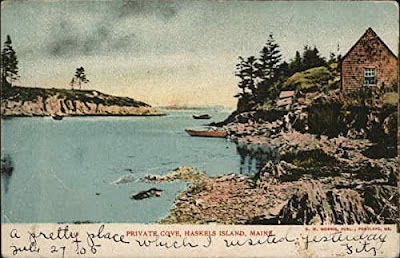
Antique Haskell Island postcard from Amazon. "A pretty place which I visited yesterday..."

To stop the rats, the Haskell brothers brought a couple of cats to their island. The brothers didn't provide any food for the cats and expected them to survive by killing rats. The cats met their expectations. They ate rats, and there were so many rats that the cats thrived and multiplied. Soon there were more cats than rats, and eventually there were no rats left at all, just an island full of hungry cats. 

The cats roved the island, howling with hunger. They climbed the apple trees, roamed the fields, and paced the shore, looking for something to kill and eat. 

The Haskell brothers had to do something about the ravenous felines, but something happened before they could devise a plan: one of them became sick. He fell seriously ill, so his brother took the boat and went to the mainland to get a physician. "Hurry back," the sick brother said weakly as he lay in bed. 

Can you see where this is going? An island full of hungry cats, an incapacitated man lying weak and helpless in bed? When the healthy brother returned to the island, he and the physician were horrified by what they found inside the Haskells' house. The sick brother had been ripped to shreds, and the cats were tearing the last morsels of flesh from his body. At last their hunger was sated. 

*****

It's a simple little story, but really resonates with me. It appears in Horace Beck's 1957 book The Folklore of Maine. The Maine Encyclopedia says Haskell Island was named for a Captain Haskell who purchased, but never lived on, the island, so I don't think the man-eating cat story is true. Still, it has the power of a good horror movie, and reads like an environmentalist fable. The brothers try to master the island, but end up doomed by their own actions and the invasive species they brought to the island. 

It reminds me of "Bart the Mother," a 1998 episode of The Simpsons where Springfield is overrun by ravenous lizards. At first people are happy because the lizards eat all the pigeons, but then realize they'll need to import snakes to eat the lizards, and then gorillas to eat the snakes...


Horace Beck notes that there is a coda to the story. According to some people, the sick brother was not killed by cats, but by pirates. He had seen the pirates burying their treasure on Haskell Island, and they killed him to keep their secret safe. Then they made it look like the cats had done it to deflect attention. I don't find that explanation quite as compelling, though. The story is structured like a version of "I Know an Old Lady Who Swallowed A Spider," and randomly introducing pirates just doesn't make sense. 

July 24, 2016

Weird Marblehead, Part Two: Lee Mansion and Screaming Woman Beach

While Lori and I were in Marblehead we took a tour of the Lee Mansion. While this historic house is not officially haunted it definitely has a few weird things going on. And I mean that in a good way.

Jeremiah Lee (1721 - 1775) was a wealthy Marblehead merchant and ship owner. He built the mansion that bears his name in 1768, but unfortunately Lee and his family only lived there for a few short years before he died in an unusual way.


In addition to being a merchant Lee was a smuggler, and had for several years been smuggling weapons into the American colonies to be used in the uprising against the British. One night Lee and two other Marblehead men were secretly meeting with John Hancock and Paul Revere at a tavern outside of Boston when they got word that a group of British soldiers were approaching. The men ran out of the tavern.

It was a fatal decision. In order to avoid detection Lee spent the night hiding in a nearby field. It was a chilly night and the exposure to the cold air made him ill. He never returned to Marblehead. Instead, he died three days later in Newton from a fever.


We asked the tour guide if Jeremiah Lee's ghost haunted the mansion. The answer was an unequivocal "No." Maybe he didn't live in it long enough to get attached, or maybe his spirit is wandering around somewhere in Newton. But either way he's not haunting the mansion. 

Lee's family went bankrupt and in 1804 the mansion was sold to a local bank. They occupied it until 1909 when the Marblehead Historical Society bought it. Because the mansion has had so few owners the interior has barely changed since the 1700s. It even has the original wallpaper, which was hand painted in England more than 200 years ago. Our tour guide said there was only one other building in the US with equally old wallpaper, which is pretty impressive.


The mansion's walls are also covered with old paintings of merchants, ministers and other historic Marblehead notables. There are also quite a few paintings of children. When asked about the child portraits our tour guide told us they were mostly paintings commissioned by local families to memorialize children that died. Wealthy families would quickly bring in artists to paint portraits of their children's corpses before burial.

I suppose that's why so many of the children look really unhealthy. One painting, of a little girl holding a book, was incredibly spooky and reminded me of something from a horror movie. Lori thought I should take a photo for the blog but I declined. It seemed like asking for trouble. Let sleeping spirits lie.

The other weird thing we saw was this carved wooden figure. It kind of looks like it has fangs, doesn't it? It might just be facial hair, though.


We thought it was a doll, but our guide told us it was actually an implement used to tighten the ropes that supported a bed's mattress. Did you know the phrase "sleep tight" refers to a bed's ropes? I learn something new all the time!

While no strange legends are attached to the Lee Mansion, the same cannot be said of Lovis Cove, which is just a short walk away. Lovis Cove is said to be haunted by a famous ghost known either as the Screeching Lady, Screaming Woman, Shrieking Lady, or some variant therof. Whatever she's called you get the picture. The ghost is loud and very unhappy.


The cove itself is informally known as Screaming Woman Cove or Screeching Lady Beach. When I think of beaches I think of soft white sand, but that's not the case at Lovis Cove. The beach is covered with rocks and there are even more rocks - big sharp ones covered with algae - out in the water. It's not the type of beach you really want to spend a lot of time at.


The ghost doesn't want to spend time there either but apparently has no choice. Samuel Roads includes the story of the Screeching Woman in his 1880 book History and Traditions of Marblehead. According to Roads, way back in the late 1600s an English ship crossing the Atlantic was captured by Spanish pirates. All the passengers and crew of the ship were slaughtered except for one beautiful English woman, whom the pirates kept alive until they reached New England.

When the pirates came ashore at Lovis Cove with the woman they brutally murdered her on the beach. Roads writes:

The few fishermen who inhabited the place were absent, and the women and children who remained could do nothing to prevent the crime. The screams of the victim were loud and dreadful, and her cries of "Lord save me! Mercy! Oh! Lord Jesus, save me!" were distinctly heard. The body was buried where the crime was perpetrated, and for over one hundred and fifty years on the anniversary of that dreadful tragedy the screams of the poor woman were repeated in a voice so shrill and supernatural as to send an indescribable thrill of horror through all who heard them. 

That's pretty gruesome, but Pam Matthias Peterson adds one more gruesome detail in her 2007 book Marblehead Myths, Legends and Lore. The pirates chopped off the woman's fingers while she was still alive to steal her rings. Ugh.


Peterson claims that Marblehead residents avoid the beach at night and that her screams can still sometimes be heard even today. The comments on this site include a few from people who say they have indeed heard her screams in the night. Creepy. Does a ghost like this ever find rest, I wonder?

It took Lori and I a while to find Lovis Cove, but here's a tip if you want to visit: it's located right next to the Barnacle Restaurant, which is at 141 Front Street. The cove doesn't sound like someplace you want to visit at night, though.

May 29, 2016

Rye and Rum Pancakes? Breakfast Fit for A Pirate!

I'm taking a break this week from the usual witches, monsters and weirdness to ask a few questions:

1. Has your physician told you that you need to get more rum in your diet?

2. Have you ever wondered what a pirate might eat for breakfast?

3. Did you ever want to put vinegar on your pancakes?

If you answered yes to any of those questions I have a recipe you need to try.

I found it The Old Farmer's Almanac Colonial Cookbook, which was published by Yankee Magazine in 1976. This was given to me many years ago by my friend Dave, and it used to belong to his mother. The Colonial Cookbook contains lots of unusual recipes, like partridge in vine leaves, green corn pudding, and snow griddle cakes. It also has a recipe innocuously titled "rye pancakes."


In addition to rye flour, which you don't often see in pancake recipes, the recipe includes molasses and rum. It's very Olde New England (and also very piratey). I've never eaten pancakes with rum in the batter, so I thought I'd give the recipe a try.

Here's the recipe:

3 cups rye flour
1 cup flour
1 cup molasses
1 teaspoon salt
1 teaspoon cream of tartar
2 eggs
2 cups milk
1/2 cup New England rum

Combine ingredients, beat, fry!

A few things to note about this batter and these pancakes. First of all, the batter is very, very thick. The recipe warns that "These are very rich." That's an understatement. The batter is thick like a bread batter. I had to plop it into the pan, not pour it.

I also have to note that sadly most of the rum cooks away, leaving just a slight flavor but no real intoxication. The predominant flavor is molasses. Happily I love molasses!


Finally, these come out really brown. I realized while making these pancakes that a lot of New England cuisine is brown. Brown bread, Indian pudding, apple pie, roast turkey, New England pot roast, switchel, etc. It is the cuisine of a region where winter is long and summer is very, very short.

The Colonial Cookbook says the following about this recipe: "Here's a recipe that dates back to the early 1700s, when great fields of rye swayed in the wind all along the Taunton River in Massachusetts. The molasses or sugar required for these pancakes was brought up the river in smalls sloops or brigs... A cherished family tradition handed down from generation to generation." The Yankee Magazine web site says the recipe was submitted to them by a Miss Helen H. Lane.

I have no way of knowing if this recipe really dates to the 1700s, but the ingredients do make it seem possible. For example, the early New England settlers found that rye grew better than wheat in this cold climate, and it featured prominently in their baked goods, like brown bread. They always preferred wheat, though, and once New England became more prosperous they imported wheat from other states.

Rum and molasses also have deep roots in New England history. Yankee merchants would trade rum for slaves in Africa, and then trade the slaves for sugar and molasses in the Caribbean. They'd bring the molasses and sugar back to New England to make rum, which they'd then trade in Africa for slaves. They'd repeat this over and over, turning a profit with each transaction.

This exploitative economic system (known as the Triangle Trade) made the merchants quite wealthy, and also infused New England cuisine with Caribbean flavors. Molasses, rum, and spices like cinnamon, ginger and nutmeg are all essential to New England cooking, but all actually come from the Caribbean islands. It's strange to think that the so-called pumpkin pie spices, which are so homey and comforting, have their origin in such a dark period of history.


One last thing about these pancakes. Rather than topping them with butter and syrup, the Colonial Cookbook recommends topping them with vinegar and sugar. It says, "Fill a cereal bowl with sugar. Add enough vinegar to make the resulting mixture spreadable as butter. As you eat the pancakes, dab them with the mixture."

I thought this might be gross, but it was actually kind of delicious. The sour vinegar cut through the sweetness. The combination of vinegar and sugar is also an old New England one. It doesn't show up much these days, unless you are lucky enough to find someplace serving switchel.

August 17, 2014

Hannah Screecham and the Pirates' Treasure: She Was Evil But Loved Her Job

We still have a couple weeks until Labor Day, so I'm still in a Cape Cod state of mind. Here's a weird story about one of the more colorful characters in the Cape's history, Hannah Screecham.

Hannah lived on Grand Island off the coast of Barnstable back in the 1600s. Grand Island (aka Oyster Harbors) is now a very posh neighborhood, but three centuries ago it was desolate and windswept. Hannah Screecham lived there nearly alone - except for occasional visitors who came at night from the ocean.

You see, Hannah was in league with every pirate captain who traveled the New England coast. Smuggling, privateering and piracy were all huge parts of the local economy, and Hannah played a vital yet unsavory role in it. She helped the pirate captains bury their treasure. That might sound like honest hard work, but you've heard the saying "Dead men tell no tales?" That was Hannah's job. She was quite good at it, and was hired by many notorious pirates, including Captain Kidd.

It worked like this. Late at night, a pirate captain would row ashore to Grand Island with a chest of gold and only one other member of his crew. The crew member was always a very recent recruit. Hannah would meet the two men on shore, and lead them to a secluded spot on the island where they could bury their treasure. She would stand watch as the captain and his man dug a pit and lowered in the chest.

Then, once the treasure was put into the deep pit, she would push the unsuspecting crew member down into it as well. The sandy soil would collapse onto the injured (but still living) pirate and bury him alive. When the deed was done Hannah would issue forth a terrifying, shrill cry, which signaled to the waiting pirate ship that its captain was ready to come back aboard.

The pirate captains would pay Hannah with a small pouch of silver, or a pillaged ring, or even a token of their love. But secretly they feared her. She seemed to like her work a little too much. She relished pushing unsuspecting men to their deaths, and her shrill cry had a note of deep pleasure in it.

Eventually Hannah was done in by greed. She lived comfortably off the small payments the captains gave her, but wanted more. She knew where every treasure was buried, so why not take some gold for herself? One moonlit night she took her shovel and unearthed a particularly rich trove of gold. But as she opened the chest she saw pale figures gather above her around the mouth of the pit. They were the ghosts of the men she had killed! As she opened her mouth to plead for mercy a ghostly figure appeared inside the pit with her and wrapped its cold fingers around her neck. As Hannah gasped for breath the pit collapsed around her, burying her forever.

Hannah was just too evil to rest in peace, though. Her own ghost is still supposed to haunt Grand Island, and her trademark shriek can sometimes be heard echoing over the dunes. The treasures she helped hide still remain undiscovered.

That version of Hannah Screecham's story can be found in Elizabeth Reynard's 1934 book The Narrow Land. Another story about Hannah, which appears in a few other sources like Cheri Revai's Haunted Massachusetts, claims that she was not evil, but just an outcast old woman feared by her neighbors. When an outbreak of smallpox struck Barnstable they accused her of causing it through witchcraft and hanged her without a trial.

A group of pirates came ashore by night and cut down her body, burying it in an undisclosed location. When confronted by the townspeople the lead pirate, who was Captain Kidd himself, said that Hannah had been his mother. He had buried her body with his treasure so her spirit could guard it. The people of Barnstable searched many years for Kidd's gold but never were able to find it. Hannah's ghost haunts the dunes near Barnstable, shrieking like a gull.

Hannah was not the only notorious person named Screecham. She had a sister named Sarah, who was a witch. More about her next week!

August 10, 2014

Sam Bellamy, Maria Hallett, and the Wreck of the Pirate Ship Whydah

Tony and I were down on the Cape recently and finally visited the Pirate Museum in Provincetown. I've wanted to go for quite a few years and was glad to finally find the time.

The museum's exhibits are focused on the pirate ship Whydah (pronounced "widdah"), which sank off the coast of Wellfleet in 1717. The wreck was located by divers in 1982, and the artifacts they found, including gold coins, a cannon, and the ship's bell, are featured in the museum.

Here are some interesting facts I learned:

  • Pirates used a primitive form of hand grenade when attacking ships.
  • Venereal disease was common among pirates, but the cure - an injection of mercury directly into the bladder - was probably worse than the sickness.
  • Pirates who had a limb amputated received an extra stipend of gold.

The Whydah was originally commissioned as a slave ship, and is named after the African coastal city of Ouidah. It was captured by notorious pirate Black Sam Bellamy while it was sailing in the Caribbean. Bellamy took the ship as his own, loaded it with approximately four tons of stolen gold, and headed north to Cape Cod. He never reached the Cape, but died with almost all his crew less than a mile off Wellfleet's Atlantic coast in an April storm. He was 28 and is believed to have been the wealthiest pirate in history.


There are quite a few legends associated with Sam Bellamy and the Whydah. The most enduring is about his love for a local Cape Cod girl named Maria Hallett. On Cape Cod he met and fell in love with Maria Hallett, who was young (only 15!) and beautiful. Her parents didn't approve of Sam - he was just a poor sailor - but one thing led to another and Maria became pregnant with Sam's child. Declaring his undying love for Maria, Sam set off for the Caribbean to make his fortune. He vowed to return a rich man.

Some stories say Sam intended to find sunken treasure in the Caribbean, but found his way into piracy instead. Maria, who was left at home on the Cape, was shunned by her family and neighbors. Premarital pregnancy was not uncommon in colonial New England, but it usually led to a speedy marriage. Maria didn't have that option. She bore her child alone and unmarried in a isolated hut in the woods.

There are many variations of the legend, but they fall into two broad types. In the first, Maria grows bitter. Really, really bitter. She's been shunned by her community and abandoned by the man who said he loved her. Alone and angry, she turns to the one person who always was available to the New England outcast - the Devil. In return for her soul, and possibly the life of her child, the Dark Man makes her a witch. When Maria learns that the Whydah is approaching Wellfleet she climbs onto one of the high dunes and raises a storm. The man who ruined her life is drowned, the Whydah sinks, and Maria dances in the wild wind and rain. The area where she cast her spell is now called the Lucifer Land, Satan's Harvest, or the Devil's Pasture in local folklore.

That's the grim, gloomy version. The slightly less grim version claims that Maria remained faithful to Sam, watching and waiting patiently for his return. On the night of the storm she watched from the dunes, hoping the Whydah would make it safely to shore. When it didn't, she lost her mind from grief and ran down to the beach. The next day she was found on the shore, screaming and wailing as she wandered through the wreckage and drowned corpses. Her ghost is still said to walk near Marconi Beach in Wellfleet, and her cries can be heard on dark stormy nights.

Tony scanning the Atlantic coast for pirates, ghosts, witches, etc.
 There's a lot of historical documentation on Sam Bellamy's life, but there's no documentation about Maria Hallett. Did she even exist? It's impossible to know, but Hallett is an old Cape Cod name so it's entirely likely. Records from the early 1700s can be a little spotty.

Legends and strange phenomena surrounded the Whydah even into the modern age. Barry Clifford, the explorer who found the Whydah in 1982, claims that the expedition was plagued by bad luck and strange mechanical malfunctions while it was searching for the wreck. The divers and crew once even heard a voice over their radio repeat the following words: "We want your boat... We want your boat..." The weird shenanigans stopped only after Clifford and his crew poured rum into the ocean and toasted the dead pirate crew. Shortly after making this offering to the dead they discovered the sunken ship and its treasure.

In 1998, the staff at a Wellfleet restaurant also reproted a strange encounter. One of their customers emerged from the restroom in a panic. He said he had seen a young woman in an old-fashioned dress, but that she had disappeared. The staff checked the restroom and found it unoccupied. The customer hastily signed his name of the credit card slip and ran out of the restaurant. His last name was Bellamy.

The story of Sam Bellamy and Maria Hallett can be found in many places, including Elizabeth Reynard's The Narrow Land and Mark Jasper's Haunted Cape Cod and the Islands. The stories about the modern ghosts are from the Houston Museum's website.

July 18, 2009

Nix's Mate: Pirates, a Curse, and Dutch Water Spirits


No pirate corpses were visible the day I sailed past Nix's Mate.

Last week a friend and I took the ferry from Boston to Provincetown. One of the sights we saw as we cruised through Boston Harbor was Nix's Mate, a very small island topped by stone pyramid. It may be only be 200 square feet, but it has more folklore per foot than any other island in the harbor.

WHERE DID ALL THE LAND GO? Nix's Mate was originally a 12 acre island where sheep grazed. Now, it's just a tiny rocky shoal that's entirely hidden during high tide. What happened? According to Skinner's Myths and Legends of Our Own Land, in the 1630s a certain Captain Nix was murdered in a ship anchored off the island. His first mate was convicted of the crime, and sentenced to death by hanging on the island. As he was led to the gallows, he shouted "God, show that I am innocent. Let this island sink and prove to these people that I have never stained my hands with human blood." After the sailor was executed, the island slowly began to sink into the sea, proving his innocence. (A more boring explanation is that the land was quarried for gravel.)

WHAT'S IN A NAME? There are a few explanations of where Nix's Mate got it's catchy name, which it's had since 1636. The first is that was named after Captain Nix's who was hanged there. However, there are no records of Captain Nix or a sailor being executed on the island in the 1630s. This leads to the second explanation - that Nix's Mate is really a garbled version of nixie scmalt, which is Old Dutch for "wail of the water spirits." Allegedly, a Dutch passenger on a boat muttered this as he heard the waves pounding against the island's cliffs. (You can read more about the water spirits known as nixen here.)

PIRATES! Although there is no record of Nix's mate being executeded on the island, three actual pirates are known to have been hanged there, with their bodies left in the gibbet as a warning to other would-be pirates. The most famous of the three was William Fly, who was executed in July of 1726. Fly refused to repent during his trial, and wanted to die as bravely as he lived. According to Robert Cahill's New England's Cruel and Unusual Punishments, Fly walked to the gallows carrying a flower, and smiled at the executioner as the noose was put around his neck. Other sources claim that Fly even helped tie the noose around his own neck. The corpses of Fly and the other pirates were buried on Nix's Mate, and are now probably at the bottom of Boston Harbor.

September 03, 2008

Dungeon Rock: Pirates, treasure, and spirits


Jason and Peter eye the entrance to Dungeon Rock.

Pirate treasure! Spirit guides! A mysterious cave! Dungeon Rock in Lynn has all this, and it's right off Route 1 outside of Boston.

The stairway goes down...

The Dungeon Rock story, which is recounted in many books, goes something like this: In 1658, a pirate ship was spotted off the coast of Lynn, Massachusetts. After it departed, one of the pirates, Thomas Veal, took up residence under an enormous rock in a wooded part of Lynn. A rumor spread that Veal had a large treasure with him, but it couldn't be substantiated before he was buried under the rock by an earthquake.


... but the tunnel goes down even deeper!

In 1852, a Spiritualist named Hiram Marble and his family came to Lynn, determined to find the pirate treasure under Dungeon Rock. Guided by spirits, Hiram and his son Edwin chiseled their way into the rock. And chiseled. And chiseled. They dug for 28 years, following the direction of their spirit guides. Hiram died in 1868, and Edwin followed him in 1880, but they never found the treasure.

In July 2008, Tony and I went with our friends Jason and James to explore Dungeon Rock. (If you decide to go, check with the park ranger first to make sure it will be open). Even though the day was insanely hot, and we brought inadequate flashlights ("Are you crazy?", Jason said when he saw our pathetic LED flashlights), the trip was great for 3 reasons:


Jason near the bottom, holding one of our inadequate flashlights.

1. It's easy to get inside Dungeon Rock. There are stairs, and the Marbles' tunnel is large enough to walk upright. But it did get wet and very slippery towards the bottom, so be careful!

2. There are no vermin. The tunnel is sealed with a large iron door at night, so you don't have to worry about raccoons or bats. We didn't even see any spiders. Hmm. Maybe that iron door is designed to keep something inside?

3. The tunnel is just freaky (in a good way). Although the temperature outside was above 90 degrees, the tunnel was so cold we could see our breath. New Enlgand doesn't have a lot of caves, so this may be normal. But as the man-made tunnel spiraled down and down into solid rock, I realized how weird Dungeon Rock is. The Marbles spent years of their lives creating a long dark path to nothing!


Me, dazzled by the flash. Or is it cave madness?

Hiram Marble was hoping to prove the validity of Spiritualism by finding the treasure. Some writers say his tunnel to nowhere proves that Spiritualism is invalid, but wouldn't the Marbles have to be guided by something to spend so many years chiseling away? Maybe they really were guided by spirits, but maybe the spirits wanted to have a good laugh.

You can find out more about Dungeon Rock and Lynn Woods here.