Showing posts with label ghosts. Show all posts

May 26, 2024

Rutland's Abandoned Prison Camp: Ruins, Graffiti, and Maybe A Ghost or Two?

Back in March, Tony and I took a road trip to Rutland, Massachusetts to visit an abandoned prison camp located in Rutland State Park. Rutland is located west of Worcester, and we had never been there before. It's a very beautiful part of the state and I recommend visiting. 

One small caveat, though. I don't recommend visiting when there's been a huge ice storm, like we did! A big nor'easter had hit the state the day before our trip, and while it brought only rain to Boston, Rutland had been hit with ice, which we didn't realize until after we were beyond Worcester. All the trees in Rutland were covered with glittering ice, making them very sparkly and captivating, but the two mile walk from the Rutland State Park parking lot to the prison camp was treacherously slippery. It took us a lot longer than we anticipated to walk to the camp. I have learned my lesson to check the local weather forecast before heading on a road trip! 

Solitary confinement cells. 

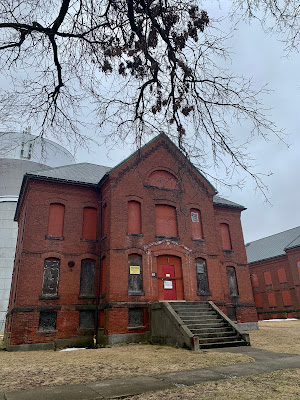
According to the signs in the park, the prison was conceived in 1898 as a "temporary industrial camp for prisoners... to rehabilitate them for their return to society while reclaiming wasteland and abandoned property..." Four years later, a Rutland farm from the 1700s was repurposed and used as a kitchen, dining area, and housing for the camp. The inmates also built additional structures, and an abandoned schoolhouse was incorporated into the prison as well. 


In 1905, a tuberculosis outbreak necessitated the construction of a hospital, which remained in use throughout the prison's history. The park's signage notes the following: "While most of the prisoners of the camp were minor offenders, some patient prisoners in later years were 'lifers' and murderers, so the hospital was a secure facility." The camp also had 150 acres of farmland which were used to raise livestock (including prize winning horses) and grow enough fruits and vegetables to feed the inmates. They even produced excess to sell locally. The fruits and vegetables were stored in an enormous underground root cellar, which still exists. 

The entrance to the root cellar.

Inside the root cellar.

Sometimes in old movies, prisoners are shown breaking big rocks into little rocks. There is some truth to that, at least at the Rutland prison, which had a rock crushing plant that made concrete, gravel, and sand for road repairs. It sounds a little grim. The solitary confinement cells, the ruins of which are still standing, are also very small and grim. They're covered with colorful graffiti and don't have any bars on them now, but it was easy to imagine how dark and confining they would have been in the prison's heyday. We didn't visit the nearby cemetery of unmarked prisoner graves, but I think that sounds grim as well. 

The prison camp was closed in 1934 because the land it stood on was part of the watershed of the newly created Quabbin Reservoir. There certainly is a lot of fresh water in Rutland State Park, including a giant beaver pond that we walked past on the way to the prison's ruins. We didn't see a beaver, but we did see some of their lodges. 

Beaver pond with a beaver lodge. 

Just in case you don't know where you're going...

I couldn't easily find any spooky legends associated with the prison camp. The blog Haunted New England mentions a legend that the ghost of the warden's wife still haunts the prison, but they couldn't find many other details. And in the comments on Abandoned Wonders, I found the following comment from 2019:

This place is incredibly haunted. Within the last 10 years, a group opened something in the tunnel area and called a non-human entity into the camp. Be advised! It followed me home and stuck around for about 3 months. Not fun.

Those were the only legends I could find about the camp. Overall, I found the prison camp interesting but not really spooky. We were the only people there for most of our visit, which was great, but also be aware that the area is isolated. As always, travel with a friend if you're wandering out in the woods, particularly to the ruins of an abandoned prison. 

A view inside the root cellar.


September 21, 2023

The Haunted Charlesgate: Ghosts, College Students, and Weird Engimas

Living someplace old and historic, like the Boston area, brings both perils and joys. Among its current perils is the decaying subway system, which has been well-documented elsewhere. To avoid the most hellish parts of the MBTA, lately my commute home from work has involved more walking. Which brings me to one of the joys of living in the Boston area: beautiful old architecture. 

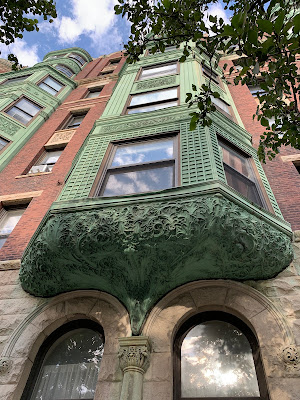
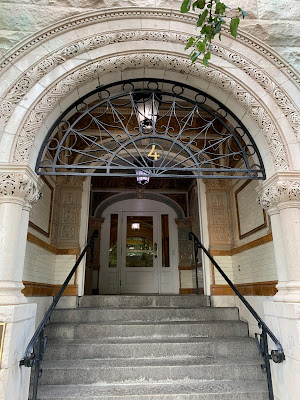
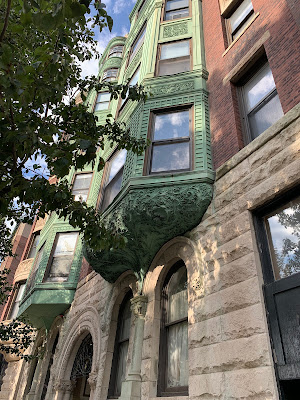
Most nights, I walk through parts of Back Bay on my way home. Among all the beautiful old brownstones and apartment buildings, one in particular stands out: the former Charlesgate Hotel, located at the corner of Beacon Street and Charlesgate East. The hotel was designed by John Pickering Putnam, a prominent local architect, and completed in the 1890s. Putnam apparently loved the building he created, and took up residence there with his own family. 

He died there on February 23, 1917 at the age of sixty. A legend claims it was suicide, but he really died of natural causes. Still, esotericists of a certain bent will notice he died on the 23rd, making his death an example of the 23 enigma, the idea that the number 23 is considered strange, somewhat sinister, and connected to unusual phenomena. So maybe Putnam's death date was a precursor of the weirdness that was to come...

The Charlesgate operated as a hotel until 1947, when it was sold to Boston University as a dorm. In 1981, it was sold to Emerson College, which also used it as a dorm until 1995. It was during those 14 years that the Charlesgate acquired its reputation as one of the most haunted buildings in Boston. Here are a few of the ghostly legends from that time..

The building was said to be haunted by the ghost of Elsa Putnam, John Pickering Putnam's daughter, who died as a little girl when she was playing with a ball on an upper floor. The ball rolled into an open elevator shaft, and Elsa ran after it and fell to her doom. This story is not true - Elsa Putnam lived until the 1970s and had several children of her own - but many Emerson students still reported seeing her ghost. 

Another legend claims that mobsters owned the building in the 1930s and murdered three people in the elevator. The ghosts of these gangland slaying victims were often seen wandering in the dormitory. Emerson students also claimed they saw the restless spirits of young women who had committed suicide in the building back when it housed female Boston University students. 

A phantom "Man in Black" was also seen lurking around the elevator. No one was quite sure who he was, but students were afraid to encounter this black-clad ghost, particularly late at night. 

Even when ghosts were not seen, Emerson students living in the Charlesgate experienced a variety of strange phenomena including unexplained cold spots, toilets flushing by themselves, and doors slamming shut. Some students also claimed the hotel had once been the headquarters for a demonic cult. According to an article in a 1990 issue of Fate magazine:

"Also at one point, a good part of Charlesgate Hall's residents allegedly belonged to a demonic cult. 

When Emerson College bought Charlesgate Hall as a dormitory in 1980, it was not completely filled by students. It was claimed that some members of the cult still lived there, and it was not unusual for students to walk by the open door of a room belonging to a cult member and find a group of them chanting."

Well, college is supposed to expose you to new experiences, isn't it? The same Fate article also claims that Emerson forbid students from using Ouija boards in the Charlesgate - and then goes on to describe a group of them using one to contact spirits in the dorm. I guess college is also about defying authority.

The Charlesgate's ghosts have been written about in many places: The Berkeley Beacon (Emerson's student paper), The Boston Phoenix, Emerson's official newsite, and various books about haunted locations in Boston. The building also appears in Scott Von Doviak's 2018 novel, Charlesgate Confidential, as do some of the ghost stories. The combination of a creepy old hotel, ghosts, and college students makes the Charlesgate an appealing subject for writers.

The Charlesgate is no longer a dormitory, but instead is filled with condos and apartments. I haven't heard of any ghosts appearing in the building since it became condos. Are any ghosts even there now? Maybe the ghosts were chased away during the renovations, or maybe they were conjured up by the Emerson students who lived there. College students tend to like ghost stories, and many local New England colleges are said to have haunted dormitories. 

I mentioned the 23 enigma at the start of this post. Although the concept first appeared in works by William S. Burroughs, it was popularized by the author Robert Anton Wilson. Wilson didn't necessarily believe the 23 enigma was real, but rather that it showed how people have the ability to find patterns in random occurrences. Some people starting seeing the number 23 in all kinds of unexpected places once they learn about the enigma. The number is only meaningful, though, because they think it is significant. They are creating a pattern out of random data.

Perhaps the ghost stories at the Charlesgate are something similar. Students heard rumors the dorm is haunted, and then noticed lights flickering, strange cold spots, and weird noises at night. These all could have perfectly rational explanations - old buildings often have bad fuses, drafty windows, and frisky rodents - but students interpreted them as ghostly phenomena because they had heard the rumors. 

This is, of course, all speculation on my part. The only way for me to know for certain would be to rent an apartment at the Charlesgate and see what happens. A one bedroom starts at $2,400/month, which is more than I have budgeted for ghost-hunting. Or then again, maybe I'm just scared that the legends are true? I don't want to encounter the Man in Black late at night, no matter what he is. 


March 29, 2023

A Visit to Medfield State Hospital: Charming and a Little Spooky

A few weeks ago Tony and I visited Medfield State Hospital, in charming Medfield, Massachusetts. Originally known as the Medfield Insane Asylum, the hospital is now a park open to the public. Intrigued? Read on. 

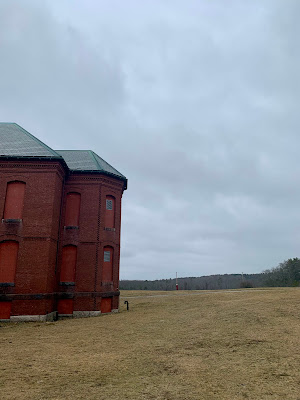
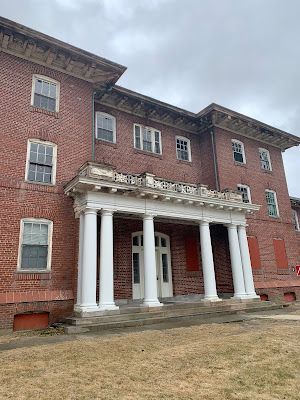
Medfield State Hospital opened in 1896, and was one of the state's first hospitals to deal with long-term patients with mental disorders. It was designed in the "cottage style," according to an informational sign erected at the hospital, with more than 50 buildings spread across 1.4 square miles. Many of the buildings are still standing, although they are now boarded up and public cannot access them. Medfield State today looks a lot like a small, traditional New England liberal arts college - but with absolutely no people. It's both charming and maybe a little spooky. 

Tony and I visited on a cold, snowy day, and there weren't many other visitors. A few people were walking their dogs, but that was about it. The hospital was quite bustling in the past, however. During World War II, almost 2,300 people lived at Medfield State. The hospital finally closed in 1993. 

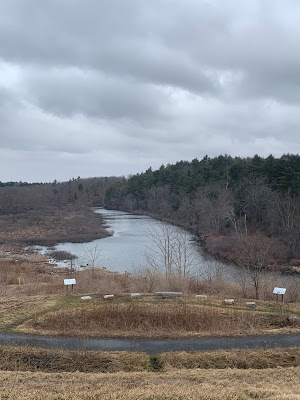
In the early part of the 20th century, the hospital was self-sufficient. Patients grew crops on hundreds of acres of farmland, and tended more than 1,000 cattle and 3,000 chickens. That's quite an operation! Medfield State Hospital even was able to supply food to the other state hospitals in eastern Massachusetts. Even today there is still quite a bit of open land at Medfield State, including a bluff overlooking the Charles River. It has a great view!


You'd think there would be some weird legends associated with an abandoned insane asylum, but that's not really the case here. The only possible ghost story is quite recent. In 2017, the movie The New Mutants was filmed at Medfield State. Part of the X-Men series, The New Mutants tells the tale of five young mutants imprisoned in a spooky hospital. The movie wasn't released until 2020, and the director suggested The New Mutants might have been cursed by being filmed at the abandoned insane asylum. 

The director, Richard Boone, told The Boston Globe the following on August 20, 2020:

It was during the press push for the first trailer that Boone first spoke of “weird” things happening to crew members at Medfield State Hospital during filming. 

“Literally every single person on my crew — all my grips — all those people had weird things happen to them while they were there,” Boone told IGN of the abandoned state hospital, which also served as a filming location for “Shutter Island” in 2009. “I even told the behind-the-scenes crew to go interview everyone who had weird stuff happen to them for an extra on the Blu-ray.”

I would like a little more detail, but I don't want to buy the Blu-Ray. Not everyone was freaked out, though. Actor Anya Taylor-Joy said the following:

"I've shot in four abandoned mental institutions, so it's kind of a second home for me," Taylor-Joy said (ABC Seven.com)

That's a good attitude to have! Soon the hospital will be home to hundreds of people again. The town of Medfield will be developing Medfield State into apartments and an arts center, which is probably a good use of the property. Maybe some more ghost stories will emerge once people start living there full time again?


October 23, 2022

The Spookiest States: Vermont and Maine Lead the Pack

People often ask me if New England is weirder or scarier than other parts of the country. I’ve been asked this by podcasters, other writers, and even personal friends. It would be easy for me to respond with a joke about scary Massachusetts drivers, our weird infatuation with Dunkin Donuts, or the frightening price of housing. But I generally avoid going for the easy laugh and try to answer the question sincerely.

Certainly, it seems that New England has a reputation in popular culture as a strange place. I usually mention that the world’s three most famous horror writers all came from New England. Edgar Allen Poe (1809 – 1849) was born in Boston, and although he left as a child he returned when he was 16 to work and enlisted in the army. He didn’t remain in Boston long, and although he thought the Bostonian literary establishment was uptight he still published his first book with the byline “a Bostonian.” 

The second writer is H.P. Lovecraft (1890 – 1937), who was born in Providence and spent most of his life there. Lovecraft incorporated lots of New England history and legends into his fiction. He definitely understood the weird appeal of the region’s moldering Puritan cemeteries, old coastal towns, and dark woods. Lastly, there is the legendary Stephen King (b. 1947), who was born in Maine and still lives there. Many of his novels, including classics like Salem’s Lot and Pet Sematary, are set in Maine.

I like to think there's something unique about New England which inspired these three influential writers. Certainly, New England has some strange history due to the Puritan colonists who came in the 1600s. They brought over their beliefs in witches, ghosts and the Devil, but not the more charming folklore like fairies. That definitely shaped our region's culture. And like most of the United States, our region has its history of violence, racism and genocide. Perhaps all these things, combined with a sometimes strange and dramatic landscape and our long dark winters, helped inspire Poe, Lovecraft, and King. (The author Faye Ringel explores these themes in her book 1995 book New England’s Gothic Literature.)

But does this really mean New England is weirder or scarier than other parts of the country? And how would you even go about measuring these things regionally? I wouldn't know how to even start, but someone has tried. Cycling Frog, a THC and CBD company in Seattle, compiled a ranked list of the scariest states in the country. Vermont ranked number one, Maine came in second, and Connecticut placed fifth. Not too bad for such a small part of the United States!

The other New England states are apparently not as spooky. New Hampshire was 14, Rhode Island 19, and Massachusetts was way down the list at 35. I feel ashamed as a Massachusetts native that we ranked so low. Massholes, we need to try harder to be spooky.

Upon reading this list two questions came to my mind. How did they rank the states, and why did a CBD/THC company do this? Sadly, I can only answer the first one. Cycling Frog looked at how many of the following each state had:

1. Serial killers (from murderpedia.org)

2. Haunted locations (from frightfind.com)

3. UFO sightings (from National UFO Reporting Center)

4. Ghosts (from ghostsofamerica.com)

5. Top 100 horror films set there (from IMDb.com)

To measure equitably across states, they wanted to show how many of each phenomena the states have per 100,000 people. For example, Texas had the most number of serial killers with 890 (!), but it has a very large population. This means that Delaware, which has a much smaller population, actually has the highest number of serial killers per person, with 41 serial killers per 100,000 inhabitants. According to Cycling Frog, this makes Delaware the most murderous state. (Note: Massholes, we do NOT need to try harder at being serial killers.)

Vermont was ranked the scariest because it had the highest number of UFO sightings and haunted places per person, and also had a high number of ghost sightings as well. That's pretty impressive, which is why they think Vermont is the scariest state. But is it? When I think of Vermont, I tend to think of Ben and Jerry's Ice Cream, rolling green hills, and peaceful hippies. Maybe all that peace and love is just a cover for the true horrors of Vermont. 

Let's face it, I don't think this survey is statistically valid, but it is fun to think about as we approach Halloween. Apparently if you live in Vermont, Maine or Connecticut you're ensured a spooky Halloween. The rest of us may just have to console ourselves by eating extra candy corn and Twix. 

September 11, 2022

Ghosts and Graffiti at Fort Revere

Over Labor Day weekend Tony and I drove down to Hull, Massachusetts. Hull is of course a popular destination in the summer because of Nantasket Beach, but we had a different destination in mind. We wanted to visit a haunted fort. 

Fort Revere sits on top of Telegraph Hill, a promontory that looks out over the town and Boston Harbor. The views are amazing, and I can understand why someone would build a fort there. You definitely would be able to see any ships approaching Hull, as well as a view of the one road leading into town.

Hull was first colonized by the English in 1622, and they considered fortifying the hill as early as 1633. It wasn't until the American Revolution, though, that anyone actually built anything there. In 1775, General Joseph Palmer constructed the first fort and named it Fort Independence. After the war that name was given to the fort on Castle Island in Boston, and the Hull fort was demolished and buried. 


The current fort on Telegraph Hill was constructed from 1898 - 1906. Named Fort Revere, it housed troops during the Spanish-American war and was armed with multiple cannons. In 1948 the US Government finally decommissioned the fort and gave it to the Commonwealth of Massachusetts. It is now a public park. 

Where are the ghosts in all this history? Well, according to local legends, the fort is haunted by the spirits of 200 French soldiers who died of smallpox in 1778. The soldiers had been captured by the British while fighting in Nova Scotia, but had been freed in a prisoner exchange. They were sent to the fort in Hull, where French marines were garrisoned. Unfortunately, most of the freed prisoners died from smallpox. Their countrymen buried them somewhere on the hill's slopes. Local archaeologists tried to find their grave in 1976 but were unable to locate it. 


The smallpox victims were real, but are the ghosts? Tony and I didn't encounter anything odd, but we went during the daytime and didn't try to engage with any restless spirits. I'm not that brave! Maybe if we had we would have experienced some of the strange phenomena said to occur. People say unseen entities will throw a rock back to you if you throw it down one of Fort Revere's many dark tunnels. They also say shadowy shapes can be seen flitting by doorways and whispers are heard in empty rooms.

As my friend Sam Baltrusis notes in his book Haunted Boston Harbor, paranormal investigators have recorded strange EVPs (electronic voice phenomena) in the fort. Anne Kerrigan and Michael Markowicz, of the group East Bridgewater's Most Haunted, investigated the site in 2007. Markowicz recored an EVP that sounded like a choir singing, which is pretty freaky. They also captured voices saying, "What do you want with us, Michael?" and "Watch us, watch you." That's even freakier.


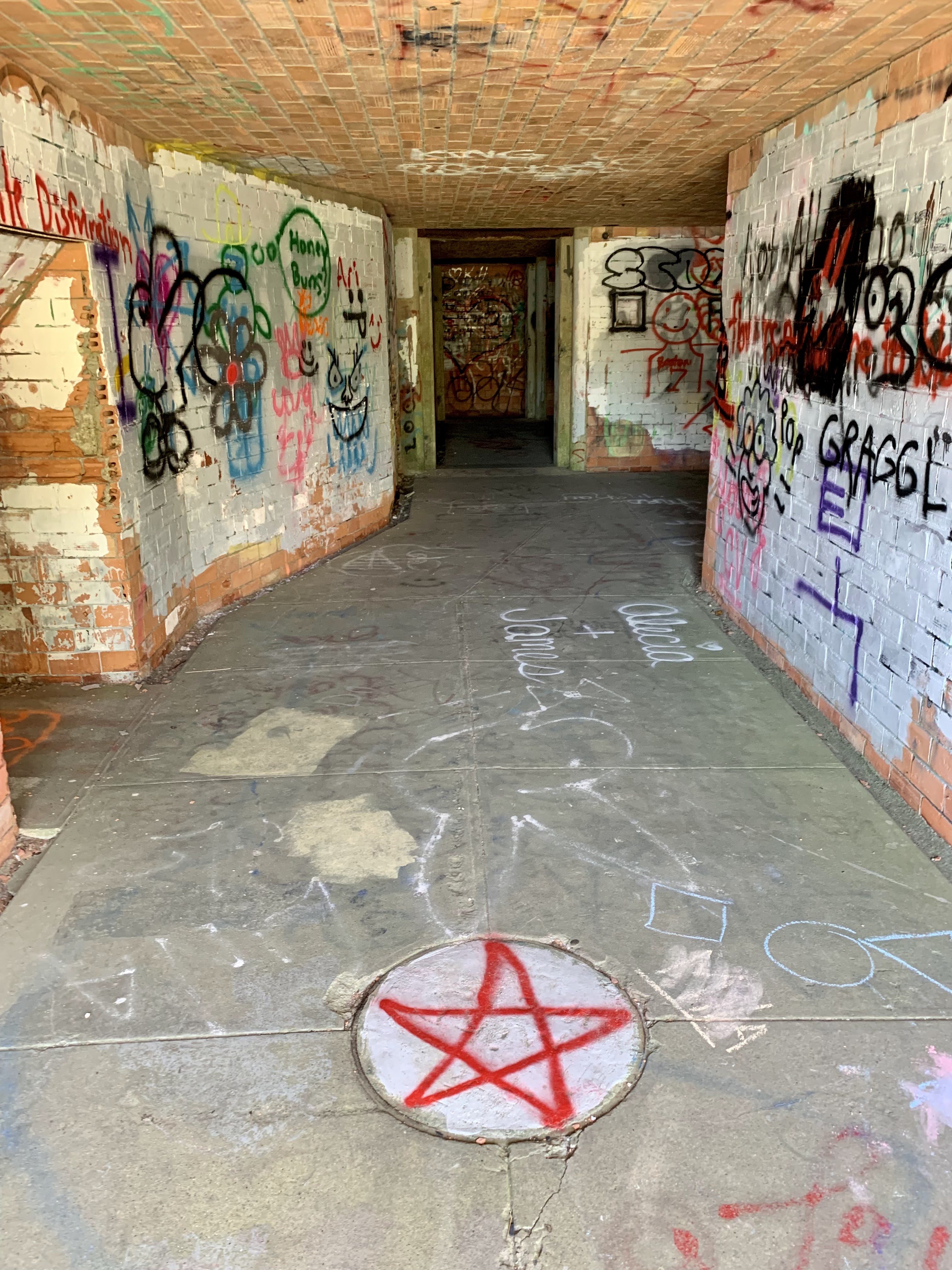
Happily, they didn't encounter any malevolent energy at the fort. Tony and I didn't either, although we did encounter a lot of graffiti. A lot!  Some of it is over 20 years old, so I don't think anyone has been cleaning the inside of the fort. The outside is almost spotless though (and has amazing views).

We had a good time exploring the fort. If you want to visit someplace historic, scenic, and possibly haunted, I'd recommend Fort Revere. 

July 17, 2021

The Whitehorse Tavern: Ghosts and A Pirate!

The historic Whitehorse Tavern in Newport, Rhode Island is on a lot of lists. It's on the National Register of Historic Places. It's on a list of the world's oldest restaurants, coming in at number 10. The Boston Globe recently placed it on a list of of the best places to eat in Newport. You get the idea. It's a historic and prestigious restaurant.

Those are some good lists to be on, but here's you should really care about: the 10 most haunted bars in America. There are a lot of haunted bars in this country, and the Whitehorse Tavern came in at number five. 

The Whitehorse was originally built in 1653 as a home for Francis Brinley, one of the early Newport colonists. Brinley sold the building in 1673 to William Mayes, Sr., who opened a tavern in it. His son, also named William Mayes, took over operation of the tavern in 1702. I don't think he paid too much attention to the business, though, since he also worked as a privateer for the English. 

A privateer was basically a licensed pirate. Mayes had permission from the English government to attack and steal from French ships, since they were one of England's political rivals at the time. Later, Mayes just became a full-on criminal pirate and raided ships sailing in the Indian Ocean, no matter who they belonged to.

After a decade of sailing the high seas, Mayes returned to Newport and resumed his duties at the tavern. His sister, Mary Mayes Nichols, took over after his death, and the business remained in the Nichols family for nearly two centuries. It acquired the name Whitehorse Tavern in 1736. The building was briefly a boarding house in the early 1900s before once again becoming a tavern. 

Hotels, restaurants, and bars often have ghost stories attached to them. It makes sense (if you believe in ghosts). Lots of people move through buildings like that, and they leave their spiritual mark on the place. The Whitehorse has been in use for almost four-hundred years, and many people have stayed there in its incarnations as a tavern and a rooming house. A lot of lives have been lived there, and some have probably ended there too. 

One ghost haunting the Whitehorse is said to be the spirit of an elderly overnight guest who died many years ago. He now wanders through the tavern in Colonial-era clothing, and is often seen by staff and guests near the fireplace in the dining room. He's also been seen in one of the bathrooms. HauntedHouses.com, which has a nice writeup about the Whitehorse, notes that this ghost sometimes pesters female guests, which is creepy, and not in a supernatural way. 

Other ghosts haunting the premises include a young girl who cries, and a presence that watches over the tavern and its staff. The latter is said to be mostly benevolent, and might possibly be the spirit of a former owner. This is something often reported at other long-running restaurants - business owners like to keep working after their deaths. For example, see my 2019 post about Local 186 in Provincetown.

The Whitehorse is only open for dinner this summer, so Tony and I weren't able to go inside during our recent Newport day trip. Maybe next time we'll get to try the food - and try to see a ghost in the bathroom. 

*****

This is totally unrelated to the Whitehorse Tavern, but I wanted to share some exciting news. I have a new book coming out in September. Here's the cover:

The cover makes me chuckle every time!

As you can probably guess, Witches and Warlocks of Massachusetts is about... well, witches and warlocks from the Bay State. For many years I looked for one book with all the local witch stories. I never found one, so I wrote it myself. It contains dozens of legends, historical accounts, and paranormal encounters, dating from the 1600s to the 21st century. So much witchcraft!

Although the book doesn't come out until September, you can pre-order it on Amazon, Barnes and Noble, Bookshop, and Books A Million. Why delay? You know you'll want a copy as soon as the nights start to get longer...

October 15, 2019

Bunhgole Liquors: Salem's Haunted Liquor Store

A few weeks ago we went up to Salem on a pre-Halloween excursion. We did a lot of our usual things. We drank cocktails made with pumpkin vodka. We visited witchcraft stores. We bought candy at Ye Olde Pepper Company. We visited a cheesy haunted house where we had to wear 3-D glasses.

You get the idea. We also took photos of Bunghole Liquors on Derby Street. It's a popular photo stop because it has a cool retro sign and "bunghole" sounds like a dirty word. Of course a bunhgole is actually the hole cut into a wooden cask so liquor can flow out, but the owners of Bunhole Liquors still play up the raunchy innuendo of the name. Their website has the motto "We're not #1 butt we're right up there," and you can buy t-shirts with slogans like "I Got It In the Bunghole."


Like many places in Salem, Bunghole Liquors is surrounded by some strange legends and weird history. According to their website the building on Derby Street was originally a funeral home where embalming was performed in the basement. During Prohibition the funeral home operated as a speakeasy. Guests would drink contraband alcohol in the basement surrounded by corpses and embalming equipment. It sounds creepy to me but I guess some people will do anything for a drink! The secret password to get in was "See you in the bunghole."

There are persistent rumors that a network of tunnels once ran between various buildings in Salem, and according to Sam Baltrusis's book Wicked Salem the bootlegging morticians smuggled in their illicit booze using a tunnel that ran from the basement of the funeral home down to the harbor. Is that true or just a rumor? I don't know but you can read more about Salem's tunnels in Christopher Jon Luke Dowgin's 2012 book Salem Secret Underground: The History of the Tunnels in the City.


After Prohibition the owner of funeral home gave up on embalming and went into the liquor business legally. In 1933 Bunghole Liquors became the second liquor store to open in Salem after Prohibition.  The tunnel (if it existed) was sealed up and the embalming equipment was sealed in the walls behind plaster. So let that sink in for a minute. Bunghole Liquors used to be a funeral home. Corpses were embalmed in the basement. The equipment was just shoved into the walls and hidden away. And there may have been a secret tunnel.

That sounds like the setup for a horror film to me, and unsurprisingly some staff at Bunghole Liquors have reported some strange things when working late. According to Baltrusis's Wicked Salem workers at the Bunghole tend to avoid the basement, a location where security cameras have recorded unexplained lights. Several have reported seeing a woman disappear after walking into the store. Perhaps strangest of all are the accounts of an unseen phantom cat that rubs against the legs of people working there. 

It's all kind of spooky, but what do you expect from a store that sells wine, beer and spirits? Get it? Spirits? I know, a bad pun. 

May 27, 2019

UFOs and Ghosts in Lincoln, Massachusetts

Why do strange things happen more in some places than in others? Some cities and towns have lots of stories about monsters, ghosts and weird phenomena. Others have almost none.

I suppose some it has do with history. A city like with a history like Salem is just going to have a lot of legends associated with it. But I suppose it could also have to do with size. Boston has been the largest and most populous city in New England for centuries and that means more people to tell more strange stories.

One theory proposes that a town's name determines how often its citizens experience paranormal phenomena. This theory is called the Fayette Factor, and it claims that places named after the Marquis de Lafayette attract weirdness like magnets attract iron. According to this theory "Lafayette" means the "little fairy," and as we all know fairies are tricksters. Naming your town after one is just asking for trouble.

An old stone wall in Lincoln.
On the other hand, some places don't have many legends at all. Or at least they don't seem to upon first glance. For example, this weekend Tony and I went out to Lincoln to walk the trails and visit the historic Gropius House. Whenever we go on a trip I research our destination's legends and weird history. I don't want to miss out on any haunted cemeteries or creepy forests!

At first as I researched Lincoln I was disappointed because I couldn't find any strange stories. Lincoln is very rural, so I was hoping to discover some Sasquatch sightings. No such luck. It's a relatively old town, so maybe a witch legend? Nope, sorry.

Happily, I found several recent UFO sightings. This makes sense, because rural towns have less light pollution and it's easier to see what's floating around in the nighttime sky. Here are three sighting from the National UFO Reporting Center website:

July 11, 1998:
Sole witness to object. At Hanscom Field/Hanscom Air Force Base watching aircraft. I am a self-aught expert on all types of aircraft (general, commercial and military). Heard jet engines overhead thinking it might be a military aircraft arriving at Hanscom. 737 at 6-7,000 feet on approach to Logan Airport in Boston. Looking up to identify aircraft I saw a sphere shaped object above the 737. The 737 traveled under it. The object was metallic as sunlight glimmered off it. Remained stationary for approximately 2 minutes then slowly moved from northwest to southeast and disappeared from my range of vision. 
November 29, 2004:
I was having a party and everyone was outside on the veranda. The sky was alive with stars. Then someone shouts WHAT'S THAT. And we all look and its slower than a plane so we know it's not that. Three lights in a triangle, flying low to the ground. 
October 11, 2017:
Three lights spinning in circles. Kind of looked like the lights of a movie theatre, but there was no beams the illumination was coming from above the clouds and they didn't move around at an exact timing like a machine. Took out my phone to take a video and they stopped. Over the sky toward Boston MA. Fuzzy oval white lights.

One of these accounts mentions Hanscom Airforce Base, part of which is located in Lincoln. Military bases often are loci for weird phenomena, particularly of the aerial kind, so it's not surprising that UFOs might be sighted near Hanscom. However, many ghost stories are also told about the base. The base's Vandenberg Gate (which I think is in Lincoln) is said to be haunted by the ghost of a suicide. Many guards have reported that something unseen bangs on the guard station's walls and windows at night. The lights also shut off on their own. Creepy!

An electrified fence and wide open skies. 
I did also find one other Lincoln ghost story which claims a house was once haunted by the ghosts of two teenage girls who killed themselves. The house was eventually torn down and a new house built on the property. The ghosts were not happy about losing their old home and have haunted the new building ever since, crying and making the lights flicker.

So I guess Lincoln does have some strange stories and legends after all. We didn't get to see any haunted sites on this particular trip but it makes me happy just knowing those stories are out there. 

April 24, 2019

Ghosts, Strange Graves and General Weirdness at Gilson Road Cemetery

I always like to read about a haunted location before we visit it. It helps me know what I should look for when I get there.

One of the first things I read about Gilson Road Cemetery really intrigued me. According to an urban legend, a ghost will appear if you leave the cemetery and shout "Betty Gilson, I have your baby!" The ghost appears as a woman in Colonial-era clothing, and is sometimes seen in the middle of Gilson Road. At other other times she hides behind the trees that line the road.


Who is Betty Gilson? Why is she so concerned about her baby? Unfortunately I didn't learn the answers to these questions when we visited Gilson Road Cemetery recently. Actually, I came away with even more questions.

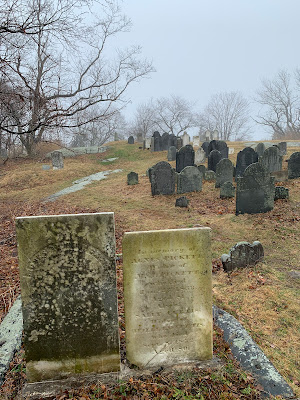
Gilson Road Cemetery is located on a quiet rural street in Nashua, New Hampshire. The cemetery itself is quite small and doesn't have a lot of gravestones standing, but it's pretty obvious there used to be more than there are today. For example, a quick scan showed that there were several stone bases that used to support gravestones that are no longer there. I'm sure there are many more graves that are completely unmarked.


I couldn't find any historical records of this cemetery online. The oldest grave, that of Hannah Robbins, seems to date from the 1790s. Most of the graves are from the 1800s. Many of them are for members of the Gilson family, although the Fiskes, Searles and other families are buried here as well.

Lisa Rogak's 2004 edition of Stones and Bones of New England claims it had a reputation as New Hampshire's most haunted cemetery, and ghost hunter Fiona Broome has been investigating since 2008. Many, many people have seen ghosts there. Orbs, strange lights, apparitions and small ghostly children have all been sighted by visitors to Gilson Road. My Facebook friend Sandra has gone to many haunted locations and said that she saw strange faces in photos she took at Gilson Road Cemetery.

Did we see ghosts? No. Was Gilson Road Cemetery weird? Yes. Unlike Vale End, which I blogged about last week, Gilson Road does not feel well-maintained. It feels vaguely neglected. Neglect doesn't necessarily equal weird in my book, but Gilson Road Cemetery is also the site of a lot of human activity. That's what made it seem so strange.


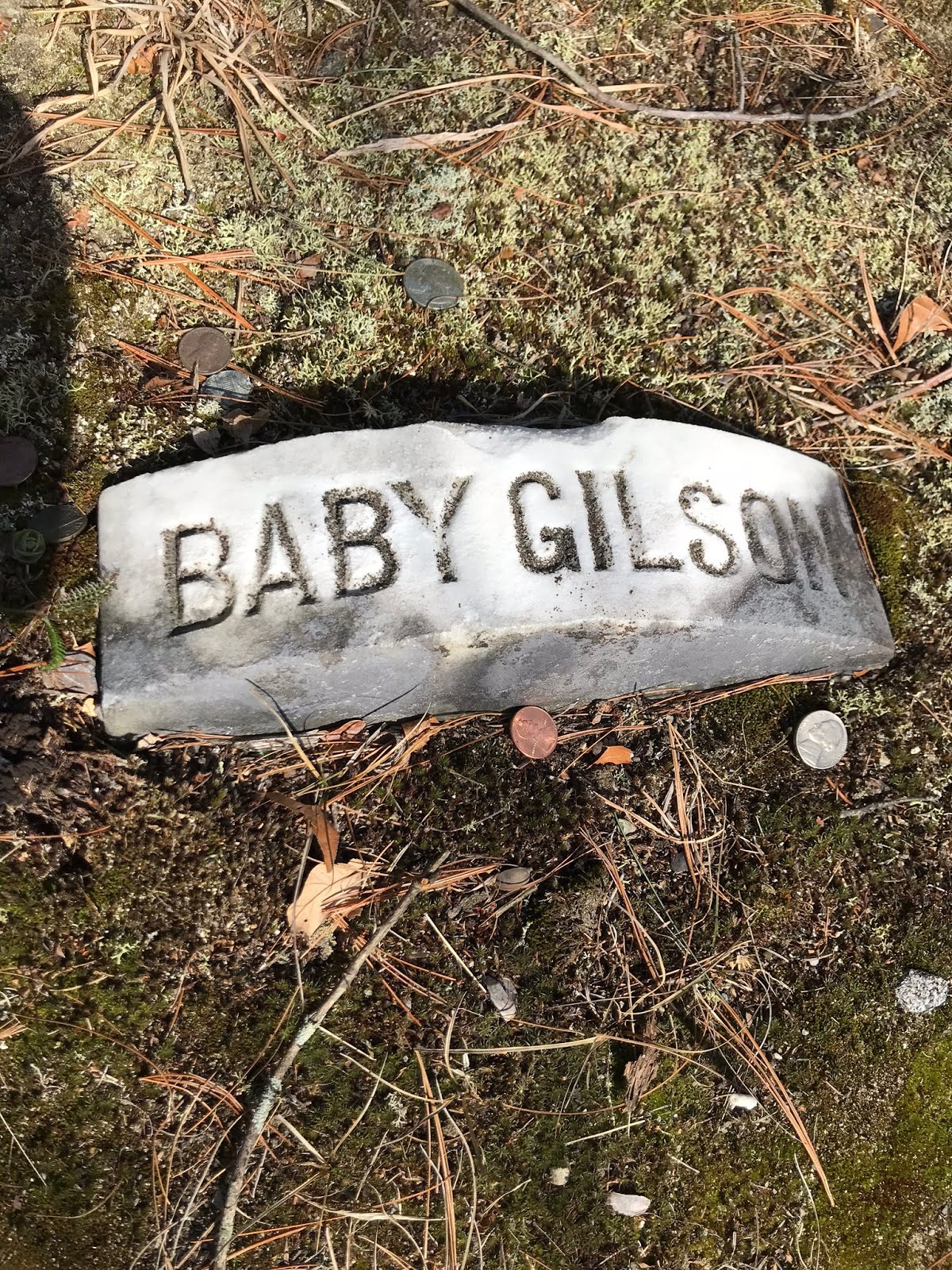
Visitors to cemeteries will sometimes leave coins on the graves of famous or important people. I think that's common. But visitors to Gilson Road have left coins on many, many graves and no one famous is buried there. I think people are leaving coins to honor (or perhaps propitiate?) the restless spirits that are said to reside there.

The neglect and the coins make Gilson Road Cemetery feel weird, and so do all the child graves. And there are a lot of them. For example, there are three identical tiny gravestones for unnamed babies from the Gilson family. Coins have been left on all of them. Perhaps these graves marked "Baby Gilson" have given rise to the legend about Betty Gilson and her baby?


Here is another child's grave, this time with a stuffed Big Bird left at it. All the graves are all quite old, so it's very, very unlikely Big Bird was left by someone who knew the child while he was alive.


The most memorable grave is probably that of little Walter Gilson, who died in 1811 when he was just over three years old. Walter's gravestone has a round hole drilled all the way through it. I haven't found a definitive explanation for this and have never seen another grave like it anywhere else.


People have left a lot of items at Walter's grave, including Barbie dolls, a solar powered crucifix, toy cars, and a rubber space alien. I think the stuffed Scooby Doo is particularly appropriate. A ghost-hunting dog is probably the best toy for a haunted cemetery.


Finally, adding to the weirdness, we saw this object on the ground. Was it a charm of some kind? It definitely had a Blair Witch vibe to it, but I suppose it could just have been a broken dreamcatcher. Or maybe not. We just left it right where it was. I'm not messing around with somebody else's graveyard magic, thank you very much.


There are a few theories about why the cemetery is supposed to be so haunted. According to one it was the site of a bloody battle between two local Native American tribes. Another claims the cemetery was the site of not one, but two deadly house fires. I don't think there's any evidence to back up either theory so they may just be legends. Still, true or not, they reflect the eerie atmosphere of the cemetery.

I guess you can see why I came away from Gilson Road Cemetery with a lot of questions. It's one of the more interesting graveyards I've been to recently and I recommend visiting if you get the chance. Maybe you'll find more answers than I did! My usual caveats apply: don't go at night and don't damage anything. This is someone's final resting place so be respectful. 

November 29, 2018

Wild Men Invaded Connecticut in 1888

Things always feel a little weird when the days grow short. The circle of civilization contracts and the wilderness encroaches with the growing darkness. Who knows what might be lurking out there in the gloom? Wild animals, criminals, ghosts... or maybe even wild men. We don't hear too much about wild men these days, but they were a popular topic in the 19th century press.

For example, the January 4, 1888 issue of The Boston Daily Globe, ran this shocking headline:

Lonely Regions Infested by Wild Men Who Terrorize All.

Connecticut Now Overrun with These Weird Creatures, Who Scare Children, Fight Men and Scream All Night. 

Cow Hill Forests and the Man with the Bearskin

Mr. Dunham's Midnight Fight by the Light of A Lantern

That's a really long headline, but I would say an effective one, since it certainly drew me in. Tell me more, Boston Daily Globe!

The article describes a variety of "wild men" who were causing trouble in Connecticut. For example, in Willimantic, a "well-dressed, wild-man who was about 40 years old" ran down the street screaming "Chloroform!" After several citizens tackled him he said his name was John Mullin, that he had deserted from the Italian Navy, and that government officials were pursuing him with the intent of chloroforming him. He ultimately escaped his captors, screaming "Chloroform!" as he ran off.

Someone dressed as Bigfoot during a 2015 snowstorm in Boston. Photo from the New York Times. 
Much creepier was the wild man who terrorized women in Spofford, Connecticut. This particular wild man, who was was "very tall, garbed in funereal black," would silently sneak up on women, grope them, and then disappear into the darkness. This wild man stopped his molestations after one of his victims, a Mrs. William Brown, emitted an ear-piercing shriek and collapsed onto the ground in terror.

One of the wild men was not a man at all, but was actually a young girl who leapt out of the bushes at some hunters in a swamp near Madison. She laughed hysterically at them and the hunters fled in fear.

The fourth wild man the Globe mentions seems like the wildest, and by wildest I mean least connected to civilization.
At Cow hill, near Mystic, there is a wild man of the woods. He wears a big black bearskin, and he looks hideous. His other clothes are not worth much. He says not a word, but he glares with a wild, determined stare. He advances on a man who approaches his lair in the forest of Cow hill, glares straight in the man's eyes once and then runs...
A man named George Dunham encountered this wild man while chopping wood and struck him on the head three times with his axe handle. The wild man ran off into the woods.

Meanwhile, outside of Norwich, a brawny man with a red face would appear in the woods at night. Carrying a lantern, he would shout "Murder!" and then dig a hole in the ground with a shovel. When confronted by a group of locals he disappeared into the dark forest.

A similar wild man haunted Monet's Valley on Rhode Island's Block Island that winter. He too would dig a hole late at night accompanied by a lantern, and when people went to investigate he would vanish with his light, leaving only a hole behind. Block Islanders were of mixed opinion about their wild man, with some thinking he was just a treasure hunter and others that he was a ghost from either the shipwrecked Palatine or Captain Kidd's pirate crew.

Wow! There's a lot to digest in that article, starting with the concept of the wild man. Although wild men appear frequently in 19th century American newspapers, the wild man is a cultural archetype who has been with us since the beginning of Western civilization. In the Sumerian Gilgamesh epic a hairy wild man named Enkidu dwells outside the city walls and frees prey from hunters' traps. Ancient Greeks and Romans thought the woods were filled with half-human satyrs and fauns, while art from Medieval Europe depicts hairy, club-carrying men lurking in the forests. When you leave the boundaries of civilization you enter the wild man's domain.

It's interesting to see how broadly this Globe article applies the term wild man. The bearskin clad man and the young girl seem the most archetypal, the first wearing an animal skin and the second scaring hunters from their prey. They also both seem to live outside of any town in the woods and swamps. But some of the wild men discussed just behave outside cultural norms and don't actually live in the wilderness. The "chloroform!" man (who sounds mentally ill) and the sexual predator who wore black fit in that category. We would use other terms to describe them today, but in 1888 they fit in the catch-all category of wild man. 

I'm not sure what to make of the two nocturnal hole-diggers, and it sounds like people in 1888 weren't either. Heck, one of them might have been a pirate's ghost, but I suppose they were also living outside cultural norms. The Norwich digger was described as "brawny," and this is a description often applied to other wild men of the time. An 1879 wild man spotted in Truro, Massachusetts was powerfully built and shirtless, while Connecticut's Winsted wild man was large, muscular and capable of breaking iron chains. I guess all the fresh air is good for your health.

An image from the 1974 TV show Korg: 70,000 BC.
Our own modern version of the wild man is Bigfoot. He's large, he's hairy, he lives in the woods, and like the 1888 Connecticut wild men is very elusive. Some wild men described in 19th century newspapers are described as ape-like and actually sound similar to Bigfoot. For example, the Winsted wild man was described by some witnesses as looking like a gorilla, and many cryptozoologists consider this an early Bigfoot sighting.

Is the wild man human, or is he a monster? Were early reports really Bigfoot sightings, or were they some kind of hoax? It's hard to say, and personally I don't think the wild man can be pinned down so easily. It just goes against his wild nature. He'll continue to elude capture and haunt the spaces outside the boundaries of civilization. Just be careful when you go out walking in the woods at night!

May 02, 2018

Gibbet Hill: Ghosts, A Ruined Castle and A Forgotten Execution?

The other day Tony and I took a road trip out to Groton, Massachusetts. Groton is an old town that was founded in 1655. It's really a beautiful place, with lots of old Colonial homes, charming white churches, and large farms. Looming just outside the town center is a big hill called Gibbet Hill.

A view up Gibbet Hill
As we all know from watching horror movies, every small town has to have at least one spooky location, and in Groton that location is Gibbet Hill. The word "gibbet" can mean a few things but none of them are pleasant. It can mean a gallows (for executions) or it can mean a metal cage used to publicly display dead bodies after execution. The "g" in gibbet is soft, so it is pronounced "jibbet."

The excursion was not without its dangers.
Gibbet Hill was quite pretty to visit on a sunny spring day, but with a name like that you know there must be some strange phenomena attached to it. According to local legends, ghosts have been seen lurking on the hill. Most of them wear Colonial attire, and some of them are missing limbs. Someone reported just seeing a dismembered foot wearing a green sock. That's it, just a foot. Stories like this are why I only visit haunted places during the day.


On top of Gibbet Hill are the ruins of a stone castle, which just adds to the spooky vibe. According to one local legend the castle dates from the 19th century. A wealthy man built it for his new wife, but unfortunately she died before it could be completed. He abandoned the project in sorrow and it was never finished.


I like that story, but it's not true. Historical records indicate the castle was constructed in 1906 by William Bancroft, a retired general and a politician, as his retirement home. Unfortunately Bancroft ran out of money and couldn't complete it. He sold the castle to a local physician and in time it became a tuberculosis sanitarium. Patients hoped that Groton's fresh air would help cure their ills.


In the 1920s the castle became a private hunting club until it finally burned down in the 1930s in a Fourth of July fireworks mishap. The property was owned for many years after that by the owners of the nearby Gibbet Hill Grill but became town conservation land in 2002. There is a spot on Route 40 where you can park and then hike up a short trail to the castle.


Kate Webber, co-owner of the Gibbet Hill Grill claimed in a 2006 Lowell Sun article that there no ghosts at the castle:
A lot of people are determined that the whole hill is haunted. Before the castle was public property, someone had snuck in and said when they looked through a window, (they) saw a severed foot with a green sock on it. People have reported seeing old colonial couples walking up and down the hills, a man in an old soldier's uniform who walks the property, and a Native American who was rumored to be chased down and killed. I'm convinced there aren't any ghosts roaming. But people look at the stone tower and think there has to be some wonderful and terrible Gothic stories that go with it.
So do ghosts haunt Gibbet Hill? I didn't see any, but I may not be the most psychically sensitive person around. We also visited during the day, and during the day I am always skeptical about all paranormal phenomena. If I had visited at night it would be a completely different matter. I would be convinced each creaking branch was a ghost and I'd be terrified of seeing that severed foot. The castle wasn't too spooky when we went, although there were some really large crows croaking in the trees.


The story behind the hill's name is a little murky. Samuel Green's 1894 book An Historical Sketch of Groton Massachusetts, 1655 - 1890 tells us the following about Gibbet Hill:
It is mentioned in the land-grant of Sergeant Jame Parker, which was entered in the town records of Richard Sawtell, the first town clerk who filled the office from June 1662 to January 1664-65. The tradition is that the hill was so called from the fact that once an Indian was gibbeted on its top. If this ever occurred, it must have happened before Sawtell's term of office.
Various sources on the web, including the Lowell Sun interview with Kate Webber, argue that since there is no proof of an execution the hill was probably named after a hill back in England. I guess that is possible, but we also know that the English settlers were not kind to local Indians, and that Groton was attacked and burned by local tribes during King Philip's War in 1676 and again in 1694 during King William's War. I wouldn't be surprised if there was an unrecorded Indian execution somewhere in the town's past.


While the ghosts at Gibbet Hill are open to debate, there is at least one well-documented weird story in Groton's history. In the 1600s a young serving girl who worked for the town's minister was possessed by Satan. It's an interesting story and I'll write about it next week.