Showing posts with label haunted house. Show all posts

August 08, 2023

A Nantucket Ghost Story: The Man with the Long Chin

Nantucket is a playground for the very wealthy these days, but that has not always been the case. In the past, the island has been home to Native Americans, Puritans, Quakers, whalers, and an assortment of artists and eccentrics. Nantucket has a very long history, and a long history usually means ghost stories. 

After the whaling industry collapsed in the mid-19th century, Nantucket became sparsely populated. There wasn't a lot of economic development on the island, which meant that very few of the old historic houses were torn down to make room for new ones. Those old houses are now mostly vacation homes for the wealthy, but there may be some unexpected guests stopping by to visit, as the following story indicates. 

The oldest house in Nantucket. 

It comes from Blue Balliett's 1984 book, The Ghosts of Nantucket: 23 True Accounts. I bought this at a used bookstore a few years ago, and really enjoy it. It's full of old-fashioned ghost stories, and also has some charming line drawings of old Nantucket houses. 

Back in July of 1981, a seven-year old girl named Jesse and her parents were invited to a dinner party at an old house on India Street in Nantucket. The adults were having a great time at the party, but Jesse was the only child there and quickly became bored. To keep her entertained, one of the hosts suggested she take a tally of interesting items in the house: candlesticks, mirrors, brass doorknobs, etc. 

The adults could hear her counting in a nearby room counting as they talked and ate dinner. But their dinner conversation was suddenly interrupted when Jesse ran into the dining room, terrified and exclaiming that she had seen a strange man in the house. Her parents and the hosts followed the frightened child into the room where she said she had seen the man, but there was no one there. 

Jesse said the man had a very large chin and was wearing a strange, dark blue suit. He had tipped his hat to her and then vanished into thin air. Although she had been scared, Jesse said he seemed friendly. She emphasized repeatedly that he had a long face and very large chin. Since Jesse was safe and unhurt, the adults at the party didn't take her story very seriously. After all, children do have active imaginations. 

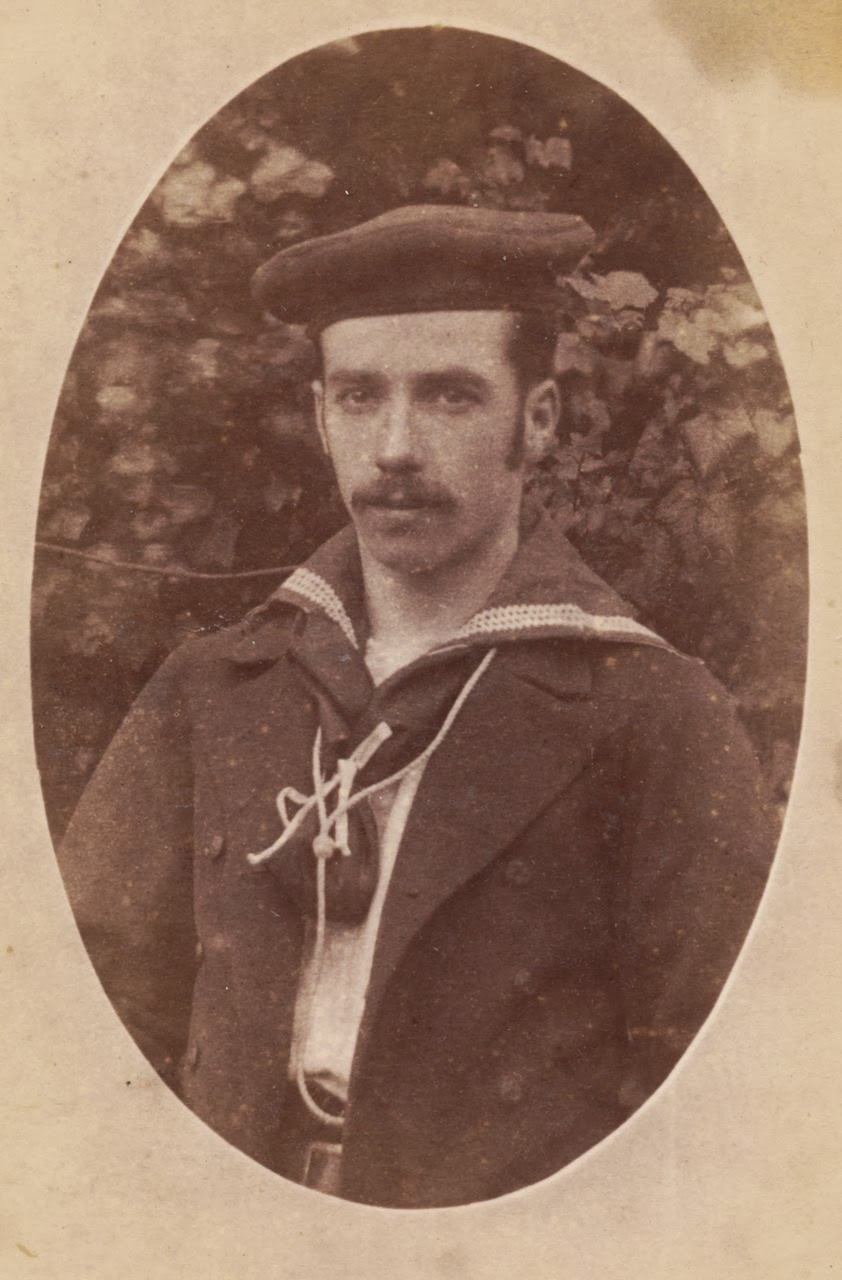
Vintage photo from Ebay

A few weeks went by, and Jesse and her parents had mostly forgotten about her strange experience. One afternoon they were invited back to the old house on India Street, and the owners showed them something they had found in the attic. It was a line drawing that showed people attending a garden party at the house, probably from the 1940s or 1950s. 

When Jesse saw the drawing she said, "That's him! The man with the long chin." One of the people in the drawing was indeed a man with an unusually long chin. Some text on the back of the drawing identified everyone in it. The long-chinned man was William Hunt, a previous owner of the old house. 

After doing a little research, the current owners of the house learned that William Hunt had committed suicide in 1961, twenty years before he tipped his hat to Jesse. 

*****

This is a very satisfying ghost story to me. It has an old house, someone encountering the supernatural, and proof at the end that the encounter was real. That proof is often a major aspect of classic ghost stories. For example, think of phantom hitchhiker stories. Someone always has to independently verify and identify the hitch-hiking ghost. "That girl hitchhiking was my daughter, and she died on this night twenty years ago on the way to her prom. You saw her ghost!" Or this story, from Cape Cod: "That seaweed you found only grows on the bodies of people who drowned. You saw the sailor's ghost!" 

In these older, classic ghost stories, someone who did not witness the paranormal encounter has to confirm it was authentic, or someone finds a piece of outside evidence (a piece of seaweed, a drawing, etc.) that confirms the encounter. It's what makes these stories satisfying. If this story just ended with Jesse telling everyone she had seen a long-chinned man it wouldn't quite feel the same. 

January 30, 2023

Haunted Houses and Terrifying Specters: Ghost (?) Stories from Weare, New Hampshire

There are a lot of ghost stories from New England, and one of my favorite types is what I call the "Scooby-Doo" ghost story. In these stories, the ghost is rationally explained away at the end. There is nothing supernatural in these stories, although people in them initially think there is. I call them Scooby-Doo stories because each episode of the Scooby-Doo ended with the ghostly terror being revealed as someone impersonating a ghost, not something supernatural. These stories are similar, but without all the greedy real estate developers and smugglers.

You can find these Scooby-Doo ghost stories in a lot of the local town history books which were written in the 19th century. I found a bunch of them recently in William Little's The History of Weare, New Hampshire, 1735 - 1888 (1888). In one story, an early settler named John Hodgdon was riding home to Weare on horseback one night when he saw something creepy in his cornfield. As the hair on his neck stood up, he saw a large white object appear on a small knoll in the field. It disappeared with an uncanny sound, only to reappear again. Hodgdon dismounted and walked through the dark field to the knoll, determined to discover what this ghostly object (or entity) was. He learned it was not a ghost, but was instead a large basket some of his workers had left in the cornfield. When the wind blew it rolled up the hill, and when the wind subsided it rolled back down. Mystery solved!

William Little, author of The History of Weare, New Hampshire

In another tale, David and Betsy Purington lived in an old shanty, and "one winter were terribly troubled with ghosts." David Purington thought it was the spirit of his deceased father-in-law. One night, a neighbor came to visit the Puringtons. As they sat talking a strange rapping sound was heard from the attic loft above them. It grew louder and louder and louder. David screamed out for the ghost to desist, but the infernal rapping grew louder! Their neighbor was the only one brave enough to climb into the attic to confront the ghost. After climbing the rickety ladder, she saw a chicken whose legs and been frozen by the cold. It was unable to walk, and made a rapping sound as it tried to stand. "The hen was carried to the room below, and the ghost was laid." Mystery solved! Hopefully the hen recovered from being frozen. 

In East Weare, there was another house that was supposedly haunted. A minister had once lived there, but after he moved away the house stood abandoned. People reported hearing strange noises and even seeing strange lights at night. Some brave schoolboys once approached the house during the day, but fled when they heard an eerie noise and heard the doorknob rattle. Eventually the apparitions stopped. When someone finally went into the haunted house, they saw a dead cat lying on the middle of the floor. Apparently the minister had left it behind when he moved and it had caused all the noise. Mystery solved! 

Or is it? A cat doesn't create ghostly lights. And clearly people didn't take very good care of their animals then...

William Little does include at least one ghost story in The History of Weare that's slightly ambiguous. A man name Mr. Eaton was out hunting raccoons one misty autumn night with some friends. Mr. Eaton paused to rest, when out of the mists emerged a terrifying ghost. "He could see the sunken eye-balls, the worm-eaten face, the shriveled hands, and he shook with terror." One of his friend arrived and Mr. Eaton explained what he had seen. The ghost was not visible to the friend. Many people in Weare believed Mr. Eaton had truly seen a ghost, but others suspected that he had just been drunk. So that mystery was perhaps not completely solved. 

There are a lot of books like The History of Weare out there, histories of New England towns written in the mid-to-late 19th century by people who lived in these places. New England had become a modern industrial area by this time, and you can sense the pride the authors feel in the progress their towns had made. At the same time, they're fascinated by the earlier, pre-industrialized way of life that is vanishing and the supernatural worldview that went with it. Maybe these rationalized ghost stories are the authors' way of straddling both worlds, of indulging the wonders and terrors of the past but also explaining them away with the light of reason. 

January 02, 2022

Two Phantom Houses Adrift in Time

I was browsing through my library of New England books and came upon two interesting stories. Both are supposedly true, and although they occurred more than 100 years apart they are very similar. They're about phantom houses that seem to travel through time. 

The first story comes from Footsteps in the Attic (2002), a book by paranormal investigator Paul Eno. In the summer of 1975, Eno was vacationing in Vermont when he met two local surveyors, Clement Ridley and Bud Harper. They told Eno about something strange they had seen. 

The previous summer, Ridley and Harper had been hired to survey a farmer's land in Johnson, Vermont. As they looked over the property they noticed an old wooden farmhouse that was not shown on any maps. The house was rundown but there was fresh laundry drying on the clothes line and smoke coming from the chimney. Someone was clearly living there. Oddly, there weren't any cars parked in the yard or any electrical or phone lines. 

The John Balch House, Beverly Massachusetts

Ridley and Harper saw a man in the yard. He carried an axe over one shoulder and wore an old-fashioned wide-brimmed hat. They called out to him, wanting more information on the property, but the man didn't hear or see them. They called out again and walked closer to the house. This time the axe-wielding man seemed to see hear something, but didn't see the surveyors even though they were only fifty feet away. 

Ridley and Harper got a little spooked. Why couldn't the man see or hear them? And should they be concerned he was carrying an axe?They decided to leave the area. 

They returned a few days later to continue surveying the land, but when they arrived they were surprised to find there was no old wooden house. Instead, they just found an overgrown cellar hole. Some of the stones looked blackened, as if they had been scorched in a fire long ago. 

Ridley and Harper were even more spooked than they had been when they encountered the man with the axe. A few days later, they learned from someone at Johnson's town hall that there had once been a house in that location - but it burned down in 1910.

Cue the spooky music.... 

Here's a very similar story, but from the 1840s. Caroline Howard King, a wealthy young woman from Salem, was vacationing in Beverly, Massachusetts with her family when she too encountered a house seemingly adrift in time. 

On a warm summer day King went for a walk in the woods with her cousin Nony and their maid Lucy Anne. People in Beverly called the woods Witches Woods, and said they were haunted. King and her companions didn't think anything strange would happen to them on a sunny afternoon, but they were wrong. 

After walking for only a short while they realized they were lost. It seemed as if the path they had followed into the woods had vanished. They wandered around for what seemed like hours until they finally came upon the ruins of an old farmhouse. King knew this was what the locals called the Homestead, and it was said to be haunted. Very little remained of the farmhouse – just a foundation, a chimney, and a stone stoop. An enormous lilac tree grew next to it. The trio explored the Homestead but there wasn’t much to see.

They soon located a path that climbed up a nearby hill. When they reached the top they could see a farmhouse below them where the ruined Homestead should have been, but this one was not in ruins. It was well-kept and smoke rose from its chimney. A small lilac shrub grew in front of it. As they watched a woman emerged and fed a flock of chickens in the yard from the stone stoop. Lucy Anne ran down to ask the farmwife for directions while King and her cousin waited at the top of the hill. 

Lucy Anne was dejected and confused when she returned. She couldn’t find the cozy little farmhouse anywhere, just the ruined Homestead and “hateful solemn old pine trees.” But now that she was back on the hill she once again could see the well-kept farmhouse with its smoking chimney. It was as if King, Lucy Anne, and Nony were looking backwards in time to a moment in history before the Homestead became a ruin. 

The threesome became even more eager to find their way home after they had this frightening realization. Luckily, they found a dry stream bed and after following it towards the ocean they emerged from the woods near their vacation house.  

Caroline Howard King includes that story in her memoir When I Lived In Salem (1822 - 1866), and I also include it in my new book Witches and Warlocks of Massachusetts. The similarities to Paul Eno's story are pretty obvious. One difference is that people in Beverly knew there was something weird about the Homestead, but no one in Johnson, Vermont seemed aware of the phantom house in their town. Also, the Homestead can only be seen in its original state from a distance, not up close, unlike the Johnson house.

I'm not really sure what to make of these stories. Neither one provides an explanation of why these houses seem to slip through time (if that's even what's happening). Or are the people who see them looking through some kind of window to the past? It's not clear.

If there's any lesson, it's that the past is not really gone and is here all around us. We live in one of the oldest parts of the US, with a rich history of strange phenomena. Maybe that history sometimes literally shows itself to the lucky few. And who knows, maybe 200 years from now someone will see a phantom McMansion appear along with its ghostly owner on a riding lawnmower. We too will become part of New England's weird and wonderful past. 

November 21, 2021

Plymouth, 1734: A Haunted Mansion and A Court Case

It's Thanksgiving week, so here's a spooky story about a haunted mansion from Plymouth, Massachusetts. It's spooky if you believe in ghosts, but it's even spookier if you've ever been a landlord. Read on...

In 1725, a wealthy sea captain named Thompson Phillips married Hannah Cotton, the daughter of Reverend Josiah Cotton of Plymouth. Shortly after their marriage, Phillips built a large mansion in Plymouth for him and his new wife to live in. It was one of the finest homes in town.

Sadly, Thompson Phillips drowned in a storm while sailing to Jamaica. Shortly after remarrying, his widow also died, from smallpox. Ownership of the mansion passed to Reverend Cotton. 

Reverend Cotton lived on a prosperous farm just outside of town and did not really want to own a large empty mansion. He tried to sell the house, but the local economy was in a slump and he could not find a buyer. He decided to rent it out and soon found some tenants. 

Foremost among them was John Clarke. Clarke worked as a joiner, a type of skilled woodworker. He renovated several rooms into workshops, and lived in the mansion with his family and some apprentices. His colleagues Thomas Savery and Samuel Holmes and their families also moved into the mansion, as did a spinster named Ann Palmer. For a while all was good. The tenants lived and worked in the deceased sea captain's mansion, and Reverent Cotton collected rent from them. 

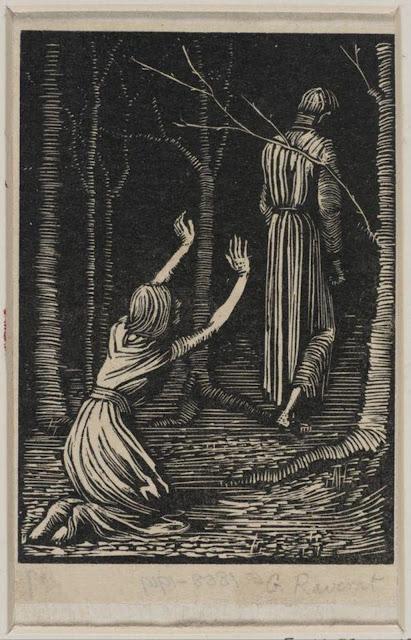
Gwendolen Raverat, Clerk Saunders' Ghost, 1918 woodcut.

The good times didn't last. In January 1733, the tenants began to hear strange noises. Sometimes they sounded like the death moans of a dying person, and at other times like a cane being struck against the walls. The tenants couldn't discern where the noises were coming from. Adding to the weirdness, doors and cabinet drawers would open on their own accord. 

Various people, both inside and outside the house, also reported strange lights. For example, one night Mary Little, who lived near the mansion, saw a strange blue light ("a pale blewish light") in one of the upstairs windows. She watched the light for nearly 30 minutes before it disappeared. The next morning she asked John Clarke's wife if the apprentices had been up in the attic late at night with a candle. Mrs. Clarke looked surprised. No one had been upstairs at all!

News of the strange phenomena began to spread through Plymouth, and soon nearly everyone in town believed the mansion was haunted. Large crowds gathered outside the house at night trying to see the weird blue lights or hear the mysterious groans. 

Reverend Cotton was unhappy about the rumors and believed they were false. Several weeks before the alleged hauntings became public, he had argued with John Clarke. Cotton wanted to move one of his son-in-laws into the mansion and wanted John Savery, Clarke's colleague, to move out. Clarke was infuriated. He shouted that the house was haunted and that he, and all the tenants, would move out. Cotton didn't believe the house was haunted and thought the rumors about ghosts were just a way to get back at him.

By October of 1733, all the tenants had vacated the mansion, claiming they were unable to live with the supernatural phenomena. Reverend Cotton attempted to find new ones, but no one was willing to move in. Many people believed the house was haunted, and those who were skeptical didn't want to deal with the large crowds of gawkers who gathered outside almost nightly.  

Cotton finally took his former tenants to court. They owed him unpaid rent and had broken their lease, but he thought it unlikely he'd be able to get recompense for that in court. Instead, he sued them for slander. The case was heard on March 5, 1734 in the Plymouth County Inferior Court of Common Pleas. Reverend Cotton was ill and could not attend the trial, but his lawyer, John Cushing Jr., grilled the defendants. He argued they had lied about the hauntings to break the lease and prevent Cotton from renting to future tenants. After all, Cushing said, it was the 18th century. How could anyone still believe in ghosts, witches, and demons?

Cushing (and Cotton, who had helped develop their legal strategy), underestimated the jury's belief in the supernatural. The jury believed the house was indeed haunted and also believed Cotton's former tenants were telling the truth. They found them innocent of slander. Cotton appealed the case and brought it to Plymouth Superior Court a month later. Once again a jury found the defendants innocent, and this time also required Cotton to pay their court costs. Clearly, people in Plymouth believed in ghosts.

Reverend Cotton gave up trying to sue the tenants, and eventually he moved into the allegedly haunted mansion with his own family. They lived there for more than five years, and never experienced any strange phenomena. Cotton also wrote an essay decrying superstitious beliefs, but sadly never published it. The building was eventually sold, and still stands on King Street in Plymouth today. As far as I know, no one has reported any ghosts since. 

My source for today's post was Douglas Winiarski's article "'Pale Blewish Lights and A Dead Man's Groan: Tales of the Supernatural from Eighteenth-Century Plymouth,"which appeared in The William and Mary Quarterly, Oct. 1998, Vol. 55, No. 4, p. 497 - 530. 

If you want to read more supernatural tales from the Bay State, I recommend my new book Witches and Warlocks of Massachusetts, which is available wherever books are sold online. It's a perfect Christmas gift too!


May 18, 2020

Orgiastic Gnomes Terrorized a Massachusetts Family in 1895

I want to thank Simon Young and Chris Woodyard of the Fairy Investigation Society for telling me about the following bizarre story. 

Here's a trigger warning - there is sexual assault involved. 


*****

Newspapers in 19th century America often printed some pretty outrageous stories. Publishers wanted to sell papers, and sometimes the stories that sold best were about weird supernatural phenomena, like this one about a family persecuted by goblins. 

The story, which was printed in the July 6, 1895 issue of The Cincinnati Enquirer, begins by describing an abandoned house in a village in Worcester County, Massachusetts. The house is "sadly dilapidated, with ragged roof and windows, in an inclosure, overgrown by brush and weeds, at the mercy of the elements, for nobody enters its creaking doors nor approaching it nearer than necessity demands. To old and young alike it is the abode of mystery and dread—of specters to torment and vanquish the strongest man!"

Many years ago a family named Dane lived in the village. They were prominent members of the community with ancestry dating back to the Puritan era. The Danes lived a respectable and unremarkable life. One day Mrs. Dane was home alone with a servant when the crockery and dishes began to fall off the shelves. At first the two women were puzzled, but they grew scared once the dishes were thrown at them by invisible hands. Even the broken pieces on the floor flew about the room, cutting the Mrs. Dane and the servant. When the men of the family returned home that evening the poltergeist activity occurred again with greater ferocity, knocking over chairs, bureaus, and mirrors. 

Up until this point the story is a classic haunted house story of the kind that has been told in New England for centuries. But it gets weirder. 

The Danes decided to leave their house and stay with their neighbors, the Grahams. The weird phenomena follow them. The Grahams' house is filled with the sounds of wood being chopped, furniture breaking, and strange voices issuing threats. This goes on for a while, until one night during a thunderstorm all hell breaks loose. 


During the storm the families' candles are mysteriously extinguished and the house is plunged into darkness. But the Grahams and Danes are suddenly not alone. Illuminated by flashes of lightning, they see that the house is filled with monstrous, foul-mouthed gnomes: 


When lightning projected vivid flashes into every nook and corner of the Graham domicile it was found to be peopled with an innumerable multitude of gnome-like creatures, with large eyes and noses, perpendicular mouths, a superabundance of hair on heads and chins, and complexion of bright green. These monsters laughed grimly and made threatening gestures. As an evidence that they prided themselves upon their hideousness the most grotesquely hideous among them were the leaders of their orgies, and gave the word of command, supplemented by voluminous profanity (The Cincinnati Enquirer, July 6, 1895, p.6)

The Danes decide to leave the house, hoping that the hideous gnomes will follow them and spare the Grahams. The gnomes have other plans, though. All the members of both families find themselves unwillingly propelled into their beds where they are unable to move. Then - there's no other way to say this - the gnomes rape everyone. 


Then began an orgy of grosser kind than can be risked in a description for the public eye. Truthfully might these devoted people have felt that “Hell is empty and all is devils here,” for in the bottomless pit no darker devilments are devised. The house was suddenly illuminated by phosphorescent gleams, making the green gnomes still greener, and at once their acts were of the grossest and most utterly indescribable obscenity. Those old tales of phallic orgies in Pompeii seem to have been rendered tame and semi-decent in comparison... (The Cincinnati Enquirer, July 6, 1895, p.6)

At one point the gnomes also whip their female victims with "illuminated wires" and two of the women "carried the marks of the devil’s flogging as long as they lived." Yikes!


The gnomes disappeared when the sun rose, but they returned to the house every time there was a thunderstorm to torment the Danes and Grahams. They turned bread into rats and meat into snakes. They threw a blood-like fluid onto people that caused festering sores, and threw real human blood on the walls, permanently staining them. 

The Danes and Grahams held a prayer meeting to exorcise the evil gnomes. The little monsters failed to appear during the next thunderstorm, but the Grahams' house was instead pelted with boulders that smashed the windows and lodged in the fireplace. During the same storm a "luminous apparition" also appeared in the sky, denouncing the Puritan witchcraft trials of the 1600s. 

The article ends inconclusively. The Dane house is destroyed by lightning and villagers see green gnomes dancing in the flames as it burns. The Graham house becomes abandoned and is eventually destroyed. But it's not clear what happens to the two families or the gnomes, or even which haunted house is being referenced at the start of the story. 


There's a lot to think about here. It's interesting that the story appeared in an Ohio newspaper. If it had appeared in a Massachusetts paper readers would have wanted more details, like the village's name or the years when it happened. They would also have suspected it wasn't true. But perhaps to an Ohio reader Massachusetts was a distant land where people used to hang witches and weird things happened*, or at least a place where people told strange stories like this one. 

Parts of Ohio were settled by New Englanders, so it makes sense that a story like this appeared in The Cincinnati Enquirer. And some aspects of it do seem authentically New Englandy to me, like the poltergeist activity (which has been reported in this region for more than 300 years) and the connections to the Puritans and the witch trials which are alluded to. 

The weirdest part of the story obviously is those evil, hyper-sexualized green gnomes. There are plenty of local stories about fairies and other Little People, but nothing like this one. I'm going to assume they came from deep inside the author's imagination. At least I hope so. 

*OK, both of those are true. 

August 28, 2019

H.P. Lovecraft's Ghost Appeared at This House

In 1971 the ghost of H.P. Lovecraft appeared to a Brown University undergraduate living in an apartment at 10 Barnes Street in Providence, Rhode Island. Lovecraft, a well-known author of horror and weird fiction, lived in this building from 1926 until 1933. He died in 1937 from intestinal cancer exacerbated by malnutrition.

The appearance of Lovecraft's ghost is briefly mentioned, as if it were no big deal, on page 441 of L. Sprague de Camp's H.P. Lovecraft: A Biography (1975). No big deal?! It's the ghost of H.P. Lovecraft!

10 Barnes Street, Providence, Rhode Island.
I'm assuming that de Camp didn't believe the story, and probably no one else did since it doesn't appear in many places. Lovecraft himself was a staunch materialist and didn't believe in the human soul so he wouldn't believe this story either. But let's suppose for a moment this story is true and that Lovecraft's ghost really did manifest to a Brown student in 1971. Why would he appear at 10 Barnes Street and in that particular year?

Ghosts allegedly appear in places to which they have strong emotional connections. We've all heard stories about ghosts appearing in the places where they were murdered, but ghosts also appear at locations where they had positive emotional experiences. That might be the case here. Lovecraft spent his most productive and successful years as a writer at 10 Barnes Street. While living there he wrote some of his most famous stories, including "Call of Cthulhu," "The Dunwich Horror," and "At The Mountains of Madness." Perhaps his spirit had fond memories and didn't want to leave.

Ghosts are also said to appear when they have unfinished business. They show up when they want someone to bury their undiscovered body or send a message to their surviving loved ones. I don't think Lovecraft's ghost appeared in 1971 to reveal any dark secrets, but he probably had a lot of unresolved issues. His childhood and adolescence were like something from a Gothic novel: both parents dying in an insane asylum, the slow dissipation of his family's wealth, his mother telling him he was too hideous to be seen publicly, and a nervous breakdown in his teenage years.

A statue of Lovecraft at the Providence Art Club.
His adult life was also quite complicated and full of contradctions. Here a few examples:


  • Lovecraft was a racist and an anti-Semite, yet he married the Jewish immigrant Sonia Greene and was best friends with Samuel Loveman, a gay Jewish poet to whom he dedicated the homo-erotic short story "Hypnos."
  • Lovecraft seemed to have little interest in sex but his stories are full of bestiality, incest and intercourse with monsters.
  • Lovecraft lived most of his life in poverty but thought full-time work was beneath him. Towards the end of his life he survived on a near-starvation diet but spent his meager income on postage answering letters from anyone who wrote to him. According to one estimate he wrote up to 100,000 letters.
  • Lovecraft didn't believe in the supernatural, but based many of his stories on dreams and nightmares so vivid that some occultists are convinced he really had access to occult secrets. 


So, I think it's very likely that Lovecraft's ghost (if it exists) has some unfinished business.

Ghosts may also be vengeful, appearing because they are angry at the living. But why would Lovecraft be angry at a Brown undergrad? Maybe because Lovecraft always wanted to attend Brown University and study astronomy but couldn't even finish high school due to his fragile mental state. Perhaps after death his ghost appeared to berate whichever poor Brown student was living at 10 Barnes Street in 1971. I can also imagine that a student at that time could be a long-haired hippie, something that might also anger the conservative author. 

Of course this is all just speculation on my part. Lovecraft's ghost probably didn't even appear at Barnes Street. However, if you want to find out, you can rent an apartment there. Nothing is available right now, but it looks like they rent for around $1,200/month.  Maybe the next time one comes on the market someone will find out for sure if the ghost of H.P. Lovecraft is still lingering around Providence. 

*****
I was inspired to write this because this past weekend was I attending NecronomiCon 2019, the bi-annual H.P. Lovecraft convention in Providence. I was browsing through Rory Raven's Haunted Providence: Strange Tales From The Smallest State (2008) to prepare for my trip and read the story about 10 Barnes Street. Raven's book directed me back to the original source, de Camp's biography of Lovecraft. 

May 27, 2019

UFOs and Ghosts in Lincoln, Massachusetts

Why do strange things happen more in some places than in others? Some cities and towns have lots of stories about monsters, ghosts and weird phenomena. Others have almost none.

I suppose some it has do with history. A city like with a history like Salem is just going to have a lot of legends associated with it. But I suppose it could also have to do with size. Boston has been the largest and most populous city in New England for centuries and that means more people to tell more strange stories.

One theory proposes that a town's name determines how often its citizens experience paranormal phenomena. This theory is called the Fayette Factor, and it claims that places named after the Marquis de Lafayette attract weirdness like magnets attract iron. According to this theory "Lafayette" means the "little fairy," and as we all know fairies are tricksters. Naming your town after one is just asking for trouble.

An old stone wall in Lincoln.
On the other hand, some places don't have many legends at all. Or at least they don't seem to upon first glance. For example, this weekend Tony and I went out to Lincoln to walk the trails and visit the historic Gropius House. Whenever we go on a trip I research our destination's legends and weird history. I don't want to miss out on any haunted cemeteries or creepy forests!

At first as I researched Lincoln I was disappointed because I couldn't find any strange stories. Lincoln is very rural, so I was hoping to discover some Sasquatch sightings. No such luck. It's a relatively old town, so maybe a witch legend? Nope, sorry.

Happily, I found several recent UFO sightings. This makes sense, because rural towns have less light pollution and it's easier to see what's floating around in the nighttime sky. Here are three sighting from the National UFO Reporting Center website:

July 11, 1998:
Sole witness to object. At Hanscom Field/Hanscom Air Force Base watching aircraft. I am a self-aught expert on all types of aircraft (general, commercial and military). Heard jet engines overhead thinking it might be a military aircraft arriving at Hanscom. 737 at 6-7,000 feet on approach to Logan Airport in Boston. Looking up to identify aircraft I saw a sphere shaped object above the 737. The 737 traveled under it. The object was metallic as sunlight glimmered off it. Remained stationary for approximately 2 minutes then slowly moved from northwest to southeast and disappeared from my range of vision. 
November 29, 2004:
I was having a party and everyone was outside on the veranda. The sky was alive with stars. Then someone shouts WHAT'S THAT. And we all look and its slower than a plane so we know it's not that. Three lights in a triangle, flying low to the ground. 
October 11, 2017:
Three lights spinning in circles. Kind of looked like the lights of a movie theatre, but there was no beams the illumination was coming from above the clouds and they didn't move around at an exact timing like a machine. Took out my phone to take a video and they stopped. Over the sky toward Boston MA. Fuzzy oval white lights.

One of these accounts mentions Hanscom Airforce Base, part of which is located in Lincoln. Military bases often are loci for weird phenomena, particularly of the aerial kind, so it's not surprising that UFOs might be sighted near Hanscom. However, many ghost stories are also told about the base. The base's Vandenberg Gate (which I think is in Lincoln) is said to be haunted by the ghost of a suicide. Many guards have reported that something unseen bangs on the guard station's walls and windows at night. The lights also shut off on their own. Creepy!

An electrified fence and wide open skies. 
I did also find one other Lincoln ghost story which claims a house was once haunted by the ghosts of two teenage girls who killed themselves. The house was eventually torn down and a new house built on the property. The ghosts were not happy about losing their old home and have haunted the new building ever since, crying and making the lights flicker.

So I guess Lincoln does have some strange stories and legends after all. We didn't get to see any haunted sites on this particular trip but it makes me happy just knowing those stories are out there. 

February 05, 2017

An Old Haunted House in Cambridge

I am one of those people who actually likes winter. Once the grim darkness of early January is gone winter here in New England is actually pretty nice. There is a certain clarity to this time of year. The leaves are down and I can really see the landscape in all its contours. Rocks and boulders that are hidden most of the time are visible now, and its easier to see those hardy birds who haven't flown south.

It's also a good time to do stuff around the house. For some reason, when February comes I always like to make traditional New England recipes. Yesterday I made cranberry bread, and today I'm cooking pumpkin soup. There's just something homey about winter. The nesting impulse from autumn continues into these months, but without the pressure and commercialism of the holidays.

Of course, the spooky vibe from Halloween continues as well. It's still dark and dead outside, and it still seems like a good time for ghost stories. (Really, is any time not good for ghost stories?) Here's one from a friend who for many years lived in the Cooper Frost Austin House, which is the oldest house in Cambridge, Massachusetts.

The Cooper Frost Austin House

The Cooper Frost Austin House was built in 1681 by Samuel Cooper. Cooper and his family were prominent members of Cambridge society, with several of them serving as deacons in the Puritan church or in municipal leadership positions. The house remained in the same family for 250 years (!) until 1913, when it was given to the organization now called Historic New England. The house is open several times a year for tours, and is worth visiting if you enjoy early Colonial architecture.

My friend was one of several resident caretakers who have lived in the house since 1913. When he was moving in, he met with the previous caretaker to see if there were any tips he needed to know. She gave him an overview of the property and the grounds, and explained the multiple rules for living in a historic house. And then she said:

"Oh, and by the way, I think there's a ghost in the house."

"A ghost?" my friend said.

"Yes, a ghost. I've sensed a presence in the house, particularly in the east bedroom upstairs. It feels like a woman, and sometimes it feels like she's watching me when I sleep. But don't worry! I don't think she's malevolent."

And with that she left, and my friend was left alone in the house. Naturally, he had already selected the east bedroom as his new bedroom.

Months went by, and my friend didn't experience anything strange. He slept through the nights without feeling any unusual presences. However, something weird happened one day when he was at the Boston Public Library. He had gone to the library to research the history of the house, and he mentioned to a young man working at the reference desk that he was now living in the Cooper Frost Austin House.

"The Cooper Frost Austin House?" the young librarian said. "Ugh. I've been inside that house and I'll never go back there again."

"Why? What happened?" my friend said.

"I spent the night there one time. Never again! A friend of mine was living there and asked me to house sit while he was out of town. At first everything was fine. It's a great old house and I was happy to have it all to myself, if even just for a weekend."

"That night I went to bed, and fell fast asleep. I was sleeping deeply when I started to have this uneasy feeling. It felt like someone was ... watching me. When I opened my eyes I saw a woman standing at the foot of the bed, staring at me. She had on old-fashioned clothes, and she didn't look happy to see me. I screamed and she vanished into thin air. I sat downstairs wide awake for the rest of the night, and I've never gone back inside that house."

Of course, the librarian said he had been sleeping in the east bedroom when he had seen the ghost.

My friend ended up living there for many years, and said he never saw the ghost, but occasionally people who visited him said they sensed something in the house. Personally I've spent a lot of time in the Cooper Frost Austin House and never saw a ghost.

I did ask my friend who he thought the ghost might be. His only thought was that she might be Susan Austin, who was born in the house and lived there in the 19th century. Susan Austin was apparently very attached to the house.

Why is Susan Austin haunting the house? That is, if there is even a ghost and if she is actually it. There's no good answer to that question. Instead, all we have are some good spooky stories from an old New England house. But sometimes spooky stories are enough, particularly on a cold winter day.

August 09, 2016

A Troll in Somerville, Massachusetts?

One great thing about writing this blog is that I get to read lots of musty old books to find strange information. Usually those books are from the 19th century - a golden age of weird New England folklore - but sometimes those old books might only be from the 1980s.

For example, while I was on vacation recently I found a copy of Arthur Myers's book The Ghostly Register, which was published in 1986. That was only thirty years ago, but that's a long time to some people, and The Ghostly Register definitely has some strange information in it.

For example, it contains an account of a house in Somerville, Massachusetts that was haunted by a troll. I have never seen this mentioned anywhere else and thought it was worth sharing. Here are the details.

A young woman named Karen bought a Victorian-era house outside of Somerville's Davis Square in 1983. She liked living there, but there were a few things that seemed a little odd. The basement often flooded, which was annoying, but Karen suspected that something else was going on.

She often felt uncomfortable near the back wall of her house, particularly on the second and third floors. She kept her spare clothing up on the third floor but got such weird vibes that she did not go up there at night. She had tried sleeping in the back bedroom on the second floor, but did so only briefly because she felt uncomfortable there as well. She felt that there was something in the room with her at night:

"I had," she says, "a feeling of a presence at night, of its being almost like an an animal, as though it had claws or wanted to bite me."

A few years after buying the house Karen took a roommate. The roommate slept in the third floor bedroom and experienced many strange occurrences. She set up her bed about six inches away from the back wall, but every morning when she awoke she found that it had been moved flush against the wall. Her clothes and shoes would appear in strange places around the house, and lights would turn themselves on and off.

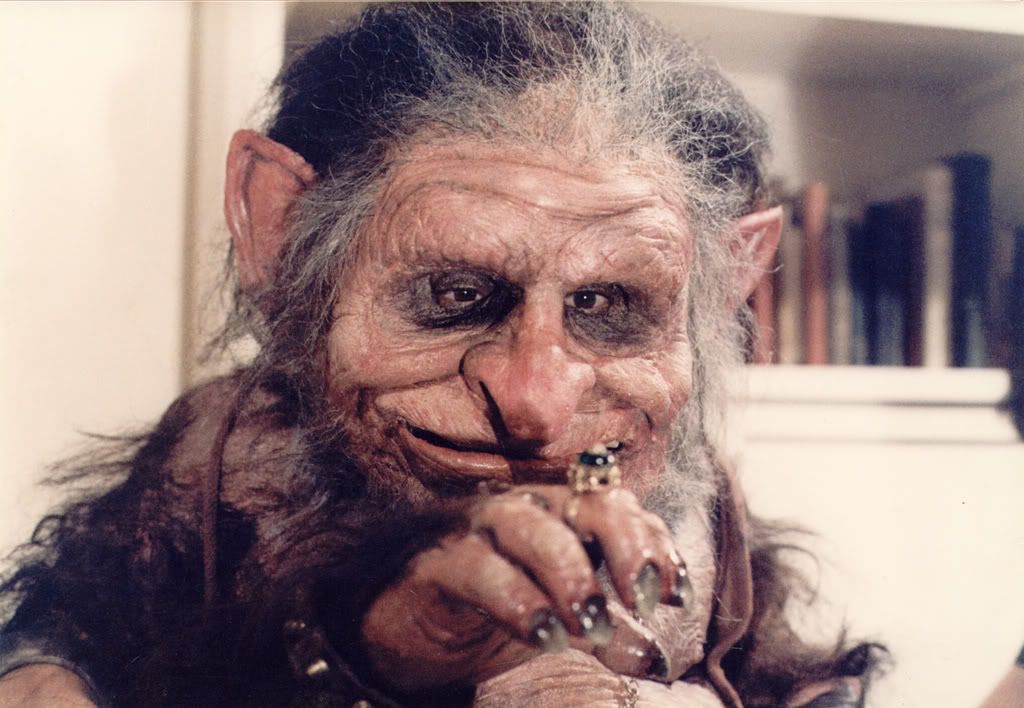
A still from the movie Troll (1986)

The two women finally realized their house might be haunted and approached a Cambridge psychic for help. But when the psychic came to investigate they were surprised to learn that the problems were being caused not by a ghost, but by a troll. The psychic said:

"Sometimes ... what we think of as ghosts - human beings who have died - are instead what might be called noxious rays, earth energies that are blocked. I felt this troll was stuck there. We did a ritual releasing of him. What came to me was to send him to another plane, where his energies could be transformed into a more positive and fruitful existence."
The troll was apparently connected with an underground spring that ran under the house and that caused the basement flooding. When the house was built on top of the spring the troll became trapped and would send its energy up along the back wall of the house. Karen had always felt its presence in the house, but the troll increased its activity once the roommate moved in and started to sleep near that wall.

The night after the ritual Karen heard a small voice speaking. It was the troll, begging her to let him stay. She also saw an image of her mind of a very small furry creature with claws. She didn't relent and told the troll he needed to leave.

It did. The strange occurrences in the house stopped, as did the basement flooding.

I find this story fascinating. For one thing, Myers gives the names of everyone involved and the address of the troll-haunted house. I have probably walked by the house several times. Here are a few more random thoughts:

1. Somerville is very, very densely settled. It has very little green space, so it's surprising that a nature spirit would show up there. I guess nature is everywhere, though, isn't it?

2. Myers's book was released in 1986. He doesn't say when the troll exorcism happened. In 1986 the horror film Troll was also released, which is about a troll taking over an apartment building. It stars Noah Hathaway as a character called Harry Potter, Jr. and Julia Louis-Dreyfus in her pre-Seinfeld days.

3. I find it very interesting that the psychic's diagnosis was a troll-haunting and not a ghost. You don't often read about troll's haunting houses in New England. I guess she was right, though, since her ritual worked. But maybe paranormal phenomena are shaped by our expectation. If you think the weird activity in your house is caused by a ghost, you'll see a ghost. If you think it's caused by a troll, you'll see a troll. If you think it's aliens, you'll see aliens.

4. This doesn't necessarily mean that paranormal phenomena exist just in our heads, though. Some writers (like Jacques Vallee or Patrick Harpur) suggest that there are actually entities out there that take different forms based on our cultural expectations. Maybe they're spirits, maybe they're daimones, or maybe they're extra-dimensional tricksters who just want to have a laugh at our expense. They could also be something lurking deep inside our subconscious, but I don't think that rules out any of the other possibilities. I'm sure there's a troll or two hiding somewhere deep inside my mind!

January 17, 2016

Haunted Happenings and Theater People in Kennebunkport

The other day I was at the Boston Athenaeum poking around in the library's folklore and occult collections. These books are kept way, way down in a deep dark windowless basement, which seems appropriate for the subject matter. The basement is brick-floored, low-ceilinged, adjacent to the Old Granary Burying ground, and probably very old.

Many of the Athenaeum's occult books are from the 19th century, and cover topics like spiritualism, astrology, and the local witch trials. Their covers are made from well-worn leather, and their pages are musty with age. Quite a few of them are in German. I haven't found a copy of the Necronomicon yet, but it's probably just sitting somewhere waiting to be shelved.

So, in this very atmospheric situation, the book that strangely caught my attention was Prominent American Ghosts (1967) by Susy Smith. The pages are not musty, and it's a light blue hardback. And let's face it, the name Susy Smith doesn't sound very ominous.

Her name may not be ominous, but a little poking around on the web revealed that Susy Smith (b. 1911, d. 2001) was quite prolific as an occult author. She wrote thirty books, including How to Develop Your ESP (2000), The Enigma of Out of Body Travel (1965), and The Afterlife Codes: Searching for Evidence of the Survival of the Human Soul (2000). Smith was a psychic and channeler, and had her first experience with a ghost when she encountered her deceased mother's spirit. After this encounter she began experimenting with the Ouija board, which led to a lifelong fascination with ghosts and the paranormal.

In short, Smith knew her stuff about ghosts (and may still, if her spirit is hanging around this material plane). To research Prominent American Ghosts, Smith traveled across the country from New Orleans to Hawaii interviewing people who had seen ghosts and visiting haunted locations. Happily for this blog she also visited New England, and wrote about a haunted house in Kennebunkport, Maine.

The house in question is the Gideon Merrill house, which was built in 1754. It remained in the Merrill family for a couple generations before it was sold to undertaker Samuel Lewis in 1830. Lewis only practiced his trade in the house for a short time before moving and selling the property to the Wells family, who owned the property until 1940, when they in turn sold it to Robert Currier, a theatrical producer from New York City who ran the Kennebunkport Playhouse.

Theater people and ghosts apparently go together like peanut butter and jelly. Currier was nonplussed to find an old coffin in the house's basement (perhaps leftover from the days of Samuel Lewis), but he was a little more surprised when guests began to see ghosts in the house. Currier's guests, primarily actors and singers, consistently saw the same two ghosts: a pleasant-looking young woman in Quaker clothing, and a gloomy-looking man dressed like a soldier. Currier and his friends nicknamed the soldier Ned after a book they were reading called Dead Ned; the Quaker woman was nicknamed Nellie. 

Psychically sensitive people who stayed in the house would see Ned and Nellie, but even those who didn't see them experienced strange phenomena. Doors were slammed by invisible hands, footsteps were heard when no one was present, and cold areas chilled guests to the bone. A professional medium named Leslie Tolman (aka Madame Shah) left the house in a panic in the middle of the night and advised Currier to sell it immediately. Dogs barked at unseen presences.

Singer Jane Morgan

The singer Jane Morgan, who had a top ten hit in 1957 with "Fascination" and was Currier's sister, reported that doors would unlock themselves. Morgan was afraid to spend the night alone in the house, and thought that Ned had murdered Nellie when she didn't requite his love.

Most of the phenomena were focused around two parts of the house: the attic, and a bedroom on the second floor. This bedroom was once inhabited by Old Lady Wells, a local herbalist and rumored witch. For the last twenty-four years of her life Old Lady Wells spent most her time confined to this room, leaving only to bring herbs up to the attic to dry. Some guests who slept in this bedroom saw the friendly Quaker ghost, but on one occasion another guest was awoken in the middle of the night when a window shattered. He assumed a rock had been thrown through the window, but nothing was found either inside or outside the building.

Strange noises have been heard in the attic, and cats ran worriedly up and down the stairs that led to that space. One night an actress who had driven up from New York pulled into the driveway of the house. It had not yet been opened for summer and no one was staying there. Then why did she see a flickering light shining out of an attic window? Unnerved, the actress refused to go inside until she found a friend in town to accompany her. They found the doors locked and the house unoccupied. When they went upstairs to the attic they found it empty ... except for a candle stub on the floor.

The Kennebunkport Playhouse burned to the ground in 1971, ending the influx of theater people into town. The Gideon Merrill house is still standing but I didn't find any recent reports of hauntings there. Perhaps the actors and other show business types were easily spooked or enjoyed telling each other scary stories, particularly when they were staying in a historic New England home. Or perhaps people drawn to work in the theater are just more psychically sensitive than the rest of us.

No one ever identified who Ned and Nellie might really be, and the connection with Old Lady Wells is suggestive but vague. Witches tend to hang around as ghosts after they die, but why wasn't the ghost of Old Lady Wells ever seen? The answers to these questions might have to wait until the next actor or actress takes up residence at the Gideon Merrill house.

 I think the Gideon Merrill house is still standing, but I don't know if Ned and Nellie are still wandering through its rooms. We might have to wait for another actor or actress to stay there to get the answer.

*******

Other than Prominent American Ghosts, my other main source for information was this page on SoMeOldNews.com. It seems to be referencing a newspaper article from the 1960s, which leads me to believe the ghosts haven't bee seen for a while.

March 07, 2015

UFO Abductions, the Great Barrington Museum, and Our Shared Mental Categories

Here's a story that's interesting in so many ways. Forgive me if you've already read about it, but I couldn't resist writing about it.

Back in 1966, Thomas Reed was a young boy living with his family on a farm in Sheffield, out in western Massachusetts. He shared a bedroom in the big Victorian farmhouse with his younger brother Matthew.

One night, Thomas and his brother saw some small, glowing orbs floating through their bedroom. They hovered just below the ceiling and Thomas felt like they were watching him. He closed his eyes several times, hoping they were just a dream and that they would disappear, but they didn't. They floated through the room repeatedly that night before they vanished.

Those orbs seemed strange at the time, but they would seem commonplace compared to what followed. Several nights later, glowing human-like shapes appeared in the boys' room. After seeing the ghostly shapes the boys found themselves outside in the woods, and the shapes (which now seemed to be small humanoids wearing masks) took Thomas and Matthew into a large metal craft that rested in a clearing.

The interior of the craft glowed with white light that had no apparent source. The humanoids brought Thomas into a room and showed him images on a screen: what seemed to be galaxies and, oddly, a willow tree. The two boys were brought back to their bedroom, and the next day after school Thomas found the clearing where the craft had landed.

A drawing by Thomas Reed of the willow tree and UFOs, from the Roswell UFO Museum.

This was Thomas's first UFO abduction. Others followed over the next three years, and included his mother and grandmother. Unlike the first abduction, the later ones were sinister and more menacing. The situation got so bad that the Reed family moved to a house in nearby Great Barrington.

A large willow tree stood in the front yard, and one of his first nights in the new house Thomas saw glowing orbs in his bedroom. Were the UFOS done with Thomas and his family?

You can find more details about Thomas Reed and his UFO abduction online. It is a well-known case, but has come to recent prominence because the Great Barrington Museum has announced it will add a display about the abduction to its exhibits.


The decision was made only after a difficult discussion by the Museum's board, but the question remains: should a mainstream museum have an exhibit about a UFO abduction? Reaction has been mixed. A researcher named Ted Acworth is quoted by the Globe, and I think many people might share his views:

“I’m convinced that there are things happening that are unexplainable, but is that proof of a UFO?” said Acworth, who lives in Boston and now works on technology startups. “A lot of highly credible people believe in their bones that they saw something. It’s not just fringe wackos. But the nearest habitable planet is many, many light years away, and I don’t think they’d come here just to scare people and fly home again. They’d make themselves known.”

The comments section on the Boston Globe article are divided into people who think aliens are visiting us from other planets, and people who explain why this might not be plausible.

Personally, I think there are some situations where truth can and should be determined. Did Aaron Hernandez kill Odin Lloyd? Either he did or didn't, and we need to figure it out. Is that skin cancer or is that just a freckle? It's one or the other, and you better find out.

But some situations feel a little more nebulous, and you just need to accept them on faith. For example, did Moses really see a talking burning bush? Some people say yes, some say no. But was there really a fiery shrub out in the wilderness, or was it a dream, or a vision? It's hard to say, and what evidence would be acceptable? Credo quia absurdum.

The Thomas Reed abduction case feels the same way to me. Reed says it happened, as do family members. He's passed a lie detector test. Corroborating sightings of UFOs were made by people not affiliated with the family in any way. But no physical trace of the craft has been found and, despite what you might see on lurid cable shows, no hard proof of alien visitors or craft has ever surfaced. And the law of physics, and common sense, indicate that alien beings won't fly across the light years just to harass a family in western Mass.

Thomas Reed's abductions sound like visionary experiences to me. It's interesting how parts of his story resemble classic ghost stories. Ghost hunters count glowing orbs as signs of supernatural activity, and the glowing figures in the bedroom sound very similar to ghosts. The fact that the family relocated in an attempt to stop the activity reminds me of The Amityville Horror and other haunted house narratives, and seems to imply they felt the visitors were associated with the house, rather than extraterrestrials who could fly wherever they wanted.

But of course, being who I am, I'm also reminded of witchcraft accounts where the witch appears as someone sleeps to torment them (and sometimes unwillingly take them on nighttime journeys), and also of fairies who take humans into the hollow hills, and... You get the picture. Supernatural beings all do similar things, even if their specific identities change over time. Aliens, witches, fairies, ghosts, daimons, demi-gods all parade through our nighttime world and work their charms on us.

You might disagree with me about the nature of Thomas Reed's abductions, and that's OK. However, we might agree that whether it was real, a visionary experience, or even a lie, Thomas's story is recognizable. We all understand that this is what a UFO abduction is like. It's a mental category we share.

After the Salem witch trials, at least one of the afflicted girls admitted that she lied about the whole thing. She confessed and asked her church for forgiveness (which they granted). Many of the other accusers probably lied as well. They wanted to settle family grudges, they wanted attention and power, etc. But the trials wouldn't have happened if everyone else in their society didn't already believe in witchcraft as a category. They all understood what a witchcraft attack was like. It was a mental category they shared. Even after the witchcraft trials ended and were revealed to be a sham, the Puritans didn't stop believing in witchcraft. They just realized it was impossible to prove.

I don't think Thomas Reed is lying, and he's certainly not accusing any neighbors of tormenting him through UFO abduction. But like witchcraft, UFO abductions are a mental category we all share and recognize. They're probably worth a museum exhibit, even if they're impossible to prove.

September 14, 2014

The Witches' Sabbath in New England: Part 2

Witch hunting in New England practically disappeared after the brutality and excesses of the Salem witch trials. Those trials served as a wake-up call to the fledgling society of old New England and as time passed more and more people realized they had just been a case of mob mentality running wild. Personal grudges and petty disputes had been erroneously inflated into a cosmic battle of good versus evil.

But that doesn't mean people stopped believing in witches. Folklore from New England is full of stories about witches after the 17th century. And like the witches the Puritans feared, these later witches also gathered to celebrate their Sabbath.

The Reverend Parris's meadow was no longer the main focal point for their magical activities. Instead, witches were said to gather in many different locales across New England for their nocturnal meetings.

For example, Charles Skinner writes in Myths and Legends of Our Own Land (1896) that

Barrow Hill, near Amesbury (Massachusetts) was said to be the meeting place for Indian powwows and witches, and at late hours of the night the light of fires gleamed from its top, while shadowy forms glanced athwart it. Old men say the lights are still there in winter, though modern doubters declare they were the aurora borealis. 

Not far off, in the town of Medway, witches gathered by an enormous, strangely shaped pine tree. They came to celebrate with the Devil, and arrived as weasels, raccoons, and other small forest animals. The tree grew near a swampy depression called Dinglehole, which still exists in the town of Millis. (Millis separated from Medway in the late 1800s.)

In Plymouth, the witches celebrated their Sabbath in a grassy area called the Witches Hollow:

"After you pass Carver Green on the old road from the bay to Plymouth", said one of these women, "you will see a green hollow in a field. It is Witches' Hollow, and is green in winter and summer, and on moonlit nights witches have been seen dancing in it to the music of a fiddle played by an old black man. I never saw them, but I know some people who saw witches dancing there..." (William Root Bliss, The Old Colony Town and Other Sketches, 1893)
Those three are just a few examples from Massachusetts. There are many examples from the other New England states. In Connecticut, the witches held their Sabbath in an area called the Devil's Hopyard, while in 19th century New Hampshire it was believed they congregated at night in abandoned houses. They traveled there in spectral form, and sometimes forcibly dragged the spirits of their sleeping neighbors along with them. It was an invitation they couldn't resist!


The idea that innocent people can be dragged to a witches' Sabbath is an old one. During the Salem trials, a man named John Ring testified he had been
strangely carried about, by daemons, from one witch-meeting to another, for near two years together.. Unknown shapes... which would force him away with them, unto unknown places, where he saw meetings, feastings, dancings... (Joseph Merrill, History of Amesbury, 1880)

Witches often flew spectrally to their Sabbaths, or traveled there in the shape of animals. Sometimes, however, they would ride spectral horses, which were usually the captive spirits of sleeping neighbors. There are quite a few legends where witches throw an enchanted bridle over the head of a sleeping man and ride him all night, quite often to the Sabbath. The man who was witch-ridden would awake exhausted, and sometimes complain of a pain in his mouth where the bit had been.

Another story from Plymouth tells of witches using magic bridles to transform bales of straw into black horses, which they ride to an abandoned house for a Sabbath celebration. When they arrive they dance around a mysterious black fiddler.

One of the stranger Sabbath stories comes from the village of Moodus, in Haddam, Connecticut. Moodus is famous for strange, subterranean noises that have been heard for centuries. Several explanations have been proposed for these noises, which are described as sounding like thunder or cannon shots. The local Indians told the earliest settlers that a god who was unhappy with the English colonists caused the noises. Other explanations have claimed the sounds are caused by pearls growing in the nearby rivers' shellfish (???), or by micro-earthquakes.

The explanation most relevant to our current topic is the following:

It was finally understood that Haddam witches, who practised black magic, met the Moodus witches, who used white magic, in a cave beneath Mount Tom, and fought them in the light of a great carbuncle that was fastened to the roof... If the witch-fights were continued too long the king of Machimoddi, who sat on a throne of solid sapphire in the cave whence the noises came, raised his wand: then the light of the carbuncle went out, peals of thunder rolled through the rocky chambers, and the witches rushed into the air. (Skinner, Myths and Legends of Our Own Land)

Machimoddi seems to be a name for the Indian manitou who ruled over Moodus, and his appearance in this story shows how Algonquian and English supernatural themes sometimes merged. Another version of this story appearing in a 1901 edition of Connecticut Magazine says the witch battles were refereed by the Devil. 

A witch battle seems different from the traditional witches' Sabbath, but European stories of battles between supernatural beings may originally have contributed to the idea of the Sabbath. Carlo Ginzburg, the Italian historian I mentioned last week, claims many European cultures shared a common myth: that good supernatural beings, often people whose spirits could leave their bodies at night, would fight evil supernatural beings, usually witches, for the fertility of the land and bounty of the harvest. Quite often, the battle was between the spiritual warriors of two adjacent villages, as in the story about Moodus.

Historical records show that many people in Europe thought they did leave their bodies at night to participate in these battles, and they shared this information openly with neighbors. As you can imagine, they were not popular with the Catholic Church, and these night battlers were often accused of witchcraft. Over time and under the influence of the Church, the myth changed. Rather than good and evil spirits fighting for fertility, these nocturnal gatherings were now said to filled only with evil spirits (witches) who worked for the Devil. Voila! The idea of the witches' Sabbath was born.

I don't know where the story about the battling witches of Moodus originated, but it's amazing to see such an old European mythic idea in Connecticut. It's definitely something that could use more investigation, but for now I'll just accept it as one more mystery of the witches' Sabbath. I hope you enjoyed this little overview of the Sabbath, and be careful when you walk around at night...

June 22, 2014

Three Haunted Buildings in Providence

Last week I was down in Providence for a conference. I had some free time one afternoon so I stopped by the Brown University Bookstore and left with a pile of new folklore books. One of them was Haunted Providence: Strange Tales from the Smallest State by Rory Raven.

As walked back to my hotel I had the sudden realization that my route could be taking me past various haunted locations. I pulled Haunted Providence out of my bag, and with just a quick scan found three haunted buildings that were on the way back to my hotel.


First up was the Nightingale-Brown House, which is located on Benefit Street. The house was built in 1792 by Captain John Nightingale, a Providence merchant who made his money trading sugar, rum and slaves in the notorious Triangle Trade. The house was sold to the Brown family in 1814, and is now part of Brown University.


Raven tells the following story about the Nightingale-Brown House. One night a new custodial worker was assigned to work in the large, rambling building. He and an older, more experienced co-worker were the only two people in the house, and the new custodian felt a little creeped out as he cleaned the old, empty rooms.

Towards the end of the shift he had to clean a room that had a large portrait on one wall. The eerie sensation he had experienced all night intensified as he vacuumed and dusted under the grim and watchful eyes of the painting. He completed his work as quickly as he could and turned off the light as he left the room.

As soon as he shut off the light a sepulchral voice said, "DON'T TURN THAT LIGHT OUT."

The  new custodian ran out and found his co-worker. After he told him what happened, the older man said, "Yeah, strange things happen in that room. Don't worry about it, but whatever you do, don't turn out that light!"


Near the Nightingale-Brown House is the Providence Athenaeum, a private library that has been in operation since the early 1700s. Today it is housed in an imposing stone building built in 1836. The ghost of Edgar Allan Poe has been sighted several times in the Athenaeum. Shortly before his death Poe spent time in Providence wooing the poet Sarah Helen Whitman, who lived just down the street from the Athenaeum and was a member. Either Poe liked Providence so much his ghost refuses to leave, or he was so traumatized by his broken engagement with Whitman that his ghost is trapped there forever. Knowing Poe's life, it's probably the latter.

The last haunted building on my list was the beloved Biltmore  Hotel. I've been to a lot of events there, but never knew it was haunted. According to Raven, the Biltmore is haunted by the ghost of a financier who lost his fortune when the Depression started on Tuesday, October 29, 1929.


The financier was staying in a room on the fourteenth floor when he received word that all his wealth had disappeared in the crash. Overwhelmed by the news, he threw himself out the window to his death. Interestingly, his ghost supposedly haunts not only the room he was staying, but also every room he passed by as he fell. Guests staying in these rooms sometimes report seeing someone falling past their windows, but never see a body on the street when they look down to the sidewalk.

February 23, 2014

The Telltale Seaweed

Once again I find myself in the mood for a ghost story. Here's a classic from Cape Cod that you may be familiar with.

********

One October day many years ago two sisters drove down from Boston to enjoy a day on Cape Cod. They spent the day touring quaint towns and visiting friends, and did not begin the drive back home until just before midnight.

As they were driving along a particularly dark country road their car broke down. This was in the days before cell phones, so after trying to fix the car themselves the two women set out on foot to find assistance.

The dark country road was quite dark indeed, but they made their way along it using a flashlight they had brought with them for just such an emergency. After walking for quite a while they glimpsed an old house by the side of the road.

There were no lights on in any of the windows, but they ran up to the front door and pulled the bell rope. They heard only a faint tinkling. They next pounded on the front door, but didn't hear anyone stir inside. Finally one of the sisters shined her flashlight into one of the windows.

Through the window they could see that the house was deserted. There was no furniture inside, and the floor was covered with dust. An old brick fireplace stood cold and empty. The front door was unlocked, so the sisters decided to spend the night inside and find an auto mechanic in the morning.

They stretched out on the floor and fell into a fitful sleep.


In the darkest part of the night they both suddenly woke up. Standing by the fireplace was  a man in a sailor's uniform, dripping wet. He held his hands out as if he were trying to warm himself at a non-existent fire.

"Who are you? What do you want?" one of the women said.

At the sound of her voice the sailor groaned and disappeared, leaving behind only a puddle of water. The sisters were amazed at this apparition, but both fell almost instantly back asleep, each thinking they had been dreaming.

When they arose in the morning they realized their dream had been real. There really was a puddle of water in front of the fireplace, and a long piece of green seaweed sat in it. As they left the house one sister took the seaweed and put it in her purse. They made their way to a small restaurant where the waitress not only procured a mechanic, but also told them that the old house was rumored to be haunted by the ghost of a sailor who had drowned at sea.

About a year later they were telling their story at a dinner party. One of the guests was a marine biologist who said, "I wish I could see that seaweed." The sister still had it in her purse and produced it for him. He studied it intently for a few moments and then turned to her. His face was pale.

"Madame," he said, "this is a very rare type of seaweed. It only grows on the corpses of people who drown at sea."

********

This story appears in B.A.Botkin's A Treasury of New England Folklore, and first appeared in a book by the literary critic Alexander Woolcott, who was a member of the Algonquin Round Table and a friend of Dorothy Parker's. Woolcott claimed the story happened in a house in Woods Hole, and that he had the telltale seaweed himself. It had been given to him by the marine biologist, and Woolcott kept it pressed in a book at home.

As I mentioned a couple weeks ago, I like a ghost story where there is some proof at the end that the ghost is real. This story must be doubly true. The sisters find the seaweed which is identified by the marine biologist, AND Alexander Woolcott had the seaweed himself.