Showing posts with label spirit. Show all posts

December 14, 2025

The Spirit of Paw Wah Pond

Paw Wah Pond is an eight-acre saltwater pond located in Orleans on Cape Cod. It’s not an ordinary pond – a local legend says it is watched over by a spirit that lives in its depths. 

Even the town historical society used to acknowledge this legend. Near the pond once stood a historical marker upon which was written: “Pau Wah Pond, named for Pau Wah, Chief of the Potonamequoits who drowned herein after Chief Quanset refused marriage to his daughter Wild Dove. Fable says - Cast a pinch of tobacco in the pond and Pau Wah gives you good fishing.” Unfortunately, the marker was destroyed in a storm and was never replaced. 

Photo by Richard Burlton, courtesy of Unsplash.

The name "Paw Wah" can be spelled several different ways, and there are a couple variations of the legend as well. The writer Elizabeth Reynard included one in her book The Narrow Land: Folk Chronicles of Old Cape Cod (1934). According to Reynard, many centuries ago a local Indian chieftain named Pau Wah fell in love with Wild Dove, the daughter of Quansett, who was chief of another local tribe. One cold winter day Pau Wah went to Quansett with offerings of furs, wampum shells, and other valuables and asked to marry Wild Dove. 

Quansett looked at the offerings. He looked at Pau Wah. Then he refused the offer, saying his daughter was worth more than anything Pau Wah could ever give him. Pau Wah stormed off, angry and humiliated. 

Days later he returned to Quansett’s village, this time with a band of warriors, intent on stealing Wild Dove by force. Pau Wah and his warriors fought fiercely, but they were defeated by Quansett and the men in his tribe. 

Pau Wah fled alone into the snowy woods, accompanied only by his faithful dog. He had been humiliated in battle and knew that he was now a pariah. No one would come to help him. He ran for hours, until he came at last to an isolated frozen pond. Here, he thought, he would be safe from his enemies.

Pau Wah built a wigwam on the frozen pond, and then cut a hole in the ice to fish. Unfortunately, in his duress he forgot one crucial thing. He neglected to give an offering to Niba-nahbeezik, the spirit who controls lakes, rivers, and ponds, as one should always do. Niba-nahbeezik was offended by Pau Wah’s oversight, and vengefully made the ice under his wigwam collapse. Pau Wah, his wigwam, and his dog all sank instantly to the bottom of the cold, icy pond. 

Pau Wah sank too quickly to realize what happened – and apparently too quickly to die. He and his dog are supposedly still alive, and they live in their wigwam at the bottom of the pond. Pau Wah spends his days controlling the pond’s fish, and wishing he had some tobacco to smoke. Therefore, if anyone goes fishing at Paw Wah pond, they should throw some tobacco into it as a gift and say “Pau Wah, Pau Wah, Pau Wah, give me fish and I give you tobacco.”

The name Pau Wah (or Paw Wah) is probably a variant of the Algonquian word powwow, which means shaman or sorcerer. (Powwow is also used these days to refer to a Native American gathering with ceremonial dances.) If Pau Wah was actually a powwow, his magical prowess might explain why he is still alive under the pond. It might also explain why Niba-nahbeezik was so offended. As a shaman, Pau Wah should have known not to forget an offering. It might have seemed like a deliberate snub to the spirit. 

A local historian named W. Sears Nickerson offered up a slightly different version of the legend. According to Nickerson, Pau Wah was actually a powwow named Pompmo, who was the son of Pekswat, a well-known chieftain. Pompmo never tried to abduct Wild Dove and did not flee into the woods. Instead, he successfully wooed and married an unnamed woman, had children, and lived to an old age. 

Pompmo met his death the same way, though. He and wife lived on the shores of a saltwater pond. One cold winter, Pompmo and his wife moved their wigwam onto its frozen surface so they could fish through the ice. According to Nickerson: 

“…Cape Cod salt water ice has a reputation for being treacherous, and one stormy night with a sweeping, high tide accompanied by a warm rain, a regular January thaw set in and caught him napping. When morning broke, every vestige of ice was gone from the pond, and old Pompmo, his wigwam, and his wife were nevermore to be seen in this life” (Delores Bird Carpenter, Early Encounters: Native Americans and Europeans in New England. From the Papers of W. Sears Nickerson, 1994).

Pompmo’s spirit became restless and bored in the afterlife, so he came back to the pond where he lived so much of his life. If you want to catch any fish in his pond, you should toss some tobacco into the water and say, “Paw Waw, Paw Waw, I give you tobacco. You give me some fish?”

Are either of these stories true? Is it even an authentic Native American legend, or was it made up by white folks? There are a lot of fake Native American legends out there, unfortunately, and this could be one of them. Still, I do like the story, particularly as we've had a lot of cold weather recently. 

I’m not sure if the legend is true, but if you go fishing at Paw Wah pond you may want to bring some tobacco, just in case. Don’t throw in a cigarette or cigar, which might kill the fish. Just a tiny pinch of plain, organic, untreated tobacco will do. Maybe Pau Wah, or Pompmo, or even Niba-nahbeezik himself will accept your offering and send you some fish.

*********

A special thank-you for my friend David Goudsward for sharing the Nickerson information with me!


February 18, 2020

A Bigfoot Sighting in Vermont: Animal, Spirit, or Legend?

Do you ever visit the website Phantoms and Monsters? If you like stories about the paranormal you should definitely check it out. Every day a new story is posted and most are first person accounts of encounters with.. well, phantoms and monsters.

The site is easily searchable which I appreciate since I can find just the stories from New England. Phantoms and Monsters featured a classic Bigfoot story on January 14 of this year. The author is a longtime Vermont resident. She was driving home with her husband from a hunting trip on a warm day when they saw a large animal in the road. At first they thought it might be a bear:

I came to a stop just yards from it. We both thought it was a bear as it was hunched over with it's back to us. I honked the horn a couple of times but to no avail, the creature continued doing its thing... until it started standing up and up and up... “It had to have been 9 foot tall, maybe 800lbs,” my husband said; reddish brown shaggy fur.

Bionic Bigfoot from The Six Million Dollar Man (1976) 

The creature turns to look at the couple in the car:

It was very apparent that whatever it was, was intelligent. It was a male but the largest animal I'd ever seen close up and my husband was as shocked as I was at the sight of the thing (not being disrespectful). It eyed us for maybe a minute or two looking directly into each of our eyes then turned, took a step towards the side of the road... Then the animal was just gone.

And that's it. The author writes that she was unfamiliar with Bigfoot when she saw this creature but later learned about him when she read a book by cryptozoologist Ivan Sanderson. (You can read the full account here.) Sadly she doesn't provide a date when the sighting occurred.

There is always the possibility that this story is a hoax, but even if it is it still reads like a classic Bigfoot account to me. It has all the usual components of a Bigfoot sighting, like the following:

1. People are just minding their own business when they encounter something strange.
2. At first they think it's an animal, but oh crap! It's a hairy humanoid.
3. The witnesses are amazed at the size of the creature, and sometimes at its intelligence.
4. The creature disappears. 

However, just because most Bigfoot stories are all similar doesn't necessarily mean they're false. Perhaps Bigfoot just acts the same way all the time.

If Bigfoot does exist I personally don't think he/it is an animal. How could people in Vermont not notice 9-foot tall, 800 pound humanoids wandering around? They would be pretty hard to miss. And why haven't all these Bigfoot hunters found anything after all these years? It's entirely possible that Bigfoot is just a creature of folklore, a legend that modern Americans tell about something lurking in the woods. He's our version of the Medieval wildman or the Ancient Greek satyr.


However, if you believe in spirits, I think it's also possible to consider Bigfoot as some type of land-spirit, like the Roman genius loci. A genius loci is the spirit of a particular place; perhaps the Bigfoots people see are the spirits of the American wilderness. Which again make him similar to the wildman or satyrs.

But whether Bigfoot is just a legend or a spirit being, the message of these classic Bigfoot stories is identical: humans are not alone. Something else shares the planet with us, something intelligent, and it's not far away. It's right there in the woods or the swamp, just waiting to show itself to us.

December 30, 2019

Ghosts, Treasure and A Scam in Exeter, New Hampshire

Rainsford Rogers arrived in Exeter, New Hampshire in 1798. Exeter was a sleepy rural town back then and Rogers made a big impression when he arrived. Not only was he an outsider, which was exciting in itself, but he also claimed he could command spirits and ghosts. 

This was a big deal in Exeter. According to Charles Henry Bell's History of the Town of Exeter, New Hampshire (1888), Exeter's citizens hadn't had many encounters with the supernatural. There weren't any witchcraft accusations in the town's past, and there weren't even any haunted houses. Well, Bell notes that one house did for a time experience some poltergeist activity ("strange and inexplicable freaks of self-propelling furniture and the like") but "it never received a bad name on that account." Exeter was just a practical-minded place full of hard-working people. So it was quite exciting to hear Rainsford Rogers say he could invoke spirits.

Rogers became an Exeter celebrity and was soon befriended by twelve of the town's wealthiest citizens. Rogers confided to these men a great secret: there was buried treasure hidden somewhere nearby. The spirits would guide Rogers to it but he needed men he could trust to help dig it up. Anyone who helped him would get a share of the treasure. He asked the twelve if they were trustworthy. With visions of treasure in their eyes they said yes.

A woodcut of a ghost from this blog!
Rogers and his followers fell into a pattern. Rogers would consult with the spirits to determine where the treasure was, and then the twelve men would try to unearth it. The digging always took place late at night, usually in desolate locations like swamps or in the woods. Rogers also told the men they needed to wear white caps while digging, and the people in Exeter named the group the White Caps. 

They made frequent night-time trips in search of treasure. One night while they were out digging a ghost appeared to the White Caps. 
On one of the nocturnal excursions there appeared before the eyes of the awe-stricken diggers a figure all in white, representing a spirit, which uttered some words which were not well understood. One of the "white caps" anxious to lose nothing of the weighty communication, responded - "a little louder, Mr. Ghost; I'm rather hard of hearing." (Bell, History of the Town of Exeter, New Hampshire, 1888, p. 413).
But despite many nights spent excavating the White Caps never found any treasure. The spirits finally told Rainsford Rogers why. He needed a special divining rod (or dowsing rod) made from expensive materials. Such an artifact could only be produced in Philadelphia. Rogers asked the White Caps if they could contribute money towards the cost of the divining rod. They agreed, giving him several hundred dollars and a new saddle for his horse. 


A diving rod or dowsing rod.
Rogers rode out of Exeter with the money. The White Caps waited eagerly for his return. And waited. And waited. After several weeks they finally realized they had been duped, something their neighbors had suspected all along. Rogers was in fact a serial con-man, and had tricked people in many states out of their money. Born in Connecticut and originally employed as a schoolteacher there, Rogers changed careers when he learned that fooling gullible people with spiritual hocus-pocus was more profitable than educating children. (Sadly I think that may still be the case.)

He pulled his most notorious scam in Morristown, New Jersey, where he fooled 50 wealthy men into believing ghostly entities would reveal buried gold left behind by the British troops in the Revolutionary War. His antics in Morristown were far more elaborate than those in Exeter. He made his followers stand in magic circles inscribed on the ground in the woods, exploded pyrotechnics hidden under the soil, told people to carry bags containing bone dust for protection, and dressed up like a ghost to lurk outside houses. He also told his wealthy followers to give him large amounts of money. He was eventually arrested, but when a still-faithful follower paid his bail he fled town. 

A book detailing Rogers's criminal exploits (called The Morristown Ghost) was published in 1792.  Some historians speculate that Rogers wrote the book himself, both as a money-making venture and to vengefully humiliate the people in Morristown by revealing their gullibility. Unfortunately no one in Exeter ever read The Morristown Ghost so they were vulnerable to Rogers's scheme.

It's easy for a 21st century person to look back and laugh at how foolish people were, but at the time it was widely believed that America was littered with buried treasure. Legends like this were found across the country, and the treasures were usually thought to be guarded by fearsome spirits that could only be tricked through magical means. Here in Massachusetts several examples immediately come to mind: the alleged pirate treasure at Dungeon Rock in Lynn, the terrifying treasure cats of Ipswich, and the legend of Hannah Screecham of Cape Cod. There are dozens of other examples from across New England alone. Washington Irving wrote several stories on this theme, and some historians even say that treasure hunting (or money-digging as it was known) might have influenced Joseph Smith, the founder of the Mormon religion. 

Although we don't believe in buried treasure these days, sadly there are still unscrupulous people out there who will take advantage of vulnerable people. Our beliefs have changed but human nature hasn't.

August 21, 2019

Dining at A Haunted Restaurant

A few years ago we were in Provincetown for the annual Tennessee Williams Festival. We met a group of friends for brunch at Local 186 and, since it was a sunny September day, decided to eat outside. Little did we know what that brunch would bring...

One of my friends ordered a Belgian waffle, and when it arrived it came topped with a mountain of whipped cream and an enormous dusting of powdered sugar. It looked very tasty, but just as we were about to eat a gusty breeze blew in from the harbor. The powdered sugar blew off the waffle and all over the person who ordered it. To make matters worse he was wearing a black shirt.

He wiped off the sugar, ordered another Bloody Mary, and moved on. We all assumed the mishap was just caused by a random seaside breeze - but we may have been wrong. Local 186 is supposed to be haunted. Perhaps a ghost had caused the sugar incident?


Many restaurants, hotels and guest houses are allegedly haunted these days. I think in the more superstitious past people would be afraid to patronize a haunted establishment but now having a resident ghost is considered an extra attraction for a business. An establishment needs good food, attentive service, and preferably an undead entity. Owners publicize their ghosts in an attempt to entice customers. Modern capitalism can absorb everything, even the restless dead.

The ghost who supposedly haunts Local 186 was a businesswoman herself so she may not mind. Her name is Esther Chamberlain, and for many years she ran the restaurant and the guest house above it when it was called Esther's Inn. She was a formidable and driven entrepreneur, and even after death she is said to be interested in how the business is run. 


For example, several staff have said the ghost has rearranged silverware when they weren't looking. Here's a quote about Esther's ghost from Sam Baltrusis's book Paranormal Provincetown:
Jeffrey Doucette, a veteran ghost tour guide, said he's heard stories of table settings being rearranged and objects moving at Local 186 if guests or employees don't adhere to basic rules of etiquette. "I ran into one woman while I was giving the tour and she confirmed that the restaurant and inn's namesake was a bit of a stickler... The spirit seems to be interested in table manners..."
Esther's ghost is apparently polite and there aren't any particularly horrific stories about her. She doesn't sound sinister, just stern. 

We had dinner at Local 186 just a couple weeks ago. Our meal passed without incident (and was quite tasty) but I noticed the Ouija board that had been in the bar on past visits was gone. Paranormal investigator Joni Mayhan told Baltrusis that sometimes people playing with Ouija boards can accidentally summon sinister entities. I think that would be doubly the case for drunk folks at a bar. Maybe the ghost haunting Local 186 isn't really Esther at all? 


Perhaps the owner removed the Ouija board for psychic safety but there may be another reason. Baltrusis notes in Paranormal Provincetown that the website Building Provincetown claimed Local 186 was reputedly haunted. That has been taken down since Baltrusis's book was published in 2016 and there's no mention of it. I wonder if the new owner is downplaying the ghost angle? If so maybe that's why they removed the Ouija board as well. 

It's their business and they can market it however they please. But if Esther's ghost really does haunt Local 186 I am sure she will stick around to make sure patrons use the right fork and place their napkins in their laps. 

October 19, 2016

Foul-Mouthed Fairies and Spirit Possession in 1846

The Massachusetts town of Wrentham is perhaps currently best known as the location of some famous outlet malls, but the town is actually quite old. It was founded in the 1600s, and like a lot of old New England towns has at least one weird incident in its history. And so I relate the following set of bizarre events...

A prominent physician named Dr. Larkin lived in Wrentham in the early 1800s. Larkin was married, had at least one child, and was a member of one of the local Protestant churches. In short, he was part of the town establishment.

Unlike most of his neighbors, though, Dr. Larkin became interested in mesmerism in the year 1837. Also known as animal magnetism, mesmerism was founded by the German Franz Mesmer in the late 18th century. Mesmer believed that all animals were filled with a vital life force which could be manipulated to produce healing effects. Mesmerists would manipulate the life force through a variety of means including the laying-on of hands and hypnosis.

Franz Anton Mesmer (from Wikipedia)

A young servant girl named Mary Jane lived with the Larkin family at this time. The Larkins were upstanding members of the community, but Mary Jane was something of an outsider. She had been born in Nova Scotia, was Roman Catholic (how shocking!), and was subject to strange fits. Dr. Larkin tried but was unable to find a physical cause for her fits or to treat them.

One day in 1844 Dr. Larkin had an "a-ha!" moment. Why not try to cure Mary Jane's fits through mesmerism? Mary Jane's fits improved slightly, but surprisingly when she was under hypnosis she was able to accurately diagnose the ailments of Dr. Larkin's other patients. Her diagnoses were so reliable that Larkin depended on her whenever he encountered an illness he couldn't diagnose.

So far so good. What doctor wouldn't want a magical office assistant? But of course that's not the end of the story.

Mary Jane claimed that while she was hypnotized she was attended to by a group of spirits. Some of them were quite benevolent. For example, a group of kind and lovely fairies from Germany would appear to her. Their leader was a female spirit named Katy whom Mary Jane claimed was her guardian angel. Katy was described as being beautiful and good, and it was she who supposedly diagnosed the patients. Sometimes when the good fairies appeared strange knocking sounds would be heard throughout the Larkin house, which seemed unusual, but they were minor inconveniences compared to the help the fairies provided.

Unfortunately, sometimes other spirits spoke through Mary Jane. These spirits were foul-mouthed and loved to spout obscenities at the doctor and his family. These nasty beings didn't just stop at swearing. They also engaged in poltergeist activity.

Her entranced lips, as if moved by automatic action over which she had no control, gave utterance to the most blasphemous oaths and rude speeches; at the same time the furniture was often moved about violently by unseen hands, and heavy weights were lifted from place to place. On one occasion, the whole family being assembled round the couch of the magnetized sleeper, and every door being shut, a heavy flat-iron, last seen in the kitchen - quite distant off - was suddenly placed in their midst, and at the request of Mrs. Larkin, as suddenly disappeared, and was next found in the kitchen...(American Spiritualism: A Twenty Years Record of the Communion Between Earth and the World of Spirits, Emma Hardinge, 1870)

The leader of the foul-mouthed spirits was a deceased sailor who swore as much in death as he did in life. Mary Jane sometimes called this spirit Captain Goodhue, and declared that he was king of the fairies. Goodhue could accurately (if obscenely) describe what Dr. Larkin did even when he was away from home. He also drank copious amounts of rum through Mary Jane.

The ghosts of other deceased spirits also began to speak through Mary Jane, and Larkin recorded the life stories of more than 270 of these entities. He supposedly was able to verify that many of their stories were true.

By 1846 Mary Jane's behavior had become even stranger. The drunken sailor's spirit would pull Mary Jane's limbs out of joint, and although this caused her no pain it made her unable to move until Dr. Larkin put them back in place. Other spirits hovered around Mary Jane, pinching her and causing her great pain. She told the doctor she was willing to endure this suffering because it would help stave off Mrs. Larkin's death, whose impending approach the spirits had warned her of. Mary Jane had accurately foretold the death of one of Dr. Larkin's children so he took her warning (and sufferings) quite seriously.

All these bizarre events drew the attention of Dr. Larkin's neighbors, and many of them began to mutter unfavorably about him. As you can imagine, people in a small 19th century New England town didn't take well to spirit possession, heavy drinking, and swearing maid-servants. Some neighbors were particularly annoyed because they were often called in to help the doctor put Mary Jane's limbs back into their sockets. A committee was convened to investigate, and Mary Jane was found guilty of disturbing the peace. (Some sources say the charge was actually necromancy.)

Dr. Larkin pleaded with the police not to arrest Mary Jane until she had completed the painful suffering necessary to save his wife. Although skeptical they honored the doctor's wishes, and waited the allotted time before arresting the servant girl. She was finally sentenced to sixty days in Dedham's jail for lewdness, indecency, profanity, and disturbing the peace. Upon hearing the sentence Mary Jane is reported to have said, "Is that all? Well, I think I can stand it."

As for Dr. Larkin, he was threatened with excommunication from his church unless he signed a document declaring that he didn't believe the living could communicate with the dead. Church membership was crucial for his professional success, so he signed.

There's so much happening in this story that I don't know where to begin. I guess I can start by saying I used two sources: Emma Hardinge's book and a newspaper article from the December 5, 1846 issue of The Portsmouth Journal of Literature and Politics. Hardinge was a Spiritualist and believed that everything that occurred at Larkin's was really caused by spirits. The Portsmouth Journal is quite skeptical and believes Dr. Larkin was taken in by a conniving servant. Real spirits or a hoax? I will let you decide for yourselves.

There is very little fairy lore from early New England, which makes this story even more unusual than it is. The Puritans who colonized this region brought over plenty of witch, ghost and Devil lore from England, but almost no fairy lore. I think it's significant that Katy was Roman Catholic and from Nova Scotia, a region whose colonizers did bring fairy stories to the New World. I suspect that she was probably Irish or Scottish.

Some of her behavior while possessed by the spirits was reminiscent of that shown by the afflicted girls in the Salem witch trials. I wonder if the town leaders had that in mind when they arrested her for disturbing the peace? They may not have wanted others in Wrentham to emulate her behavior.

Most modern Americans don't group fairies and dead spirits together, but the connection between the two is strong in some older European folklore. For example people often reported seeing deceased humans living among fairies, and it's not a coincidence that fairies dress in old-fashioned clothes. So-called fairy mounds in Britain and Ireland are often actually ancient burial mounds. And much like ghosts, fairies are often active around the dark time of year, including Halloween.

*****

Special thanks to Simon Young of the Fairy Investigation Society for forwarding me the article from The Portsmouth Journal which inspired this post!

September 27, 2016

Swamp Woman and Other Dangerous Spirits

If you are out alone in the woods please be cautious if you hear someone crying and moaning. It could be Swamp Woman trying to to trick you, particularly if you are a man.

Swamp Woman is a spirit found in Penobscot folklore from Maine. In Algonquian her names are  Swaktemus and Pskegdemus, but most people think both names simply refer to the same being. She should be avoided at all costs whatever name you give her.

Swamp Woman lives alone in the forest, and wears only moss. Moss also grows in her hair, which is so long that it covers most of her body. I think that's a pretty distinctive look, so you'll probably know if you encounter her.

Poor Swamp Woman is lonely, and cries out in the woods for men and children to come live with her. She is particularly fond of hunters, but perhaps they are just the men she sees is the most familiar with. Maybe she would like high-tech nerds or Uber drivers just as much if she encountered them more often. Regardless of their profession, anyone who responds to her call is never seen again. Do they die? Do they live with her forever in her swampy forest home? It's not clear, but it's probably not good either way.

Swamp Woman sounds easy to avoid. Just stay out of the woods, right? Unfortunately it's not that simple. If a man sincerely wishes to see Swamp Woman she will come to him wherever he is, and any man who even pities her will never marry a mortal woman. In other words, not only do you have to avoid Swamp Woman, you have to avoid thinking about her. Ugh. I bet you're thinking about her right now, aren't you? She will also snatch children, and they are often warned to behave lest Swamp Woman come and steal them away.


The Penobscot also tell of another, similar creature called Maskiksu, a.k.a. Toad Creature, who appears as a small dwarfish woman clad in moss. She also seduces men and cries out in loneliness for children. Toad Creature likes to nurse human babies, but any child she nurses will fall into an endless sleep. Again, best to be avoided.

Other beings in New England folklore lure men and children to their dooms too. For example, a while ago I wrote about the Abenaki swamp spirit of Vermont, while further south the Wampanoag of Cape Cod tell tales of Granny Squannit. Granny Squannit's long hair covers her face (which is rumored to be strangely ugly), and she sometimes kidnaps men and young boys. Granny Squannit also has a benevolent side, teaching people about healing plants and feeding people who are shipwrecked. Granny Squannit is probably a modern version of the ancient Algonquian women's goddess Squauanit who was mentioned by Roger Williams in 1643.


Are all these beings distinct entities, or are they just different versions of each other? They sound similar in some ways to those seductive fairies who enchant questing knights in Medieval romances, or even to folkloric fairies like the Skogsnuva, or Wood Women, of Sweden. Fairies are not a laughing matter. Some death certificates from 17th century Sweden have been found where the cause of death is listed as "involvement with a Skogsnuva." My mind also drifts to the succubi of Christian demonology, the demoness Lilith from Jewish folklore, and even the seductive ghostly witch who haunts the Freetown State Forest here in Massachusetts. .

There is definitely a pattern here. Maybe there actually is a supernatural force (or forces) behind these different legends, or maybe the stories just reflect a male fear of female sexuality.The forests and swamps are dark and unknowable, making them a perfect blank slate to project one's fears onto. But still, if you see a long-haired woman covered in moss it's probably safest to run in the other direction.

August 09, 2016

A Troll in Somerville, Massachusetts?

One great thing about writing this blog is that I get to read lots of musty old books to find strange information. Usually those books are from the 19th century - a golden age of weird New England folklore - but sometimes those old books might only be from the 1980s.

For example, while I was on vacation recently I found a copy of Arthur Myers's book The Ghostly Register, which was published in 1986. That was only thirty years ago, but that's a long time to some people, and The Ghostly Register definitely has some strange information in it.

For example, it contains an account of a house in Somerville, Massachusetts that was haunted by a troll. I have never seen this mentioned anywhere else and thought it was worth sharing. Here are the details.

A young woman named Karen bought a Victorian-era house outside of Somerville's Davis Square in 1983. She liked living there, but there were a few things that seemed a little odd. The basement often flooded, which was annoying, but Karen suspected that something else was going on.

She often felt uncomfortable near the back wall of her house, particularly on the second and third floors. She kept her spare clothing up on the third floor but got such weird vibes that she did not go up there at night. She had tried sleeping in the back bedroom on the second floor, but did so only briefly because she felt uncomfortable there as well. She felt that there was something in the room with her at night:

"I had," she says, "a feeling of a presence at night, of its being almost like an an animal, as though it had claws or wanted to bite me."

A few years after buying the house Karen took a roommate. The roommate slept in the third floor bedroom and experienced many strange occurrences. She set up her bed about six inches away from the back wall, but every morning when she awoke she found that it had been moved flush against the wall. Her clothes and shoes would appear in strange places around the house, and lights would turn themselves on and off.

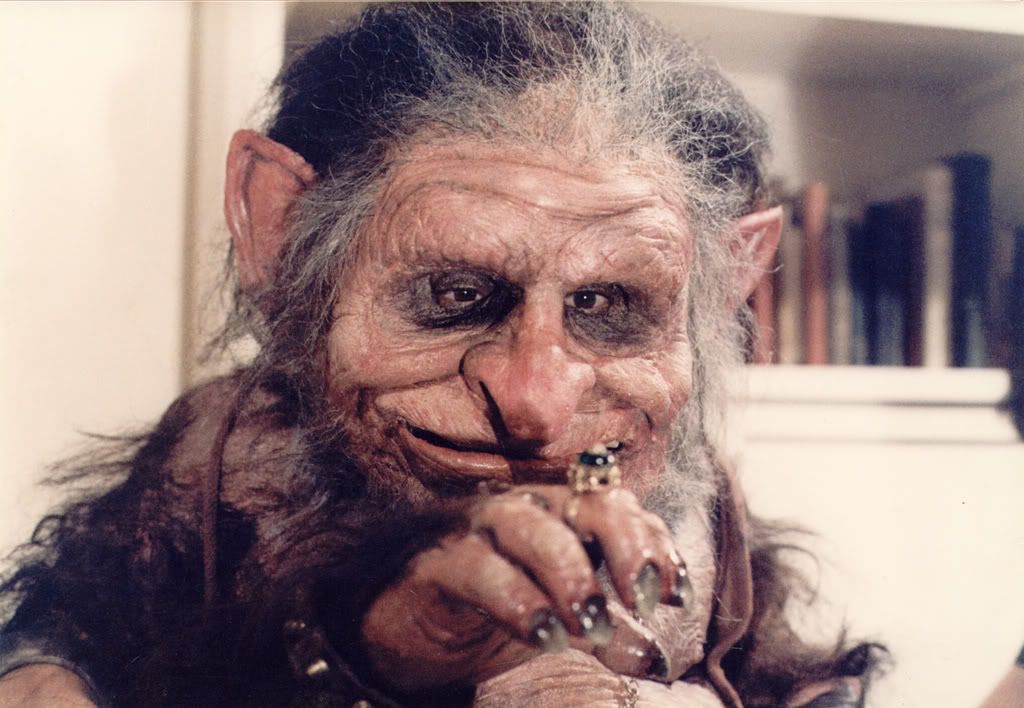
A still from the movie Troll (1986)

The two women finally realized their house might be haunted and approached a Cambridge psychic for help. But when the psychic came to investigate they were surprised to learn that the problems were being caused not by a ghost, but by a troll. The psychic said:

"Sometimes ... what we think of as ghosts - human beings who have died - are instead what might be called noxious rays, earth energies that are blocked. I felt this troll was stuck there. We did a ritual releasing of him. What came to me was to send him to another plane, where his energies could be transformed into a more positive and fruitful existence."
The troll was apparently connected with an underground spring that ran under the house and that caused the basement flooding. When the house was built on top of the spring the troll became trapped and would send its energy up along the back wall of the house. Karen had always felt its presence in the house, but the troll increased its activity once the roommate moved in and started to sleep near that wall.

The night after the ritual Karen heard a small voice speaking. It was the troll, begging her to let him stay. She also saw an image of her mind of a very small furry creature with claws. She didn't relent and told the troll he needed to leave.

It did. The strange occurrences in the house stopped, as did the basement flooding.

I find this story fascinating. For one thing, Myers gives the names of everyone involved and the address of the troll-haunted house. I have probably walked by the house several times. Here are a few more random thoughts:

1. Somerville is very, very densely settled. It has very little green space, so it's surprising that a nature spirit would show up there. I guess nature is everywhere, though, isn't it?

2. Myers's book was released in 1986. He doesn't say when the troll exorcism happened. In 1986 the horror film Troll was also released, which is about a troll taking over an apartment building. It stars Noah Hathaway as a character called Harry Potter, Jr. and Julia Louis-Dreyfus in her pre-Seinfeld days.

3. I find it very interesting that the psychic's diagnosis was a troll-haunting and not a ghost. You don't often read about troll's haunting houses in New England. I guess she was right, though, since her ritual worked. But maybe paranormal phenomena are shaped by our expectation. If you think the weird activity in your house is caused by a ghost, you'll see a ghost. If you think it's caused by a troll, you'll see a troll. If you think it's aliens, you'll see aliens.

4. This doesn't necessarily mean that paranormal phenomena exist just in our heads, though. Some writers (like Jacques Vallee or Patrick Harpur) suggest that there are actually entities out there that take different forms based on our cultural expectations. Maybe they're spirits, maybe they're daimones, or maybe they're extra-dimensional tricksters who just want to have a laugh at our expense. They could also be something lurking deep inside our subconscious, but I don't think that rules out any of the other possibilities. I'm sure there's a troll or two hiding somewhere deep inside my mind!

March 29, 2015

The Witch's Grave of York Maine: Is The Story True?

A while ago someone who reads this blog asked me to post about an alleged witch's grave in York, Maine. What a great idea! I love old graveyards, and I love New England witches. So here's a post that brings those two great tastes together like a Reese's peanut butter cup of the uncanny.

When I was a kid my family went to York, Maine a few times for vacations. I remember going to the beach, and visiting the zoo there. When I was a kid I think it was called York Wild Animal Farm, but these days it's York's Wild Kingdom.

As far as I know, we did not visit the Old Burying Ground, which is located in charming and historic York Village. It's too bad, because as with most charming cemeteries around here it has a weird legend is attached to it. I probably would have enjoyed hearing it.

The legend is about the grave of Mary Nasson, who who passed away in 1774. Her gravestone is a little different than the others. It has a portrait of Mary on it, and is covered with a big stone slab.

Photo from The Journal Inquirer.
A plaque on the cemetery wall indicates that the stone slab was put there by her family to prevent animals from digging around in Mary's grave. Local folklore gives another explanation: it was put there to keep Mary, who was a witch, from rising from the dead.

I think the stone succeeded in keeping the animals away, but it hasn't kept Mary's ghost from coming up to the surface. According to Joseph Citro's Weird New England, her ghost has reportedly been seen pushing local children on swings and giving them wildflowers. Hmmm. For a witch's ghost she doesn't seem particularly menacing. Online I've found quite a few sites claiming that Mary Nasson only acquired her witchy reputation because she was an effective herbalist. Her neighbors didn't understand how her cures worked and therefore thought they were magic. Oh, and maybe she could perform exorcisms...

Image from Atlas Obscura
Those stories indicate that Mary was basically a good person, and if she was a witch she only practiced white magic. Other, creepier stories say Mary was executed for witchcraft and that her gravestone emanates a strange heat. The crows that flock around the cemetery are said to be her familiars. Spooky!

So, was Mary Nasson a good witch, or a bad witch, or just someone who has an unusual gravestone? Are any of these legends true?

I don't know if they are true, but they definitely are old. I thought they might just be recent urban folklore but found they date back to at least the 19th century. I found this passage in ‪1894's Ancient City of Gorgeana and Modern Town of York (Maine) from Its Earliest Settlement‬: ‪Also Its Beaches and Summer Resorts‬ by George Alexander Emery:

Near the southwest corner of the old burying-ground is a grave, with head and foot stones, between which and lying on the grave is a large flat rock, as large as the grave itself. The inscription reads thus: - "Mary Nasson, wife of Samuel Nasson, died August 28, 1774, aged 29 years." No one, at least in this town, seems to know anything about her origin, death or even of the singular looking grave. No other occupant of a grave bearing this cognomen can be found in this cemetery, and the name is unknown in the town. A great many surmises and conjectures have been advanced in regard to this matter, in order to arrive at the facts, if there be any, and to clear up the dark affair, but nothing definite has ever come out of the effort. The writer of this, when a youth, living in York, was given to understand that this stone was placed there to keep down a witch that was buried beneath it.

In short, no one knows the real, historically-documented truth about Mary Nasson. Although George Alexander Emery doesn't believe Mary Nasson was a witch, he adds fuel to the fire by providing yet another legend. According to this one, a disembodied evil spirit used to haunt some rooms in an old house near the cemetery. It was banished from the house, but now roams the cemetery's perimeter, waiting for Mary to arise from her grave and join it.

I don't like to debunk legends; I like to savor them, so I'll just close with a couple thoughts. First, anomalous gravestones often attract legends. Rightly or wrongly, people tend to think that strange graves must contain strange occupants. 

Second, the idea is very old that special effort is required to restrain a restless spirit. For example, in old European vampire lore a stake to the heart literally nails a vampire into its grave. Closer to home, Eunice Cole, an accused witch of Hampton, New Hampshire, was supposedly staked through the heart after death and had a horseshoe placed on top of her. It's not unreasonable (in folk belief) to think that a big rock might keep a ghost from coming out of the grave.

One last note: I am now writing a bi-monthly column for Spare Change News called Bizarre Boston. If you live or work in Boston be sure to buy an issue and help the city's homeless community. You can see one of my columns (about a Boston smallpox epidemic) here.

March 15, 2014

Moll Ellis's Bee: The Witch's Familiar and the Human Spirit

Here's an interesting witch story from Cape Cod. I think it illustrates how really old metaphysical beliefs survived in disguise until quite recently in New England. The story is from William Root Bliss's 1893 book The Old Colony Town and Other Sketches.

********


Everyone in Plymouth knew that Moll Ellis was a witch, but no one knew it better than Mr. Stevens. Moll and Mr. Stevens had argued about something (as people in small towns do), and for three years since she had tormented him in small ways with her witchcraft.

Stevens had been able to ignore the years of minor but annoying witchery, but his patience ran out one day when he was hauling a big load of hay in a ox-driven cart. The oxen had just pulled the cart across a stream when something spooked them. They reared up, and the hay fell into the stream and was ruined.

Mr. Stevens stomped over to Moll's house. He barged inside, and found her lying on her back with her eyes shut, "a-muttering dretful spell words." He yelled at Moll that if she every bothered him or his cattle again he would have her hung as a witch.

Frightened to find her enemy inside her home, Moll opened her eyes and apologized. She also said she would never bother him again, but while she was talking to Mr. Stevens something strange happened.

When she was talking, a little black devil, that looked just like a bumblebee, flew into the window and popped down her throat; 't was the one she had sent out to scare the cattle...
********

That little black bumblebee is Moll's familiar spirit. According to New England folklore, the Devil gives his witches minor devils called familiars to work their mischief. Although sometimes monstrous in form, familiars most often appear as animals like birds, cats, dogs and toads. Insect familiars are rarer, but not completely unknown. In addition to Moll's bee, a witch from Rock's Village near Haverhill, Massachusetts had a familiar shaped like a junebug.


Like a lot of our local witch lore, the demonic familiar spirit is an idea that originated in Europe. But before it even became associated with the Devil and malevolent witches, it was a widely held metaphysical concept. For example, here is a story from a 14th century book about the Cathars, a heretical Christian sect.

********

Two men were sitting by the side of a river when one of them fell asleep. As the other man watched, a small lizard emerged from the sleeping man's mouth. The lizard crawled along the river bank and then crossed over the river using a branch that extended from one bank to the other. While it was on the other side it crawled in and out of a donkey's skull that was lying on the ground.

The man who was awake moved the branch, trapping the lizard on the other side. As the lizard tried to find a way across the river the sleeping man began to thrash in his sleep. The man replaced the branch and the lizard scurried back into the sleeping man's mouth. When the sleeper awoke he told his friend how he had dreamt he crossed a mighty river and explored a palace that had many entrances and chambers.

The two men were quite puzzled by this and went to one of the Cathar religious leaders, who were known as the perfecti.

"The soul," he said, "resides permanently in the body of man; the spirit, on the other hand, goes in and out of the human body, exactly as the lizard who went from the sleeping man's mouth to the donkey's head, back and forth."
(The story is quoted in Claude Lecouteux's Witches, Werewolves and Fairies (2003).)

********

The Cathar story is not the earliest version of this tale. Similar accounts appear in Norse sagas, and in a story about King Guntram, a Frankish king who lived in the sixth century. 

Somehow, this belief in an animal spirit that can leave the body survived for more than 1,300 years, finding its way from a story about a king to Moll Ellis, a witch who lived in Plymouth. Over time it became transformed from a neutral statement about human metaphysics to a demonic story to scare children, but it's still exciting to find these little ancient gems hidden in our local folklore.