Showing posts with label insane asylum. Show all posts

March 29, 2023

A Visit to Medfield State Hospital: Charming and a Little Spooky

A few weeks ago Tony and I visited Medfield State Hospital, in charming Medfield, Massachusetts. Originally known as the Medfield Insane Asylum, the hospital is now a park open to the public. Intrigued? Read on. 

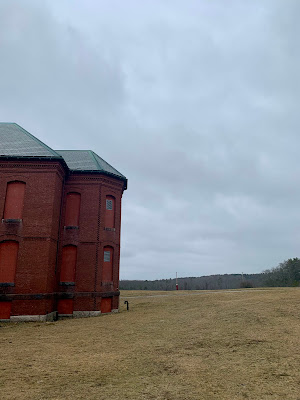
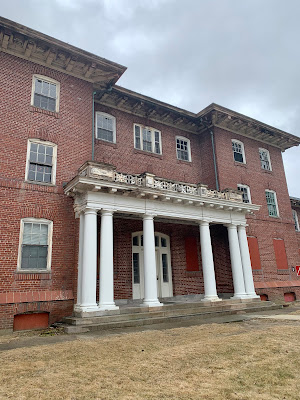
Medfield State Hospital opened in 1896, and was one of the state's first hospitals to deal with long-term patients with mental disorders. It was designed in the "cottage style," according to an informational sign erected at the hospital, with more than 50 buildings spread across 1.4 square miles. Many of the buildings are still standing, although they are now boarded up and public cannot access them. Medfield State today looks a lot like a small, traditional New England liberal arts college - but with absolutely no people. It's both charming and maybe a little spooky. 
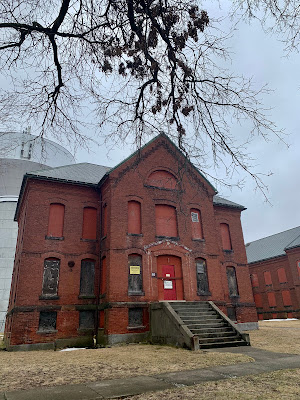
Tony and I visited on a cold, snowy day, and there weren't many other visitors. A few people were walking their dogs, but that was about it. The hospital was quite bustling in the past, however. During World War II, almost 2,300 people lived at Medfield State. The hospital finally closed in 1993. 

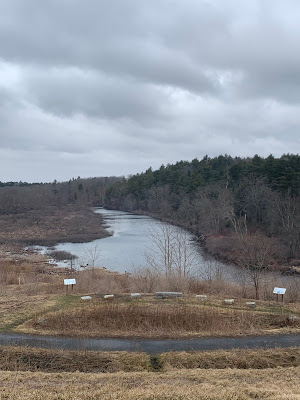
In the early part of the 20th century, the hospital was self-sufficient. Patients grew crops on hundreds of acres of farmland, and tended more than 1,000 cattle and 3,000 chickens. That's quite an operation! Medfield State Hospital even was able to supply food to the other state hospitals in eastern Massachusetts. Even today there is still quite a bit of open land at Medfield State, including a bluff overlooking the Charles River. It has a great view!
You'd think there would be some weird legends associated with an abandoned insane asylum, but that's not really the case here. The only possible ghost story is quite recent. In 2017, the movie The New Mutants was filmed at Medfield State. Part of the X-Men series, The New Mutants tells the tale of five young mutants imprisoned in a spooky hospital. The movie wasn't released until 2020, and the director suggested The New Mutants might have been cursed by being filmed at the abandoned insane asylum. 

The director, Richard Boone, told The Boston Globe the following on August 20, 2020:

It was during the press push for the first trailer that Boone first spoke of “weird” things happening to crew members at Medfield State Hospital during filming. 

“Literally every single person on my crew — all my grips — all those people had weird things happen to them while they were there,” Boone told IGN of the abandoned state hospital, which also served as a filming location for “Shutter Island” in 2009. “I even told the behind-the-scenes crew to go interview everyone who had weird stuff happen to them for an extra on the Blu-ray.”

I would like a little more detail, but I don't want to buy the Blu-Ray. Not everyone was freaked out, though. Actor Anya Taylor-Joy said the following:

"I've shot in four abandoned mental institutions, so it's kind of a second home for me," Taylor-Joy said (ABC Seven.com)

That's a good attitude to have! Soon the hospital will be home to hundreds of people again. The town of Medfield will be developing Medfield State into apartments and an arts center, which is probably a good use of the property. Maybe some more ghost stories will emerge once people start living there full time again?


August 25, 2020

Cursed Movie Filmed in Abandoned Insane Asylum

A new X-Men movie is being released this week. The New Mutants comes out on the 28th, and is notable for two reasons. First, it's actually being released in theaters, so if you dare to to the movies you can see it on the big screen. Second, it was filmed in Massachusetts in 2017, but its release was delayed for several years. The director has hinted that the movie is "cursed."

The New Mutants tells the tale of five young folks who are imprisoned in a spooky hospital because their mutant powers are considered dangerous. Much of the movie was shot at Medfield State Hospital, an abandoned 100-year old insane asylum in Medfield. It sounds like an appropriately spooky setting.

Medfield State Hospital. Photo by Ghostfacesouthshore on Wikipedia.

The movie was originally supposed to be released in 2018, but was delayed due to studio mergers and conflicting opinion's over the final tone of the film. The director, Josh Boone, has suggested the movie is cursed and that perhaps filming at Medfield State caused it.

It was during the press push for the first trailer that Boone first spoke of “weird” things happening to crew members at Medfield State Hospital during filming. 
“Literally every single person on my crew — all my grips — all those people had weird things happen to them while they were there,” Boone told IGN of the abandoned state hospital, which also served as a filming location for “Shutter Island” in 2009. “I even told the behind-the-scenes crew to go interview everyone who had weird stuff happen to them for an extra on the Blu-ray.” (from Boston.com, "The story of ‘The New Mutants,’ the ‘cursed’ Marvel movie filmed in Mass.")

I was of course intrigued by the idea of a haunted insane asylum nearby, so I did a little research. Here's what I found. Medfield State Hospital opened in 1896 and was composed of dozens of buildings spread out over 900 acres of land. The hospital was designed on a "cottage plan," with many small buildings intended to create a homey atmosphere. It closed in 2003, and is now open to the public as a park. You can walk on the grounds (it looks like a college campus) but can't enter any of the buildings for safety reasons.

Here's what I didn't find: any stories about ghosts, hauntings, or a curse. I was a little surprised, given it's an abandoned insane asylum, but most visitors say Medfield State is very peaceful.
The citizens of Medfield really seem to enjoy the park-like atmosphere, and several articles I've read online have recommended visiting. 

The cast of The New Mutants

There are probably a few reasons why no spooky stories are attached to Medfield State. It's hard to think of a place as scary when people are walking dogs, playing frisbee, and having picnics there. By opening it up to the public the town has effectively made it wholesome and inherently unspooky. Fencing it off and putting up "No Trespassing" signs would have done the opposite.

Also, the hospital only closed in 2003, which isn't that long ago. It's probably not long enough for any really good local legends to arise or gain traction. Maybe they'll show up in a few years.

It's quite possible The New Mutants will kick off some new legends. Maybe locals will say, "Oooh! Medfield State is so creepy. I heard they filmed a movie there and it was cursed!" It certainly sounds like the start of a good urban legend, doesn't it? The only problem is that you have to buy the Blu-ray to learn about the creepy stuff. Hopefully someone at Marvel will release those interviews on YouTube or another format so the legend can spread. 

August 23, 2015

Melonheads Part II: Why So Many Big Heads?

This is the second of two posts about the Melonheads. Read part one here!

One of the many interesting things about Melonheads is that in New England the legend is only found in Connecticut. But it is also found in the Midwest, particularly in Michigan and Ohio. Much like their New England cousins, these Melonheads also lurk in the woods and delight in terrifying teenagers.

In Ohio, the legend is found in the rural areas outside of Cleveland, and the creatures' origin is ascribed to a mysterious man named Dr. Crowe. Dr. Crowe allegedly experimented on children that he either kidnapped or acquired from a local insane asylum. He imprisoned them in his secluded house, where he injected them with chemicals and possibly radioactive materials. These painful experiments caused them to mutate. Eventually the children rebelled and killed their tormentor. They escaped into the surrounding woods where they have remained to this day.

There are several versions of the Dr. Crowe legend. In some he has a kindly wife who treats the children well, and the mutant children only rebel against him when they see him abuse her. In another, he actually experiments on children with hydrocephalus. Hydropcephalus is a real medical disorder that causes fluid to build up in the skull, giving its sufferers enlarged heads. Let's be clear, though: hydrocephalus does NOT make anyone into an insane monster.

In Michigan, the Melonheads are said to have either escaped or been released from an insane asylum near the Felt Mansion in Ottawa County. They didn't wander far from their old home, and now lurk in the woods surrounding the mansion.

Melonhead illustration from Joseph Citro's Weird New England.

I don't know why the Melonhead legend is only found in these three parts of the country. Did it spread from New England to the Midwest, or did it happen in the opposite direction? It's a good topic for a folklore master's thesis, I suppose. I do know that the legends in all three areas have one thing in common: they use the language of science to explain where the Melonheads came from. Inbreeding, evolution, mutation, psychology, radiation - these are all terms from the physical and social sciences. They give the Melonheads an aura of plausibility.

Ghosts, witches, vampires, fairies, werewolves - these creatures are all supernatural in origin. We live in a scientific age, so we deserve scientific monsters. The Melonheads are one of them.

Extraterrestrial aliens are another monster of the scientific age, and it's interesting how similar they are in appearance to the Melonheads. Although the Melonheads are feral and bestial, both they and the gray aliens often share a similar physical morphology. They are short, thin, and have really big heads.

Gray aliens.
A monster was seen in Dover, Massachusetts who also had the same physical appearance. This was the infamous Dover Demon, who terrorized several teenagers in 1977. Like the Melonheads and the gray aliens, the Demon had a disproportionately large head and a very small body. Its eyes also glowed orange when lights shone on them. In Connecticut, some people have said the Melonheads' eyes glow orange as well.

The Dover Demon!


The Dover Demon was never quite categorized as either supernatural or scientific, but in earlier eras, little supernatural monsters with large heads were also said to lurk in the woods. The fairies, gnomes and dwarves of European legend often were described this way. In Connecticut, the Mohegan Tribe has the legend of the makiawisug, small magical people who live in the forests. They are often called pukwudgies these days by paranormal investigators, and illustrations show them with small bodies and large oversized heads.

Illustration by Lupi, used without permission.


Fairies, gnomes and pukwudgies are not monsters of science, but they share similar traits with the Melonheads. They dwell outside the fringes of our civilized world, terrorizing those who trespass on their territory. One key difference is that there are ways to placate the supernatural creatures who live in the woods, such as leaving them offerings of food and milk. There is no way to interact socially with the Melonheads. They simply emerge from their hiding places and terrify trespassers. Some accounts from Connecticut say the Melonheads abduct lost hikers and transform them into new Melonheads; fairies and aliens also enjoy abducting humans. 

So what does all this mean? There are some practical, "commonsense" explanations for the Melonheads. Michigan's Felt Mansion was a seminary for boys in the 1940s, and one man who studied there claims that the local townies called the seminarians "melon heads" because they were so educated. (Egghead is a more common derogatory term for the educated, but you get the point.) In the book Weird U.S., writer Ryan Orvis claims to have met an Ohio man who used to scare teenagers out parking in cars at night when he was a kid. A friend who helped him had hydrocephalus, and supposedly this led to the legend of the Melonheads. Similarly, perhaps random encounters with hydrocephalic individuals cruelly gave rise to the legend.

I suppose any of these origins are plausible, but they don't explain the particular form the legend took or why it persists. It's a long road from someone being called a "melon head" to stories about cannibalistic mutants that live in the woods. Maybe there is something primitive deep inside us that fears the darkness outside our little circle of light and knows that monsters are out there waiting for us. It might not be rational, but I think the feeling is persistent and powerful.

That still doesn't explain why so many of these monsters have a particular shape though, does it? All these creatures are childlike and sometimes almost embryonic in appearance. That doesn't really seem like a shape that people would inherently find frightening.

If you like supernatural or paranormal explanations, maybe you're inclined to believe there is some force (or some entity) out there that takes this shape repeatedly over the centuries, materializing as small big-headed monsters to scare the pants off us before disappearing into the darkness. Right now sitting here at my computer, I don't find that explanation too compelling, but if you bring me out into the woods at night I might just change my mind.

August 16, 2015

Melonheads Part I: A Trip Down Dracula Drive

If you ever travel the back roads of Connecticut's Fairfield County late at night, you might see an old blue Ford Granada barreling down the road. In 2015 Granadas are officially antique cars, but that's not what makes this car so unique. It's remarkable for the the people - or creatures? - that ride in it.

Back in the 1980s, a group of girls from Notre Dame High School in Fairfield decided to go out joyriding after a Friday night football game. Their names: Megan, Sue, Kim, Deb, Jen and Karen. Just a group of all-American girls looking for harmless fun, they got into Deb's blue Granada and set off into the dark night.

After driving around for a while they decided to go someplace spooky: Velvet Street in neighboring Trumbull. The locals had given Velvet Street the nickname Dracula Drive because of the strange things that supposedly happened there. Megan told her friends that strangest of all, little monstrous humanoids with huge heads were said to live in the woods surrounding Dracula Drive. Why not try to find them?


The girls drove down Dracula Drive and parked the car. They left the headlights and climbed out into the cool autumn air. The woods were very still and very, very dark. Other than the headlights there was no illumination - no streelights, no houses nestled among the trees. The girls were alone in the night-time woods.

Laughing with nervous energy they started to walk down the road, hoping yet fearful of seeing the monsters who supposedly lived in the woods. After walking a couple hundred feet they heard the car door open and slam behind them. The engine started and the car barreled down the road towards them. Someone had stolen Deb's car!

The girls jumped into the woods to avoid the car as it charged towards them. The Granda's thieves were illuminated by the interior light. They were the size of children with disproportionately large heads and were clad in dirty rags. Their eyes glowed with orange light, and they cackled wildly as they drove past the girls. The tail lights disappeared into the distance.

Megan, Deb and their friends had found what they were looking for. They had found the Melonheads.

I first read about the Melonheads in Joseph Citro's Weird New England, which is where the story about the stolen car comes from. After doing some research, I learned two things. First, Melonhead legends are very localized in New England. Stories about Bigfoot, ghosts, witches and UFOs can be found everywhere in this region, but you'll need to go to the Nutmeg State to encounter Melonheads. (Melonhead legends are also found in Ohio and Michigan, but more on that later.)

Second, the legend is not that old, at least in New England terms. Some of our legends go back to the first English settlers or even to the Algonquin Indians. Melonhead stories can only be traced back to the 1960s, and don't appear in older collections of New England legends like Botkin's Treasury of New England Folklore or Dorson's Jonathan Draws the Longbow.

Melonheads are small, spindly little humanoids with heads the size of melons. But what exactly do they do? Mostly they terrorize teenagers, as so many American monsters do. The Melonheads lurk in the rural areas of Connecticut where they live a feral lifestyle, sustaining themselves by eating small animals, stray cats, and human flesh (when given the opportunity). A hiker gone missing in the woods? A runaway teen who never comes home? Blame the Melonheads. Some people say they eat anyone they catch, while others say they do something even worse: turn them into Melonheads. While that seems far-fetched, some people also claim the Melonheads communicate by telepathy, so if they are psychic they may have powers unknown to the average human.

Several towns in Connecticut have roads that pass through Melonhead territory. Velvet Street (aka Dracula Drive) in Trumbull and Monroe is the most famous, but other towns have their own special streets. Shelton's Saw Mill City Road, Milford's Zion Hill Road, and Marginal Road in New Haven are just a few of the streets where Melonheads lurk.

Where did they come from? One origin story ties the Melonheads to New England's Puritan past. Way, way back in the 1600s a family from the Trumbull area was accused of witchcraft by their town's elders. The family was banished into the surrounding wilderness, where it was assumed they would starve to death. They didn't. They survived by hunting and gathering, and when their young children reached maturity the brothers and sisters interbred. The family remained isolated in the woods, mutating from generations of inbreeding and a diet of wild animal flesh, but increasing their numbers to become the Melonhead tribe people encounter today.

An alternative story claims the Melonheads are really escapees from a mental asylum. According to this version of the legend, an asylum operated in the area from the 1860s to the 1960s, but mysteriously burned to the ground one day. Every staff member and most of the inmates perished, but a few were never accounted for. Locals claim they escaped into the woods, where they interbred and became the feral Melonheads.

I am not a debunker. I don't think it is an interesting or fruitful activity, and I don't want to discount what people experience. However, even if people are encountering something strange in the Connecticut woods, I don't think these two stories are historically true. There's no record of a disastrous insane asylum fire in the area, and there aren't any records of people being banished for witchcraft. People found guilty of witchcraft were flogged, jailed, or even executed, but they weren't usually banished.

The forests in southern New England are not old growth forests. They haven't been here for 350+ years. Most of the original forests in Connecticut were cut down to carve out farms, and only started to take over again in the 19th century when people abandoned the farms for the mill towns or moved out west to more fertile lands in New York and Ohio. In other words, I don't think there have been enough woods for a family of inbred monsters to hide in for three consecutive centuries.

But, having said that, I still think something interesting is happening with the Melonhead legends, and I'll write about that next week. Stay tuned!

*** UPDATE: Part two now online! ***