Showing posts with label Newport. Show all posts

July 31, 2022

Hiding Shoes to Bring Luck and Avert Evil

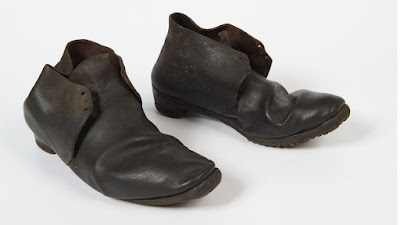
I’m always excited when some local folklore appears in the news, as it did this week. Several Boston-area news outlets reported that archaeologists working at the historic Tilden House in Canton, Massachusetts unearthed some shoes buried underneath the kitchen floor. Why all the excitement over some shoes? Because they could possibly be a form of protective magic. 

The Tilden House was built in 1725 by David and Abigail Tilden in what was then part of Dorchester, Massachusetts. That part of Dorchester ultimately became a separate town, Canton, in 1797. A strange and interesting fact: it was named Canton because Elijah Dunbar, one of the town’s leading citizens, thought it was on the exact opposite side of the planet from Canton, China. This is not the case, but the name stuck. 

A photo of hidden shoes from England. 
For those of you not from the Boston area, please note the names of the two cities are not pronounced the same. The town in Massachusetts is said CANT-in, or more often CAN’-in, with some kind of glottal stop instead of the “t”. The city in China is often pronounced can-TAWN, but it’s true Chinese name is Guangzhou. It’s also important to note that Cantonese cuisine originates from Guangzhou, not the Massachusetts town. 

The Tilden House is currently owned by the town of Canton, and leased to the Canton Historical Society, who are restoring and modernizing it so it can be used as a history center. After archaeologists removed the kitchen floor, they found several pairs of shoes, along with bottles, plates, and other items, all of which seemed to date from the mid-19th century. All these items could just be trash that past residents discarded, but it’s also possible the shoes were placed there to protect the house from witches or evil spirits. 

Hidden shoes are often found in the walls, ceilings, or under the floors of old buildings in England and North America, and historians suspect it was a form of protective magic. For example, back in 2013 archeologists found shoes hidden under the floor of the Old Colony House in Newport, Rhode Island. But why did our New England ancestors think hiding shoes would defend against evil magic? Historians  Matthew Cochran and Jeanne Ward explain it this way:

This well-documented practice dates from the l5th to the early 20th century. The underlying premise of using concealed shoes as a means of personal or household protection lies both in the shoe’s shape as well as the personal qualities imbued in a shoe by the wearer. Shoes take on the literal shape of the wearer and therefore can act as a form of proxy for the wearer. If a malicious entity is presumed to be haunting you, the concealment of the shoe in a relatively inaccessible space, such as the cellar or the attic, may draw the malicious entity to the shoe instead of you. And, if luck holds, the malicious entity may become trapped in the shoe (from the Maryland Archeology Newsletter, quoted here.)

This explanation makes sense to me, since it matches another important type of protective magic in New England: the witch bottle. I've written about witch bottles before. When someone thought they were being cursed by a witch, they would fill a bottle with their own urine, and then add nails, broken glass, and other sharp items to it. The urine acted as a substitute or proxy for the victim. The witch's evil magic would be drawn to the urine, which came from their victim, rather than to the actual intended target. To make things worse for the witch, the sharps objects would send pain and physical harm back to the witch. 

I suppose you should always have some old shoes, a bottle and some nails on hand just in case things start getting weird? It's like a supernatural form of recycling. But please, don't go around accusing your neighbors of witchcraft.

July 17, 2021

The Whitehorse Tavern: Ghosts and A Pirate!

The historic Whitehorse Tavern in Newport, Rhode Island is on a lot of lists. It's on the National Register of Historic Places. It's on a list of the world's oldest restaurants, coming in at number 10. The Boston Globe recently placed it on a list of of the best places to eat in Newport. You get the idea. It's a historic and prestigious restaurant.

Those are some good lists to be on, but here's you should really care about: the 10 most haunted bars in America. There are a lot of haunted bars in this country, and the Whitehorse Tavern came in at number five. 

The Whitehorse was originally built in 1653 as a home for Francis Brinley, one of the early Newport colonists. Brinley sold the building in 1673 to William Mayes, Sr., who opened a tavern in it. His son, also named William Mayes, took over operation of the tavern in 1702. I don't think he paid too much attention to the business, though, since he also worked as a privateer for the English. 

A privateer was basically a licensed pirate. Mayes had permission from the English government to attack and steal from French ships, since they were one of England's political rivals at the time. Later, Mayes just became a full-on criminal pirate and raided ships sailing in the Indian Ocean, no matter who they belonged to.

After a decade of sailing the high seas, Mayes returned to Newport and resumed his duties at the tavern. His sister, Mary Mayes Nichols, took over after his death, and the business remained in the Nichols family for nearly two centuries. It acquired the name Whitehorse Tavern in 1736. The building was briefly a boarding house in the early 1900s before once again becoming a tavern. 

Hotels, restaurants, and bars often have ghost stories attached to them. It makes sense (if you believe in ghosts). Lots of people move through buildings like that, and they leave their spiritual mark on the place. The Whitehorse has been in use for almost four-hundred years, and many people have stayed there in its incarnations as a tavern and a rooming house. A lot of lives have been lived there, and some have probably ended there too. 

One ghost haunting the Whitehorse is said to be the spirit of an elderly overnight guest who died many years ago. He now wanders through the tavern in Colonial-era clothing, and is often seen by staff and guests near the fireplace in the dining room. He's also been seen in one of the bathrooms. HauntedHouses.com, which has a nice writeup about the Whitehorse, notes that this ghost sometimes pesters female guests, which is creepy, and not in a supernatural way. 

Other ghosts haunting the premises include a young girl who cries, and a presence that watches over the tavern and its staff. The latter is said to be mostly benevolent, and might possibly be the spirit of a former owner. This is something often reported at other long-running restaurants - business owners like to keep working after their deaths. For example, see my 2019 post about Local 186 in Provincetown.

The Whitehorse is only open for dinner this summer, so Tony and I weren't able to go inside during our recent Newport day trip. Maybe next time we'll get to try the food - and try to see a ghost in the bathroom. 

*****

This is totally unrelated to the Whitehorse Tavern, but I wanted to share some exciting news. I have a new book coming out in September. Here's the cover:

The cover makes me chuckle every time!

As you can probably guess, Witches and Warlocks of Massachusetts is about... well, witches and warlocks from the Bay State. For many years I looked for one book with all the local witch stories. I never found one, so I wrote it myself. It contains dozens of legends, historical accounts, and paranormal encounters, dating from the 1600s to the 21st century. So much witchcraft!

Although the book doesn't come out until September, you can pre-order it on Amazon, Barnes and Noble, Bookshop, and Books A Million. Why delay? You know you'll want a copy as soon as the nights start to get longer...

July 05, 2021

The Newport Tower: Vikings, Knights Templar, and Benedict Arnold

This weekend Tony and I took a quick day trip to Newport, Rhode Island. It was cool and rainy, which is perfect weather for exploring historic seaports with a history of strange happenings. 

One sight I really wanted to see was the Newport Tower, located in Touro Park. The Newport Tower is an old stone structure that has stood for centuries on a hill overlooking the harbor. It is protected by an iron fence these days so sadly you can't get too close to it. There are several theories about about who built the tower, and why they did so.

For example, it is sometimes called the Viking Tower. In the early 19th century, a Danish archeologist theorized the tower was erected by Norse explorers who came south to Rhode Island from Vinland (the Canadian provinces of Newfoundland and New Brunswick) centuries before Columbus visited the New World. I am not quite sure why the Vikings would have built such a tower, but the theory was quite popular. 

In the 19th century, many Anglo Americans embraced the theory that Vikings had journeyed far down the Atlantic coast. As I mentioned a few years ago, some even believed there had been a vast Viking metropolis along the banks of the Charles River in Massachusetts, where Boston and Cambridge now stand. This simply isn't true. The only known Viking settlement in North America was in Newfoundland, which only supported around 150 people, and only lasted for a few years. There's no evidence for Viking settlements in New England. 

Nineteenth century Anglo-Americans were open to the Viking theory for political and cultural reasons. Many of them were disturbed by the large number of Catholic immigrants entering the US from southern Europe at the time. They also didn't like that Christopher Columbus, an Italian Catholic working for Spain, had been the first person to open up North America to European colonization. They wanted to believe a Northern European, like themselves, had done this first. While it is true that Vikings reached North America long before Columbus, they made very little impact and didn't stay very long. 

Back to the Newport Tower. The Viking theory was just the first of several theories claiming the tower had been built by some forgotten European explorers who came before Columbus. Perhaps the tower was built by Irish monks in the 6th century. Or maybe it was the Portuguese. Some people have even suggested it was the Knights Templar, fleeing to North America from persecution in the 14th century. The New England Antiquities Research Association has an extensive monograph outlining the various theories here

Unfortunately, there's no good evidence to support any of them. There isn't any evidence that Irish monks or the Knights Templar came to Rhode Island before Columbus, and most historians and archaeologists believe the Newport Tower was actually built by Benedict Arnold, the first royal governor of Rhode Island, sometime in the 17th century. (Note: Benedict Arnold's great-grandson, also named Benedict Arnold, was the notorious Revolutionary War traitor.) 

Arnold refers to a "stone-built mill" in his will, and the Newport Tower is located near the site of Arnold's home. Documents from the early 18th century refer to "the old stone mill," and carbon-dating suggests the tower's mortar dates to the late 17th century. The tower is similar to other stone mills in England, and archaeological excavations at the tower didn't unearth any artifacts older than the colonial era. 


I think the evidence indicates pretty clearly that this tower was built by Benedict Arnold (or someone hired by him). Surely someone in 17th century Newport would have mentioned discovering a giant stone tower of unknown origin when they settled the area, but they didn't. Instead, they mention a mill built by Governor Arnold. Not everyone may share my opinion, but I think a 350 year old stone windmill is still pretty cool, even if it wasn't built by Vikings. 

December 01, 2013

Folklore in the Media: Magic Shoes, Sea Monsters, and New England Vikings

There were three stories related to New England folklore in the media this week. Very often there are none, so it's a bonanza!

Newport's Old Colony House once served as Rhode Island's State House.

First, my good friend Ed directed me to this article in The Providence Journal about some very old shoes found underneath the floorboards at the Old Colony House in Newport. The brown leather shoes date from the 1830s, and were probably left there when the Old Colony House was being renovated in the 1840s. Shoes are often found in the walls and chimneys of old buildings, and it's believed they were placed there while the buildings were under construction to bring luck. The Old Colony House is still standing so I guess the shoes worked their magic.

Second, Atlas Obscura recently published this fun map showing various water monsters across the United States.


New England is represented by four aquatic oddities. In Vermont's Lake Champlain  you can find Champ, a cousin of the Loch Ness Monster who has been seen swimming in the lake since the 1600s. In Maine, the White Monkey (a small pale-skinned man with webbed hands) haunts the Saco River and was last seen in the 1970s. Also in Maine, Lake Pocomoonshine is inhabited by a serpentine monster who leaves enormous snake trails through the woods surrounding the lake. And last but not least, a sea monster has been seen of the coast of Gloucester, Massachusetts for hundreds of years. 

Many other New England lake monsters and sea serpents are not shown on this map, but I still learned a lot from it. I never knew there was an aquatic goatman in Texas or a lake monster called Slimy Slim in Idaho!

Boston's Leif Erikson statue outside Kenmore Square.
Finally, the Boston Globe's travel section has an article about places the Vikings visited in New England. Or, more accurately, places people have at one time or another said the Vikings visited. There is no firm proof Leif Erikson amd his crew made it this far down the coast when they visited North America, but the article lists some fun places to visit including stone towers in Weston, Mass. and Newport, Rhode Island.

That's all for this week. Next week, a haunted hotel in the White Mountains!

January 27, 2013

Rum Shrub

Tony and I had a party this weekend, and as happens at most parties the guests brought bottles of wine to share. But unlike most parties, a lot of the wine remained unopened at the end of the night.

We mentioned this to a friend who attended and he said, "Oh, that's because instead of wine everyone drank the punch. You know, the rum shrub."

Oh, right the rum shrub!

No, it's not a bush. A shrub is an alcoholic drink that was popular in the colonial era. It seems to come in two forms: either a cordial made from liquor and fruit, or a punch-like concoction made from liquor, sugar and fruit juice. Unlike a traditional punch, a punch-like shrub is made days or weeks in advance to let the flavors mellow.

I made my rum shrub from a recipe I found in Yankee Magazine's Lost and Vintage Recipes. The authors say their recipe comes from Newport, Rhode Island, which was once the rum capital of the world. We'll revisit that fact in a minute.

Basically, the recipe involved twelve cups of rum, lemon and lime juice, sugar and some water. Stir it up in a big bowl and let it sit for at least a week. It was really good! I could definitely taste the rum but the citrus and the sugar mellowed out the alcohol flavor. One person at the party said, "It's like a Colonial margarita!"

Add ice. Drink.

Doesn't it seem odd that Newport was the rum capital of the world? Rum is made from sugar products, usually molasses, and even with global warming no one's growing sugar cane in New England. Molasses, despite its omnipresence in New England cookery, is imported from warmer climates like the Caribbean.

Rum was probably first discovered in the 1600s in the Caribbean by plantation slaves, who realized that molasses (which is a by-product of the sugar manufacturing process) could be distilled into a delicious liquor. The Caribbean islands lacked the skilled workforce and lumber needed for a large-scale rum industry, but New England had both. The first rum distillery in New England opened in Boston in 1667.

New England merchants engaged in what is known as the "triangle trade" to make and sell their rum. First, they would buy molasses in the Caribbean. Ships would carry the rum to New England where it was distilled into rum. Ships would then carry the rum to western Africa where it was sold for slaves. The slaves were shipped to the Caribbean where they were sold for more molasses. A profit was made on each point of the triangle, helping to make New England one of the wealthier regions in North America.

As a New Englander I don't usually think much about this region's role in the slave trade. After all, there weren't a lot of large plantations here, and the Abolitionist movement was very strong here, right?

Both true, but it doesn't change the fact that a lot of people in New England got very rich from the slave trade. So many of the historic dishes from this region, like baked beans, brown bread, Indian pudding, and Joe Froggers get their distinctive molasses flavor from human misery.

I'm not going to stop making these foods or enjoying molasses, but like every part of the world I need to remember that our region's history is very, very complicated.

March 09, 2011

How Tough Is Your Indian Pudding?


As some of you might know, I’m a big fan of Indian pudding. I can’t get enough of that spicy/sweet/mealy dessert!

If you don’t know what Indian pudding is and are embarrassed to ask, it’s a Colonial-era pudding made from corn meal, molasses, spices, salt, milk and usually eggs. It's named Indian pudding because the Puritans called corn meal “Indian meal.”

A post I wrote two years ago still gets lots of hits, so clearly there are other fans of Indian pudding out there. Rejoice, Indian pudding fans. Today’s post is for you!

Harriet Beecher Stowe is best known as an abolitionist and the author of Uncle Tom’s Cabin, but this Connecticut native wrote several other novels. Some of them contain interesting pieces of New England folklore. For example, her 1859 novel The Minister’s Wooing is set in Newport, Rhode Island and contains this cryptic piece of dialogue. It’s uttered by a young woman discussing her skills as a potential wife:

“I’ve been practicing on my pudding now these six years, and I shouldn’t be afraid to throw one up chimney with any girl.”

I like how she says “up chimney”, rather than “up the chimney.” It reminds me of when I was a kid and I’d ask my mother where Dad was. Ninety percent of the time her answer was “Down cellar!”, which is a New England way of saying down in the basement.

Watch out for the pudding! Photo from a site about the history of chimneys.

However, I wasn’t alive in 1859 so I don’t understand why girls would be throwing puddings up the chimney. Well, according to Mrs. Stowe there was a tradition that “no young lady was fit to be married till she could construct a boiled Indian-pudding of such consistency that it could be thrown up chimney and come down on the ground, outside, without breaking.” The Minister’s Wooing is actually set in the 1790s, so Stowe is describing something that was probably told to her by her parents or grandparents.

Was this an actual tradition, or did someone pull a fast one on Harriet? I might say she’s the one pulling a hoax on her readers, but that seems unlikely because she seems very sincere in her devotion to Indian pudding. At one point in the novel she rhapsodizes about its “gelatinous softness, matured by long and patient brooding in the motherly old oven.” I don’t think someone who wrote that would knowingly lie to us!

On the other hand, that same softness she raves about would seem to preclude throwing it up and out a chimney. Wouldn’t it need to be really bouncy and tough to survive that? To settle this question, I’d ask my readers with fireplaces to give this a try. To make things easier, boil your pudding in a bag or maybe cheesecloth, like the characters in The Minister’s Wooing do. They don’t bake it in a dish. Perhaps that’s the secret to a bouncy pudding?

I wish I could say I unearthed this crazy factoid myself, but I actually read it in America’s Founding Food: the Story of New England Cooking by Keith Stavely and Kathleen Fitzgerald. It’s a great book!