Showing posts with label lake monster. Show all posts

January 23, 2024

Tales of A Tentacled Lake Monster: Fact or Fiction?

Does a tentacled, horned, snake-like monster haunt Nagog Pond in Littleton, Massachusetts? There aren't a lot of legends about lake monsters here in the Bay State, so I was excited when I first stumbled upon the possible Littleton lake monster a few years ago. It has been lurking in the back of my mind since then, and I finally decided to do a little more research. 

Nagog Pond is on the border of Littleton and Acton, and was formerly called Nagog Lake. It's a kettle hole pond, meaning it was formed thousands of years ago when the glaciers melted at the end of the last ice ice. Kettle hole ponds are so-called because they hold water just like a tea kettle. 

I've seen a few explanations for the name "Nagog," which is apparently derived from a word in one of the local Algonquin dialects. Some people say nagog means "corner," since the lake is in one corner of Littleton, and other say it is derived from "magog," which means water. As an FYI, Nagog is pronounced NAY-gog. Nagog Pond was used for fishing and recreational sailing in the past, and it now supplies drinking water to the nearby town of Concord. 

Illustration from Uriah Jewett and the Sea Serpent of Lake Mephemgagog (1917)

To understand the monster, you first need to know a little local history. Littleton was originally established in 1645 as Nashoba Plantation, a village for local Nipmuc and Pennacook Indians who had converted to Christianity. It was one of six so-called Praying Indian Villages that were created in Massachusetts by the Puritan minister John Eliot. The term "plantation" here does not refer to a large farm based on slave labor like you would find in the old American south, but instead to a farming settlement. The Praying Indians from Nashoba and the other villages were forcibly moved to Deer Island in Boston Harbor during King Philip's war by their English neighbors who thought they would join Philip (Metacomet) in his rebellion. Many of the Indians died from starvation and exposure on Deer Island, and the rest intermarried with English settlers or gradually joined other Indian groups after the war ended. All the Praying Indian villages eventually became English towns. 

The last Indian to live in Nashoba was Wunnuhhew, also known as Sarah Doublet, who returned to the village after King Phillip's War. Doublet sold the remaining 500 acres of Nashoba in 1734 to cover the cost of her care when she was elderly. She died two years later. 

Sarah Doublet is one of the topics in John Hanson Mitchell's 1998 non-fiction book Trespassing: An Inquiry into the Private Ownership of Land. This is where the monster comes in. Mitchell's book is the only place I've found reference to the Nagog Pond monster. According to Mitchell, Sarah Doublet and the other Indians at Nashoba believed the pond was home to a large monster named Ap'cinic. Ap'cinic was a horned water-serpent, and also had tentacles that it used to probe the shoreline for prey. The creature seemed to have a particular appetite for human intestines. 

"She knew the terror that flies by night, the fiery worm, the gnashing devils, and the legends of the tentacled, horned monster who would reach up out of the dark waters of Nagog at certain times and draw the entrails of passing villagers down into the depths." (Mitchell, Trespassing, p. 23)

Mitchell talks about Ap'cinic's tentacles a few other times. An earthquake struck the area in the 1600s, and he describes the monster reacting to it: "... the waters of Nagog churned and roiled and swelled, and the horned water beast who lived most of his time unseen beneath the surface rose up and spirited his vicious hunting tentacles through the drying air." (Mitchell, Trespassing, p. 65) 

At one point in the book, Mitchell encounters some teenagers illegally swimming in Nagog Pond. He tries to warn them away by telling them about Ap'cinic:

"It had these long tentacles, they say, and a huge gnashing beak and horns on its head. At night it would reach up and feel along the shore for people, fishermen, swimmers, things like that. If it caught you, it would either drag you down into the waters, or worse, slice you open and suck out your intestines."

The teenagers were quiet for a minute.

"You mean it would like eat you alive?" Tracy asked. 

"Yeah, suck out your inner body parts while you clung to a tree."

"Cool," she said. (Mitchell, Trespassing, p. 154)

The teenagers are intrigued, but not too worried. After all, is the story about Ap'cinic even true? Was there ever a monster lurking in the pond? You may wonder the same thing yourself. 

To be clear, Trespassing is marketed as a non-fiction book. It is about the history of Littleton, Massachusetts, about people who actually lived, and even about the dry business of town governance. Town hearings about zoning are a key part of the book. Ap'cininc is only a very small part of Trespassing

From Native People of Southern New England, 1500 - 1650.

Sarah Doublet (Wunnuhhew) really lived in Nashoba, but we don't know much about her life, and sadly Mitchell doesn't cite any sources for the legend of Ap'cinic. It's possible he made the story up. On the other hand, it's entirely possible that the Indians at Nashoba did believe a horned serpent lived in the pond. Horned serpents were part of the Alonquin cosmology. The anthropologist Kathleen Brandon writes:

"Among the manitou known to the Ninnimissinuok (i.e. New England Indians) was the giant horned or antlered, under (water) world serpent, a being familiar to other Algonquian-speaking people as well. Images of this fearsome underwater dweller sometimes decorated amulets, bowls, and other objects." (Kathleen Bragdon, Native People of Southern New England, 1500 - 1650, 1996, p.187)

So perhaps the Indians at Nashoba did believe a horned serpent lived in this particular pond, but John Hanson Mitchell doesn't present any concrete evidence they did. He doesn't explain where he found the name Ap'cinic, or why he thinks Ap'cinic had tentacles. 

I think the word "manitou" is key to understanding what's happening with Ap'cinic. Manitou means spiritual power, or anything that has a lot of spiritual power. My hunch is that Mitchell is responding to the spiritual power he feels around Nagog Pond, and he's trying to tell the reader what it feels like for him, and what he thought it felt like for the Indians who lived there hundreds of years ago. Mitchell has written several books about the history of Littleton, and has a deep awareness of its history and geology. Ap'cinic is the sensation Mitchell feels when he is near the pond. Ap'cinic is how Mitchell experiences the spirit of the place:

"Back at the car I stood on the road for a while looking up at the hill, simply feeling the sensation. Nothing happened, nothing seized me by the throat and dragged me back into the swamps to draw me, struggling, into the murky depths. And below me at the pond, I could not see the slimy gleam of the blind, searching tentacles of the Ap'cinic, feeling along the shores for victims." (Mitchell, Trespassing, p. 109)

If you were to probe the depths of Nagog Pond with a camera, I don't think you would find any trace of a giant monster. But perhaps, if you were sitting in the woods by the lake on a still autumn night, with your phone silenced and your mind cleared from worries, you might catch a glimpse of Ap'cinic. Maybe it would look differently to you, and instead of a horned serpent you'd see a hairy humanoid wading along the shore, or a giant black bird flying overhead, or a strange glowing orb hovering above the water. Or maybe you'd just get the feeling of a sentient presence surrounding you. 

The ancient Romans had a term for the spirit of a place: genius loci, or local spirit. Your belief in spirits as actual autonomous beings, or as a psychological metaphor, will depend on your intellectual temperament. But Ap'cinic may still hold a strange power, even if you think of him simply as a psychological experience:

"...a lake provides a ready-made metaphor for the Soul of the World, a symbol of the collective unconscious, an imaginative nexus where individual perception (or "misperception") and collective myth meet. Regardless of the actual characteristics of the lake, it is transformed by the Imagination into a reflection of the unconscious itself, becoming a dark, impenetrable, bottomless kingdom which does not yield up its dead. (Patrick Harpur, Daimonic Reality. A Field Guide to the Otherworld. 2003, p. 129)

That sounds intimidating, doesn't it? But perhaps less intimidating than a tentacled monster that wants to eat your intestines. 

August 03, 2021

Bottomless Ponds of New England: Monsters, Witches, and Dead Horses

I read a lot of books about local legends and folklore, and have discovered some weird things. I recently learned there are several bottomless lakes and ponds here in New England. Yes, you read that correctly. There are several bodies of water here that are immeasurably deep. And some have monsters in them...

One of these bottomless bodies of water is Hall's Pond in Brookline. Hall's Pond is located just off Beacon Street, one of the Boston area's busiest thoroughfares, and you can even take the Green Line trolley to it. Very convenient!

The pond is now part of Amory Park, and there is a nice boardwalk that leads you around it. The last time I visited it was teeming with fish, turtles, and birds. Hall's Pond used to be much larger and swampier, and is actually the remains of an ancient cedar swamp. The soil is quite peaty, and creates an oily sheen on the water. 

Hall's Pond in Brookline

The January 28, 1902 proceedings of the Brookline Historical Society, include the following information about the development of Amory Park:

The town's purchase was about eight acres, which includes a part of Hall's Pond, the dreaded hole and terror of youngsters, which was believed to be bottomless.

The 1954 - 1955 proceedings of the Society include the following reminiscence from one Mrs. Luquer:

The story goes that, in my childhood, one dark night, a man with his horse and buggy went down what he thought was Essex Street straight down to Beacon Street right down into Hall's Pond where there was quicksand and he was never seen again. I remember I often skated on the Pond and always wondered whether I was over the horse and buggy.

It's a grim story, but not as terrifying as the stories told about Dublin Lake in Dublin, New Hampshire. According to a July 26, 2017 issue of the Monadnock Ledger-Transcript, in the early 20th century people thought the lake was bottomless. More contemporary legends say it is the home of hideous monsters who live in underwater caves:

Lore surrounding the lake monster dates back to the 1980s, when a free-diver allegedly went missing after a routine dive. The diver was found a number of days later, naked and incoherently babbling about monsters. 

Another version of the story states a diver was using a diving bell when exploring the lake’s bottom, but the tether was not long enough as he descended. 

After heading down deeper to find the caverns, the diver disappeared. A group of hikers found the diver in the woods naked days later, with the diver once again was babbling about monsters. ("The search for the Dublin Lake Monster," Monadnock Ledger-Transcript, July 26, 2017)

I think the whole "naked diver babbling insanely about monsters" is pretty creepy. Perhaps those monsters are from another planet, because another legend claims there is a spaceship or UFO at the bottom of the lake. 

Dinglehole, a small pond in Millis, Massachusetts, is also believed to be bottomless. Much like Hall's Pond, Dinglehole was once larger and swampier. In the 18th and 19th century, legends said it was haunted by a headless ghost who misled travelers. People also heard the ringing of a mysterious bell near the pond, giving it the name Dinglehole. (The bell went "dingle dingle dingle.")

Hall's Pond in Brookline

A headless ghost and mysterious bell are bad enough, but the the Devil and his witches would gather near Dinglehole to celebrate the Witches Sabbath. The witches arrived in the shape of weasels, raccoons, and other small woodland animals. 

One evening, a local hunter was walking home when he noticed a large raccoon watching him from a tree. Unable to resist such an easy target, the hunter shot the raccoon and hit it squarely in the chest. Nothing happened to the raccoon. It sat there unharmed. Did the hunter notice a slight smirk on its face? He fired several more shots, each time hitting the raccoon, which continued to ignore the bullets.

Finally, it dawned on the hunter that this was no ordinary animal. He plucked a branch from a nearby witch hazel shrub, a plant known for its magical powers, and fired it from his rifle like a small harpoon. It hit the raccoon in the face. The animal then vanished. Several days later, the hunter learned that Murky Mullen, a local woman suspected of witchcraft, had an unexplained injury on her face. Clearly, she (or her spirit) had been wandering the woods in the shape of a raccoon. (That story appears in Ephraim Orcutt Jameson and George James La Croix's 1886 book The History of Medway, Mass. 1713-1885.)

Hall's Pond, Dublin Lake and Dinglehole are just three bottomless bodies of water I learned about while researching other things. I assume there are probably others out there in New England. Of course, modern science says a bottomless pond or lake is an impossibility. After all, the center of our planet is hot and molten. If a lake reached all the way down to Earth's molten core it would probably be some kind of volcano, not a nice body of water you can swim in or skate on. 

I suspect the idea of a bottomless lake reflects an older view of the world, one in which the universe was filled with water. We now know that our planet is a sphere floating in the void of outer space. Many earlier civilizations believed the world was a flat disc that floated in an infinite abyss of water. For example, in the Babylonian creation myth, the only two beings that exist at the beginning of time are Apsu, the primal god of fresh water, and Tiamat, the dragon goddess of the sea. There is no land. It only appears after Apsu and Tiamat are slain and the god Marduk divides the waters using Tiamat's corpse. 

A similar situation is seen in the Biblical Book of Genesis, where God separates the waters from the waters during the creation of the world. There is water above the world, and water below the world.

And God said, Let there be a firmament in the midst of the waters, and let it divide the waters from the waters.

And God made the firmament, and divided the waters which were under the firmament from the waters which were above the firmament: and it was so.

So in a traditional Biblical view, the world looks something like this:

The Earth is surrounded by water, both above and below. This is alluded to in the Flood story, where not only are the "windows of heaven" opened to make it rain, but "all the fountains of the great deep broken up" as well. God is letting all the primal waters back in, returning the world to its primal state of chaos. 

I think local legends about bottomless bodies of water might reflect this older cosmology, even if accidentally. The ponds and lakes in these stories are not only immeasurably deep, but they are also associated with terrifying things. Dead men and dead horses, lost in the middle of the night. Monsters so hideous they cause insanity. Witches, ghosts, and even the Devil himself. The forces of chaos are lurking just below the surface, ready to drag the unwary down into the fathomless waters. These things are probably just lurking in our subconscious, not in the water, but I'd still be careful. You don't want to wander too far from shore and get in over your head. Who knows what you might find there?

*****

I wanted to give you an update on my new book, Witches and Warlocks of Massachusetts. I got my author's copies the other day, and they look great. I'm really excited for people to read this one. 


It's currently available for pre-order on Bookshop.org, Barnes and Noble, Books-A-Million, Amazon, and most other places you buy books. It will be available on September 1, just in time for the fall and spooky season. 

December 08, 2017

The Monster of Lake Champlain

I recently was up in Burlington, Vermont, which is located on the shores of Lake Champlain. For those of you who aren't familiar with it, Lake Champlain is big! Really big! It's over 100 miles long and 14 miles wide. Strange things might lurk in a lake that big.

Well, according to local legends, something strange does indeed lurk in the lake. It's a monster named Champ, and it supposedly has been seen more than one-hundred times.

A lot of books and websites claim the creature was first seen by French explorer Samuel de Champlain way back in 1609, who described as "a 20- foot serpent, with a horse-shaped head and body as thick as a keg." This claim was even repeated by Discover magazine in 1998. Unfortunately, it just isn't true. De Champlain never wrote about a giant serpent in his journal. The story that he had seen Champ first appeared in a 1970 issue of Vermont Life and spread from there.

Lake Champlain in November. It looks like a good home for a monster...
The real first sighting of Champ was reported on Saturday, July 24, 1819. A letter to The Plattsburgh Republican claimed that one Captain Crum had seen a monster while he was on the lake:

Captain Crum took a particular survey of this singular animal, which he described to be 187 feet long, its flat head with three teeth, two in the center and one in the upper jaw, in shape similar to the sea-horse - color black with a star in the forehead and a belt of red around the neck - its body about the size of a hogshead with hunches on the back as large as a common potash barrel - the eyes large and the color of a pealed (sic) onion... (quoted in Robert Bartholomew's The Untold Story of Champ: A Social History of America's Loch Ness Monster)

This account appeared shortly after a wave of sea serpent sightings near Cape Anne in Massachusetts. The letter was titled "Cape Ann Sea Serpent on Lake Champlain," and was signed "Horse Mackerel," so perhaps it was meant to be taken as a joke.

Later sightings were not quite so humorous. In 1826 two men fishing reported that a thirty foot serpent slithered out of a cave. They said it was covered in black and red spots and smelled terrible. In the summer of 1873 a group of men working on the lake's shore claimed they saw a large serpentine monster. According to the July 9, 1873 issue of The Whitehall Times,

From his his nostrils he would occasionally spurt streams of water above his head to an altitude of about 20 feet. The appearance of his head was round and flat, with a hood spreading out from the lower part of it... His eyes were small and piercing, his mouth broad and provided with two rows of teeth, which he displayed to his beholders. (quoted in Robert Bartholomew's The Untold Story of Champ: A Social History of America's Loch Ness Monster.)

Other people also reported seeing the monster that summer, and it was blamed for a rash of missing farm animals.

Help the homeless by feeding Champ spare change in Burlington.
Champ has made many other appearances over the years. For example, in 1915 it disrupted a canoe race:

"The Lake Champlain sea serpent has again appeared to the astounded inhabitants of this place. He was seen at the encampment of the American Canoe Association when, coming to the surface in the neighborhood of a flotilla of cruising canoes, he scattered the occupants in panic." (The Burlington News, April 1915)

I also like this testimony from someone who saw Champ in 1981:

"I said, 'Holy Jesus, look at that thing.' I've seen porpoises and whales when I was in the Navy, but this wasn't like that. It was 40 or 50 feet long, the whole thing." Walter Wojewodzic of Port Henry, N.Y, quoted in The Burlington Free Press, Feb. 10, 1981.

Is there any conclusive evidence that Champ exists? No, not really. If there was you'd read about Champ in biology class and not on this folklore blog. On June 30, 1981 the New York Times published the following photo of Champ taken by Vermont resident Sandra Mansi. Many people take this as the best evidence yet for Champ's existence:


It's a great photo, but no one has ever been able to affirm its veracity. Mansi unfortunately threw away the negative, which prevented experts from looking at the image for more details. She also said she couldn't remember exactly where she took the photo. Several people have taken videos of Champ as well, but they are equally inconclusive.

Is Champ a giant prehistoric plesiosaur that has somehow survived for millennia in Lake Champlain? That seems unlikely. Is Champ just a hoax? I think that's unlikely too. Some Champ sightings may be pranks, but I think a lot of people sincerely see strange things on the lake.

Good benches for monster viewing.
Bodies of water are mysterious and full of latent power. Folklore and legends tell us that water hides secrets, like lost Atlantis, sunken treasure, and mysterious monsters. Maybe the initial Captain Crum story, which was probably a hoax, acted like a magic spell, summoning something people always suspected lurked in the water but had never been named. Champ could be a manifestation of Lake Champlain, given form through local folklore and showing itself to a select few. I didn't see Champ while I was in Burlington, but maybe one day you'll be lucky and see him yourself.

*****

Additional sources: John Bartholomew's excellent articles in The Skeptical Inquirer (here and here), Wikipedia, and this newspaper article: "Just maybe, scientists say, a monster's in Champlain," The Boston Globe, June 28, 1981, p. 1.

August 02, 2017

Dublin Lake: Horrifying Monsters That Induce Madness

This week I was going to write another post about Norumbega, the Atlantis of Maine, but I'm putting that topic on hold for now. Something more interesting has come up: lake monsters so terrifying they drive people insane. Who can resist a story like this?

The Monadnock Ledger-Transcript recently ran an article about monsters that supposedly lurk at the bottom of a lake in Dublin, New Hampshire:

At its surface, Dublin Lake may be a family-friendly body of water – offering the region a place to fish, swim, and recreate – but dive deeper and you might not like what you find.

Legend has it that a yet-to-be-classified form of sea monster dwells in caverns at the deepest point of the lake, which is 100-feet according to New Hampshire Fish and Game.

While those who have allegedly seen the monster have been driven mad, that doesn’t stop some lake-goers from hoping they find Dublin’s underwater cryptid. ("The Search for the Dublin Lake Monster," The Monadnock Ledger-Transcript, July 26, 2017)
Accounts of the Dublin Lake monster date back to the 1980s. According to one story, the monster was first encountered when a scuba diver became separated from his group and did not return to the surface. Several days later a group of teenagers encountered him in the woods, naked and raving about hideous creatures he had encountered in a cavern at the bottom of the lake. He was unable to describe them because their terrifying appearance had driven him completely insane.

It does look like monsters could be in here... (photo from Wikipedia)

I love it! That's a really fantastic legend and there is another version as well. In the alternate version, a group of scuba divers were using a diving bell to try to reach the lake's bottom. The tether was not long enough, so one of the divers swam down to the murky bottom. He did not return and his companions assumed he was dead. Several days later, hikers encountered a naked madman in the woods near Lake Dublin. It was of course the missing diver, who had been driven totally insane by the hideous creatures he saw. Due to his fragile mental state he was unable to tell anyone what the creatures looked like.

Most lake monsters are describable, and usually look like giant snakes or extinct plesiousaurs. They may be strange or unusual, but aren't ugly to a madness-inducing degree. That really makes the Dublin Lake monsters stand out. Some sources say the diver referred to something vaguely eel-like, but others are totally silent on what the creatures look like. Isn't it better to let the imagination run wild?

Another distinctive feature of this legend is that some accounts claim air-filled caverns exist at the bottom of the lake. This is where the creatures live, which seems to imply they aren't your average giant eel or aquatic dinosaur. Who knows what they are?

Some of you may have a prurient curiosity about why the diver is found naked. What happened to his diving gear and scuba suit? Well, your curiosity will not be satisfied. No one knows, which makes this whole thing even creepier.

To sum up: the Dublin Lake monsters are so hideous they drive grown men insane, they might dwell in air-filled caverns, and for some reason they want to take your clothes off. All of this combines to make a really great legend.

Although a lot of local residents weren't familiar with the story they became enthusiastic when they learned about it:

“I haven’t heard of the legend but I love it and hope it’s true,” said Augusta Petrone, of Dublin, who said that as a child, she heard a rumor that the lake didn’t have a bottom. “I’m 80 years old and I used to not believe a lot of things. I’m hoping they find Atlantis..."

I think that's a great attitude to have about your local monster. Scuba diver Maurica Smith was also excited about the legend:

“I would definitely love to go out to Dublin Lake again, to explore a little deeper,” said Smith. “I’ve also heard that there is a space ship down there, which would be cool.”

It sounds like there are several legends circulating about the lake, perhaps inspired by its great depth. If anyone knows anything else about Dublin Lake please leave a message in the comments.

*****
You can read more about the Dublin Lake monsters at Cryptopia. Hopefully it won't drive you insane!


April 03, 2016

The Frogman of Silver Lake: A Truly Mysterious Monster

I purchased a bunch of new paranormal and folklore books just the other week, including Monsters of Massachusetts: Mysterious Creatures of the Bay State by Loren Coleman, one of the superstars of the cryptozoology scene.

I guess I should have had that one on my shelf earlier because while Coleman discusses lots of the famous local monsters, like the Dover Demon and the Gloucester sea serpent, he also mentions one that's pretty obscure: the Frogman of Silver Lake. He's not just obscure, he's downright mysterious.

I'm a sucker for any monster that has "man" as part of its name, whether it's the Mothman, the Goatman, or the Lizardman. I think it's because I read too many comic books when I was a kid and now my mind is drawn to any creature whose name reminds me of a superhero.

Sadly, most of these "(insert name of animal here)man" monsters tend to live outside of New England, with the Vermont Pigman being the prominent exception. And it is true that a goatman has been seen in Maine, but only once. So I was pretty excited to read about a Frogman right here in Massachusetts.

Coleman doesn't include very much information about the Frogman. Here is what he writes:

For instance, the 'lakemonster' accounts from Silver Lake in Plymouth County tell of a 'Giant Frog' or little 'Frogman' being sighted.

But unfortunately he doesn't give any more information. He then goes on to discuss how two police officers encountered a four foot tall froggy humanoid on the outskirts of Loveland, Ohio in 1972. One of them even shot at the creature but missed. One of the police officers later said he probably just saw an iguana, not a monster, but a local farmer also reported seeing a weird little humanoid around the same time.

Coleman suggests that the officer probably changed his story because people made fun of him, and then writes:

Can anyone blame the folks who saw the Frogman of Silver Lake, Massachusetts, for wishing it never happened to them and thus never fully was detailed in the record?

So in other words, there might not be much written about our local Frogman because the witnesses were afraid how others might react. I suppose that's a legitimate concern. The Ohio farmer who saw the Frogman reported that the creature was riding a bicycle, a claim that I'm sure was met with some derision. He was probably teased down at the grange hall until his dying day. (If I knew the farmer I would have asked what type of bicycle the Frogman was riding but would not have teased.)

The Loveland frogman as seen in 1972.

That's all the information about the Frogman in Monsters of Massachusetts. However, Coleman did provide a little more in an October 25, 2013 Boston Globe article titled "Monsters of New England." Here he notes that:

In the 1940s and 1950s, there were reports of a “lake monster” — said to be a “Giant Frog” or little “Frogman” — in Plymouth County’s Silver Lake that were talked about around general stores and mentioned in passing in old newspaper articles.

So at least here we get the years when the Frogman was seen, and information about how the stories were reported. I did some searching online, but unfortunately The Boston Globe archives didn't have any further articles about the Frogman, and neither did Google books or Newspapers.com.

That's why the Frogman of Silver Lake is so mysterious: because there's so little information about him. Who saw the Frogman? Were the witnesses scared? Did they shoot at him? I have a lot of questions but no answers, at least for now. I've written to Loren Coleman to see if he has any more information, and if he writes back I will be sure to give an update. (Note: Loren Coleman did write back to me - thank you Loren! - but said he didn't have any more information about the Frogman.)

I don't know much about the Frogman, but here's what I know about Silver Lake (thanks to Wikipedia). It is a freshwater lake, covers over 600 acres, and provides drinking water to the city of Brockton. It sits within or touches the following towns: Pembroke, Kingston, Plympton, and Halifax.

You can hike around the lake, and fish in it, but swimming is not allowed. That's probably a good idea, just in case there really is a Frogman lurking somewhere its depths.

*****
Speaking of monsters, this past summer I filmed a segment about the Melonheads for the Travel Channel's show Mysteries at the Museum. That episode is going to air on Thursday, April 14 at 9:00 pm. Did the segment I filmed make the final cut, or was I edited out because I am scarier than a frog monster on a bicycle? We'll all just have to wait and see!

June 09, 2015

Wishes from the Water Dwarf: A Creature from Penobscot Legend

It seems like Bigfoot is the monster most frequently sighted out in the woods these days. He's been seen in every New England state, even Rhode Island. However, in the past a much greater variety of strange creatures could be seen lurking around New England, and many of them are documented in the region's Native American lore.

One of the more interesting creatures was the water dwarf of Penobscot legend. I write in the past tense, implying that the water dwarfs are gone, but that may not be the case. Maybe they are just lying low and keeping out of sight. That might be OK, because seeing a water dwarf often brought trouble.

The Penobscot name for the dwarfs was alambegwinosis, which literally translates to "underwater dwarf man." (That would be an awesome name for a superhero!) Sometimes singly and sometimes in villages, these creatures dwell in deep pools in rivers, or at the bottom of lakes. An alambegwinosis is quite distinctive looking. If you encounter a three-foot tall naked man with long straight hair down to his waist near an isolated deep body of fresh water you've probably stumbled on a water dwarf.


If you do see one you should probably get away as fast as you can. The water dwarfs don't look menacing, but they generally bring bad luck. The anthropologist Frank Speck tells the story of a Penobscot man who was hunting by the shore of frozen lake. When darkness fell the hunter made camp and fell asleep, but was awakened by the sound of someone walking nearby. He stuck his head out of his tent and by the firelight saw an alambegwinosis run away from the camp and jump into a hole in the frozen lake. Several days later the hunter was crossing another frozen lake on his way home when he fell into a hole in the ice and died. The water dwarf had foretold his death.

TRIGGER WARNING (as the kids say these days): Folklore can sometimes be bawdy and crude. If dirty jokes or sexual situations offend you stop reading now and come back next week!

If you help a water dwarf he will grant you three wishes, but they might not work out the way you hope. Speck tells another story of a father, mother and son who were camping by a lake. Shortly after they set up camp a huge storm struck. Thunder shook the sky, and heavy winds churned the lake's waters into foamy waves. When the storm passed the family emerged from their tent and found a small naked man with long hair lying unconscious on the shore. It was an alambegwinosis who had been injured in the storm.

The family took him back to their camp and nursed him back to health. He recovered fully and as he walked back into the lake he granted the family three wishes in gratitude.

A few days later the family broke camp and made their way to a local trading post. They had trapped many animals and hoped to trade their furs for household goods.

When they arrived at the trading post a well-made manufactured broom caught the mother's eye. "Wow!" she said without thinking, "I wish I had that broom." Instantly the broom appeared in her hand. One wish had been used.

Her husband was enraged. "Arrrgh! You wasted one wish on that stupid broom! I wish it was stuck up your arse!" Uttered in anger, his wish unfortunately came true. Two wishes had been used.

Their young son kept a cool head, and wished that the broom was back where it belonged. Instantly it was once again hanging on the wall. The water dwarf's wishes had all been used. 

A few random thoughts on these stories, which are from Frank Speck's 1935 article "Penobscot Tales and Religious Beliefs" in Volume 48 of The Journal of American Folklore.

1. The three wishes gone bad is an old folk motif found in places as diverse as India, Estonia, France and England. A very raunchy version appears in the unexpurgated version of 1001 Arabian Nights. The classic horror story "The Monkey's Paw" is a literary example of the same motif, but the folk versions are usually humorous and serve as warnings against greed and stupidity. Was the motif brought to Maine by English settlers or did it arise independently? There's a good question for someone looking for a thesis topic.

2. It's interesting that the Penobscot family wastes their wishes in a trading post over goods manufactured by whites. Maybe it's a precautionary tale?

3. Finally, circling back to how I started this story: does anyone see water dwarfs these days? I haven't read about any alambegwinosis sightings recently. When it comes to the paranormal I believe you often find only what you're looking for. If you go out looking for Bigfoot, you'll only see Bigfoot. Then again, Bigfoot seems safer than the water dwarfs. He might be scary-looking but at least he doesn't grant wishes...

December 01, 2013

Folklore in the Media: Magic Shoes, Sea Monsters, and New England Vikings

There were three stories related to New England folklore in the media this week. Very often there are none, so it's a bonanza!

Newport's Old Colony House once served as Rhode Island's State House.

First, my good friend Ed directed me to this article in The Providence Journal about some very old shoes found underneath the floorboards at the Old Colony House in Newport. The brown leather shoes date from the 1830s, and were probably left there when the Old Colony House was being renovated in the 1840s. Shoes are often found in the walls and chimneys of old buildings, and it's believed they were placed there while the buildings were under construction to bring luck. The Old Colony House is still standing so I guess the shoes worked their magic.

Second, Atlas Obscura recently published this fun map showing various water monsters across the United States.


New England is represented by four aquatic oddities. In Vermont's Lake Champlain  you can find Champ, a cousin of the Loch Ness Monster who has been seen swimming in the lake since the 1600s. In Maine, the White Monkey (a small pale-skinned man with webbed hands) haunts the Saco River and was last seen in the 1970s. Also in Maine, Lake Pocomoonshine is inhabited by a serpentine monster who leaves enormous snake trails through the woods surrounding the lake. And last but not least, a sea monster has been seen of the coast of Gloucester, Massachusetts for hundreds of years. 

Many other New England lake monsters and sea serpents are not shown on this map, but I still learned a lot from it. I never knew there was an aquatic goatman in Texas or a lake monster called Slimy Slim in Idaho!

Boston's Leif Erikson statue outside Kenmore Square.
Finally, the Boston Globe's travel section has an article about places the Vikings visited in New England. Or, more accurately, places people have at one time or another said the Vikings visited. There is no firm proof Leif Erikson amd his crew made it this far down the coast when they visited North America, but the article lists some fun places to visit including stone towers in Weston, Mass. and Newport, Rhode Island.

That's all for this week. Next week, a haunted hotel in the White Mountains!

April 28, 2013

Praying Indians and a Tentacled Lake Monster

When Tony and I recently went out to Acton we also stopped by the neighboring town of Littleton. My parents lived in Littleton before I was born, but I had ever been there before this. It has some very beautiful rural areas, including Sarah Doublet Forest, the site of one of the 17th century praying Indian villages.

In the 1640s Reverend John Eliot of Roxbury, Massachusetts began trying to convert local Indians to Christianity. He had some success, and word spread to England. Donors there sent Eliot a significant amount of money to support his missionary efforts.


 Eliot used the money to found fourteen villages in Massachusetts for his so-called "praying Indians", including Natick, Ponkapoag (now Canton), and Nashoba (now Littleton). Although the villages had native names, Eliot expected their inhabitants to adopt not just Christianity but also an English way of life. Apparently hunting, gardening and a seasonally nomadic life were just too pagan. Instead, the Indians lived in wooden houses, raised livestock, and farmed like their Puritan neighbors. Men and women cut their hair in the English fashion and discarded their traditional dress for wool clothes.

It's estimated that up to 20% of Massachusetts Indians eventually lived in these villages, but since no villages remain you can correctly surmise things didn't turn out well. In 1675 the other 80% of the native population rose up to oust the English from Massachusetts in the conflict called King Philip's war. Although the praying Indian's pledged their support to the colonists they were nonetheless rounded up and confined to Deer Island and Long Island in Boston Harbor. Hundreds starved and froze to death during the winter of 1675 - 1676.

One of those who survived was Sarah Doublet of Nashoba. Sarah and a few others had made their way back to Nashoba, but eventually she became the last survivor of that praying Indian village. When she died in 1736 she willed whatever land had not already been taken by her English neighbors to Ephraim and Elnathan Jones, two local men who had cared for her when she grew infirm. The land eventually came into the hands of two women named Edith Jenkins and Fanny Knapp, who willed the land to Littleton in the 1970s.


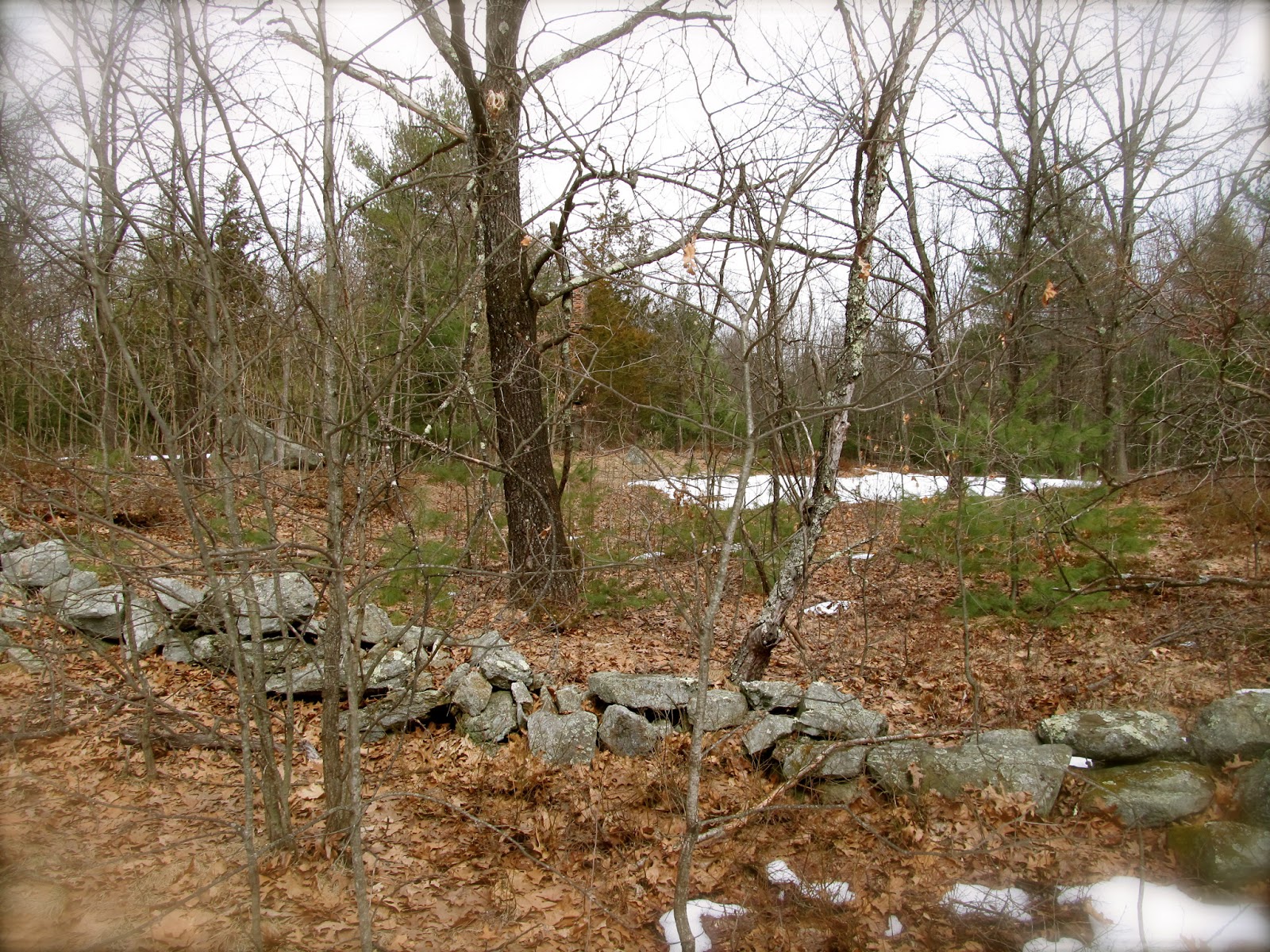
The forest encompasses 500 acres, and includes old stone walls, the remains of a farmhouse, and lots of interesting rocks. I don't believe there is anything left of the Indian village. Despite it's tragic history the landscape is beautiful and peaceful.

Over at his blog, the author John Hanson Mitchell describes Sarah Doublet before her conversion:

She fixed pendants of swan's down or shells in her pierced ears, placed a bird wing headdress in her hair, and strung herself with shell necklaces and ropes of wampum, and perhaps --- all this is conjecture --- an amulet at her breast, a winged thunderbird, or the carved image of A'pcinic, the horned water monster who lived in the depths of the pond below her village.

A'pcinic the lake monster would have lived in Lake Nagog, which is adjacent to Sarah Doublet forest. Perhaps he still does. A'pcinic, who had a beak and horns, supposedly dragged his tentacled arms along the shoreline when hungry to find his next meal. Happily, I'm unable to confirm his existence through personal experience.


You can find more information about Sarah Doublet and Nashoba in John Hanson Mitchell's book Trespassing and at his blog. Daniel Boudillion also has lots of interesting facts about Nashoba and Littleton over at his excellent website.