Showing posts with label Brookline. Show all posts

April 01, 2025

Brookline's Haunted Schoolhouse: Stalked by an Angry Ghost

A few weeks ago, Tony and I paid a visit to Larz Anderson Park in Brookline, Massachusetts. Although it's a popular place for dog walkers, and well-known for its Auto Museum, we went there for a different reason. We wanted to see a schoolhouse that was once haunted by a vengeful ghost.

Built in 1768, the schoolhouse in question is a charming, one-room building known as the Putterham School, and originally stood at the intersection of Grove Street and Newton Street. In addition to being a school, the building may also have served as a synagogue and a Catholic church after World War II. It was moved to Larz Anderson Park in 1966, where it now serves as a museum. 

I love a historic building, but I love a historic building with a ghost story even more. According to Ken Liss, president of the Brookline Historical Society, the Putterham School was allegedly haunted for seven years by an angry ghost. Well, at least according to a local legend, that is.  

Here's how the school supposedly became haunted. Sometime after the Revolutionary War, a young man named Samuel Frothingham fell in love with the Putterham School's teacher. Unfortunately for him, she loved another man, and rejected Samuel's advances. 

Samuel did not accept rejection lightly. He became so distraught that he stopped eating, growing ever more emaciated. He eventually starved to death, but not before he wrote a message on the chalkboard, "berating the teacher for her betrayal and saying the note would appear every year until she died"(Brookline Tab, October 25, 2018, "Spooky Brookline: ghost stories").

True to his word, the angry message appeared on the blackboard every year for seven years, until the teacher eventually died. I don't think her death was connected to being haunted, but I'm sure the ghostly messages didn't help her mental health. As far as I know, Samuel Frothingham's ghost never haunted the schoolhouse after her death. 

To use a modern term, Samuel Frothingham seems a little bit like a stalker, doesn't he? The schoolteacher wanted another man, but rather than move on, Samuel starved himself to death and then sent her nasty messages from beyond the grave. This doesn't seem like a very mature reaction. Even though she was haunted for seven years, I think the teacher made the right choice. If Samuel was that creepy while dead, think how bad he would have been while alive?

August 03, 2021

Bottomless Ponds of New England: Monsters, Witches, and Dead Horses

I read a lot of books about local legends and folklore, and have discovered some weird things. I recently learned there are several bottomless lakes and ponds here in New England. Yes, you read that correctly. There are several bodies of water here that are immeasurably deep. And some have monsters in them...

One of these bottomless bodies of water is Hall's Pond in Brookline. Hall's Pond is located just off Beacon Street, one of the Boston area's busiest thoroughfares, and you can even take the Green Line trolley to it. Very convenient!

The pond is now part of Amory Park, and there is a nice boardwalk that leads you around it. The last time I visited it was teeming with fish, turtles, and birds. Hall's Pond used to be much larger and swampier, and is actually the remains of an ancient cedar swamp. The soil is quite peaty, and creates an oily sheen on the water. 

Hall's Pond in Brookline

The January 28, 1902 proceedings of the Brookline Historical Society, include the following information about the development of Amory Park:

The town's purchase was about eight acres, which includes a part of Hall's Pond, the dreaded hole and terror of youngsters, which was believed to be bottomless.

The 1954 - 1955 proceedings of the Society include the following reminiscence from one Mrs. Luquer:

The story goes that, in my childhood, one dark night, a man with his horse and buggy went down what he thought was Essex Street straight down to Beacon Street right down into Hall's Pond where there was quicksand and he was never seen again. I remember I often skated on the Pond and always wondered whether I was over the horse and buggy.

It's a grim story, but not as terrifying as the stories told about Dublin Lake in Dublin, New Hampshire. According to a July 26, 2017 issue of the Monadnock Ledger-Transcript, in the early 20th century people thought the lake was bottomless. More contemporary legends say it is the home of hideous monsters who live in underwater caves:

Lore surrounding the lake monster dates back to the 1980s, when a free-diver allegedly went missing after a routine dive. The diver was found a number of days later, naked and incoherently babbling about monsters. 

Another version of the story states a diver was using a diving bell when exploring the lake’s bottom, but the tether was not long enough as he descended. 

After heading down deeper to find the caverns, the diver disappeared. A group of hikers found the diver in the woods naked days later, with the diver once again was babbling about monsters. ("The search for the Dublin Lake Monster," Monadnock Ledger-Transcript, July 26, 2017)

I think the whole "naked diver babbling insanely about monsters" is pretty creepy. Perhaps those monsters are from another planet, because another legend claims there is a spaceship or UFO at the bottom of the lake. 

Dinglehole, a small pond in Millis, Massachusetts, is also believed to be bottomless. Much like Hall's Pond, Dinglehole was once larger and swampier. In the 18th and 19th century, legends said it was haunted by a headless ghost who misled travelers. People also heard the ringing of a mysterious bell near the pond, giving it the name Dinglehole. (The bell went "dingle dingle dingle.")

Hall's Pond in Brookline

A headless ghost and mysterious bell are bad enough, but the the Devil and his witches would gather near Dinglehole to celebrate the Witches Sabbath. The witches arrived in the shape of weasels, raccoons, and other small woodland animals. 

One evening, a local hunter was walking home when he noticed a large raccoon watching him from a tree. Unable to resist such an easy target, the hunter shot the raccoon and hit it squarely in the chest. Nothing happened to the raccoon. It sat there unharmed. Did the hunter notice a slight smirk on its face? He fired several more shots, each time hitting the raccoon, which continued to ignore the bullets.

Finally, it dawned on the hunter that this was no ordinary animal. He plucked a branch from a nearby witch hazel shrub, a plant known for its magical powers, and fired it from his rifle like a small harpoon. It hit the raccoon in the face. The animal then vanished. Several days later, the hunter learned that Murky Mullen, a local woman suspected of witchcraft, had an unexplained injury on her face. Clearly, she (or her spirit) had been wandering the woods in the shape of a raccoon. (That story appears in Ephraim Orcutt Jameson and George James La Croix's 1886 book The History of Medway, Mass. 1713-1885.)

Hall's Pond, Dublin Lake and Dinglehole are just three bottomless bodies of water I learned about while researching other things. I assume there are probably others out there in New England. Of course, modern science says a bottomless pond or lake is an impossibility. After all, the center of our planet is hot and molten. If a lake reached all the way down to Earth's molten core it would probably be some kind of volcano, not a nice body of water you can swim in or skate on. 

I suspect the idea of a bottomless lake reflects an older view of the world, one in which the universe was filled with water. We now know that our planet is a sphere floating in the void of outer space. Many earlier civilizations believed the world was a flat disc that floated in an infinite abyss of water. For example, in the Babylonian creation myth, the only two beings that exist at the beginning of time are Apsu, the primal god of fresh water, and Tiamat, the dragon goddess of the sea. There is no land. It only appears after Apsu and Tiamat are slain and the god Marduk divides the waters using Tiamat's corpse. 

A similar situation is seen in the Biblical Book of Genesis, where God separates the waters from the waters during the creation of the world. There is water above the world, and water below the world.

And God said, Let there be a firmament in the midst of the waters, and let it divide the waters from the waters.

And God made the firmament, and divided the waters which were under the firmament from the waters which were above the firmament: and it was so.

So in a traditional Biblical view, the world looks something like this:

The Earth is surrounded by water, both above and below. This is alluded to in the Flood story, where not only are the "windows of heaven" opened to make it rain, but "all the fountains of the great deep broken up" as well. God is letting all the primal waters back in, returning the world to its primal state of chaos. 

I think local legends about bottomless bodies of water might reflect this older cosmology, even if accidentally. The ponds and lakes in these stories are not only immeasurably deep, but they are also associated with terrifying things. Dead men and dead horses, lost in the middle of the night. Monsters so hideous they cause insanity. Witches, ghosts, and even the Devil himself. The forces of chaos are lurking just below the surface, ready to drag the unwary down into the fathomless waters. These things are probably just lurking in our subconscious, not in the water, but I'd still be careful. You don't want to wander too far from shore and get in over your head. Who knows what you might find there?

*****

I wanted to give you an update on my new book, Witches and Warlocks of Massachusetts. I got my author's copies the other day, and they look great. I'm really excited for people to read this one. 


It's currently available for pre-order on Bookshop.org, Barnes and Noble, Books-A-Million, Amazon, and most other places you buy books. It will be available on September 1, just in time for the fall and spooky season. 

April 29, 2021

Old New England Cemetery Lore: Watch Your Step

This past Saturday was warm and sunny, and although I'm always happy to stay home with a pile of obscure books I decided to go for a walk. I went to one of my favorite places, Brookline's Old Burying Ground. 

It's a really charming cemetery, well-cared for with just the right amount of decay. Although it's only a few miles from downtown Boston it feels like a rural environment. A few notable folks are buried there, including Zabdiel Boylston, a local physician who inoculated people against smallpox in 1721. It was the first inoculation campaign in North America, and Boylston got the idea from Onesimus, a slave in the household of Cotton Mather, the (in)famous minister associated with the Salem witch trials.


Cotton Mather's stepmother, Anna Mather, is also buried in Old Burying Ground. Her husband Increase Mather (also associated with the Salem trials) is buried at Copp's Hill in Boston, but she outlived him by several years and was buried in Brookline in 1737. Her grave is marked by a beautiful and well-preserved stone. 

As I wandered through Old Burying Ground I thought about some old New England cemetery folklore I've been reading recently. Some of it is probably familiar. For example, if you feel a cold chill for no reason it's probably because someone has walked over the site of your future grave. I think that one is well-known. 


A related piece of lore says that you should never step on anyone's grave when you're in a cemetery. That makes sense to me. If the living get a chill from someone just walking over their future grave, think how annoyed the dead must be when you step on their actual grave. Unfortunately, sometimes this advice is hard to follow, particularly in old cemeteries. The graves are placed really closely together at Brookline's Old Burying Ground, and it is hard not to step on one. There are also lots of unmarked graves, so you're probably unintentionally walking on someone. I think the intent behind this piece of lore is what's really important: treat the dead with respect. 

Many years ago when I was a kid I went for a bike ride with my friend Bobby in a neighborhood cemetery. We were riding pretty fast and goofing around, and I started to worry that we weren't being respectful. I said, perhaps half-jokingly, that we shouldn't be too loud or we'd disturb the dead. 

Bobby laughed and said, "I'm not afraid of any dead people!"

As soon as he said that he skidded, fell off his bike, and scraped his knee up really badly. His pants were torn and there was a lot of blood. We both left the cemetery immediately and went home. We kind of laughed but were also a bit spooked. Perhaps it was just a coincidence, but I've never forgotten it. 


Speaking of forgetting, according to another piece of old lore you shouldn't spend too much time reading gravestone inscriptions. This is bad news for me, since I really like to read old inscriptions. I'm not sure what constitutes too much time and hopefully I am under the limit. I can understand the sentiment, though, because when I read too many gravestones I do feel a little lightheaded from all the dates and names. It's like when I spend too much time on Instagram!

One final piece of advice: you shouldn't walk through a cemetery on your way to see friends. You run the risk of carrying death to their house if you do. Happily, I just went back home after visiting Old Burying Ground. It was a pleasant way to spend a sunny afternoon. 


I got this cemetery lore from Clifton Johnson's What They Say in New England (1896) and Fanny Bergen's Current Superstitions (1896).

July 09, 2020

The Clown Scare of 1981 That Terrified Boston

With the COVID-19 pandemic I haven't been taking any long road trips to visit strange places. I've been exploring closer to home, though, and luckily there are some weird places very close by. That's one of the nice things about New England. There are spooky stories all over the place. 

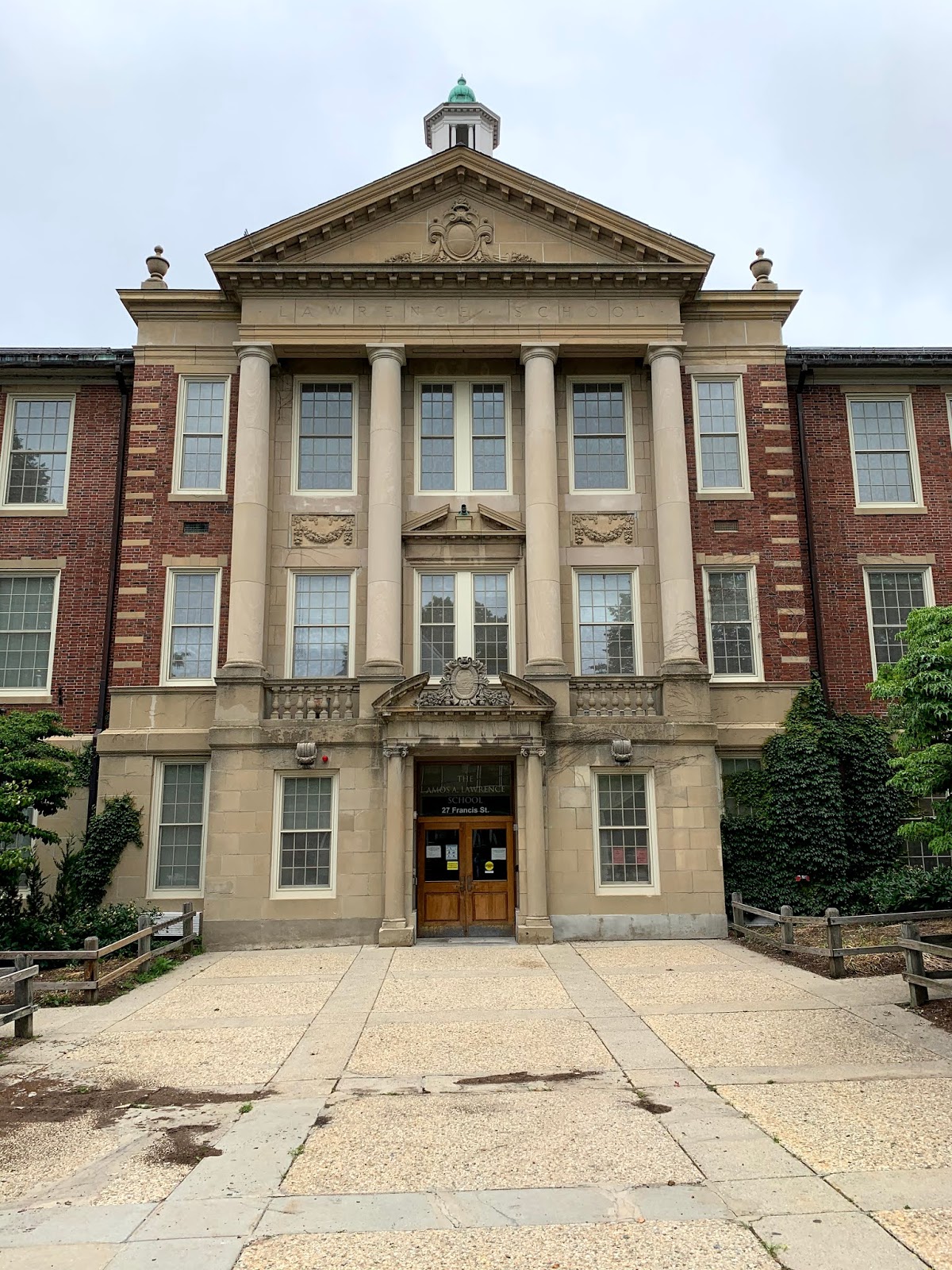
Recently I took a short trip to the Lawrence School in Brookline, Massachusetts. Built in the early 20th century, the Lawrence School is part of Brookline's public school system. It's a very stately looking building, but in May of 1981 some students at the school reporting something very unusual: creepy clowns. 

Actor Lon Chaney as a clown in He Who Gets Slapped (1924)

On Tuesday, May 5, 1981 the Brookline Police received a report that two men dressed as clowns had approached children on Longwood Avenue near the Lawrence School. The men were driving a van and tried to entice the children into the van by offering them candy. According to The Boston Globe


The vehicle was describe as an older model black van with ladders on the side, a broken front headlight and no hubcaps.  
Brookline Police called the town's school department and told administrators to be "extra cautious." 
School Superintendent Robert I. Sperber instructed all ten elementary schools to warn pupils. (The Boston Globe, May 7, 1981, p. 21, "Beware 'clown' pupils told")

This was not an isolated incident, but was instead just one of several creepy clown sightings across greater Boston that spring. Officials in Boston's school system were told the last week of April to warn elementary and middle school pupils about sinister clowns. The memo was sent on May 6:


"It has been brought to the attention of the police department and the district office that adults dressed as clowns have been bothering children to and from school," the memo said.  
"Please advise all students," it continued, "that they must stay away from strangers, especially ones dressed as clowns." (The Boston Globe, May 7, 1981, p. 21, "Beware 'clown' pupils told")

Yes, especially ones dressed as clowns. Boston Police even issued a citywide bulletin for a clown who had been seen in a black van near Franklin Park in Roxbury and the Curley School in Jamaica Plain. He was reportedly naked from the waist down and was wanted for questioning. 

Just a few days later, though, the clown scare had died down in Boston. On May 9, The Globe reported that a clown driving a pickup was stopped by police in Randolph, but was released when they realized he was delivering a "clown-a-gram" to a department store in Canton. No other clowns were arrested because no other clowns, particularly creepy ones, could be found. There was nothing behind all the reports the police had received. 


... police officers in Boston, Cambridge, Brookline, Randolph and Canton all said yesterday that their departments had received no calls from adults who claimed to have seen clowns doing anything questionable.  
The police said virtually all reported sightings of clowns originated with children aged 5 to 7. Police could offer no evidence of any child being harassed, molested, injured or kidnapped in the metropolitan area by a person in a clown's get-up. 
No adult (civilian) or police officer has even seen a clown. We've had calls saying there was a clown at a certain intersection and happened to have (police) cars sitting there, and the officers saw nothing. When the officers get there, no one tells them anything. I don't know if someone's got a hoax going or not, but it's really foolhardy." (The Boston Globe, May 9, 1981, p. 15, "Police discount reports of clowns bothering kids")

A May 13 article in The Globe told parents how to talk with their children about 'stranger danger,' noting that 27 children had been murdered in Atlanta. The clown scare may have been a hoax, but the world could indeed be dangerous for young children. 

The Lawrence School in Brookline
That seems to be the end of the 1981 creepy clown scare in Boston, but the phenomenon popped up in other parts of the country later that spring. Author Loren Coleman notes in Mysterious America (2007) that children in Providence, Rhode Island reported scary clowns soon after the Boston clown scare, and by late May children in Kansas and Missouri were reporting the same thing. Children were seeing the clowns in Pennsylvania by June. Once again, Massachusetts was the cradle of innovation, since we brought America its first scary clown panic. I don't think tour guides on the Freedom Trail will be bragging about this one too much.

Coleman thinks that the media helped to spread the panic. Parents read about the clowns in the newspapers or saw it on TV and mentioned them to their children. The children then reported seeing the clowns, which got reported to the media. More parents read about the clowns and told their kids. And so it went. Luckily, unlike the Satanic panic that came a few years later, no innocent people were arrested.

The creepy clown phenomena first appeared in 1981, but has happened several times since then. Many of you might remember the big, nationwide clown scare in 2016. Although no one really knows why America was receptive to the idea of creepy clowns back in 1981, Coleman notes that creepy clowns (or phantom clowns, as he calls them) tend to show up in election years. That was certainly the case in 2016, and I feel like those clowns were just foreshadowing the scary circus we're living through now. Will clowns show up to scare us in time for this year's election? I hope not. We all have enough to worry about already. 

October 28, 2018

Halloween Treats: A Big Cat, Monsters in Leominster, and More Ghost Chronicles

It's hard to believe Halloween is only three days away. Here are a few treats to get you through the next few days that I've found in the media. 

ANOTHER BIG FELINE IN BROOKLINE

A few weeks ago I posted about an alleged mountain lion sighting in an urban section of Brookline, Massachusetts. I didn't really know what to make of it, but now I wonder if there really is some large cat roaming around town. On October 5, someone called the Brookline Police to report a bobcat on Shaw Road. Here is the item from the October 11 issue of The Brookline Tab:

Bobcat on Shaw Road: At 10:51 a.m., a caller reported seeing a bobcat cross the road and said the animal was "much, much larger than a domestic animal." The caller thought the area should be checked. 

Shaw Road is several miles from the location of the first sighting, and is also in an area with more open space (cemeteries, parks, and woods). While the first sighting happened at night, this second sighting happened in broad daylight. Bobcats can live in suburban areas so maybe one is indeed living in Brookline?


MONSTERS AND ALIENS IN LEOMINSTER

The Boston Herald ran an article about paranormal activity in Leominster, Massachusetts. The October 21 article titled "Talk of UFOs, ghosts turns Massachusetts City into 'Leomonster'" focuses mainly on Leominster resident Ronny LeBlanc who in 2016 wrote a book about his hometown called Monsterland. LeBlanc collected hundreds of stories for his book, so it sounds like something I should add to my holiday wish list. Here is an interesting quote from the Herald piece:

LeBlanc took the Herald to all the hot spots around Leominster, like St. Leo’s cemetery on Lancaster Street where in the 1960s, a couple witnessed a flying saucer emerge from fog, prompting them to call the police. The man who saw the saucer claimed his hand and body was frozen upon pointing to the saucer, only to be released when it flew away. 
Leominster State Forest, another spot mentioned in LeBlanc’s book, has yielded several reports of Bigfoot prints and Sasquatch sightings. 
LeBlanc said he isn’t completely sure why these encounters continue to happen in Leominster, but “it might be something that we don’t want to know.”

Another Leominster resident, Susan Spuhler, had this to say: “There are certain energetic lines that run around the earth. And Leominster, from what I’ve studied over time, has a certain energetic quality to it,” she said. 

Photo from Boston Herald. 
I applaud anyone who investigates the strange stories and folklore of their hometowns. Books like Monsterland are valuable records of what people in 21st century New England believe about the places they live. They are also good to read on dark autumn nights!

MORE GHOST CHRONICLES

Speaking of spooky books, Weiser Books kindly sent me a copy of Maureen Wood and Ron Kolek's book More Ghost Chronicles to review. Wood and Kolek are paranormal investigators who host a popular radio show called Ghost Chronicles, and their book highlights fifteen recent investigations. 

Twelve of them take place across New England. Wood and Kolek visit old lighthouses, haunted restaurants, charming inns (built next to creepy old cemeteries), and even a few places I've visited like Dudley Road and the Freetown State Forest. 


My trip to Dudley Road was relatively uneventful, but theirs is a little more lively. For example, here is an excerpt where Kolek and Wood try to communicate with the spirits of Dudley Road using a pendulum on a dark night. They are trying to figure out how many ghosts haunt the road.

The pendulum responded quickly, while Maureen continued her questioning. "Are there more than one, more than three? Are there more than five?" 
Once again, the answer was a yes.  
I asked, "Do they know the rumors about the haunting of Dudley Road?" 
Maureen nodded. "Yes. Yes, they do." 
I continued. "Do they play games with the people who come to look for them?" 
The pendulum swung back and forth. She laughed out loud. "Sometimes." (More Ghost Chronicles, p. 30)

Watch out for self-aware ghosts, I guess. Although my trip to Dudley Road was peaceful, I did find the Freetown State Forest to be kind of unnerving when I visited although I can't pinpoint why. Was it the sounds of gunfire from a nearby firing range? The group of drugged-out teenagers we encountered on a secluded path? The sound of dead trees creaking in the wind? All of these?

Or perhaps it was really the puckwudgies, small malevolent fairies who are said to live in the forest. Wood and Kolek have an even more unnerving visit than I did, with Wood becoming briefly and frighteningly possessed by the spirit of a puckwudgie. This is why I only go to these places during the day!

So, if you like good old-fashioned ghost investigations with creaking doors, rosaries that shatter, and misty figures advancing through the dark woods I think you will like More Ghost Chronicles. And at this time of year, who doesn't like those things?

Happy Halloween everyone!

August 28, 2018

A Mountain Lion in Brookline Massachusetts?

If you ever want to read strange things you should look through your town's police blotter. Many unusual occurrences happen every day and most people don't even notice - except for the police. For example, here are a few interesting things reported in the August 16, 2018 edition of The Brookline Tab, the local newspaper for Brookline, Massachusetts.
"Tuesday, Aug. 7 - Suspicious person on Harvard Street: At 7:28 p.m. a caller reported that a man wearing mask, aviator glasses, a skull head necklace and an American flag pin was harassing the caller's girlfriend.  
Wednesday, Aug. 8 - Assault and Battery on Beacon Street: At 5:31 a.m. a caller reported that at midnight  his roommate threw a jar of mayonnaise at the back of his head."
Those aren't the worst of it. Next to the list of police incidents is an article titled "Police: Man wearing nightgown and garter gropes woman." It describes how a "stocky man in his 20s wearing a black dress or nightgown with a lace garter belt" grabbed and groped a woman at the intersection of Washington Street and Salisbury Road early on the morning of August 6. Yikes!


Perhaps the summer heat is driving people to commit weird crimes. But I'm not sure what to make of this report:
"Wednesday, Aug. 8... Strange looking animal on Addington Road: At 10:01 p.m. a caller reported a strange looking animal walking back and forth in the area. The caller thought it might be a mountain lion as it was too big for a fox or coyote."
Brookline has a lot of wildlife (rabbits, geese, turkeys, coyotes) but as far as I know there aren't any large carnivorous cats roaming around. And to make things stranger, Addington Road is in the densely settled Aspinwall Hill area. It's only a few blocks away from the Green Line. It is definitely not a rural area. Could there really be a mountain lion in Brookline?

There are a few possible answers:

1. The caller was mistaken.
If you're a natural skeptic you'll find this the most appealing explanation. Ordinary things often look very different in the dark, and the caller probably really saw some other animal (a dog or coyote). Maybe they just saw a raccoon or skunk which looked bigger in the dark, or misperceived the shadows thrown by leaves and streetlights. 


Addington Road in Brookline
Humans have an innate tendency to see living beings in inanimate phenomena. For example, have you ever seen a stick in the grass and thought it was a snake? This psychological trait is called pareidolia and it seems to be an evolutionary survival from a time when humans always had to be on the lookout for predators. It's safer to think something is a mountain lion rather than assume it is just a shadow. You wouldn't want to blunder into a large hungry cougar!


2. It really was a mountain lion. 
Mountain lions were once common in New England but were exterminated by the European settlers. There are still mountain lions in the western parts of the country and in Florida, but none around here. Despite this New Englanders report seeing mountain lions to the present day. For example, in 2014 citizens of Winchester, Massachusetts reported seeing a large feline creature in town, as did people in Rhode Island, while in the 1980s a mountain lion reportedly terrorized parts of Cape Cod. There's even a bulletin board for New England mountain lion sightings.


However, local wildlife authorities claim there are no mountain lions in New England. Well, to clarify, they say there is "no evidence of a reproducing mountain lion population." To quote this official Commonwealth of Massachusetts site:
Mountain Lions became scarce in the East after a bounty system wiped out most predatory animals. Today, Mountain Lions are found in the mountainous regions of the West. There is also a small population in southern Florida. 
Despite this fact, Massachusetts residents continue to report Mountain Lion sightings. It is difficult to know if someone saw a Mountain Lion without any tangible evidence. 
Nowadays, many reports include photographic evidence, thanks to camera phones and trail cameras. There have been only two cases where evidence supports the presence of a Mountain Lion in Massachusetts. All other reports of Mountain Lions in Massachusetts have turned out to be other animals.
In April 199, a hunter found unusual animal scat near the Quabbin Reservoir; lab tests confirmed it came from a mountain lion. In March 2011, a forester photographed animal tracks in the snow near the Quabbin, which were again confirmed to be from a mountain lion. Those are the only two cases of authenticated mountain lion evidence in modern Massachusetts.


Totally excited for monster-hunting - just as long as I never find one!
However, in June 2011, a male mountain lion was struck by an SUV and killed in Milford, Connecticut. DNA testing showed that the animal had traveled all the way from South Dakota to Connecticut, a distance of 1,800 miles. Most mountain lions don't roam that far. Still, I suppose there is a very, very slim chance that a mountain lion made its way from a western state to New England and came into Brookline. 

3. Manitous, witches, phantom animals.
Maybe it was really a mountain lion. Or maybe the caller was totally wrong and mistook something ordinary for a large predator. It was either real or it was not. The answer is either yes or no, right?

I think there is a third possibility, though, somewhere in that weird realm where myth, folklore and psychology collide. People in New England have been seeing unusual (dare I say unnatural?) animals for centuries. For example, the Algonquins believed the forests were haunted by a black fox. The fox was often glimpsed by could never be captured or killed, even by the most skilled hunter. It was a manitou, or spirit-being. 


The Puritans saw equally strange creatures. Puritans didn't believe in manitous, so they associated these strange animals with witches and the Devil. Witches and their familiar spirits were said to assume the shapes of cats, pigs, birds and strange bestial hybrids. For example, on February 27, 1692 Elizabeth Hubbard was walking home from her uncle's house in Salem Village when she realized a large animal was stalking her. She thought it might be a wolf, although wolves were rare even in the 1690s. There was something unnatural about the creature and although it didn't harm her she thought it might be a witch in animal form.

On April 19 of that year, Abigail Hobbs mentioned unusual animals in her testimony before the Court of Oyer and Terminer:
"I will speak the truth," she said. "I have seen sights and been scared. I have been very wicked. I shall be better, if God will help me." 
"What sights did you see?" asked Hathorne.  
"I have seen dogs and many creatures." 
"What dogs do you mean? Ordinary dogs?" 
"I mean the Devil." 
(quoted in Marilynne Roach, The Salem Witch Trials. A Day-By-Day Chronicle of A Community Under Siege, 2002)
Even in our modern, post-Puritan world people continue to see animals. Cryptozoologists and paranormal researchers often call them phantoms since they leave little evidence behind. For example, in 1976 a large black dog terrorized the town of Abington near Massachusetts's infamous Hockomock Swamp. A police officer shot at the beast after it killed two ponies but it ignored the bullets and walked off into the swamp. 


I didn't see a mountain lion, but there were a lot of wild turkeys down this path. I turned back!
Perhaps more relevant to the Brookline sighting, phantom animals of the feline variety have also terrorized towns near the Hockomock Swamp:
In 1972, in Rehoboth, Mass., a "lion hunt" was organized by local police. Residents of the area had been terrorized by what they said was a large cat or mountain lion. Cattle and sheep n the area had been mysteriously killed and carcasses were discovered raked with claw marks. Police took casts of the animal's tracks and used dog and helicopter in an attempt to track it down. Nothing was caught. But similar incidents involving phantom cats have occurred in other places throughout the Bridgewater Triangle and across the nation. None of these mysterious felines has yet been captured. (Loren Coleman, Mysterious America, 2007)
Spirits, witches, phantom cats - I don't know what these strange animals are, but New Englanders have seen them for a long, long time. I think they'll continue to see them in the future. Perhaps the caller who reported seeing the mountain lion on Addington Street was just part of this long tradition. Weird things happen in New England all the time, even close to the MBTA.


Animal graffito in Brookline

June 18, 2018

Brookline's Old Burying Ground: Slaves, Smallpox, and Witch Trials

The other day I visited the Old Burying Ground in Brookline, Massachusetts. Brookline is a very well-maintained, genteel town right next to Boston, but I was pleasantly surprised to find that the Old Burying Ground is a little scruffy. When I was inside its gates I felt like I was transported to the past even though I was really only a few blocks from an MBTA stop. Goodbye home-brewing store and arthouse movie theater, hello crumbling gravestones and ancient oak trees!


Brookline was originally settled in the early 1600s as a hamlet of Boston called Muddy River (after the body of water that runs through it). By 1705 it became a separate town and took its current name (after two brooks that separated it from Boston). So in other words, Brookline is old, and although it is now a tasteful liberal suburb it does have some strange and unsavory things lurking in its past. The good old days weren't always that good...


For example, a sign inside the Old Burying Ground notes that eleven slaves are buried somewhere in the cemetery. Slavery was abolished in Massachusetts in 1782. I didn't see any indicators denoting where the slaves were buried. It's possible their graves are mixed in with the other graves, or perhaps were not even marked. That same sign that mentions the slaves also notes that many burials had been disturbed over the years as the cemetery became more and more crowded, so perhaps the actual locations of the slave burials have long since been lost. 


Edward Devotion's grave
I did find the grave of Edward Devotion, whose name has recently been connected with slavery in the local media. Devotion was an important person in the founding of Brookline and donated money and land upon his death for a town school. When the school was finally built (more than a century after his death) it was named the Edward Devotion School. The public school stands near Coolidge Corner and was attended by John F. Kennedy when he was a child.

This sound like an inspiring story of philanthropy, but people recently learned that Edward Devotion was a slave owner. An inventory of Devotion's estate upon his death included "one Negrow." So perhaps he isn't the best person to name a school after? On May 28, the Brookline town meeting voted to remove Devotion's name from the school. The school will be called the Coolidge Corner School until a new name is voted on. 


Anna Mather's grave
Near Devotion's gravestone I found the grave of Anna Mather, who died in 1734 at the age of 74. The name Mather may sound familiar if you've read anything about the Salem witch trials. Anna Mather was the second wife of Increase Mather, one of Boston's most prominent Boston Puritan ministers (and also a  president of Harvard University). When the Salem witch trials broke out the governor of Massachusetts turned to Increase for his opinion. He urged the magistrates to proceed with caution, but did not denounce the use of "spectral evidence" until much later in the trials. Spectral evidence were the dreams, visions and possible hallucinations that the magistrates used as evidence to convict defendants of witchcraft, even though no one could verify any of them. I think you can see why this might be problematic.

Increase Mather eventually did denounce spectral evidence, writing "It were better that Ten Suspected Witches should escape, than that one Innocent Person should be Condemned." He never denounced the trials themselves though, possibly because many of his friends and peers served as magistrates during them. After the trials ended his reputation was permanently damaged. He married Anna Mather in 1715, many years after the trials concluded.


Increase Mather's son Cotton Mather was also a prominent minister who was involved with the Salem witch trials. His 1689 account of several possessed Boston children, Memorable Providences Relating to Witchcrafts and Possessions, is believed to have set a precedent for the Salem trials that began three years later. Cotton was a strong supporter of the trials, and even wrote to Chief Justice William Stoughton to congratulate him on executing eleven people for witchcraft. Cotton is also infamous for urging the magistrates to execute Reverend George Burroughs for witchcraft even after Burroughs successfully said the Lord's Prayer, which it was believed a witch could not recite. Cotton's reputation suffered even more than his father's after the trials ended. 

However, he did a few good things, and one of them was to promote inoculation. Smallpox was greatly feared in early Boston and two epidemics swept through the city's crowded and unsanitary streets in 1690 and 1702. In 1721 another epidemic broke out. Inoculation was known in parts of the Old World, and Mather had learned about it from his slave Onesimus. Mather urged Boston physician Zabdiel Boylston to try inoculating Bostonians against smallpox. Boylston agreed, and of the 287 people he inoculated only six died. More than 800 people who were not inoculated died in that epidemic. 


The grave of Joshua Woodward
The grave of Mary Russell
Unfortunately inoculation did not become a widespread practice until many years later, and I found graves of two smallpox victims in Brookline's Old Burying Ground. One is for Joshua Woodward, who died from smallpox in 1776 at the age of 46. That is quite young, but not as young as poor Mary Russell, "the virtuous and amiable daughter of Capt. John and Mrs. Miriam Russell" who died from the disease in 1792 at the age of 14 "to the inexpressible grief of her friends."


I like reading about the past, and really love visiting old graveyards. But I am quite happy to live in the present. Our country does face some significant problems these days, but happily we don't have slavery, witch trials, or smallpox epidemics. Let's keep those things buried in the past.