Showing posts with label burial. Show all posts

September 23, 2021

The Barren Circle: A Maine Witch's Cursed Grave

As this blog's readers know, I love stories about witches. I also love cemeteries. So I really, really love this story from Bowdoin, Maine since it involves a cemetery and a witch.

First, a little clarification. Bowdoin, Maine is a small town in Sagadahoc County, Maine, and is pronounced "bow-din." It shouldn't be confused with well-known Bowdoin College (also pronounced "bow-din"), which is nearby in Brunswick, Maine. Both are named after the Bowdoin family, who played important roles in Maine's 18th century history, but they are not the same place. 

Bowdoin, Maine looks like a charming small town, but small towns often hide terrifying secrets, as every Stephen King fan knows. According to a local legend, Bowdoin's terrifying secret is inside North Cemetery on Litchfield Road. Here, a circle of cedar trees grows around a barren patch of earth at the back of the cemetery. This, people say, marks the grave of a witch.

Or, perhaps more likely the grave of an innocent person labeled a witch. Many years ago, a woman named Elizabeth was accused by her Bowdoin neighbors of witchcraft. An angry mob dragged her into the cemetery and hanged her from a tree. After she was dead, they cut her down and buried her. Since that time, the trees have grown up in a circle around her grave, but nothing grows on the grave itself. The earth remains barren.

This barren circle is said to be cursed. Anyone who steps on the ground there will meet a grim death. According to one story, one night three teenage boys dared each other to step onto Elizabeth's grave. They all took the dare, and all soon regretted it. The three of them died soon afterwards, each succumbing to a gruesome fate. 

Image of the barren circle by Dori Upham on Find A Grave

Some accounts say Elizabeth was hanged in the 1800s, which makes me suspect the story is probably purely legend. The Salem trials were the last time anyone was executed for witchcraft in New England, and they ended in 1692. I suppose Elizabeth could have been murdered by a mob, but other details of the story (like Elizabeth's lack of a last name) make me think it's just a legend. 

Of course, saying it is "just" a legend sounds dismissive, which I don't intend. Legends and myths have power, whether or not they're based on fact. If I visited North Cemetery I wouldn't step onto that barren circle, would you? I'm skeptical when I'm sitting here at home, but put me in a lonely cemetery and I get a lot more superstitious. Why take the risk? That's the power a legend has. 

Photos on this site show that people have left coins and flowers on the barren circle. Are they literal offerings to Elizabeth's restless spirit, or do people just feel compelled to leave an acknowledgment of the legend? 

I first learned about this legend from the Jumping Frenchmen podcast. I've never been to Bowdoin, Maine but would like to visit someday. In the meantime, I did enjoy this video from the Maine Ghost Hunters that documents their visit to Elizabeth's grave. A misty day, a country road, an old cemetery - very evocative!


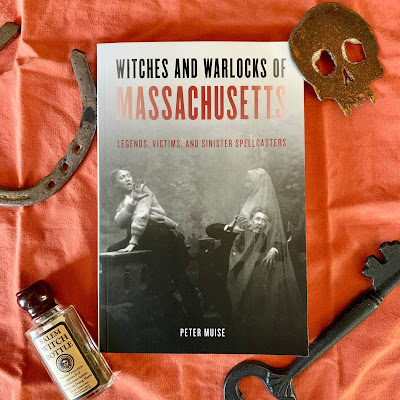
If you like witch stories, please consider buying my new book, Witches and Warlocks of Massachusetts, which just came out this month. It's available wherever you buy books. Lots of spooky stories and accounts of historical witchcraft!


June 18, 2018

Brookline's Old Burying Ground: Slaves, Smallpox, and Witch Trials

The other day I visited the Old Burying Ground in Brookline, Massachusetts. Brookline is a very well-maintained, genteel town right next to Boston, but I was pleasantly surprised to find that the Old Burying Ground is a little scruffy. When I was inside its gates I felt like I was transported to the past even though I was really only a few blocks from an MBTA stop. Goodbye home-brewing store and arthouse movie theater, hello crumbling gravestones and ancient oak trees!


Brookline was originally settled in the early 1600s as a hamlet of Boston called Muddy River (after the body of water that runs through it). By 1705 it became a separate town and took its current name (after two brooks that separated it from Boston). So in other words, Brookline is old, and although it is now a tasteful liberal suburb it does have some strange and unsavory things lurking in its past. The good old days weren't always that good...


For example, a sign inside the Old Burying Ground notes that eleven slaves are buried somewhere in the cemetery. Slavery was abolished in Massachusetts in 1782. I didn't see any indicators denoting where the slaves were buried. It's possible their graves are mixed in with the other graves, or perhaps were not even marked. That same sign that mentions the slaves also notes that many burials had been disturbed over the years as the cemetery became more and more crowded, so perhaps the actual locations of the slave burials have long since been lost. 


Edward Devotion's grave
I did find the grave of Edward Devotion, whose name has recently been connected with slavery in the local media. Devotion was an important person in the founding of Brookline and donated money and land upon his death for a town school. When the school was finally built (more than a century after his death) it was named the Edward Devotion School. The public school stands near Coolidge Corner and was attended by John F. Kennedy when he was a child.

This sound like an inspiring story of philanthropy, but people recently learned that Edward Devotion was a slave owner. An inventory of Devotion's estate upon his death included "one Negrow." So perhaps he isn't the best person to name a school after? On May 28, the Brookline town meeting voted to remove Devotion's name from the school. The school will be called the Coolidge Corner School until a new name is voted on. 


Anna Mather's grave
Near Devotion's gravestone I found the grave of Anna Mather, who died in 1734 at the age of 74. The name Mather may sound familiar if you've read anything about the Salem witch trials. Anna Mather was the second wife of Increase Mather, one of Boston's most prominent Boston Puritan ministers (and also a  president of Harvard University). When the Salem witch trials broke out the governor of Massachusetts turned to Increase for his opinion. He urged the magistrates to proceed with caution, but did not denounce the use of "spectral evidence" until much later in the trials. Spectral evidence were the dreams, visions and possible hallucinations that the magistrates used as evidence to convict defendants of witchcraft, even though no one could verify any of them. I think you can see why this might be problematic.

Increase Mather eventually did denounce spectral evidence, writing "It were better that Ten Suspected Witches should escape, than that one Innocent Person should be Condemned." He never denounced the trials themselves though, possibly because many of his friends and peers served as magistrates during them. After the trials ended his reputation was permanently damaged. He married Anna Mather in 1715, many years after the trials concluded.


Increase Mather's son Cotton Mather was also a prominent minister who was involved with the Salem witch trials. His 1689 account of several possessed Boston children, Memorable Providences Relating to Witchcrafts and Possessions, is believed to have set a precedent for the Salem trials that began three years later. Cotton was a strong supporter of the trials, and even wrote to Chief Justice William Stoughton to congratulate him on executing eleven people for witchcraft. Cotton is also infamous for urging the magistrates to execute Reverend George Burroughs for witchcraft even after Burroughs successfully said the Lord's Prayer, which it was believed a witch could not recite. Cotton's reputation suffered even more than his father's after the trials ended. 

However, he did a few good things, and one of them was to promote inoculation. Smallpox was greatly feared in early Boston and two epidemics swept through the city's crowded and unsanitary streets in 1690 and 1702. In 1721 another epidemic broke out. Inoculation was known in parts of the Old World, and Mather had learned about it from his slave Onesimus. Mather urged Boston physician Zabdiel Boylston to try inoculating Bostonians against smallpox. Boylston agreed, and of the 287 people he inoculated only six died. More than 800 people who were not inoculated died in that epidemic. 


The grave of Joshua Woodward
The grave of Mary Russell
Unfortunately inoculation did not become a widespread practice until many years later, and I found graves of two smallpox victims in Brookline's Old Burying Ground. One is for Joshua Woodward, who died from smallpox in 1776 at the age of 46. That is quite young, but not as young as poor Mary Russell, "the virtuous and amiable daughter of Capt. John and Mrs. Miriam Russell" who died from the disease in 1792 at the age of 14 "to the inexpressible grief of her friends."


I like reading about the past, and really love visiting old graveyards. But I am quite happy to live in the present. Our country does face some significant problems these days, but happily we don't have slavery, witch trials, or smallpox epidemics. Let's keep those things buried in the past.

July 05, 2015

Judith Howard's Funeral: A Maine Witch Story


This legend comes from Harpswell, Maine.

Way back in the 1700s, a woman named Judith Howard lived on Sebascodegan, one of the islands that make up the town of Harpswell. Judith made her living as a healer, treating people's wounds and illnesses with various herbal remedies.

This was always a risky trade to practice in the pre-Industrial era. If your cures weren't effective you would lose clients, but if your cures were TOO effective people might think you were a witch. For example, Margaret Jones of Charlestown, Massachusetts was executed as a witch for this very reason in 1648. Talk about being too good at your job!

Judith Howard's cures were very effective, so her neighbors of course muttered that she was in witch. How else could one woman's salves and teas cure so many illnesses? Clearly the Devil must have something to do with it. Luckily Judith lived in the 1700s when people were no longer hanged for witchcraft. She suffered from social ostracization but still lived a long life.

It's often believed that female herbalists were unjustly accused of witchcraft. In many historical cases, like Margaret Jones, that seems to be true. It doesn't quite turn out that way in the legend about Judith Howard.

Most accounts of Judith's life indicate that she was good natured and kind, and didn't demand much from her neighbors. But when she died, all Hell broke loose.

On her deathbed, she had one dying wish. "Please don't bury me next to Old Lambo," she said. Old Lambo was a local Native American buried near Cundy's Harbor. The stories don't say why she didn't want to be buried next to him. Was he a rival healer, a profession many Native Americans followed? Was she a racist? Who knows? Maybe they had an affair that ended poorly. Perhaps he was buried in a pauper's grave or outside of the cemetery walls. The stories just don't say.

After Judith died her neighbors breathed a sigh of relief. They had all benefited from her cures, but they had also been spooked by living so close to someone who was possibly a witch. They put her body in a pine coffin, brought her over to Cundy's Harbor, and buried her right next to Old Lambo.

No one on Harpswell got any sleep that night. Barn doors slammed open and shut all night long. At first some people blamed the wind, but then the doors inside people's homes began slamming open and shut too. Cats ran around in the darkness, howling in agony, and less identifiable but even uncannier noises were also heard.

This went on for several nights, until one morning a group of brave Harpswell citizens went to Cundy's Harbor and dug up Judith's coffin. They carried it two miles across the island and buried her near the main road. Apparently this location was more to her liking, because the hauntings and weird apparitions stopped. Judith and the island had peace.

This is of course a legend, and not a piece of history, and it's not clear if Judith Howard even existed. However, the story does show that people believed witch's powers continued even after they died. (See the story about Hannah Cranna or the witch's grave in York for similar legends). Witches have powerful souls while they live, and their souls continue to exert strange powers even after their bodies die.

This story appears in a few different places, but I found it in Dorothy Simpson's The Maine Islands in Story and Legend (1960).