Showing posts with label graveyard. Show all posts

March 28, 2024

Walnut Cemetery: A Ghost, A Crossroads, and A Poetic Tragedy

I was chatting with someone a while ago, and they asked if I had ever visited Walnut Cemetery in Haverhill, Massachusetts. I was born and raised in Haverhill, but had surprisingly never been to this particular cemetery. After they told me it was haunted, I decided it was finally time to pay a visit. It's an interesting place, and I have lots of thoughts. 


Walnut Cemetery is located in one of the more rural areas of Haverhill. I couldn't find what year the cemetery was started, but it's quite old, with a few gravestones dating back to the 1700s. It's still active today, with newer burials and monuments being added. The newer section is well-maintained, but the older section is a little rough looking. It looks, in fact, like a haunted cemetery. There are a lot of tall weeds. Tree branches have fallen on the graves. Some of the oldest monuments are covered in lichen. We went in the winter, so it may just have been between scheduled maintenance. The older section of the cemetery is also on a rocky hill, so perhaps it is harder to cut the grass there. But whatever the reason, the old part of Walnut Cemetery looks a little spooky. I can understand why someone might think it's haunted. 


The cemetery is said to be haunted by a ghost known as the Woman in White, who roams through it at night. You don't even need to go inside the cemetery to see her - the Woman in White has also been seen by motorists just driving by. Some people say she's terrifying, but others say she is simply eerie and mysterious. As with so many things, I think your mindset might influence what you see. If you go expecting something scary, that's what you'll probably encounter. 

When we visited, I noticed that Walnut Cemetery is located within a triangular crossroads. There's a lot of interesting folklore associated with crossroads, so perhaps it's not surprising there are legends associated with this particular cemetery. The ancient Greeks and Romans believed that crossroads were sacred to Hecate, the goddess of witches, and to Hermes, the divine messenger who guided the dead to the underworld. In England, Scotland and Ireland, people who died by suicide were buried at crossroads, often with stake in their heart. Something similar happened more locally in 1680 in Hampton, New Hampshire, when the citizens of that town buried accused witch Eunice Cole at a crossroads with a stake in her heart. For good measure, they placed a horseshoe on her chest to keep her in her unhallowed grave. And in the American south, legends say that if you want to sell your soul to the Devil, you can find him at a crossroads at midnight. 


Speaking of triangular shapes, paranormal investigator Fiona Broome thinks Walnut Cemetery could be linked to a ley line triangle connecting several weird, legendary places in New England. Ley lines are straight lines that connect important locations on a map, and some people believe these lines conduct mystical energy across the landscape. I can't say if that's true or not, but it's another interesting idea to consider when thinking about Walnut Cemetery. Ghosts plus a  crossroads plus ley lines must all add up to something, right? Well, it may not, but it's still fun to think about. 

Broome and several other ghost hunters investigated Walnut Cemetery back in 2009. They perceived several spirits, including a woman in black, an undefined male spirit, and possibly the restless spirit of a small child. They did not encounter the Woman in White, however. 


Who exactly is the Woman in White? Some people think she is the ghost of Lydia Ayer, the most famous person buried in the cemetery. Ayer was immortalized by the Haverhill poet John Greenleaf Whittier in his 1868 poem "In School-days." In this autobiographical poem, Whittier recalls an incident from his childhood, when he lost a spelling bee to a girl in his class. The girl was Lydia Ayer. Rather than revel in her victory, Ayer instead felt sorry for Whittier.

'I'm sorry that I spelt the word: 

I hate to go above you, 

Because,’ - the brown eyes lower fell, - 

'Because, you see, I love you! ' 


Still memory to a gray-haired man 

That sweet child-face is showing. 

Dear girl! the grasses on her grave 

Have forty years been growing!

He lives to learn, in life's hard school,
How few who pass above him
Lament their triumph and his loss,
Like her, - because they love him.

It's a melancholy poem, and justifiably so, because Ayer died in 1827 when she was just fourteen years old. It's clear that her death made a big impact on Whittier. The poem itself also made a big impact. "In School-days" was one of Whittier's most popular poems, and is often still taught to students today. 

Death is the great equalizer, but Lydia Ayer is the star attraction for living visitors to Walnut Cemetery. A wooden sign points towards her grave, which is marked with a large, handsome memorial that was put up in 1937 by a local civic organization. But is her spirit the Woman in White? 


I'm not sure. Ayer died when she was just a young teenager, and the Woman in White is usually described as a woman, not a young girl. Maybe people only see that the ghost is female, and can't really discern her age, and think she is a full-grown woman. Or maybe Ayer's ghost actually looks older than fourteen. After all, she's over two-hundred years old. Or maybe it's not her ghost at all. And of course, this could all just be a legend. There may not be a ghost at all. 

Women in white are a classic form that ghosts appear in, and stories about them can be found all over the world. In a sense, a Woman in White transcends the story of an individual and partakes in a greater, archetypal identity. In his book Daimonic Reality (2003), Patrick Harpur says the following about "white ladies":

"A ghost? Possibly. But it is a distinguishing characteristic of white lady apparitions they are not individually identifiable. They have deeper resonances than the shade of a historical personage. The time and location are suggestive... an hour and place of transition, of in-between. "

He goes on to say: 
"... white ladies do not speak. But their silence is eloquent. Their appearance itself is the message: enigmatic, often sinister, pointing towards the unknown."


September 23, 2021

The Barren Circle: A Maine Witch's Cursed Grave

As this blog's readers know, I love stories about witches. I also love cemeteries. So I really, really love this story from Bowdoin, Maine since it involves a cemetery and a witch.

First, a little clarification. Bowdoin, Maine is a small town in Sagadahoc County, Maine, and is pronounced "bow-din." It shouldn't be confused with well-known Bowdoin College (also pronounced "bow-din"), which is nearby in Brunswick, Maine. Both are named after the Bowdoin family, who played important roles in Maine's 18th century history, but they are not the same place. 

Bowdoin, Maine looks like a charming small town, but small towns often hide terrifying secrets, as every Stephen King fan knows. According to a local legend, Bowdoin's terrifying secret is inside North Cemetery on Litchfield Road. Here, a circle of cedar trees grows around a barren patch of earth at the back of the cemetery. This, people say, marks the grave of a witch.

Or, perhaps more likely the grave of an innocent person labeled a witch. Many years ago, a woman named Elizabeth was accused by her Bowdoin neighbors of witchcraft. An angry mob dragged her into the cemetery and hanged her from a tree. After she was dead, they cut her down and buried her. Since that time, the trees have grown up in a circle around her grave, but nothing grows on the grave itself. The earth remains barren.

This barren circle is said to be cursed. Anyone who steps on the ground there will meet a grim death. According to one story, one night three teenage boys dared each other to step onto Elizabeth's grave. They all took the dare, and all soon regretted it. The three of them died soon afterwards, each succumbing to a gruesome fate. 

Image of the barren circle by Dori Upham on Find A Grave

Some accounts say Elizabeth was hanged in the 1800s, which makes me suspect the story is probably purely legend. The Salem trials were the last time anyone was executed for witchcraft in New England, and they ended in 1692. I suppose Elizabeth could have been murdered by a mob, but other details of the story (like Elizabeth's lack of a last name) make me think it's just a legend. 

Of course, saying it is "just" a legend sounds dismissive, which I don't intend. Legends and myths have power, whether or not they're based on fact. If I visited North Cemetery I wouldn't step onto that barren circle, would you? I'm skeptical when I'm sitting here at home, but put me in a lonely cemetery and I get a lot more superstitious. Why take the risk? That's the power a legend has. 

Photos on this site show that people have left coins and flowers on the barren circle. Are they literal offerings to Elizabeth's restless spirit, or do people just feel compelled to leave an acknowledgment of the legend? 

I first learned about this legend from the Jumping Frenchmen podcast. I've never been to Bowdoin, Maine but would like to visit someday. In the meantime, I did enjoy this video from the Maine Ghost Hunters that documents their visit to Elizabeth's grave. A misty day, a country road, an old cemetery - very evocative!


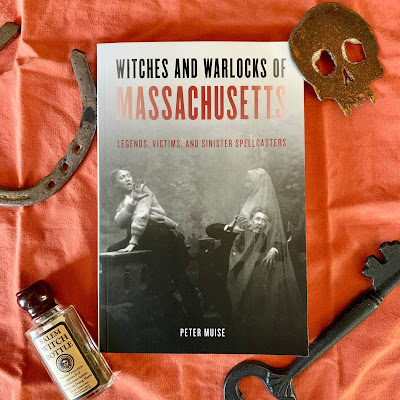
If you like witch stories, please consider buying my new book, Witches and Warlocks of Massachusetts, which just came out this month. It's available wherever you buy books. Lots of spooky stories and accounts of historical witchcraft!


April 29, 2021

Old New England Cemetery Lore: Watch Your Step

This past Saturday was warm and sunny, and although I'm always happy to stay home with a pile of obscure books I decided to go for a walk. I went to one of my favorite places, Brookline's Old Burying Ground. 

It's a really charming cemetery, well-cared for with just the right amount of decay. Although it's only a few miles from downtown Boston it feels like a rural environment. A few notable folks are buried there, including Zabdiel Boylston, a local physician who inoculated people against smallpox in 1721. It was the first inoculation campaign in North America, and Boylston got the idea from Onesimus, a slave in the household of Cotton Mather, the (in)famous minister associated with the Salem witch trials.


Cotton Mather's stepmother, Anna Mather, is also buried in Old Burying Ground. Her husband Increase Mather (also associated with the Salem trials) is buried at Copp's Hill in Boston, but she outlived him by several years and was buried in Brookline in 1737. Her grave is marked by a beautiful and well-preserved stone. 

As I wandered through Old Burying Ground I thought about some old New England cemetery folklore I've been reading recently. Some of it is probably familiar. For example, if you feel a cold chill for no reason it's probably because someone has walked over the site of your future grave. I think that one is well-known. 


A related piece of lore says that you should never step on anyone's grave when you're in a cemetery. That makes sense to me. If the living get a chill from someone just walking over their future grave, think how annoyed the dead must be when you step on their actual grave. Unfortunately, sometimes this advice is hard to follow, particularly in old cemeteries. The graves are placed really closely together at Brookline's Old Burying Ground, and it is hard not to step on one. There are also lots of unmarked graves, so you're probably unintentionally walking on someone. I think the intent behind this piece of lore is what's really important: treat the dead with respect. 

Many years ago when I was a kid I went for a bike ride with my friend Bobby in a neighborhood cemetery. We were riding pretty fast and goofing around, and I started to worry that we weren't being respectful. I said, perhaps half-jokingly, that we shouldn't be too loud or we'd disturb the dead. 

Bobby laughed and said, "I'm not afraid of any dead people!"

As soon as he said that he skidded, fell off his bike, and scraped his knee up really badly. His pants were torn and there was a lot of blood. We both left the cemetery immediately and went home. We kind of laughed but were also a bit spooked. Perhaps it was just a coincidence, but I've never forgotten it. 


Speaking of forgetting, according to another piece of old lore you shouldn't spend too much time reading gravestone inscriptions. This is bad news for me, since I really like to read old inscriptions. I'm not sure what constitutes too much time and hopefully I am under the limit. I can understand the sentiment, though, because when I read too many gravestones I do feel a little lightheaded from all the dates and names. It's like when I spend too much time on Instagram!

One final piece of advice: you shouldn't walk through a cemetery on your way to see friends. You run the risk of carrying death to their house if you do. Happily, I just went back home after visiting Old Burying Ground. It was a pleasant way to spend a sunny afternoon. 


I got this cemetery lore from Clifton Johnson's What They Say in New England (1896) and Fanny Bergen's Current Superstitions (1896).

December 22, 2020

Fat Graveyards, Hay, and Magic Cows: Folk Magic for Christmas

This is definitely shaping up to be one of the stranger Christmases in recent American history, with most of the traditional festivities being canceled due to the pandemic. So why not cozy up by the Yule log (even if its on your computer screen) and enjoy some old New England folklore about Christmas?

As a lot of you know, for many years Christmas was not celebrated in New England. The Puritans didn't believe there was any basis for it in the Bible - the date of Jesus's birth is not given, after all - and suppressed Christmas celebrations here. New Englanders began to celebrate the holiday more widely in the 19th century as the Puritan influence weakened, and all of the folklore I present to you is from the late 19th century. 

Much of it concerns the weather, since Christmas falls close to the astronomical start of winter. I'm just going to give you the grimmest piece of lore first. Let's get it over with.

 A green Christmas make for a fat graveyard. 

Ugh. That's from Fanny Bergen's 1896 book Current Superstitions. This next one comes from Clifton Johnson's What They Say in New England (1896):  

A green Christmas makes a full churchyard. The foundation for this saying is the fact that open winters with their constant freezings and thawing are very unhealthy.

I don't think there's any medical validity behind that, do you? I hope not, because with climate change we're going to get more "open winters." I'm going to chalk this one up to old time Yankees considering almost everything as an omen of death, which is true. These folklore books have a huge number of death omens. I think those sayings also demonstrate the law of inversion that shows up sometimes in folklore. A green, pleasant Christmas foretells death, or the groundhog seeing his shadow on a sunny day indicates six weeks of bad weather. Something foretells its opposite.

Here's another one from Clifton Johnson, which is less grim:

Half the pork and half the hay

On Christmas Day

Johnson notes that men used to visit their neighbors on Christmas to see how the hay and pork were holding out. It sounds very bucolic and a nice way to see folks, doesn't it? It's also practical. On Christmas there are still three more months of winter to come, so you definitely want to have enough food for your livestock and yourself. There are similar sayings about Candlemas Day on February 2.

To me, the most magical piece of Christmas folklore is the following:

There is a saying that on the night before Christmas when the clock strikes twelve the cows kneel in their stalls. Some young girls in Hadley, years ago, sat up to discover whether this was true or not. At midnight they went out to the barn, and sure enough when the hour struck the cows knelt. At any rate, that was what the girls said. (Johnson, What They Say in New England)
That story is very similar to the European belief that animals can talk at midnight on Christmas Eve. The exact origins of that legend are murky, but are probably tied to the belief that Christ was born in a stable. Some sources say God allowed the animals in the stable to speak so they could praise the newborn messiah, something they have been able to do once a year ever since. 

The New England version of the legend is a little more subdued. It's as if people wanted to believe in Christmas magic, but couldn't fully commit. "Talking cows? No way. Cows that kneel at midnight? Hmm. Well, maybe..." It's interesting that Johnson has the caveat "At any rate, that was what the girls said," as if he or his informant knew people would receive the story with skepticism.

He also includes this version of the legend:

A still older story told in town with the same theme is that at midnight when the Christmas Day begins, all the cattle in the yards and fields might be seen kneeling with their heads turned towards the east in adoration. Two girls of the olden time, who were eager to see for themselves whether this was true or not, sat up on Christmas Eve until the spellbound hour, and then visited the farm cattleyard. But the cattle made no sign that they were at all affected.

So which is it? Do the cattle kneel or not? For now, I am comfortable with the ambiguity and holding both possibilities in my mind. Please let me know if you happen to say up until midnight to see what happens. I'd be curious to know. 

Have a safe and happy Christmas!

April 24, 2019

Ghosts, Strange Graves and General Weirdness at Gilson Road Cemetery

I always like to read about a haunted location before we visit it. It helps me know what I should look for when I get there.

One of the first things I read about Gilson Road Cemetery really intrigued me. According to an urban legend, a ghost will appear if you leave the cemetery and shout "Betty Gilson, I have your baby!" The ghost appears as a woman in Colonial-era clothing, and is sometimes seen in the middle of Gilson Road. At other other times she hides behind the trees that line the road.


Who is Betty Gilson? Why is she so concerned about her baby? Unfortunately I didn't learn the answers to these questions when we visited Gilson Road Cemetery recently. Actually, I came away with even more questions.

Gilson Road Cemetery is located on a quiet rural street in Nashua, New Hampshire. The cemetery itself is quite small and doesn't have a lot of gravestones standing, but it's pretty obvious there used to be more than there are today. For example, a quick scan showed that there were several stone bases that used to support gravestones that are no longer there. I'm sure there are many more graves that are completely unmarked.


I couldn't find any historical records of this cemetery online. The oldest grave, that of Hannah Robbins, seems to date from the 1790s. Most of the graves are from the 1800s. Many of them are for members of the Gilson family, although the Fiskes, Searles and other families are buried here as well.

Lisa Rogak's 2004 edition of Stones and Bones of New England claims it had a reputation as New Hampshire's most haunted cemetery, and ghost hunter Fiona Broome has been investigating since 2008. Many, many people have seen ghosts there. Orbs, strange lights, apparitions and small ghostly children have all been sighted by visitors to Gilson Road. My Facebook friend Sandra has gone to many haunted locations and said that she saw strange faces in photos she took at Gilson Road Cemetery.

Did we see ghosts? No. Was Gilson Road Cemetery weird? Yes. Unlike Vale End, which I blogged about last week, Gilson Road does not feel well-maintained. It feels vaguely neglected. Neglect doesn't necessarily equal weird in my book, but Gilson Road Cemetery is also the site of a lot of human activity. That's what made it seem so strange.


Visitors to cemeteries will sometimes leave coins on the graves of famous or important people. I think that's common. But visitors to Gilson Road have left coins on many, many graves and no one famous is buried there. I think people are leaving coins to honor (or perhaps propitiate?) the restless spirits that are said to reside there.

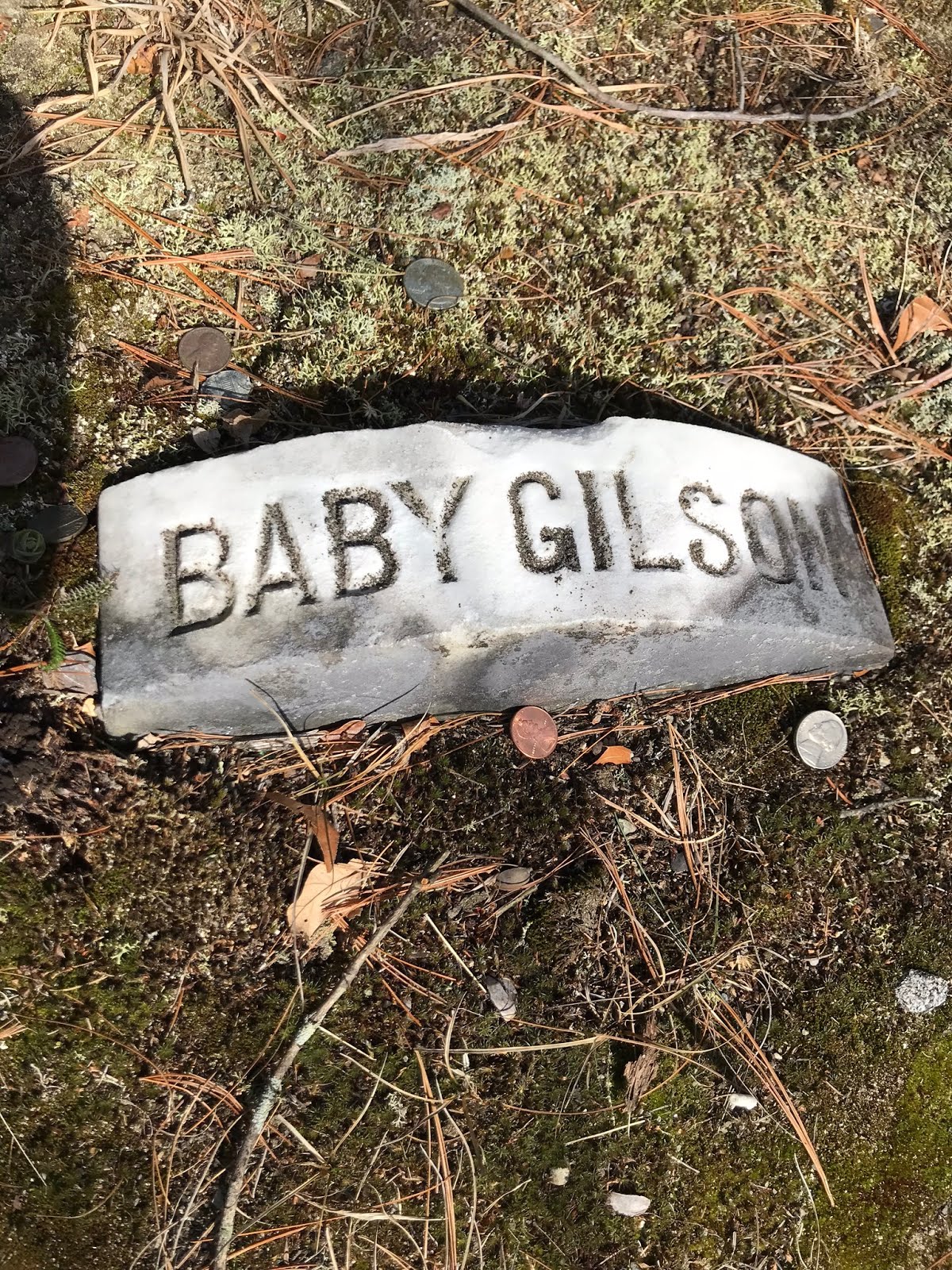
The neglect and the coins make Gilson Road Cemetery feel weird, and so do all the child graves. And there are a lot of them. For example, there are three identical tiny gravestones for unnamed babies from the Gilson family. Coins have been left on all of them. Perhaps these graves marked "Baby Gilson" have given rise to the legend about Betty Gilson and her baby?


Here is another child's grave, this time with a stuffed Big Bird left at it. All the graves are all quite old, so it's very, very unlikely Big Bird was left by someone who knew the child while he was alive.


The most memorable grave is probably that of little Walter Gilson, who died in 1811 when he was just over three years old. Walter's gravestone has a round hole drilled all the way through it. I haven't found a definitive explanation for this and have never seen another grave like it anywhere else.


People have left a lot of items at Walter's grave, including Barbie dolls, a solar powered crucifix, toy cars, and a rubber space alien. I think the stuffed Scooby Doo is particularly appropriate. A ghost-hunting dog is probably the best toy for a haunted cemetery.


Finally, adding to the weirdness, we saw this object on the ground. Was it a charm of some kind? It definitely had a Blair Witch vibe to it, but I suppose it could just have been a broken dreamcatcher. Or maybe not. We just left it right where it was. I'm not messing around with somebody else's graveyard magic, thank you very much.


There are a few theories about why the cemetery is supposed to be so haunted. According to one it was the site of a bloody battle between two local Native American tribes. Another claims the cemetery was the site of not one, but two deadly house fires. I don't think there's any evidence to back up either theory so they may just be legends. Still, true or not, they reflect the eerie atmosphere of the cemetery.

I guess you can see why I came away from Gilson Road Cemetery with a lot of questions. It's one of the more interesting graveyards I've been to recently and I recommend visiting if you get the chance. Maybe you'll find more answers than I did! My usual caveats apply: don't go at night and don't damage anything. This is someone's final resting place so be respectful. 

May 09, 2017

Paging Dr. Freudstein: Burials Inside Old Houses?

Have you ever seen a horror movie called The House by the Cemetery (aka Zombie Hell House)? It's from 1981, and although it was directed by infamous Italian goremeister Lucio Fulci much of it was actually filmed in Concord and Scituate, Massachusetts.

One British reviewer called it "hackwork of almost awesome incoherence." The story, such as it is, involves researcher Norman Boyle and his wife Lucy moving with their son Bob from New York City to a spooky New England mansion. Norman's boss had previously lived in the house - that is, until he killed his girlfriend and then committed suicide under strange circumstances. For some reason Norman thinks it will be the perfect location to write a book about old houses.

The Boyles move into the house, aided by a local realtor who neglects to tell them that the old house has been the site of many, many multiple murders in the past. But why let some inconvenient history get in the way of a good commission? The house of course is also located next to an old spooky cemetery.
This is actually the Ellis Estate in Scituate, Massachusetts.
Italian horror movies from the 1980s are famous for their almost nonexistent plots, and House by the Cemetery certainly fits that mold. Norman researches the old house. Lucy realizes the door to the cellar is nailed shut. A mysterious babysitter that no one asked for arrives and starts to care for Bob. Everyone hears weird noises. The realtor is killed by something lurking in the cellar. The babysitter cleans up the mess. Bob meets a little girl in the cemetery that no one else can see. The cellar-monster kills more people. And so it goes for 87 minutes of gore and non-sequitur filled dialogue.

I confess: I love House by the Cemetery. It's a terrible movie, but somehow the incoherence and bad dubbing makes it all seem dreamlike to me. It's also nicely filmed. Even though I love it, I don't think Lucio Fulci really understood much about New England when he made it. For example, the house is located somewhere called "New Whitby, Boston." Didn't Fulci didn't know that Boston is a city, not a state?

A sinister babysitter!

There is also a scene that made me roll my eyes. While Lucy is cleaning the house she rolls back an old rug. What's that underneath it? Why, it's a gravestone embedded in the floor. The house's original owner, one Dr. Jacob Freudstein (!), is buried under the living room. Lucy freaks out, but when her husband comes home he calms her down. "Most of the old houses in the area have tombs in them," he says. "That's because in the winter it freezes here."

That's when I rolled my eyes. I have been in innumerable old New England houses, I grew up in an old house, and none of them had tombs in them. Lucio Fulci just made that up, I thought.

But maybe I was wrong. Because at least one old New England might have a tomb in it. Maybe Lucio Fulci was right?

The house in question is the Gideon Straw House in Newfield, Maine. Built in the 1700s, the kitchen of this large farmhouse supposedly contains the grave of Gideon Straw's daughter, Hannah Chadbourne. According to Robert Ellis Cahill's book New England's Ghostly Haunts (1983), her final resting place is marked by a gravestone on the floor that reads:

SACRED to the memory of Mrs. Hannah
Wife of Ira Chadbourne
Who died March 2, 1826 - age 30
Blest are the dead, who die in Christ
Whose triumph is so great. 
Who calmly wait a nobler life
A nobler life shall meet

According to Cahill, the Straw House was used as a hunting lodge for many years, and it was traditional for the hunters to stand around Hannah's grave and salute her with their beers. Cahill also says some of them made rude jokes at Hannah's expense.

Perhaps it's no surprise that the house has a reputation for being haunted. One owner reported strange whistling noises coming from all the fireplaces, while still another claimed to have seen Hannah's ghost looking in the window. That owner also said he awoke one night to find Hannah caressing his cheek. Yikes!

At one point the building was sold to two schoolteachers, who at first enjoyed living in a haunted house. They changed their minds after one particularly noisy night when something unseen slammed the doors and charged up and down the stairs until sunrise. The two teachers left shortly thereafter.

So after reading Cahill's book I thought maybe Lucio Fulci was really on to something. But then I tried to find more information about the Gideon Straw house and Hannah's ghost. It turns out that the story just isn't true. Several past owners have said they never experienced any ghosts, and that Hannah is definitely not buried in the kitchen. The gravestone people talk about was probably just a spare marker kept on the property after the family replaced it with a nicer one. If it ever was on the property it's not there now. All this information is from a site specializing in the paranormal. When even a paranormal site tells you there's no ghost, there's probably no ghost.

It's a little disappointing that the Straw house is (probably) not haunted because it does make for a good story. It would have been nice if Lucio Fulci had included some authentic old New England lore in House by the Cemetery. On the other hand, I suppose he did include an authentic legend, even if it was not true.

Fulci made one other film set in New England: City of the Dead, aka Gates of Hell. This film is set in H. P. Lovecraft's mythical town of Dunwich, but in Fulci's movie it looks suspiciously like a small dusty town in Italy. The plot involves the ghost of a priest that committed suicide who makes people vomit up their innards when he stares at them. Maybe I should see if that's a piece of authentic folklore too?

*****

Just a reminder, I will be speaking about the monsters of Cape Cod on Saturday, May 13 as part of the Provincetown Paracon. Other speakers include Adam Barry and Amy Bruni from the TV shows Ghost Hunters and Kindred Spirits, and there will be a special Traveling Museum of the Occult and Paranormal as well. I hope you can make it!

Me and Paracon organizer Sam Baltrusis talking about the event on What's New Massachusetts.

September 06, 2016

Spider Gates Cemetery: Portals to Hell and College Kids in Robes

Labor Day. The end of summer.

We could have gone to the beach.

Instead we went looking for... the Eighth Gate to Hell!

We didn't find it. Or at least I don't think we did.

The trail leading to Spider Gates.

The eighth gate to Hell is supposed to be located somewhere in Friends Cemetery in Leceister, Massachusetts, a rural town just outside Worcester. It seems odd that a Quaker burying ground would host a portal to perdition, but that's only one of the strange things about this cemetery.

While the graveyard's formal name is Friends Cemetery, it's probably better known by its nickname, Spider Gates Cemetery. It got that nickname because of these distinctive iron gates:


They do sort of look like abstract spiders, don't they? Maybe? From what I've read the gates are actually supposed to be images of the sun, with its happy connotations of life and rebirth. They don't really look like the sun to me, but then again they also have too many legs to really be spiders either.

Weird structures in cemeteries often give rise to weird legends. A strange-looking statue? It must be murderous. An inscription that seems out of place? It must be a warning about a curse. A strange slab? It's there to keep a witch down. Usually the weird structure has just one weird story attached to it. But at Spider Gates, there are many, many strange stories.

For example, it is said that the eighth gate to Hell is located somewhere in this cemetery. Or perhaps if you pass through seven gates at the cemetery the eighth one will lead you into Hell. It's little unclear, as good legends often are. I didn't even know there were eight gates into Hell, so it's always good to learn new things. There are only two formal iron gates (one large and one small) at the cemetery, but there are smaller openings in the stone walls throughout the woods. Maybe they all add up to eight?


The iron gates clearly gave rise to the gateway to Hell legend, but where did these ten other legends came from?

1. There is an oak tree with a rope hanging from it known as the Hanging Tree. Someone committed suicide here and their ghost still haunts the cemetery.

2. A demonic creature has been heard roaring in the woods.

3. Near the cemetery is a cave where a young woman was murdered many years ago.

4. Across from the main cemetery is a secret second cemetery that can only be seen once.

5. Unnatural white ooze emerges from the ground.

6. A haunted house is located nearby. Don't go inside!

7. Outside the walls of the cemetery are many small stones with strange runes inscribed on them. 

8. The nearby river is actually the River Styx, which leads to the underworld.

9. At midnight, walk around the gravestone of Marmaduke Earle (b. 1749 - d. 1839) and then rest your head on it. You will hear him speak to you.

10. Satanists have permission to conduct their rituals in part of the cemetery called the Altar. 

Those are all pretty cools stories, and I think there are more out there. Happily, Tony and I didn't encounter any strange phenomena, and the cemetery actually has a pretty innocuous history. It was established in the 1700s by a group of Leceister Quakers. In the mid-1800s they merged with the more numerous Worcester Quakers, who still maintain the cemetery today. The gates were built in 1895, and have been replaced at least once after being stolen. I think that's the most shocking thing that's ever been documented that happened at Spider Gates.

Earle family graves.
So are any of those legends true? I don't know, but there is at least a kernel of truth behind the Satanist legend. And here's why.

Last week I told a friend that I was going to visit Spider Gates. He said, "I love Spider Gates! I used to go there when I was in college." This friend attended a college near Leceister, and when he was a junior he was initiated into a secret society for seniors. The initiation happens like the this.

First, the senior members decide who they want to initiate from the junior class. Then the seniors don black hooded robes, find the juniors they want on campus, and wordlessly tap them on the shoulder. That tap is the invitation to join the secret society.

Me looking spooked!
Next, to become full-fledged members the juniors go through an initiation process that involves locating the grave sites of the college's founders. This doesn't sound too hard, except that they need to do it at night, in the middle of winter, and under the watchful gaze of the seniors, who silently stand by wearing their hooded robes.

As a junior, my friend had been to Spider Gates at night to find a college founder's grave. When he became a senior, he wore a hooded robe and watched the juniors do the same thing.

"The police totally left us alone," he said. "They knew it was just a bunch of dorky college kids and that we weren't causing any trouble."

Hmmm. Do you see how this initiation could have given rise to the Satanist legend? Someone may have seen the students in their black robes walking towards the cemetery, or maybe even in the cemetery itself. When they reported this to the police they might have been told, "Don't worry, they have permission to go there at night." Over time, a harmless college initiation could become misinterpreted as a dark Satanic ritual.


In reality, practicing adult Satanists are harmless as well and don't go around breaking the law. Think of the Martin Starr character on Silcon Valley, for example! However, the people who might sometimes break the law are teenagers experimenting with the occult or just partying in the cemetery. We did find the remains of a fire in the middle of the cemetery, right on the raised area called the Altar. Lighting fires in cemeteries is disrespectful and illegal, so don't do it! No one is supposed to be in the cemetery at night - not even college kids wearing robes.


I assume the fire was lit by teenagers, but who knows? Legends can give rise to imitators, so maybe someone really is out there at Spider Gates conducting abominable rites. It's easy for me to be a rational skeptic here in my well-lit study, but if you put me out in the woods late at night I might become a true believer.


There is a lot of information about Spider Gates out there, but I got most of mine from Joseph Citro's Weird Massachusetts, Daniel Boudillion's excellent page on the topic, and this fun little site as well.  Special kudos to Tony for taking some great photos on our expedition!

May 25, 2014

Old Burying Ground in Cambridge, and Maybe Some Ghosts

Tomorrow is Memorial Day, so I suppose it's appropriate that I stopped by Cambridge's Old Burying Ground yesterday on my way to see a matinee. I've walked by this historic cemetery for years and have never gone inside.


I'm glad I did. Like most cemeteries it was very peaceful inside, even though it's only a few steps from the Harvard Square T-stop. In fact, tt was so peaceful someone was sitting in the lotus position meditating.

The Old Burying Ground dates back to the early 1600s, and has lots of gravestones in the three classic New England styles: skulls, cherubs, and willow and urn.

A very ornate death's head.

Another ornate carving, this time of a cherub.
This cherub looks a little dour.

Willow and urn.


There are also some things I hadn't really seen before. Some of the gravestone inscriptions are in Latin. Not just a little Latin, like "Requiescat In Pace," but paragraphs of dense Latin.

Break out the Latin dictionary!
 The Latin-inscribed markers all seem to be for Harvard faculty and librarians. If you were erudite while alive, you might as well let people know it after you're dead too.

In addition to the Latin gravestones, some other stones had elaborately unfinished backsides. Take a look at this one.


But from the front, it's just a standard gravestone.


The Old Burying Ground is host to several soldiers from the Revolutionary War. There's a prominent marker for several Cambridge men who were killed at the Battle of Lexington and Concord, and two African-American soldiers from the Revolution are also buried in the cemetery. I didn't find their markers, but one of the men was named Neptune Frost, which is an amazing name. The other black soldier's name was Cato Stedman, so they both had Latin names.


I assumed there must be a ghost story associated with the Old Burying Ground, but there really isn't anything definite. Sam Altrusis, in his book Ghosts of Cambridge: Haunts of Harvard Square and Beyond, claims that the Old Burying Ground is indeed full of spirits, but they're not particularly malevolent or active. None of them are identified by name. It sounds like they're just hanging out enjoying the peaceful surroundings.

If you do want someplace a little more haunted, you might visit Christ Church Cambridge, which is located next door. The church is supposedly haunted by the ghost of a British soldier who was buried inside the building during the Revolution. His burial so angered the local Patriots that they rioted and vandalized the building, and his spirit has haunted the place ever since. The lesson to this story? Be nice to dead people, and they'll be nice to you.

March 09, 2014

Early New England Gravestone Styles: From Morbid to Contemplative

I enjoy walking around old cemeteries, and I bet a lot of my readers are the same. The really, really old graveyards are the most interesting to me. They give a glimpse at what life (and death) was like here centuries ago.

The earliest gravestones you can find are from the 17th century, when this area was a hotbed of orthodox Puritanism. Although the Puritans apparently weren't as grim as many people think (they did invent Thanksgiving, after all!), their religious outlook was still pretty gloomy. Gravestones from this era are decorated with skulls, usually winged.

Grave of Edward Dean, 1716, Charter Street Burying Ground, Salem

The Puritans were staunch Christians, but their religious beliefs didn't provide a lot of hope for the individual. Only God knew who would be admitted to Heaven, and He didn't tell anyone. Even the most devout people went through life fearing not only death, but that they would be sent to Hell by God. I've read somewhere that young Puritan children were often sent to look at open graves and watch burials so they could meditate on their own mortality and innate sinfulness.

The fears created by Puritan religious beliefs were probably compounded by how unstable the New England settlements were in the 17th century. Indian attacks, war with the French, piracy, outbreaks of disease, and the occasional witch hunt all made the world feel threatening. No wonder they carved skulls on their tombstones.

Grave of Sarah Gardner, 1791, Charter Steet Burying Ground, Salem
Although death's heads continued to be used in the 18th century, they were slowly replaced by a new image: cherubs. It's almost like the winged skulls grew their skin back! Cherubs started to appear shortly after the Great Awakening swept over New England. The ministers of the Great Awakening emphasized personal revelation and close study of the Bible, rather than relying solely on official religious authorities. Many schisms split apart the New England churches, and people found new enthusiasm for religion. There was also an emphasis on resurrection, which is reflected the cherubs, who are often smiling. The settlements at this time began to feel more permanent, and there were fewer external threats to New England.

Grave of Captain Clifford Crowninshield, 1809, Charter Street Burying Ground, Salem

Gravestones decorated with willows and urns slowly replaced the cherubs in the 19th century. The urn-and-willow motif apparently began in Cambridge, Massachusetts, which was a center for intellectual trends like the Greek revival, which sought a return to classical forms in art and architecture. Also spreading across New England from Harvard University was Unitarianism, which brought a more intellectual approach to the old Puritan congregations. Both skulls and cherubs were too visceral for this new, more philosophical strand of Christianity. In the 19th century New England was the intellectual and financial center of the United States, and I think the new peace and prosperity are probably reflected in this soothing grave art as well.

If you want to read more about this, you should check out "Death's Head, Cherub, Urn and Willow," a famous article printed in 1967 in Natural History. The authors lay it all out in much greater detail than I did. Have fun exploring your local graveyard!

November 24, 2013

Strange Gravestones of Whitefield, New Hampshire

Tony and I were recently up in the White Mountains, and I paid visit to Pine Street Cemetery in Whitefield, New Hampshire.


Pine Street is just outside downtown Whitefield and has some nice old gravestones dating back to the 18th century. It's very peaceful. On the day I went I was the only person there.


Some of the 19th century stones have a finger pointing up, indicating the deceased is bound for heaven. Take for example this stone which memorializes the fantastically-named Varnom Blood:


The text above the finger reads "Gone Home." It's a nice sentiment.


The same upward-pointing finger appears on the memorials for Varnom's wife Lydia and for George Parker, who died when he was only thirteen.


But apparently the people of Whitefield did not think all their neighbors were going home to Jesus. Here is the gravestone for poor Henry Lane, deceased at age twenty-two. 


Clearly whoever made this stone didn't think Henry was going to heaven. I'm surprised that Henry's family would pay for such a judgmental gravestone but maybe Henry really was that bad. The stone indicates he was bad enough to make Jesus cry, which is pretty bad. 


According to Joseph Citro's Weird New England there is another stone like this in Whitefield. That one is for Ira Bowles (dead at age 63) and is located in the Methodist Cemetery nearby. Apparently stones with the downward-pointing fingers are quite rare, and only two have been found outside of  Whitefield.


No one knows what Henry Lane and Ira Bowles did to deserve such damning gravestones. Were they murderers? Thieves? Drunkards? 

Or maybe none of the above. Charles Jordan suggests in his book Tales Told In the Shadows of the White Mountains that the downward fingers may have actually reflected Seventh Day Adventist beliefs that were popular at the time. Rather than believing that the dead went immediately to heaven, the Adventists felt they waited in the grave until Judgment Day. The finger points just to the soil, not to Hell. It's not as dramatic as the other explanation, but it does make me feel better about Henry and Ira's families.