Showing posts with label cemetery art. Show all posts

March 26, 2022

The Grave of Susanna Jayne: Bats, Angels and the Grim Reaper

Marblehead is one of the prettiest towns in Massachusetts, with an amazing and historic downtown, dramatic ocean views, and streets full of Colonial-era homes. Lots of people visit it for these reasons, but this past weekend we went for a different one: to see the grave of Susanna Jayne.


Like so many coastal New England towns, Marblehead is quite old. It was founded in 1635 as a fishing village by English colonists, and its first cemetery, Old Burial Hill, was established three years later. Old Burial Hill is located on a rocky outcrop overlooking the town center and the harbor. This was also the site of Marblehead's first meeting house (the Puritan term for a church). The meeting house is long gone, but the cemetery remains. 


We were lucky enough to visit on a rainy, foggy day. Our stroll through Old Burial Hill was really atmospheric due to the mist and wet weather, which also kept a lot of people indoors. We we had the place to ourselves. This was my first time visiting Old Burial Hill, and it's already one of my favorite cemeteries. 


Old Burial Hill was one of the locations for the movie Hocus Pocus, which draws some tourists. Nearly 600 Revolutionary War veterans are buried there, which is another draw, but we had come particularly to see the grave of Susanna Jayne. The wife of Peter Jayne, a local schoolmaster, Susanna died in August of 1776. Her epitaph reads:

Deposited Beneath this Stone the Mortal Part of Mrs. Susanna Jayne, the amiable Wife of Mr. Peter Jayne, who lived Beloved and Died Universally Lamented, on August 8th, 1776, in the 45th Year of her Age.

Many of the gravestones I visit have some legend associated with them, but there isn't a legend attached to Susanna Jayne's grave. It's just an incredibly beautiful headstone with lots of symbolism that, to the modern eye, is very gothic. 

Susanna Jayne's headstone is on the right. It's recently been embedded 
in stone to preserve it. 

The headstone was carved by Henry Christian Geyer (1727 - 1785), a Boston artisan who made many other Massachusetts gravestones. Some of Geyer's work follows standard styles popular at the time, while others, like Susanna Jayne's gravestone, are quite creative.  


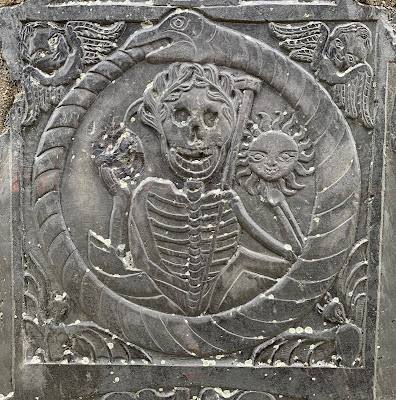
The centerpiece of Jayne's headstone is this carving of the Grim Reaper, portrayed as a skeleton holding a scythe. The skeleton is crowned with laurel wreaths, and holds the sun in one hand and the moon in the other. (Sadly, the moon has been damaged.) Overall, the message is one of Death triumphant and the passage of time. 

The Grim Reaper is encircled by snake biting its own tail. This image, known as the ouroboros, is a symbol that dates back to the ancient Egyptians and was found on the wall of King Tut's tomb. It's had many meanings over the centuries, but most commonly represents eternity and the cycles of time. More time symbolism appears at the top of Susanna Jayne's headstone, where Geyer carved an hourglass framed by two bones. Time passes, and Death takes us all.


However, the universe is not purely mechanistic and grim. There's a moral aspect, symbolized by the angels and bats that hover around the corners. Good and evil play a role in the eternal drama as well. 


Modern gravestones are quite subdued these days, and very plain. I miss the artistry and symbolism of the older headstones. Susanna Jayne's gravestone is a work of art, and was actually photographed by the well-known artist Ansel Adams. If you'd like to see some beautiful New England art, I'd recommend taking a trip to Old Burial Hill.


You can read more about Susanna Jayne's gravestone here. More details about Henry Christian Geyer can be found here.

April 29, 2021

Old New England Cemetery Lore: Watch Your Step

This past Saturday was warm and sunny, and although I'm always happy to stay home with a pile of obscure books I decided to go for a walk. I went to one of my favorite places, Brookline's Old Burying Ground. 

It's a really charming cemetery, well-cared for with just the right amount of decay. Although it's only a few miles from downtown Boston it feels like a rural environment. A few notable folks are buried there, including Zabdiel Boylston, a local physician who inoculated people against smallpox in 1721. It was the first inoculation campaign in North America, and Boylston got the idea from Onesimus, a slave in the household of Cotton Mather, the (in)famous minister associated with the Salem witch trials.


Cotton Mather's stepmother, Anna Mather, is also buried in Old Burying Ground. Her husband Increase Mather (also associated with the Salem trials) is buried at Copp's Hill in Boston, but she outlived him by several years and was buried in Brookline in 1737. Her grave is marked by a beautiful and well-preserved stone. 

As I wandered through Old Burying Ground I thought about some old New England cemetery folklore I've been reading recently. Some of it is probably familiar. For example, if you feel a cold chill for no reason it's probably because someone has walked over the site of your future grave. I think that one is well-known. 


A related piece of lore says that you should never step on anyone's grave when you're in a cemetery. That makes sense to me. If the living get a chill from someone just walking over their future grave, think how annoyed the dead must be when you step on their actual grave. Unfortunately, sometimes this advice is hard to follow, particularly in old cemeteries. The graves are placed really closely together at Brookline's Old Burying Ground, and it is hard not to step on one. There are also lots of unmarked graves, so you're probably unintentionally walking on someone. I think the intent behind this piece of lore is what's really important: treat the dead with respect. 

Many years ago when I was a kid I went for a bike ride with my friend Bobby in a neighborhood cemetery. We were riding pretty fast and goofing around, and I started to worry that we weren't being respectful. I said, perhaps half-jokingly, that we shouldn't be too loud or we'd disturb the dead. 

Bobby laughed and said, "I'm not afraid of any dead people!"

As soon as he said that he skidded, fell off his bike, and scraped his knee up really badly. His pants were torn and there was a lot of blood. We both left the cemetery immediately and went home. We kind of laughed but were also a bit spooked. Perhaps it was just a coincidence, but I've never forgotten it. 


Speaking of forgetting, according to another piece of old lore you shouldn't spend too much time reading gravestone inscriptions. This is bad news for me, since I really like to read old inscriptions. I'm not sure what constitutes too much time and hopefully I am under the limit. I can understand the sentiment, though, because when I read too many gravestones I do feel a little lightheaded from all the dates and names. It's like when I spend too much time on Instagram!

One final piece of advice: you shouldn't walk through a cemetery on your way to see friends. You run the risk of carrying death to their house if you do. Happily, I just went back home after visiting Old Burying Ground. It was a pleasant way to spend a sunny afternoon. 


I got this cemetery lore from Clifton Johnson's What They Say in New England (1896) and Fanny Bergen's Current Superstitions (1896).

September 03, 2018

Death's Head, Cherubs and Urns: Gravestone Art in Bradford Burial Ground

This past Saturday was cool and pleasant, and you could sense that fall is on the way. So why not get into the autumnal mood and visit a historic old cemetery? We decided to visit Bradford Burial Ground in Bradford, Massachusetts.

In 1665 settler John Heseltine gave land to the town of Bradford to be used for a church and a cemetery. The church is long gone, but the cemetery still remains and is now on the National Register of Historic Places. The oldest gravestone is from 1689, but it is believed that there are older burials in the cemetery along with multiple unmarked graves. The Burial Ground is sometimes called the Ancient Burial Ground, which is kind of a nice name.

Walking through the cemetery we noticed the three major motifs you see on old gravestones in Massachusetts: death's heads, cherubs, and willows and urns. Death's heads are the earliest motif of the three, appearing first in the 1600s. Cherubs appeared by the mid-1700s, while the willow-and-urn motif became popular later in that century. Some historians have argued that the evolution of New England funerary motifs arose from changes in New Englanders' religious views, with the death's head representing the grim Puritan world-view, the cherub a more humanistic approach to religion, and the willow-and-urn a more intellectual one. Others have claimed this is not true and that the motifs just changed with the fashions of the time. Specific motifs lasted longer in some towns than others due to the influence of local stone carvers, and there is quite often chronological overlap between the motifs in the same cemetery. 


DEATH'S HEADS

The Bradford Burial Ground has a nice assortment of stones engraved with death's heads. There's something morbid but also charming about these stones. Maybe because this motif is frequently used to illustrate books and on Halloween decor I've just gotten used to it. It also is one of those quintessentially New England things, like clam chowder made with cream or old white wooden churches. 


This stone is beautiful and very well-preserved. 

The flowers carved on the side borders contrast with the winged skull. 

This death's head is more abstract than the others and its wings are replaced with flowers.  The stone also has what looks like a typo: "Hear lyes buried...", but spelling was less circumscribed in the early 18th century. 
What looks like another abstract death's head, but without the typo. Is this  even supposed to be a skull or is it a face?

CHERUBS

In my mind cherubs are those cute little angels that appear on Valentine's Day cards and in Renaissance paintings. The cherubs in Bradford Burial Ground are definitely not cute. They're actually quite grim. Latin inscriptions (memento mori) appear on the cherub stones, but not on the earlier death's head stones. 


Similar to the cherubs are these carvings, which are sometimes called "portraits." They aren't supposed to actually look like the person buried under them, but are symbolic representations of a human. Like the cherubs they are somewhat grim and have the Latin "memento mori" under them. 


WILLOW AND URN

These stones are less morbid and grim than the earlier stones. They are more melancholy. The willow and urn were symbols of mourning from the ancient Mediterranean and appeared in New England as part of the Classical revival in art and architecture. 


A more ornate carving adorns this stone. 


Although they are more gracious, some of the willow-and-urn stones are inscribed with dire warnings to the living. For example, one stone has this carved on it;

Think blooming youth when this you see
Tho young yet you may die like me
Like you a rosy youth was I
Yet in my youth was called to die

Another stone tells us this:

Think, friends, when you these lines have read
How soon we're numbered with the dead
Our years are few and quickly fly
O friends remember you must die

Consider yourself warned. Carpe diem! 

AND THE REST...

Not every gravestone fits into one of those three categories (and maybe those portraits are really a fourth category). For example, some are just decorated with a floral motif: 


Others feature just a name but with no decoration at all, not even a death date. Were these the graves of paupers or people whose families couldn't afford more elaborate gravestones?


And this headstone features a finger pointing heavenward, letting us know where the grave's occupant has gone. This is a motif I've seen in a few other cemeteries in this area, but it's not as common as some of the others. 


I hope you had a great summer and are excited for the coming of autumn!