Showing posts with label protective magic. Show all posts

July 31, 2022

Hiding Shoes to Bring Luck and Avert Evil

I’m always excited when some local folklore appears in the news, as it did this week. Several Boston-area news outlets reported that archaeologists working at the historic Tilden House in Canton, Massachusetts unearthed some shoes buried underneath the kitchen floor. Why all the excitement over some shoes? Because they could possibly be a form of protective magic. 

The Tilden House was built in 1725 by David and Abigail Tilden in what was then part of Dorchester, Massachusetts. That part of Dorchester ultimately became a separate town, Canton, in 1797. A strange and interesting fact: it was named Canton because Elijah Dunbar, one of the town’s leading citizens, thought it was on the exact opposite side of the planet from Canton, China. This is not the case, but the name stuck. 

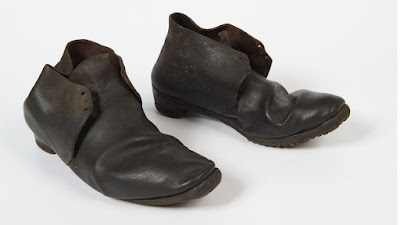
A photo of hidden shoes from England. 
For those of you not from the Boston area, please note the names of the two cities are not pronounced the same. The town in Massachusetts is said CANT-in, or more often CAN’-in, with some kind of glottal stop instead of the “t”. The city in China is often pronounced can-TAWN, but it’s true Chinese name is Guangzhou. It’s also important to note that Cantonese cuisine originates from Guangzhou, not the Massachusetts town. 

The Tilden House is currently owned by the town of Canton, and leased to the Canton Historical Society, who are restoring and modernizing it so it can be used as a history center. After archaeologists removed the kitchen floor, they found several pairs of shoes, along with bottles, plates, and other items, all of which seemed to date from the mid-19th century. All these items could just be trash that past residents discarded, but it’s also possible the shoes were placed there to protect the house from witches or evil spirits. 

Hidden shoes are often found in the walls, ceilings, or under the floors of old buildings in England and North America, and historians suspect it was a form of protective magic. For example, back in 2013 archeologists found shoes hidden under the floor of the Old Colony House in Newport, Rhode Island. But why did our New England ancestors think hiding shoes would defend against evil magic? Historians  Matthew Cochran and Jeanne Ward explain it this way:

This well-documented practice dates from the l5th to the early 20th century. The underlying premise of using concealed shoes as a means of personal or household protection lies both in the shoe’s shape as well as the personal qualities imbued in a shoe by the wearer. Shoes take on the literal shape of the wearer and therefore can act as a form of proxy for the wearer. If a malicious entity is presumed to be haunting you, the concealment of the shoe in a relatively inaccessible space, such as the cellar or the attic, may draw the malicious entity to the shoe instead of you. And, if luck holds, the malicious entity may become trapped in the shoe (from the Maryland Archeology Newsletter, quoted here.)

This explanation makes sense to me, since it matches another important type of protective magic in New England: the witch bottle. I've written about witch bottles before. When someone thought they were being cursed by a witch, they would fill a bottle with their own urine, and then add nails, broken glass, and other sharp items to it. The urine acted as a substitute or proxy for the victim. The witch's evil magic would be drawn to the urine, which came from their victim, rather than to the actual intended target. To make things worse for the witch, the sharps objects would send pain and physical harm back to the witch. 

I suppose you should always have some old shoes, a bottle and some nails on hand just in case things start getting weird? It's like a supernatural form of recycling. But please, don't go around accusing your neighbors of witchcraft.

September 01, 2020

Chicken Blood and Steel Rods: Magic and Treasure in 18th Century Vermont

In the 18th and early 19th centuries many New Englanders believed the area was riddled with buried treasure. I've written about this a few times before, but basically people thought pirates, or sometimes Spanish explorers, had buried gold and silver all over New England. It was in fact a very common pastime for people to dig for treasure. All you needed was spare time and a shovel - and some magic.

Before you could dig for treasure you had to find it. Sometimes local legends provided the location where the treasure was buried. For example, that's the case with Dungeon Rock in Lynn, Massachusetts, which according to legend collapsed onto a pirate and his treasure during an earthquake and was subsequently the site of a famous attempt to unearth the buried booty. The treasure was never found.

However, if local legends were no help you'd need some magic to locate the treasure. Many people turned to dowsing rods for assistance. Traditionally dowsing rods were made from forked witch hazel branches, but in some cases they were made of various metals, sometimes expensively. They were most often used to find water but in theory could also find buried gold. Well, at least in theory.


If the dowsing rod wasn't working out you could always try following your dreams, and I mean that literally. There are many accounts of New Englanders dreaming about the location of buried treasure. For example, Silas Hamilton (1736 - 1816) of Whitingham, Vermont, kept a notebook where he recorded dozens of tips and stories he'd heard about buried treasure across New England. Many of them involved dreams:

... Mrs. Woodbury and her daughters have dreamed sundry times in a remarkable manner of money or  hid (sic) treasure in Brookfield on her husband's farm in Brookfield in the Bay State. 
Ebenezer Felton of New Salem dreamed of money hid.  
Mr. Lamb informs that Bezalel Pierce informs that his brother of South Hadley dreamed of a large quantity of money hid near Mount Tom on the West Side of the Connecticut River.  
Also Capt. Doneson dreamed of hid money on Fisher's Island on Mount Prospect near a rock not the bigness of a haycock. Said Prospect is on on the west end of the island. 

You get the idea. But still, learning where the treasure was hidden (or "hid" as Hamilton would say) was really just the start of the process. You still had to dig it up, which sounds easier than it was. Yes, New England soil is stony, but that's not why it was hard to get the treasure. It was hard because the treasure was almost always protected by supernatural guardians and magic spells.

Various legends tell of the eerie guardians that watch over the hidden gold. Giant ghosts on horseback, armies of black cats, devilish hounds, and undead pirates - these were just a sample of the demonic beings a treasure-digger might encounter. Certain magical precautions had to be taken to ward them off. Treasure-digging should only take place at midnight, for example, and strict silence must be observed by all participants. Some stories also claim the digging had to be doe within a protective circle drawn on the ground.

Breaking any of these rules would allow the demonic guardians to attack, but even worse it would make the treasure move. That's right - even after you found the treasure, it could still move to a new location. Many treasure-diggers claimed they had the hidden gold within reach, just a single shovelful of dirt away, only to see it disappear or sink deeper into the earth when someone spoke or made too much noise. Imagine their frustration. It's like being one number away from winning PowerBall. The whole process of finding the treasure had to begin all over again.

Silas Hamilton believed that he had a solution to this problem. It involved animal blood:

Take nine steel rods about ten or twelve inches in length, sharp or piked to pierce into the earth, and let them be besmeared with blood from a fresh hen mixed with hogging. The make two circles around  the hid (sic) treasure. One of the said circles a little larger in circumference than the hid treasure lays in the earth, the other circle some larger still, and as the hid treasure is wont to move to North or South or East or West place your rods as described on the other side of this leaf (page).

Silas Hamilton's illustration from Green Leaves from Whitingham

In essence, the rods created a cage around the treasure which prevented it from moving away. The circular formation is reminiscent of the magical circles that have been cast by ceremonial magicians for centuries.

Just a few words about Silas Hamilton. He was a wealthy landowner, and helped found Whitingham in the 1770s. He was an important and reputable person, yet he was writing about smearing steel rods with chicken blood to prevent buried treasure from moving around in the ground. I think it shows how prevalent and normal magic was in New England at  the time.

I don't think Silas Hamilton ever found any pirate gold, and I don't think many people ever did. That didn't stop them from trying, though. Treasure digging sounds like a fun activity to me. You got to run around late at night in the woods with your friends, hoping to get rich while simultaneously scared of encountering a ghost or some demonic animal. It sounds like a lot of the paranormal shows that are on TV right now, or even some weird legend trips I've been on myself. Perhaps finding the treasure wasn't really the point. No one ever got rich, but I'm sure people kept doing it because they wanted to hang out with their friends and have some spooky fun.

One closing thought. Whitingham, Vermont is a small town on the Massachusetts border, and one of its most famous residents was Brigham Young, the second leader of the Mormon Church. The Mormon Church was founded by Joseph Smith, who was also born in Vermont and later said he was led by an angel to unearth a book written on golden plates buried in a hill.

*****

I got the information about Silas Hamilton from Clark Jillson's 1894 book Green Leaves from Whitingham, Vermont: A History of the Town.

March 22, 2020

Daisy Wheels and Witch Marks in New England

People in pre-modern New England used a variety of magical techniques to protect their homes from witches. Some of these are attested to in witch trial documents, where we read about people hanging horseshoes over doorways or lining their windows with bay leaves. The Puritans thought the world was full of sinister magical forces and they tried to ward them off with these protective spells. 

Historians and archaeologists believe other techniques were used as well. For example, a cat skeleton and a pot were found buried under the entrance of a historic tavern in Charlestown, Massachusetts. The cat was killed with a single blow to the skull. Animal burials inside walls or under foundations are also commonly found in England, and it's believed the animals were buried to somehow deter witches from entering the buildings. Pots (and shoes) are also commonly found buried under or hidden inside walls, and researchers believe they were intended to trap witches. 

Unfortunately, no one has found a historic document that explicitly spells this out so it's not clear if that's really the case. Researchers assume these odd burials had a magical purpose but the people who performed them didn't leave any written explanations. Because witches were perceived to be a common threat it seems likely these burials were protective magic. It's likely - but not proven. 

The Fall 2019 issue of Historic New England magazine had an interesting article about daisy wheels, another likely form of defensive magic. "Magic Markings" by Michael J. Emmons, Jr. examines a type of distinctive circular marking that is found many older New England buildings. They look like this:

From Spade and the Grave
You can see why they're called daisy wheels. Emmons notes that one of these markings is found in a Portsmouth, New Hampshire house built in 1664, and that they are found in many other old buildings in New England and along the East Coast:
I have encountered dozens of sites featuring these symbols. They are found on walls, doors, fireplace lintels, stairs, attic beams, and even floorboards, and they probably exist in hundreds of early American houses. Apparently created (most of the time) with compasses or carpenters' dividers, the symbols typically consist of an inscribed outer circle enclosing six pointed "petals" that stretch from the circle's center to its perimeter, thus resembling a flower. ("Magic Markings," Michael J. Emmons, Jr., Historic New England, Fall 2019, pp. 4 - 8.)
Emmons goes on to write that they are thought to be "..'witch marks' or 'hex signs,' protective inscriptions to guard one's house, and family, against misfortune (and perhaps actual witches)." He also lays out some other theories: that they were used by carpenters when designing buildings, or were simply doodles carved into the walls by children. There's no strong proof for those theories either, and currently we just don't know the purpose of the daisy wheels. 

From Country Living
Personally, I think they probably did have a magical purpose, at least at some point in history. As this site points out, daisy wheels are not limited to North America. The ancient Romans seem to have been the first to carve daisy wheels into buildings, and after they conquered Britain the symbol began to appear there as well. It can be found in many Medieval English churches, often carved near baptismal fonts, and carved into furniture as well. The Puritans brought the practice with them when they colonized New England, and in addition to houses the symbol also appears on some 17th century grave stones. I think there must be a purpose to something that was done for nearly 2,000 years. 


But perhaps over time the exact purpose was slowly forgotten until finally the practice finally died out. Americans stopped carving daisy wheels into houses by the middle of the 19th century. Significantly, that's also when most Americans had stopped believing seriously in witches. Witchcraft changed from something to be feared to something quaint and folkloric. Witches became the subject of stories told to scare children, not entities to protect your house from.