Showing posts with label magic spell. Show all posts

September 01, 2020

Chicken Blood and Steel Rods: Magic and Treasure in 18th Century Vermont

In the 18th and early 19th centuries many New Englanders believed the area was riddled with buried treasure. I've written about this a few times before, but basically people thought pirates, or sometimes Spanish explorers, had buried gold and silver all over New England. It was in fact a very common pastime for people to dig for treasure. All you needed was spare time and a shovel - and some magic.

Before you could dig for treasure you had to find it. Sometimes local legends provided the location where the treasure was buried. For example, that's the case with Dungeon Rock in Lynn, Massachusetts, which according to legend collapsed onto a pirate and his treasure during an earthquake and was subsequently the site of a famous attempt to unearth the buried booty. The treasure was never found.

However, if local legends were no help you'd need some magic to locate the treasure. Many people turned to dowsing rods for assistance. Traditionally dowsing rods were made from forked witch hazel branches, but in some cases they were made of various metals, sometimes expensively. They were most often used to find water but in theory could also find buried gold. Well, at least in theory.


If the dowsing rod wasn't working out you could always try following your dreams, and I mean that literally. There are many accounts of New Englanders dreaming about the location of buried treasure. For example, Silas Hamilton (1736 - 1816) of Whitingham, Vermont, kept a notebook where he recorded dozens of tips and stories he'd heard about buried treasure across New England. Many of them involved dreams:

... Mrs. Woodbury and her daughters have dreamed sundry times in a remarkable manner of money or  hid (sic) treasure in Brookfield on her husband's farm in Brookfield in the Bay State. 
Ebenezer Felton of New Salem dreamed of money hid.  
Mr. Lamb informs that Bezalel Pierce informs that his brother of South Hadley dreamed of a large quantity of money hid near Mount Tom on the West Side of the Connecticut River.  
Also Capt. Doneson dreamed of hid money on Fisher's Island on Mount Prospect near a rock not the bigness of a haycock. Said Prospect is on on the west end of the island. 

You get the idea. But still, learning where the treasure was hidden (or "hid" as Hamilton would say) was really just the start of the process. You still had to dig it up, which sounds easier than it was. Yes, New England soil is stony, but that's not why it was hard to get the treasure. It was hard because the treasure was almost always protected by supernatural guardians and magic spells.

Various legends tell of the eerie guardians that watch over the hidden gold. Giant ghosts on horseback, armies of black cats, devilish hounds, and undead pirates - these were just a sample of the demonic beings a treasure-digger might encounter. Certain magical precautions had to be taken to ward them off. Treasure-digging should only take place at midnight, for example, and strict silence must be observed by all participants. Some stories also claim the digging had to be doe within a protective circle drawn on the ground.

Breaking any of these rules would allow the demonic guardians to attack, but even worse it would make the treasure move. That's right - even after you found the treasure, it could still move to a new location. Many treasure-diggers claimed they had the hidden gold within reach, just a single shovelful of dirt away, only to see it disappear or sink deeper into the earth when someone spoke or made too much noise. Imagine their frustration. It's like being one number away from winning PowerBall. The whole process of finding the treasure had to begin all over again.

Silas Hamilton believed that he had a solution to this problem. It involved animal blood:

Take nine steel rods about ten or twelve inches in length, sharp or piked to pierce into the earth, and let them be besmeared with blood from a fresh hen mixed with hogging. The make two circles around  the hid (sic) treasure. One of the said circles a little larger in circumference than the hid treasure lays in the earth, the other circle some larger still, and as the hid treasure is wont to move to North or South or East or West place your rods as described on the other side of this leaf (page).

Silas Hamilton's illustration from Green Leaves from Whitingham

In essence, the rods created a cage around the treasure which prevented it from moving away. The circular formation is reminiscent of the magical circles that have been cast by ceremonial magicians for centuries.

Just a few words about Silas Hamilton. He was a wealthy landowner, and helped found Whitingham in the 1770s. He was an important and reputable person, yet he was writing about smearing steel rods with chicken blood to prevent buried treasure from moving around in the ground. I think it shows how prevalent and normal magic was in New England at  the time.

I don't think Silas Hamilton ever found any pirate gold, and I don't think many people ever did. That didn't stop them from trying, though. Treasure digging sounds like a fun activity to me. You got to run around late at night in the woods with your friends, hoping to get rich while simultaneously scared of encountering a ghost or some demonic animal. It sounds like a lot of the paranormal shows that are on TV right now, or even some weird legend trips I've been on myself. Perhaps finding the treasure wasn't really the point. No one ever got rich, but I'm sure people kept doing it because they wanted to hang out with their friends and have some spooky fun.

One closing thought. Whitingham, Vermont is a small town on the Massachusetts border, and one of its most famous residents was Brigham Young, the second leader of the Mormon Church. The Mormon Church was founded by Joseph Smith, who was also born in Vermont and later said he was led by an angel to unearth a book written on golden plates buried in a hill.

*****

I got the information about Silas Hamilton from Clark Jillson's 1894 book Green Leaves from Whitingham, Vermont: A History of the Town.

July 20, 2020

Henry Tufts: Wizard, Fortune-Teller, and Criminal

Henry Tufts (1748 - 1831) led what might euphemistically be called a colorful life. Tufts was born in Newmarket, New Hampshire and spent many years as a criminal, earning his living as a thief, con-man, gambler, and counterfeiter across New England. He also was a bigamist, marrying a woman named Lydia Bickford around 1770 and then several other women after that without divorcing any of them. This doesn't include the many, many other women he also slept with as he bamboozled his way across the countryside.

At least that's what he claims in his 1807 autobiography, which is titled A Narrative of the Life, Adventures, Travels and Sufferings of Henry Tufts, Now Residing at Lemington, in the District of Maine. In Substance, As Compiled from His Own Mouth. I think any suffering that Tufts endured came mostly from his own sociopathic nature and chronic lying, but that's me. Your opinion may differ. The book was reprinted in 1930 with the shorter and blunter title The Autobiography of A Criminal. 

Woodcut of an 18th century criminal

I'm not sure it's all 100% true, but Tufts's autobiography is a very entertaining read. It's well-written, quite funny, and consists mostly of how he gets himself into (and then out of) bad situations. What's most interesting though, at least to readers of this blog, was that Henry Tufts often made money as a traveling wizard and fortune-teller. Even though Tufts was a scam artist, A Narrative of the Life etc. provides information into how 18th century New Englanders viewed the occult and magic. 

For example, while tarrying briefly in Norwich, Vermont, Tufts let the locals know he could predict the future. Young people visited him to get their fortunes told, while "sometimes, too, did the elderly approach my levee to enquire for lost goods, so that I had business enough, and was generally received with a hearty good welcome, go whither I would. Indeed I found it in no way difficult to cajole my ignorant followers into the belief of whatever idle tale I was pleased to fabricate..."

His services as a fortune teller were much in demand. Even while he was imprisoned in Exeter, New Hampshire (for desertion from the Continental Army) several young women visited him to get their futures told. Tufts would normally be happy to make money off them, but in this case he had just cut a hole in the wall of the jail and was preparing to escape. Rather than indulge the women, he chased them off with "unseemly language, as caused them to scamper down the stairs with more than customary agility." Spoiler alert: he escaped from jail and embarked on more criminal endeavors. 

Engraving of a lobster
It's not always clear what method Tufts used to tell fortunes, but during one period he used a small lobster claw. 


I had picked up, by chance, the small claw of a lobster, which I informed the people as I passed along, was an enchanted horn; by virtue of which I could predict future events; but that, unfortunately, I had lost another horn, its counterpart, to which had been attached the rare property of enabling its possessor to foretell past events. This ridiculous tale was accredited by many; I therefore gained much celebrity, as a conjuror; sometimes my fee amounting to eight shillings in an evening.

Tufts led people to believe he was a "Salem wizard." Being a wizard was no longer a criminal offense in the 1700s, and by that time it seems Salem already had the reputation for being the source of powerful magic, a reputation it maintains to this day. If Tufts had claimed to be a Salem wizard in the 1690s he would have been hanged; in the 1770s it was a way to market his talents. 

Tufts also let people think he worked with the Devil. Again, this would be a dangerous claim to make in the the 1600s but was good marketing in the 1770s, giving Tufts an aura of mystery and danger. 


In respect to myself, it was the concurrent opinion, that I must be an extraordinary wizard, complete master of the black art, and able to employ the agency of the devil, whenever I saw fit. The belief of those things I endeavored to cultivate, well knowing, that reputation is sometimes of more advantage, in our intercourse with the generality of mankind, than are real requirements, because a fool may possess it. 

The Devil was invoked when Tufts found himself once again in Exeter jail, this time for stealing livestock with an accomplice, James Smith. The jailers put Tufts and Smith in adjacent cells. Friends smuggled tools to Tufts which he used to secretly drill a hole through the wall, and not even Smith knew he had made the hole. 

As Tufts prepared to escape, he whispered to Smith through the wall they shared that he was leaving the jail "by the help of the devil, who is now at my beck and call, whenever I need his assistance." Smith already believed that Tufts was a wizard and begged him to free him using his magic. Tufts agreed, saying that first Smith must throw his clothes out the window of his cell, which he did. 


Tufts then told Smith he must repeat the following spell to escape the jail:
Come in old man,
With that black ram,
And carry me out,
As fast as you can
Smith did as he was told. While he repeatedly recited the spell Tufts escaped through the hole he made and put on Smith's clothes, which were lying on the ground outside. Tufts fled into the countryside wearing Smith's clothing while poor gullible Smith was left naked in jail reciting the spell. 

Henry Tufts eventually gave up his life of crime and settled in Lemington, Maine, where he made a living as a physician. He had learned to be a physician from Molly Ockett, an Abenaki woman whose medical skills he required when he was suffering from a knife wound. Tufts lived among the Abenaki for several years and learned how to use local herbs and roots to treat illnesses. 

Indian doctors (as they were called) were in high demand at the time, much like Salem wizards, but happily the practice of medicine involved much less deception. If Tufts is to be believed, he was an honorable doctor who devoted himself to healing the sick. I'm just not sure we can believe anything he wrote...

March 22, 2020

Daisy Wheels and Witch Marks in New England

People in pre-modern New England used a variety of magical techniques to protect their homes from witches. Some of these are attested to in witch trial documents, where we read about people hanging horseshoes over doorways or lining their windows with bay leaves. The Puritans thought the world was full of sinister magical forces and they tried to ward them off with these protective spells. 

Historians and archaeologists believe other techniques were used as well. For example, a cat skeleton and a pot were found buried under the entrance of a historic tavern in Charlestown, Massachusetts. The cat was killed with a single blow to the skull. Animal burials inside walls or under foundations are also commonly found in England, and it's believed the animals were buried to somehow deter witches from entering the buildings. Pots (and shoes) are also commonly found buried under or hidden inside walls, and researchers believe they were intended to trap witches. 

Unfortunately, no one has found a historic document that explicitly spells this out so it's not clear if that's really the case. Researchers assume these odd burials had a magical purpose but the people who performed them didn't leave any written explanations. Because witches were perceived to be a common threat it seems likely these burials were protective magic. It's likely - but not proven. 

The Fall 2019 issue of Historic New England magazine had an interesting article about daisy wheels, another likely form of defensive magic. "Magic Markings" by Michael J. Emmons, Jr. examines a type of distinctive circular marking that is found many older New England buildings. They look like this:

From Spade and the Grave
You can see why they're called daisy wheels. Emmons notes that one of these markings is found in a Portsmouth, New Hampshire house built in 1664, and that they are found in many other old buildings in New England and along the East Coast:
I have encountered dozens of sites featuring these symbols. They are found on walls, doors, fireplace lintels, stairs, attic beams, and even floorboards, and they probably exist in hundreds of early American houses. Apparently created (most of the time) with compasses or carpenters' dividers, the symbols typically consist of an inscribed outer circle enclosing six pointed "petals" that stretch from the circle's center to its perimeter, thus resembling a flower. ("Magic Markings," Michael J. Emmons, Jr., Historic New England, Fall 2019, pp. 4 - 8.)
Emmons goes on to write that they are thought to be "..'witch marks' or 'hex signs,' protective inscriptions to guard one's house, and family, against misfortune (and perhaps actual witches)." He also lays out some other theories: that they were used by carpenters when designing buildings, or were simply doodles carved into the walls by children. There's no strong proof for those theories either, and currently we just don't know the purpose of the daisy wheels. 

From Country Living
Personally, I think they probably did have a magical purpose, at least at some point in history. As this site points out, daisy wheels are not limited to North America. The ancient Romans seem to have been the first to carve daisy wheels into buildings, and after they conquered Britain the symbol began to appear there as well. It can be found in many Medieval English churches, often carved near baptismal fonts, and carved into furniture as well. The Puritans brought the practice with them when they colonized New England, and in addition to houses the symbol also appears on some 17th century grave stones. I think there must be a purpose to something that was done for nearly 2,000 years. 


But perhaps over time the exact purpose was slowly forgotten until finally the practice finally died out. Americans stopped carving daisy wheels into houses by the middle of the 19th century. Significantly, that's also when most Americans had stopped believing seriously in witches. Witchcraft changed from something to be feared to something quaint and folkloric. Witches became the subject of stories told to scare children, not entities to protect your house from. 

July 30, 2016

Drought, Snakes, and Rain Magic

I don't know about you, but I actually like a rainy day now and then. My favorite type of weather is a windy and cloudy day. So this long spate of clear, dry (and hot) weather has been nice enough but I am ready for a change.

Much of Massachusetts is in a drought situation, so I think everyone is ready for a change. We had a little rain recently but it hasn't helped. The grass in all the parks near my house yellow and crunchy, and a lot of the flowers that usually bloom this time of year just haven't appeared. I feel like I'm living in California instead of New England. Is this what climate change looks like?

Happily we are supposed to get some more rain this weekend but probably not enough to alleviate our drought. Perhaps a little rain magic is due?

When I was a child in the unenlightened 1970s I always associated rain magic with American Indians, since cartoons often showed them performing dances to bring rain. Some Native American groups do indeed perform rain dances, as do other groups around the world as well. I haven't seen any indication that rain dances were ever performed in this part of the country, though.

Rain magic can be found in New England folklore, but most of it involves predicting when and how long it will rain. There isn't a lot of magic to actually bring rain. I think that might be because this area is usually pretty wet. But perhaps rain magic might be in order if we continue to get more droughts like this one!

Clifton Johnson's book What They Say in New England (1896) contains two techniques to bring rain. Johnson collected his folklore among the farmers in western Massachusetts. I don't think those crusty old farmers used words like 'magic' or 'spell' to describe their practices. They were just things you did. However, they sound like magic spells to me.

They are both violent and I don't recommend them since they involve killing animals, which is not a good thing to do! DO NOT KILL ANIMALS TO BRING RAIN. Anyway, here are the rain spells folkloric weather techniques.

A garter snake in my front yard.

The first is just to kill a beetle. That's it. Just kill a beetle and it will make it rain.

The second is to kill a snake, and then hang up its body. This should produce rain. On the other hand, if you want the weather to be dry you should bury the snake's body.

I'm not sure what the connection is between these animals and rain. Certainly, serpents are associated with water in myths around the world. In China dragons often live in water, and in ancient Babylonian mythology the god Marduk creates the world by killing Tiamat, a primordial water-serpent goddess. In some Algonquian myths the thunderbird fights a watery horned serpent. But would any of these myths really make their way to Yankee farmers in Massachusetts? If you have any insight please share it.

So to wrap up: don't kill animals to make it rain, but maybe try some other magic if you know some. The drought will end at some point I'm sure. What's the old New England saying? "If you don't like the weather just wait a minute."

May 08, 2016

How To Make A Witch Bottle (And How They Work)

Last fall I gave a talk in Rowley, Massachusetts about New England witchcraft. As part of my program I showed the audience how to make a traditional New England witch bottle. Most people hadn't seen this before, which made me wonder: what are the public schools teaching kids these days?

I'm just kidding about the public school thing. I don't really think the schools need to teach children how to make witch bottles. But if you are interested in knowing how to make one read on. Maybe if you are a home schooler you can work it into your curriculum!

Witch bottles are an old European form of defensive magic, and were brought to New England by the English colonists when they crossed the Atlantic in the 1600s. The Puritan leadership frowned on any form of magic, considering it all diabolic, but many people in New England still practiced various forms of divination and defensive magic. They believed there were witches among them using malevolent magic, and it was best to fight fire with fire.

Witch bottles work on a very basic magic principle. The English colonists believed that a magical connection was made between a witch and their victim when the witch cursed them. The witch's malevolent magic would flow through this connection, causing illness, pain, and various other torments to their victim.

However, the magical connection was a two way channel. The witch sent pain and suffering through it, but the clever person could send pain along it right back to the witch. This could be done without even knowing who the witch was.

The witch bottle was designed to send pain or even death to an attacking witch. Surprisingly, for something so powerful, it could be made using common items found in any home.

There are only three ingredients: a bottle, pins or nails, and urine of the bewitched person. That last one is kind of gross, but I'll explain why it was considered necessary.


It's more of a jar, really, but it's what I had available...

A few notes about the bottle. In some European countries special bottles were sold specially for making make witch bottles. They were usually imprinted with an ugly face, and were often called Greybeards or Bellarmines. Bellarmine was a particularly notorious Catholic Inquisitor, so you can understand why you'd want his image on a bottle that was supposed to defeat witches. I haven't seen any records of Bellarmines here in New England. The early colonists did not have a lot of material luxuries and would have just used whatever bottles were available.


The nails and pins were used to send pain back along the magical connection to the attacking witch. I've seen some modern recipes for witch bottles that include special herbs and things like that. I suppose you could include herbs if you want to, but again I haven't seen any records of that being done in New England. The colonists just used sharp, metal items like needles, pins and nails. If you're feeling creative you could add some broken glass or thorns. Really anything that will cause pain will suffice.

Note: this isn't really urine in this photo, but Red Bull.

The final and grossest ingredient is urine from the bewitched person. A couple years ago I bought a cute little souvenir witch bottle from a Salem gift shop. It contains herbs, salt, a nail, and a little scroll with a spell. It is sealed with wax. It's really nice, but it wouldn't pass muster in the 1600s because it doesn't have any urine in it.

The urine is absolutely necessary for a witch bottle to function. Again, according to the theory behind witch bottles, a witch establishes a magical connection with their victim. This connection links to the victim's physical body. The connection is also linked to any product of the victims body, like their hair, fingernail clippings, or urine.


Many witch narratives from New England tell how a farmer notices that one of his farm animals is acting strangely. Suspecting witchcraft, the farmer will cause pain to his animal by doing things like cutting off an ear or beating it with a stick. The pain he causes to the animal travels along the magical connection back to the witch. Usually these stories end with a mean neighbor being seen the next day with bruises right where the farmer beat his animal or with a missing ear. It was gruesome proof that they were the witch.


Happily, even the early colonists realized they shouldn't beat the hell out of a bewitched child or cut off a bewitched spouse's ear. But because the magic connection is linked to products of the body, not just the body itself, they didn't need to. Instead they just needed to put urine from the suffering bewitched person into the bottle along with the nails. The urine served as a substitute for the bewitched person's body, and mixing it with the nails had the same effect as actually driving nails into that person's body. Pain from the nails would shoot back along the magical connection to the witch, causing harm to them and forcing them to stop bewitching the victim.


In Europe people would usually bury a witch bottle for safe keeping once it was assembled, and many have been unearthed by archaeologists. Not many have been found here in New England, though, even though historians know they were used. One reason might be that the early colonists often added a final special twist to their bottles. Rather than bury them, they would set them in the fireplace until the urine heated up and exploded, which was believed to send extra pain and suffering back at the witch.

DISCLAIMER: Obviously, don't try this at home. Even if you decide to try making a witch bottle, heating it up will just fill your house with boiling urine, broken glass, and hot nails. It might even be worse than being cursed by a witch.

October 26, 2013

Halloween Magic: Grab Your Cabbage

A few weeks ago I was talking with some people at Boston's History Project about the misbehavior that is allowed during Halloween. During the conversation my friend Andrew, who grew up in western Massachusetts and is in his early 30s, said that when he was a kid the night before Halloween was called "Cabbage Night", and it was the designated time for pulling pranks on neighbors.

Halloween in the past was often a multiple day celebration, and each day had its own name. This tradition continues in some places. Detroit is infamous for its Devil's Night on October 30, and a few years ago I wrote about the multiple days of Halloween in Haverhill, Massachusetts in the 1930s. In Haverhill a Beggar's Night was celebrated on October 30, but the local youths also practiced vandalism on Cabbage Night on October 28.

So what's up with Cabbage Night? The connection between the humble cabbage and Halloween is not readily apparent unless you are a gardener, in which case you know that cabbage grows well in cooler temperatures. It can be harvested well into the autumn, and in the past when more people kept vegetable gardens heads of cabbage would have been easy targets for pranksters to steal (and throw).

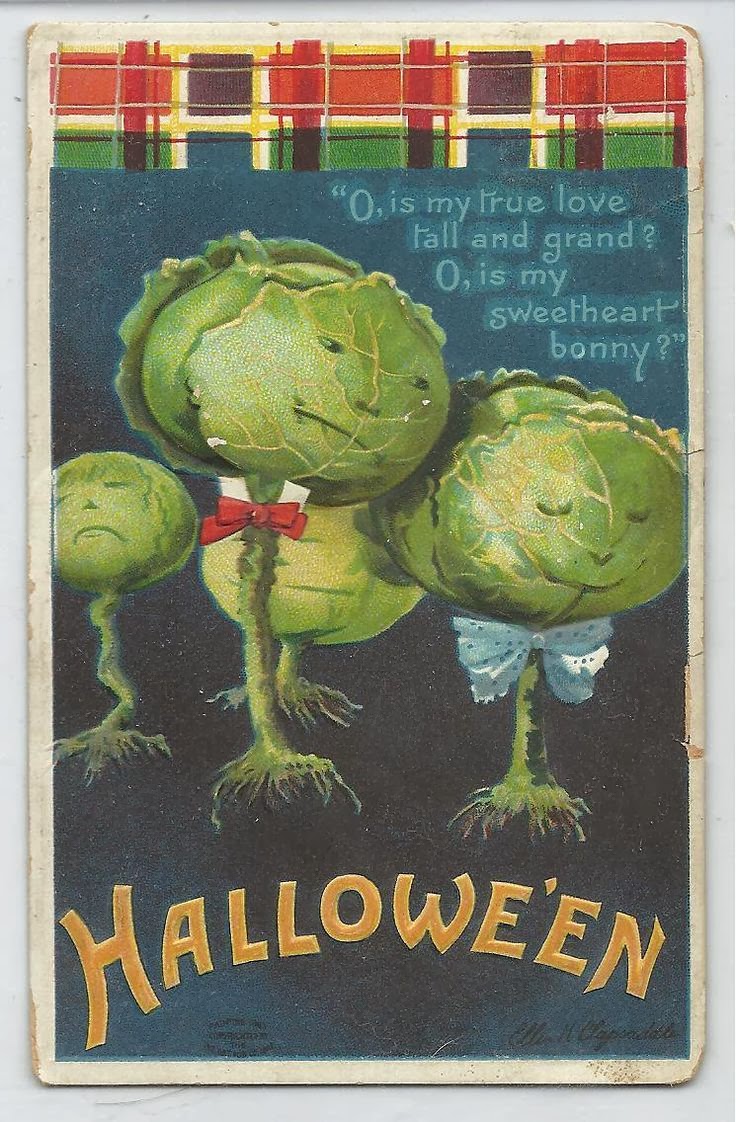
A vintage Halloween postcard with cabbages, from this great Pinterest board.


Happily, there were also more beneficial Halloween roles for cabbage to play. In Ireland, for example, cabbage and potatoes are ingredients in a dish called colcannon. At Halloween, colcannon would be served with a ring, coins, or other items hidden it. Each item foretold a specific future for the person who found it. The ring indicated a happy marriage, the coins wealth, etc.

Cabbage also had a magical role to play in New England once Halloween began to be celebrated here in the nineteenth century. Clifton Johnson found the following divinatory practice in western Massachusetts in the late 1800s:

On Halloween hang up a cabbage-stump over the door. The first person of the opposite sex that comes in is the one you will marry (What They Say In New England, 1896).

Fanny Bergen also found this more elaborate version in Massachusetts:

On Halloween a girl is to go through a graveyard, steal a cabbage and place it above the house-door. The one on whom the cabbage falls as the door is opened is to be the girl’s husband (Current Superstitions, 1896).

I like Bergen's version better. Not only does the girl need to walk through a graveyard (spooky!) and steal (breaking the law!), but her poor beau will get hit on the head by a cabbage (pranking!). It's a little more transgressive and therefore seems more Halloweeny to me. However, I don't condone trespassing, theft, or dropping cabbages on anyone.

Have a safe and happy Halloween, with or without your cabbage!