Showing posts with label love magic. Show all posts

October 21, 2018

Halloween Love Magic and Summoning Demons

People in 19th century New England often celebrated Halloween by performing love magic. Halloween did have the spooky supernatural aspect we love today but it was also a time for romance and discovering your future spouse. This was particularly true for girls or young women, who would perform a variety of rituals aimed on Halloween night designed to identify who they would marry.

These rituals were often called "projects," which sounds much less threatening than ritual, rite, or even magic spell. Still, they are clearly folk magic and folklore books from the 19th century contain many accounts of Halloween projects. They were performed with simple ingredients that almost anyone could acquire, like a cabbage, cornmeal, or a small dish of dirt.

One popular project requires nothing more than a ball of string. To find out the identity of your true love, do the following at midnight on Halloween. Take a ball of string and walk to a well, an old barn or an abandoned house. If none of those are available even a cellar or basement will do. You just need an empty structure of some kind. 

Turn your back and throw the ball of string over your shoulder into the barn, well or cellar. Then, with your back still turned, began to wind the string back into a ball. As you wind it, recite the following rhyme:

I wind, I wind, my true love to find,
The color of his hair, the clothes he’ll wear,
The day he is married to me.

Your true love should appear and wind the string with you. 

Someone in Maine contributed that to Fanny Bergren's 1896 book Current Superstitions. I can see why it would be appealing to a young person. You get to go someplace spooky at midnight (on Halloween no less), there's a special rhyme, and love is involved. It all sounds like harmless fun, right?


I think so, but apparently not everyone shares my opinion. A cautionary tale about this type of "project" appears in Frederic Denison's 1878 book Westerly (Rhode Island) and Its Witnesses. According to Denison, during the Revolutionary War two young women named Hannah Maxson and Comfort Cottrell were staying at the Westerly home of one Esquire Clark. One day while Mrs. Clark was bed-ridden from illness and the Esquire was away on business the two young ladies had to entertain themselves.

They decided to do some magic. Taking two balls of yarn, Hannah and Comfort went to a well and "tried to bring their beaus, by throwing each her ball of yarn into the well, and winding them off while they severally repeated a verse from the Scriptures, backwards." Completing their project, they proceeded to the front of the house to await the arrival of their true loves.

As the sun began to set they saw a tall figure walking down the road towards them. At first they were excited. Was it a rich handsome man? But as the figure drew nearer their excitement became terror. The tall figure was a monster! "It was some eight or ten feet high, and marched with a stately step, but with eyes, as they said, 'as big as saucers,' and breathing flame from his distended jaws." Hannah and Comfort fled into the house and hid behind the bed where Mrs. Clark lay ill and incapacitated. 

At this time Esquire Clark arrived home, entering through the back door. He could see through the glass panes over the front door "the steady unmistakable gaze of the demon" looking into the house.  Being a pious man, Esquire Clark immediately began to pray. At the sound of the holy words the monster departed into the darkness. Alas, its departure was too late for Mrs. Clark, whose weakened constitution could not endure the supernatural excitement and who died soon afterwards. The two young women gave up their experiments in magic and became devout Christians.

Frederic Denison found this story in a November 1860 issue of The Narragansett Weekly. It's author was one Deacon William H. Potter, a former resident of Westerly. Being a religious man, I guess his aim was to show the dangers of toying with the supernatural. I'm sure you noticed that the women in this story don't recite a cute little rhyme while winding the yarn. Instead, they recite Christian psalms backwards, a practice associated with summoning the Devil. The moral: folk magic will really summon the Devil, so don't do it!

Deacon Potter adds a strange epilogue to the story. Not being content to illustrate the dangers of magic, he goes on to claim the magic was not even real. According to Potter, the demon was actually a young neighbor, Daniel Rogers, who had seen Hannah and Comfort working on their project and decided to play a prank on them. Once it began to get dark he put a large pumpkin on his head and walked towards their house. He initially planned to reveal his identity but decided not to after seeing the terror he caused and learning of Mrs. Clark's death. Only seventy years later did he tell the truth about what had happened.


Gladys Tantaquidgeon, an anthropologist and Mohegan medicine woman, recorded a similar story from the Wampanoag of Martha's Vineyard in 1928. In this version of the story, a minister on Martha's Vineyard had four daughters. One night while he was away preaching they decided to try a "project." The details are not given, but it involved removing their undergarments and hanging them by the fireplace. Once they complete their spell a storm erupts and they hear something clawing at the door. The four sisters hide in terror. When their father comes home he sees a large monster, "part human and part animal" trying to enter the house, which departs upon his arrival. He warns his daughters to never play with magic again. 

Tantaquidgeon also recorded a version of the string project in 1928, but with a slightly different rhyme: "Here I wind, here I wind, here I hope my true love find." Her informant told her that your beloved would emerge from the well or cellar holding the other end of the string. 

The Puritan clergy who led New England's 17th century colonization were opposed to magic in all its forms, and you can still see that mentality lingering centuries later in these stories. I think you can also see concerns about women's independence and sexuality as well. These stories say, "See what happens when women try to control their own love lives? The Devil gets involved." Sadly I think that's another mentality that still lingers today. 

*****
Note: I found the Tantaquidgeon material in William Simmons's Spirit of the New England Tribes.

July 05, 2018

Magical Mullein: Witches, Love and Captain Marvel

Well, summer is in full swing. One nice thing about living someplace with long winters is that I really appreciate all the vegetation when it finally appears in the summer. Everything here is bare for so long in the winter months. Every bit of green looks great when it shows up, even the weeds.

I think "weed" is basically just a derogatory term. Really, a weed is just a plant growing somewhere people don't want it. It's not an actual scientific category. Many of the plants people call weeds have interesting histories and folklore attached to them. Some might even have magical powers. Intrigued? Read on.

One of the most dramatic weeds plants that appears in the summer is mullein. You've probably seen it because it's hard to miss. Mullein has a single stalk that grows up to six feet in height and is crowned by tiny yellow flowers. Its leaves are grey and lightly fuzzy. Mullein is very dramatic. It looks like it comes from another planet.

It doesn't, but it's not native to New England either. Mullein is indigenous to the Mediterranean and over time spread across Europe, Asia, and North Africa. When the Europeans colonized the New World mullein hitched a ride across the Atlantic with them. Its official name is verbascum thapsus, a Latin term whose origin is uncertain but is most likely derived from the words barba (beard) and Thapsos (a name of several Mediterranean cities). It's English name, mullein, probably comes from the Latin word mollis, which means "soft." And just an FYI, it's pronounced "mullen," not "mullane."


There are several varieties of mullein worldwide, but the plant that grows in New England is called "great mullein."' The plant also has several colorful folk names. Some are inspired by its long central stalk: Aaron's Rod, Jupiter's Staff, Peter's Staff and Shepherd's Club. Others come from its soft fuzzy leaves: Our Lady's Flannel, Blanket Herb and Beggar's Flannel. The dried plant was used as a torch, and its leaves as wicks for lamps and candles. Witches were said to be particularly fond of using the plant for these purposes, so mullein is sometimes called Hag's Taper. Very witchy!

Mullein can also be used to repel evil spirits and harmful magic. According to Mrs. Grieves's A Modern Herbal (1931):
Both in Europe and Asia the power of driving away evil spirits was ascribed to mullein. In India it has the reputation among the natives that the St. John's Wort once had here, being considered a sure safe-guard against evil spirits and magic, and from the ancient classics we learn that it was this plant which Ulysses took to protect himself agains the wiles of Circe.
Mrs. Grieves is referring to an incident in Homer's epic poem The Odyssey. Odysseus (Ulysses in Latin) and his men land on an island ruled by Circe, a witch-like goddess. She turns Odysseus's men into pigs, but Odysseus is given a plant called moly by the god Hermes which protects him from her magic.

On an interesting side note, perhaps you are familiar with the exclamation "Holy Moley!" This phrase was popularized in the 20th century by the comic book hero Captain Marvel, who would say it when he was faced with surprising situations.


The creators of Captain Marvel were well-versed in classical mythology; the Captain got most of his powers from the Greek gods when he shouted out the magic word "Shazam." The phrase "Holy Moley" (sometimes spelled "Holy Moly") seems to be older than Captain Marvel comics, though, and it's exact origin is unclear. Some theorists claim it is derived from "Holy Moses," others that it honored Teddy Roosevelt's adviser Raymond Moley, and still others claim it comes from the holy red thread of Hinduism, the mauli. Those are all good theories but I like the Greek mythology explanation the best, even if it is not really true.


And it turns out the great mullein plant probably was not really the one referenced in The Odyssey. Mrs. Grieves's theory has spread widely, but the great mullein doesn't really look like the plant described by Homer, of which he said "The root was black, while the flower was as white as milk..." That doesn't describe the great mullein.

Independent of its connection to Homer people have still ascribed magical powers to the plant. For example, in her 1896 book Current Superstitions, Fanny Bergen recorded the following belief from Newton, Massachusetts regarding mullein:

Twist a mullein-stalk nearly off after naming it. If it lives, he or she loves you; if not, not.

This is an example of the many simple love spells that are found in 19th century New England folklore. Most are aimed at determining if someone loves you. For example, if you think three people might be in love with you, you would take three apple seeds and name them after the three people. Then you would wet them with spit and stick them to your forehead. The last seed that falls off tells you who loves you.


This mullein spell works on a similar principle: the behavior of the plant indicates the intentions of the beloved. You think John Doe might be secretly in love with you. You find a mullein plant and name it "John Doe," and then twist the stalk. If the plant survives it means that John Doe really does love you.


Personally I don't think you should do this. Mullein has such a short growing season and is such an interesting plant. Don't hurt it! If you do want to work some magic with mullein, maybe you can wait until the fall and harvest the dried central stalk. Then you can use it as a torch to light your way to the Witch's Sabbath, which is probably more fun than going on a date with John Doe anyway.

*****

In addition to Wikipedia, my other additional sources were Pamela Jones's Just Weeds: History, Myths and Uses (1994) and Paul Beyerl's A Compendium of Herbal Magick (1998).

October 10, 2017

Apple Lore: Death, Love and Magic

The other day I went to the farmers market and was very excited to see a bin full of small greenish brown apples. I am an apple fanatic, and those little beauties were Roxbury Russets. They actually weren't much to look at, but they have a long history in New England. In fact, Roxbury Russets are the oldest type of apple grown in the United States.

Their origin is a little murky, but they are said to have first been discovered growing in Roxbury, Massachusetts way back in the mid-1600s. One source claims they were growing as early as 1649. The word "discovered" is a little puzzling. It implies that some hapless Puritan just stumbled upon an apple tree, but apples are not native to New England. The Roxbury Russet must have been introduced by someone, but who? I've read that William Blackstone, the first Englishman to live on  the Boston peninsula, grew apple trees on what is now Boston Common. Perhaps the Roxbury Russet is a wild American version of an English cultivar he planted, its seeds carried into the hills of Roxbury by a bird or beast.

That's just speculation on my part. According to folklore, the first person to grow Roxbury Russets was a colonist named Joseph Warren. He died falling off a ladder while picking apples. That story almost seems too ironic to be true, but death by apple may have been a common thing in Colonial New England. For example, a man named Peter Parker died in the 1700s when a giant barrel of his home-made cider rolled off a wagon and crushed him. This happened in his orchard on top of Roxbury's Mission Hill (formerly known as Parker Hill), near what is now McLaughlin Park next to the New England Baptist Hospital. I lived on Mission Hill for many years, and every fall a local neighborhood group gathered the apples that still grow in the park to make cider. Some of the trees in the park may be descendants of Peter Parker's original trees. No one ever reported seeing Peter Parker's ghost, though.

Roxbury Russet apples
Given the apple's Biblical connections with sin, death and sex, it's not surprising there is some weird apple folklore in New England. Some of it is downright creepy. Take the strange story of Roger Williams's corpse. Williams was the founder of Rhode Island, and in 1936 his descendants exhumed his body to move it to another location. They were horrified to find that the roots of a nearby apple tree had grown into Williams's coffin and apparently absorbed most of his corpse. There were very few bones left inside and the tree roots had taken the shape of Williams's body. The roots are now part of the collection at the John Brown House museum in Providence.

The legend of Micah Rood is similarly grim. Micah Rood was a surly farmer who lived in Connecticut in the 1600s. One night a traveling peddler came to Rood's house and asked if he could spend the night. Rood grunted that he could. In the morning the peddler's cold dead body was found lying underneath one of Rood's apple trees. The peddler had been murdered and his money and wares stolen. The town naturally suspected Rood but had no evidence to prove he was the killer. The next autumn, though, all the apples that grew from Micah Rood's trees had a single blood-red spot in their white flesh.

One end of the sin continuum is death, but the other end is sex, and apples are a key component in a lot of nineteenth century New England love magic. Most of it is focused on determining who your true love is. For example, here's a simple charm involving apple seeds. If you have several potential lovers in mind, take some apple seeds and name each seed after one of the potential mates. Wet the seeds and then stick them to your forehead. The last seed to fall off is the person you are meant to be with.

Similarly, you can take two apple seeds and name them after two potential lovers. Wet them. Put one seed on each eyelid. Blink rapidly. Whichever seed falls off last represents your true love.

You can also predict a lover's name using an apple peel. Remove an apple's peel so it comes off in one long piece. Throw the peel over your shoulder onto the ground. Turn around and examine the peel. What letter does it form? That letter will be the first letter of your true love's first name.

Those love charms are kind of cute and would make good party games. This last one is a little more spooky. Stand in front of a mirror holding a lamp (or candle) and an apple. As you eat the apple repeat the following words:

Whoever my true love may be
Come and eat this apple with me

Is your true love supposed to arrive in person or just appear in the mirror? I'm not sure. That charm is in Fanny Bergren's 1896 book Current Superstitions, and she notes that it is particularly effective when done on Halloween. If you dare to try it let me know what happens.

October 26, 2013

Halloween Magic: Grab Your Cabbage

A few weeks ago I was talking with some people at Boston's History Project about the misbehavior that is allowed during Halloween. During the conversation my friend Andrew, who grew up in western Massachusetts and is in his early 30s, said that when he was a kid the night before Halloween was called "Cabbage Night", and it was the designated time for pulling pranks on neighbors.

Halloween in the past was often a multiple day celebration, and each day had its own name. This tradition continues in some places. Detroit is infamous for its Devil's Night on October 30, and a few years ago I wrote about the multiple days of Halloween in Haverhill, Massachusetts in the 1930s. In Haverhill a Beggar's Night was celebrated on October 30, but the local youths also practiced vandalism on Cabbage Night on October 28.

So what's up with Cabbage Night? The connection between the humble cabbage and Halloween is not readily apparent unless you are a gardener, in which case you know that cabbage grows well in cooler temperatures. It can be harvested well into the autumn, and in the past when more people kept vegetable gardens heads of cabbage would have been easy targets for pranksters to steal (and throw).

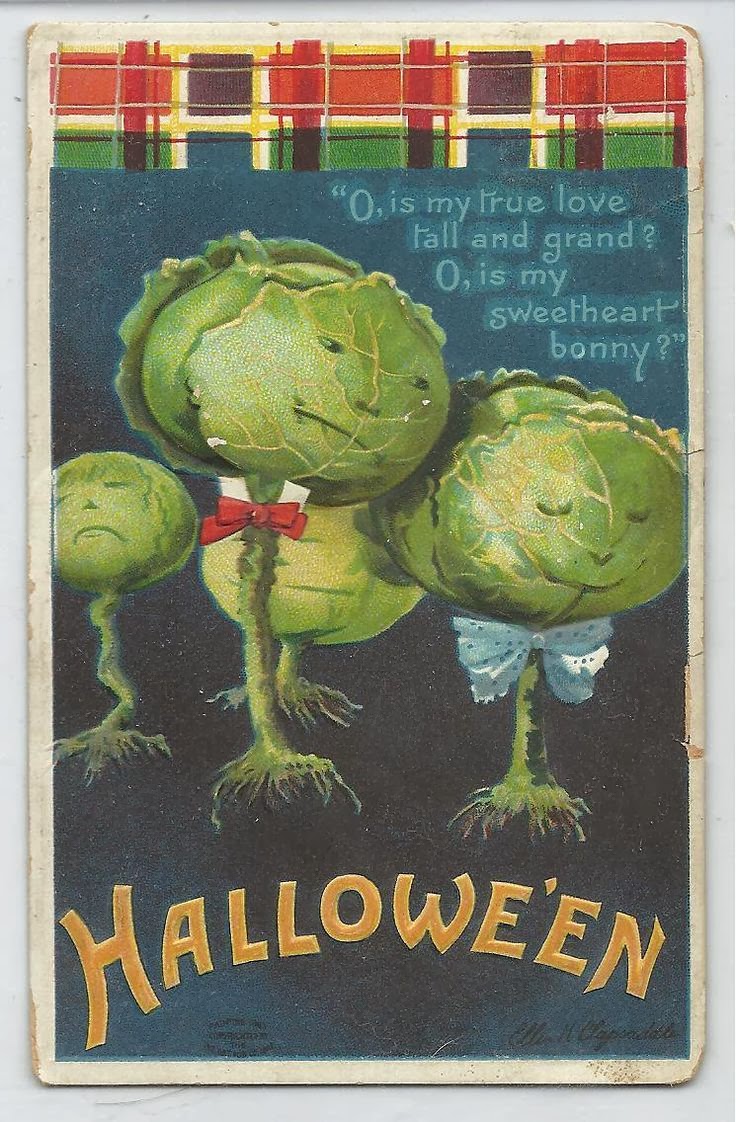
A vintage Halloween postcard with cabbages, from this great Pinterest board.


Happily, there were also more beneficial Halloween roles for cabbage to play. In Ireland, for example, cabbage and potatoes are ingredients in a dish called colcannon. At Halloween, colcannon would be served with a ring, coins, or other items hidden it. Each item foretold a specific future for the person who found it. The ring indicated a happy marriage, the coins wealth, etc.

Cabbage also had a magical role to play in New England once Halloween began to be celebrated here in the nineteenth century. Clifton Johnson found the following divinatory practice in western Massachusetts in the late 1800s:

On Halloween hang up a cabbage-stump over the door. The first person of the opposite sex that comes in is the one you will marry (What They Say In New England, 1896).

Fanny Bergen also found this more elaborate version in Massachusetts:

On Halloween a girl is to go through a graveyard, steal a cabbage and place it above the house-door. The one on whom the cabbage falls as the door is opened is to be the girl’s husband (Current Superstitions, 1896).

I like Bergen's version better. Not only does the girl need to walk through a graveyard (spooky!) and steal (breaking the law!), but her poor beau will get hit on the head by a cabbage (pranking!). It's a little more transgressive and therefore seems more Halloweeny to me. However, I don't condone trespassing, theft, or dropping cabbages on anyone.

Have a safe and happy Halloween, with or without your cabbage!

March 24, 2013

The Magic Easter Garter

Good Friday is coming up, which means Tony and I will run around the house and strike all our furniture with a piece of wood. Preferably, we should do this at noon. This is something that Tony's grandmother used to do, so we carry on the tradition the best we can. I'm not quite sure why we're supposed to do this on Good Friday. I think his grandmother mentioned scaring out the evil spirits, which sounds good to me. 

I'm writing about this not because it has any particular connection to New England folklore (his grandmother was Italian-American and from New Jersey), but as an example of the interesting folk practices that have become attached to the Easter season. Everyone is familiar with the Easter bunny and egg hunts, the most widespread American folklore associated with this holiday, but there are definitely some other curious traditions out there in the world.

In Sweden, little girls dress like witches at Easter-time and travel door-to-door, begging for candy. It sounds a lot like Halloween to me, but the Swedes claim that witches actually gather together before Easter to cause trouble. Are people buying them off by giving them candy? In neighboring Norway it is traditional to read mystery novels at Easter. Publishers release new mysteries the week before Easter, and most TV stations show mysteries.

Easter witches, from this site.

In Latin America and some Mediterranean countries people build bonfires and burn effigies of Judas Iscariot, while in Slovakia and the Czech Republic men traditionally spank or whip women on Easter Monday, a practice that supposedly maintains the women's beauty. The next day women retaliate by pouring buckets on cold water on men. I don't know if that makes the men look better, or just makes the women feel better.

All those examples are just a preface to this little piece of Easter love magic I found in Fanny Bergen's Current Supersitions (1896). Ms. Bergen collected this piece of foklore from an informant in Salem, New Hampshire:

Knit a garter and color it yellow. Don it on Easter Day. Wear it for a year. The wearer will be engaged before the year is out. 

The 19th century was ripe with love spells like this one, and they were associated with all kinds of holidays: Easter, Halloween, May Day, Midsummer's Day. After the Industrial Revolution people used magic less for life-and-death matters and more in those other domains where they felt powerless, like romance. Can't get the farmer down the street to give you a second look? Make a magic Easter garter and not only will he give you a look, he'll even propose.

I don't know where the tradition came from, but an informant from Maryland also told Ms. Bergen something similar. I assume it died out when people stopped wearing garters. If anyone knows anything else about the magic Easter garter please get in touch!

October 29, 2012

Mirror Magic for Halloween

Halloween wasn't really celebrated in New England until the 19th century. The Puritans frowned on most holidays although they and their descendants did celebrate Guy Fawkes Day, which has some similarities with Halloween like costumes and people roaming around begging for things.

Unlike Halloween Guy Fawkes Day doesn't have a supernatural component. No witches, ghosts or monsters, just raucous excess and drunken revelry. But when large numbers of Irish and Scottish immigrants began to arrive in the United States in the 19th century they brought Halloween and its supernatural practices with them. These Halloween practices spread across the country, through both immigrant social networks and magazines and newspapers. Eventually Halloween magic became part of the nation's regional folklore, including New England's.

Most modern Americans associate Halloween with scary things, but a lot of the older folklore deals with love magic and love divination. Here's a nice example I found in Eva Speare's New Hampshire Folk Tales.

On Halloween night, an unmarried man or woman should hold a mirror and walk down the cellar steps backwards. As they walk down the steps, they should repeat:

Whoever my true love is to be
Come and look in this glass with me.

A person's face will appear in the mirror, looking over the unmarried person's shoulder. This will be the person they will marry. However, if a coffin appears in the mirror the unmarried person will die. (Hmm. I guess even the love magic can be a little scary, and walking down the stairs backwards sounds dangerous.)

Watch your step with that mirror...

There once was a young man who was very sick with tuberculosis. Despite being weak from his illness, he walked down backwards into the cellar while looking into a mirror on Halloween night. His family heard a crash, and rushed down to find him collapsed on the dirt floor.

When he revived, the young man said, "Don't worry! I did not see a coffin, but instead saw a pretty young girl in a blue dress. I will live and marry her."

The prediction came true. He recovered and went on to become a school teacher in Maine. While he was there he met a pretty young woman who looked exactly like the girl he had seen in the mirror. Upon talking with her, he discovered that she had once owned a blue dress exactly like he had seen in the mirror that Halloween night. The two fell in love, got married, and lived long happy lives.

Happy Halloween everyone!

September 16, 2012

Some Apple Magic

September is apple season. I love going to the farmers market in my neighborhood to see what varieties they have, and sometimes we head out of the city and go apple picking. I love the sight, smell and of course the taste of apples!

This week over at Boston.com they ran an article about fifteen ways to use apples, ranging from barbecue sauce to apples. They don't mention you can use apples to tell the future, but you can.

Apples are associated in European and American lore with love and sex (thank you Adam and Eve!), so apple magic from New England tends to be focused on divining who your true love might be. There are many ways to do this, but here are a few of my favorites.

One of the easiest divinations is to pare an apple in one long piece, and then throw this long piece of peel over your shoulder. Look at the shape the peel makes on the ground. It should form the first letter of your true love's name. Some writers stress that you also need to twirl the apple peel three times around your head before you throw it over your shoulder.

This belief comes from England, where it was mentioned by John Gay in his comic 1714 poem The Shepherd's Week. The country maiden Hobnelia says,

I pare this pippin round and round again,
My shepherd's name to flourish on the plain.
I fling th' unbroken paring o'ver my head,
Upon the grass a perfect L. is read. 

She's happy with the result, since she's in love with a shepherd named Lubberkin. Yay!

You can easily do the apple paring divination surreptitiously while you are making a pie, but the next form of divination is a little harder to hide. Take two apple seeds, and give each the name of someone you think might be attracted to you. Wet the seeds in your mouth, and then stick them on your eyelids. Blink rapidly. Whichever seed falls off last is the person who will be your true love. If anyone walks in while you have apple seeds stuck on your eyelids just tell them you are exploring your New England heritage.

The two previous forms of divination are from Alice Morse Earle's 1902 book Old Time Gardens, Newly Set Forth. I think they're both kind of charming, but here's one that's a little spookier from Fanny Bergren's Current Superstitions (1896).

At midnight, stand in front of a mirror holding a lamp and a mirror. As you eat the apple, say the following:

Whoever my true love may be,
Come and eat this apple with me.

Your true love should appear, though I'm not sure if they will appear in the mirror or in person. Bergren notes that this charm works better if performed on Halloween. I will also note that sometimes the person who shows up in these love spells is not always what you expect.

There is of course a darker side to apple lore, which I have written about here, here and here. I describe some additional apple charms here. Enjoy apple season!

September 17, 2011

Looking for love, but finding Satan!


Love magic has a long history in New England. For example, the girls who started the Salem witch trials made a Venus glass, which was supposed to predict their future husbands. As we all know, once they started dabbling in magic they got more than they asked for.

Love magic continued for centuries here, and I found this story in Westerly (Rhode Island) and Its Witnesses by Frederic Denison, published in 1878. Once again young women are involved, and once again things get out of hand.

In the 1700s, two young ladies named Hannah Maxson and Comfort Cottrell were staying at the Westerly home of one Esquire Clark. One afternoon, while Mr. Clark was out on business and his wife was ill in bed, Hannah and Comfort became bored and decided to try some love magic. What could possibly go wrong?


They took a ball of yarn to the well, and repeatedly tossed it down and pulled it up, all the while reciting Biblical psalms backwards. According to popular belief at the time, these magical actions should make their future husbands appear.

As the sun went down, Hannah and Comfort went to the front of the house to wait for their beaus to manifest. Their thoughts turned to rich, handsome men.

Soon, they saw a figure walking towards them. Was it a future husband?

As the figure got closer, they noticed he was taller than the average man. In fact, he was between 8 and 10 feet tall. His height wasn't the only thing strange. His face was hideous - his eyes were the size of saucers, and flames spouted from his mouth.

Clearly, this was not what they expected.

The young ladies ran into the house, shrieking, and threw themselves onto the bed where Mrs. Clark lay ill. The monster, meanwhile, made his way to the front door.

At this point, Mr. Clark returned home. Seeing a large, and possibly demonic, monster in front of his house, the pious man began to pray. The prayers worked! The monster shuffled away, and was seen no more in Westerly.

Hannah and Comfort never used the Bible for magical purposes again, and lived very religious lives from that time on. Unfortunately Mrs. Clark died shortly after that night. The shock of having a monster from Hell on her stoop was too much for her weakened constitution.

It was only decades later that the people of Westerly learned it was not Satan who appeared that evening, but a fellow mortal. A man named Daniel Rogers, who had once been a neighbor of the Clarks, confessed he had really been the monster, and his demonic visage was merely a large jack-o-lantern. He wanted to play a prank on the girls, but had kept quiet for years afterwards out of guilt for causing Mrs. Clark's death.

That's the end of the story. It reminds me of an episode of Scooby Doo. The monster's real - no, wait, it isn't! The part about Daniel Rogers being the monster feels a little tacked on to me. Isn't this story really about the perils of unmarried young women with too much free time? A cautionary tale from a more patriarchal era?

I think so, and a very similar story recorded in 1928 among the Wompanoag of Gay Head proves my point.

Once upon a time, a Wompanoag minister had four daughters. One evening while he was out preaching, his daughters tried a little love magic that involved hanging their underwear in front of the fireplace. Soon a howling wind picked up, and they heard someone (or something?) pounding on the doors and windows of their house. The girls cowered inside, terrified. When the minister came home, he saw a large creature, half human and half animal, clawing at the front door. The monster disappeared into the night, and the minister reprimanded his daughters for raising spirits. (From William Simmons's Spirit of the New England Tribes (1986)).

I definitely like this version better. There's no Scooby Doo ending, just magic, a monster, and some teenage girls causing trouble. It could be the basis for someone's thesis in Women's Studies.