Showing posts with label apples. Show all posts

October 10, 2017

Apple Lore: Death, Love and Magic

The other day I went to the farmers market and was very excited to see a bin full of small greenish brown apples. I am an apple fanatic, and those little beauties were Roxbury Russets. They actually weren't much to look at, but they have a long history in New England. In fact, Roxbury Russets are the oldest type of apple grown in the United States.

Their origin is a little murky, but they are said to have first been discovered growing in Roxbury, Massachusetts way back in the mid-1600s. One source claims they were growing as early as 1649. The word "discovered" is a little puzzling. It implies that some hapless Puritan just stumbled upon an apple tree, but apples are not native to New England. The Roxbury Russet must have been introduced by someone, but who? I've read that William Blackstone, the first Englishman to live on  the Boston peninsula, grew apple trees on what is now Boston Common. Perhaps the Roxbury Russet is a wild American version of an English cultivar he planted, its seeds carried into the hills of Roxbury by a bird or beast.

That's just speculation on my part. According to folklore, the first person to grow Roxbury Russets was a colonist named Joseph Warren. He died falling off a ladder while picking apples. That story almost seems too ironic to be true, but death by apple may have been a common thing in Colonial New England. For example, a man named Peter Parker died in the 1700s when a giant barrel of his home-made cider rolled off a wagon and crushed him. This happened in his orchard on top of Roxbury's Mission Hill (formerly known as Parker Hill), near what is now McLaughlin Park next to the New England Baptist Hospital. I lived on Mission Hill for many years, and every fall a local neighborhood group gathered the apples that still grow in the park to make cider. Some of the trees in the park may be descendants of Peter Parker's original trees. No one ever reported seeing Peter Parker's ghost, though.

Roxbury Russet apples
Given the apple's Biblical connections with sin, death and sex, it's not surprising there is some weird apple folklore in New England. Some of it is downright creepy. Take the strange story of Roger Williams's corpse. Williams was the founder of Rhode Island, and in 1936 his descendants exhumed his body to move it to another location. They were horrified to find that the roots of a nearby apple tree had grown into Williams's coffin and apparently absorbed most of his corpse. There were very few bones left inside and the tree roots had taken the shape of Williams's body. The roots are now part of the collection at the John Brown House museum in Providence.

The legend of Micah Rood is similarly grim. Micah Rood was a surly farmer who lived in Connecticut in the 1600s. One night a traveling peddler came to Rood's house and asked if he could spend the night. Rood grunted that he could. In the morning the peddler's cold dead body was found lying underneath one of Rood's apple trees. The peddler had been murdered and his money and wares stolen. The town naturally suspected Rood but had no evidence to prove he was the killer. The next autumn, though, all the apples that grew from Micah Rood's trees had a single blood-red spot in their white flesh.

One end of the sin continuum is death, but the other end is sex, and apples are a key component in a lot of nineteenth century New England love magic. Most of it is focused on determining who your true love is. For example, here's a simple charm involving apple seeds. If you have several potential lovers in mind, take some apple seeds and name each seed after one of the potential mates. Wet the seeds and then stick them to your forehead. The last seed to fall off is the person you are meant to be with.

Similarly, you can take two apple seeds and name them after two potential lovers. Wet them. Put one seed on each eyelid. Blink rapidly. Whichever seed falls off last represents your true love.

You can also predict a lover's name using an apple peel. Remove an apple's peel so it comes off in one long piece. Throw the peel over your shoulder onto the ground. Turn around and examine the peel. What letter does it form? That letter will be the first letter of your true love's first name.

Those love charms are kind of cute and would make good party games. This last one is a little more spooky. Stand in front of a mirror holding a lamp (or candle) and an apple. As you eat the apple repeat the following words:

Whoever my true love may be
Come and eat this apple with me

Is your true love supposed to arrive in person or just appear in the mirror? I'm not sure. That charm is in Fanny Bergren's 1896 book Current Superstitions, and she notes that it is particularly effective when done on Halloween. If you dare to try it let me know what happens.

December 20, 2015

Snow Magic

There's an old New England saying that a green Christmas means a full graveyard. This is one of those classic reverse weather predictions, like a sunny Groundhog's Day indicating winter will last a long time. In this case, mild Christmas weather means the winter will be ferocious later on.

Friends in Vermont have posted pictures of snow, but we're definitely going to have a green Christmas down here in southern New England. But who knows? Myaybe we'll get walloped with snow later in the winter. Last year it was so warm and humid on Christmas that I saw a salamander on our front porch, and we all know what the rest of the winter was like for Boston.


So, in case we do get some snow this year, here are some snow charms from 19th century New England.

  • It's a sign of coming snow if your wood sizzles when you put it on the fire. 
  • The day of the month of the first snow storm indicates the number of storms in the year. So, it it snows on the 2nd you'll get two storms, if it storms on the 3rd you'll get three, etc. Let's hope the first storm doesn't happen on the 31st.
  • If the bottom of your teakettle is white when you take it off the stove, it means a snow storm is coming. 
  • Wish on the first snowflake of the season and your wish will come true. (It flurried here in October so it's too late for me!)

Those are from Fanny Bergen's book Current Superstitions (1896), but here are a few more from Clifton Johnson's What They Say in New England (1896).

  • Snow that comes in the old moon will stick around for a long time; snow that comes in the new moon will melt away fast. 
  • A snowy winter indicates a good harvest. 

Perhaps we shouldn't be too upset that we're having a green Christmas. According to Johnson, if the sun shines through the branches of an apple tree on Christmas it means there will be a good apple crop. I do like a good apple...

September 29, 2013

America's Oldest Apple Pie Recipe, Plus Some Strange Apple Stories

I'm taking a brief break from writing about the Devil and witchcraft because we are in the heart of apple season. It's been a great year for the New England orchards, and the trees are literally groaning under the weight of all those apples. Shhh! If you listen closely you can probably hear them.

Although I live in Boston my neighborhood used to be an agricultural area, and the streets near me are still lined with apple trees. There are so many apples this year they are literally rolling down the sidewalks. The Roxbury russet, the first variety of apple grown in North America, was domesticated not far from where I live now. My neighbor has a Roxbury russet tree growing in the backyard.

Apple pie is the quintessential American dessert, and I can't even begin to guess how many recipes for it exist. My mother always makes hers with a crust made from vegetable oil. The crust is really difficult to roll out, but after baking it's flaky and thin, almost like a puff pastry or phyllo dough. Delicious!

I was curious about the oldest American recipe for apple pie, so I looked at Amelia Simmons's 1796 book American Cookery. The first cookbook published in America (in Hartford, Connecticut, to be exact), American Cookery's recipes have their roots deep in New England's history. But even two centuries ago there were multiple recipes for apple pie - Simmons includes two.

The first recipe is just called "Apple Pie." Note that the "paste No. 3" Simmons references is a pastry crust recipe in her book made from flour, butter, and eggs.


Stew and strain the apples, to every three pints, grate the peal of a fresh lemon, add cinnamon, mace, rose-water and sugar to your taste--and bake in paste No. 3.

This recipe is a big change from most contemporary apple pie recipes because it involves cooking the apples first. Stewing the apples first probably sped up the baking time, which would have been helpful to cooks at that time who were baking in their fireplaces. The lemon, cinnamon and sugar are still used, but I think most people now would substitute nutmeg for mace. Mace comes from the same nut as nutmeg, but is kind of hard to find these days in supermarkets. I don't think very many people still use rose-water in their apple pie. It's just not a flavor we associate now with fall cooking.

Simmons's second recipe is perhaps a little more similar to modern recipes, but there's still a twist or two. Here's her recipe for "A Buttered Apple Pie":

Pare, quarter and core tart apples, lay in paste No. 3, cover with the same; bake half an hour, when drawn, gently raise the top crust, add sugar, butter, cinnamon, mace, wine or rose-water.

So this recipe involves putting the cut and peeled apples into a pastry crust and baking it for a while, which we still do, but strangely without any of the spices or sugar. They're are added in after the top crust is cooked enough to lift it off. Again, it seems like the recipe is designed for ovens that took a long time to cook, and it also involves rose water or wine. 

OK, those are America's two oldest apple pie recipes! I think they're kind of quirky and interesting, but if you're not a baker and want to read some really strange things about apples I'd suggest these past posts:


Enjoy apple season while you can. It's all too brief.

March 03, 2013

UFOs in Derry, and Bigfoot in the Orchard

My tastes in New England folklore are pretty broad. Sometimes my attention is captured by a 17th witchcraft story, sometimes by something more contemporary and paranormal. I say that because I was planning to write about an old witchcraft story from the New Hampshire mountains today, but at a party last night someone told me something too good to ignore. The witch story will wait until next week.

My friend David lives on Beaver Lake in Derry, New Hampshire. While talking with him at a birthday party for a mutual friend he asked me if I knew about the UFOs that had been seen in his neighborhood. When I said no, he pulled out his cellphone and showed me this video:


I don't know if the video is real or not, and I certainly don't like the creepy "UFOs are Satanic" preface. However I do think it is interesting and, like all UFO videos, a little freaky. What are these lights? Why are they hovering over a small lake in a residential neighborhood? I'm sure we'll never have authoritative answers to those questions, but David said he and his neighbors have also seen the lights in the sky.

As I wrote a few years ago, Beaver Lake is connected with some of the rare fairy folklore found in New England. A fairy named Tsienneto supposedly lived in the lake, and helped local heroes Hannah Duston and John Spark (who coined the phrase "Live free or die").

Some authors who write about the paranormal, like Patrick Harpur or Jacques Vallee, claim fairies and UFOs are two sides of the same coin. They're both both visitors from another world, but while our ancestors often placed this other world underground or in a mystical realm, we place it in outer space. Maybe Tsienneto has just upgraded her mode of transportation.

By the way, this isn't the first time UFOs have been seen in Derry. In October 1973 multiple witnesses saw a UFO splash into the waters of Rainbow Lake. According to an article in the Derry News, police divers searched the lake but did not find anything.

Here's another interesting video I found while poking around on YouTube. The video was uploaded recently, but apparently it is really from 2010. A Hubbardston, Vermont man noticed that apples had been disappearing from his orchard. When he set up a camera to capture the thief he got a photo of Bigfoot!


I love apples myself, so I can sympathize with Bigfoot here.

Next week I'm going to write about something "Olde Tyme", but as this week's videos show lots of strange things continue to happen in New England. 


November 18, 2012

Boiled Cider Pie

Thanksgiving is one of New England's great gifts to American culture. Originating in Puritan feast days, the holiday gradually spread across the country bringing turkey, stuffing and pies with it.

Modern Americans eat a wide variety of pies on Thanksgiving, many of them unrelated to the holiday's origins in New England. Let's face it, the Puritans weren't eating coconut cream or key lime pie, so a few years ago I wrote about the obscure pies of old New England, like squash pie, mincemeat pie, and boiled cider pie.

At the time I had never eaten or made a boiled cider pie, but this year in honor of Thanksgiving I decided to give it a try. I was really happy with the results.

Boiled cider is not something you see in many 21st century pantries. Its use has been recorded as early as the 1670s in western Massachusetts, and it was a common sweetener in the Colonial era. It makes sense. Molasses and sugar were expensive imports, but apple cider was locally produced and inexpensive. You can still buy boiled cider at country stores in northern New England and online from the King Arthur store, but I decided to make my own using instructions from an old Yankee Magazine cookbook.


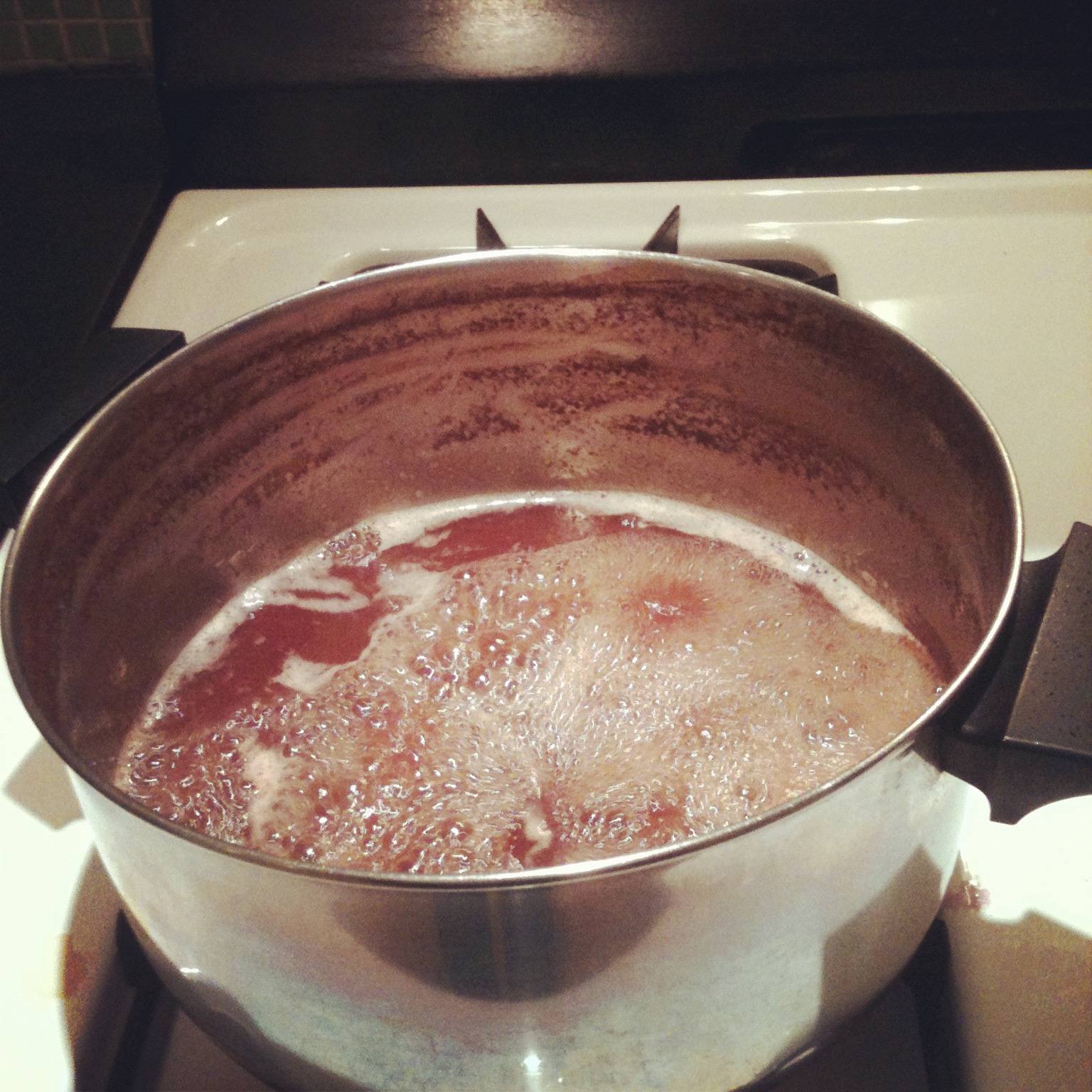
It was easy, but took a long time. I poured a gallon of cider into a large pot, and then boiled it at high heat until it was reduced to a single cup of gelatinous goop. Even though I boiled it over high heat it still took around two and a half hours! I didn't need to stir it much until the end when it was really getting thick.
Boiling, boiling, boiling...
... Still boiling more than two hours later!

What I had after two hours and thirty minutes of boiling.
After it cooks down to a cup, let it cool. I put it in the refrigerator but I don't know if this was the smartest move. The boiled cider became almost completely solid which made it harder to use in the recipe. I would recommend letting it cool on the counter or maybe not boiling it down as much. The cider that is sold commercially is more syrupy and less goopy than what I made.

There are a few boiled cider pies floating around on the web, but I liked this one from Wood's Cider Mill in Vermont, which has been owned by the same family for seven generations. They make and sell boiled cider so I figured they must know what they're talking about. Also, their recipe is simple and really focuses on the boiled cider as the main ingredient. I baked the pie for an hour, which is 10 minutes longer than the recipe instructs, but that could just be my stove.

Sugar, eggs, milk, a little flour, and boiled cider. Mix it well because that boiled cider is thick!

It's looking a little  like pumpkin pie, but don't be fooled.

Boiled cider pie - sweet, tart, goopy and historic!
The pie came out great. Its consistency is similar to a custard or pumpkin pie, and although it's really sweet the sweetness is cut by the cider's tartness. If you like cider, sugar and pie crust (and who doesn't?) you will like this pie. It's like autumn, New England, and three centuries of history all in one dessert.

Have a great Thanksgiving!

October 22, 2012

Richard Carrier: Confessions of a Cider-Drinking Witch

Richard Carrier was only eighteen years old when he and his younger brother Andrew were accused of witchcraft.

He was quite surprised, but should he have been? His mother, Martha Carrier, had recently been accused of witchcraft herself, and the Carrier family had never been popular in Andover, Massachusetts. They were considered poor even by the low standards of 1692 New England, and they were also pugnacious - Richard had been in fistfights with several other men and boys. When smallpox struck their family they had lived as pariahs on the outskirts of town.

When the constables brought Richard and his brother to Salem for questioning, they were obviously terrified. (Records note that Andrew was so frightened he stuttered when he spoke.) Both brothers pled innocent, but the afflicted girls who had accused them convulsed wildly in their presence, indicating guilt. The Carrier boys were brought into an adjacent room, where the questioning continued privately and the constables tied their heads to their ankles. Under this torture, they confessed to being witches.

When he was returned to the courtroom, Richard told how the Devil had first approached him on the Andover road one night in May of 1691. The dark man in the high-crowned hat claimed he was Jesus, and offered Richard new clothes and a horse in return for making his mark in a red book. A tempting offer for a poor Puritan, and Richard signed. His initiation was complete when the Devil baptized him in a waterfall at Newbury, Massachusetts. His brother Andrew later signed the Devil's book in an apple orchard in the presence of Richard and their mother.


As a witch, Richard followed Satan's orders. He sent his spirit to torment Timothy Swan of Andover, who had argued with another witch about the price for thatching her roof. Richard used a simple poppet to torment the wife of Salem Village's minister Samuel Parris. He attended the witch meetings, which his spirit was summoned to by the beating of a drum.

And he drank stolen cider. 

Mary Lacy, who had been accused of witchcraft shortly before the Carrier brothers, had told the court that she, the Carrier family, and other witches had flown to the home of Elizabeth Ballard and drunken all the cider in her cellar.

"Sometimes we leave our bodies at home, but at other times we go in our bodies and the Devil puts a mist before their eyes and will not let them see us." Mary Lacy had drunken the cider while invisible.

Richard confessed to this as well, but said his spirit had done it while outside his body. Mary Lacy supported his confession. "He went in his spirit, and his body lay dead the while out of doors."

After he confessed, the afflicted girls touched his hand without convulsing, a sign of his true contrition. The court spared Richard and Andrew's lives because they had confessed to witchcraft. Their mother never confessed, and was hanged. 

***

There are lots of things I find interesting about Richard Carrier's story. For example, he was male (most of the accused witches in Salem and New England overall were women) and the torture he and Andrew endured is horrifying.

What struck me the most, though, was the cider. Richard and all the confessed witches created stories about their witchy exploits that were believable to their accusers. People in Puritan New England believed in the reality of witches; it was part of their shared worldview. Everyone knew what witches did. All it took was a little persuasion (or torture) to tell a convincing story about your own actions as a witch.

And apparently, witches sent their spirits or invisible bodies to drink their neighbors' cider. Elizabeth Ballard's cider would have been alcoholic cider, which was one of the main drinks at the time. Water was often polluted, tea was expensive, and grain for beer was too hard to grow. People drank hard cider morning, noon and night.

Spirits entering a house to drink liquor (or eat food) is an old folklore motif. For example, the Swedish historian Olaus Magnus wrote in his History of the Northern Peoples (1555) that at Yuletide werewolves break into cellars to drink beer and mead. The line between werewolves and witches is blurry, since both are shapeshifters. Many people who confessed to being werewolves talked about sending out their spirits in the shape of a wolf, much as witches sent their spirits to do mischief.

We don't believe in these things in the 21st century, of course, but a surprising number of people leave out milk and cookies for Santa on Christmas Eve. But that's just for children, right?


In parts of Medieval and Renaissance Europe it was believed that a night-riding goddess and her followers (sometimes called the Good Ladies) traveled across the countryside. To gain their favor, people would leave out food and beverages for them. In the British Isles, food was left out for faeries and elves. In many countries, food and beverages are still left out for the wandering spirits of the dead who might enter the home.

The origins of this belief in traveling spirits that enter your house to eat and drink is quite murky. Writers like Carlo Ginzburg and Claude Lecouteux trace it back to ancient shamanic practices and ideas about the dead. It sounds good to me. Apparently it is a very resilient belief that has changed shape and expressed itself differently over time.

For Halloween, maybe I'll leave out some cider for who or whatever is wandering around that night, and be thankful that I can write about this topic without being tortured. 

***

I got the information about Richard Carrier from Marilynne Roach's wonderful The Salem Witch Trials: A Day-by-Chronicle of New England Under Siege.  This is the book if you want to read a straightforward and detailed narrative of what transpired in Salem.

September 16, 2012

Some Apple Magic

September is apple season. I love going to the farmers market in my neighborhood to see what varieties they have, and sometimes we head out of the city and go apple picking. I love the sight, smell and of course the taste of apples!

This week over at Boston.com they ran an article about fifteen ways to use apples, ranging from barbecue sauce to apples. They don't mention you can use apples to tell the future, but you can.

Apples are associated in European and American lore with love and sex (thank you Adam and Eve!), so apple magic from New England tends to be focused on divining who your true love might be. There are many ways to do this, but here are a few of my favorites.

One of the easiest divinations is to pare an apple in one long piece, and then throw this long piece of peel over your shoulder. Look at the shape the peel makes on the ground. It should form the first letter of your true love's name. Some writers stress that you also need to twirl the apple peel three times around your head before you throw it over your shoulder.

This belief comes from England, where it was mentioned by John Gay in his comic 1714 poem The Shepherd's Week. The country maiden Hobnelia says,

I pare this pippin round and round again,
My shepherd's name to flourish on the plain.
I fling th' unbroken paring o'ver my head,
Upon the grass a perfect L. is read. 

She's happy with the result, since she's in love with a shepherd named Lubberkin. Yay!

You can easily do the apple paring divination surreptitiously while you are making a pie, but the next form of divination is a little harder to hide. Take two apple seeds, and give each the name of someone you think might be attracted to you. Wet the seeds in your mouth, and then stick them on your eyelids. Blink rapidly. Whichever seed falls off last is the person who will be your true love. If anyone walks in while you have apple seeds stuck on your eyelids just tell them you are exploring your New England heritage.

The two previous forms of divination are from Alice Morse Earle's 1902 book Old Time Gardens, Newly Set Forth. I think they're both kind of charming, but here's one that's a little spookier from Fanny Bergren's Current Superstitions (1896).

At midnight, stand in front of a mirror holding a lamp and a mirror. As you eat the apple, say the following:

Whoever my true love may be,
Come and eat this apple with me.

Your true love should appear, though I'm not sure if they will appear in the mirror or in person. Bergren notes that this charm works better if performed on Halloween. I will also note that sometimes the person who shows up in these love spells is not always what you expect.

There is of course a darker side to apple lore, which I have written about here, here and here. I describe some additional apple charms here. Enjoy apple season!

February 26, 2012

The Ghost of Enoch Pratt

Here's a great little ghost story I found in John Hanson Mitchell's book Ceremonial Time.

Back in the 1700s a wealthy farmer named Jeremiah Caswell lived in Littleton, Massachusetts. He owned many acres of fertile cropland, as well as an extensive apple orchard. Jeremiah had a son named Adam, and a daughter named Eve. Eve was quite beautiful.

When she was a young woman, Eve fell in love with Enoch Pratt, a hard-working farm boy from a modest background. They would meet illicitly almost every night in the apple orchard, where they were safe from prying eyes. Eve was afraid that her father would disapprove of their love.

One night Jeremiah secretly followed his daughter out to the orchard and saw her meet Enoch. To the young lovers' surprise, Jeremiah saw they were genuinely in love and gave his blessing. Eve and Enoch became engaged.


Before they could celebrate their wedding, however, Enoch was called away with other local men to fight in the the French and Indian War, which was raging to the west.

The might before he departed, he and Eve met once again in the orchard. "Swear to me you'll return," Eve said.

Holding her tight, Enoch said, "I will, in body or spirit."

Eve said, "And I will meet you."

Enoch left for the war, and a few months later word came to Littleton that he had been killed in the fighting. Eve was devastated by the news but carried on with her duties on the farm.

One night, as she was walking by the orchard, she heard someone calling her name. It was Enoch! Eve was overjoyed and ran to greet him, thinking that his death was falsely reported.


As she wrapped her arms around Enoch, though, she noticed that his body was unnaturally cold, and that his eyes stared lifelessly. Enoch did die, and his ghost had returned to Littleton. Terrified, Eve ran to her father's house and told him what she saw under the apple trees.

And do you know what her father said?

He said, "If you vowed to meet him, Eve, you must meet him, in the flesh or in the spirit."

Eve returned to the orchard that night and consummated her marriage with Enoch. All through that fall and winter Enoch called out her name from the apple orchard, and Eve would dutifully leave her bed to join him under the dark trees. Eve became weaker and weaker, and finally died when the spring came.

Although Eve passed over to the other side, Enoch's ghost lingered in Littleton. Locals reported seeing him throughout the 1800s, calling Eve's name in the woods and orchards. His ghost was even seen in the Caswell house.

His ghost was last seen in 1975, when a Littleton man who had been walking in the woods reported seeing a twenty year old man with his black hair pulled back, dressed in Colonial attire, with a mournful look in his eyes.

February 05, 2012

Sally Somers, the Witch of Southwest Harbor

Which is scarier - a ghost, or an evil witch? If you visit Southwest Harbor, Maine you don't have to choose because it's haunted by an evil witch's ghost. You'll get two supernatural creatures for the price of one!

Sally Somers was born in 1791 to Elsie Somers, a witch who was known for extracting tribute from sea captains to guarantee safe passage of their ships, but also for using herbs to heal the sick. I suppose you could call Elsie morally neutral, since she was just trying to make a living from her dark arts.

Sally, on the other hand, was just no damn good.

Sally bewitched a young man named John Clark into marrying her. He spent much of their marriage wandering around in an enchanted, zombie-like daze. John tried to escape Sally's spell by booking passage on a ship bound for Europe, but disappeared before the it set sail. Everyone suspected Sally, but since his body was never found she wasn't charged with a crime.

According to another legend, Sally sacrificed two black dogs on the top of a nearby mountain so she could assume their form when she sent her spirit out to cause mischief. These devil dogs roamed through the area, terrifying the locals and sometimes drinking blood. Creepiest of all, they were said to have human eyes.

Like all successful witches, though, Sally's preferred to take the form of a black cat when she wanted to cause trouble. In this shape Sally would spy on her neighbors and find out if anyone was gossiping about her. Those who did usually came to a bad end. This black cat was also said to have human eyes.

Sally's reign of terror ended when one of her neighbors, tired of all the witchy shenanigans, fashioned a silver bullet and shot the spectral black cat. It died instantly, and Sally passed away three days later.

That was in 1832, but Sally's malefic influence supposedly still lingers around Southwest Harbor. The apples that grow on a tree near her house allegedly cause illness, accidents and even death to anyone who eats one.

In 2004, a woman named Daisy Harper was concerned for her mother's well-being because she was working in Sally's former home. Hoping to appease Sally's ghost, Daisy dropped an offering of colored stones into a crack in the apple tree's trunk. The stones fell for a long, long, long time before they hit the bottom. I don't think we want to know what's lurking under Sally's tree.

Daisy had good reason to be concerned about her mother. The furniture in Sally's house sometimes moves on its own, and it's said that anyone who breaks a pane of glass will die shortly afterwards. One window that overlooks the harbor even has an imperfection in it that looks like a witch.

If you ever go hiking near Southwest Harbor, be careful. The locals say a large black cat with human eyes haunts the woods. I guess Sally's spirit is still out there causing trouble.

I found this story about Sally in Marcus LiBirzzi's Ghosts of Acadia. If you like lurid stories about ghosts, this is the book for you.

September 20, 2009

Apple Love, and Some Media Updates


Adam and Eve go apple-picking!

My last post was about the ominous side of apples. Today, I thought I'd share some happier lore. Sure, apples have a bad reputation in Western culture because of that incident in the Garden of Eden, but that story isn't just about sin, it's also about love. If Adam and Eve (or Steve) hadn't eaten the forbidden fruit, there'd be no love in the world!

Discovering the identity of your true love through magic was widespread in New England in the 1800's. I think some of it spread through the magazines of the time, but some may also have been brought over with the Puritans. Apples figured prominently.

To figure out if someone loves you, split open an apple and count the seeds. The number of seeds inside determines where the relationship is heading. There is a chant that goes like this:

One I love,
Two I love,
Three, I love, I say
Four, I love with all my heart,
And five I cast away;
Six he loves,
Seven she loves,
Eight they both love;
Nine he comes,
Ten he tarries,
Eleven, he courts,
Twelve he marries;
Thirteen wishes,
Fourteen kisses,
All the rest little witches.

There's another way to use apple seeds to predict love. Let's say you're romantically interested in multiple men. Take some apple seeds, and assign the name of a potential lover to each. Wet the seeds and stick them on your forehead. The one that falls off last is the person you're meant to be with.

Those are quoted in Botkin's Treasury of New England Folklore, but are originally found in William Wells Newells' Games and Songs of American Children and Alice Morse Earle's Old Time Gardens.
******************************

New England folklore has been appearing in the media lately. Today's Boston Globe has an article about George's Island, including the ghost who is supposed to haunt Fort Warren, something I wrote about a while ago.

The October 2009 issue of Martha Stewart Living has a brief article about New England gravestone art. There are some nice photos of historic Massachusetts cemeteries in Haverhill, Salem and Ipswich. Martha Stewart can even make death look tasteful. I don't think the article is online, but you can see many grave stones from across New England at A Very Grave Matter.


September 10, 2009

Death by Apples


Roxbury Russet apples from Flickr.

An article in the Boston Globe noted that the apple crop has been particularly good this year. The cool rainy weather that ruined things like tomatoes and eggplant has been perfect for apples. So, get out to your local orchard or farmers' market and get a bag of local apples!

There's a lot of folklore about apples in New England, much of it spooky. I guess apples pair with strange deaths as well as they pair with pie crust. I've mentioned bloody Micah Rood apples and the apple tree that ate Roger Williams' body earlier, but the very introduction of apples into New England was a cause for misery and death.

The first named variety of apple cultivated in New England and the the United States was the Roxbury Russet. Named for the Colonial town of Roxbury (now a Boston neighborhood), and the apple's greenish brown color, the Roxbury Russet was in cultivation by the mid-1600's. Some sources say it was being grown as early as 1649. I guess apples were a high priority for the English, since they only settled the Boston area in the late 1620s.

According to a book called Apples of New York State, an English settler in Roxbury named Joseph Warren was the first person to grow the Roxbury russet. He died in 1755 when he fell off a ladder while picking apples and broke his neck. (I got that little tidbit here).

The idea that Joseph Warren was killed by the very thing he was famous for makes this story seem mythic to me. Not mythic in a "what a lie" way, but in a "Wow! That's seems to make strange sense" way. I'm not saying it isn't true, but the story wouldn't be as resonant if he died in bed from pneumonia.

When I read the Roxbury Russet story I was reminded of a similar "death by apple" story. Strangely, it's also from Roxbury.

I live on Mission Hill in Boston, which is part of Roxbury. Mission Hill used to be called Parker Hill, after the wealthy Parker family which lived here in the 1700's. Back then, the hill was quite agricultural and covered in orchards. Peter Parker, the scion of the family and owner of the hill, also met his end through apples. He was crushed by a barrel of his own cider when if fell off a cart. (This tidbit is from Samuel Francis Drake's book The Town of Roxbury: Its Memorable Persons and Places, Its History and Antiquities, with Numerous Illustrations of Its Old Landmarks and Noted Personages.)

Although Mission Hill is now quite urban, it still has a lot apple trees. They grow in people's yards, and the park at the top of the hill actually has an orchard in it. One of my neighbors has an apple tree, and he told me it is indeed a Roxbury Russet. The agricultural past peeks through into our modern urban neighborhood.

I feel I should wrap up this post on a dramatic note, like "And I've seen the bloody ghosts of Peter Parker and Joseph Warren wandering in the orchard!" I haven't though, so the stories will have to stand on their own.

October 06, 2008

Flesh Eating Apples, Blood-Sucking Pumpkins


As we move into October (Halloween season!), I'm starting to feel spooky.

I eat a lot of apples, but did you know that apple trees eat humans? Shockingly true. The most famous case of a man-eating apple tree comes from Rhode Island.

In 1936, the descendants of Roger Williams, the founder of Rhode Island, decided to move his remains to a monument befitting his fame. As they dug into his grave, they make a strange discovery: the roots of a nearby apple tree had worked into his coffin and assumed the shape of his skeleton. Very few bones remained, so the assumption is that the roots absorbed all of the organic matter (i.e., his skeleton). The man-eating root is on view at the John Brown House in Providence.

Apparently other fall produce likes to feast on flesh. The Boston Globe ran an article about a farmer in Sharon, Massachusetts who is on track to grow the world's biggest pumpkin. It already weighs 1,878 pounds and is still growing. What does this pumpkin eat to get so big? The farmer feeds it "ground bone, blood, fish, molasses, and cow and chicken manure." Yikes! The molasses is a nice Yankee touch, but the ground bone and blood are kind of creepy. It's probably better not to ask what type of blood...