Showing posts with label divination. Show all posts

November 20, 2023

Fowl or Fair: Thanksgiving Weather Magic

Thanksgiving is fast approaching. It's the holiday most closely associated with New England, having its origin in the old Puritan tradition of celebrating thanksgiving days. Many of the foods we associate with the holiday, like cranberries, pumpkins, and turkey, are also foods indigenous to New England. 

This is a New England-centric blog, and I like to post something about Thanksgiving each year. So here, from 19th century Massachusetts, are some ways to predict on Thanksgiving what the weather will be during the upcoming winter:

Method #1 - Examine the feathers of your chickens. Do they seem particularly thick? If so, a hard winter is on its way.

Method #2 - Examine the breastbones of your chickens (after you have cooked and eaten them, sadly). Do they seem particularly light in color? If so, you can expect a lot of snow. If they are dark, you won't get much snow at all.

Method #3 - Look at the breastbone of your goose (again, after you have cooked and eaten them). Is it particularly dark? Yes? You can expect more rain than snow.

James Audubon, Wild Turkey, 1825

On the surface, method #1 appears to be the most "scientific." It seems logical that chickens will grow heavier feathers if a cold winter is coming. But do chickens' bodies somehow intuit what the weather will be like in the future, and then grow extra feathers in response to it? Do they actually grow heavier feathers if the next few months will be cold? I don't know think that's true. Chickens do tend to molt in the fall, but I don't think their feathers grown back heavier if the future weather will be cold. 

Method #2 seems more magical, and relies on similarity in color:  white breastbone = white snow. Method #3 also relies on magical color similarity, but doesn't predict if heavy snow is coming, only the proportion of rain to snow. I guess this is because of the goose's affinity for water? I suppose eating both chicken and goose would give you the most accurate forecast, telling you if you'll get more snow than rain, and also how heavy the snow will be.  

I found these methods of predicting the weather in Clifton Johnson's 1897 book What They Say in New England. Interestingly, there's no weather prognostication centered on turkey bones. Turkeys have long been the centerpiece of the Thanksgiving feast, but the magic associated with turkeys is focused on the wishbone

There are other forms of folk magic based on fowl. For example, Fanny Bergren's 1896 book Current Superstitions contains this unusual piece of advice from Winn, Maine:

"Swallow a chicken's heart whole, and the first man you kiss afterwards will be your future husband." 

Chicken hearts apparently had a lot of magical power, because elsewhere in the book Bergren notes the following:

"Swallow a chicken's heart whole and make a wish. It will come true." 

I don't think people eat a lot of chicken hearts these days, and even if you do I don't recommend swallowing them whole. You won't get married and your wish won't come true if you choke to death on a chicken heart. Chew your food!

I'm vegetarian, so I'm not eating any of these birds next week. I couldn't find any weather magic involving pumpkins, potatoes or Tofurkey, so let know if you try any of these divinations. I want to be prepared for the winter weather! 

May 08, 2021

Chloe Russell: "The Old Witch or Black Interpreter" and Her Dream Book

Chloe Russell was born in 1745, about three hundred miles southwest of Sierra Leone. At the age of nine she captured by slave traders, brought across the Atlantic, and sold to a Virginia plantation owner named George Russel. When Russel died his cruel and violent son inherited the plantation. He was incredibly abusive towards Chloe, and she contemplated suicide:

Such a cruel treatment at length drove me to the resolution of destroying myself!... But the night previous, I dreamed that I saw my father, who told me that he had just come from the world of spirits, where there was nothing but joy and happiness. He informed me that he was killed by the fire of the Baccaranas (white slavers) twenty moons after I was captured by them, in attempting to rescue my mother, whom they had taken. 

He said that he had been made acquainted with my resolve to destroy myself, and had come to persuade me not to do it, as it would soon be well with me, and I should be free from my master. This singular dream made such a deep impression upon my mind, as to deter me from committing suicide the succeeding day... (Chloe Russell, The Complete Fortune Teller and Dream Book, 1827)

Things didn't improve for Chloe though, so she once again contemplated suicide. Her father appeared to her again in a dream, this time accompanied by a spirit clad in purple who gave Chloe the ability to foretell the future:

Young woman, stay thy hand and raise it not against thy own life, for thy afflictions shall shortly cease. Thy unjust punishments have enkindled the the wrath of the Most High, who has commissioned me to unrivet thy chains, and to vest thee with power to foretell remarkable events, and prophecy things that that shall surely come to pass, whereby thou shalt gain thy freedom, and be ranked among the most extraordinary of thy fellow-creatures... (Russell, The Complete Fortune Teller, 1827)

When she awoke from the dream, Chloe Russell had the power to predict future events. She supposedly foretold the American Revolution and many other major occurrences. Her reputation spread through Virginia, and eventually a neighboring plantation owner asked for her help. His uncle had died after hiding a fortune worth $60,000 and hadn't told anyone where it was. Using her powers, Chloe told the plantation owner it was hidden inside a wall in the uncle's house. He found the hidden money, and used part of it to purchase Chloe's freedom. He also paid her $500, with which she purchased a house and started working as a professional fortune teller. She was quite successful, and eventually spent $3,000 purchasing the freedom of other slaves from her violent former master. 

That story appears in the 1827 edition of a small book called The Complete Fortune Teller and Dream Book, whose author was "Chloe Russell, a woman of colour in the state Massachusetts, commonly termed the Old Witch or Black Interpreter." The book was first published in Boston around 1798. There were several other editions, but Chloe Russell's biography only appears in the 1827 edition, which seems to have been the last. 

Her biography seems almost unbelievable, and there are some aspects of it that are clearly not true. She mentions that tigers live in Africa (they don't), and says she spent her childhood 300 miles southwest of Sierra Leone (which would be in the middle of the ocean). On the other hand, she was sold into slavery at the age of nine, so her memory of her childhood home may understandably have been faint. However, many readers may also be skeptical of her claims to psychic powers, and recall that other well-known fortune-tellers, like Lynn's Moll Pitcher, also supposedly predicted the American Revolution. 

On the other hand, records indicate that a free Black woman named Chloe Russell did indeed live in Boston in the early 19th century. Censuses from 1820 - 1833 indicate that she lived on Belknap Street, which was in Beacon Hill's historic Black neighborhood. Her occupation is described either as a washerwoman or a cook. She also owned a building which she may have operated as a rooming house.

It seems very likely that Chloe Russell also worked as a fortune teller. As I mentioned in my recent post about treasure digging, after the Puritan era many people worked as dream interpreters, fortune-tellers, and magical consultants. These people often came from the society's lower echelons, and it was a good way to earn some extra income if you had the talent.

The contents of The Complete Fortune Teller vary by edition. Some contain lists of dream interpretations. For example:

Cards - If you dream you are playing at cards, it denotes you will soon be married.

Cattle - To dream of driving cattle, is a sign you that you will be prosperous through life. 

Cat - Should you dream of a cat, you must expect trouble. 

I don't know much about cards or cattle, but I do know that cats are trouble, so maybe there is validity to these interpretations! Some editions contain instructions on palm reading, and on how to determine a person's character by the moles on their body.  

Love spells are included as well. For a man who is romantically interested in a woman, Russell counsels him to soak flowers in musk and cinnamon oil and wear them on his body for three days, bathing them each day with the aforementioned fragrances. After three days, he should send half the flowers to the woman in a small packet with a note, and keep the other half of the flowers on his person. True love will result. 

Scholars question who actually wrote The Complete Fortune Teller. Its contents are very similar to other popular fortune-telling books of the time, and it seems likely that an enterprising publisher simply repackaged older material under a new title. Little is known about Chloe Russell's life beyond the book, but I suspect the publisher attached her name to The Complete Fortune Teller in order to capitalize on her reputation. Hopefully Russell got a portion of the profits. 

There are lots of questions. When and how did Russell get from Virginia to Boston? Did Russell write her own biography, and how much of it is true? Nicole Aljoe, the director of Northeastern University's Africana Studies program, is working with her students to find out more about Russell's life. You can see a presentation by Professor Aljoe on the topic here. Hopefully she'll publish a book or article on the topic.

Other than Professor Aljoe's presentation, I got most of my information from Eric Gardner's article, "The Complete Fortune Teller and Dream Book: An Antebellum Text by "Chloe Russel, A Woman of Color," The New England Quarterly, June 2005, Vol. 78, No. 2 (June 2005), pp. 259 - 288. 

One last note: if you're into Tarot cards, Chloe Russell is represented on a card in the Hoodoo Tarot Deck.

July 20, 2020

Henry Tufts: Wizard, Fortune-Teller, and Criminal

Henry Tufts (1748 - 1831) led what might euphemistically be called a colorful life. Tufts was born in Newmarket, New Hampshire and spent many years as a criminal, earning his living as a thief, con-man, gambler, and counterfeiter across New England. He also was a bigamist, marrying a woman named Lydia Bickford around 1770 and then several other women after that without divorcing any of them. This doesn't include the many, many other women he also slept with as he bamboozled his way across the countryside.

At least that's what he claims in his 1807 autobiography, which is titled A Narrative of the Life, Adventures, Travels and Sufferings of Henry Tufts, Now Residing at Lemington, in the District of Maine. In Substance, As Compiled from His Own Mouth. I think any suffering that Tufts endured came mostly from his own sociopathic nature and chronic lying, but that's me. Your opinion may differ. The book was reprinted in 1930 with the shorter and blunter title The Autobiography of A Criminal. 

Woodcut of an 18th century criminal

I'm not sure it's all 100% true, but Tufts's autobiography is a very entertaining read. It's well-written, quite funny, and consists mostly of how he gets himself into (and then out of) bad situations. What's most interesting though, at least to readers of this blog, was that Henry Tufts often made money as a traveling wizard and fortune-teller. Even though Tufts was a scam artist, A Narrative of the Life etc. provides information into how 18th century New Englanders viewed the occult and magic. 

For example, while tarrying briefly in Norwich, Vermont, Tufts let the locals know he could predict the future. Young people visited him to get their fortunes told, while "sometimes, too, did the elderly approach my levee to enquire for lost goods, so that I had business enough, and was generally received with a hearty good welcome, go whither I would. Indeed I found it in no way difficult to cajole my ignorant followers into the belief of whatever idle tale I was pleased to fabricate..."

His services as a fortune teller were much in demand. Even while he was imprisoned in Exeter, New Hampshire (for desertion from the Continental Army) several young women visited him to get their futures told. Tufts would normally be happy to make money off them, but in this case he had just cut a hole in the wall of the jail and was preparing to escape. Rather than indulge the women, he chased them off with "unseemly language, as caused them to scamper down the stairs with more than customary agility." Spoiler alert: he escaped from jail and embarked on more criminal endeavors. 

Engraving of a lobster
It's not always clear what method Tufts used to tell fortunes, but during one period he used a small lobster claw. 


I had picked up, by chance, the small claw of a lobster, which I informed the people as I passed along, was an enchanted horn; by virtue of which I could predict future events; but that, unfortunately, I had lost another horn, its counterpart, to which had been attached the rare property of enabling its possessor to foretell past events. This ridiculous tale was accredited by many; I therefore gained much celebrity, as a conjuror; sometimes my fee amounting to eight shillings in an evening.

Tufts led people to believe he was a "Salem wizard." Being a wizard was no longer a criminal offense in the 1700s, and by that time it seems Salem already had the reputation for being the source of powerful magic, a reputation it maintains to this day. If Tufts had claimed to be a Salem wizard in the 1690s he would have been hanged; in the 1770s it was a way to market his talents. 

Tufts also let people think he worked with the Devil. Again, this would be a dangerous claim to make in the the 1600s but was good marketing in the 1770s, giving Tufts an aura of mystery and danger. 


In respect to myself, it was the concurrent opinion, that I must be an extraordinary wizard, complete master of the black art, and able to employ the agency of the devil, whenever I saw fit. The belief of those things I endeavored to cultivate, well knowing, that reputation is sometimes of more advantage, in our intercourse with the generality of mankind, than are real requirements, because a fool may possess it. 

The Devil was invoked when Tufts found himself once again in Exeter jail, this time for stealing livestock with an accomplice, James Smith. The jailers put Tufts and Smith in adjacent cells. Friends smuggled tools to Tufts which he used to secretly drill a hole through the wall, and not even Smith knew he had made the hole. 

As Tufts prepared to escape, he whispered to Smith through the wall they shared that he was leaving the jail "by the help of the devil, who is now at my beck and call, whenever I need his assistance." Smith already believed that Tufts was a wizard and begged him to free him using his magic. Tufts agreed, saying that first Smith must throw his clothes out the window of his cell, which he did. 


Tufts then told Smith he must repeat the following spell to escape the jail:
Come in old man,
With that black ram,
And carry me out,
As fast as you can
Smith did as he was told. While he repeatedly recited the spell Tufts escaped through the hole he made and put on Smith's clothes, which were lying on the ground outside. Tufts fled into the countryside wearing Smith's clothing while poor gullible Smith was left naked in jail reciting the spell. 

Henry Tufts eventually gave up his life of crime and settled in Lemington, Maine, where he made a living as a physician. He had learned to be a physician from Molly Ockett, an Abenaki woman whose medical skills he required when he was suffering from a knife wound. Tufts lived among the Abenaki for several years and learned how to use local herbs and roots to treat illnesses. 

Indian doctors (as they were called) were in high demand at the time, much like Salem wizards, but happily the practice of medicine involved much less deception. If Tufts is to be believed, he was an honorable doctor who devoted himself to healing the sick. I'm just not sure we can believe anything he wrote...

June 16, 2019

The Venus Glass, or Fortune-Telling with An Egg

The Puritan ministers who dominated early New England really hated magic. Their hatred of witchcraft is well known, but they didn't even like simple folk magic or fortune-telling. 

They warned their parishioners against using magic in sermons and  pamphlets, and from these documents we know what type of magic was being practiced at the time. Because the ministers weren't just complaining about an imaginary problem. They were complaining about forms of magic that people were actually using. 

Various forms of fortune-telling were common because, like all humans, the early New Englanders were interested in learning about their futures. Palm-reading and astrology were as popular in the 17th century as they are now, but some other types of divination popular then are barely practiced at all today. For example, here is what Reverend Deodat Lawson complained about in 1692: "the Sieve and the Scissors, the Bible and the Key, and the White of an Egg in a Glass."


Cotton Mather had preached against those same types of magic three years earlier:
This is the Witchcraft of them, that with a Sieve, or a Key will go to discover how their lost Goods are disposed of. This is the Witchcraft of them, that with Glasses and Basins will go to discover how they shall be Related before they die. They are a sort of Witches who thus employ themselves. 
A sieve and scissors. A Bible and a key. An egg in a glass. Your average 21st century psychic is more likely to use Tarot cards, but those other three types of magic were very popular in the 17th century. They were discussed by many ministers and also come up in the witchcraft trial records. I've written about the Bible and key and sieve and scissors before, so today I'm focusing on using an egg and a glass. 

Technically, fortune-telling with an egg is called ovomancy but the New England Puritans called the practice "the Venus glass." Venus is the planet that astrologically rules matters of love, and the English colonists used an egg in a glass to predict who they would marry. Therefore the practice was called the Venus glass. It was used primarily by young women. 

It worked something like this. You would separate the egg's white from its yolk and then slip the white into a glass of water. Being a colloid, the white would form shapes as it floated in the water. These shapes would be examined to determine the career of one's future husband. For example, if the egg white looked like a ship, your husband would be a sailor. If it looked like a plow, your husband would be a farmer, etc.

You get the picture. It seems pretty harmless to me, but not to the ministers of the 17th century. Reverend John Hale of Beverly, Massachusetts described two times when using the Venus glass went horribly, horribly wrong. 

In the first case a young woman "did try with an Egg and a Glass to find her future Husband's calling; till there came up a Coffin, that is a Spectre in the likeness of a Coffin. And she was afterward followed with a Diabolical molestation to her death; and so died a single person. A just warning to others, to take heed of handling the Devil's weapons, lest they get a wound thereby."

Take note. Not only did this poor woman die after using a Venus glass, she died single, which was one of the worst things that could happen to a woman in patriarchal Puritan society. 

In the other case, Reverend Hale spoke with one of the afflicted girls of the Salem witch trials. This girl confessed that before she had become afflicted by witches she had used a Venus glass to learn about her future husband. After she confessed this to Reverend Hale she was "speedily released from those bonds of Satan." At least this time there was a happy ending. 

So consider yourself warned. If you get tempted to use the Venus glass, maybe you should just make an omelet instead. 

******

My sources for this week's post: Richard Godbeer's The Devil's Dominion: Magic and Religion in Early New England and John Hale's A Modest Enquiry Into the Nature of Witchcraft

October 10, 2017

Apple Lore: Death, Love and Magic

The other day I went to the farmers market and was very excited to see a bin full of small greenish brown apples. I am an apple fanatic, and those little beauties were Roxbury Russets. They actually weren't much to look at, but they have a long history in New England. In fact, Roxbury Russets are the oldest type of apple grown in the United States.

Their origin is a little murky, but they are said to have first been discovered growing in Roxbury, Massachusetts way back in the mid-1600s. One source claims they were growing as early as 1649. The word "discovered" is a little puzzling. It implies that some hapless Puritan just stumbled upon an apple tree, but apples are not native to New England. The Roxbury Russet must have been introduced by someone, but who? I've read that William Blackstone, the first Englishman to live on  the Boston peninsula, grew apple trees on what is now Boston Common. Perhaps the Roxbury Russet is a wild American version of an English cultivar he planted, its seeds carried into the hills of Roxbury by a bird or beast.

That's just speculation on my part. According to folklore, the first person to grow Roxbury Russets was a colonist named Joseph Warren. He died falling off a ladder while picking apples. That story almost seems too ironic to be true, but death by apple may have been a common thing in Colonial New England. For example, a man named Peter Parker died in the 1700s when a giant barrel of his home-made cider rolled off a wagon and crushed him. This happened in his orchard on top of Roxbury's Mission Hill (formerly known as Parker Hill), near what is now McLaughlin Park next to the New England Baptist Hospital. I lived on Mission Hill for many years, and every fall a local neighborhood group gathered the apples that still grow in the park to make cider. Some of the trees in the park may be descendants of Peter Parker's original trees. No one ever reported seeing Peter Parker's ghost, though.

Roxbury Russet apples
Given the apple's Biblical connections with sin, death and sex, it's not surprising there is some weird apple folklore in New England. Some of it is downright creepy. Take the strange story of Roger Williams's corpse. Williams was the founder of Rhode Island, and in 1936 his descendants exhumed his body to move it to another location. They were horrified to find that the roots of a nearby apple tree had grown into Williams's coffin and apparently absorbed most of his corpse. There were very few bones left inside and the tree roots had taken the shape of Williams's body. The roots are now part of the collection at the John Brown House museum in Providence.

The legend of Micah Rood is similarly grim. Micah Rood was a surly farmer who lived in Connecticut in the 1600s. One night a traveling peddler came to Rood's house and asked if he could spend the night. Rood grunted that he could. In the morning the peddler's cold dead body was found lying underneath one of Rood's apple trees. The peddler had been murdered and his money and wares stolen. The town naturally suspected Rood but had no evidence to prove he was the killer. The next autumn, though, all the apples that grew from Micah Rood's trees had a single blood-red spot in their white flesh.

One end of the sin continuum is death, but the other end is sex, and apples are a key component in a lot of nineteenth century New England love magic. Most of it is focused on determining who your true love is. For example, here's a simple charm involving apple seeds. If you have several potential lovers in mind, take some apple seeds and name each seed after one of the potential mates. Wet the seeds and then stick them to your forehead. The last seed to fall off is the person you are meant to be with.

Similarly, you can take two apple seeds and name them after two potential lovers. Wet them. Put one seed on each eyelid. Blink rapidly. Whichever seed falls off last represents your true love.

You can also predict a lover's name using an apple peel. Remove an apple's peel so it comes off in one long piece. Throw the peel over your shoulder onto the ground. Turn around and examine the peel. What letter does it form? That letter will be the first letter of your true love's first name.

Those love charms are kind of cute and would make good party games. This last one is a little more spooky. Stand in front of a mirror holding a lamp (or candle) and an apple. As you eat the apple repeat the following words:

Whoever my true love may be
Come and eat this apple with me

Is your true love supposed to arrive in person or just appear in the mirror? I'm not sure. That charm is in Fanny Bergren's 1896 book Current Superstitions, and she notes that it is particularly effective when done on Halloween. If you dare to try it let me know what happens.

December 14, 2014

How to Predict Snow

The first official day of winter is coming up fast. With winter comes snow. Some people hate it, some people love it (like me), but we all want to know when the white stuff is going to fall from the sky.

Modern New Englanders have satellite technology and the Weather Channel to help us, but our regional forebears weren't so lucky. They had to rely on almanacs and their own senses to predict when snow was coming.

They also had a storehouse of folk knowledge to draw upon. For example, it was believed that you could predict snow by looking at the bottom of your tea kettle when you took it off the stove. Snow was on the way if the bottom was white. Similarly, you could be sure a snowstorm was coming if the wood in your fireplace hissed a certain way. Sadly, there's no record of what that certain way is.


The logic behind those two methods is a little murky to me, but these next three seem more practical:

1. When it starts to snow, look at the size of the snowflakes. Large flakes mean the storm will be over soon. Small, fine flakes mean the snow will continue for quite a while.

2. If the snow on your roof melts off, the next storm to come will be rain. If the snow on the roof blows off, the next storm will be more snow.

3. In the same vein, if the ice on the trees melts off, the next storm will be rain. If it is blown off by the wind, more snow is on the way. 

Unlike the kettle and firewood methods, these three seem like they're based on some empirical fact, which is the air temperature. If the air is warmer, the flakes will be bigger and the snow will melt off trees and roofs. It's still no guarantee the next storm will be rain, though, because a new cold front could always move in.


Of course, you can always throw practicality out the window and indulge your irrational side. It was believed that if you make a wish on the first snowflake your wish will come true. And if you're the betting type, writing down the date of the first snow storm will guarantee that you'll win a bet sometime that winter.

I culled this information from Clifton Johnson's What They Say in New England (1896) and Fanny Bergen's Current Superstitions (1896). It looks like 1896 was a good year for folklore books!

November 30, 2014

Conjuring by Sieve and Scissors

On September 8, 1692, Rebecca Johnson testified before the magistrates at Salem court. Like so many others, this Andover widow had been accused of witchcraft.

Rebecca Johnson pleaded innocent to the crime of witchcraft, but she did confess that in the winter of 1691 her daughter-in-law had used magic. She had conjured using a sieve and scissors.

One of her daughter-in-law's relatives, a man named Moses Hagget, had been kidnapped during an Indian raid. She wanted to know if he was alive or dead. With the help of two family members, the daughter-in-law balanced a sieve upon a pair of scissors and repeated the following spell:

By Saint Peter and Saint Paul
If Hagget be dead
Let this sieve turn around.

The sieve rotated, confirming her suspicion that Moses Hagget was dead.

Telling the future with a sieve and scissors was a common practice in Puritan New England, but like all magic it was frowned upon by the clergy. Cotton Mather wrote:

The children of New England have secretly done many things that are pleasing to the Devil. They say, that in some towns, it has been an usual thing for people to cure hurts with spells, or to use detestable conjurations, with sieves, and keys, and peas, and nails, and horseshoes, and I know not what other implements to learn the things for which they have a forbidden and impious curiosity.

This form of divination didn't originate in New England. Fortune-telling with a sieve and scissors has been practiced in the Western world for thousands of years, and is recorded by ancient Greek writers. The official name for the practice is coscinomancy, from the Greek word for sieve, koskinon. Feel free to use the term coscinomancy at a cocktail party to sound smart!

Although it has been around for millennia, there's currently some uncertainty about exactly how it should be done. (If anyone actually practices this please let me know how you do it!) Most instructions claim at least two people are needed to perform coscinomancy properly. For example, here is an old illustration floating around the Web that shows two people very gently holding the scissors.


That's a cool picture, but I'm not really sure how the sieve would rotate. Other writers say the sieve should be tied with string to the scissors or shears. The famous occultists Cornelius Agrippa (1486 - 1535) vouches for the string method, and also claims the following words (incomprehensible to humans) must be chanted: Dies, mies, jeschet, benedoefet, dowima, enitemaus. Agrippa thought this incantation compelled a demon to move the sieve.

You'll notice that in Andover the spell invoked Catholic saints instead of demons. The Puritan clergy was opposed to the idea of saints, but apparently they still lingered in folk religion and magic. Saints were often invoked in English and European magic, and Peter and Paul have been associated with coscinomancy for many years.

For example, in 1554 a London cleric named William Hassylwoode was brought to court on the charge that he used "witchcraft, or sorcery, with a sieve and pair of shears." Hassylwoode confessed that he had learned from his mother to invoke Saints Peter and Paul while trying to find lost items. This is just one of multiple cases from 16th century London where people were accused of using coscinomancy to discover thieves or find missing items.

To find a thief, the following spell was recited:

By St. Peter and St. Paul,
If (name of suspected thief) hath stolen (legitimate owner's name)'s (missing item)
Turn about riddle and shears and all.

Although this form of fortune-telling has a pre-Christian origin, it was believed in Renaissance England that Peter and Paul had invented the practice. Peter and Paul were also associated with using the Bible and a key for telling the future. As historian George Kittredge writes, "Almost the same formula has been utilized for the Bible and Key, where indeed, the saints' names seem more appropriate than in coscinomancy."

*****
My sources for this week's post were George Lyman Kittredge's Witchcraft in Old and New England (1929) and Marilynne Roach's The Salem Witch Trials. A Day-By-Day Chronicle of A Community Under Siege (2002).

October 05, 2014

Halloween Magic from New Hampshire: A Grim Party Game

Before I turn to this week's lore, I want to thank everyone who came out to one of my readings or signings this week. It was great talking with people and fantastic to meet some readers of this blog in person!

Now, onto the lore. On Friday when I was traveling up to Haverhill for one of the readings it really hit me that fall is here. The leaves are turning color quickly and gloriously, particularly near rivers, ponds and swamps. The temperatures are falling and we've had some wonderfully gloomy days. Fall is here, and soon it will be Halloween, which is perhaps my favorite holiday.

As I've mentioned before, Halloween has only been celebrated in New England since the 19th century. Early New Englanders put on masks and caused trouble during other holidays like Guy Fawke's Day, Thanksgiving and Christmas - those traditions migrated easily to Halloween.

Halloween isn't only about costumes and trick-or-treating, though. It's also a celebration of the supernatural. Our early New England ancestors took the supernatural very seriously, and it was only during the 19th century that witchcraft and fortune-telling became something to be celebrated. Nature had been tamed (at least apparently) through industrialization, and science could explain occurrences once blamed on witches or their Master. It was finally safe to bring fortune-telling and divination into the front parlor as party games.

Here's a fortune-telling Halloween party game from early 20th century New Hampshire. It's from The Book of Hallowe'en (1919) by Ruth Edna Kelley, a writer who lived in Marblehead, Massachusetts.The game was played primarily girls, but I don't think there's any reason other people can't play. But be warned: this game is morbid.

The game goes something like this. Take three bowls and place them in a row on a table. Put a ring in bowl number one.


Put some water in bowl number two.


Finally, in bowl number three, put some dirt.


A party guest is blindfolded and led into the room. The guest reaches out and touches one of the bowls. Each bowl indicates a different future for the guest.


Touching the bowl with the ring means they'll marry soon.

Touching the one filled with water means they'll never marry.

Touching the dish with the dirt means they'll die shortly.  

That's right, this is a party game that tells your guests if they'll die soon. "Okay everyone, now that we've found out who's going to die let's get back to the party! Does anyone want some cake?" I don't think so. This game definitely seems like a mood-killer to me.

There have been divination methods like this going back to the 17th century. In the 1690s girls floated an egg white in a glass of water. The shapes it made indicated the career of their future husbands (a ship meant a sailor, a plow meant a farmer), but a coffin indicated death. I expect something like this from the 17th century, when life was grimmer. I don't expect it in a party book from 1919!

Needless to say, I won't be including this game in my Halloween plans, but let me know what happens if you do. I suspect your guests won't be rushing back for your next party.

December 15, 2013

Traditions and Magic for a Snowy Day

The first snowstorm of the year is always exciting to me. I like the way it transforms the city into someplace magical, even just for a little while. Everything is so quiet and bright. Of course then the plows come...

Not surprisingly, there are quite a few traditions and divinations associated with snow from New England. Apparently I'm not the only one who thinks it's magical.

I think most people associate Christmas with snow in their minds, but even though we're all dreaming of a white Christmas in reality there's no guarantee of one in much of New England, particularly in the southern parts. I suspect we all want a white Christmas because snow is pretty and makes a nice backdrop for holiday lights, but there's also an old saying that "A green Christmas means a full graveyard." Not only is it pretty but I guess snow is good for your health.

However maybe we shouldn't literally be dreaming of a white Christmas, but rather just hoping for one, because another tradition claims that to dream of a snowstorm is a sign of the speedy death of a relative.


Not all the New England snow traditions are quite so gloomy. People in Winn, Maine used to say that if you rub your hands with the first snow of winter you won't have sore hands all season. I'm sure this was good advice for the hard-working farmers of Winn, and probably would still be useful for those of us who spend our lives at keyboards today. If you try it out let me know if it works.

This next belief may or may not be gloomy, depending on how much you like snow. In the nineteenth century people in Massachusetts believed the following:

The day of the month of the first snowstorm indicates the number of storms in the year.  

Let's see, yesterday was the fourteenth so that means we'll have fourteen storms this year. If we count the one we just had we'll only have thirteen. Depending on your feelings about snow this could be good news or it could be devastating.

Lastly, here's something to remember for next year: if you wish on the first snowflake of the season you'll get your wish. 

I found this information in Fanny Bergen's 1896 book Current Superstitions.

October 26, 2013

Halloween Magic: Grab Your Cabbage

A few weeks ago I was talking with some people at Boston's History Project about the misbehavior that is allowed during Halloween. During the conversation my friend Andrew, who grew up in western Massachusetts and is in his early 30s, said that when he was a kid the night before Halloween was called "Cabbage Night", and it was the designated time for pulling pranks on neighbors.

Halloween in the past was often a multiple day celebration, and each day had its own name. This tradition continues in some places. Detroit is infamous for its Devil's Night on October 30, and a few years ago I wrote about the multiple days of Halloween in Haverhill, Massachusetts in the 1930s. In Haverhill a Beggar's Night was celebrated on October 30, but the local youths also practiced vandalism on Cabbage Night on October 28.

So what's up with Cabbage Night? The connection between the humble cabbage and Halloween is not readily apparent unless you are a gardener, in which case you know that cabbage grows well in cooler temperatures. It can be harvested well into the autumn, and in the past when more people kept vegetable gardens heads of cabbage would have been easy targets for pranksters to steal (and throw).

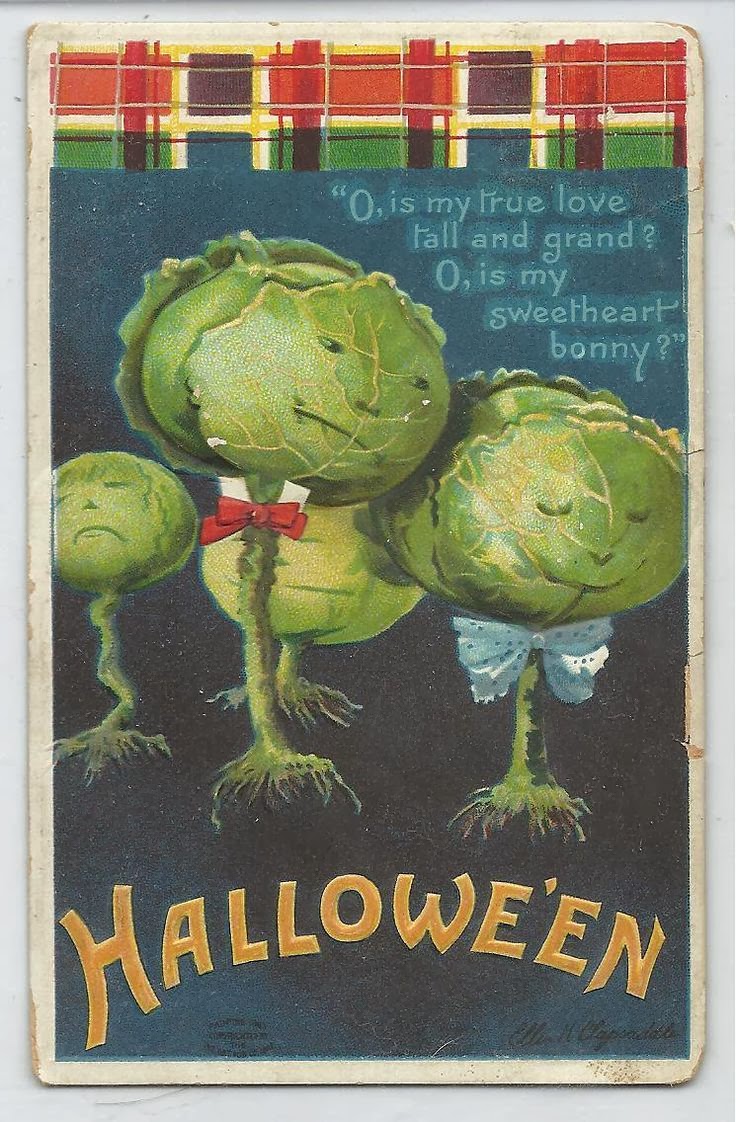
A vintage Halloween postcard with cabbages, from this great Pinterest board.


Happily, there were also more beneficial Halloween roles for cabbage to play. In Ireland, for example, cabbage and potatoes are ingredients in a dish called colcannon. At Halloween, colcannon would be served with a ring, coins, or other items hidden it. Each item foretold a specific future for the person who found it. The ring indicated a happy marriage, the coins wealth, etc.

Cabbage also had a magical role to play in New England once Halloween began to be celebrated here in the nineteenth century. Clifton Johnson found the following divinatory practice in western Massachusetts in the late 1800s:

On Halloween hang up a cabbage-stump over the door. The first person of the opposite sex that comes in is the one you will marry (What They Say In New England, 1896).

Fanny Bergen also found this more elaborate version in Massachusetts:

On Halloween a girl is to go through a graveyard, steal a cabbage and place it above the house-door. The one on whom the cabbage falls as the door is opened is to be the girl’s husband (Current Superstitions, 1896).

I like Bergen's version better. Not only does the girl need to walk through a graveyard (spooky!) and steal (breaking the law!), but her poor beau will get hit on the head by a cabbage (pranking!). It's a little more transgressive and therefore seems more Halloweeny to me. However, I don't condone trespassing, theft, or dropping cabbages on anyone.

Have a safe and happy Halloween, with or without your cabbage!

February 16, 2013

Finding Water with a Whalebone

As a modern American I'm really spoiled. I have heat when it's cold, light when it's dark, and water when I'm thirsty. Of course I need to pay for all these things, but they're still available almost instantly.

Heat and electric light are generally accepted as modern conveniences, but it wasn't even easy for to get water for past generations of New Englanders, many of whom had to haul buckets of water from streams or rivers. Some lucky people had wells on their property, but getting a well was no simple task. It was difficult and potentially dangerous, so people didn't want to waste time digging where there wasn't any water underground. How then to make the important decision of where to put your well?

Many farmers and property owners consulted a dowser, someone who would use divination to find objects hidden below the earth. Dowsing has been documented back to Germany in the Renaissance, and can be used to find buried treasure, precious metals, petroleum and water. Dowsers carry an object in their hands that points mysteriously downwards when they are standing over the buried item.

Although some modern dowsers use a metal rod or pendulum, dowsers in North America have traditionally used a forked witch-hazel branch to find buried water. I'm not sure why this particular shrub is supposed to be better at finding water than other types. Perhaps it's because it has the word "witch" in its name, connoting magical power?

Frank Smith describes a traditional New England dowser in his 1914 book Dover Farms. In Which Is Traced the Development of the Territory from the First Settlement in 1640 to 1900. The dowser, named Joseph A. Smith, lived in Dover in the 1800s.

He often cut a fresh witch-hazel rod, but sometimes employed split whalebone. In using the divining-rod the legs were held in the hands, and when a spring or vein of water was crossed, the point would turn down; the power was often shown in the cracked bark of the stick when resistance was offered. 

Frank Smith writes that Smith the dowser was sought out by local farmers when sinking wells, and that he could "unerringly locate springs of water" and even estimate the number of feet that would have to be dug before water was hit. He also writes that dowsing probably operates on the same principals as magnetism or electricity.

I think it's interesting that Smith sometimes used a whalebone instead of a y-shaped branch. At first I pictured him dowsing with a giant whale rib, but realized he was probably using a smaller piece of whalebone from a women's corset. 

I think modern science is a little skeptical of dowsing, but there is a society for modern dowsers in Rhode Island.

Interestingly, a groups of dowsers in Vermont founded an apocalyptic church in the 1700s. Their rods foretold earthquakes, avenging angels, and naked young ladies. At least two of their predictions didn't come true.

October 29, 2012

Mirror Magic for Halloween

Halloween wasn't really celebrated in New England until the 19th century. The Puritans frowned on most holidays although they and their descendants did celebrate Guy Fawkes Day, which has some similarities with Halloween like costumes and people roaming around begging for things.

Unlike Halloween Guy Fawkes Day doesn't have a supernatural component. No witches, ghosts or monsters, just raucous excess and drunken revelry. But when large numbers of Irish and Scottish immigrants began to arrive in the United States in the 19th century they brought Halloween and its supernatural practices with them. These Halloween practices spread across the country, through both immigrant social networks and magazines and newspapers. Eventually Halloween magic became part of the nation's regional folklore, including New England's.

Most modern Americans associate Halloween with scary things, but a lot of the older folklore deals with love magic and love divination. Here's a nice example I found in Eva Speare's New Hampshire Folk Tales.

On Halloween night, an unmarried man or woman should hold a mirror and walk down the cellar steps backwards. As they walk down the steps, they should repeat:

Whoever my true love is to be
Come and look in this glass with me.

A person's face will appear in the mirror, looking over the unmarried person's shoulder. This will be the person they will marry. However, if a coffin appears in the mirror the unmarried person will die. (Hmm. I guess even the love magic can be a little scary, and walking down the stairs backwards sounds dangerous.)

Watch your step with that mirror...

There once was a young man who was very sick with tuberculosis. Despite being weak from his illness, he walked down backwards into the cellar while looking into a mirror on Halloween night. His family heard a crash, and rushed down to find him collapsed on the dirt floor.

When he revived, the young man said, "Don't worry! I did not see a coffin, but instead saw a pretty young girl in a blue dress. I will live and marry her."

The prediction came true. He recovered and went on to become a school teacher in Maine. While he was there he met a pretty young woman who looked exactly like the girl he had seen in the mirror. Upon talking with her, he discovered that she had once owned a blue dress exactly like he had seen in the mirror that Halloween night. The two fell in love, got married, and lived long happy lives.

Happy Halloween everyone!

September 16, 2012

Some Apple Magic

September is apple season. I love going to the farmers market in my neighborhood to see what varieties they have, and sometimes we head out of the city and go apple picking. I love the sight, smell and of course the taste of apples!

This week over at Boston.com they ran an article about fifteen ways to use apples, ranging from barbecue sauce to apples. They don't mention you can use apples to tell the future, but you can.

Apples are associated in European and American lore with love and sex (thank you Adam and Eve!), so apple magic from New England tends to be focused on divining who your true love might be. There are many ways to do this, but here are a few of my favorites.

One of the easiest divinations is to pare an apple in one long piece, and then throw this long piece of peel over your shoulder. Look at the shape the peel makes on the ground. It should form the first letter of your true love's name. Some writers stress that you also need to twirl the apple peel three times around your head before you throw it over your shoulder.

This belief comes from England, where it was mentioned by John Gay in his comic 1714 poem The Shepherd's Week. The country maiden Hobnelia says,

I pare this pippin round and round again,
My shepherd's name to flourish on the plain.
I fling th' unbroken paring o'ver my head,
Upon the grass a perfect L. is read. 

She's happy with the result, since she's in love with a shepherd named Lubberkin. Yay!

You can easily do the apple paring divination surreptitiously while you are making a pie, but the next form of divination is a little harder to hide. Take two apple seeds, and give each the name of someone you think might be attracted to you. Wet the seeds in your mouth, and then stick them on your eyelids. Blink rapidly. Whichever seed falls off last is the person who will be your true love. If anyone walks in while you have apple seeds stuck on your eyelids just tell them you are exploring your New England heritage.

The two previous forms of divination are from Alice Morse Earle's 1902 book Old Time Gardens, Newly Set Forth. I think they're both kind of charming, but here's one that's a little spookier from Fanny Bergren's Current Superstitions (1896).

At midnight, stand in front of a mirror holding a lamp and a mirror. As you eat the apple, say the following:

Whoever my true love may be,
Come and eat this apple with me.

Your true love should appear, though I'm not sure if they will appear in the mirror or in person. Bergren notes that this charm works better if performed on Halloween. I will also note that sometimes the person who shows up in these love spells is not always what you expect.

There is of course a darker side to apple lore, which I have written about here, here and here. I describe some additional apple charms here. Enjoy apple season!

August 10, 2012

Fortune Telling with a Key

Here's an exciting word for today: cleidomancy. It means using a key to predict the future. If any reader is studying for their SATs, remember that word. It might be on the test!

Cleidomancy originated in Europe, and was practiced here in early New England. Reverend Increase Mather, the father of Cotton Mather, fulminated against it in his book Angelographia, saying cleidomancy and other forms of fortune-telling had invited evil spirits into the colony.


For all I know cleidomancy may still be practiced here, but I think in our modern consumer society New Englanders are more likely to use something designed specifically for divination like Tarot cards or the I Ching rather than a key. If you're feeling folksy or are broke, though, cleidomancy is pretty easy.

We don't know exactly how early New Englanders did it but here is what modern practitioners suggest. Tie a piece of thread to the loop of a key, and dangle the key from your hand. Ask the question you want to know, such as "Will I marry Joe?" or "Did Sheila steal my iPhone at yoga class?" If the key starts to move, you have the answer to your question. Cleidomancy works best with yes/no questions. Lots of modern psychics and witches use small crystal pendulums to tell the future, and this is basically the same.


Now here's another exciting word: bibliomantic cleidomancy, which means using a book AND a key to predict the future. I don't think that will be on the SAT, but you never know. Ask your key.

Again, we know bibliomantic cleidomancy was practiced in New England because a Puritan minister preached against it. Deodat Lawson delivered a sermon at Salem in 1692 titled Christ's Fidelity the Only Shield Against Satan's Malignity, where he condemned people who use "the Bible and Key" to tell the future. (Please note bibliomancy does not require you to use the Bible - any large dense book will do - but it was the most common book in Puritan New England.)

I was a little puzzled by how you might use both a Bible and a key, but I found some interesting instructions from the Association of Independent Rootworkers and Readers (AIRR), a group for traditional folk magic practitioners. Early New Englanders may not have followed these exact same procedures, but probably did something very similar. 


You need a big key for this, like a skeleton key. Find a passage in the Bible that relates to your question. For example, if you're curious about who you will marry, open the passage in the Book of Ruth that reads "Wherever you go, I will go; wherever you live, I will live." Put your key on that page, with the loop protruding over the top of the Bible. Close the Bible and then wrap it up with string or ribbon (if you're feeling fancy). You should be able to hold your wrapped Bible by the key loop sticking out the top. 


Holding the key with two fingers, begin to ask your questions. For example, "Will I marry John? Will I marry George? Will I marry Sebastian?" You have your answer when the Bible turns or it falls off the key. Bibliomantic cleidomancy works best with multiple choice questions. 


I have to wonder if Tony and I did this correctly, though, since the Bible barely stayed on the key at all. Perhaps we were supposed to hold out the Bible horizontally? That doesn't seem correct either, though, since the instructions say two people should grasp the key using their pinky fingers. According to the AIRR site, children are supposed to be particularly good at using the key and Bible since their hearts are pure. Perhaps when you hit middle age there's not enough purity left to do this right.

If anyone knows the correct way to do this please let me know! I won't ask how pure your heart is.