Showing posts with label ruins. Show all posts

May 26, 2024

Rutland's Abandoned Prison Camp: Ruins, Graffiti, and Maybe A Ghost or Two?

Back in March, Tony and I took a road trip to Rutland, Massachusetts to visit an abandoned prison camp located in Rutland State Park. Rutland is located west of Worcester, and we had never been there before. It's a very beautiful part of the state and I recommend visiting. 

One small caveat, though. I don't recommend visiting when there's been a huge ice storm, like we did! A big nor'easter had hit the state the day before our trip, and while it brought only rain to Boston, Rutland had been hit with ice, which we didn't realize until after we were beyond Worcester. All the trees in Rutland were covered with glittering ice, making them very sparkly and captivating, but the two mile walk from the Rutland State Park parking lot to the prison camp was treacherously slippery. It took us a lot longer than we anticipated to walk to the camp. I have learned my lesson to check the local weather forecast before heading on a road trip! 

Solitary confinement cells. 

According to the signs in the park, the prison was conceived in 1898 as a "temporary industrial camp for prisoners... to rehabilitate them for their return to society while reclaiming wasteland and abandoned property..." Four years later, a Rutland farm from the 1700s was repurposed and used as a kitchen, dining area, and housing for the camp. The inmates also built additional structures, and an abandoned schoolhouse was incorporated into the prison as well. 


In 1905, a tuberculosis outbreak necessitated the construction of a hospital, which remained in use throughout the prison's history. The park's signage notes the following: "While most of the prisoners of the camp were minor offenders, some patient prisoners in later years were 'lifers' and murderers, so the hospital was a secure facility." The camp also had 150 acres of farmland which were used to raise livestock (including prize winning horses) and grow enough fruits and vegetables to feed the inmates. They even produced excess to sell locally. The fruits and vegetables were stored in an enormous underground root cellar, which still exists. 

The entrance to the root cellar.

Inside the root cellar.

Sometimes in old movies, prisoners are shown breaking big rocks into little rocks. There is some truth to that, at least at the Rutland prison, which had a rock crushing plant that made concrete, gravel, and sand for road repairs. It sounds a little grim. The solitary confinement cells, the ruins of which are still standing, are also very small and grim. They're covered with colorful graffiti and don't have any bars on them now, but it was easy to imagine how dark and confining they would have been in the prison's heyday. We didn't visit the nearby cemetery of unmarked prisoner graves, but I think that sounds grim as well. 

The prison camp was closed in 1934 because the land it stood on was part of the watershed of the newly created Quabbin Reservoir. There certainly is a lot of fresh water in Rutland State Park, including a giant beaver pond that we walked past on the way to the prison's ruins. We didn't see a beaver, but we did see some of their lodges. 

Beaver pond with a beaver lodge. 

Just in case you don't know where you're going...

I couldn't easily find any spooky legends associated with the prison camp. The blog Haunted New England mentions a legend that the ghost of the warden's wife still haunts the prison, but they couldn't find many other details. And in the comments on Abandoned Wonders, I found the following comment from 2019:

This place is incredibly haunted. Within the last 10 years, a group opened something in the tunnel area and called a non-human entity into the camp. Be advised! It followed me home and stuck around for about 3 months. Not fun.

Those were the only legends I could find about the camp. Overall, I found the prison camp interesting but not really spooky. We were the only people there for most of our visit, which was great, but also be aware that the area is isolated. As always, travel with a friend if you're wandering out in the woods, particularly to the ruins of an abandoned prison. 

A view inside the root cellar.


April 01, 2020

The Cursed Village: The Witch of North Pepperell

North Pepperell is a village that no longer exists. Centuries ago it was a prosperous part of the Massachusetts town of Pepperell. But now it's just a memory and a few ruins hidden in the woods. The village became a ghost town after it was cursed by a local witch. Well, at least that's what the legends say.

Pepperell was settled in 1702 and incorporated as a town in 1775. Pepperell was known for its farmlands and orchards, but the village of North Pepperell was a center of industrial activity. Located along the Nissitissit River, the village (which was also called North Village) supported a sawmill, a gristmill and a cloth mill, as well as a blacksmith and a cigar manufacturer. It also had a school and a tavern.

Sometime in the early 1800s a strange woman moved to the village. Some sources don't name her, while others claim her name was Mrs. Lovejoy. New Englanders can be standoffish even today, but back then the region's Puritan influence was still strong and newcomers who didn't fit in were viewed with great suspicion. And Mrs. Lovejoy definitely did not fit in with the industrious folks of North Pepperell.


She lived alone in a rundown shack near the schoolhouse, and she let her pigs and cows wander into her neighbors' fields. She dressed strangely and wore a handkerchief over her head. She also never talked with her neighbors. None of this behavior is particularly criminal or really even that strange, but it was enough to make Mrs. Lovejoy's neighbors eye her with suspicion.

I'm sure you can see where this is going. People in North Pepperell soon began to mutter that Mrs. Lovejoy was a witch, and eventually three men decided to do something about the "witch" in their midst. In 1820 they went to Mrs. Lovejoy's shack and dragged out the elderly woman. Then they branded her in the middle of her forehead with a hot iron rod.

She shrieked in pain, but when she regained her composure she cursed her assailants. "This village will die. Flames will devour your businesses! The river will dry up! Death will visit each house!" And with that she fled into the woods, never to be seen again.

At first the people of North Pepperell congratulated themselves on getting rid of Mrs. Lovejoy, but their attitude changed as misfortune repeatedly struck the village. First the sawmill burned in a mysterious fire, then the gristmill. Over time the village's other businesses burned as well. The town's industry was decimated. People tried to rebuild, but the village's dam burst and the river's water level sank to a level that couldn't support any mills. 

Of course, the river was still deep enough to drown a four-year old boy who fell in. His accidental death was just one of many that haunted North Pepperell. One man tripped over a chair, instantly breaking his neck, while another died when he fell from his wagon after the horses became startled by something unseen. A respected community member choked to death in front of his family during dinner. A young woman went to milk the cows in the barn and disappeared. Her body was never found.

Those villagers who didn't die under mysterious circumstances began to move away, driven by economic desperation and fear of the witch's curse. The last of the curse's victims may have been two elderly sisters who died in 1900. One night they saw a fire in the woods near their house and tried to extinguish it. The fire overwhelmed them both, but only one body was ever found.

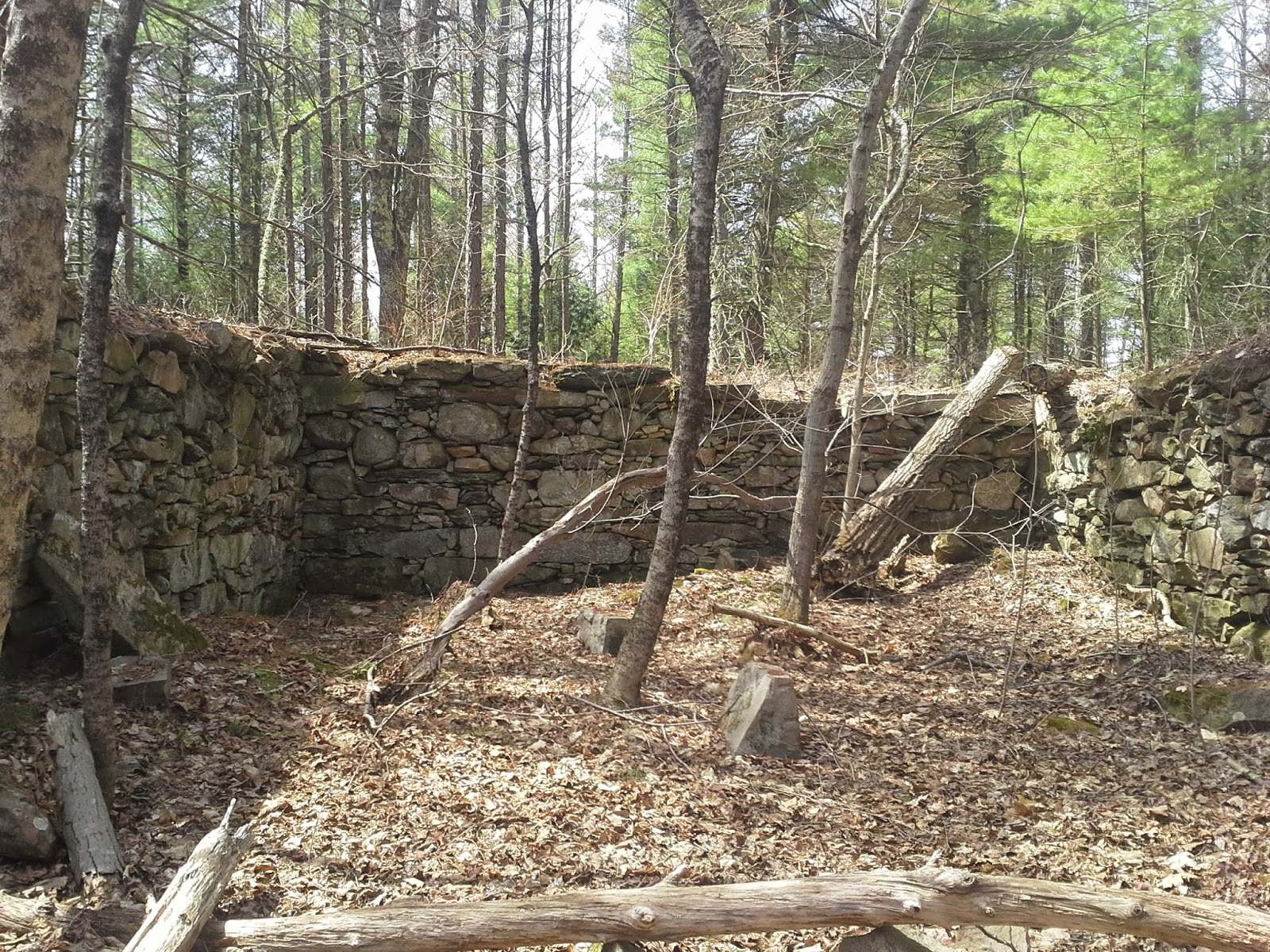
They were the last inhabitants of North Pepperell. Now the village has been taken over by the trees and birds. A few rock walls are the only signs that anything was ever there at all.

*****

This legend appears in a few different places, but the most comprehensive account I've seen is in Joseph Citro's 2004 book Cursed In New England: Stories of Damned Yankees. Joe is a great storyteller and I always enjoy reading his books.

There are lots of stories in New England about witches' curses, and most follow the same  basic pattern. Suspicious townspeople harass someone they suspect is a witch. The harassment turns violent or even deadly. The suspected witch curses their abusers. The curse happens and the townspeople regret what they did.

The story about North Pepperell fits this pattern, but it's interesting that it supposedly happened in 1820. Certainly witchcraft beliefs lingered in New England well after the 17th century witch trials ended, but it's surprising to read about people attacking an alleged witch in the 19th century. Of course, the story may not be true and could just be a legend to explain the misfortunes that ruined North Pepperell. I don't think there are any legal documents or town records corroborating the legend of Mrs. Lovejoy.

On the other hand, according to Cursed In New England, some people speculate that Mrs. Lovejoy may have actually been a Quaker who was persecuted for her religious belief. I suppose that's possible, since the Massachusetts Puritans executed several Quakers in the 1600s. The anti-Quaker laws were repealed in the early 1660s, though, so it seems strange that the North Pepperell villagers would still be branding a Quaker 120 years later. Maybe I just underestimate how bigoted and violent people can be.

Regardless of its truth, the lesson behind this legend is ambiguous, as it is with many of these witch's curse stories. Mrs. Lovejoy is presented as an innocent old eccentric who is not a witch. On the Yet, she has the ability to curse an entire village, causing destruction and many deaths. What agency is responsible for the curse coming true? Is it God? Karma? Or perhaps it's witchcraft after all?

May 02, 2018

Gibbet Hill: Ghosts, A Ruined Castle and A Forgotten Execution?

The other day Tony and I took a road trip out to Groton, Massachusetts. Groton is an old town that was founded in 1655. It's really a beautiful place, with lots of old Colonial homes, charming white churches, and large farms. Looming just outside the town center is a big hill called Gibbet Hill.

A view up Gibbet Hill
As we all know from watching horror movies, every small town has to have at least one spooky location, and in Groton that location is Gibbet Hill. The word "gibbet" can mean a few things but none of them are pleasant. It can mean a gallows (for executions) or it can mean a metal cage used to publicly display dead bodies after execution. The "g" in gibbet is soft, so it is pronounced "jibbet."

The excursion was not without its dangers.
Gibbet Hill was quite pretty to visit on a sunny spring day, but with a name like that you know there must be some strange phenomena attached to it. According to local legends, ghosts have been seen lurking on the hill. Most of them wear Colonial attire, and some of them are missing limbs. Someone reported just seeing a dismembered foot wearing a green sock. That's it, just a foot. Stories like this are why I only visit haunted places during the day.


On top of Gibbet Hill are the ruins of a stone castle, which just adds to the spooky vibe. According to one local legend the castle dates from the 19th century. A wealthy man built it for his new wife, but unfortunately she died before it could be completed. He abandoned the project in sorrow and it was never finished.


I like that story, but it's not true. Historical records indicate the castle was constructed in 1906 by William Bancroft, a retired general and a politician, as his retirement home. Unfortunately Bancroft ran out of money and couldn't complete it. He sold the castle to a local physician and in time it became a tuberculosis sanitarium. Patients hoped that Groton's fresh air would help cure their ills.


In the 1920s the castle became a private hunting club until it finally burned down in the 1930s in a Fourth of July fireworks mishap. The property was owned for many years after that by the owners of the nearby Gibbet Hill Grill but became town conservation land in 2002. There is a spot on Route 40 where you can park and then hike up a short trail to the castle.


Kate Webber, co-owner of the Gibbet Hill Grill claimed in a 2006 Lowell Sun article that there no ghosts at the castle:
A lot of people are determined that the whole hill is haunted. Before the castle was public property, someone had snuck in and said when they looked through a window, (they) saw a severed foot with a green sock on it. People have reported seeing old colonial couples walking up and down the hills, a man in an old soldier's uniform who walks the property, and a Native American who was rumored to be chased down and killed. I'm convinced there aren't any ghosts roaming. But people look at the stone tower and think there has to be some wonderful and terrible Gothic stories that go with it.
So do ghosts haunt Gibbet Hill? I didn't see any, but I may not be the most psychically sensitive person around. We also visited during the day, and during the day I am always skeptical about all paranormal phenomena. If I had visited at night it would be a completely different matter. I would be convinced each creaking branch was a ghost and I'd be terrified of seeing that severed foot. The castle wasn't too spooky when we went, although there were some really large crows croaking in the trees.


The story behind the hill's name is a little murky. Samuel Green's 1894 book An Historical Sketch of Groton Massachusetts, 1655 - 1890 tells us the following about Gibbet Hill:
It is mentioned in the land-grant of Sergeant Jame Parker, which was entered in the town records of Richard Sawtell, the first town clerk who filled the office from June 1662 to January 1664-65. The tradition is that the hill was so called from the fact that once an Indian was gibbeted on its top. If this ever occurred, it must have happened before Sawtell's term of office.
Various sources on the web, including the Lowell Sun interview with Kate Webber, argue that since there is no proof of an execution the hill was probably named after a hill back in England. I guess that is possible, but we also know that the English settlers were not kind to local Indians, and that Groton was attacked and burned by local tribes during King Philip's War in 1676 and again in 1694 during King William's War. I wouldn't be surprised if there was an unrecorded Indian execution somewhere in the town's past.


While the ghosts at Gibbet Hill are open to debate, there is at least one well-documented weird story in Groton's history. In the 1600s a young serving girl who worked for the town's minister was possessed by Satan. It's an interesting story and I'll write about it next week.

April 20, 2015

The Ghost of Ram Tail Mill

This Sunday Tony and I made an excursion down to Foster, Rhode Island to visit the Ram Tail Mill ruins. What better way to spend a sunny spring day than visiting a notorious haunted ghost town?

Ram Tail Mill was founded in the 1813 by William Potter, Peleg Walker, and several other partners. The mill was powered by the nearby Ponangansett River, and mechanically spun and wove woolen cloth. Wool comes from sheep which is why it was called the Ram Tail Mill.


William Potter's two sons managed the operations in tandem with Peleg Walker. Walker was supposedly a cranky, disagreeable man, but managed to find his niche as the mill's night watchman. He would patrol the mill buildings with a lantern in his hand, and then ring the bell after sunrise when it was time for the workers to start their day. Things went well for several year and a small village formed around the mill. 

There was always tension between Peleg Walker and the Potters, but at some point it erupted into a major argument. Neither legends or historical records indicate what it was about, but it was bad. It ended with Walker shouting, "You'll have to take the key to this mill from a dead man's pocket!"


 His warning came true. On the morning of May 19, 1822 the bell did not ring. When the puzzled workers arrived from their houses they found Peleg Walker hanging dead from the bell rope. The key to the mill was tucked into his pocket. Walker was 35 years old.

The locals assumed Walker was a suicide and buried his body nearby. Operations resumed at the mill, and with the cranky night watchman gone the atmosphere at Ram Tail was much calmer. But one night the workers and the Potter family were awakened by the mill's bell ringing wildly. They ran to to investigate but found the mill was empty. The bell was ringing on its own.


The mysterious ringing happened on several other nights (usually at the stroke of midnight) until the Potters took down the bell rope. Maybe the rope was just blowing in the wind? This didn't help - the bell still would ring late at night. They finally removed the bell itself.

This brought peace for a short while, but other strange things started to happen. The water wheel moved backwards, against the flow of the river, and the mill's machinery would run by itself late at night. Even worse, someone could be seen walking around the mill at night carrying a lantern. It looked suspiciously like Peleg Walker...

Fearing that the mill was cursed, the workers began left to find other jobs. Without anyone willing to work there the Potters were forced to shut it down. The little village was abandoned and became a ghost town. No one lived there anymore, but Peleg Walker could still be seen wandering through the empty buildings late at night.


The mill burned down in 1873 but kept its reputation as a haunted location. In fact, the 1885 Rhode Island census lists the Ramtail Mill as haunted, making it the only officially haunted place in the state.

We did not see Peleg Walker's ghost, but we did have one weird thing happen to us. As I was taking a photo of the trail that leads directly to the ruins, my phone's camera went a little haywire. The screen just turned blinding white. This happened to me one other time that day. The same thing happened to Tony, but he didn't notice until we got home that some of his photos were all white. Supernatural phenomenon or just a camera malfunction on a bright sunny day?

One of my all white photos!
I definitely felt a little creeped out as we explored the ruins, but it could have just been my fear of deer ticks combined with a very quiet forest. We only saw two other people, and when we asked them if they knew where the mill was they told us they didn't even know there was such a thing. It was really quiet there.

The conservation land is very beautiful and has some amazing stone walls that run along the main trail and into the woods. The walls are covered in lichen, as was the ground at a nearby historic cemetery where we found the graves of some members of the Walker family. (Peleg Walker is buried in another cemetery about a mile away.)


DIRECTIONS: I've read some accounts online of people having trouble finding the ruins, but we got there relatively easily. Take Route 6 west from Providence until you reach Foster. Go south on Rams Tail Road. You'll know you're going the correct way because you'll pass a cemetery on the left. Rams Tail road becomes a dirt road for a while, but when it ends take a left on Central Pike. A short way down the road you'll see the trail entrance with a fire gate on your left. There is space for one or two cars to park.

Follow the path until you reach a four way crossroad. Go left and follow the path as it curves along the water. When the path splits like a T, take the right and follow the path up along the hill. The ruins are at the top of the hill.

My sources for this post: Joseph Citro and Diane Foulds's Curious New England, Rory Raven's Haunted Providence, Michael Bell's Food for the Dead, and Rhode Island's Haunted Ramtail Factory by Thomas D'Agostino and Arlene Nicholson.