Showing posts with label horror movie. Show all posts

January 13, 2021

Let's Scare Jessica to Death: Folk Horror in 1970s Connecticut

It's a classic urbanite fantasy. You'll escape all the stresses of big city life by moving to the country, where you'll live in a big farmhouse, grow crops, and make your own strawberry preserves. Maybe you'll raise some goats and sell artisanal cheese. Your life will be like a never-ending Martha Stewart photo shoot.

It's definitely something I've fantasized about, but I realize I'm probably not suited for country life. I haven't lived less than a ten-minute walk from a subway stop in the last thirty years - how am I going to shear sheep? And who knows what lurks out there in the countryside? After all, that same escapist fantasy is also the premise of many horror films. 

Last night we watched one of those films. Let's Scare Jessica to Death (1971) tells the story of Jessica (Zohra Lampert) and Duncan (Barton Heyman), a married couple who move from New York City to rural Connecticut. Jessica is recovering from some type of nervous breakdown, and Duncan thinks quiet country living will help the recovery process. Their friend Woody (Kevin O'Connor) comes with them to help manage the apple orchard at the old farm they've bought. 


Their move to Connecticut isn't quite the idyll they hoped for. On their way to the farm the trio stops at a historic cemetery for some sightseeing and Jessica sees a feral-looking woman in a white gown. In their new hometown they encounter a group of surly and disapproving old men, all strangely bandaged and wounded, at the general store. And at their farmhouse they discover an attractive bohemian young squatter named Emily (Mariclare Costello) who disrupts the group's equilibrium.

I first saw Let's Scare Jessica to Death on TV when I was a kid, and rewatched because I'm in the mood for some New England atmosphere. The movie was actually filmed on location in Connecticut in the autumn of 1970 and it makes the most of the setting. There are shots of an old 19th century farmhouse shrouded in fog - real fog, not smoke machine fog. Jessica traipses through a field of blooming goldenrod and an orchard whose trees are covered in red apples. When someone drives down the road I saw a maple tree that had just lost all its leaves in the background. The characters visit an antique store in a barn, a common sight across the area.

Seeing these scenes is like comfort food for me, particularly now, but it's a horror movie, not a video promoting tourism. The antiques dealer tells them the house they bought might be haunted. A young woman named Abigail Bishop drowned on the property, he says, but her body was never found. Local folks say she now roams the countryside as a vampire, eternally frustrated because she never got to marry and wear her wedding gown. Needless to say, the legend of Abigail Bishop doesn't sit too well with the still fragile Jessica.

Image from this excellent review. 

Abigail Bishop's vampiric ghost is at the heart of Let's Scare Jessica to Death and is open to many interpretations. Maybe she's just a figment of Jessica's imagination, something the movie hints at repeatedly. Abigail might also be symbolic of the characters' unspoken sexual needs and fears, particularly as they explore the new social norms of the late 1960s.

The movie was made when America's hippie counterculture was still strong, and although the main characters are too old to be true hippies they are clearly toying with the hippie lifestyle. Instead of a traditional car they drive an old hearse with a peace sign painted on the door, and their move "back-to-nature" is straight from the 1960s counterculture playbook. Abigail's ghost is the dark side of that counterculture, the footloose Manson girl who'll party with you and then quite literally drink your blood. 

Image from this great review.

She might also represent the spirit of the land itself, a grim genius loci who doesn't really approve of outsiders. Abigail Bishop is rooted in the town's history, in its lakes and coves, its orchards and old cemeteries. Her ghost is often shown in beautiful natural settings. The local old-timers have learned to live in harmony with their town's rapacious spirit, but the newcomers find out there's more to country life than sing-a-longs and antiquing. 

There really were cases of alleged vampirism in Connecticut. Folklorist Michael Bell discusses three of them in his excellent book Food for the Dead: On the Trail of New England's Vampires (2001). They weren't the seductive sexual predators we see in movies, but rather were victims of tuberculosis who died. When their relatives also became sick they thought the recently deceased person was feeding on them after death. The only way to stop the "vampire" from feeding was to unearth the corpse and burn its heart. It sounds unbelievable, but Bell has evidence that the practice continued up until the 1890s. This type of vampirism is very different from what's portrayed in Let's Scare Jessica to Death but it serves as a reminder that beautiful rural landscapes often have unpleasant histories. 

Venture Smith's gravestone rubbing. Screen cap from here. 

The movie alludes directly to one of those histories early on, when Jessica visits a cemetery to make some gravestone rubbings. The scene was filmed in East Haddam's First Church Cemetery, and Jessica makes a rubbing from a real gravestone, that of Venture Smith, a former slave who died in 1805. In 1798, Smith wrote a narrative of his life and as you might imagine it is full of violence and abuse. In the movie, Jessica decorates the bedroom of their new home with graverubbings, and Venture Smith's is taped right above the bed she shares with her husband. To her Smith's life is a charming relic, an attitude showing she and her friends are unfortunately clueless about the real history of their new home. 

Let's Scare Jessica to Death has a minor cult following, and several people have tracked down the various locations where it was filmed. The farmhouse in Old Saybrook where many of the exterior scenes were shot is now a decaying ruin. The house was surrounded by wide open fields when the movie was made in 1970. Now, fifty years later, the woods have reclaimed the land and will probably reclaim the house soon too. 

The house today. From DreadCentral. 

Let's Scare Jessica to Death isn't a perfect movie, but it's an interesting one, and definitely worth watching if you want to experience some unsettling New England folk horror vibes.

February 27, 2020

Eight Movies About New England Witches You Should Watch

Although the Puritan era witch trials ended centuries ago, the fear of and fascination with witches still lingers in New England. Witchcraft doesn't die. It just bides its time and waits. 

Here is a short list of films, primarily horror movies, that deal with New England witches of several varieties. Watch them for entertainment or as cautionary tales. You'll never know what you might see out in the woods or what that mysterious neighbor is really up to. And don't forget: a witch hunt is always scarier than a witch.


Horror Hotel (aka City of the Dead) (1960)
College student Nan Barlow (Venetia Stevenson) has an interest in the history of New England witchcraft. At the urging of her advisor (Christopher Lee) she decides to visit Whitewood, Massachusetts, where  a witch named Elizabeth Selwyn was burned at the stake in 1692. Whitewood is a perpetually foggy and slightly surreal village filled with eccentric inhabitants but Nan settles in at the Raven's Inn to pursue her research. She soon discovers evidence that that Elizabeth Selwyn may not be dead. What else do you expect when your adviser is Christopher Lee?


I feel compelled to point out that witches in New England were executed by hanging, not by burning. That's just a minor quibble about an overall great horror movie, though. Horror Hotel starts out pretty mild but becomes surprisingly scary and has a shocking plot twist about halfway through. The black and white cinematography is atmospheric and creepy. Don't watch this one alone at night.

Dunwich Horror (1970)
I think I was ten or eleven years old when I first read H.P. Lovecraft's story "The Dunwich Horror." I was so scared I had to stop reading halfway through (although I finished it the next day). This 1970 film version isn't particularly scary but is still a lot of fun. Once again we have a college student getting into trouble, but this time it's all-American sweetheart Sandra Dee as Nancy Wagner, a student at Miskatonic University in Arkham, Massachusetts. After a lecture by her professor Nancy is returning a copy of The Necronomicon to the library when she's approached by Wilbur Whateley (Dean Stockwell), a dreamy young occultist from rural Dunwich who just wants a peak inside the forbidden book. Her professor interrupts but Nancy ends up giving Wilbur a ride home. Faster than you can say "Yog-Sothoth!" she's drugged, hypnotized, and the focus of a demonic sex ritual...


This is definitely a product of it's time, with a psychedelic monster in the attic and hallucinations involving sinister pagan hippies. Nancy's ritualistic rape still feels shocking, though, particularly in this #MeToo moment and is the one serious note in what is otherwise campy Lovecraftian fun.

Crowhaven Farm (1970)
Maggie (Hope Lange) inherits an old farm in Essex County, Massachusetts after a relative dies in a bizarre accident. She and her husband Ben (Paul Burke) decide to leave New York City and relocate to the farm, hoping it will rekindle their failing marriage. After she learns a coven of witches was executed there in the 1600s, Maggie begins having visions of angry Puritans and to feel a strange sense of deja vu. Things get really weird when Maggie and Ben take in an orphaned adolescent girl who becomes sexually fixated on Ben. Will Maggie learn the  secret of Crowhaven Farm in time to save her marriage - and her life?


Crowhaven Farm was made for television and is fondly remembered by people who saw it when they were kids. I've only seen it as an adult. I thought it was kind of funny that the producers tried to pass off mountainous Southern California as Massachusetts and that the characters talk about Lowell like it's a huge metropolis. On the other hand, the orphaned girl is creepy in a few different ways and the movie does have a nice shocking ending.

The Dark Secret of Harvest Home (1978)
Another made for TV production, this two-part miniseries was based on Tom Tryon's bestselling 1973 novel Harvest Home. As in Crowhaven Farm, a couple leaves the big city for the country hoping to find a peaceful life. But the Connecticut village of Cornwall Coombe is more than your average rural farm community. It's also home to a pagan fertility cult ruled over by the Widow Fortune (Bette Davis), and she takes her religious duties very seriously. Every seven years the villagers choose a new man to preside as Corn King over the Harvest Home celebration. But why won't anyone tell the newcomers what happens at the festival?


I was debating if I should include this one on the list. On one hand, the villagers of Cornwall Coombe aren't Satan-worshipping spellcasters like some of the witches on this list. On the other hand, Tom Tryon was obviously inspired by the writings of anthropologist James Frazer and poet Robert Graves, two writers whose work also inspired the modern witch-cult of Wicca. And the Widow Fortune's interest in herbalism would resonate with a lot of Instagram witches today. Think of this one as the American version of The Wicker Man.

Hocus Pocus (1993)
Once again Puritan-era witches return from the dead, but this time they're played by Bette Midler, Sarah Jessica Parker and Kathy Najimy. Oh, and the movie's a comedy from Disney! But despite the comedic overtones the plot is still rather dark. Three executed witches who are accidentally resurrected by a teenage boy trying to impress his crush devise a plan to suck the souls out of all the children in Salem on Halloween to gain eternal life. Not the lightest of comedies!


This was a modest hit when it was released in theaters but gained a huge following in subsequent when it aired on cable and as a VHS and DVD rental. Hocus Pocus still brings in millions of viewers when it airs on cable, particularly around Halloween. I guess those witches do have some magic after all! One bonus attraction for New Englanders: many of the outdoor scenes were shot in Salem and Marblehead, giving the movie some authentic Massachusetts flavor.

The Crucible (1996)
All the movies I've mentioned so far have been horror movies, but The Crucible isn't. Based on Arthur Miller's classic 1953 play, this drama points out what the other movies don't: there weren't really any witches in Salem, just innocent people persecuted because of ignorance and hatred. Although The Crucible isn't 100% historically accurate it drives home its point with strong performances from Daniel Day-Lewis as John Proctor and Winona Ryder as his accuser Abigail Williams.


Although The Crucible was praised by critics and nominated for multiple awards it didn't take in much money at the box office. I guess viewers would rather be scared by fictional witches than be reminded about the dark side of this country's past.

The Lords of Salem (2012)
When Salem radio DJ Heidi Hawthorne (Sheri Moon Zombie) plays a record from an unknown band called the Lords of Salem she has an eerie vision of witches worshiping Satan. Her co-workers at the radio station brush it off as just a hallucination, but Heidi's not so sure, particularly when other strange things start to occur. Heidi's downstairs neighbors give her an ominous Tarot reading. A local historian interrogates Heidi about the Lords of Salem's music, which is oddly familiar to him. And most importantly, a hideous naked witch keeps materializing in Heidi's apartment...


The Lords of Salem was directed by horror-rocker Rob Zombie and I think it's probably the best movie he's made. It's beautiful to watch, with innovative costumes, sets and special effects. Although it is another variation on the "dead witches won't stay dead" theme it filled me with an impending sense of dread, making it one of the more effective movies on this list. Rob Zombie is also from my hometown of Haverhill, Massachusetts, and he ably captures the New England gloom with scenes shot on location in Salem.

The Witch (2015)
Another film made a New England native, Robert Eggers's The Witch made a big arthouse splash when it opened and also made a goat named Black Phillip a pop culture phenomenon. Much like Crowhaven Farm and The Dark Secret of Harvest Home, it too focuses on a family whose plans to leave their old home and start anew are thwarted by witches, but this time the family in question is kicked out of a 17th century Puritan settlement and moves deep into the New England wilderness. Eggers worked hard to make the film feel like a window into the past, going so far as to incorporate snippets from 17th century documents into the script as dialogue. I think audiences expecting a traditional horror film were puzzled but The Witch is now considered a classic in the folk horror genre. 


Well, that wraps up my list. If you have any other suggestions please leave them in the comments. I'm always looking for good movies about witches.

January 28, 2020

Madness, Monsters and A Meteor: A Review of Color Out of Space

This past weekend I went to see Color Out of Space, the new film based on H.P. Lovecraft's 1927 story of the same name. The film begins with narration from Ward Phillips (Elliott Knight), a hydrologist from the big city who's been sent to rural Massachusetts on an assignment. His dialogue is lifted directly from Lovecraft's story:

West of Arkham the hills rise wild, and there are valleys with deep woods that no axe has ever cut. There are dark narrow glens where the trees slope fantastically, and where thin brooklets trickle without ever having caught the glint of sunlight... When I went into the hills and vales to survey for the new reservoir they told me the place was evil. They told me this in Arkham, and because that is a very old town full of witch legends I thought the evil must be something which grandams had whispered to children through centuries... (H.P. Lovecraft, "The Colour Out of Space," 1927).

The film follows the outlines of Lovecraft's tale relatively closely. While surveying for a new reservoir Phillips meets the Gardners, a local family whose lives are impacted when a strange meteor lands on their property. The original story is set in the 1880s, but the the film updates the setting to the present, and rather than hardscrabble Yankee farmers the Gardners are now urban transplants trying to re-start their lives on an inherited farm.


Their efforts aren't working out too well. Father Nathan Gardner (Nichola Cage) spends his time drinking, learning to farm via audio recordings, and raising alpacas for reasons he doesn't seem clear about.  His wife, Theresa (Joely Richardson), is recovering from breast cancer and trying to continue her career as a stockbroker on their isolated farm with a terrible internet connection. And is it really a good idea for her to be living an hour away from the nearest hospital? Oldest son Benny (Brendan Meyer) spends his time getting stoned and looking at NASA's website, while daughter Lavinia (Madeleine Arthur) practices Wicca in the woods, imploring the spirits to help her get away from the boredom of the farm. Only youngest son Jack (Julian Hilliard) seems adjusted to the situation.

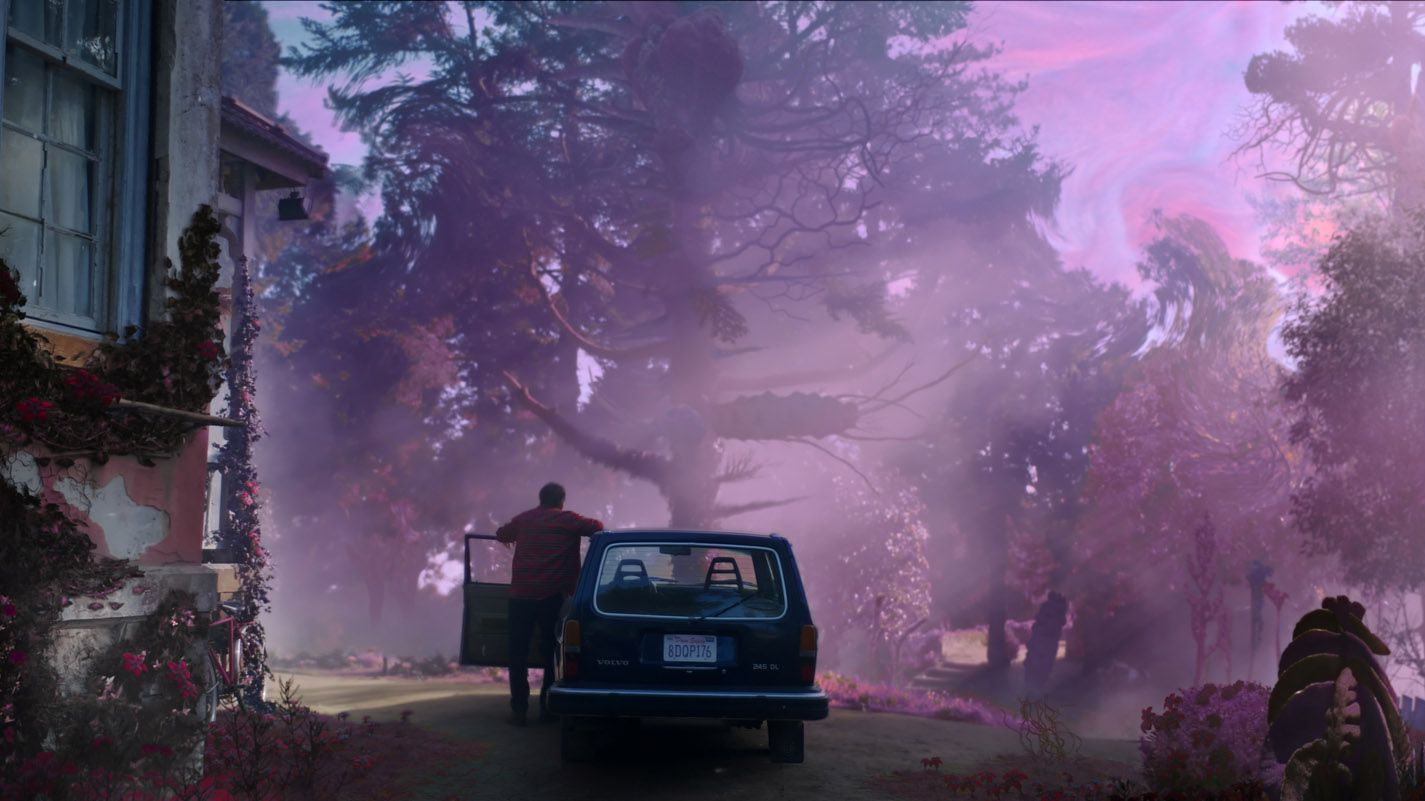
Life on the farm seems stifling and a little dysfunctional, but things only get weirder once the glowing meteor lands in the yard. Some of the changes are almost imperceptible - the parents fight more than usual, stoner Benny gets even more distracted, the Gardners' phone and internet reception degrades. The family barely even notices when strange plants start growing in the yard, neon pink mist fills the surrounding woods, and the progression of time itself becomes disrupted. Is radiation from the meteor affecting everyone's sanity, or is there really a monster in the alpaca barn? The answer is both.


"The Colour Out of Space" is one of Lovecraft's classic tales of cosmic horror where human protagonists learn the hard way that they're living in an uncaring universe. It's a horrific science fiction story, not a tale of the supernatural. Still, the film's director Richard Stanley is a practicing occultist and occult imagery appears throughout the film, mostly in rituals that Lavinia performs. She invokes archangels using the Lesser Banishing Ritual of the Pentagram, reads the Simon Necronomicon, and carves the odal rune on her forehead. The rune symbolizes inheritance and land, and is germane to her family's situation. It also looks like she carves the words "solve" and "coagula" into her hands. These words may be familiar to you from Eliphas Levi's illustration of Baphomet, and they mean "dissolve" and "coagulate." Many things dissolve and coagulate in Color Out of Space, often in a gruesome manner.

Speaking of coagulation, Nathan says "Families stick together" several times during the movie. When I recently re-read the story I was struck by how the Gardners don't leave their farm, even as things get worse and worse. The family in the movie behaves the same way. Like frogs in slowly boiling water, they don't realize they're in danger until it's much too late. It's hard to know you're in a strange situation when it's what you've grown accustomed to.

Director Stanley and Amaris Scarlett, who co-wrote the script with him, incorporate nods to Lovecraft's work throughout the film (a Miskatonic University t-shirt, a symbol on a TV news van, character names) and it's clear they appreciate their source material. They're not afraid to modernize the story where appropriate, not just by adding well-written female characters but also by casting people of color: Elliot Knight as Ward, Tommy Chong as a blissed out hippie unbothered by all the weirdness, and Q'orianka Kilcher as the town's ambitious mayor.


If I have one complaint, it's a minor one. Color Out of Space was filmed in Portugal, and it just doesn't look like New England. The trees are wrong, the Gardner's house clearly is not an old Massachusetts farmhouse, and the town hall is obviously European. Lovecraft's story is an homage to the New England landscape and an elegy for the Yankee farmers whose way of life was fading away and it would have been nice to see those incorporated into the film. But like I said, that's a minor complaint.


This is definitely a classic B movie, and I mean that in a good way. There are rubbery monsters, men with shotguns shooting things, copious amounts of gore and slime, and Nichola Cage chewing the scenery. It's not an arthouse horror film like Midsommar, The Witch or Mandy. On the other hand, there is also beautiful psychedelic imagery, a script with multiple levels of meaning, and good acting (including some by Nicholas Cage) so it's more like a B+ movie. It's also one of the best Lovecraft adaptations I've seen in a long time.


Surprisingly, it's also emotionally moving. I found myself teary-eyed by the end and got a little choked up as the film ended with this narration, pulled directly again from Lovecraft's story:

It was just a colour out of space—a frightful messenger from unformed realms of infinity beyond all Nature as we know it; from realms whose mere existence stuns the brain and numbs us with the black extra-cosmic gulfs it throws open before our frenzied eyes.

November 13, 2019

Folklore and Pagan Gods in The Lighthouse

My work schedule has been very busy the last few weeks, but I did manage to see The Lighthouse, the new film by Robert Eggers, the New Hampshire-born director who gave us The Witch a few years ago. My review is a little delayed but I wanted to post it anyway because The Lighthouse has some interesting New England folklore in it. Be warned: my review has a few (but not many) SPOILERS.

THE PLOT

The plot is relatively simple. In the late 1800s, two lighthouse keepers (or wickies as they're called) arrive for duty at a lighthouse located on a small rocky island off the coast of Maine. The older wickie, Thomas Wake (Willem Dafoe) has served on the island many times before. His new assistant, Ephraim Winslow (Robert Pattinson) is a former lumberjack reporting for his first stint in a lighthouse. When asked what happened to his previous assistant, Wake replies that he went insane and became convinced the lighthouse was enchanted and that merfolk haunted the island. Oh, and by the way Wake adds, never kill a seabird because they contain the souls of dead sailors.


After this ominous set-up the two men settle into a monotonous routine. As the senior lighthouse keeper Wake tends to the actual light itself, a role he guards jealously. He forbids Winslow from even entering the chamber at the top of the lighthouse and instead assigns to him all the manual labor: hauling coal, cleaning their tiny living quarters, and emptying bedpans. Winslow grows to resent his poor treatment, and his unhappiness is only compounded by a one-eyed seagull that regularly torments him. Winslow's sole pleasure is a scrimshaw mermaid he finds hidden in his mattress which fuels his sexual fantasies.

Over the course of their four-week stint the two men gradually come to an understanding, but things become complicated when the ship that is supposed to bring their replacements is delayed by a powerful storm. The men are stuck on the island. The storm lasts for weeks, and when their liquor runs out Wake and Winslow start to drink kerosene sweetened with honey. And that's when things start to get really weird...

DIALECT AND KILLING A SEABIRD

As he did with The Witch, Robert Eggers incorporates local folklore into his film to make it feel authentic. Much of the dialogue was influenced by 19th-century writers including Sarah Orne Jewett, whose novels and stories were drawn from her experience living in Maine. I've read that Eggers used Jewett's work to craft the two distinct dialects the lighthouse keepers speak: Wake's nautical one and Winslow's inland Maine dialect. I think Willem Dafoe has the easier job, since he basically gets to talk like a pirate or Mr. Crabs from Spongebob Squarepants. Robert Pattinson, on the other hand, has to speak with an accent somewhere between a classic Boston accent and the "Yah cahn't theyah from heyah" Mainer accent. He does a good job though, and I enjoyed hearing him deliver his dialogue.


One of the key plot points is Wake's admonition to never kill a seabird. This is an actual piece of nautical folklore although I think it is particularly local. Many people are familiar with it from Samuel Taylor Coleridge's poem The Rime of the Ancient Mariner, where a ship becomes cursed after a sailor kills an albatross. According to this article the belief was still extant as late as 1959, when sailors transporting an albatross in a cage blamed various malfunctions on the bird's accidental death.

However, there is one possible link to Maine's folklore. Maine lumberjacks believed that is was bad luck to kill gray jays (also known as gorbeys), which were small birds that frequented lumber camps. They were said to be the souls of dead lumberjacks, and hurting a gray jay would bring grave misfortune. In one tale a brutish lumberjack plucks the feathers from a gray jay on a cold winter night, thinking it is the soul of a deceased colleague that he despised. When he awakes in the morning he finds he finds himself bald, weak, and constantly pursued by stormy weather. He had plucked the feathers from his own soul.

MERFOLK

The island in The Lighthouse may be haunted by a mermaid. I won't give away too much, but if it is she's definitely not the happy Little Mermaid variety. There are quite a few mermaid and merman stories from New England, and none of them are happy. They're much closer to horror stories than fairy tales.


One of the earliest comes from John Josselyn's 1674 book An Account of Two Voyages to New England. Josselyn, an Englishman, visited New England in 1633 and 1638. While visiting Maine some of the settlers told him about strange things that had happened to them.
One Mr. Mittin related of a triton or merman which he saw in Casco Bay. This gentleman was a great fowler, and used to go out with a small boat or canoe, and fetching a compass about a small island (there being many small islands in the bay), for the advantage of a shot, was encountered with a triton, who laying his hands upon the side of the canoe, had one of them chopt off with a hatchet by Mr. Mittin, which was in all respects like the hand of a man. The triton presently sunk, dyeing the water with his purple blood, and was no more seen.
Gruesome. Merfolk were generally believed to be aggressive, and an almost identical encounter with a violent merman supposedly happened in Gloucester Harbor in Massachusetts, according to author Edward Rowe Snow. 

Snow also claims that in 1900 a lighthouse keeper at Nantucket's Great Point saw something humanoid emerge from the ocean and crawl into the woods near the beach. Other people who lived nearby saw signs that something large had crawled through the underbrush and made a nest. It's kind of creepy. The plot of The Lighthouse might not be that far from reality (or at least folklore). 

PAGAN GODS

There are several references to classical Greek and Roman gods in The Lighthouse. The myth of Prometheus, the Titan who was punished for stealing fire from Mount Olympus, is alluded to throughout the movie, as is the myth of Proteus, the shapeshifting Old Man of the Sea. I was also struck by this curse that Wake hurls at Winslow when the younger man complains about Wake's cooking:

WAKE: Hark, Triton, Hark! Bellow, and bid our father, the sea king, rise up from the depths, full-foul in his fury, black waves teeming with salt-foam, to smother this young mouth with pungent slime... 
(addressed directly to Winslow)... to choke ye, engorging yer organs till ye turn blue and bloated with bilge and brine and can scream no more... only when, he, crowned in cockle shells with slithering tentacled tail and steaming beard, takes up his fell, be-finnèd arm -– his coral-tined trident screeches banshee-like in the tempest and runs you through the gullet, bursting ye, a bulging bladder no more, but a blasted bloody film now -- a nothing for the Harpies and the souls of dead sailors to peck and claw and feed upon, only to be lapped up and swallowed by the infinite waters of the dread emperor himself, forgotten to any man, to any time, forgotten to any god or devil, forgotten even to the sea... for any stuff or part of Winslow, even any scantling of your soul, is Winslow no more, but is now itself the sea.

Triton was the son and herald of the sea-god Poseidon and mermen were sometimes called 'tritons' after him (as in Josselyn's account). Wake seems to be invoking Poseidon but the 'slithering tentacled tail' also makes me think of H.P. Lovecraft's squid-like deity Cthulhu, and Eggers has said that Lovecraft's weird fiction was one of the film's inspirations.


The references to classical mythology are more prominent than the nods to Lovecraft, though, and I don't think they are out of place in a film set in New England. Many of the original English colonists were well-versed in classical mythology. For example, Thomas Morton invoked a variety of pagan gods (including Neptune, Triton, Priapus and Ganymede) at his 1628 May Day celebration in what is now Quincy, Massachusetts. Of course, the Pilgrims at Plymouth weren't too happy about this and burned down his settlement, but even the die-hard Puritans of Boston and Connecticut knew their ancient gods. For example John Winthrop Jr., the son of Massachusetts's first governor, was so skilled in alchemy and medicine that his peers dubbed him the Christian Hermes. 

In 1776, four captive British sailors carved a statue of Bacchus, the god of wine, for an innkeeper in Windham, Connecticut, while in 1820 Ephraim Lyon of Eastford, Connecticut started a church of Bacchus and declared himself its priest. Perhaps Lyon was just really the town drunk, but in the 1800s many large New England towns also built athenaeums, libraries named after the Greek goddess of wisdom. Many athenaeums were decorated with statues of her. In downtown Boston there are also several large mercantile buildings from the late 19th century decorated with statues of Poseidon and Hermes as well. New England was founded by Puritan Christians but they brought the gods of their ancestors with them as well. We can try to escape the past but it usually catches up with us, which is one of the film's themes.


MY THOUGHTS 

I'm the perfect audience member for The Lighthouse. I like horror movies, I like art films, and I love weird old New England stuff. I enjoyed The Lighthouse and will probably see it again. It had good actors, beautiful cinematography, sea shanties, writhing tentacles, a sinister seagull, and something gruesome in a lobster trap. 

I'm curious how audiences will react to the movie. When I saw The Witch some audience members were puzzled and angry after it ended because it was not the straightforward horror film they expected. The Lighthouse is much weirder than The Witch and even harder to categorize. Is is a dark slapstick comedy? A mythopoetic meditation on the price we pay to tell the truth? A 19th century nautical version of The Odd Couple with repressed erotic undertones? If you see it let me know what you think.

March 01, 2015

The Pigman On TV: "Half Human, Half Hog, 100% Hideous"

Here's a little history about one of my favorite monsters, the Pigman of Northfield, Vermont. 

Way back in 1999, University Press of New England printed Green Mountains, Dark Tales by Vermont folklorist Joseph Citro. Towards the back of the book was a story told to Citro by Jeff Hatch, a resident of Northfield. The story was about a horrible humanoid monster that lurked in the woods outside town: the Pigman.

As his name implies, the Pigman has a humanoid body and the head of a pig. He is most often seen in a wooded area called the Devil's Washbowl, where he likes to menace teenagers at night. Jeff Hatch thought he was a missing a farm boy gone feral, or perhaps the "consummation of blasphemous backwoods bestiality." Joseph Citro estimated that hundreds of people in Northfield were familiar with the Pigman story.

That number was destined to grow. In 2005 Citro's book Weird New England was published by Sterling Publishing Company. Hard cover and filled with color illustrations, Weird New England was more widely distributed than Green Mountains, Dark Tales and could be found in bookstores across New England. The Pigman legend spread.

Soon, the Pigman appeared on the Web, often accompanied by the illustration from Weird New England or Citro's later book, The Vermont Monster Guide (2009). I've posted about the Pigman three times:

1. In 2011, the basic, original Pigman story. In 1971, teenagers drinking beer in the woods see something horrible - is it a missing farm boy gone feral? But if it is, why does he have a pig's head?

2. In 2013, I posted an updated Pigman story that was circulating on the web. According to this story, the Pigman was really a missing teenager named Sam Harris. Sam had gone out to cause trouble on Picket Night, which was the local name for the night before Halloween. He was never seen again, but something returned to his parents' house three years later, leaving madness and insanity in its wake...

3. In 2014, I found another Pigman account that was circulating on the Web. According to this story, in the 1980s a group of teenagers were camping overnight in the Devils' Washbowl when one was clubbed over the head and dragged into the night by a man wearing a pig's head. I had found the story on a website that presented it as true, but it turns out that particular story was actually written by horror writer William Dalphin. Fact and fiction are intertwined in the Pigman legend...

This February, the Pigman got his widest exposure yet when the TV show Monsters and Mysteries in America ran a segment on Northfield's favorite monster. With taglines like "Half human, half hog, 100% hideous" and "Where the man ends and the pig begins is anybody's guess", the show featured some of the familiar Pigman stories, but also included some that were new to me. For example, a young man making out with his girlfriend in the Devil's Washbowl is attacked by something that leaves claw marks on his stomach, and a group of teenagers encounter something pale and swine-like that tosses branches at them as they walk in the woods.


The Pigman stories have always seemed like they were shaped by basic horror movie tropes: misbehaving teenagers, dark woods, and sexual transgression. The Pigman himself is often described as naked, pink, hairy, and sometimes muscular. He's a terrifying walking libido. One older Northfield resident even says teenage boys would tell the story to get their girlfriends to cuddle a little closer. Anyway, Monsters and Mysteries presents these stories in an appropriately lurid fashion, or as lurid as a basic cable show can get away with.

I'm sure this isn't the last of the Pigman saga. Now that he has appeared on TV I'm sure that more stories about his porcine terror will pop up. Whether the stories are true or false, it's interesting to watch as a legend takes shape.

February 01, 2015

New England Folk Horrror a Big Hit at Sundance Film Festival

The Sundance film festival just wrapped up, and one of the surprise hits this year is a horror film based on New England folklore.

The movie is called The Witch, and it sounds like something readers of this blog would really enjoy. Here's the basic premise. The year is 1630, and a farmer named William and his wife have been exiled from their New England settlement for being religious extremists. They've carved out a small farm on the edge of a forest where they and their five children try to eke out a meager existence.

Anya-Taylor Joy in The Witch

Life isn't easy on the farm, and their crops are failing as winter slowly approaches. Things aren't looking good, and tensions within the family increase when their infant son Samuel disappears while under the care of oldest daughter Thomasin. Was it merely negligence or was it something more?

The Witch is being billed as a horror film, so I think it's not just negligence. Accusations fly within the family and things get weird. Why is eldest son Caleb, who likes to hunt alone in the dark woods, suddenly speaking in tongues? Should the parents be concerned that the young twins Mercy and Jonas are spending a lot of time with the family's goat, a large beast named Black Phillip? Who, if anyone, is actually the witch of the title?

Welcome to sunny New England! A still from The Witch.

We'll have to wait a while to get answers. A release date hasn't been set yet, but it looks like The Witch will be shown in theaters and through DirecTV at some point. But some reviews have said the movie's ending is ambiguous, so maybe we won't get any clear answers at all. The Witch has been described as a cross between The Crucible, The Shining and The Exorcist which should give some indication of what type of movie it is.

The director is Robert Eggers, a New Yorker who was born in New Hampshire. He has said the movie was inspired by old New England folk stories, and that he strove for authenticity in the costumes, sets and even the language. Here's a quote from an interview:

"The kind of research I did here was wild and obsessive, almost disgusting,” he says. “I have always been into folktales and fairy tales and New England’s past, so with this film I wanted to create an archetypal New England horror story. Something that would feel like an inherited nightmare of a Puritan family."

It all sounds great to me! I'm excited to see something set so early in our country's history. It might be the art house answer to The Lords of Salem.

Making horror films about New England witchcraft is challenging. After all, there weren't any real witches executed during the witch trials, just innocent victims of gossip and politics. The real witches were lurking where they always have been, barely glimpsed in our dreams and deep in the dark woods of our unconscious. Horror films often ignore these historical and psychological nuances and just go for the gore. I'll be curious to see what path The Witch takes.