Showing posts with label occult. Show all posts

April 24, 2022

Edward Dimond, the Wizard of Marblehead

This is my final Marblehead post, at least for now. It's a fascinating town and I hope to write more about it in the future. But today I just want to talk about Edward Dimond, the wizard of Marblehead. 

Witches and magicians of all types were generally viewed with suspicion in early New England. People definitely consulted fortune tellers and herbal healers in times of need (despite their Puritan ministers telling them not to), but those fortune tellers and healers often became scapegoats when things went wrong. Openly practicing magic was a risky business, and you might find yourself hanging by your neck from a tree. 

Edward Dimond of Marblehead seems to be an exception to this rule. He had a reputation in town as a powerful magician, and was known as Wizard Dimond. But unlike many others who practiced magic, he was a well-respected member of the community. 

The Old Brig, Edward Dimond's house. Photo from the Phillips
Library at the Peabody Essex Museum.
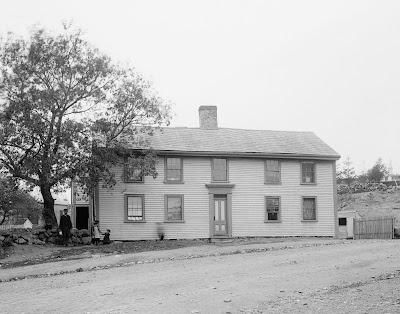
Born in 1641, Dimond claimed he came from a long line of famous astrologers and necromancers. Records indicate Wizard Dimond’s profession was “shoreman” and tradition says he was a retired sea captain. Like most Marblehead residents he had a strong connection to the ocean and his house, called the Old Brig, was supposedly constructed from the planks of a ship. It still stands today on Orne Street. 

Unlike most towns in Massachusetts, Marblehead wasn’t founded by Puritans looking to practice their religion but instead by fisherman and sailors who just wanted to earn a living. They were more tolerant of magic and fortune-telling than their Puritan neighbors, particularly if it helped them in their daily lives. In other towns Wizard Dimond would have been accused of witchcraft. In Marblehead, he was a valued member of the community.  

According to legends, Dimond used his magic to help ships off the coast of Marblehead when they encountered trouble. On stormy nights, Wizard Dimond positioned himself in the graveyard on Burial Hill, roaming around the tombstones and shouting orders to ships miles away. The sailors on those ships should have been too far away to hear his voice, but amazingly they did, and they also knew to follow his commands if they wanted to safely reach the harbor. The hungry waves claimed those who didn’t heed the wizard of Marblehead.

Old Burial Hill, Marblehead.

People also came to Wizard Dimond to learn the future, but one of his specialties was finding lost or stolen objects. He once helped an elderly couple locate their stolen money and also identified the man who stole it. 

Another well-known Marblehead legend tells how he helped an elderly widow. The widow, who was quite poor, came to Dimond’s house on a cold winter night. All her firewood had been stolen, she said, and she would freeze to death unless he found the thief. Using his magical abilities, Wizard Dimond first learned the thief’s name. Going further, he then cast a spell on him, cursing him to walk up and down the Marblehead streets until sunrise with a huge, heavy log tied to his back. In the morning the thief, cold and exhausted, confessed to the widow and returned her firewood. He learned his lesson and never stole again. 

Dimond claimed that magical powers ran in his family. His granddaughter was Moll Pitcher, the famous fortune-teller of Lynn, so maybe there is some truth to that claim. 

Edward Dimond died in 1732 at the venerable age of 91. His grave site has been long forgotten, but perhaps his spirit is still roving around Burial Hill on stormy nights, giving orders to ships at sea.

*****

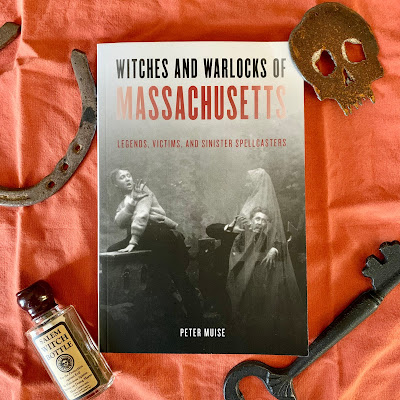
If you like reading about Massachusetts's magical past, you may enjoy my book Witches and Warlocks of Massachusetts, which was published last October. It's available wherever you buy books online


January 28, 2020

Madness, Monsters and A Meteor: A Review of Color Out of Space

This past weekend I went to see Color Out of Space, the new film based on H.P. Lovecraft's 1927 story of the same name. The film begins with narration from Ward Phillips (Elliott Knight), a hydrologist from the big city who's been sent to rural Massachusetts on an assignment. His dialogue is lifted directly from Lovecraft's story:

West of Arkham the hills rise wild, and there are valleys with deep woods that no axe has ever cut. There are dark narrow glens where the trees slope fantastically, and where thin brooklets trickle without ever having caught the glint of sunlight... When I went into the hills and vales to survey for the new reservoir they told me the place was evil. They told me this in Arkham, and because that is a very old town full of witch legends I thought the evil must be something which grandams had whispered to children through centuries... (H.P. Lovecraft, "The Colour Out of Space," 1927).

The film follows the outlines of Lovecraft's tale relatively closely. While surveying for a new reservoir Phillips meets the Gardners, a local family whose lives are impacted when a strange meteor lands on their property. The original story is set in the 1880s, but the the film updates the setting to the present, and rather than hardscrabble Yankee farmers the Gardners are now urban transplants trying to re-start their lives on an inherited farm.


Their efforts aren't working out too well. Father Nathan Gardner (Nichola Cage) spends his time drinking, learning to farm via audio recordings, and raising alpacas for reasons he doesn't seem clear about.  His wife, Theresa (Joely Richardson), is recovering from breast cancer and trying to continue her career as a stockbroker on their isolated farm with a terrible internet connection. And is it really a good idea for her to be living an hour away from the nearest hospital? Oldest son Benny (Brendan Meyer) spends his time getting stoned and looking at NASA's website, while daughter Lavinia (Madeleine Arthur) practices Wicca in the woods, imploring the spirits to help her get away from the boredom of the farm. Only youngest son Jack (Julian Hilliard) seems adjusted to the situation.

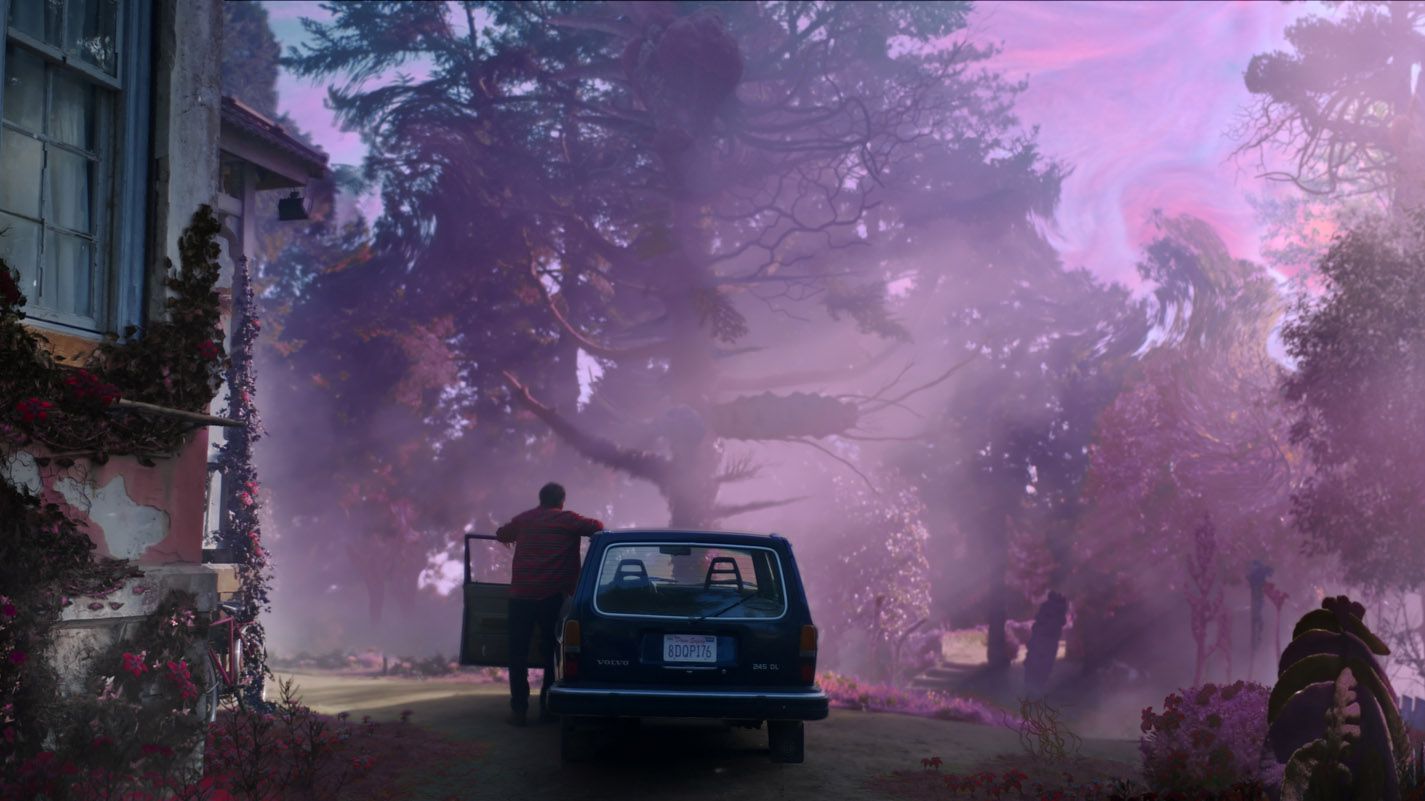
Life on the farm seems stifling and a little dysfunctional, but things only get weirder once the glowing meteor lands in the yard. Some of the changes are almost imperceptible - the parents fight more than usual, stoner Benny gets even more distracted, the Gardners' phone and internet reception degrades. The family barely even notices when strange plants start growing in the yard, neon pink mist fills the surrounding woods, and the progression of time itself becomes disrupted. Is radiation from the meteor affecting everyone's sanity, or is there really a monster in the alpaca barn? The answer is both.


"The Colour Out of Space" is one of Lovecraft's classic tales of cosmic horror where human protagonists learn the hard way that they're living in an uncaring universe. It's a horrific science fiction story, not a tale of the supernatural. Still, the film's director Richard Stanley is a practicing occultist and occult imagery appears throughout the film, mostly in rituals that Lavinia performs. She invokes archangels using the Lesser Banishing Ritual of the Pentagram, reads the Simon Necronomicon, and carves the odal rune on her forehead. The rune symbolizes inheritance and land, and is germane to her family's situation. It also looks like she carves the words "solve" and "coagula" into her hands. These words may be familiar to you from Eliphas Levi's illustration of Baphomet, and they mean "dissolve" and "coagulate." Many things dissolve and coagulate in Color Out of Space, often in a gruesome manner.

Speaking of coagulation, Nathan says "Families stick together" several times during the movie. When I recently re-read the story I was struck by how the Gardners don't leave their farm, even as things get worse and worse. The family in the movie behaves the same way. Like frogs in slowly boiling water, they don't realize they're in danger until it's much too late. It's hard to know you're in a strange situation when it's what you've grown accustomed to.

Director Stanley and Amaris Scarlett, who co-wrote the script with him, incorporate nods to Lovecraft's work throughout the film (a Miskatonic University t-shirt, a symbol on a TV news van, character names) and it's clear they appreciate their source material. They're not afraid to modernize the story where appropriate, not just by adding well-written female characters but also by casting people of color: Elliot Knight as Ward, Tommy Chong as a blissed out hippie unbothered by all the weirdness, and Q'orianka Kilcher as the town's ambitious mayor.


If I have one complaint, it's a minor one. Color Out of Space was filmed in Portugal, and it just doesn't look like New England. The trees are wrong, the Gardner's house clearly is not an old Massachusetts farmhouse, and the town hall is obviously European. Lovecraft's story is an homage to the New England landscape and an elegy for the Yankee farmers whose way of life was fading away and it would have been nice to see those incorporated into the film. But like I said, that's a minor complaint.


This is definitely a classic B movie, and I mean that in a good way. There are rubbery monsters, men with shotguns shooting things, copious amounts of gore and slime, and Nichola Cage chewing the scenery. It's not an arthouse horror film like Midsommar, The Witch or Mandy. On the other hand, there is also beautiful psychedelic imagery, a script with multiple levels of meaning, and good acting (including some by Nicholas Cage) so it's more like a B+ movie. It's also one of the best Lovecraft adaptations I've seen in a long time.


Surprisingly, it's also emotionally moving. I found myself teary-eyed by the end and got a little choked up as the film ended with this narration, pulled directly again from Lovecraft's story:

It was just a colour out of space—a frightful messenger from unformed realms of infinity beyond all Nature as we know it; from realms whose mere existence stuns the brain and numbs us with the black extra-cosmic gulfs it throws open before our frenzied eyes.

August 16, 2016

Seductive New England Witches, Part One: Mrs. Paterson

Austin Osman Spare was born in London in December of 1886. From a young age he showed an aptitude for the arts, and by age thirteen he was working in a stained glass factory and taking art classes by night. He went on to study at the Royal College of Art and his father, a London policeman, secretly submitted one of young Austin's drawings to the prestigious Royal Academy. It was accepted and exhibited. Spare was on the road to art world greatness.

But things didn't work out exactly as expected. Spare briefly had a successful art career, but he's more famous for his work as an occultist and practitioner of witchcraft. Spare claimed that a witch named Mrs. Paterson set him on this unusual path.

As a child Spare had been raised Anglican, but in his early adolescence met an elderly fortune teller named Mrs. Paterson. Spare described her as a "colonial woman," and Paterson claimed she was from a venerable line of New England witches who had escaped the Puritan prosecution in the 1600s. Although quite old and not traditionally attractive Spare found himself drawn to her. Paterson seduced him, and for the rest of his life Spare was attracted to older women.

Austin Spare and Witch, 1947, by Austin Osman Spare

Although Paterson was poorly educated and had a limited vocabulary she had a powerful grasp of abstract metaphysical concepts. More impressively, she had strong occult powers. In addition to being an accurate fortune teller she was able to materialize her thoughts into physical manifestation, and often created visions of the future for her clients using this power. Spare claimed she taught him this talent but he could never use it as skillfully she could.

Mrs. Paterson possessed several other unusual talents. Using her ability to externalize her thoughts, she was able to easily transform herself from an elderly woman into a beautiful young one. Spare painted portraits of her in both forms.

Paterson could also travel to the Witches' Sabbat, and took Spare with her several times. Spare claimed the Sabbat occurred in "spaces outside of space" that were indescribable and could not be physically represented. Paterson gave Spare the witch name "Zos" after initiating him into the cult. In return, Spare called her his Witch Mother.

Drawing by Austin Osman Spare

Spare eventually turned his back on the mainstream art world to devote himself to his occult and magical studies, briefly associating with Aleister Crowley before striking out on his own. (An interesting note: Adolf Hitler asked Spare to paint his portrait, but Spare turned him down, rightly thinking he was evil.) He lived in squalid conditions in London's slums where he wrote books with titles like The Book of Pleasure, The Focus of Life, and The Anathema of Zos, and sketched and painted his poverty-stricken neighbors and spirits that he summoned. He died in relative obscurity in 1956, but his work on magical sigils (a way of encoding desires in visual form) was rediscovered by occultists in the 1980s. Today his art work is quite expensive; the largest collection of his work is held by Led Zeppelin's Jimmy Page.

And what of Mrs. Paterson, the New England witch who set him on this path? It's unclear what happened to her, if she really existed at all. Perhaps she is now residing in a space beyond space, but some writers think Spare simply made her up. People who start magical cults or new religions often claim they were taught by divine beings like angels, secret Ascended Masters, or extraterrestrials. After all, the magic has to come from somewhere. Mrs. Paterson fits into this pattern. Then again, if Spare really did have the ability to manifest his desires in the material world, perhaps the elderly witch emerged from his subconscious mind to teach him.

Witches, undated, by Austin Osman Spare
Whatever she really was, I find it interesting that Paterson allegedly came from New England. Britain has plenty of witches in its own history, so why would Spare need one of ours? There is a trend in the occult world to think that more 'primitive' people have the most powerful magic. Although 'primitive' is an ethnocentric and meaningless word when applied to cultures, occultists and New Agers have often thought that groups like American Indian medicine men, swamp-dwelling Voodoo practitioners, or rural Appalachian conjure folk have the secrets to the universe. Primitive people are allegedly closer to nature, and therefore closer to the source of magic. An elderly, uneducated fortune-teller from that wilderness called New England would probably have seemed primitive - and therefore powerful - to a Londoner like Austin Osman Spare.

Mrs. Paterson doesn't fit the mold of most traditional New England witches, who were not usually seductive. Accounts of the Witches' Sabbat from early New England witch trials were quite chaste and lack the descriptions of orgies that are found in European trial documents. There is some underlying sexual tension in tales of New England witchcraft - particularly those where the witch 'rides' her male victim all night long like a horse - but it is usually not explicit. If anything, Mrs. Paterson reminds me of the shape-shifting fairies and enchantresses from Medieval romances like Gawain and the Loathly Lady, where one of King Arthur's knights marries a hideous crone who later transforms into a lovely maiden.

"Dreams in the Witch House" from the Masters of Horror TV series, 2005
Paterson also reminds me of Keziah Mason, the ancient witch in H.P. Lovecraft's short story "Dreams in the Witch House." Like Paterson, Keziah Mason takes that story's male protagonist to the Witches' Sabbat, which lies beyond the boundaries of normal space. Unlike the highly libidinous Spare, Lovecraft was much more repressed, and Keziah Mason is not seductive in his story. (However, Keziah is both seductive and able to transform into an attractive young lady in the 2005 TV version directed by Stuart Gordon.)

Lovecraft and Spare were contemporaries, but I don't think they were aware of each other's work. Perhaps Mrs. Paterson was working behind the scenes? Lovecraft did once receive a letter from a female fan who claimed to be descended from the Salem witches. She offered to share her magical knowledge with him, but he declined her offer. Who knows what might have happened if he had taken her up on it.

April 11, 2016

Fish Monsters From Newburyport: Are the Deep Ones Real?

Last week I wrote about the Frogman of Silver Lake. It's interesting to think there might be a humanoid frog creature lurking in Plymouth County, but could there also be humanoid fish people hiding in the waters off the North Shore of Massachusetts?

Most people would say no, but a few people say yes.

The legend of these particular fish people started in the fall of 1931, when the Rhode Island horror writer H.P. Lovecraft visited Newburyport, Massachusetts. These days Newburyport is an expensive and upscale coastal community, but in 1931 the city was run-down and full of crumbling old houses. The downtown was full of boarded-up businesses.

Things were so bad that some locals jokingly called Newburyport the "City of the Dead." It sounds like a grim place, but Lovecraft of course loved it and used his visit as inspiration for one of his most famous stories, "The Shadow Over Innsmouth."

"The Shadow Over Innsmouth" tells how a young man from the Midwest comes to Massachusetts to research his family's genealogy. His search leads him to Innsmouth, a depressed and decaying coastal town. Most of the town's businesses are shut down, and many houses are boarded up (but still seem to be occupied). Some people in Innsmouth also share the same strange physical deformities: receding foreheads, bulging eyes, and creased necks. To make things even creepier, Innsmouth's churches have been closed and replaced by a Masonic-style cult called the Esoteric Order of Dagon.

A priest of the (fictional) Esoteric Order of Dagon from Propnomicon.
The young man encounters an elderly drunkard who tells him about Innsmouth's unusual history.  Innsmouth was once a prosperous fishing and mill town, but overfishing and bad economic times led to hardship for Innsmouth's citizens. As the town's leaders debated what to do, a sea captain named Obed Marsh proposed an unusual solution.

While Captain Marsh was sailing in the South Seas he learned about a group of aquatic humanoids called the Deep Ones. In return for the occasional human sacrifice, the Deep Ones provided local South Seas islanders with gold and bountiful catches of fish. Well, they actually wanted more than just sacrifices. The Deep Ones also liked to mate with attractive islanders. The hybrid offspring of these unusual couplings were born looking human, but as they aged they slowly turned into Deep Ones themselves.

Perhaps, Captain Marsh suggested, the people of Innsmouth could strike a similar bargain with the Deep Ones, who quite conveniently had a large underwater city just off the coast of Innsmouth? The citizens of Innsmouth were at first repulsed by the idea, but many of them changed their minds after seeing the gold Captain Marsh brought back from the South Seas - and after learning that their hybrid offspring would be immortal, like the Deep Ones themselves. Those citizens who didn't support Captain Marsh became the first human sacrifices...

That would have been a great town meeting to attend, wouldn't it? "My plan to revitalize the downtown business district stands on two pillars: human sacrifice and sex with scary fish people." I won't rehash the rest of the story, but it involves an encounter with a horde of hideous monsters, a daring escape, and a surprise twist ending.

A human/Deep One hybrid from Propnomicon.

"The Shadow of Innsmouth" is of course fiction. Lovecraft wrote horror stories, not history. But a few readers have always wondered if there was some kernel of truth behind what he wrote. When Lovecraft was alive his friend William Lumley told Lovecraft that he thought his stories were accounts of actual occult events. Lovecraft laughed it off. A woman also wrote to Lovecraft and said she was the descendant of a Salem witch. If Lovecraft would share his magical secrets she would share hers. Lovecraft thought he was nuts.

Despite Lovecraft's lifelong denial that his stories were anything but fiction, many practicing occultists have believed otherwise. This trend only accelerated after his death in 1937, and multiple books have been written that allegedly contain the secrets of "true" Lovecraftian magic. Several claim to be authentic versions of the Necronomicon, the terrible tome of blasphemous knowledge he created for his stories.

The British occultist Kenneth Grant (b.1924 - d. 2011) believed quite strongly that Lovecraft had tapped into a source of authentic magical power through his fiction. Grant claimed that Lovecraft accessed true occult knowledge - and supernatural entities - while dreaming and unknowingly incorporated them into his fiction.

Based on this supposition, Grant conducted many Lovecraftian rituals during his life, and several of them involved the Deep Ones. During one, a priestess in Grant's occult lodge descended into a tank of water where the Deep Ones materialized and attacked her. Another of his priestesses died when the plane she was on crashed over the ocean. Grant speculated that the Deep Ones were responsible.

It all may sound crazy to you (or perhaps not!), but Grant is not alone in trying to summon the Deep Ones through magic rituals. Here in the U.S., Episcopal-priest-turned-occultist Michael Bertiaux claims to have successfully summoned the aquatic humanoids in an isolated Midwestern lake (possibly Devil's Lake in Wisconsin). Sadly, Bertiaux hasn't offered up a detailed descriptions of how he did it, but perhaps that's a blessing. Do we really want our lakes infested with amorous fish monsters?

If you have encountered the Deep Ones please let me know. I don't think anyone has yet reported seeing them near Newburyport, but I suppose if people keep summoning them it's only a matter of time before they pop up on some Plum Island beach. The borders between fact, fiction and the occult are always blurry, particularly here in New England.

*****

My sources for this week's post include The Necromicon Files (2003) by Daniel Harms and John Wisdom Gonce III, and my own book, Legends and Lore of the North Shore (2014). Thanks also to the reader who used the word "Lovecraftian" in their comment last week, which inspired me to write this post.

By the way, I filmed a segment for the Travel Channel's show Mysteries at the Museum last summer about the Melonheads, and it should be airing this Thursday, April 14 at 9:00 pm. I hope you are able to tune in!