Showing posts with label sex. Show all posts

December 31, 2018

The Witch Who Loved Satan in The Shape of A Bear

Most people are familiar with the Salem witch trials, but there were many other witchcraft accusations in early New England history. Some of these stories are quite interesting, like the following. 

In the year 1660 William Holmes of Scituate*, Massachusetts learned that a rumor was being spread about his wife. The rumor claimed Goodwife Holmes was a witch, and it was being spread by one of the Holmes's neighbors, Dinah Sylvester. 

Goodman Holmes was outraged and took Sylvester to court for slander. It took about a year for the case to come to trial, but finally in May of 1661 Sylvester testified as follows:

Magistrate: "What evidence have you of the fact that William Holmes's wife is a witch?"

Sylvester: "She appeared to me as such."

Magistrate: "In what shape did she appear?"

Sylvester: "In the shape of a bear."

Magistrate: "How far off was the bear?"

Sylvester: "About a stone's throw from the highway."

Magistrate: "What manner of tail had the bear?"

Sylvester: "I cannot tell as his head was towards me."

Sylvester went on to tell the court that Goodwife Holmes was not the only one near the highway in the shape of a bear. The Devil was there as well, and he too was in ursine form. And the Evil One was feeling frisky; he and Goodwife Holmes were making love as only two bears can. 


Apparently Sylvester gave explicit details of the lovemaking she saw by the side of the road, but they were blacked out of the final records. The court didn't seem to find her story convincing, and not just because it was so outrageous. Laws at the time specified at least two people needed to bear witness against a witch, and no one else came forward to support Sylvester's testimony.

The court did find Sylvester guilty of slander, though, and sentenced her to either pay Goodman Holmes five pounds (a huge amount of money at the time) or be publicly whipped. They also offered a third option: she could publicly acknowledge that she lied about Goodwife Holmes being a witch. She took the the third option. 

Aside from the Satanic bear sex, there are some interesting aspects to this story. One is the location. Scituate was at the time part of Plymouth Colony, which included not only the modern city of Plymouth but also Cape Cod and most of Southeastern Massachusetts. Plymouth Colony was founded by the Pilgrims, and they seem to have been a little mellower than the other Puritans who founded Massachusetts Bay Colony and Connecticut. Although there is a lot of witch folklore from Plymouth Colony, there were only two trials involving witches. Sylvester admitted she lied in the trial involving the bear, and in the other case the woman accused of witchcraft was acquitted. Compare that to the many witch trials in Massachusetts Bay and Connecticut, which led to the execution of more than 30 people. 

Dinah Sylvester is another interesting part of this story. She appears in several court cases from that time. In 1666 she and her brother were accused of attacking a town constable who was arresting their mother. She was later accused of fornication (having sex while unmarried), and in 1669 is mentioned in a case against Elkanah Johnson, whom Sylvester claimed was the father of her baby. 


*****
* Older sources say Scituate, modern sources say Marshfield. I think this is because parts of Marshfield used to belong to Scituate, but I am not sure.

Sources: Elizabeth Renard The Narrow Land (1934), Frederick Freeman The History of Cape Cod: The Annals of Barnstable County, Including the District of Mashpee, Volume 1 (1858),  and James and Patricia Scott Deetz The Times of Their Lives: Life, Love, and Death in Plymouth Colony (2001).

April 26, 2018

The Maypole of Merrymount: Religion, Sex and Money

When I was in elementary school, way back in the 1970s, we had to make May Day baskets as an art project. I don't remember what grade it was, but I do remember thinking "May Day? That's not really something we celebrate here." I knew it was a holiday in other countries, but was it something celebrated in Haverhill, Massachusetts? Still, I made my basket from construction paper and dutifully left it on a neighbor's doorstep like the teacher suggested.

Apparently I was on the dying end of a tradition, because May Day baskets were quite popular in the nineteenth and early twentieth century. Maybe I would have been more enthusiastic about May Day if I had been allowed to dance around a Maypole, but that was not part of my school's curriculum.

*****

The first and most famous Maypole erected in Massachusetts was the one put up by Thomas Morton at his colony of Merrymount in 1624. Morton was a well-educated English lawyer who had come to Massachusetts as part of a colonial expedition. Their colony, in what is now the city of Quincy, was initially called Mount Wollaston after Captain Wollaston, the commander of the expedition's ship. When Morton learned the captain was selling indentured servants to another colony in Virginia he encouraged the other servants to rebel. Wollaston fled, and Morton became the new leader of the calling. Preferring to call himself the colony's "host," he renamed it Merrymount.

Since Thomas Morton was an educated, literary type of guy, the name Merrymount had a variety of meanings to it. First, it indicated that the colony was to be a place of happiness now that Captain Wollaston was gone. Second, it was a play on the Latin word for the sea, mare, since the colony was on the coast. Ma-re-mount, get it? Finally, there was a sexual connotation to the colony's name, indicating it was someplace where the mounting (aka sex) was merry.
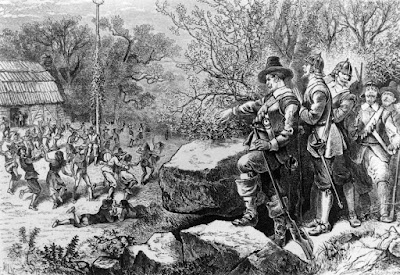
Puritans disapprovingly watching Maypole festivities at Merrymount.
As May 1st approached the colonists Merrymount erected an 80' Maypole topped with a pair of deer antlers. They fired rifles and pistols in celebration, and Morton composed a poem that was nailed to the pole. Morton's poem mentions various Roman sea deities like Neptune, Amphitrite and Triton, and ends with these lines:

With proclamation that the first of May
At Ma-re-Mount shall be kept holiday

Morton and the other colonists invited the local Indians to join them at their celebration, particularly the Indian women. Beer flowed, people got drunk, and a good time was had by all. The Merrymount men sang a song that was composed in honor of the celebration. Here are some of the lyrics:

Drink and be merry, merry, merry boys;
Let all your delight be in Hymen's joys
IĆ“ to Hymen, now the day is come,
About the merry Maypole take a roam. 
Make green garlands, bring bottles out
And fill sweet Nectar freely about.
Uncover thy head and fear no harm,
For here's good liquor to keepe it warm. 
Give to the Nymph that's free from scorn
No Irish stuff nor Scotch overworn.
Lasses in beaver coats come away,
Ye shall be welcome to us night and day

The "Hymen" mentioned in this poem is the Greco-Roman god of marriage, but again I am sure there is a double entrendre intended. 

Hymen, god of marriage
I suppose if Merrymount had survived as a colony the history of New England would have been quite different, but it didn't survive. Shortly after the May Day celebration the Pilgrims from Plymouth Colony marched on Merrymount. They chopped down the May Pole, arrested Thomas Morton, and exiled him from New England. Morton made his way back to Merrymount in 1630, but most of the inhabitants had scattered by then. This time, the Puritans of Boston arrested Morton and burned Merrymount to the ground. Morton was sent back to England.

Back in England, Morton and his wealthy patron Fernando Gorges successfully sued to revoke the Plymouth Colony charter, but Morton's victory was short-lived because the English Civil War started. Morton fled from the chaos back to New England, where he died penniless in York, Maine in 1647. I believe he is buried somewhere in York, but I couldn't find a location for his grave. Perhaps it has been lost?

The New England Puritans and Thomas Morton came into conflict for three big reasons:

RELIGION

The Puritans followed a very strict version of Christianity that had rigid rules about how people should behave. They also didn't celebrate holidays like May Day or even Christmas, which they associated with the Catholic and Anglican Churches. Holidays were one of the things they were trying to purge from the English church.

Thomas Morton, on the other hand, was an Anglican who clearly enjoyed a good holiday. He was also well-educated and appreciated the ancient paganism of Greece and Rome. I don't think he was a practicing pagan, but he did enjoy the literature and mythology of the Classical World, as evidenced by his poem's references to Roman gods. This was quite common for educated people of his time. For example, Shakespeare's late romances Cymbeline, Pericles and The Tempest all include pagan gods.

The Puritans specifically cast Morton as a sinful pagan, calling Merrymount Mount Dagon (after the ancient Canaanite sea god) and saying the maypole was a modern version of the Golden Calf. Morton took up this mantle proudly. He titled his book about New England The New English Canaan, and urged readers to help protect the new Canaan from the invading Puritans.

SEX

As mentioned above, the Puritans expected people to follow very strict codes of behavior. Sex was intended for married couples. Morton and the settlers at Merrymount had a more relaxed view on these matters.

I think it is useful to note that many of the Puritan settlers were already married and brought their families to New England with them, while most of the Merrymounters were unmarried men with no problem enjoying the company of the local Indian women or possibly even marrying them. Intermarriage between European colonists and indigenous people was common in parts of the New World where the colonists were single men, but the Puritans took a dim view of this practice.

Some historians have also suggested that homosexuality may have been tolerated at Merrymount. For example, the authors of the Boston History Project's book Improper Bostonians point out that Morton mentions Jupiter, the king of the gods, and Ganymede, his male mortal lover, when writing about Merrymount. Of course, Ganymede was also Jupiter's cupbearer so he may have been mentioned because of his connection with getting drunk. Still, male homosexuality was somewhat tolerated among educated Englishmen like Morton. For example, the character of Antonio in Shakespeare's Twelfth Night is clearly in love with Sebastian, something the other characters do not question.

Morton himself never married, for whatever reason, so he would have personally benefited from "hosting" a sexually liberal colony.

MONEY

The Merrymounters were trading with the local Indians for beaver pelts, which brought them into direct conflict with the Puritans, who wanted to corner the trade in pelts. Morton and his men were also giving the Indians guns in return for the pelts, which the Puritans definitely didn't want. This just gave the Pilgrims one more good reason to shut down Morton's colony.

*****

What would I have learned about Maypoles in elementary school if Thomas Morton had succeeded? Probably more than I did (which was nothing). Maybe in some alternate universe he did succeed, and happy New England school children descended from both English and Algonquin Indian ancestors frolic around Maypoles and learn their history. That's not the universe we live in, but Merrymount is still fondly remembered as a brief glimpse of what might have been. 

December 11, 2016

A Sexy Puritan Christmas: Lewd Behavior at Yule in Old New England

The war over Christmas has been going on for centuries. Is the holiday too commercial? Is it too religious? People have been arguing those points for hundreds of years, but you don't hear a lot of people complaining these days that Christmas is too sexual.

Surprisingly, that was a complaint lodged against Christmas in the past. Before Christmas became focused on children, gift-giving, and cozy crafts, it was a raucous public holiday where the lower classes drank heavily and roamed through the streets. They traveled from house to house demanding food and drink from their wealthier neighbors, who themselves were drinking heavily and also feasting on the best foods from the recent late autumn harvests.

All that partying sometimes led to lascivious behavior, as illustrated by the following information from Stephen Nissenbaums' book The Battle for Christmas.

When the Puritans founded New England they banned the holiday outright. Puritan theologians did not believe there was any Biblical justification for celebrating Jesus's birth in December, and they also knew that Christmas was placed on December 25th by early Christians to co-opt the pagan Roman holiday of Saturnalia. They didn't view Christmas as a Christian holiday, but rather as a pagan survival that encouraged disorderly behavior.

Unfortunately for the Puritans, some people in New England continued to celebrate Christmas. These celebrants were originally people on the fringes of Puritan society: servants, the poor, and sailors and fishermen. To help quash the lingering Christmas festivities the leaders of the Massachusetts Bay Colony even passed a law in 1659 levying a five shilling fine against anyone found celebrating the holiday.

This law wasn't successful. People have always loved an excuse for a party, even in 17th century New England, and authors and diarists of the time often disapprovingly noted that their trashy neighbors were enjoying the holiday in the old-fashioned, drunken way. Much to the dismay of the Puritans, Christmas even briefly became legal during the short three-year governorship of the royally-appointed Sir Edmund Andros.

Yule-tide partying continued even after Andros was sent back to England in 1689. In fact, the problem seemed to be worsening. Cotton Mather, Boston's leading minister, wrote the following in his journal in December of 1711:

I hear of a number of young people of both sexes, belonging, many of them, to my flock, who have had on the Christmas-night, this last week, a Frolick, a reveling feast, and Ball...

Uh-oh. Not only were the marginal people celebrating Christmas, but now the children of good upstanding Puritans were too. Note how he is specifically concerned about "young people of both sexes."

Reverend Mather took action and preached against Christmas parties in 1712 and 1713. He preached the following:


The Feast of Christ's Nativity is spent in Reveling, Dicing, Carding, Masking, and in Licentious Liberty... by Mad Mirth, by long Eating, by hard Drinking, by lewd Gaming, by Rude Reveling...

Mather also told his congregation that "Abominable Things" were done in the name of Christmas. What were these unnameable abominations? Pre-marital sex.

Mather wasn't just being alarmist. Historians have analyzed New England birth records from the early 18th century, and they've found that the largest number of children were born in September and October, roughly nine months after Christmas. Even more interesting, many of these children were born only seven months after their parents were married. In other words, they were conceived illegitimately during Christmas, and their parents only married once they realized a child was coming.

The lewd behavior associated with Christmas was finally tamed not by preaching, but by commercialism. In the 19th century the holiday became associated with gift-giving and Santa Claus, and those associations remain with us today. The battle against lascivious Christmas behavior was won, but not with Cotton Mather's weapons of choice.

*****

I highly recommend Stephen Nissenbaum's The Battle for Christmas if you like strange Christmas lore and history. It's a fascinating book!

August 22, 2016

Seductive New England Witches, Part Two: The Freetown Forest Witch

Last week I wrote about A.O. Spare, the British art world, and witchcraft. This week I'm bringing the witchcraft back to New England for a particularly creepy story.

It comes from Christopher Balzano's Dark Woods: Cults, Crime and the Paranormal in the Freetown State Forest. I highly recommend this book if you like your folklore scary and weird. Balzano interviewed people who live near Massachusetts's Freetown Forest and also researched some uncanny occurrences that happened there. The result is a collection of spooky - and allegedly true - stories like this one.

Dave (no last name given) grew up in a rural area in southern Massachusetts. His backyard abutted the Freetown State Forest, and as a boy he and his friends liked to play in the thick woods. The forest has more than 50 miles of unpaved roads and covers more than 5,000 acres, so there was plenty of space for the boys to play.

There was also plenty of space for strange things to happen. One day when he was six, Dave and a friend were in the woods when they heard someone laughing at them. They thought they could see someone hiding in the trees nearby, but when they tried to get a closer look it seemed as though the light was refracting strangely around the laughing figure, making it hard to see. Both boys were terrified and ran home. They kept their encounter secret.

Dave didn't encounter anything strange again until he was ten, when he had a very vivid dream. He dreamed he was an adult male walking through the woods towards a small house. He carried an axe in one hand. When he entered the small house he saw a middle-aged woman with long gray hair making love to a Native American man. In a jealous rage he killed them both, but as he did the woman glared at him not with fear, but with hatred and evil.

OK. Let me just interject to say that's one freaky dream for a ten-year old to have. But more on that later. Back to David's story ...

The Freetown State Forest.
Things got really weird for Dave and the other boys in the neighborhood over the next few years. One day while the boys were out walking in the woods when they came upon the foundation of an old house. Dave recognized it as the ruins of the house he had seen in his dream. This discovery spurred discussion among the boys, and as they talked they all realized they had recently seen the same gray-haired woman. She often appeared outside their bedroom windows at night, begging to come in, while the boys hovered in the space between wakefulness and sleep. They all thought she might be a witch.

Only one of the boys had invited her to enter his bedroom. The results were disastrous. She forced herself on the boy, which terrified him. His parents had to break down the bedroom door to reach their screaming son, who lay in bed as if someone was holding him down. The family eventually moved away from the Freetown State Forest.

Dave had his own nighttime visit from the witch, which he claims happened while he was awake. He sometimes saw a white figure following him in the woods and heard the eerie laughter he had heard years ago. He also told Balzano that he had seen a large black cat in the area. Black cats aren't that unusual, but this one walked on its rear legs.

The witch definitely was scary, but despite this Dave and some of the boys became obsessed with her. They visited the old foundation repeatedly, and one of Dave's friends would wander through the woods trying to find her.

The witchy phenomena quieted down as Dave got older. He hasn't seen the witch for many years. He moved out of his parents' house, and has a girlfriend and a child. He still gets nervous when he goes to visit his parents at his old house near the woods, though.

******

I really like this story. Yes, it's spooky, but it reminds me of the stories I'd hear when I was just a kid, sitting on my back porch in the late summer. Plus, I love a good New England witch story.

First off, let's get something out of the way. Is this story true? I have no way to tell. Balzano says the Freetown Historical Society has no record of anyone living in the woods, but the ruins of the house seem to be real. I also don't recall any famous witch cases from that area, but that doesn't mean strange things don't still happen. 

The Freetown State Forest.
Rather than trying to prove or debunk it, I think it's more interesting to look at what's happening in Dave's story,  For example, it's interesting to compare this story with last week's post about Austin Osman Spare and Mrs. Paterson. Both involve older female witches trying to seduce teenage boys. Austin Spare found the experience liberating and enlightening; Dave and his friends were terrified. Can it just be chalked up to Spare's artistic sensibility? Maybe, but perhaps the Freetown boys were just much more aware that even women can be sexual abusers. 

If I were a Freudian analyst, and not just someone who read some Freud in college, I'd probably make a lot out of Dave's dream where he is an adult male killing the witch and her lover. That feels like some heavy-duty Oedipal symbolism to me. That dream also somehow kicks off several years of unpleasantly sexual witch-haunting as the boys work their way through puberty. The haunting seems to have stopped when Dave and friends reached full maturity. It all seems to make symbolic sense.

Finally, what exactly who or what was this mysterious woman? The boys called her a witch because of her appearance, and the black cat seems to support them. She's also a ghost. I've mentioned on this blog before that witches tend to live on after death, so that's not really surprising. She also reminds me of the rapacious succubi, seductive female demons that appear in Medieval folklore. 

Witch? Ghost? Demon? Maybe the forest just shows us what we're looking for. Balzano writes that "the paranormal is often defined by the people who experience it," so it makes sense that teenage boys who lived on the edge of a big New England forest experienced what they did. 

Tony and I have actually been to the Freetown State Forest. We didn't see any ghostly witches, but did find the woods there kind of unsettling. So if you go looking for the witch use caution. Who knows what you might find there yourself?

July 21, 2013

A Haunted House and Puritan Fornication

Instead of one big topic, this week I just wanted to share a couple interesting things.

First up, a horror movie called The Conjuring opened this week. It's supposedly based on an actual haunting that occurred in Burrillville, Rhode Island in the early 1970s.

The supernatural shenanigans started almost immediately after Carolyn and Roger Perron moved their family into an old farmhouse. Objects moved on their own, blood oozed out of food, and strange voices were heard in empty rooms. The wife Carolyn was particularly afflicted by the multiple spirits that haunted the house.


Eventually, Ed and Lorrain Warren (ghost hunters who later became famous for The Amityville Horror) showed up at the Perron's house to investigate. I won't tell you what they found in case you want to see the movie, but you can also read about their investigation in this article from The Providence Journal.

Although Ed Warren has passed away, Lorraine still actively investigates the paranormal and maintains an occult museum in her home in Monroe, Connecticut. This sounds like a great field trip, but don't touch the exhibits - most of them are cursed. Youtube has a short video tour of the museum:


Fast forward to 3:00 if you want to see a spooky possessed doll named Annabelle, and then watch to the end to see a sinister wooden statue found by a hunter lost in the woods of Newtown, Connecticut. Creepy!

Maybe all this is too scary for you and you want something a little more academic. In that case, I give you this article that appeared in Boston.com about fornication charges in colonial America. A professor at Louisville University has recently published a paper on the topic, and she notes that women were charged for fornication more than any other crime in 17th century New England. There was even a category of crime called "open and notorious fornication." I suppose Puritan sex laws are scary in their own way, but unlike the ghosts who sometimes haunt our houses the sex laws seem to be staying dead and buried.


June 05, 2011

Sex Lives of the Puritans, Part 2: Bundling

My last post was about courting tubes, which unwed couples used to communicate with each other while in the same room as their families. The New England Puritans wanted young couples to be compatible before they got married - but didn't want them to have sex.

These two somewhat contradictory cultural impulses culminated in a practice known as bundling.

Courting tubes are kind of cute, like kids using cans on a string to play telephone, but bundling is just bizarre to me! It originated among the Puritans, and seems to have continued in parts of New England until the early 19th century. I believe it may still happen among the Amish in Pennsylvania.

What was bundling? Well, if a young couple was getting along well and marriage seemed likely, their families encouraged them to spend a night together in the same bed. So far, so good. I think many modern Americans would agree sleeping together can determine compatibility.

But would we agree it should be done while tied up in giant sacks? Probably not.

To prevent the young lovers from actually making love, their families would tie them up in large cloth bags before putting them in bed. Only their heads would be outside the sacks, so they could talk with each other.

To further prevent physical contact, sometimes a board would be placed between the man and woman. Some beds were even built with grooves in their headboards to accommodate a bundling board. There must have been a lot of bundling going on if special beds were being made!

Strangely, despite all their precautions, the New England Puritans and their descendants still experienced a high rate of pre-marital births. Researchers have found that while less than 10% of New England brides were pregnant at their wedding in the 17th century, this number climbed to a whopping 40% in the 18th century.

Were the sacks tied too loosely? Did the boards have holes in them? Possibly, but I think it also could be that the definition of bundling was pretty flexible.

It appears that strict families used boards and sacks, but some families didn't use either. They would simply allow the youngsters to lie together in bed with their clothes on. And it's pretty easy for clothes to come off…

Dana Doten's 1938 book The Art of Bundling contains this little story, which first appeared in the 1796 Vermont Almanac. I think it sums up the whole situation nicely.

An Indian warrior who supported the American troops in the Revolution was staying at a large house in Cambridge, Massachusetts. One night he went upstairs and came upon the young lady of the house bundling with her beau.

In embarrassment the Indian tried to leave the room, but the beau asked him to stay. "We're not behaving inappropriately", he said. "It is just as easy for us to be good here as anyplace else!"

"Yes", said the Indian, "but it is much easier to be wicked."

A couple of this blog's readers commented and emailed me about bundling after my last post - great minds think alike!

May 22, 2011

Sex Lives of the Puritans, Part 1: The Courting Tube

Today's post is short, but a little spicy.

When most people hear the word Puritan today, they think of dour people in black who never had sex. That's not quite true. The Puritans encouraged lots of sex within a marriage, and the New England Puritans had a very high birth rate.

In order to ensure a successful marriage, and therefore a successful sex life, young people went through a lengthy courting process. One goal was to make sure both families approved of the union, but another was to let the young man and woman become well acquainted.

Unfortunately, a few factors made this difficult. Courting couples could not be left unchaperoned, so young beaus had to visit their sweethearts in their families' homes. If you've ever been in a house built in the 1600s you know they are often quite small. Private conversation between the couple was impossible, what with the whole family sitting in one small room, and a watchful grandmother seated between the young man and woman.

How then, were a young couple supposed to get acquainted, and maybe even whisper some sweet nothings into each other's ears?

From this page about the history of hearing aids.

Through a courting tube, of course. A courting tube was a long wooden tube through which the lovers could talk to each other without being overheard. The young woman would place one end in her ear, and her beau would speak softly into the other. To hear her reply, the young man would then put his end in his ear when she spoke. The tube could be passed in front of or behind grandma, so it worked even with a chaperone separating the couple. Ingenious! Repressive social rules were overcome with a cumbersome, but effective, device.

The courting tube is sometimes also called a speaking tube or courting stick, but by whatever name I first read about it in Albion's Seed by David Hackett Fisher.

Next week - more shocking Puritan sex secrets!