April 09, 2022

Wilmot Redd, the Witch of Marblehead

This is my second post about Marblehead. As I mentioned in my last one, Marblehead is incredibly charming and beautiful. It's the archetypal old New England seaside town. And as we all know, old New England towns often have some weird legends attached to them...

Engraving of a witch by James Caulfield, courtesy the Wellcome Collection
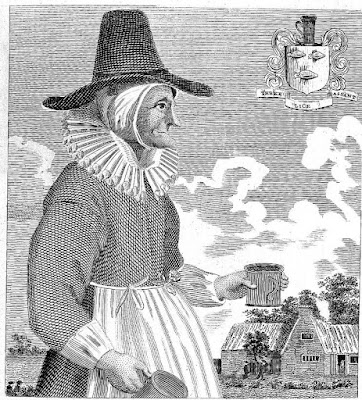
In Marblehead, that weird legend is about Mammy Redd, a fearsome witch who lived in the 17th century. According to various 19th century sources, Mammy Redd was a hideous old woman who terrorized the people of Marblehead. In New England Legends and Folklore (1883), Samuel Adams Drake wrote the following about her:

This woman was believed to possess the power of malignant touch and sight, and she was able, so it was whispered, to cast a spell over those whom she might in her malevolence wish to injure. To some she sent sickness and death, by merely wishing that a 'bloody cleaver' might be found in the cradle of their infant children.

A popular rhyme about Mammy Redd from the 19th century described another of her evil powers:

Old Mammy Redd

Of Marblehead

Sweet milk could turn

To mould in churn

Other versions of the rhyme specify that the mold looked like "blue wool," which sounds pretty gross. Ruining dairy products (milk, cream, or butter) is a classic New England witch's hex. 

Photo by my friend Onix Marrero
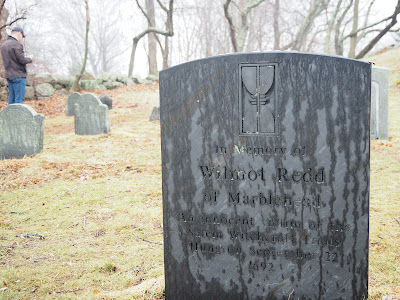
The legend of Mammy Redd is based, quite loosely, on Wilmot Redd (or Read, depending on the source), a Marblehead woman who was executed during the Salem witch trials. She was the wife of a fisherman and, like many of the woman accused of witchcraft by the Puritans, was older and cantankerous. Some sources describe her as "grouty," which means rude or ill-tempered. She was not a witch, but was simply unpopular. 

Most records from her trial are lost, but those that remain describe an argument Redd had with a neighbor, Mrs. Syms. Syms believed Redd's maid had stolen some bed linens, and  exchanged harsh words with Redd. At the end of the argument, Redd supposedly cursed Syms, telling her she would never defecate or urinate again. Soon after, Syms began to suffer from constipation and had difficulty urinating. These problems only ended once she moved away from Marblehead. 

This is an absurd thing to be executed for, but the Salem judges accepted even the most ridiculous accusations at face value. During her questioning, the afflicted Salem girls (the driving force behind the witch hunt) claimed they saw Wilmot Redd's spirit offering them the Devil's black book to sign. This alleged vision sent the girls into convulsions. While most people in the courtroom took them seriously, Wilmot Redd did not. When a judge asked her opinion of the girls' convulsions, she said "My opinion is they are in a sad condition." Grouty to the end, Wilmot Redd was hanged on September 22, 1692 at Gallows Hill in Salem. 

Photo by Onix Marrero

Like everyone executed for witchcraft in Salem, Redd's body was discarded in an unmarked grave somewhere near Gallow's Hill. Perhaps her family retrieved it and secretly reburied her, perhaps not. Many years later, the town of Marblehead erected a monument to her in Old Burial Hill graveyard. As you can see from the photo, people leave coins at her grave to honor her memory. 

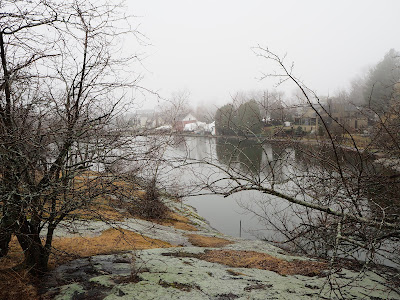
The town also named this small behind pond behind Old Burial Hill Redd's Pond in her honor. She and her husband lived next to the pond in the 17th century, and although her house is long gone her memory and legend still survives to this day. 

Photo of Redd's Pond by Onix Marrero
*****
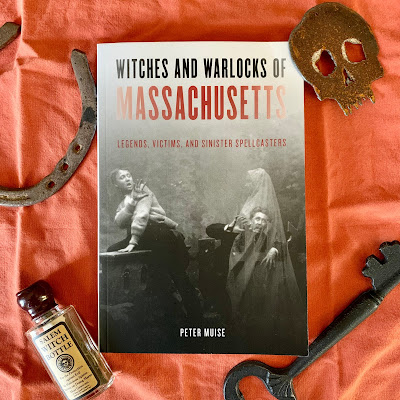
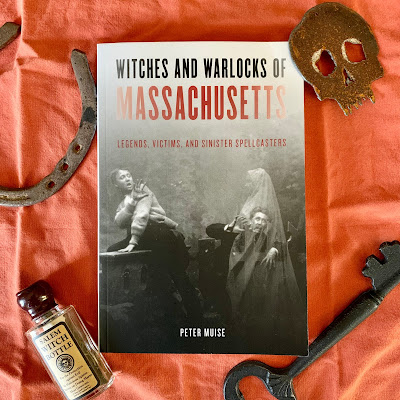
If you like witch legends and the history behind them, you might like my newest book, Witches and Warlocks of Massachusetts, which is available wherever you buy books online. 


March 26, 2022

The Grave of Susanna Jayne: Bats, Angels and the Grim Reaper

Marblehead is one of the prettiest towns in Massachusetts, with an amazing and historic downtown, dramatic ocean views, and streets full of Colonial-era homes. Lots of people visit it for these reasons, but this past weekend we went for a different one: to see the grave of Susanna Jayne.


Like so many coastal New England towns, Marblehead is quite old. It was founded in 1635 as a fishing village by English colonists, and its first cemetery, Old Burial Hill, was established three years later. Old Burial Hill is located on a rocky outcrop overlooking the town center and the harbor. This was also the site of Marblehead's first meeting house (the Puritan term for a church). The meeting house is long gone, but the cemetery remains. 


We were lucky enough to visit on a rainy, foggy day. Our stroll through Old Burial Hill was really atmospheric due to the mist and wet weather, which also kept a lot of people indoors. We we had the place to ourselves. This was my first time visiting Old Burial Hill, and it's already one of my favorite cemeteries. 


Old Burial Hill was one of the locations for the movie Hocus Pocus, which draws some tourists. Nearly 600 Revolutionary War veterans are buried there, which is another draw, but we had come particularly to see the grave of Susanna Jayne. The wife of Peter Jayne, a local schoolmaster, Susanna died in August of 1776. Her epitaph reads:

Deposited Beneath this Stone the Mortal Part of Mrs. Susanna Jayne, the amiable Wife of Mr. Peter Jayne, who lived Beloved and Died Universally Lamented, on August 8th, 1776, in the 45th Year of her Age.

Many of the gravestones I visit have some legend associated with them, but there isn't a legend attached to Susanna Jayne's grave. It's just an incredibly beautiful headstone with lots of symbolism that, to the modern eye, is very gothic. 

Susanna Jayne's headstone is on the right. It's recently been embedded 
in stone to preserve it. 

The headstone was carved by Henry Christian Geyer (1727 - 1785), a Boston artisan who made many other Massachusetts gravestones. Some of Geyer's work follows standard styles popular at the time, while others, like Susanna Jayne's gravestone, are quite creative.  


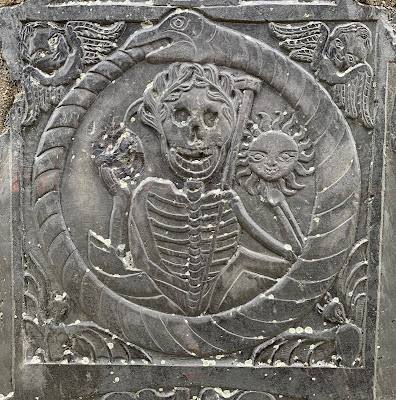
The centerpiece of Jayne's headstone is this carving of the Grim Reaper, portrayed as a skeleton holding a scythe. The skeleton is crowned with laurel wreaths, and holds the sun in one hand and the moon in the other. (Sadly, the moon has been damaged.) Overall, the message is one of Death triumphant and the passage of time. 

The Grim Reaper is encircled by snake biting its own tail. This image, known as the ouroboros, is a symbol that dates back to the ancient Egyptians and was found on the wall of King Tut's tomb. It's had many meanings over the centuries, but most commonly represents eternity and the cycles of time. More time symbolism appears at the top of Susanna Jayne's headstone, where Geyer carved an hourglass framed by two bones. Time passes, and Death takes us all.


However, the universe is not purely mechanistic and grim. There's a moral aspect, symbolized by the angels and bats that hover around the corners. Good and evil play a role in the eternal drama as well. 


Modern gravestones are quite subdued these days, and very plain. I miss the artistry and symbolism of the older headstones. Susanna Jayne's gravestone is a work of art, and was actually photographed by the well-known artist Ansel Adams. If you'd like to see some beautiful New England art, I'd recommend taking a trip to Old Burial Hill.


You can read more about Susanna Jayne's gravestone here. More details about Henry Christian Geyer can be found here.

March 06, 2022

The Ghost of Central Burying Ground

Boston is one of the oldest cities in America. It was first settled by the Puritans in 1630, and downtown Boston has some fine old cemeteries that reflect the city's age. Copp's Hill Burying Ground, the Granary Burying Ground, and King's Chapel Burying Ground are the resting places for patriots, Puritans, founding fathers, and possibly even Mother Goose

Those three cemeteries are amazing places to visit, and if you haven't been you should go today! They're also quite popular with tourists. But if you want a quieter, spookier, cemetery experience you should visit Central Burying Ground. It's the least popular of the four downtown cemeteries, but definitely has its own particular charms. 

I visited Central Burying Ground recently on a warm Saturday. I was meeting a friend downtown and arrived early, so I decided to kill some time wandering around the cemetery. It's located on Boston Common right next to the Boylston T station, but despite its convenient location very few visitors were there that day. There were only two people other than myself: someone feeding squirrels, and an Emerson student sitting on a crypt smoking a cigarette. 

At first I wasn't even sure it was open to tourists. Most of its gates were locked, and it took me a while to find the one open entrance. But once I was inside I had the cemetery mostly to myself. 

Central Burying Ground is the newest of the four old cemeteries. It was established in 1756, and is the resting place of British soldiers who died during the Revolution, American patriots from the Battle of Bunker Hill and the Boston Tea Party, composer William Billings, and painter Gilbert Stuart. Stuart is well-known for his portraits of George Washington, and is probably the most famous person buried there. 


According to local lore, Central Burying Ground is also home to at least one ghost. In the 1970s, a local dentist named Matt Rutger was walking through the cemetery on a pleasant spring day when he had a strange encounter. He was alone in the cemetery, but kept feeling someone tapping him on the shoulder. There was no one behind him when he turned around. The weird tapping continued, until finally he felt someone grab him by the collar and pull him backwards. Again, there was no one there. 

Rutger was understandably disturbed, so he began to walk quickly towards the cemetery gates. As he did, he saw something odd. 

"'I saw a young girl standing motionless in the rear corner of the cemetery, staring at me intently.' She wore a white dress, and her utter immobility in and of itself seemed eerie. Dr. Rutger turned in the opposite direction, but, to his amazement, the girl instantly relocated to the front of the cemetery, nearly fifty yards from where she'd stood only moments before. Dr. Rutger changed directions a couple more times, and each time the ghostly figure cropped up at a different station. Finally he made it to the sidewalk, but as he strode away he felt a hand slip into his pocket. He watched in amazement as his car keys levitated free of his pocket, dangled in mid-air, then fell with a jingle to the ground." (Holly Mascott Nadler, Ghosts of Boston Town, 2002).

That's quite the encounter. Rutger is not the only person who's encountered a ghost at Central Burying Ground. According to Sam Baltrusis's Ghosts of Boston (2012), other visitors have reported seeing a ghostly young girl in the cemetery, and one woman on a tour even became annoyed because she thought a fellow tourist was tapping her on the back. No one else had touched her, though. Some visitors have also said that someone (or something) grabbed their keys from their pockets. The ghost is apparently quite consistent. 

No one has identified the ghost who haunts Central Burying Ground. Many of the cemetery's graves have been disturbed by construction, so if you believe in ghosts perhaps that is what causes the alleged haunting. For example, in 1836 many bodies were moved to new tombs to accommodate a Boylston Street extension, and in 1895 many bodies were found in unmarked graves during construction of the subway line. They were re-interred in a large mass grave in the cemetery's northwest corner. No one likes to be awoken rudely from their sleep, right?

I did not see anything strange when I visited, but just had a peaceful cemetery stroll. I'd definitely recommend going to Central Burying Ground if you are interested in ghosts, or just want to enjoy a quiet space in the busiest part of the city. 

February 27, 2022

Visiting the Devil's Den

There are at least 110 places in New England that have the word “Devil” in their name, and forty-three of them are in Massachusetts. Hmmm. What does that say about the Bay State? There's Devil’s Hollow in Marshfield, the Devil’s Landslide in Wellesley, Devil’s Garden in Amherst, etc. And in Newbury, there is... the Devil's Den. 

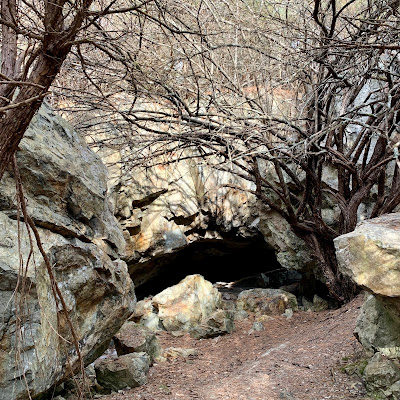
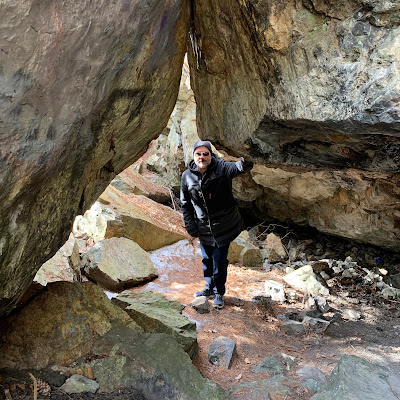
Last weekend Tony and I took a trip up to Newbury to visit the Devil's Den. The Den is actually a small cave located in an old, abandoned limestone quarry. There are a lot of old quarries in New England, but this one is really old. It was first quarried in 1697 and finally shut down in 1830. The quarry is not large but is very dramatic looking, which is why is probably why it got its devilish reputation.

Long after these quarries had ceased to have a commercial value, pleasure parties were accustomed, during the summer months, to seek rest and recreation there, beguiling the time with marvelous stories in which the Prince of Darkness was given a conspicuous place. In later years, the young and credulous found traces of his Satanic Majesty's footsteps in the solid rock, and discovered other unmistakable signs of his presence in that locality; and ever since the Devil's Den, the Devil's Basin, and the Devil's Pulpit have been objects of peculiar interest to every native of old Newbury. (Ould Newbury. Historical and Biographical Sketches, John James Currier, 1896)

That passage mentions several devilish places. The Devil's Basin was another nearby limestone quarry, filled with water, which I believe was about a half mile away from the Devil's Den (according to Volume 3 of Contributions to the Geology of Eastern Massachusetts, 1880). I'm not sure if the Basin still exists, but according to this site it was located south of the Devil's Den. That area now seems to be mostly landfill which is why I think the Devil's Basin is gone. The Devil's Pulpit was a large boulder nearby but we couldn't locate that either. 


The Devi's Den still exists, and in the early 19th century young boys who lived nearby would perform a strange initiation ritual at it. They believed that a certain magic word had been written on the floor of the cave which would kill anyone who entered it. Certain precautions had to be taken before entering the cave to nullify this curse.

I suppose that no boy ever went to that place alone, and a sort of solemn ceremony attended his first visit with his older playmates, to a scene bearing an appellation ominous enough to call up every vague dread of his youthful heart. The approach on these occasions was rather circuitous, through the pastures, until an elevated mass of stone, standing quite solitary, was reached, designated as “Pulpit Rock.” To the summit of this, the neophyte was required to climb, and there to repeat some accustomed formula, I fear not very reverent, by way of initiation, and supposed to be of power to avert any malign influences to which the unprepared intruder upon the premises of the nominal lord of the domain might otherwise be subjected. (George Lunt, Old New England Traits, 1873)

In other words, after repeating the irreverent phrases from Pulpit Rock, (aka the Devil's Pulpit), it was safe to enter the Devil's Den. However, even then it was only safe to enter the cave with companions - never alone.

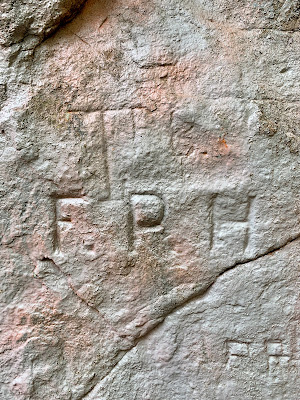
Old graffiti at the Devil's Den

Other than this curse and ritual, the Devil's Den had one other interesting feature. The Devil’s Den was made of limestone, but also had deposits of a mineral called chrysotile, a naturally occurring form of asbestos. Chrysotile is soft and chewy, and in the 19th century boys going into the cave would supposedly chew it. Hopefully, they avoided any dangerous side effects. Ingesting asbestos is probably scarier than than a Devil's curse!

I first learned about the Devil's Den while writing my first book, Legends and Lore of the North Shore. Back then, the Devil's Den was on private property, but it is now part of the 28-acre Jennie Lagoulis Reservation. It's worth a visit if you're in the area. Despite it's scary name and legend, you shouldn't be too spooked if you visit. The reservation is the site of a children's nature camp. If little kids can brave the terrors of the Devil's Den you can too.

*****

If you like New England legends, you might like my newest book, Witches and Warlocks of Massachusetts. It's available now wherever you buy books online!


February 13, 2022

Hallucinations, Magic Crows, and Witches: Random Thoughts While Making Bread

The other day I made some brown bread. Many of you might be familiar with this delicious loaf, but if you're not here's the scoop. It's a bread made with rye flour, wheat flour, and cornmeal that is usually sweetened with molasses. You usually find it at clambakes these days, but in the past it was just an everyday bread. 

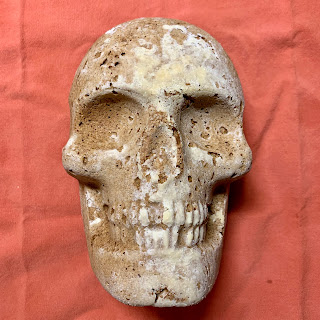
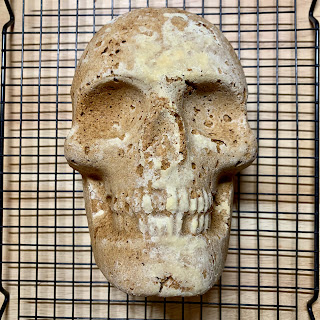
Some people make brown bread by steaming it in cans, but although that results in a very moist loaf it is not really necessary. You can bake it in a regular pan. I was feeling a little bit Goth, so I baked mine in a skull-shaped Halloween pan I have. 

Brown bread has its roots deep in New England's culinary history. It's had different names in the past, like "rye and Indian," which refers to the rye flour and the cornmeal, which was once called Indian meal since it originated with the local indigenous people. Sometimes brown bread was also called "thirds" because the recipe called for one third each of wheat, rye, and cornmeal. Wheat does not grow well in New England and was very expensive here in the 17th and 18th centuries, so the English colonists made their bread by mixing this precious commodity with the other two grains, both of which grow better in this climate.

I oiled and floured my skull-shaped ban so the bread came out looking like this!

As I made my brown bread, interesting stories about rye and cornmeal came to mind, one about the Salem witch trials and one from local Algonquin lore. 

Here is the Salem story. Most historians think the Salem witch hunt was caused by social and psychological factors. But what if there was a simple biological cause? In 1976 Linnda Caporael, a biology grad student at the University of California Santa Barbara, suggested that ergot, a fungus found on grain, might be responsible for the witch trials.

The English colonists grew a lot of rye, and during warm wet weather, ergot grows on rye. Ergot contains a compound similar to the hallucinogen LSD. People who consume rye ergot-infected with ergot can suffer from hallucinations, auditory disturbances, convulsions, strange skin sensations, vomiting, and psychosis. These symptoms sound like the symptoms suffered by the allegedly bewitched Salem girls. Carporeal argued that the spectral visions and strange fits these girls experienced were caused by the fungus.

This theory received a lot of publicity when it was published, even meriting a front-page article in The New York Times. A critique was published a few years later by Nicholas Spanos and Jack Gottlieb, two psychologists from Carleton University. They argued there was not strong evidence connecting ergotism to the Salem witch trials.

Convulsive ergotism, they claim, is only found in people with a Vitamin A deficiency. Someone with sufficient Vitamin A in their body suffers instead from gangrenous ergotism, a different variety of the disease which causes gangrene and rotting flesh. (Yikes.) The farmers in Salem Village consumed lots of dairy products, and the residents of Salem Town ate plenty of fish, both foods rich in Vitamin A. If ergot was present they should have suffered from gangrene, which they didn’t. 

Spanos and Gottlieb also point out that some symptoms of convulsive ergotism weren’t present in Salem, like vomiting and diarrhea. Most importantly, though, the afflicted girls only experienced their torments at specific times, usually in the courtroom when accused witches were brought in. Outside of the courtroom they were usually symptom-free. This strongly suggests their symptoms were not caused by ergotism. Many people who testified during the trials also said they only testified because they feared imprisonment or execution. It would be nice if the witch trials had been caused by something as simple as a fungus, but regrettably it seems that human ignorance and malevolence were more likely to blame.

That's kind of a weird and unpleasant thing to consider while making bread, but the other story is happier. It's connected to cornmeal. Corn was one of the staple foods for the local Algonquin tribes, and many tribes told stories about how it was brought to Earth from heaven by a crow. 

Here's one version of that story from Kitt Little Turtle (1940 - 2004), a Nipmuck medicine man from Webster, Massachusetts. It appears in the book Dawnland Voices: An Anthology of Indigenous Writing From New England (2014), edited by Siobhan Senier.

Many generations in the past, the Nipmuck lived only by hunting and gathering. They depended entirely on wild game and other food they could forage. Because of this they were always on the move and never settled in one place. 

One year food was very scarce and the Nipmuck were close to starvation. During this time a crow appeared in a vision to a young man. The crow told the man about a wonderful plant that would prevent the Nipmuck from starving. 

The man wanted to go find this plant, but the crow told him it was too far for him to ever find. The crow would bring it to him. The crow also told him that the crows would follow the Nipmuck forever if they grew this special plant. It was, after all, the crows' favorite food. 

A few days later the man was wandering through the woods when a crow appeared. It was the same one he saw in his vision. The crow gave the man three seeds: corn, squash, and beans. These are the Three Sisters which grow well together in the same field. The crow told the man how to cultivate and harvest these crops. 

Ever since that time, the crows visit whenever the corn is harvested to get the share that is due them. 

There you have it. Two stories, one delicious loaf of bread!