January 26, 2021

The Flesher Witch: Menace in the Maine Woods

I'm always excited when I learn about a new weird legend, so I was pretty happy recently when I learned about the Flesher Witch of Haynesville, Maine. Thank you Jeremy for pointing this one out! The Flesher Witch legend is creepy, unique, and blends old and new folklore motifs into one gruesome package.

Still from The Incredible Melting Man (1977)

**********

Haynesville is located up in Aroostook County, and it's quite small. Like really small. The last census counted fewer than 200 people living there. Haynesville may be tiny, but it's rich in spooky folklore. A lot of it focuses on Route 2A. The stretch of 2A that passes through the Haynesville Woods is notoriously winding and treacherous, particularly in the winter, and has been the site of many fatal car and truck accidents. 

All of those accidents have earned this part of Route 2A a reputation as one of the most dangerous roads in America. Country singer Dick Curless even had a hit in 1965 with "A Tombstone Every Mile," which was a country song about the dangers of trucking on Route 2A:

All you big and burly men who roll the trucks along

Better listen you'll be thankful when you hear my song

You have really got it made if you're haulin' goods

Anyplace on earth but those Haynesville Woods

It's a stretch of road up north in Maine

That's never ever ever seen a smile

If they'd buried all them truckers lost in them woods

There'd be a tombstone every mile

Count 'em off there'd be a tombstone every mile...

Curless was born in Aroostook County and lived much of his life in Maine, so he knew what he was writing about. The song's bouncy and catchy, but there's nothing fun about driving on Route 2A during the winter. Because of all the fatal accidents it's said to be one of the most haunted roads in New England. Many forlorn lost souls have been seen wandering along Route 2A, including a hitchhiking woman in white who disappears once a driver stops to pick her up. She's a classic "vanishing hitchhiker" type of ghost. 


I'm not here to really talk about ghosts, though. There's more happening in Haynesville than just ghosts. I'm here to talk about the Flesher Witch, a terrifying being who supposedly lurks in the Haynesville Woods. 

According to a local story, in the 1800s a young girl named Annie Wilcox moved with her parents and brothers to Haynesville. Shortly after they moved in, Annie began to complain of strange things happening at night. She said he heard a scratching noise at her window, as if something were trying to get in. Her parents ignored her - young children have active imaginations - but the phenomena got stranger as time went on. Annie said something unseen pulled off the blankets while she slept, and she sometimes felt something (or someone?) biting her skin late at night. She also heard a voice softly whispering indistinguishable words in the darkness. 

Her parents thought she was just trying to get attention, but they changed their minds one night when Annie ran into their bedroom in tears. Her face was covered in bloody scratches. She said an old woman with a face like melting wax had attacked her. When they searched her room it was empty. They let Annie sleep with them that night. 

The weird phenomena in their house stopped after this, but it wasn't the end of Annie's ordeal. One day about a month later, the Wilcox family was walking through the woods. The parents realized that Annie, who had been bringing up the rear, was no longer visible. They heard a terrifying scream ring out, but despite searching for hours her family was unable to find her. She had vanished.

Some hunters made a gruesome discovery several weeks later. They found Annie's dead body in a clearing in the woods. Her face was missing. Lying next to her on the ground was the corpse of an old woman whose face looked like melting wax.  
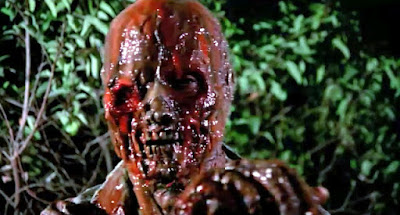
The Incredible Melting Man (1977)

Annie's death devastated her family. Her mother hanged herself, and her two brothers drowned while swimming. Mr. Wilcox was the sole survivor, and he slowly lost his sanity, scratching endlessly at his face as if he wanted to remove it. He wandered off into Haynesville Woods one day and was never seen again.

People say the Flesher Witch still lurks in the Haynesville Woods, even today. An old woman with a melting face is sometimes seen walking among the trees, and whenever animals or children go missing she is blamed. No one know who she is, and no one wants to get close enough to find out. 

So there's the legend of the Flesher Witch. I like it. Some parts of it draw on classic New England legends. Witches are one of the most common topics in pre-20th century New England folklore, and the nighttime attacks on Annie are every similar to witchcraft stories from the 1600s. In older stories the witch is usually a curmudgeonly neighbor, but the Flesher Witch seems to be a purely supernatural being. She's not just some mean old lady down the road. I think this is an improvement because it means no one's going to get hanged for being a witch up in Haynesville. 

Other parts of this legend seem more modern to me. The melting face seems modern and possibly inspired by horror movies, as does the witch trying to steal someone's face. That's not something you'd hear in a legend before the mid-20th century. And that's OK. Folklore changes over time. People in the 21st century are scared by different things than our ancestors were. 

In some ways this story reminds me of the Freetown State Forest witch who is described in Christopher Balzano's 2007 book Dark Woods: Cults, Crime and the Paranormal in the Freetown State Forest. Like the Flesher Witch, the Freetown Forest witch menaces young people and also seems to be a purely supernatural being. Are these witches really ghosts? Demons? Particularly gruesome land spirits? Or maybe just the manifestation of how people feel about the place they live? The woods can be pretty scary.

These stories are fascinating. If you know about any other strange modern witch legends please let me know, either in the comments or by emailing me. And of course, be careful when you go wandering out in the woods. 

January 13, 2021

Let's Scare Jessica to Death: Folk Horror in 1970s Connecticut

It's a classic urbanite fantasy. You'll escape all the stresses of big city life by moving to the country, where you'll live in a big farmhouse, grow crops, and make your own strawberry preserves. Maybe you'll raise some goats and sell artisanal cheese. Your life will be like a never-ending Martha Stewart photo shoot.

It's definitely something I've fantasized about, but I realize I'm probably not suited for country life. I haven't lived less than a ten-minute walk from a subway stop in the last thirty years - how am I going to shear sheep? And who knows what lurks out there in the countryside? After all, that same escapist fantasy is also the premise of many horror films. 

Last night we watched one of those films. Let's Scare Jessica to Death (1971) tells the story of Jessica (Zohra Lampert) and Duncan (Barton Heyman), a married couple who move from New York City to rural Connecticut. Jessica is recovering from some type of nervous breakdown, and Duncan thinks quiet country living will help the recovery process. Their friend Woody (Kevin O'Connor) comes with them to help manage the apple orchard at the old farm they've bought. 


Their move to Connecticut isn't quite the idyll they hoped for. On their way to the farm the trio stops at a historic cemetery for some sightseeing and Jessica sees a feral-looking woman in a white gown. In their new hometown they encounter a group of surly and disapproving old men, all strangely bandaged and wounded, at the general store. And at their farmhouse they discover an attractive bohemian young squatter named Emily (Mariclare Costello) who disrupts the group's equilibrium.

I first saw Let's Scare Jessica to Death on TV when I was a kid, and rewatched because I'm in the mood for some New England atmosphere. The movie was actually filmed on location in Connecticut in the autumn of 1970 and it makes the most of the setting. There are shots of an old 19th century farmhouse shrouded in fog - real fog, not smoke machine fog. Jessica traipses through a field of blooming goldenrod and an orchard whose trees are covered in red apples. When someone drives down the road I saw a maple tree that had just lost all its leaves in the background. The characters visit an antique store in a barn, a common sight across the area.

Seeing these scenes is like comfort food for me, particularly now, but it's a horror movie, not a video promoting tourism. The antiques dealer tells them the house they bought might be haunted. A young woman named Abigail Bishop drowned on the property, he says, but her body was never found. Local folks say she now roams the countryside as a vampire, eternally frustrated because she never got to marry and wear her wedding gown. Needless to say, the legend of Abigail Bishop doesn't sit too well with the still fragile Jessica.

Image from this excellent review. 

Abigail Bishop's vampiric ghost is at the heart of Let's Scare Jessica to Death and is open to many interpretations. Maybe she's just a figment of Jessica's imagination, something the movie hints at repeatedly. Abigail might also be symbolic of the characters' unspoken sexual needs and fears, particularly as they explore the new social norms of the late 1960s.

The movie was made when America's hippie counterculture was still strong, and although the main characters are too old to be true hippies they are clearly toying with the hippie lifestyle. Instead of a traditional car they drive an old hearse with a peace sign painted on the door, and their move "back-to-nature" is straight from the 1960s counterculture playbook. Abigail's ghost is the dark side of that counterculture, the footloose Manson girl who'll party with you and then quite literally drink your blood. 

Image from this great review.

She might also represent the spirit of the land itself, a grim genius loci who doesn't really approve of outsiders. Abigail Bishop is rooted in the town's history, in its lakes and coves, its orchards and old cemeteries. Her ghost is often shown in beautiful natural settings. The local old-timers have learned to live in harmony with their town's rapacious spirit, but the newcomers find out there's more to country life than sing-a-longs and antiquing. 

There really were cases of alleged vampirism in Connecticut. Folklorist Michael Bell discusses three of them in his excellent book Food for the Dead: On the Trail of New England's Vampires (2001). They weren't the seductive sexual predators we see in movies, but rather were victims of tuberculosis who died. When their relatives also became sick they thought the recently deceased person was feeding on them after death. The only way to stop the "vampire" from feeding was to unearth the corpse and burn its heart. It sounds unbelievable, but Bell has evidence that the practice continued up until the 1890s. This type of vampirism is very different from what's portrayed in Let's Scare Jessica to Death but it serves as a reminder that beautiful rural landscapes often have unpleasant histories. 

Venture Smith's gravestone rubbing. Screen cap from here. 

The movie alludes directly to one of those histories early on, when Jessica visits a cemetery to make some gravestone rubbings. The scene was filmed in East Haddam's First Church Cemetery, and Jessica makes a rubbing from a real gravestone, that of Venture Smith, a former slave who died in 1805. In 1798, Smith wrote a narrative of his life and as you might imagine it is full of violence and abuse. In the movie, Jessica decorates the bedroom of their new home with graverubbings, and Venture Smith's is taped right above the bed she shares with her husband. To her Smith's life is a charming relic, an attitude showing she and her friends are unfortunately clueless about the real history of their new home. 

Let's Scare Jessica to Death has a minor cult following, and several people have tracked down the various locations where it was filmed. The farmhouse in Old Saybrook where many of the exterior scenes were shot is now a decaying ruin. The house was surrounded by wide open fields when the movie was made in 1970. Now, fifty years later, the woods have reclaimed the land and will probably reclaim the house soon too. 

The house today. From DreadCentral. 

Let's Scare Jessica to Death isn't a perfect movie, but it's an interesting one, and definitely worth watching if you want to experience some unsettling New England folk horror vibes.

January 04, 2021

Easing into the New Year with Weather Magic

I'm one of those people who really love holidays, particularly holidays where we get to do something special. Foods only eaten on special days? Decorations? Costumes? Count me in. This might be one of the reasons October, November and December are my favorite months of the year.
Often in the past I have been a little depressed when New Year's ends. It's the last of the major holidays, and once it's done it's time to take down the tree and the lights and stop eating so much gingerbread. It's also time to stop engaging in all the holiday socializing we usually do and get back to work. But this year I'm not feeling quite as depressed about the end of the holidays. Partly that's because we just didn't do any holiday socializing, except on Zoom. There's nothing to miss! I also don't miss some of our other usual holiday activities, like going to the movies or trying new restaurants, because we didn't do any of that either.

However, my New Year's attitude might also be better because I'm engaging in a little piece of folk magic: paying attention to the weather. There's an old piece of New England folklore that says the weather on the twelve days of Christmas predicts the weather for the next twelve months of the year. So I've been writing down a weather report every day since Christmas.
To be honest, I'm not entirely sure how this is supposed to work. The tradition that Christmas has twelve days dates back to 567 AD, when a council of bishops declared it a special festive season. I think there's still some confusion, though, whether the twelve days include Christmas and end on January 5, or if they start the day after Christmas and end on January 6, the Feast of Epiphany. Different churches and different regions have different rules. 
Personally, I started keeping track of the weather on Christmas Day. The weather was warm, wet and windy. Gusty winds knocked down power lines, but the temperatures were above average and most of the snow melted. So does this mean that January will be warmer than normal with heavy winds? According to the folklore it does. 
I'm not entirely convinced this is an accurate way to forecast the weather, but writing down my observations about the weather at least helps me feel more grounded. I've also been taking notes about birds and animals. They aren't technically weather, but I'm hoping they can offer some insight into what's going to happen in the coming year. For instance, I saw a black squirrel outside my house on December 25, 26 and 28. I dubbed him the Black Squirrel of Winter. Who knows what he foretells for January, February and April? Hopefully good things...
I hope 2021 has good things in store for all of us. Happy New Year!

December 22, 2020

Fat Graveyards, Hay, and Magic Cows: Folk Magic for Christmas

This is definitely shaping up to be one of the stranger Christmases in recent American history, with most of the traditional festivities being canceled due to the pandemic. So why not cozy up by the Yule log (even if its on your computer screen) and enjoy some old New England folklore about Christmas?

As a lot of you know, for many years Christmas was not celebrated in New England. The Puritans didn't believe there was any basis for it in the Bible - the date of Jesus's birth is not given, after all - and suppressed Christmas celebrations here. New Englanders began to celebrate the holiday more widely in the 19th century as the Puritan influence weakened, and all of the folklore I present to you is from the late 19th century. 

Much of it concerns the weather, since Christmas falls close to the astronomical start of winter. I'm just going to give you the grimmest piece of lore first. Let's get it over with.

 A green Christmas make for a fat graveyard. 

Ugh. That's from Fanny Bergen's 1896 book Current Superstitions. This next one comes from Clifton Johnson's What They Say in New England (1896):  

A green Christmas makes a full churchyard. The foundation for this saying is the fact that open winters with their constant freezings and thawing are very unhealthy.

I don't think there's any medical validity behind that, do you? I hope not, because with climate change we're going to get more "open winters." I'm going to chalk this one up to old time Yankees considering almost everything as an omen of death, which is true. These folklore books have a huge number of death omens. I think those sayings also demonstrate the law of inversion that shows up sometimes in folklore. A green, pleasant Christmas foretells death, or the groundhog seeing his shadow on a sunny day indicates six weeks of bad weather. Something foretells its opposite.

Here's another one from Clifton Johnson, which is less grim:

Half the pork and half the hay

On Christmas Day

Johnson notes that men used to visit their neighbors on Christmas to see how the hay and pork were holding out. It sounds very bucolic and a nice way to see folks, doesn't it? It's also practical. On Christmas there are still three more months of winter to come, so you definitely want to have enough food for your livestock and yourself. There are similar sayings about Candlemas Day on February 2.

To me, the most magical piece of Christmas folklore is the following:

There is a saying that on the night before Christmas when the clock strikes twelve the cows kneel in their stalls. Some young girls in Hadley, years ago, sat up to discover whether this was true or not. At midnight they went out to the barn, and sure enough when the hour struck the cows knelt. At any rate, that was what the girls said. (Johnson, What They Say in New England)
That story is very similar to the European belief that animals can talk at midnight on Christmas Eve. The exact origins of that legend are murky, but are probably tied to the belief that Christ was born in a stable. Some sources say God allowed the animals in the stable to speak so they could praise the newborn messiah, something they have been able to do once a year ever since. 

The New England version of the legend is a little more subdued. It's as if people wanted to believe in Christmas magic, but couldn't fully commit. "Talking cows? No way. Cows that kneel at midnight? Hmm. Well, maybe..." It's interesting that Johnson has the caveat "At any rate, that was what the girls said," as if he or his informant knew people would receive the story with skepticism.

He also includes this version of the legend:

A still older story told in town with the same theme is that at midnight when the Christmas Day begins, all the cattle in the yards and fields might be seen kneeling with their heads turned towards the east in adoration. Two girls of the olden time, who were eager to see for themselves whether this was true or not, sat up on Christmas Eve until the spellbound hour, and then visited the farm cattleyard. But the cattle made no sign that they were at all affected.

So which is it? Do the cattle kneel or not? For now, I am comfortable with the ambiguity and holding both possibilities in my mind. Please let me know if you happen to say up until midnight to see what happens. I'd be curious to know. 

Have a safe and happy Christmas!

December 15, 2020

The Festival: Christmas with H.P. Lovecraft

You might be surprised to learn that H.P. Lovecraft, Rhode Island's famous master of horror, wrote a Christmas story. "The Festival" was published in Weird Tales in 1925, and like much of Lovecraft's fiction it combines local folklore, horror tropes, and the his own personal obsessions into a weird, unnerving tale. 

The story begins with a man arriving in an old Massachusetts coastal town called Kingsport for the first time. He's also the narrator, and he tells us he's there to join a celebration that his family has kept for centuries. It's an old family tradition he's heard of but never participated in before.

It was the Yuletide, that men call Christmas though they know in their hearts it is older than Bethlehem and Babylon, older than Memphis and mankind. It was the Yuletide, and I had come at last to the ancient sea town where my people had dwelt and kept festival in the elder time when festival was forbidden; where also they had commanded their sons to keep festival once every century, that the memory of primal secrets might not be forgotten. 

Lovecraft was well-versed in New England colonial history, and he's probably referring to the 17th century when he mentions the "elder time when the festival was forbidden." The Puritans did not celebrate Christmas because they didn't think there was any evidence for the holiday in the Bible. In fact, Christmas was not widely celebrated in New England until the 19th century. 

The narrator's ancestors were not English Puritans, though. He claims they "they had come as dark furtive folk from opiate southern gardens of orchids, and spoken another tongue before they learnt the tongue of the blue-eyed fishers." Lovecraft was something of a racist, and you can see some of that in this description, but he may also be alluding to the fact that New England's coastal towns were often more diverse than some of the area's other English settlements. Even if they were dominated by the Puritans, coastal towns did attract sailors and merchants from all over the world. 

A portrait of H.P. Lovecraft as an 18th gentleman by Virgil Finlay.

That was definitely the case in Marblehead, Massachusetts, which inspired Lovecraft's fictional Kingsport. Marblehead is a peninsula that juts out into the Atlantic from Salem, and is difficult to get to even today. It was even harder to reach in the past. Unlike its neighbors, Marblehead was first settled not by East Anglian Puritans but by fishermen from a variety of areas. In its early years Marblehead had a reputation as a rough, unchurched town where old practices lingered. For example, some British fairy folklore was remembered in Marblehead that was not found anywhere else in Massachusetts, brought there by its original colonists. In Lovecraft's story, something even weirder is found in Kingsport.

Marblehead was one of Lovecraft's favorite places. He first visited it in December, 1922, and described it in nearly orgasmic terms as "the most powerful single emotional climax experienced during my nearly forty years of existence." He returned several more times before writing "The Festival." Lovecraft was obsessed with New England's Colonial era, and he loved Marblehead's extensive and well-preserved colonial architecture. When the narrator finally reaches Kingsport and sees it glistening on a snowy night, he is basically describing Marblehead: 

...willow-trees and graveyards; endless labyrinths of steep, narrow, crooked streets, and dizzy church-crowned central park that time durst not touch; ceaseless mazes of colonial houses piled and scattered at all levels like a child's disordered blocks; antiquity hovering on grey wings over winter-whitened gables and gambrel roofs...

It sounds very charming, right? In reality Marblehead is very charming, but since this is an H.P. Lovecraft story and not a Hallmark Christmas movie we know something sinister is lurking under the Currier and Ives scenery of Kingsport. Our narrator will encounter something much more terrifying than eggnog and fruitcake. 

One giveaway is that he is coming to meet family he has never seen before. Many of Lovecraft's stories deal with people coming to bad ends after investigating their family tree. They find out their ancestors were cannibals ("The Rats in the Walls"), albino gorillas ("Facts Concerning the Late Arthur Jermyn..."), or evil, undead, murderous wizards ("The Case of Charles Dexter Ward"). Insanity and death usually ensue. Lovecraft was very concerned with his own heritage. He was obsessed with his role in America's racial hierarchy as white man of English descent, but also keenly aware that both his parents had died in an insane asylum. Ancestry is a double-edged sword.

These issues definitely appear in "The Festival." When the narrator reaches the home of his distant relatives it is a scene right from a history book. The main room has a thick-beamed ceiling and a massive fireplace. Old books line the walls. There's even an old woman spinning at a spinning wheel. What could be more proper and New Englandy? But something seems off. His hosts don't speak and their faces are oddly waxen, like masks. Their gloved hands are unnervingly flabby. And one of the old books is the Necronomicon, a forbidden book of ancient, evil knowledge.

His hosts take it with them when they leave for the big celebration, which is probably a good sign this won't be your average holiday party. The narrator follows them into the street, and they join a throng of hooded and silent people making their way up a hill towards an old church. Oddly, whenever the narrator bumps into someone he notices their body is unusually soft and pulpy. By the way, I also forgot to mention that four of the narrator's ancestors were hanged during the Salem witch trials.

Illustration by Virgil Finally for Colour Out of Space

"The Festival" has a bizarre ending, even for an H.P. Lovecraft story. The narrator and the other celebrants make their way down an enormous secret stairway carved into the bedrock under the church, finally arriving at a huge underground cavern. It's illuminated by a pale green fire that throws no shadows, and an oily black river flows through it. 

Fainting and gasping, I looked at that unhallowed Erebus of titan toadstools, leprous fire, and slimy water, and saw the cloaked throngs forming a semicircle around the blazing pillar. It was the Yule-rite, older than man and fated to survive him; the primal rite of the solstice and of spring’s promise beyond the snows; the rite of fire and evergreen, light and music. And in the Stygian grotto I saw them do the rite, and adore the sick pillar of flame, and throw into the water handfuls gouged out of the viscous vegetation which glittered green in the chlorotic glare.

The narrator joins in the celebration, but cannot maintain his composure when hideous winged monsters arrive to carry the hooded celebrants even further into the underworld. One of his hosts silently tries to convince him by pulling out a watch and signet ring that belonged to the narrator's great-great-great-great grandfather - which were buried with him in 1698. The host's waxen face slips off - it is a mask- revealing something so horrible the narrator throws himself into the river in terror. 

He wakes up in a hospital; the staff tell him he was pulled from the harbor. They diagnose him with 'psychosis' due to his ravings. As part of his treatment they let him read a copy of the Necronomicon, and a  passage in it leads him to believe that the people at the ritual were really long dead sorcerers and witches whose souls had created new bodies to inhabit from the worms and maggots that ate their corpses.

"Great holes secretly are digged where earth's pores ought to suffice, and things have learnt to walk that ought to crawl."

And that is the end of the story. It's one of my favorite Lovecraft stories, and if you haven't read it you can do so online here. It's Christmas but filtered through Lovecraft's various obsessions. 

Speaking of obsessions, I realized when I was almost done writing this post that I had already written about "The Festival" a few years earlier. I guess it's one of those things I return to every year. Maybe it's my new holiday tradition. Happy holidays?