Showing posts sorted by date for query Rock. Sort by relevance Show all posts

April 26, 2026

The Devil's Den in Hemlock Gorge

There are lots of places in New England named after the Devil. A few years ago, I published some lists on this blog. I'm not going to repost the full list today, but I have included a list of the Bay State's devilish places at the end of this post. 

I've been to several of these places, like the Devil's Footprint in Ipswich, the Devil's Den in Ashland, and another Devil's Den in Newbury. Amazingly, though, I've never been to the Devil's Den in Hemlock Gorge, which is in Needham right on the Newton border. I've lived in the Greater Boston area for more than 30 years, but somehow never visited the devilish place closest to me.


Last weekend we set out to rectify that. Hemlock Gorge is easily accessible by the MBTA Green Line, so Tony and I filled our water bottles, hopped on the T, and were soon at the Hemlock Gorge Reservation. I have to say that this park is worth visiting even if you aren't interested in vaguely Satanic caves. It's situated right on the Charles River and has some nice walking trails, but it also has the enormous Echo Bridge, which was built in 1877 to contain an aqueduct. The bridge is only open to pedestrians and has amazing views from its top. 


We entered the reservation from the northern side. The first thing we passed was this very dramatic spillway, where water from the Charles River flows under Route 9. I'm glad I'm not a fish or a small duck because I would definitely go over those falls to my doom.


Near the spillway was this old stone barn. Since I'm a horror-nerd, at first it reminded me of the Whateley house in H.P. Lovecraft's "The Dunwich Horror," whose windows and doors have been sealed up to contain an amorphous, ever-growing, ravenous monstrosity. A closer look revealed there was indeed an unsealed door and also some open windows, and a sign indicated that the building is used for some type of scientific purpose. 


Sadly, this probably means there isn't a monster inside. I guess that's good news for the neighbors, but the barn has always been a source speculation. For example, when the barn was built in 1839 some locals thought it was going to be used to raise silkworms. That never worked out, even though silkworms are preferable to monsters.

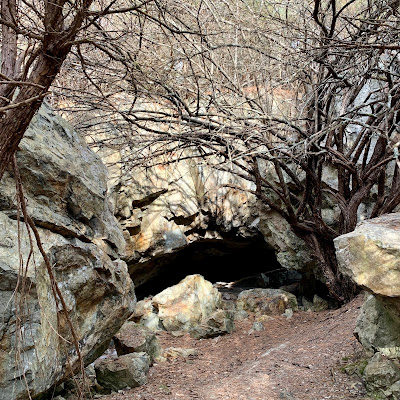
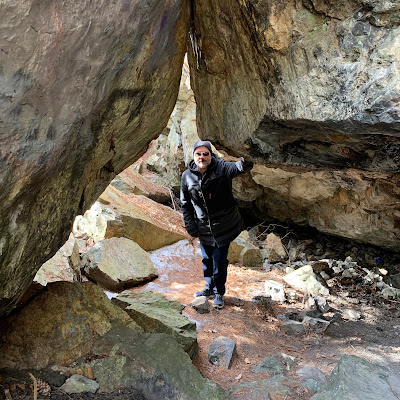
The Devil's Den was just a short walk from the barn. I knew it was a cave of some kind, but I had modest expectations because most caves in Massachusetts are pretty small. That was not the case! It's actually large enough to stand up in, and is located on a steep embankment overlooking a pond. There's also a small, little cave right next to it which is too small to hold a human.


A lot of Massachusetts caves are formed by boulders that were piled on top of each other by the glaciers. That type of cave is called a tallus cave, but the Devil's Den is quite different. It's carved out of solid puddingstone, not formed by assorted boulders. I don't know what geological forces did this, and I'm assuming it was a combination of water and wind. 


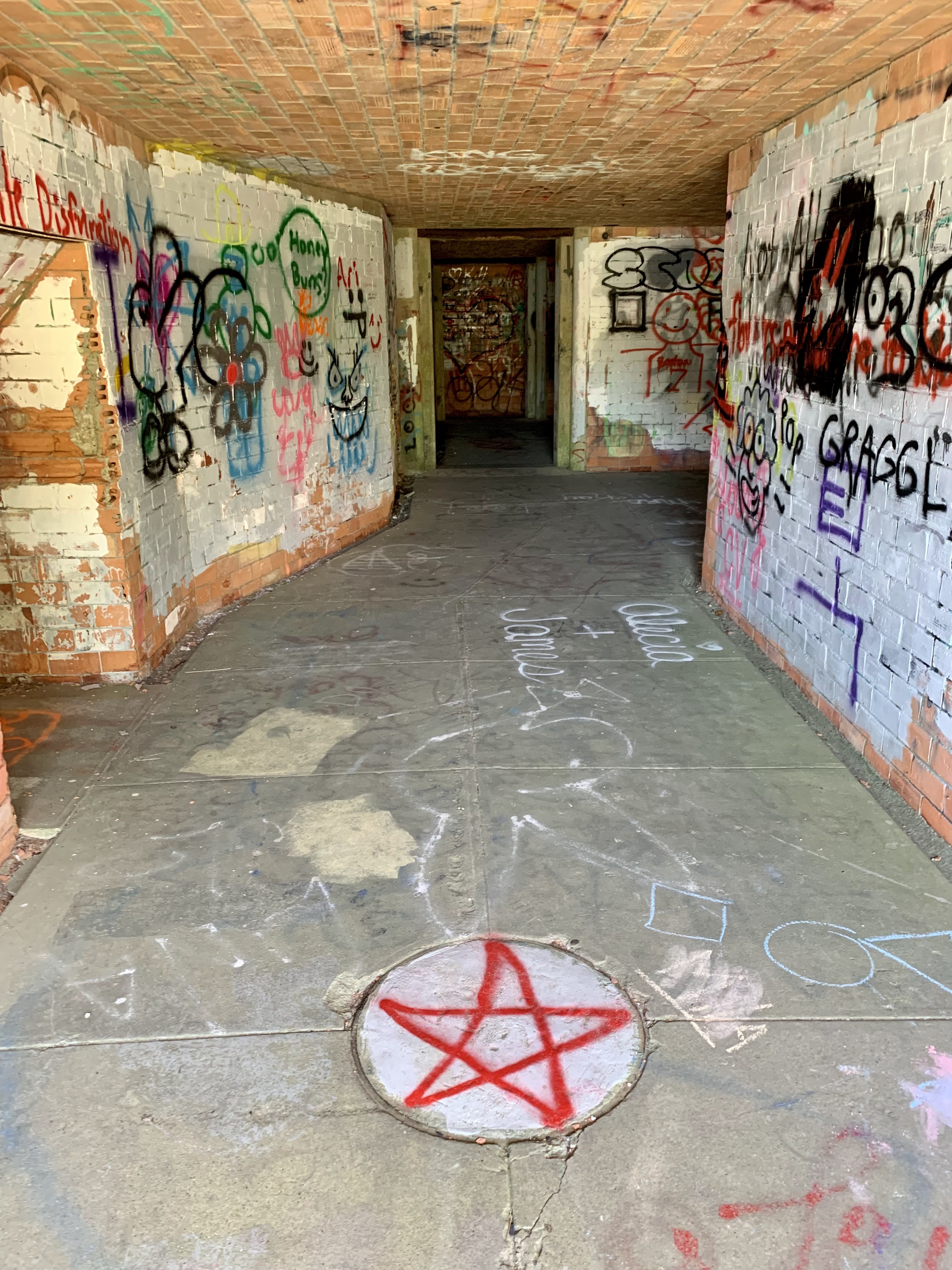
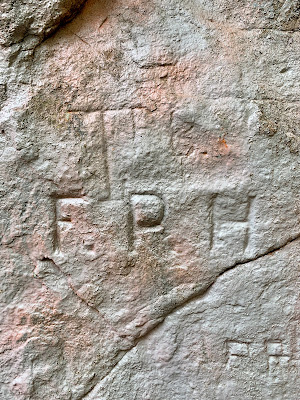
Like a lot of weird places we've visited, there was some graffiti in the Devil's Den. Although I'm not a fan of graffiti, I can understand why teenagers would want to leave their mark in someplace named after the Devil. Many of the places we visit are just slightly off the beaten path and are good locations for teens who want to hide their illicit behavior from their parents. At least there wasn't a lot of trash or broken glass in the cave, which was nice. 

This excellent page about Hemlock Gorge says that that local Native Americans may have used the cave to dry fish, but I couldn't find any information about why it's called the Devil's Den. King's Handbook of Newton (1879) only says the following: 
Just across, on the Needham Shore, is the old rocky grotto known as the Devil's Den. This is, of course, to be expected; for poor must be the New-England town that has not its bit of a cavern, consecrated to his Plutonian Majesty. 
As that quote sarcastically notes, you really can find caves or rock formations named after the Devil in many places. But why? I've seen a few theories trying to explain this. One claims that many of these places were associated with Native Americans, and that racist settlers gave them them devilish names because they thought the Native Americans were evil. That could explain the Devil's Den in Hemlock Gorge.


Sometimes there are also legends about particular devilish places that explain how they got their name. The legends might claim a particular cave earned its sinister name because it was used by smugglers or bandits, or that a particular rock formation was literally formed by the action of the Devil (like the Devil's footprints in Ipswich and Norton). Underlying all these legends and place names are old Puritan ideas about good and evil, where things outside the norm (like strange rock formations) were considered suspicious and assigned to the Devil. 


Interestingly, Needham has two Devil's Dens - the one we visited in Hemlock Gorge, and another one in the Town Forest. I think the one in Hemlock Gorge is larger and easier to access, but I'm jealous that Needham has two Devil's Dens. I can imagine it might cause confusion, though, if you're invited to the Devil's Den for nefarious deeds (or just a hike) but the location is not specified. 

*******

Places in Massachusetts named after the Devil

Devil's Back, Hull 
Devil's Basin, Newbury
Devil's Bridge, Gay Head 
Devil's Brook, Sharon
Devil's Brook, Stoughton 
Devils Cavern, Amherst (see also Devil's Garden)
Devil's Coffin, Sutton 
Devil's Corncrib, Sutton 
Devil's Den, Andover (now often called Den Rock)
Devil's Den, Aquinnah 
Devil's Den, Arlington (now Menotomy Rocks Park)
Devil's Den, Ashland
Devil's Den, Goshen 
Devil's Den, Hemlock Gorge, Needham and Newton
Devil's Den, Needham
Devil's Den, Newbury
Devil's Den, Oxford 
Devil's Den, Rockport
Devil's Den, Weston
Devil's Dishfull Pond, Peabody 
Devil's Foot Island, Woods Hole
Devil's Football, Hadley  
Devil's Footprint, Ipswich 
Devil's Footprint, Norton
Devil's Garden, Amherst (see also Devil's Cavern)
Devil's Garden, Lynnfield 
Devil's Hollow, Marshfield 
Devil's Hopyard, Shelburne Falls 
Devil's Kitchen, Lynnfield
Devil's Landslide, Wellesley
Devil's Lane, Warren 
Devil's Oven, Sherborn 
Devil's Oven, Westwood
Devil's Peak, Warren
Devil Pond, Westport (now called Devol Pond because it is more family friendly)
Devil's Pond, Rehoboth (sometimes called Sabin Pond)
Devil's Pool, Pelham 
Devil's Pulpit, Great Barrington
Devil's Pulpit, Housatonic 
Devil's Pulpit, Leominster 
Devil's Pulpit, Nahant
Devil's Pulpit, Newbury (historic, may no longer exist)
Devil's Rock, Rochester
Devil's Rock, Sharon
Devil's Rock, Swansea

June 15, 2025

H.P. Lovecraft, Rhode Island Witches, and Weather Magic

H.P. Lovecraft (1890 - 1937) is one of America's best-known horror writers. Born in Providence, Rhode Island, he wrote dozens of stories which appeared in the pulp magazines of the 1920s and 1930s. He was very popular with pulp readers, but didn't make much money from his writing, and died in poverty at the age of forty-seven from stomach cancer. 

His work became better-known after his death, particularly when it started appearing in cheap paperback editions in the 1960s, and he's now quite famous. Novelist Stephen King and director Guillermo del Toro both cite him as an influence, and his stories have been turned into many movies, games, and toys in the years since his death. 

H.P. Lovecraft in 1934

Lovecraft was a big fan of New England folklore, and often incorporated it into his fiction. For example, stories like "The Dunwich Horror," "Dreams in the Witch House," and "The Case of Charles Dexter Ward" all include concepts and imagery borrowed from traditional New England witch-lore. Lovecraft also wrote about New England witch legends in the many letters he wrote. And when I say many letters, I do mean many. It's estimated he wrote 87,000 letters to friends, colleagues, and fans. Around 10,000 of those letters still exist today. 

Recently, I've been reading a collection of some of those letters: A Means to Freedom: The Letters of H.P. Lovecraft and Robert E. Howard: 1930 - 1932. Robert E. Howard, the creator of Conan the Barbarian, was another well-known pulp writer, and A Means to Freedom collects the correspondence he and Lovecraft shared. Most of their letters are about history and politics, but Lovecraft does mention witchcraft in some of them. 

Arnold Schwarzenegger in CONAN THE DESTROYER (1984)

For example, in a letter from October 4, 1930, he discusses witch legends from North Kingstown, Rhode Island. First, he lists several that were allegedly gathering places for witches, including "Hell Hollow, Park Hill, Indian Corner, Kettle Hole, and Goose Neck Spring." At Indian Corner, a large rock supposedly oozed blood when the moonlight shined on it. 

Then Lovecraft tells the following story:

Witch Rock, near Hopkins Hill, is the site of a cabin where a monstrous old witch dwelt in the 1600s, and the ground around it is so accursed that it is impossible to plough it. If anyone traces a furrow, the ploughshare is mysteriously deflected. The old witch, incidentally, still skulks nearby in the form of a black crow or black cat - her present abode being an underground burrow (A Means to Freedom, p. 66). 

That's a nice, spooky New England witch story, and Lovecraft appears excited to share it with Howard, who lived in Texas, where they sadly lack centuries-old witchcraft legends. 

Lovecraft probably found that story in Charles Skinner's 1896 book, Myths and Legends of Our Own Land, where it appears on page 32 of volume two. In turn, Skinner took it from a story that appeared in newspapers around the country in 1886. It's not clear if there ever really was a suspected witch at Hopkins Hill in the 1600s, or if the legend was just created for the newspapers. 

My copy of Myths and Legends, which I bought years ago before it was available online.

Lovecraft also probably found the list of witches' gathering places in Skinner's Myths and Legends, where it appears on page 30 of volume two. Somewhere along the way, though, a few typos were made, either by Lovecraft or the person who transcribed his handwritten letters for publication, because Skinner lists Pork Hill and Goose-Nest Spring, not Park Hill and Goose Neck Spring.  

Lovecraft also tells Robert E. Howard some witch-lore that he heard from a friend. Lovecraft writes:

Rumors and and whispers directed against eccentric characters were common all through the 18th and into the 19th century, and are hardly extinct today in decadent Western Massachusetts. I know an old lady in Wilbraham whose grandmother, about a century ago, was said to be able to raise a wind by muttering at the sky (A Means to Freedom, p.74).

An editor's note in A Means to Freedom indicates the "old lady" was the journalist and author Edith Miniter, who was Lovecraft's good friend. ("The Dunwich Horror" was at least partly inspired by time he spent visiting her in Wilbraham.) When the letter was written, Miniter would have been around 63 years old. I don't know who her weather-witching grandmother was, but that might be a good research project for a Lovecraft fan who is into genealogy. 

Also, please email me if you know how to raise a wind by muttering at the sky. Summer's coming, and it would be a nice skill to have on a hot, humid day. 

May 26, 2024

Rutland's Abandoned Prison Camp: Ruins, Graffiti, and Maybe A Ghost or Two?

Back in March, Tony and I took a road trip to Rutland, Massachusetts to visit an abandoned prison camp located in Rutland State Park. Rutland is located west of Worcester, and we had never been there before. It's a very beautiful part of the state and I recommend visiting. 

One small caveat, though. I don't recommend visiting when there's been a huge ice storm, like we did! A big nor'easter had hit the state the day before our trip, and while it brought only rain to Boston, Rutland had been hit with ice, which we didn't realize until after we were beyond Worcester. All the trees in Rutland were covered with glittering ice, making them very sparkly and captivating, but the two mile walk from the Rutland State Park parking lot to the prison camp was treacherously slippery. It took us a lot longer than we anticipated to walk to the camp. I have learned my lesson to check the local weather forecast before heading on a road trip! 

Solitary confinement cells. 

According to the signs in the park, the prison was conceived in 1898 as a "temporary industrial camp for prisoners... to rehabilitate them for their return to society while reclaiming wasteland and abandoned property..." Four years later, a Rutland farm from the 1700s was repurposed and used as a kitchen, dining area, and housing for the camp. The inmates also built additional structures, and an abandoned schoolhouse was incorporated into the prison as well. 


In 1905, a tuberculosis outbreak necessitated the construction of a hospital, which remained in use throughout the prison's history. The park's signage notes the following: "While most of the prisoners of the camp were minor offenders, some patient prisoners in later years were 'lifers' and murderers, so the hospital was a secure facility." The camp also had 150 acres of farmland which were used to raise livestock (including prize winning horses) and grow enough fruits and vegetables to feed the inmates. They even produced excess to sell locally. The fruits and vegetables were stored in an enormous underground root cellar, which still exists. 

The entrance to the root cellar.

Inside the root cellar.

Sometimes in old movies, prisoners are shown breaking big rocks into little rocks. There is some truth to that, at least at the Rutland prison, which had a rock crushing plant that made concrete, gravel, and sand for road repairs. It sounds a little grim. The solitary confinement cells, the ruins of which are still standing, are also very small and grim. They're covered with colorful graffiti and don't have any bars on them now, but it was easy to imagine how dark and confining they would have been in the prison's heyday. We didn't visit the nearby cemetery of unmarked prisoner graves, but I think that sounds grim as well. 

The prison camp was closed in 1934 because the land it stood on was part of the watershed of the newly created Quabbin Reservoir. There certainly is a lot of fresh water in Rutland State Park, including a giant beaver pond that we walked past on the way to the prison's ruins. We didn't see a beaver, but we did see some of their lodges. 

Beaver pond with a beaver lodge. 

Just in case you don't know where you're going...

I couldn't easily find any spooky legends associated with the prison camp. The blog Haunted New England mentions a legend that the ghost of the warden's wife still haunts the prison, but they couldn't find many other details. And in the comments on Abandoned Wonders, I found the following comment from 2019:

This place is incredibly haunted. Within the last 10 years, a group opened something in the tunnel area and called a non-human entity into the camp. Be advised! It followed me home and stuck around for about 3 months. Not fun.

Those were the only legends I could find about the camp. Overall, I found the prison camp interesting but not really spooky. We were the only people there for most of our visit, which was great, but also be aware that the area is isolated. As always, travel with a friend if you're wandering out in the woods, particularly to the ruins of an abandoned prison. 

A view inside the root cellar.


February 29, 2024

Cotton Mather and the Connecticut Triton

Many of you are probably familiar with Cotton Mather, the 17th century Puritan minister. Mather was born in Boston in 1663, and was the son of Increase Mather, the city’s leading minister. Cotton attended Harvard, entering at age eleven and a half, making him the youngest person to attend the university. (Thanks for that tidbit, Wikipedia!) Clearly, he was a smart person. After graduating, he followed in his father’s footsteps and became a minister, serving with him as co-pastor of Boston’s most prominent church. 

During the 1692 Salem witch trials, the colony’s political leaders asked Cotton Mather for his opinion on witchcraft. They wanted some guidance on what types of evidence were acceptable, and to know if witchcraft was even real. Mather replied that witchcraft was indeed real, and that execution was an appropriate punishment for the most dangerous witches. He did tell the judges to proceed with caution and be careful with the types of evidence they accepted, but he otherwise said the Salem trials were valid. He maintained this position even after most other people in Massachusetts realized no witches were being executed, just innocent people. 

Ultimately, nineteen people were executed during the Salem trials, one man was crushed to death during questioning, and several people died in jail. Some, or maybe many, of those deaths might have been avoided if Cotton Mather had given the magistrates a different opinion.

Cotton Mather was twenty-nine in 1692. I had a lot to learn about life when I was twenty-nine, and it's pretty obvious that Cotton Mather did too. Luckily, no one was asking me to make life-or-death decisions, or maybe I would have screwed up like he did. Mather's misjudgment about the Salem trials tainted his reputation for the rest of his life. He expected to become president of Harvard, like his father was, but that didn't happen. A shadow hung over him until he died, and still hangs over our memory of him today. 

Despite Mather’s superstitious and ignorant beliefs about witches, he was also one of the best-educated people in Massachusetts and was very interested in science. In 1721, he even helped to start an inoculation campaign in Boston against smallpox, one of the first in the Western world. Most of Boston's physicians violently opposed the campaign, but it turned out to be a resounding success. It's odd to think of Mather as the voice of scientific reason, but in that situation he was.

Mather also wrote dozens of letters to the Royal Society, England’s national academy of sciences, describing interesting phenomena in New England. Some of his letters discussed topics that today we might think of as appropriately scientific, like local New England wildlife (snakes, muskrats, moose), people suffering from unusual medical conditions, and earthquakes. Other letters covered somewhat stranger topics, such as prophetic dreams, ghosts, and a calf born with a human face. The boundaries between science, religion, and magic were poorly delineated at the time, and Cotton Mather was not alone in mixing these topics together. 


One letter, which he wrote in July of 1716, describes a triton, or what we might call a merman. In the letter, Mather writes that he doubted the existence of merfolks until learning about three men who had seen a triton off the coast of Connecticut. On February 22, 1716, the men had been sailing from Milford to Branford when they saw a “creature that seemed a man, lying on the top of a rock” close to the Branford shore. 

“… his head, and face, and neck, and shoulders, and arms, and elbows, and breast and back, all of a human shape, only his arms were little more than half the length of a man’s. He wanted not for hair, which was of a grayish color. However – desinit in piscem (Latin – “it ends in a fish”); his lower parts were those of a fish, and colored like a mackerel. His tail was forked, and he had two fins about a half foot above the tail. The whole animal was about five or six feet in length.” 

That's a very vivid and specific description. Was this a hoax played on Cotton Mather, or did the men actually see something strange on that rock? Or maybe they misidentified a large seal or some other creature? My mind tries to find a rational explanation, but here in the 21st century we're more skeptical about the existence of mermen and mermaids. People were still learning how the physical world worked back in the 17th century and were more willing to believe strange, half-human creatures lurked in the ocean.

It’s interesting that Cotton Mather considered the triton an animal, rather than a mythical being, a monster, or some kind of sea-demon. I suppose he was trying to be scientific, and not superstitious. I’m sure he would have liked to study the triton, but he did not get the opportunity. The men who saw the triton attempted to capture it, but it jumped off the rock and quickly swam away. 

The truth about the Connecticut triton will never be known. Was there a scientific explanation, or a supernatural one? It's fun to speculate there might supernatural creatures like tritons. That type of speculation is less fun when those "supernatural" creatures are innocent people being accused of witchcraft. 

August 20, 2023

Beyond Skinwalker Ranch: Orbs, Pukwudgies, and Sacred Chants

I don't watch a lot of paranormal TV shows, but I felt compelled to watch Beyond Skinwalker Ranch when I heard they filmed an episode here in Massachusetts. Pukwudgies, glowing orbs, and people wandering around a bleak wintry New England swamp? Count me in.

First, a little background. Skinwalker Ranch is a ranch in Utah where people have supposedly witnessed many strange phenomena over the years, like UFOs, Bigfoot, cattle mutilations, glowing orbs, and electromagnetic disturbances. The ranch is named after a type of legendary shape-shifting Navaho shaman, the skinwalker. Skinwalker Ranch has been the subject of books, movies and TV shows, including the History Channel's Secrets of Skinwalker Ranch. Beyond Skinwalker Ranch is a spin-off of that show, where paranormal investigators visit places that are not Skinwalker Ranch.

An illustration of a pukwudgie from Beyond Skinwalker Ranch

On July 18, Beyond Skinwalker Ranch aired an episode where two investigators, Andy Bustamente and Paul Beban, visit the Bridgewater Triangle in Massachusetts to find similarities between the weird phenomena there and what goes on at Skinwalker Ranch. The Bridgewater Triangle is an area in southeastern Massachusetts where a lot of strange phenomena have been reported, and was given its name by cryptozoologist Loren Coleman in the 1970s. I'm not sure when they filmed the episode, but Bustamente and Beban wear winter coats and you can see their breath, so I'm guessing sometime last winter or fall? I'm a sucker for anything filmed in the New England woods, particularly when the leaves are down, so I was hooked. 

Bustamente and Beban first visit three locations in the Triangle. The first is Skim Milk Bridge, an old Colonial-era stone bridge in West Bridgewater. The bridge was once part of a busy commercial route, but roads were rerouted and now it's part of a hiking trail in the woods. In 1916, a young woman went missing while canoeing, and her body was found under the bridge. There have been rumors since that time that the bridge may be haunted, but blogger Kristen Evans contacted me after reading this post and said the body may have actually been discovered at another bridge. 

Location number two is Anawan Rock, a large rock where Chief Anawan was captured by English colonists in 1676 during King Philip's War. Anawan was executed shortly thereafter. Much like Skim Milk Bridge, Anawan Rock is also said to be haunted. 

Finally, Bustamente and Beban wander into the Hockomock Swamp looking for pukwudgies, the small, hairy, magical humanoids that are said to lurk in the swamps and woods of New England. But before they head into the swamp, they talk with Raynham resident Bill Russo about his famous 1990 encounter with a pukwudgie. This is one of my favorite pukwudgie stories and is very creepy to hear. 

Andy Bustamente in Beyond Skinwalker Ranch

Do the Beyond Skinwalker crew actually find anything? They don't find a pukwudgie, but while walking around the swamp at night they do find an animal den which their infrared equipment shows to be very warm. They also hear something walking around and snapping branches. The investigators say this is strange, but maybe it was just a fox or a raccoon walking back to its cozy den? All of Bustamente and Beban's equipment also malfunctions at one point, leaving them with no recorded data. "No data is data," someone says at the end of the show. 

At another point, their equipment shows high levels of background radiation and their compasses all indicate that north is in different directions. I thought this was interesting, but a local resident who is with the two investigators expresses some concern about the high radiation. He raises a good point. Should people who live nearby be worried about radiation? No one answers the question, so I'm assuming they don't? 

The highlight of the episode is that they see two glowing objects in the sky. UFOs? UAPs? Call them what you will. They see the first one at Anawan Rock. Bustamente and Beban discuss playing some kind of Algonquin chant to summon the spirits haunting the rock, but since they don't have one handy they instead play a recording of a Hebrew religious chant that was used in an earlier episode. As the chant plays, a glowing object flies above them through the night sky. They insist it is not a plane, and although I suppose it could be a drone I was willing to suspend my disbelief. The weirdness of the situation was very appealing to me. Playing a Hebrew chant at a rock haunted by Algonquin ghosts to summon a UFO? It doesn't quite make any sense but seems very appropriate somehow for 21st century America. 

They see the other glowing object when they're out looking for pukwudgies. Again, it flies above them through the night sky, and this time one of the Beyond Skinwalker crew says the FAA shows no planes flying near them. This glowing object appears spontaneously without any Hebrew chanting. The crew doesn't get a pukwudgie, but does get another UFO, which is a good consolation prize. 

Overall, I enjoyed the episode. It was great to see some local people and locations on the show, and I liked seeing the UFOs, whatever they were. Did Beyond Skinwalker Ranch find any definite evidence of weird paranormal phenomena? Not really, and I doubt anyone ever will. By it's very nature, the paranormal can't be pinned down, categorized, or satisfactorily explained. That would just make it normal, not paranormal. It's the little hints at an answer, and the mystery itself, that keeps us watching these shows, and lures us into the New England swamps and woods.

March 15, 2023

HP Lovecraft and the Witch's Familiar

In 1648, the healer Margaret Jones became the first person executed for witchcraft in Massachusetts. She was accused of various things, like making her clients sick just so they would buy her medicine, but also of having a small demonic spirit that did her bidding. This demon, or familiar spirit, took the form of a small child. Her accusers said they saw it around her Charlestown home, and in her jail cell after she had been arrested. The familiar spirit supposedly suckled on Jones's blood for nourishment, a grotesque parody of the mother/child relationship. 

The Devil also allegedly gave many other New Englanders accused of witchcraft familiar spirits (or familiars, for short). John Godfrey, who was accused of witchcraft four times between 1658 and 1669, was said to have a mysterious teat under his tongue, which he used to suckle his familiar spirit, which appeared large black bird. The testimony from the 1692 Salem witch trials is full of accounts of familiars in a bewildering variety of shapes: wolves, yellow birds, cats. Some were more monstrous, like the creature with a monkey's body, rooster's feet and human face that crept into John Louder's bedroom while he slept, or the three-foot tall humanoid ("all over hairy, all the face hairy") that supposedly did Sarah Osborn's bidding. Even in the late 19th century, people in Truro, Massachusetts told stories of a dune-dwelling witch who cursed local sailors and was attended to by a small black goat. 

Brown Jenkin, from Dreams in the Witch House (2005)

There's something particularly nightmarish about the idea of the familiar spirit. Local witchcraft accounts and legends are full of horrific imagery, but to me there's something extra spooky about these small demons. In animal form, they possess a demonic intelligence and malevolence at odds with their mundane, or even cute, appearance. As monstrous hybrids, they're the type of thing that makes you wake up screaming. Familiars are like something from a horror movie or story. 

At least one local horror writer wrote about witches' familiars. Rhode Island native H.P. Lovecraft (1890 - 1937) often drew on New England folklore for his weird tales. Witches make appearances in several of his stories, and a very nasty familiar spirit appears in his 1932 story "The Dreams in the Witch House." The story describes what happens to hapless graduate student Walter Gilman when he moves into a house once inhabited by Keziah Mason, a 17th century witch. Keziah supposedly was served by a familiar named Brown Jenkin: 

Witnesses said it had long hair and the shape of a rat, but that its sharp-toothed, bearded face was evilly human while its paws were like tiny human hands. It took messages betwixt old Keziah and the devil, and was nursed on the witch’s blood—which it sucked like a vampire. Its voice was a kind of loathsome titter, and it could speak all languages. Of all the bizarre monstrosities in Gilman’s dreams, nothing filled him with greater panic and nausea than this blasphemous and diminutive hybrid...

Brown Jenkin is a weird and ambiguous creature. Lovecraft is clearly using the classic image of the familiar from the 17th century witch trials, but he takes the concept much further. In the story, witchcraft is a form of advanced science. Keziah can travel through space and time via a hyperspace wormhole, and she wants to bring Walter Gilman with her to the center of the universe to meet Azathoth, the daemonic ruler of the world. The story is strange and unsettling mix of science fiction and folk horror. Sure, you can use the wormhole to visit alien planets, but there are also witches and books signed in human blood. So what is Brown Jenkin - an emissary from an alien world, or a servant of evil? Or maybe both? Even though Gilman manages to escape Keziah's clutches, Brown Jenkin manages to get the last laugh (or loathsome titter, to be more accurate). 

In addition to horror stories, Lovecraft also wrote poetry, much of it as scary as his fiction. Some if might even be scarier, like this poem simply called "The Familiars," from his sonnet collection Fungi from Yuggoth

XXVI. The Familiars

John Whateley lived about a mile from town,
Up where the hills began to huddle thick;
We never thought his wits were very quick,
Seeing the way he let his farm run down.
He used to waste his time on some queer books
He’d found around the attic of his place,
Till funny lines got creased into his face,
And folks all said they didn’t like his looks.

When he began those night-howls we declared
He’d better be locked up away from harm,
So three men from the Aylesbury town farm
Went for him—but came back alone and scared.
They’d found him talking to two crouching things
That at their step flew off on great black wings.

That's a pretty creepy poem, and the ending packs quite a wallop. Everyone thought John Whateley was insane, but (surprise!) he wasn't. In that poem and "The Dreams in the Witch House," Lovecraft imagines the witch's familiar in the modern world, where they're even more anomalous and frightening. Winged demons and human-faced rats belong in the semi-mythical past, not in industrialized New England.

A 16th century illustration of a witch and her familiars

If you believe in familiar spirits, you might wonder what happens to them after their witch dies. Do they go back to some infernal realm, or do they linger here in the physical realm? Here's another Lovecraft poem from Fungi which might be about that very topic:

XII. The Howler

They told me not to take the Briggs’ Hill path
That used to be the highroad through to Zoar,
For Goody Watkins, hanged in seventeen-four,
Had left a certain monstrous aftermath.
Yet when I disobeyed, and had in view
The vine-hung cottage by the great rock slope,
I could not think of elms or hempen rope,
But wondered why the house still seemed so new.

Stopping a while to watch the fading day,
I heard faint howls, as from a room upstairs,
When through the ivied panes one sunset ray
Struck in, and caught the howler unawares.
I glimpsed—and ran in frenzy from the place,
And from a four-pawed thing with human face.

So what's scarier, Lovecraft's familiars or the familiars from local folklore and trial documents? It's hard for me to decide. I suppose the scariest thing is that people once took this all very literally and executed people for supposedly working with familiar spirits. I enjoy reading Lovecraft and learning about local witch legends, but am happy to be living in an era where familiar spirits remain fictional. 

November 22, 2022

The Tough Pie Crusts of Old New England

My family always eats the same meal every Thanksgiving, consisting of turkey, squash, potatoes, turnip, stuffing and cranberry sauce. Appetizers might vary, and Tony and I eat tofurkey, but the outline of the main meal remains the same. It's basically it's a lot of autumn vegetables boiled up and mashed. Delicious!

Thanksgiving has its roots in the old New England Puritan feast days, and it's surprising how closely my family's menu matches what people would have eaten three hundred years ago. I'm descended from relatively recent immigrants (I'm only second generation American on my father's side), but somehow this was the menu that my Quebecois grandmother learned to cook. 

Dessert traditionally consists of the same three pies: squash, mincemeat, and apple. Again, these are the pies that my grandmother always made. Why squash instead of pumpkin? I have no idea. Thank God that the One Pie company still makes canned squash. When they stop we might need to abandon the squash pie for pumpkin.

This year I'll be helping out by baking the squash and mincemeat pie. My mother always makes her pie crust with flour, oil and water. It makes a very delicate crust, but is hard to roll out. I make my crust with shortening, flour, and butter. It is not quite so flakey and delicate, but it is easier for me to handle. Now, do you want to hear about a really tough pie crust?

  
I can hear you asking, "What does all this have to do with New England folklore?"

Pie is very, very old form of food. There are recipes for pie-like dishes from ancient Rome and Egypt. In Medieval England, pies usually contained a mix of sweet and savory ingredients. Mix together some fish, some fowl, some game, some vegetables and some fruit and voila! A pie. Although the ingredients have changed over time, the basic concept has remained the same: food baked inside a pastry crust. 

The pie crusts of old were generally not the tender, flaky delights that we experience today. Whether it's butter, oil or shortening, fat is inexpensive to buy these days. In the past that was not the case, and many people made their pie crusts just from flour and water with no fat added. Fat adds tenderness to the pastry, so these fat-free crusts were quite tough.

You may think I exaggerate the toughness, but it was noted by several authors. In the 1500s this type of dough was called "strong dough." The English cookbook author Hannah Glasse included the following instructions in 1747's The Art of Cookery: "First make a good standing crust, let the Wall and Bottom be very thick..." If I'm not misinterpreting her, it sounds like the crust can stand up on it's own like Play-Doh. Yikes! 

The Swedish minister Israel Acrelius lived in Delaware during the middle of the 18th century, and experienced some tough pie crusts firsthand. He wrote in 1759 that the crust "of a house pie, in country places ... is not broken even if a wagon wheel goes over it." Acrelius was probably exaggerating a little, but you get the picture.

The pie crusts in Colonial New England were as tough as those in Delaware, if not tougher. Rye grows better in our climate than wheat, so rye flour was the most commonly used flour here. Have you ever baked with rye flour? It is much, much harder than wheat flour, so imagine making a fat-free rye flour pie crust. It was probably like edible ceramic.

A sturdy rye pie crust appears in Harriet Beecher Stowe's novel Oldtown Folks (1869), which is set in late 1700s Massachusetts. Two abandoned children find shelter for the night at the home of a friendly farmer. In the morning he sends them on their way with kindly words, and a pie:
Sol added to these words a minced pie, with a rye crust of peculiarly solid texture, adapted to resist any of the incidents of time and travel, which had been set out as part of his last night's supper. 
The crust was so hard that it could be carried without a pan. Now that's a strong crust.

The hard crust does explain one thing that has always puzzled me. Housewives in pre-Industrial New England made dozens and dozens of pies in the weeks leading up Thanksgiving, and a cook prided herself on the number and variety of pies she could produce. Although some of these pies were eaten at Thanksgiving, the majority were stored in the root cellar for the winter. I always wondered if people had dozens and dozens of pie pans in their houses, but apparently they didn't. They probably just turned the pie out of its baking pan and stuck it on the shelf. The crust was so hard it would hold its shape for months. I wonder how the flavor held up?

In his 1877 book Being A Boy, Massachusetts-born writer Charles Dudley Warner talks about how a boy could steal pie from the root cellar by hiding it under his coat: 
And yet this boy would have buttoned under his jacket an entire round pumpkin-pie. And the pie was so well made and so dry that it was not injured in the least, and it never hurt the boy's clothes a bit more than if it had been inside of him instead of outside; and this boy would retire to a secluded place and eat it with another boy, being never suspected because he was not in the cellar long enough to eat a pie, and he never appeared to have one about him.
So Warner is writing about a pie so solid and so dry that someone could stuff it in their shirt without it leaking. Wow! 

Traditional New England menus are great, but let's praise innovation where we can. I don't think anyone wants to go back to eating rock solid pie crust, no matter how portable it is.

*****

If you want to learn more about traditional New England pies, I recommend James Baker's Thanksgiving: The Biography of An American Holiday and Keith Stavely and Kathleen Fitzgerald's America's Founding Food: The Story of New England Cooking. I got most of my information from those two books, which are great! This post is an updated version of one I wrote on this topic way back in 2015. 

September 11, 2022

Ghosts and Graffiti at Fort Revere

Over Labor Day weekend Tony and I drove down to Hull, Massachusetts. Hull is of course a popular destination in the summer because of Nantasket Beach, but we had a different destination in mind. We wanted to visit a haunted fort. 

Fort Revere sits on top of Telegraph Hill, a promontory that looks out over the town and Boston Harbor. The views are amazing, and I can understand why someone would build a fort there. You definitely would be able to see any ships approaching Hull, as well as a view of the one road leading into town.

Hull was first colonized by the English in 1622, and they considered fortifying the hill as early as 1633. It wasn't until the American Revolution, though, that anyone actually built anything there. In 1775, General Joseph Palmer constructed the first fort and named it Fort Independence. After the war that name was given to the fort on Castle Island in Boston, and the Hull fort was demolished and buried. 


The current fort on Telegraph Hill was constructed from 1898 - 1906. Named Fort Revere, it housed troops during the Spanish-American war and was armed with multiple cannons. In 1948 the US Government finally decommissioned the fort and gave it to the Commonwealth of Massachusetts. It is now a public park. 

Where are the ghosts in all this history? Well, according to local legends, the fort is haunted by the spirits of 200 French soldiers who died of smallpox in 1778. The soldiers had been captured by the British while fighting in Nova Scotia, but had been freed in a prisoner exchange. They were sent to the fort in Hull, where French marines were garrisoned. Unfortunately, most of the freed prisoners died from smallpox. Their countrymen buried them somewhere on the hill's slopes. Local archaeologists tried to find their grave in 1976 but were unable to locate it. 


The smallpox victims were real, but are the ghosts? Tony and I didn't encounter anything odd, but we went during the daytime and didn't try to engage with any restless spirits. I'm not that brave! Maybe if we had we would have experienced some of the strange phenomena said to occur. People say unseen entities will throw a rock back to you if you throw it down one of Fort Revere's many dark tunnels. They also say shadowy shapes can be seen flitting by doorways and whispers are heard in empty rooms.

As my friend Sam Baltrusis notes in his book Haunted Boston Harbor, paranormal investigators have recorded strange EVPs (electronic voice phenomena) in the fort. Anne Kerrigan and Michael Markowicz, of the group East Bridgewater's Most Haunted, investigated the site in 2007. Markowicz recored an EVP that sounded like a choir singing, which is pretty freaky. They also captured voices saying, "What do you want with us, Michael?" and "Watch us, watch you." That's even freakier.


Happily, they didn't encounter any malevolent energy at the fort. Tony and I didn't either, although we did encounter a lot of graffiti. A lot!  Some of it is over 20 years old, so I don't think anyone has been cleaning the inside of the fort. The outside is almost spotless though (and has amazing views).

We had a good time exploring the fort. If you want to visit someplace historic, scenic, and possibly haunted, I'd recommend Fort Revere. 

August 18, 2022

Vampires, Punk Rock and Local Legends in The Pallbearers Club

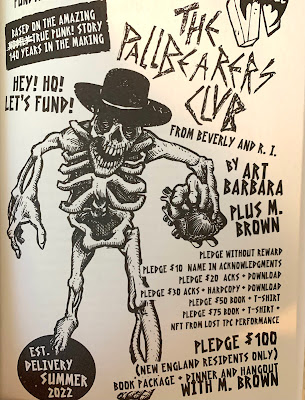
I don't often review novels here, but Paul Tremblay's new book The Pallbearers Club is based on an important piece of New England folklore. Tony gave it to me, thinking I might like it. He was right! It's creepy and very steeped in weird local history. 

The Pallbearer's Club tells the story of Art Barbara, a local rock musician, and his friendship with a mysterious woman named Mercy Brown. Art and Mercy first meet when Art is a high school student in Beverly, Massachusetts. He's tall, skinny, acne-ridden, and has a serious case of scoliosis. He's not the most popular kid in school and doesn't participate in any extracurricular activities. In order to beef up his college applications, he starts the Pallbearers Club, a group that attends funerals of people who don't have anyone to mourn them. Other than Art, only two other Beverly High students are members.  

And then Mercy joins. She's older than Art and is a student at Salem State. She introduces him to punk rock and alternative music. She has her own car. She helps him write a paper for a class on local history. The topic: the famous Rhode Island vampire Mercy Brown. 

Wait, what? The Pallbearers Club is presented as a memoir by "Art Barbara," but Art admits that this is a pseudonym. It's not his real name. "Mercy Brown" is not really his friend's name either. Art gives her that name in his memoir because... well, because he suspects she's a New England vampire.  

I've written about New England vampires before, and they're not like the vampires you see in pop culture. In the 19th century, tuberculosis was rampant across this area. No one knew what caused the disease, which was called 'consumption' at the time because it consumed people's lives and health. It often killed entire families, slowly and one person at a time. Some New Englanders believed the disease was actually caused by a dead family member feeding from the grave on the life force of their loved ones.

Artwork from The Pallbearers Club

Mercy Brown is the best-known of the alleged New England vampires. Beginning in the 1880s, consumption began killing multiple members of the Brown family of Exeter, Rhode Island. The family's mother, Eliza, was the first to die, followed by her daughters Mary and Mercy. When young son Edwin grew ill, neighbors convinced his father George Brown to exhume their corpses to see if any showed signs of life in the grave. Mercy's corpse was undecayed and had blood in its hearts, which according to local folklore indicated she was feeding on Edwin. Her heart and liver were burned to ashes and mixed with water, which was given to young Edwin to drink. This was supposed to prevent Mercy's vampirism and save Edwin's life, but he died two months later. (Michael Bell's book Food for the Dead is the best non-fiction book about New England vampires.)

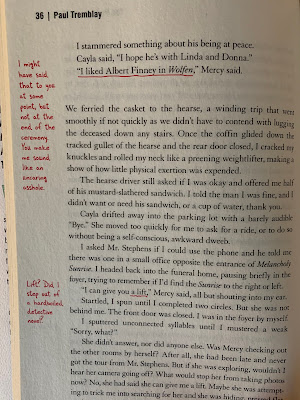
Is "Mercy Brown" in The Pallbearers Club really a vampire? Art certainly seems to think so and blames her for some unfortunate and unusual events in his life. Mercy vehemently disagrees. The Pallbearers Club is full of notes from Mercy in red pen, offering her perspective on events. Maybe, she suggests, Art is really a drug addict and incapable of moving on from the past. 

Who is right, Art or Mercy? I won't tell you. The Pallbearers Club is a creepy slow burn and keeps you guessing until the last page (and maybe even after). It doesn't have a lot of gore or violence, so when the weird stuff happens it's all the more effective. There are some nice twists, and I definitely was surprised by the ending. This is also very much a New England novel, set almost entirely in Providence, Rhode Island and Beverly. Tremblay lives north of Boston, and his love and knowledge of the region really shines through. If you like New England, weird folklore, and a twisty plot, add this to your reading list. 

February 27, 2022

Visiting the Devil's Den

There are at least 110 places in New England that have the word “Devil” in their name, and forty-three of them are in Massachusetts. Hmmm. What does that say about the Bay State? There's Devil’s Hollow in Marshfield, the Devil’s Landslide in Wellesley, Devil’s Garden in Amherst, etc. And in Newbury, there is... the Devil's Den. 

Last weekend Tony and I took a trip up to Newbury to visit the Devil's Den. The Den is actually a small cave located in an old, abandoned limestone quarry. There are a lot of old quarries in New England, but this one is really old. It was first quarried in 1697 and finally shut down in 1830. The quarry is not large but is very dramatic looking, which is why is probably why it got its devilish reputation.

Long after these quarries had ceased to have a commercial value, pleasure parties were accustomed, during the summer months, to seek rest and recreation there, beguiling the time with marvelous stories in which the Prince of Darkness was given a conspicuous place. In later years, the young and credulous found traces of his Satanic Majesty's footsteps in the solid rock, and discovered other unmistakable signs of his presence in that locality; and ever since the Devil's Den, the Devil's Basin, and the Devil's Pulpit have been objects of peculiar interest to every native of old Newbury. (Ould Newbury. Historical and Biographical Sketches, John James Currier, 1896)

That passage mentions several devilish places. The Devil's Basin was another nearby limestone quarry, filled with water, which I believe was about a half mile away from the Devil's Den (according to Volume 3 of Contributions to the Geology of Eastern Massachusetts, 1880). I'm not sure if the Basin still exists, but according to this site it was located south of the Devil's Den. That area now seems to be mostly landfill which is why I think the Devil's Basin is gone. The Devil's Pulpit was a large boulder nearby but we couldn't locate that either. 


The Devi's Den still exists, and in the early 19th century young boys who lived nearby would perform a strange initiation ritual at it. They believed that a certain magic word had been written on the floor of the cave which would kill anyone who entered it. Certain precautions had to be taken before entering the cave to nullify this curse.

I suppose that no boy ever went to that place alone, and a sort of solemn ceremony attended his first visit with his older playmates, to a scene bearing an appellation ominous enough to call up every vague dread of his youthful heart. The approach on these occasions was rather circuitous, through the pastures, until an elevated mass of stone, standing quite solitary, was reached, designated as “Pulpit Rock.” To the summit of this, the neophyte was required to climb, and there to repeat some accustomed formula, I fear not very reverent, by way of initiation, and supposed to be of power to avert any malign influences to which the unprepared intruder upon the premises of the nominal lord of the domain might otherwise be subjected. (George Lunt, Old New England Traits, 1873)

In other words, after repeating the irreverent phrases from Pulpit Rock, (aka the Devil's Pulpit), it was safe to enter the Devil's Den. However, even then it was only safe to enter the cave with companions - never alone.

Old graffiti at the Devil's Den

Other than this curse and ritual, the Devil's Den had one other interesting feature. The Devil’s Den was made of limestone, but also had deposits of a mineral called chrysotile, a naturally occurring form of asbestos. Chrysotile is soft and chewy, and in the 19th century boys going into the cave would supposedly chew it. Hopefully, they avoided any dangerous side effects. Ingesting asbestos is probably scarier than than a Devil's curse!

I first learned about the Devil's Den while writing my first book, Legends and Lore of the North Shore. Back then, the Devil's Den was on private property, but it is now part of the 28-acre Jennie Lagoulis Reservation. It's worth a visit if you're in the area. Despite it's scary name and legend, you shouldn't be too spooked if you visit. The reservation is the site of a children's nature camp. If little kids can brave the terrors of the Devil's Den you can too.

*****

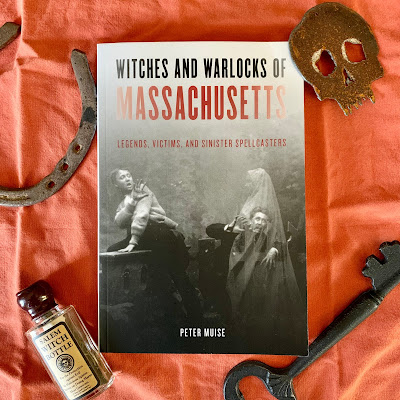
If you like New England legends, you might like my newest book, Witches and Warlocks of Massachusetts. It's available now wherever you buy books online!