June 13, 2021

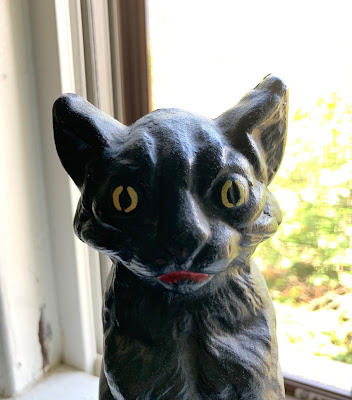
A Vermont Black Cat Death Curse

 Many years ago, a farmer was walking home through the countryside late at night. He felt a little spooked because the road was dark and lonely.

After walking for a while he saw a strange procession walking towards him in the gloom. Nine black cats were carrying a tiny black coffin draped in velvet. It was a funeral procession. 

As the cats walked past him, one turned to the farmer and said, "Tell Tom Tildrum that Tim Toldrum is dead." The farmer was too shocked to reply and the cats processed off into the darkness.

The farmer was relieved to get home. The fireplace cast a cheery glow, and his wife greeted him with a bowl of warm soup. Their cat lay sleeping by the fire, as it did most nights. Everything seemed normal. 

As he ate his soup, he told his wife what he had seen. "And then," he said, "one of the cats turned and spoke to me. It said, 'Tell Tom Tildrum that Tim Toldrum is dead.' What do you think that means? Who is Tom Tildrum or Tim Toldrum?"

Upon hearing this, the farmer's cat opened its eyes and stood on its hind legs. It seemed to grow in size and importance. The cat said, "Tim Toldrum's dead? Then I'm the King of the Cats!" It howled triumphantly and flew up the chimney, never to be seen again. 

*****

You may have heard that story before. It's an old folk tale called, appropriately enough, the King of the Cats. There are many versions of it, mainly from England, Scotland, and Ireland, but there are some from continental Europe as well. The gist of the stories is usually the same, although the cat names vary: Dildrum and Doldrum, or Madam Momfort and Mally Dixon, or Dan Ratcliffe and Peggy Poison. At the end, though, the humans always discover their humble domestic pet was secretly a special supernatural being. 

A strange New England version of King of the Cats was printed in The Journal of American Folklore in 1908. Author Clara Kern Bayliss noted the following:

WITCHCRAFT - At Shaftsbury, Vermont, eighty years ago, the belief in witches was quite general, and even the children knew the rhyme which brought disaster into the family circle; for it often happened that a witch would come down the chimney in the form of a black cat, and say, - 

"I, Tattaru,  

Tell you

To tell Tatterrier

That sits by the fire

That Tatterags is dead."

And soon after that some of those sitting around the fireplace would sicken and die. (Journal of American Folklore, Vol. 21, No. 82 (Oct - Dec., 1908), p. 363)

The similarities with the King of the Cats story are obvious. The black cat which speaks, the cryptic names and announcement of a death, and even the fireplace - all of these are shared with other versions of the story. But rather than ending in a surprise revelation, the Vermont version ends in death. 

It's kind of strange to see a playful story transformed in this way, but it's totally understandable given New England's history and culture. England, Scotland, and Ireland have lots of lore about fairies and other magical beings. A story whose ending reveals that a common house cat is magical nobility fits in well with fairy lore, and some version of the King of Cats are explicitly about fairies.

When the Puritans colonized New England they did not bring their mother country's fairy lore with them. However, they did bring lore about witches. Lots and lots of it! 

It was believed that witches could transform themselves into animals, and sometimes even speak in animal form. So in the Puritan worldview, a talking cat would not be feline nobility or a fairy, but would instead be a malevolent witch. And what do witches do? Cause misery and death. The core for the story remains, but the ending is quite different and reflects old New England's grim culture. 

One thing I really like about Bayliss's account is this:

...for it often happened that a witch would come down the chimney in the form of a black cat...

I have so many questions about that word "often." Was this a weekly occurrence? Monthly? Life in 19th century Vermont sounds really dangerous. It makes me glad I don't have a fireplace. 

June 06, 2021

The Devil Made Me Do It: Is The New Conjuring Film True?

I'm a big horror movie fan, and enjoyed the first two Conjuring films, The Conjuring (2103) and The Conjuring 2 (2016). Both films are based on supposedly true cases examined by Ed and Lorraine Warren, Connecticut paranormal investigators. Played by Patrick Wilson and Vera Farmiga, in these films the Warrens are portrayed as clean-cut, devout Catholics who are deeply in love with each other. I think their relationship is one of the reasons the Conjuring movies stand out in the crowded horror field. Ed and Lorraine are so wholesome it's almost comical at times. 

The real-life Warrens are now deceased, and a 2017 article in The Hollywood Reporter suggests they may not have been as wholesome as their film counterparts. According to the Reporter, Ed Warren initiated a relationship with a 15-year old girl when he was in his 30s and married to Lorraine. The girl eventually moved in with the Warrens and lived with them for forty years. At one point, the girl became pregnant with Ed's child and Lorraine arranged for her to have an abortion, something clearly at odds with the Warrens' public image as strict Catholics. 

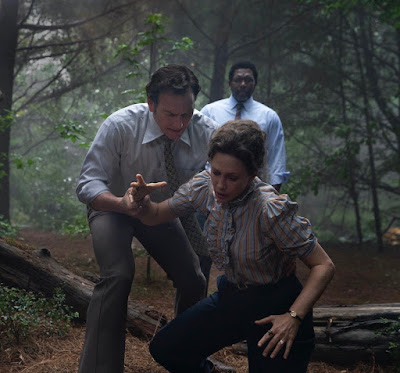
A scene from The Conjuring: The Devil Made Me Do It.

So what does it mean when a movie like The Conjuring says it's "Based on a true story?" Very little, I think. It's marketing, and not a legally defensible claim. Take it with a big grain of salt. You certainly won't see Ed Warren having sex with teenage girls in the Conjuring movies, or his wife arranging for an abortion. And I think that's OK, as long as you realize the movies are basically fiction.

The newest Conjuring movie has just been released: The Conjuring: The Devil Made Me Do It. It's a great title, and once again it's supposedly based on a true case investigated by the Warrens. 

Here are the facts of the case. On February 16, 1981, nineteen-year old Arne Cheyenne Johnson of Brookfield, Connecticut, stabbed his landlord, Alan Bono, several times in the chest with a knife. Johnson's fiancee, Debbie Glatzel, watched as it happened and later testified that Johnson growled like an animal as he did it. 

Johnson was arrested and charged with murder. When asked why he killed Bono, Johnson said, "The Devil made me do it." He claimed he was possessed by a demon. 

The Conjuring: The Devil Made Me Do It

It had started the previous summer. On July 3, 1980, Debbie Glatzel's brother, 11-year old David, woke up in a panic. He said he had seen a demon in his sleep, "a man with big black eyes, a thin face with animal features and jagged teeth, pointed ears, horns and hoofs." David continued to see the demon throughout the summer, and a house-blessing by the a local priest did nothing to stop his visions. David sometimes even saw the demon in the daytime, when it appeared as an old man wearing a flannel shirt and jeans. According to People magazine:

In desperation, the Glatzels called on a couple from nearby Monroe, Conn. who are self-styled “demonologists.” Ed and Lorraine Warren, both 54, were professional artists until 1968, when they decided to pursue what was until then an avocation, the occult. Though they accept no fees for conducting demonic investigations, they lecture indefatigably (at up to $1,000 per), and once hosted a weekly local TV show, Ghost Hunting With Ed and Lorraine Warren.

Lorraine, who also claims the gift of clairvoyancy, describes her first encounter with David Glatzel: “While Ed interviewed the boy, I saw a black, misty form next to him, which told me we were dealing with something of a negative nature. Soon the child was complaining that invisible hands were choking him—and there were red marks on him. He said that he had the feeling of being hit.” ("In a Connecticut Murder Trial, Will (Demonic) Possession Prove Nine-Tenths of the Law?", People, October 26, 1981)

The Warrens believed there were 43 demons inside David, and coordinated several exorcisms. They had little effect. At one point, in desperation, Arne Cheyenne Johnson taunted the demons to enter his body instead. Again, it had little effect. David was eventually sent to a private school for "disturbed children."

Johnson seemed changed, though. After his taunt during the exorcism, he too claimed to see the demon that David had seen, and Debbie later testified he fell into trances in the months leading up to Bono's murder. 

On February 16, Johnson and Debbie Glatzel were taken to lunch by Alan Bono, who was Debbie's boss at a kennel and was also their landlord. Johnson's sister Wanda and Glatzel's nine-year old cousin Mary joined them. Bono supposedly drank heavily during lunch, and later that day became agitated and grabbed Mary. Johnson argued with Bono, and stabbed him several times in the chest and stomach. Johnson then walked into the woods, where he was found by the police. It was the first murder in Brookfield's 193-year history. Johnson was convicted of first-degree manslaughter and served five years of a 10 - 20 year prison sentence. 

After the trial ended, an author named Gerald Brittle published a book about the case, The Devil in Connecticut, which was written with help from Lorraine Warren. When the book was republished in 2006, Brittle was sued by David Glatzel and his brother Carl for misrepresenting them in the book. Carl also claimed his brother's possession had been a hoax created by the Warrens to take advantage of David's mental illness. Arne Cheyenne Johnson and Debbie Glatzel, who were by this point married, stood by the Warrens and author Brittle, claiming they accurately presented the situation. 

The Conjuring: The Devil Made Me Do It

So there you go. Were David Glatzel and Arne Cheyenne Johnson really possessed by demons, or were the Warrens taking advantage of a mentally ill boy? I can't say, but it's interesting that David, the subject of the Warrens' exorcisms, now claims he was not possessed. 

The judge in Johnson's trial didn't accept his claim of demonic possession. As we all learned from the 1692 Salem witch trials, it's impossible to prove the Devil's existence in court.

'Demon' defense rejected in Conn. murder trial.

Danbury, Conn. - A Superior Court judge yesterday refused to allow a much-publicized "demon defense" to be used in the murder trial of a Connecticut man. 

The defense strategy was to try to prove that Arne Cheyenne Johnson was possessed by demons when he allegedly stabbed a neighbor to death eight months ago. 

The jury process had just begun when Judge Robert Callahan said the defense that attorney Martin Minnella planned was "irrelevant and I am not going allow it, period." (Boston Globe, October 29, 1981)

I haven't seen The Conjuring: The Devil Made Me Do It yet, but have seen the trailer. It shows Arne Cheyenne Johnson walking down the road covered in blood, Lorraine Warren being dragged off a cliff by a monstrous arm, a little boy getting pulled into a waterbed, and Lorraine Warren saying, "It's a witch's totem. We think your family was cursed, and that connection is still open." 

It looks like a great horror movie, but is it a true story? Probably not. Horror movies require literal monsters, but the real situation in Brookfield seems complicated and nuanced. 

May 22, 2021

Book Reviews: Folk Magic, Bigfoot, and More Folk Magic

Book, books, books! I have a lot of books about folklore and legends, but somehow alway find room for more. This week I'm reviewing some recent books I really enjoyed. 

First up, let's talk about New World Witchery, by Cory Thomas Hutcheson. This book is a massive, 452-page compendium of magical folklore from across North America. Hutcheson has a PhD in folklore and is the long-time cohost of the New World Witchery podcast, so he really knows his stuff. I was a guest on the podcast several years ago and had a great time. 


Like many of my readers, Hutcheson is also a practicing witch, and New World Witchery is written primarily for an audience eager to get its hands dirty and do some magic. Other people will enjoy the book as well - there's so much information in it! - but he includes exercises and tips for those who want to do more than just read. 

New World Witchery covers a wide range of topics, with chapters on divination, animal magic, counter magic, necromancy, dealing with the Devil, and a whole lot more. The book draws upon the many diverse magical traditions found in North America, including Hoodoo, Southern Conjure, Mountain Magic, Cuaranderismo and Brujeria, Pow-Wow, and Neo-Paganism. Even if you're familiar with a variety of folk magic traditions you'll definitely learn new things. I did. 

For example, in addition to the traditions above, Hutcheson also discusses New England Witchery, which is a favorite topic of mine. I've been studying it for years but I still found new insights in his book. Before reading New World Witchery, I didn't know that Nathaniel Hawthorne wrote an article about the hallucinogenic ointments witches allegedly used to fly to their devilish revels. Now I do! 

Another book in a similar vein, but also very different, is Folkloric American Witchcraft and the Multicultural Experience by Via Hedera. The publisher, Moon Books, sent me a copy for review, but I would have purchased this one anyway. 


Hedera is a practicing witch who lives in the Pacific Northwest, and she is also ethnically multi-racial, which shapes the tone of Folkloric American Witchcraft. 

Every one of my grandparents were a different ethnicity from the other; my siblings, their siblings and I all have different fathers and thus have different genetic backgrounds. My mother was adopted so I spent a good deal of my life immersed in cultures that I am not ethnically related to but very familiar with. It's an old story, an American one, a magical one... (Via Hedera, Folkloric American Witchcraft, p.21)

While New World Witchery provides you with maximum magical information, Folkloric American Witchcraft gives you the inspiration to use it. Hedera does include spells and charms that you can use, but she is more concerned with finding the motivation to practice folk magic in America's weird, messy, and often violent history. 

American folk magic and witchcraft is a crossroads of clashing cultures. Brought together by adversity, theft, enslavement, expansion, love, war and liberty, our culture as Americans is defined by our diversity, and our traditions of magic were birthed first by a synthesis of European, African, and Indigenous spiritual beliefs and superstitions, and then later by all the many parts of the world (Via Hedera, Folkloric American Witchcraft, p. 64)

After reading Folkloric American Witchcraft you'll want to get off the couch and start casting spells. I know money is tight these days for many people, but if you can afford it I would recommend both New World Witchery and Folkloric American Witchcraft. They work together well as companion books. 


Finally, and on a totally different topic, there's Mike Dupler's On the Trail of Bigfoot: Tracking the Enigmatic Giants of the Forest, which was sent to me by New Page Books. I am a Bigfoot fan, and really enjoyed On the Trail of Bigfoot. There are a lot of Bigfoot books out there, and I liked Dupler's book because it provides a nice overview of current thinking about Bigfoot. 

Dupler addresses questions like the following: Does Bigfoot make structures in the woods? How does Bigfoot communicate? If those topics sound dry (and they aren't), you might enjoy the chapter titled, "Is Sasquatch Interdimensional?" Dupler believes Bigfoot is a physical animal, but does speculate about other dimensions. Here's a description of something seen at the famous Skinwalker Ranch in Utah:

While watching from a bluff one evening, team members saw a strange yellow light appear. This glowing anomaly grew and morphed into a tunnel. One of the crew watched the spectacle through binoculars and, to his amazement, a large faceless black humanoid exited the tunnel and lumbered away. The creature seemed reminiscent of a Sasquatch. The tunnel then dissipated as if it had never been there, leaving the creature in the night with the shaken investigators (Mike Dupler, On the Trail of Bigfoot, p. 117)

I love a strange Sasquatch story, and Dupler includes many in his book, including classics from the 19th and early 20th century with titles like "The Salmon River Devil" and "The Beast of Mica Mountain." Trappers and hunters sure seemed to encounter lots of weird, hairy humanoids back then. 

There you have it: books about folk magic, folk magic, and Bigfoot. Perfect beach reading as summer begins!

May 08, 2021

Chloe Russell: "The Old Witch or Black Interpreter" and Her Dream Book

Chloe Russell was born in 1745, about three hundred miles southwest of Sierra Leone. At the age of nine she captured by slave traders, brought across the Atlantic, and sold to a Virginia plantation owner named George Russel. When Russel died his cruel and violent son inherited the plantation. He was incredibly abusive towards Chloe, and she contemplated suicide:

Such a cruel treatment at length drove me to the resolution of destroying myself!... But the night previous, I dreamed that I saw my father, who told me that he had just come from the world of spirits, where there was nothing but joy and happiness. He informed me that he was killed by the fire of the Baccaranas (white slavers) twenty moons after I was captured by them, in attempting to rescue my mother, whom they had taken. 

He said that he had been made acquainted with my resolve to destroy myself, and had come to persuade me not to do it, as it would soon be well with me, and I should be free from my master. This singular dream made such a deep impression upon my mind, as to deter me from committing suicide the succeeding day... (Chloe Russell, The Complete Fortune Teller and Dream Book, 1827)

Things didn't improve for Chloe though, so she once again contemplated suicide. Her father appeared to her again in a dream, this time accompanied by a spirit clad in purple who gave Chloe the ability to foretell the future:

Young woman, stay thy hand and raise it not against thy own life, for thy afflictions shall shortly cease. Thy unjust punishments have enkindled the the wrath of the Most High, who has commissioned me to unrivet thy chains, and to vest thee with power to foretell remarkable events, and prophecy things that that shall surely come to pass, whereby thou shalt gain thy freedom, and be ranked among the most extraordinary of thy fellow-creatures... (Russell, The Complete Fortune Teller, 1827)

When she awoke from the dream, Chloe Russell had the power to predict future events. She supposedly foretold the American Revolution and many other major occurrences. Her reputation spread through Virginia, and eventually a neighboring plantation owner asked for her help. His uncle had died after hiding a fortune worth $60,000 and hadn't told anyone where it was. Using her powers, Chloe told the plantation owner it was hidden inside a wall in the uncle's house. He found the hidden money, and used part of it to purchase Chloe's freedom. He also paid her $500, with which she purchased a house and started working as a professional fortune teller. She was quite successful, and eventually spent $3,000 purchasing the freedom of other slaves from her violent former master. 

That story appears in the 1827 edition of a small book called The Complete Fortune Teller and Dream Book, whose author was "Chloe Russell, a woman of colour in the state Massachusetts, commonly termed the Old Witch or Black Interpreter." The book was first published in Boston around 1798. There were several other editions, but Chloe Russell's biography only appears in the 1827 edition, which seems to have been the last. 

Her biography seems almost unbelievable, and there are some aspects of it that are clearly not true. She mentions that tigers live in Africa (they don't), and says she spent her childhood 300 miles southwest of Sierra Leone (which would be in the middle of the ocean). On the other hand, she was sold into slavery at the age of nine, so her memory of her childhood home may understandably have been faint. However, many readers may also be skeptical of her claims to psychic powers, and recall that other well-known fortune-tellers, like Lynn's Moll Pitcher, also supposedly predicted the American Revolution. 

On the other hand, records indicate that a free Black woman named Chloe Russell did indeed live in Boston in the early 19th century. Censuses from 1820 - 1833 indicate that she lived on Belknap Street, which was in Beacon Hill's historic Black neighborhood. Her occupation is described either as a washerwoman or a cook. She also owned a building which she may have operated as a rooming house.

It seems very likely that Chloe Russell also worked as a fortune teller. As I mentioned in my recent post about treasure digging, after the Puritan era many people worked as dream interpreters, fortune-tellers, and magical consultants. These people often came from the society's lower echelons, and it was a good way to earn some extra income if you had the talent.

The contents of The Complete Fortune Teller vary by edition. Some contain lists of dream interpretations. For example:

Cards - If you dream you are playing at cards, it denotes you will soon be married.

Cattle - To dream of driving cattle, is a sign you that you will be prosperous through life. 

Cat - Should you dream of a cat, you must expect trouble. 

I don't know much about cards or cattle, but I do know that cats are trouble, so maybe there is validity to these interpretations! Some editions contain instructions on palm reading, and on how to determine a person's character by the moles on their body.  

Love spells are included as well. For a man who is romantically interested in a woman, Russell counsels him to soak flowers in musk and cinnamon oil and wear them on his body for three days, bathing them each day with the aforementioned fragrances. After three days, he should send half the flowers to the woman in a small packet with a note, and keep the other half of the flowers on his person. True love will result. 

Scholars question who actually wrote The Complete Fortune Teller. Its contents are very similar to other popular fortune-telling books of the time, and it seems likely that an enterprising publisher simply repackaged older material under a new title. Little is known about Chloe Russell's life beyond the book, but I suspect the publisher attached her name to The Complete Fortune Teller in order to capitalize on her reputation. Hopefully Russell got a portion of the profits. 

There are lots of questions. When and how did Russell get from Virginia to Boston? Did Russell write her own biography, and how much of it is true? Nicole Aljoe, the director of Northeastern University's Africana Studies program, is working with her students to find out more about Russell's life. You can see a presentation by Professor Aljoe on the topic here. Hopefully she'll publish a book or article on the topic.

Other than Professor Aljoe's presentation, I got most of my information from Eric Gardner's article, "The Complete Fortune Teller and Dream Book: An Antebellum Text by "Chloe Russel, A Woman of Color," The New England Quarterly, June 2005, Vol. 78, No. 2 (June 2005), pp. 259 - 288. 

One last note: if you're into Tarot cards, Chloe Russell is represented on a card in the Hoodoo Tarot Deck.

April 29, 2021

Old New England Cemetery Lore: Watch Your Step

This past Saturday was warm and sunny, and although I'm always happy to stay home with a pile of obscure books I decided to go for a walk. I went to one of my favorite places, Brookline's Old Burying Ground. 

It's a really charming cemetery, well-cared for with just the right amount of decay. Although it's only a few miles from downtown Boston it feels like a rural environment. A few notable folks are buried there, including Zabdiel Boylston, a local physician who inoculated people against smallpox in 1721. It was the first inoculation campaign in North America, and Boylston got the idea from Onesimus, a slave in the household of Cotton Mather, the (in)famous minister associated with the Salem witch trials.


Cotton Mather's stepmother, Anna Mather, is also buried in Old Burying Ground. Her husband Increase Mather (also associated with the Salem trials) is buried at Copp's Hill in Boston, but she outlived him by several years and was buried in Brookline in 1737. Her grave is marked by a beautiful and well-preserved stone. 

As I wandered through Old Burying Ground I thought about some old New England cemetery folklore I've been reading recently. Some of it is probably familiar. For example, if you feel a cold chill for no reason it's probably because someone has walked over the site of your future grave. I think that one is well-known. 


A related piece of lore says that you should never step on anyone's grave when you're in a cemetery. That makes sense to me. If the living get a chill from someone just walking over their future grave, think how annoyed the dead must be when you step on their actual grave. Unfortunately, sometimes this advice is hard to follow, particularly in old cemeteries. The graves are placed really closely together at Brookline's Old Burying Ground, and it is hard not to step on one. There are also lots of unmarked graves, so you're probably unintentionally walking on someone. I think the intent behind this piece of lore is what's really important: treat the dead with respect. 

Many years ago when I was a kid I went for a bike ride with my friend Bobby in a neighborhood cemetery. We were riding pretty fast and goofing around, and I started to worry that we weren't being respectful. I said, perhaps half-jokingly, that we shouldn't be too loud or we'd disturb the dead. 

Bobby laughed and said, "I'm not afraid of any dead people!"

As soon as he said that he skidded, fell off his bike, and scraped his knee up really badly. His pants were torn and there was a lot of blood. We both left the cemetery immediately and went home. We kind of laughed but were also a bit spooked. Perhaps it was just a coincidence, but I've never forgotten it. 


Speaking of forgetting, according to another piece of old lore you shouldn't spend too much time reading gravestone inscriptions. This is bad news for me, since I really like to read old inscriptions. I'm not sure what constitutes too much time and hopefully I am under the limit. I can understand the sentiment, though, because when I read too many gravestones I do feel a little lightheaded from all the dates and names. It's like when I spend too much time on Instagram!

One final piece of advice: you shouldn't walk through a cemetery on your way to see friends. You run the risk of carrying death to their house if you do. Happily, I just went back home after visiting Old Burying Ground. It was a pleasant way to spend a sunny afternoon. 


I got this cemetery lore from Clifton Johnson's What They Say in New England (1896) and Fanny Bergen's Current Superstitions (1896).