October 17, 2021

Jack-O-Lanterns: Demons, Gemstones, and New England Origins

The jack-o-lantern is a ubiquitous symbol of Halloween. All across America, people carve faces into pumpkins, placing them on doorsteps and windowsills as part of the holiday celebrations. Despite New England's modern connection with Halloween because of Salem's annual October festivities, Halloween really only became popular in New England in the latter half of the 19th century as more Irish and Scottish immigrants arrived here. The English Puritans and their descendants did not celebrate before then. 

Still, despite this, the jack-o-lantern has deep roots in New England. It seems likely that people were carving jack-o-lanterns well before Halloween was even celebrated here, and that pumpkin carving became associated with the holiday only later. Read on if you dare...

Nathaniel Hawthorne: Giant Gems and Enchanted Scarecrows

Massachusetts author Nathaniel Hawthorne was apparently the first person to ever use the term "jack-o-lantern" in print. His 1835 story "The Great Carbuncle" is about a group of adventurers searching for a giant, glowing gemstone in the White Mountains. One of the adventurers tells his companions he will hide the gem inside his tattered cloak if he finds it.

‘Well said, Master Poet!’ cried he of the spectacles. ‘Hide it under thy cloak, sayest thou? Why, it will gleam through the holes, and make thee look like a jack-o’-lantern!’

It's not entirely clear what Hawthorne means by jack-o-lantern here. It sounds like it could be our familiar carved pumpkin lit by a candle, but the term jack-o-lantern also was used to mean ignis fatus, the glowing swamp gas phenomena also called willow-the-wisp. Either usage makes sense in the story. Halloween is not mentioned at all in "The Great Carbuncle," which was published before the holiday was celebrated in New England.

Nathaniel Hawthorne

However, a carved pumpkin does appear in Hawthorne's 1851 story "Feathertop," when a New England witch named Mother Rigby uses one as a head for her scarecrow:

Thus we have made out the skeleton and entire corporosity of the scarecrow, with the exception of its head; and this was admirably supplied by a somewhat withered and shrivelled pumpkin, in which Mother Rigby cut two holes for the eyes and a slit for the mouth, leaving a bluish-colored knob in the middle to pass for a nose. It was really quite a respectable face.

Mother Rigby is so pleased with her handiwork that she brings the scarecrow to life, and since this is a Hawthorne story the scarecrow learns a lot about human morality. Hawthorne does not use the term jack-o-lantern in the story, though, and Halloween is not mentioned. 

John Greenleaf Whittier: Boyhood Memories?

The Massachusetts poet John Greenleaf Whittier mentions a carved pumpkin in his poem, "The Pumpkin," which was first published in 1846 (according to Cindy Ott's 2012 book The Pumpkin: The Curious History of An American Icon).

Oh, fruit loved of boyhood! the old days recalling, 
When wood-grapes were purpling and brown nuts were falling! 
When wild, ugly faces we carved in its skin, 
Glaring out through the dark with a candle within! 

Whittier was born in 1807. If he really carved faces into pumpkins when he was a boy, it would have been very early in the 19th century, long before Halloween was celebrated in New England. Whittier only refers to Thanksgiving in "The Pumpkin," but not Halloween, and he doesn't call the carved pumpkin a jack-o-lantern.
John Greenleaf Whittier

It's a little confusing, isn't it? The earliest instance historian Cindy Ott found where "jack-o-lantern" refers to a carved pumpkin comes from 1846. It appeared in a South Carolina publication called Tales for Youth, but again with no apparent connection to Halloween. It sounds as though people were carving pumpkins and using the term jack-o-lantern well before Halloween was celebrated, even if not always together.

A Demon and A Pumpkin in Rhode Island

Enough with the history, let's turn to the spooky stories. Many years ago, during the Revolutionary War, two young women named Hannah Maxson and Comfort Cottrell were staying at the Westerly, Rhode Island home of one Esquire Clark. One day while the Esquire was away on business, and his wife was sick in bed, the two young ladies decided to practice a little love magic. 

They took a ball of yarn, and tossed it repeatedly down a well and then pulled it back up. As they did, they chanted some psalms backwards. The goal of this magic spell? To find the men they would marry. 

As the sun set, Hannah and Comfort saw a tall figure walking up the road towards the house. They ran eagerly towards it, but their excitement turned to terror as they saw the figure had an enormous, misshapen head with two glowing, fiery eyes. This was no dream lover, but a demonic monster. 

Hannah and Comfort ran into the Clarkes' house and locked the door, but the hideous creature pounded on it insistently. The young women hid behind Mrs. Clarke's bed in fear, listening with the sick woman as the monster tried to break into the house. The supernatural assault only stopped when Esquire Clark returned home. Seeing a demonic creature clawing at his front door, he said some prayers against evil, which sent the monster slinking off into the woods.

This story first appeared in a November 1860 issue of The Narragansett Weekly, and the author, Deacon William Potter, notes that Mrs. Clarke died from all the excitement. Hannah and Comfort vowed never to use magic again. But Deacon Potter includes a strange epilogue. He claims that the demon was really a hoax played by a young many who lived near the Clarkes. He put a carved pumpkin on his head to scare Hannah and Comfort, not anticipating his joke's deadly results. The neighbor only revealed his role in the story seventy years later. 

It's a good spooky, cautionary tale. Young ladies - don't mess around with the occult. Young men - don't play stupid pranks that kill people. But despite the carved pumpkin, the story doesn't reference Halloween. And it's not called a jack-o-lantern.

The Sea Captain and Satan

Captain Snaggs was a wealthy sea captain who lived in Barnstable on Cape Cod. He had earned his riches the old-fashioned way: by selling his soul to the Devil. He had been young and foolhardy when he signed Satan's contract, but as an old man on his deathbed he was filled with regret. He could hear the Devil's hooves coming up the walkway towards his house, and Captain Snaggs didn't want to go to Hell. So he jumped out of bed, climbed out the window, and ran like... well, he ran like hell. 

He ran down the length of Cape Cod to Orleans, where he hid in a hollow tree. But the Devil was hot on his heels, and could smell Captain Snaggs's soul. So Captain Snaggs ran again, this time to Wellfleet, where he hid in a cemetery. 

The Devil was not far behind, so Captain Snaggs grabbed a pumpkin from a nearby pumpkin patch, carved a face in it, and set it up on a tall, white gravestone. Then he lit a candle inside of it and ran towards Truro.

When the Devil arrived in the cemetery he said to the pumpkin, "Your contract is up, Snaggs. I've come to take your soul." When the pumpkin didn't answer, the Devil poked the gravestone with one talon. "Do you hear me Snaggs? Ouch! You're awfully tough for an old man! Where'd you get those muscles?" He grabbed the gravestone and gave it a mighty shake. The pumpkin fell to the ground and shattered. Realizing he had been tricked, the Devil ran towards Truro with a demonic roar. 

Captain Snaggs, meanwhile, had run all the way to Provincetown. He had reached the end of the Cape. There was no place left to go. When the Devil finally caught up with him, sulfurous smoke billowing from his nose and ears, Captain Snaggs stood there in terror.

With a tremor in his voice, he said, "All right, I'm ready. You can take me to Hell now."

The Devil looked puzzled and said, "Take you to Hell? We're in Provincetown, aren't we? We're already there."

As Elizabeth Renard notes in her 1934 book The Narrow Land, there are many variations on this story. The comedic ending always remains the same, but the name of the captain, the Cape Cod towns he visits, and the number of pumpkins involved all vary. You can listen to an excellent audio version of this tale at New England Legends, where the sea captain is named Jedidy Cole. 

Renard also notes that this story is probably of late origin, so perhaps it was first told after Halloween became a popular holiday here. It's hard to say. Have a happy Halloween!

*****

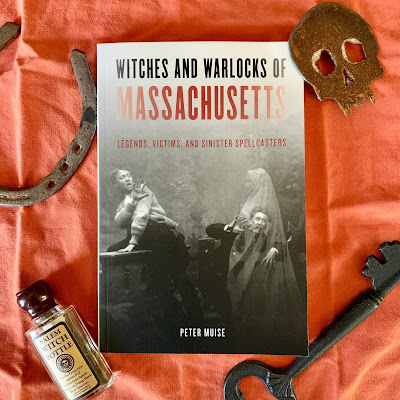
My new book, Witches and Warlocks of Massachusetts, was just released on Kindle recently. So now you can enjoy it either in paperback or on your device of choice. You can buy it wherever books are sold online


October 09, 2021

The Witches of Norton: Magic, Animals, and Poverty

Well, it's October now, the month which many people call "Spooky Season." Even thought it's always spooky season here at the New England Folklore blog, I do love this month and Halloween. It's the season for pumpkins, ghosts, and of course witches. 

New England is full of witch legends. Although the Salem trials are the most famous witchcraft incident in Massachusetts, lots of other cities and small towns held witch trials or have legends about witches. For example, Norton, a small town in the southeastern part of the state, was supposedly home to three witches in the 1700s. 

The most famous alleged witch in Norton was Ann Cobb. I am not sure exactly why Ann was suspected of witchcraft, except for the following. One day she went into town to purchase some items at the general store. She lived about two miles away from the town center, but arrived there only minutes after leaving her house. This was quite fast, so her neighbors suspected she had used supernatural means to travel so quickly. Perhaps she flew, or was transported by some sort of evil spirit? Historical sources don’t specify her neighbors' exact suspicions, but the event was so memorable the town named a bridge after her. (It still exists today, and bears the name Witch Bridge.) Apparently, it didn’t take much to be considered a witch in Norton. Ann Cobb was quite poor and was supported financially by the town in her old age. She died in 1798.

The Witches by Henry Fuseli

Dora Leonard was another Norton woman suspected of witchcraft. She supposedly caused various forms of mischief around town, like magically setting farm animals loose so they could wander free. Two boys also said she once caused them to miss a squirrel they were shooting at. Despite having a clear shot at a the animal, the boys missed it repeatedly. 

As they walked home, frustrated, they noticed a large cat watching them pass by. They believed the cat was really Dora and that she had used witchcraft to make them miss the squirrel. (It seems more likely they were just bad shots looking for someone to blame.) Much like Ann Cobb, Dora Leonard was poor and had to be supported by the town in her old age. As she lay dying in 1786, her house was supposedly filled with strange and terrible noises that frightened away the people attending to her death. Those details about her death are a standard trope in witch legends from New England. 

The third alleged witch in this small town was Naomi Burt. Local historian Duane Hurd wrote of her in 1859: “Naomi Burt was also accounted a member of the mysterious sisterhood of witches, and by her wonderful powers gave some trouble to those who fell under the ban of her displeasure.” Wagons lost their wheels when they passed her house, and oxen escaped their yokes. Children held their breath in fear as they ran past her home lest she bewitch them. Sadly, Naomi Burt took her own life on July 4, 1808, a harsh reminder that while these old tales of witchcraft are entertaining to read, it was hard to really be the person they were about. 

The Salem witch trials were the last trials of their kind in Massachusetts. They occurred in 1692, but people in New England continued to think their neighbors were witches for hundreds of years after that. They didn't bring them to court anymore, but instead whispered, gossiped about, and sometimes physically threatened anyone they thought was a witch. Often those suspected were poor women who depended on their neighbors' charity for survival. That's clearly the case with the Norton witches. Resentment at having to support someone easily curdled into hatred and accusations of witchcraft. 

In many cases, suspected witches were accused of making animals misbehave or preventing hunters from shooting their prey. Maybe this is because the witches were associated with the natural world more than the human world, as evidenced also by their ability to transform into animals. Perhaps they are protecting the animals from harm or mistreatment. "Free the oxen!" It's the more modern, romantic interpretation. 

James Audubon, The Dusky Squirrel

On the other hand, people in the 18th century would have had a very different opinion. A farmer depended on his oxen the way a modern person depends on their car, and a family needed their livestock for food. Any disruption threatened someone's ability to survive. And even though I love squirrels, those two boys probably would have eaten that squirrel for dinner if they killed it. Maybe they went to bed hungry that night.

Just to be clear, I am not saying these women were witches. They weren't. They were social outcasts accused of witchcraft. People just projected their fear onto them. Fear of hunger, of poverty, of illness, and of death. These are real fears we all have, but hopefully we don't project them onto our neighbors. So what's spookier: legendary witches, or real people who actually accused their neighbors of being witches? I think it's the latter.

If you want to read more witch stories for Spooky Season, and I know you do, I'll recommend my new book Witches and Warlocks of Massachusetts, which was just published by Globe Pequot last month. It contains dozens of legends and historical accounts of witches from across this glorious state. It's available wherever you buy books online, and hopefully in your local bookstore as well. 


September 29, 2021

Book Review: Mythical Creatures of Maine

If you ever find yourself in the lonely woods of far northern Maine, be careful going out at night. According to legends, headless giants are sometimes seen wandering the roads in the darkness. Are they dangerous? Probably, but no one has ever gotten close enough to one to find out. No one has been that brave - or that stupid. 

I hadn't heard about the headless giants of Maine until I read Christopher Packard's Mythical Creatures of Maine, which was recently published by Down East Books. Mythical Creatures is a handsome little hardcover book, with full-color illustrations, that describes dozens of strange and wonderful creatures from Maine folklore. The publisher sent me a copy to review, but it was too late - I had already bought a copy for myself. 


Some of the creatures described in this book will definitely be familiar to you, like mermaids (seen in Casco Bay in 1639) and Bigfoot (seen since at least the 1950s, and probably much earlier). Others might be moderately familiar, like the loup-garou, the French-Canadian werewolf, or the Turner Beast, aka the Maine mutant, a strange dog-like animal that was hit by a car in 2006. And some will be downright obscure, like the dungavenhooter, a mouthless crocodile that appeared in tall tales told by lumberjacks. Or those headless giants that roam around at night. 

Packard includes quite a few creatures from the tall tales of lumberjacks and other woodsmen. These are creatures like the aforementioned dungavenhooter or the wamfahoofus, a one-armed monster that lurks in muddy puddles and likes to eat boots. I don't know if anyone really ever believed in these "fearsome critters of the lumber woods," and they may just have been jokey explanations for things like losing your boot in a big mud puddle. Still, they're interesting to read about.

Packard's book is arranged like an encyclopedia or dictionary, with entries for the different creatures listed in alphabetical order, and it's fun to browse through descriptions of creature like the Ice Hornet or Will-O-The-Wisp. But Mythical Creatures also explains which cultures these creatures originated from, like the indigenous Wabanaki tribes, the French, and the English. (Note: legends about the headless giants come from the Maliseet, a Native American tribe found in Maine and New Brunswick). 

An appendix at the end of the book gives a brief but helpful overview of Wabanaki languages and culture, topics probably new to some readers, and Packard describes many creatures and beings from Wabanaki mythology in the book, including Pamola, the guardian spirit of Mt. Katahdin, various little people like the river-dwelling manogmasak and the forest-dwelling mikumwesuk, and the fearsome man-eating giants known variously as the wendigo, chenoo, or kiwakw
Much like the headless giants, you don't want to meet a wendigo.

I would recommend this book for anyone who likes folklore, New England history, or even just stories about monsters. So really, probably most people who read this blog!

*****

Speaking of books, I will give a shameless promotion for my own new book, Witches and Warlocks of Massachusetts. I've been appearing on a lot of podcasts recently; I was recently on the Weird Tales radio show, which was a lot of fun. 

Witches and Warlocks of Massachusetts is available wherever you buy books online!


September 23, 2021

The Barren Circle: A Maine Witch's Cursed Grave

As this blog's readers know, I love stories about witches. I also love cemeteries. So I really, really love this story from Bowdoin, Maine since it involves a cemetery and a witch.

First, a little clarification. Bowdoin, Maine is a small town in Sagadahoc County, Maine, and is pronounced "bow-din." It shouldn't be confused with well-known Bowdoin College (also pronounced "bow-din"), which is nearby in Brunswick, Maine. Both are named after the Bowdoin family, who played important roles in Maine's 18th century history, but they are not the same place. 

Bowdoin, Maine looks like a charming small town, but small towns often hide terrifying secrets, as every Stephen King fan knows. According to a local legend, Bowdoin's terrifying secret is inside North Cemetery on Litchfield Road. Here, a circle of cedar trees grows around a barren patch of earth at the back of the cemetery. This, people say, marks the grave of a witch.

Or, perhaps more likely the grave of an innocent person labeled a witch. Many years ago, a woman named Elizabeth was accused by her Bowdoin neighbors of witchcraft. An angry mob dragged her into the cemetery and hanged her from a tree. After she was dead, they cut her down and buried her. Since that time, the trees have grown up in a circle around her grave, but nothing grows on the grave itself. The earth remains barren.

This barren circle is said to be cursed. Anyone who steps on the ground there will meet a grim death. According to one story, one night three teenage boys dared each other to step onto Elizabeth's grave. They all took the dare, and all soon regretted it. The three of them died soon afterwards, each succumbing to a gruesome fate. 

Image of the barren circle by Dori Upham on Find A Grave

Some accounts say Elizabeth was hanged in the 1800s, which makes me suspect the story is probably purely legend. The Salem trials were the last time anyone was executed for witchcraft in New England, and they ended in 1692. I suppose Elizabeth could have been murdered by a mob, but other details of the story (like Elizabeth's lack of a last name) make me think it's just a legend. 

Of course, saying it is "just" a legend sounds dismissive, which I don't intend. Legends and myths have power, whether or not they're based on fact. If I visited North Cemetery I wouldn't step onto that barren circle, would you? I'm skeptical when I'm sitting here at home, but put me in a lonely cemetery and I get a lot more superstitious. Why take the risk? That's the power a legend has. 

Photos on this site show that people have left coins and flowers on the barren circle. Are they literal offerings to Elizabeth's restless spirit, or do people just feel compelled to leave an acknowledgment of the legend? 

I first learned about this legend from the Jumping Frenchmen podcast. I've never been to Bowdoin, Maine but would like to visit someday. In the meantime, I did enjoy this video from the Maine Ghost Hunters that documents their visit to Elizabeth's grave. A misty day, a country road, an old cemetery - very evocative!


If you like witch stories, please consider buying my new book, Witches and Warlocks of Massachusetts, which just came out this month. It's available wherever you buy books. Lots of spooky stories and accounts of historical witchcraft!


September 06, 2021

Last Room at the Inn: A Cape Cod Ghost Story

I just started watching the new season of American Horror Story, and the first half of the show is set in Provincetown, Massachusetts. It's not the first time the show has invoked New England's weird history. The second season was also set in Massachusetts (at an asylum full of dark secrets), and the show has invoked the myths and legends surrounding the Salem witch trials a few times. 

In the new season, a writer and his family move to Provincetown in the off-season so he can focus on his work. I'm sure nothing good will come of it, and it reminded me of a story I heard recently from a friend. Like the fictional writer, my friend moved to Provincetown in the off-season to do some writing. And like the writer, my friend also encountered something strange. There's one big difference though - my friend swears his story is true. 

In the 1980s, my friend (whom I'll call James) moved to Provincetown to work on a book. To cover his expenses, he took a job as the front-desk clerk at an inn in town. He worked the nightshift. The inn (which is still in business today) had multiple buildings and many rooms. 

On his first night on the job, the owner showed him where all the room keys were. They were all organized very neatly, but there was one key kept separate from all the rest. 

Not the haunted inn, just a motel I liked the looks of...

"That room," the owner said, "Don't let anyone stay there except as a last resort. It's not... a good room." The owner's stern expression discouraged James from asking any questions. 

Fall turned into winter, and James didn't need to think about the unrentable room. Business was slow, and the inn never became full. But that changed one holiday weekend in February. The weather became unseasonable warm, and all the rooms filled up - except that one. It was the only room left.

James was at the desk at midnight when a car pulled up. The driver came in, and asked if a room was available. "There's no place else in P-town with a vacancy," he said. "I'll take any room you have."

James rented him the last room.

The next morning he told one of the housekeeping staff he had rented the last room. The housekeeper, an older local woman, looked at him in horror. "You're never supposed to rent that room!" she said. 

"I know," James said. "But we were totally full. Can you tell me why we're not supposed to rent that room out?"

"Only if you help me clean it," she said. "I hate going there alone."

After the guest checked out, James and the housekeeper went to the unrentable room. James was disappointed when they opened the door. It looked just like any of the other rooms, with a large double bed and small bathroom. There was nothing strange at all. They set about stripping the sheets.

"Many years ago," the housekeeper said, "a young woman checked into this room by herself. No one thought much of it. She stayed one night, and then added another night. In the morning, she didn't check out. I came into this room to see if everything was OK."

"It wasn't. She had shot herself in the middle of the night. She had put a pillow over her head to mute the sound, and there was blood and brains and feathers everywhere. It was horrible. The worst thing I've ever seen."

The housekeeper explained that the young woman's ghost still haunted the room. People would hear her crying at night when the room was vacant, and the housekeepers heard her footsteps when they came in to clean. 

James and the housekeeper finished making up the bed, left the room, and closed the door. "And that's why," the housekeeper said, "the owner doesn't like to rent the room. That's also why he put twin beds in there. It discourages people from taking the room. No one likes to sleep in small beds these days." 

James was confused. "But there aren't twin beds in there," he said. "There's just one big bed. We changed the sheets on a double bed."

The housekeeper opened the door to the room. Inside were two twin beds.

*****

That's a great story, and it's perfect for Labor Day as the summer vacation season winds down and we move into fall. Thank you, "James" for sharing it with me!

I have a few updates. If you want to hear some interesting stories about witches (not ghosts), I'll be speaking Thursday, September 9 at 7:00 pm for the History Project about "Witches, Sex and Queer People: 1644 - 2021." The talk is free. You can register and find more details here


Also, my new book Witches and Warlocks of Massachusetts is now available wherever you buy books. It contains more than 70 stories about Bay State witchcraft, from witch trials in the 1600s to paranormal encounters in the 21st century. It's what you want to be reading this fall as the days grow short and the weather turns cool! I wouldn't suggest reading it at a haunted inn, though...