February 27, 2020

Eight Movies About New England Witches You Should Watch

Although the Puritan era witch trials ended centuries ago, the fear of and fascination with witches still lingers in New England. Witchcraft doesn't die. It just bides its time and waits. 

Here is a short list of films, primarily horror movies, that deal with New England witches of several varieties. Watch them for entertainment or as cautionary tales. You'll never know what you might see out in the woods or what that mysterious neighbor is really up to. And don't forget: a witch hunt is always scarier than a witch.


Horror Hotel (aka City of the Dead) (1960)
College student Nan Barlow (Venetia Stevenson) has an interest in the history of New England witchcraft. At the urging of her advisor (Christopher Lee) she decides to visit Whitewood, Massachusetts, where  a witch named Elizabeth Selwyn was burned at the stake in 1692. Whitewood is a perpetually foggy and slightly surreal village filled with eccentric inhabitants but Nan settles in at the Raven's Inn to pursue her research. She soon discovers evidence that that Elizabeth Selwyn may not be dead. What else do you expect when your adviser is Christopher Lee?


I feel compelled to point out that witches in New England were executed by hanging, not by burning. That's just a minor quibble about an overall great horror movie, though. Horror Hotel starts out pretty mild but becomes surprisingly scary and has a shocking plot twist about halfway through. The black and white cinematography is atmospheric and creepy. Don't watch this one alone at night.

Dunwich Horror (1970)
I think I was ten or eleven years old when I first read H.P. Lovecraft's story "The Dunwich Horror." I was so scared I had to stop reading halfway through (although I finished it the next day). This 1970 film version isn't particularly scary but is still a lot of fun. Once again we have a college student getting into trouble, but this time it's all-American sweetheart Sandra Dee as Nancy Wagner, a student at Miskatonic University in Arkham, Massachusetts. After a lecture by her professor Nancy is returning a copy of The Necronomicon to the library when she's approached by Wilbur Whateley (Dean Stockwell), a dreamy young occultist from rural Dunwich who just wants a peak inside the forbidden book. Her professor interrupts but Nancy ends up giving Wilbur a ride home. Faster than you can say "Yog-Sothoth!" she's drugged, hypnotized, and the focus of a demonic sex ritual...


This is definitely a product of it's time, with a psychedelic monster in the attic and hallucinations involving sinister pagan hippies. Nancy's ritualistic rape still feels shocking, though, particularly in this #MeToo moment and is the one serious note in what is otherwise campy Lovecraftian fun.

Crowhaven Farm (1970)
Maggie (Hope Lange) inherits an old farm in Essex County, Massachusetts after a relative dies in a bizarre accident. She and her husband Ben (Paul Burke) decide to leave New York City and relocate to the farm, hoping it will rekindle their failing marriage. After she learns a coven of witches was executed there in the 1600s, Maggie begins having visions of angry Puritans and to feel a strange sense of deja vu. Things get really weird when Maggie and Ben take in an orphaned adolescent girl who becomes sexually fixated on Ben. Will Maggie learn the  secret of Crowhaven Farm in time to save her marriage - and her life?


Crowhaven Farm was made for television and is fondly remembered by people who saw it when they were kids. I've only seen it as an adult. I thought it was kind of funny that the producers tried to pass off mountainous Southern California as Massachusetts and that the characters talk about Lowell like it's a huge metropolis. On the other hand, the orphaned girl is creepy in a few different ways and the movie does have a nice shocking ending.

The Dark Secret of Harvest Home (1978)
Another made for TV production, this two-part miniseries was based on Tom Tryon's bestselling 1973 novel Harvest Home. As in Crowhaven Farm, a couple leaves the big city for the country hoping to find a peaceful life. But the Connecticut village of Cornwall Coombe is more than your average rural farm community. It's also home to a pagan fertility cult ruled over by the Widow Fortune (Bette Davis), and she takes her religious duties very seriously. Every seven years the villagers choose a new man to preside as Corn King over the Harvest Home celebration. But why won't anyone tell the newcomers what happens at the festival?


I was debating if I should include this one on the list. On one hand, the villagers of Cornwall Coombe aren't Satan-worshipping spellcasters like some of the witches on this list. On the other hand, Tom Tryon was obviously inspired by the writings of anthropologist James Frazer and poet Robert Graves, two writers whose work also inspired the modern witch-cult of Wicca. And the Widow Fortune's interest in herbalism would resonate with a lot of Instagram witches today. Think of this one as the American version of The Wicker Man.

Hocus Pocus (1993)
Once again Puritan-era witches return from the dead, but this time they're played by Bette Midler, Sarah Jessica Parker and Kathy Najimy. Oh, and the movie's a comedy from Disney! But despite the comedic overtones the plot is still rather dark. Three executed witches who are accidentally resurrected by a teenage boy trying to impress his crush devise a plan to suck the souls out of all the children in Salem on Halloween to gain eternal life. Not the lightest of comedies!


This was a modest hit when it was released in theaters but gained a huge following in subsequent when it aired on cable and as a VHS and DVD rental. Hocus Pocus still brings in millions of viewers when it airs on cable, particularly around Halloween. I guess those witches do have some magic after all! One bonus attraction for New Englanders: many of the outdoor scenes were shot in Salem and Marblehead, giving the movie some authentic Massachusetts flavor.

The Crucible (1996)
All the movies I've mentioned so far have been horror movies, but The Crucible isn't. Based on Arthur Miller's classic 1953 play, this drama points out what the other movies don't: there weren't really any witches in Salem, just innocent people persecuted because of ignorance and hatred. Although The Crucible isn't 100% historically accurate it drives home its point with strong performances from Daniel Day-Lewis as John Proctor and Winona Ryder as his accuser Abigail Williams.


Although The Crucible was praised by critics and nominated for multiple awards it didn't take in much money at the box office. I guess viewers would rather be scared by fictional witches than be reminded about the dark side of this country's past.

The Lords of Salem (2012)
When Salem radio DJ Heidi Hawthorne (Sheri Moon Zombie) plays a record from an unknown band called the Lords of Salem she has an eerie vision of witches worshiping Satan. Her co-workers at the radio station brush it off as just a hallucination, but Heidi's not so sure, particularly when other strange things start to occur. Heidi's downstairs neighbors give her an ominous Tarot reading. A local historian interrogates Heidi about the Lords of Salem's music, which is oddly familiar to him. And most importantly, a hideous naked witch keeps materializing in Heidi's apartment...


The Lords of Salem was directed by horror-rocker Rob Zombie and I think it's probably the best movie he's made. It's beautiful to watch, with innovative costumes, sets and special effects. Although it is another variation on the "dead witches won't stay dead" theme it filled me with an impending sense of dread, making it one of the more effective movies on this list. Rob Zombie is also from my hometown of Haverhill, Massachusetts, and he ably captures the New England gloom with scenes shot on location in Salem.

The Witch (2015)
Another film made a New England native, Robert Eggers's The Witch made a big arthouse splash when it opened and also made a goat named Black Phillip a pop culture phenomenon. Much like Crowhaven Farm and The Dark Secret of Harvest Home, it too focuses on a family whose plans to leave their old home and start anew are thwarted by witches, but this time the family in question is kicked out of a 17th century Puritan settlement and moves deep into the New England wilderness. Eggers worked hard to make the film feel like a window into the past, going so far as to incorporate snippets from 17th century documents into the script as dialogue. I think audiences expecting a traditional horror film were puzzled but The Witch is now considered a classic in the folk horror genre. 


Well, that wraps up my list. If you have any other suggestions please leave them in the comments. I'm always looking for good movies about witches.

February 18, 2020

A Bigfoot Sighting in Vermont: Animal, Spirit, or Legend?

Do you ever visit the website Phantoms and Monsters? If you like stories about the paranormal you should definitely check it out. Every day a new story is posted and most are first person accounts of encounters with.. well, phantoms and monsters.

The site is easily searchable which I appreciate since I can find just the stories from New England. Phantoms and Monsters featured a classic Bigfoot story on January 14 of this year. The author is a longtime Vermont resident. She was driving home with her husband from a hunting trip on a warm day when they saw a large animal in the road. At first they thought it might be a bear:

I came to a stop just yards from it. We both thought it was a bear as it was hunched over with it's back to us. I honked the horn a couple of times but to no avail, the creature continued doing its thing... until it started standing up and up and up... “It had to have been 9 foot tall, maybe 800lbs,” my husband said; reddish brown shaggy fur.

Bionic Bigfoot from The Six Million Dollar Man (1976) 

The creature turns to look at the couple in the car:

It was very apparent that whatever it was, was intelligent. It was a male but the largest animal I'd ever seen close up and my husband was as shocked as I was at the sight of the thing (not being disrespectful). It eyed us for maybe a minute or two looking directly into each of our eyes then turned, took a step towards the side of the road... Then the animal was just gone.

And that's it. The author writes that she was unfamiliar with Bigfoot when she saw this creature but later learned about him when she read a book by cryptozoologist Ivan Sanderson. (You can read the full account here.) Sadly she doesn't provide a date when the sighting occurred.

There is always the possibility that this story is a hoax, but even if it is it still reads like a classic Bigfoot account to me. It has all the usual components of a Bigfoot sighting, like the following:

1. People are just minding their own business when they encounter something strange.
2. At first they think it's an animal, but oh crap! It's a hairy humanoid.
3. The witnesses are amazed at the size of the creature, and sometimes at its intelligence.
4. The creature disappears. 

However, just because most Bigfoot stories are all similar doesn't necessarily mean they're false. Perhaps Bigfoot just acts the same way all the time.

If Bigfoot does exist I personally don't think he/it is an animal. How could people in Vermont not notice 9-foot tall, 800 pound humanoids wandering around? They would be pretty hard to miss. And why haven't all these Bigfoot hunters found anything after all these years? It's entirely possible that Bigfoot is just a creature of folklore, a legend that modern Americans tell about something lurking in the woods. He's our version of the Medieval wildman or the Ancient Greek satyr.


However, if you believe in spirits, I think it's also possible to consider Bigfoot as some type of land-spirit, like the Roman genius loci. A genius loci is the spirit of a particular place; perhaps the Bigfoots people see are the spirits of the American wilderness. Which again make him similar to the wildman or satyrs.

But whether Bigfoot is just a legend or a spirit being, the message of these classic Bigfoot stories is identical: humans are not alone. Something else shares the planet with us, something intelligent, and it's not far away. It's right there in the woods or the swamp, just waiting to show itself to us.

February 06, 2020

On The Track: A Ghostly Dog in A Haunted Swamp

This week I thought I'd just share a creepy story I recently read.

It comes from William Simmons's book Spirit of the New England Tribes: Indian History and Folklore (1986) which is a collection of Native American folklore from southern New England. This is one of my favorite folklore books, and every time I look through it something new jumps out at me. Divided into topical chapters like "Shamans and Witches" and "Little People," the book shows how local Native folklore has changed and evolved over the centuries.

The following story comes from the chapter titled "Ghosts and the Devil," so you know it will be creepy. It first appeared in 1936 in The Narragansett Dawn, a publication put out by the Narragansett tribe, with the title "On The Tracks." The author was a man named Lone Wolf. 


*****

The land between Westerly and Bradford, Rhode Island is kind of swampy, and is located in the homeland of the Eastern Niantic tribe. Way back in the 19th century a train track was put down through this swampy area, carrying people from Stonington to Providence. 


One night a Niantic man was making his way home after being out late. It was very dark, so the man decided to walk along the train track rather than risk losing his way in the swamp. He had his trusty dog with him for companionship and protection. The dog was large and covered in white fur. 

No one knows exactly why the man and his dog just didn't hear the train coming, but they didn't. It hit them at full speed and they both died instantly. 

Ever since that night their ghosts have haunted the train tracks in that swamp. The Niantic man's ghost has no head, but his dog's ghost is even more frightening. The animal was cut clean in half when the train struck and its ghost walks in two bloody halves down the track, following its headless master. People avoid going into the swamp at night, and have named it White Dog Swamp. 


*****

That's the story. Short, sweet, and spooky. William Simmons notes that the current Amtrak route still runs through this area so perhaps passengers should keep their eyes peeled for the ghostly white dog and its master. I don't know if the swamp is still called White Dog Swamp.  A search through the US Geographic Survey name locator didn't show anything with that name but perhaps it was not used outside of the Narragansett tribe. 

One last thought. I am not of Native American descent and don't have any ownership of this story. I write mostly about Puritan and Yankee folklore, but I think it's important to post local Native American stories occasionally as a reminder that they were and still are an important part of local folklore and history. 

January 28, 2020

Madness, Monsters and A Meteor: A Review of Color Out of Space

This past weekend I went to see Color Out of Space, the new film based on H.P. Lovecraft's 1927 story of the same name. The film begins with narration from Ward Phillips (Elliott Knight), a hydrologist from the big city who's been sent to rural Massachusetts on an assignment. His dialogue is lifted directly from Lovecraft's story:

West of Arkham the hills rise wild, and there are valleys with deep woods that no axe has ever cut. There are dark narrow glens where the trees slope fantastically, and where thin brooklets trickle without ever having caught the glint of sunlight... When I went into the hills and vales to survey for the new reservoir they told me the place was evil. They told me this in Arkham, and because that is a very old town full of witch legends I thought the evil must be something which grandams had whispered to children through centuries... (H.P. Lovecraft, "The Colour Out of Space," 1927).

The film follows the outlines of Lovecraft's tale relatively closely. While surveying for a new reservoir Phillips meets the Gardners, a local family whose lives are impacted when a strange meteor lands on their property. The original story is set in the 1880s, but the the film updates the setting to the present, and rather than hardscrabble Yankee farmers the Gardners are now urban transplants trying to re-start their lives on an inherited farm.


Their efforts aren't working out too well. Father Nathan Gardner (Nichola Cage) spends his time drinking, learning to farm via audio recordings, and raising alpacas for reasons he doesn't seem clear about.  His wife, Theresa (Joely Richardson), is recovering from breast cancer and trying to continue her career as a stockbroker on their isolated farm with a terrible internet connection. And is it really a good idea for her to be living an hour away from the nearest hospital? Oldest son Benny (Brendan Meyer) spends his time getting stoned and looking at NASA's website, while daughter Lavinia (Madeleine Arthur) practices Wicca in the woods, imploring the spirits to help her get away from the boredom of the farm. Only youngest son Jack (Julian Hilliard) seems adjusted to the situation.

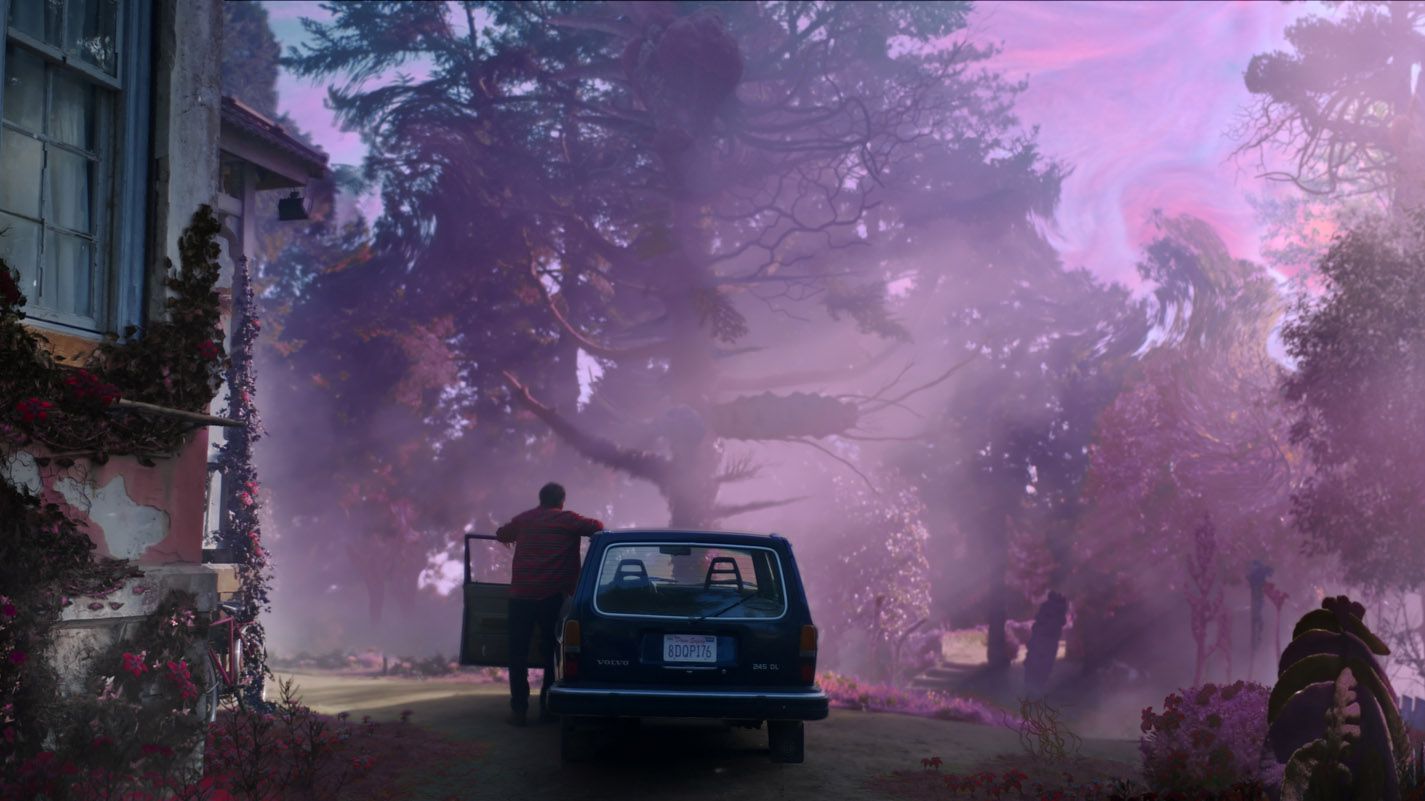
Life on the farm seems stifling and a little dysfunctional, but things only get weirder once the glowing meteor lands in the yard. Some of the changes are almost imperceptible - the parents fight more than usual, stoner Benny gets even more distracted, the Gardners' phone and internet reception degrades. The family barely even notices when strange plants start growing in the yard, neon pink mist fills the surrounding woods, and the progression of time itself becomes disrupted. Is radiation from the meteor affecting everyone's sanity, or is there really a monster in the alpaca barn? The answer is both.


"The Colour Out of Space" is one of Lovecraft's classic tales of cosmic horror where human protagonists learn the hard way that they're living in an uncaring universe. It's a horrific science fiction story, not a tale of the supernatural. Still, the film's director Richard Stanley is a practicing occultist and occult imagery appears throughout the film, mostly in rituals that Lavinia performs. She invokes archangels using the Lesser Banishing Ritual of the Pentagram, reads the Simon Necronomicon, and carves the odal rune on her forehead. The rune symbolizes inheritance and land, and is germane to her family's situation. It also looks like she carves the words "solve" and "coagula" into her hands. These words may be familiar to you from Eliphas Levi's illustration of Baphomet, and they mean "dissolve" and "coagulate." Many things dissolve and coagulate in Color Out of Space, often in a gruesome manner.

Speaking of coagulation, Nathan says "Families stick together" several times during the movie. When I recently re-read the story I was struck by how the Gardners don't leave their farm, even as things get worse and worse. The family in the movie behaves the same way. Like frogs in slowly boiling water, they don't realize they're in danger until it's much too late. It's hard to know you're in a strange situation when it's what you've grown accustomed to.

Director Stanley and Amaris Scarlett, who co-wrote the script with him, incorporate nods to Lovecraft's work throughout the film (a Miskatonic University t-shirt, a symbol on a TV news van, character names) and it's clear they appreciate their source material. They're not afraid to modernize the story where appropriate, not just by adding well-written female characters but also by casting people of color: Elliot Knight as Ward, Tommy Chong as a blissed out hippie unbothered by all the weirdness, and Q'orianka Kilcher as the town's ambitious mayor.


If I have one complaint, it's a minor one. Color Out of Space was filmed in Portugal, and it just doesn't look like New England. The trees are wrong, the Gardner's house clearly is not an old Massachusetts farmhouse, and the town hall is obviously European. Lovecraft's story is an homage to the New England landscape and an elegy for the Yankee farmers whose way of life was fading away and it would have been nice to see those incorporated into the film. But like I said, that's a minor complaint.


This is definitely a classic B movie, and I mean that in a good way. There are rubbery monsters, men with shotguns shooting things, copious amounts of gore and slime, and Nichola Cage chewing the scenery. It's not an arthouse horror film like Midsommar, The Witch or Mandy. On the other hand, there is also beautiful psychedelic imagery, a script with multiple levels of meaning, and good acting (including some by Nicholas Cage) so it's more like a B+ movie. It's also one of the best Lovecraft adaptations I've seen in a long time.


Surprisingly, it's also emotionally moving. I found myself teary-eyed by the end and got a little choked up as the film ended with this narration, pulled directly again from Lovecraft's story:

It was just a colour out of space—a frightful messenger from unformed realms of infinity beyond all Nature as we know it; from realms whose mere existence stuns the brain and numbs us with the black extra-cosmic gulfs it throws open before our frenzied eyes.

January 20, 2020

Anna and Her Damn Bread: A Legendary Recipe

This past weekend actually felt like winter, by which I mean it was cold and we got some snow. The recent 70 degree weekend was pleasant but a little freakish. Give me a cold snowy weekend instead! I know some of you out there hate snow but it always makes me happy to see it falling. It also makes me want to bake.

I'm still recovering from eating too many cookies and too much candy over Christmas, so I decided to bake some bread rather than a dessert. A wintry New England weekend calls for a classic New England recipe: anadama bread.


Anadama bread is a yeasted bread made with wheat flour, cornmeal, and molasses. Its consistency and taste is somewhere between cornbread and traditional sandwich bread. You can certainly use it to make sandwiches, but I think it's best just toasted and spread with butter. 

The cornmeal and molasses are dead giveaways that anadama bread originated in New England. These two ingredients feature in classic Yankee recipes like Indian pudding and brown bread and have deep roots in New England history. Corn (aka maize or Indian corn) has been part of the local diet for thousands of years. The Pilgrims stopped by Provincetown in 1620 on their way to Cape Cod and stole some corn that the local Wampanoags had stored there. That's how deeply rooted corn is in local history. 


Molasses also has deep roots in New England as part of what's known as the Triangular Trade. In the 1700s distilleries in New England produced rum from molasses, which merchants then traded in Africa for slaves. The slaves were transported to the Caribbean to work on sugar plantations which produced molasses. The molasses was then brought to New England to be distilled into rum which was traded in Africa for more slaves to make more molasses to make more rum... You get the picture and it's pretty grim. I tend to think of molasses as a quaint ingredient used in gingersnaps and molasses cookies but it does have an unhappy history. 

Back to the bread. There are two legends that explain anadama bread's unusual name, and they both center on a woman named Anna. In the first, Anna is the wife of a Cape Ann fisherman and she is a lousy cook. A really lousy cook. Every day she serves her husband the same exact thing for breakfast, lunch and dinner: cornmeal mush sweetened with molasses. Finally he can't take it anymore. He screams "Anna damn her!" and combines the cornmeal mush with flour and yeast to make bread. Thus we have anadama bread. 

In a second, less prevalent legend Anna is the wife of a sea-captain. This Anna is a great cook and provided baked goods for her husband's long ocean voyages that never spoiled or went bad. Still, the captain always referred to her as "Anna damn her" to his ship's crew, and her bread became known as "Anna damn her's bread." Thus we again have anadama bread. When Anna died the captain put the following on her tombstone: "Anna was a lovely bride, but Anna damn her, up and died." 


I don't know if either of these stories are true. They're pretty vague (what was Anna's surname and when did she live?) but the bread's unique name has no good historical explanation. None. Some people have suggested the recipe was created by Finnish fishermen or stonecutters living in Gloucester or Rockport, but I couldn't find anadama in the Finnish dictionary. The stories about Anna and her damned bread are the best explanations we have for the name.

Food historian Joyce White, on her blog A Taste of History, notes that "anadama bread" was filed with the U.S. Patent and Trademark Office in 1850 as a brand of bread and was used in 1876 by a company called Anadma Mixes, Inc. The bread is definitely connected to Cape Ann. A man named Baker Knowlton produced the bread in Rockport by the end of the 19th century and shipping it across New England. 


Me and my bread! My expression's kind of odd...
If you have a hankering for anadama bread, rich in legend and history, you can probably buy some at the supermarket. When Pigs Fly, the bread company from York, Maine, sells a multi-grain version that is widely available. Anadama bread is not that hard to make, though, and you can find lots of recipes online (like this one from Yankee Magazine). Baking bread is great way to spend a cold, wintry day.


*****
My source for the two legends is Morris Dictionary of Word and Phrase Origins, second edition (1988 ) by William, Mary and William Otis Morris.