September 11, 2022

Ghosts and Graffiti at Fort Revere

Over Labor Day weekend Tony and I drove down to Hull, Massachusetts. Hull is of course a popular destination in the summer because of Nantasket Beach, but we had a different destination in mind. We wanted to visit a haunted fort. 

Fort Revere sits on top of Telegraph Hill, a promontory that looks out over the town and Boston Harbor. The views are amazing, and I can understand why someone would build a fort there. You definitely would be able to see any ships approaching Hull, as well as a view of the one road leading into town.

Hull was first colonized by the English in 1622, and they considered fortifying the hill as early as 1633. It wasn't until the American Revolution, though, that anyone actually built anything there. In 1775, General Joseph Palmer constructed the first fort and named it Fort Independence. After the war that name was given to the fort on Castle Island in Boston, and the Hull fort was demolished and buried. 


The current fort on Telegraph Hill was constructed from 1898 - 1906. Named Fort Revere, it housed troops during the Spanish-American war and was armed with multiple cannons. In 1948 the US Government finally decommissioned the fort and gave it to the Commonwealth of Massachusetts. It is now a public park. 

Where are the ghosts in all this history? Well, according to local legends, the fort is haunted by the spirits of 200 French soldiers who died of smallpox in 1778. The soldiers had been captured by the British while fighting in Nova Scotia, but had been freed in a prisoner exchange. They were sent to the fort in Hull, where French marines were garrisoned. Unfortunately, most of the freed prisoners died from smallpox. Their countrymen buried them somewhere on the hill's slopes. Local archaeologists tried to find their grave in 1976 but were unable to locate it. 


The smallpox victims were real, but are the ghosts? Tony and I didn't encounter anything odd, but we went during the daytime and didn't try to engage with any restless spirits. I'm not that brave! Maybe if we had we would have experienced some of the strange phenomena said to occur. People say unseen entities will throw a rock back to you if you throw it down one of Fort Revere's many dark tunnels. They also say shadowy shapes can be seen flitting by doorways and whispers are heard in empty rooms.

As my friend Sam Baltrusis notes in his book Haunted Boston Harbor, paranormal investigators have recorded strange EVPs (electronic voice phenomena) in the fort. Anne Kerrigan and Michael Markowicz, of the group East Bridgewater's Most Haunted, investigated the site in 2007. Markowicz recored an EVP that sounded like a choir singing, which is pretty freaky. They also captured voices saying, "What do you want with us, Michael?" and "Watch us, watch you." That's even freakier.


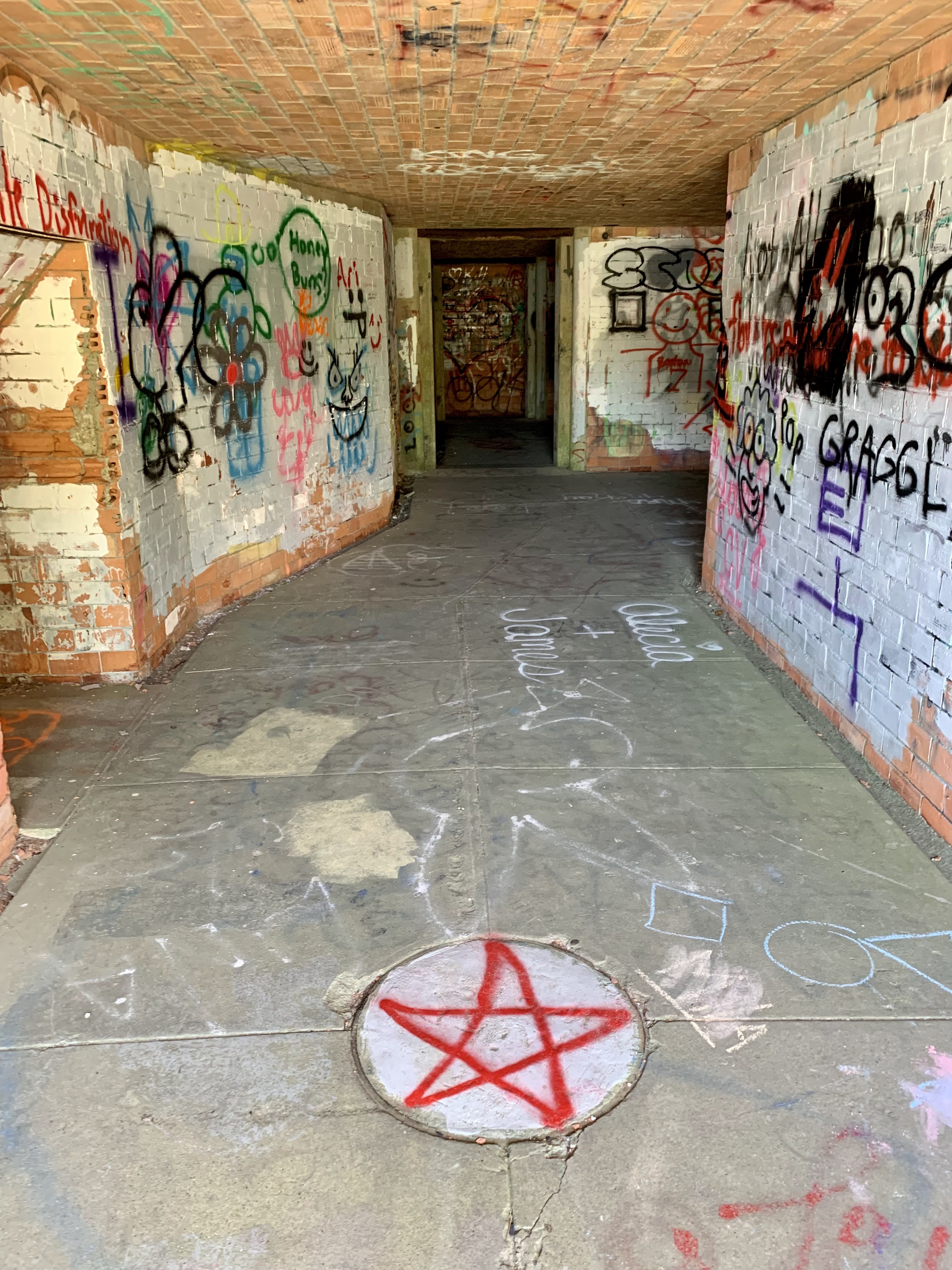
Happily, they didn't encounter any malevolent energy at the fort. Tony and I didn't either, although we did encounter a lot of graffiti. A lot!  Some of it is over 20 years old, so I don't think anyone has been cleaning the inside of the fort. The outside is almost spotless though (and has amazing views).

We had a good time exploring the fort. If you want to visit someplace historic, scenic, and possibly haunted, I'd recommend Fort Revere. 

August 29, 2022

Gerald the Bigfoot Goes Missing in Bernardston

On the night of April 22, 2020, thieves stole a large statue of Bigfoot from the Brimfield, Massachusetts lawn of Tod Disotell. Disotell, an anthropologist at UMass Amherst, had appeared on the TV show 10 Million Dollar Bigfoot Bounty and liked to decorate his Bigfoot statue with surgical masks and messages about COVID social distancing. 

Security camera footage showed two showed two hooded figures cutting a chain before absconding with the statue. Happily, police located the statue a few days later in downtown Worcester. Bigfoot was returned to Disotell's front yard. The thieves were never apprehended.

Sadly, Bigfoot thieves have struck again, this time in Bernardston, Massachusetts. On June 22, they stole an 18-inch concrete statue of Bigfoot from the front lawn of Sarah Gray. The statue, which she named Gerald, was a 2021 Christmas gift from her husband and children. 

Photo from The Greenfield Reporter

The Greenfield Reporter has the scoop:
“I was out doing errands and I came back and realized that he was missing from our front yard, off of our stump out here,” Sarah said in her kitchen on Friday. She posted a picture of the statue to Facebook to explain it had disappeared and ask for help finding it. That post got 250 shares and she placed near the stump a large sign asking for the statue’s return, but Gerald remains missing.

“We don’t know what happened. I don’t know if somebody thought he was maybe free,” she said.

Sarah said she did not report the incident to the police because she does not want to burden them with such a matter.

“It was upsetting, but I didn’t want to really involve the police and make a huge deal out of it,” she said. “But for me, it’s very sentimental. I have no hard feelings toward the person that took him or whatever – I would just like my Bigfoot back.”
The Reporter also notes that various friends have shown Gray photos of Bigfoot statues they have seen, but none were Gerald. 

If you've stolen Gerald, please return him! Alternately, if Gerald simply ran off on his own, I hope he returns back to Bernardston and the family that loves him. 

August 18, 2022

Vampires, Punk Rock and Local Legends in The Pallbearers Club

I don't often review novels here, but Paul Tremblay's new book The Pallbearers Club is based on an important piece of New England folklore. Tony gave it to me, thinking I might like it. He was right! It's creepy and very steeped in weird local history. 

The Pallbearer's Club tells the story of Art Barbara, a local rock musician, and his friendship with a mysterious woman named Mercy Brown. Art and Mercy first meet when Art is a high school student in Beverly, Massachusetts. He's tall, skinny, acne-ridden, and has a serious case of scoliosis. He's not the most popular kid in school and doesn't participate in any extracurricular activities. In order to beef up his college applications, he starts the Pallbearers Club, a group that attends funerals of people who don't have anyone to mourn them. Other than Art, only two other Beverly High students are members.  

And then Mercy joins. She's older than Art and is a student at Salem State. She introduces him to punk rock and alternative music. She has her own car. She helps him write a paper for a class on local history. The topic: the famous Rhode Island vampire Mercy Brown. 

Wait, what? The Pallbearers Club is presented as a memoir by "Art Barbara," but Art admits that this is a pseudonym. It's not his real name. "Mercy Brown" is not really his friend's name either. Art gives her that name in his memoir because... well, because he suspects she's a New England vampire.  

I've written about New England vampires before, and they're not like the vampires you see in pop culture. In the 19th century, tuberculosis was rampant across this area. No one knew what caused the disease, which was called 'consumption' at the time because it consumed people's lives and health. It often killed entire families, slowly and one person at a time. Some New Englanders believed the disease was actually caused by a dead family member feeding from the grave on the life force of their loved ones.

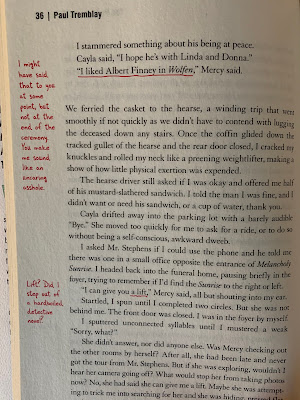
Artwork from The Pallbearers Club

Mercy Brown is the best-known of the alleged New England vampires. Beginning in the 1880s, consumption began killing multiple members of the Brown family of Exeter, Rhode Island. The family's mother, Eliza, was the first to die, followed by her daughters Mary and Mercy. When young son Edwin grew ill, neighbors convinced his father George Brown to exhume their corpses to see if any showed signs of life in the grave. Mercy's corpse was undecayed and had blood in its hearts, which according to local folklore indicated she was feeding on Edwin. Her heart and liver were burned to ashes and mixed with water, which was given to young Edwin to drink. This was supposed to prevent Mercy's vampirism and save Edwin's life, but he died two months later. (Michael Bell's book Food for the Dead is the best non-fiction book about New England vampires.)

Is "Mercy Brown" in The Pallbearers Club really a vampire? Art certainly seems to think so and blames her for some unfortunate and unusual events in his life. Mercy vehemently disagrees. The Pallbearers Club is full of notes from Mercy in red pen, offering her perspective on events. Maybe, she suggests, Art is really a drug addict and incapable of moving on from the past. 

Who is right, Art or Mercy? I won't tell you. The Pallbearers Club is a creepy slow burn and keeps you guessing until the last page (and maybe even after). It doesn't have a lot of gore or violence, so when the weird stuff happens it's all the more effective. There are some nice twists, and I definitely was surprised by the ending. This is also very much a New England novel, set almost entirely in Providence, Rhode Island and Beverly. Tremblay lives north of Boston, and his love and knowledge of the region really shines through. If you like New England, weird folklore, and a twisty plot, add this to your reading list. 

July 31, 2022

Hiding Shoes to Bring Luck and Avert Evil

I’m always excited when some local folklore appears in the news, as it did this week. Several Boston-area news outlets reported that archaeologists working at the historic Tilden House in Canton, Massachusetts unearthed some shoes buried underneath the kitchen floor. Why all the excitement over some shoes? Because they could possibly be a form of protective magic. 

The Tilden House was built in 1725 by David and Abigail Tilden in what was then part of Dorchester, Massachusetts. That part of Dorchester ultimately became a separate town, Canton, in 1797. A strange and interesting fact: it was named Canton because Elijah Dunbar, one of the town’s leading citizens, thought it was on the exact opposite side of the planet from Canton, China. This is not the case, but the name stuck. 

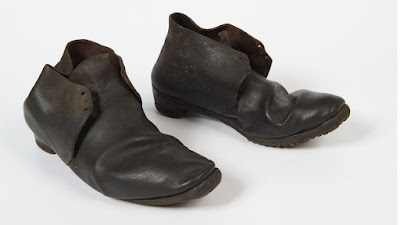
A photo of hidden shoes from England. 

For those of you not from the Boston area, please note the names of the two cities are not pronounced the same. The town in Massachusetts is said CANT-in, or more often CAN’-in, with some kind of glottal stop instead of the “t”. The city in China is often pronounced can-TAWN, but it’s true Chinese name is Guangzhou. It’s also important to note that Cantonese cuisine originates from Guangzhou, not the Massachusetts town. 

The Tilden House is currently owned by the town of Canton, and leased to the Canton Historical Society, who are restoring and modernizing it so it can be used as a history center. After archaeologists removed the kitchen floor, they found several pairs of shoes, along with bottles, plates, and other items, all of which seemed to date from the mid-19th century. All these items could just be trash that past residents discarded, but it’s also possible the shoes were placed there to protect the house from witches or evil spirits. 

Hidden shoes are often found in the walls, ceilings, or under the floors of old buildings in England and North America, and historians suspect it was a form of protective magic. For example, back in 2013 archeologists found shoes hidden under the floor of the Old Colony House in Newport, Rhode Island. But why did our New England ancestors think hiding shoes would defend against evil magic? Historians  Matthew Cochran and Jeanne Ward explain it this way:

This well-documented practice dates from the l5th to the early 20th century. The underlying premise of using concealed shoes as a means of personal or household protection lies both in the shoe’s shape as well as the personal qualities imbued in a shoe by the wearer. Shoes take on the literal shape of the wearer and therefore can act as a form of proxy for the wearer. If a malicious entity is presumed to be haunting you, the concealment of the shoe in a relatively inaccessible space, such as the cellar or the attic, may draw the malicious entity to the shoe instead of you. And, if luck holds, the malicious entity may become trapped in the shoe (from the Maryland Archeology Newsletter, quoted here.)

This explanation makes sense to me, since it matches another important type of protective magic in New England: the witch bottle. I've written about witch bottles before. When someone thought they were being cursed by a witch, they would fill a bottle with their own urine, and then add nails, broken glass, and other sharp items to it. The urine acted as a substitute or proxy for the victim. The witch's evil magic would be drawn to the urine, which came from their victim, rather than to the actual intended target. To make things worse for the witch, the sharps objects would send pain and physical harm back to the witch. 

I suppose you should always have some old shoes, a bottle and some nails on hand just in case things start getting weird? It's like a supernatural form of recycling. But please, don't go around accusing your neighbors of witchcraft.

July 13, 2022

Dog Days and Dog Lore

The other day while browsing through The Old Farmer's Almanac, I saw this notation for July 3rd: Dog Days Begin. I experienced the dog days quite viscerally today myself. I was out walking around during my lunch and noticed that it was blindingly bright, unpleasantly hot, and extremely humid. I felt a little stupefied. 

The dog days of summer begin on July 3rd and end on August 11th. They are said to be the hottest days of summer in the Northern Hemisphere, and get their name from the star Sirius, which rises in conjunction with the sun during this time. Sirius is part of the constellation Canis Major (Latin for the Greater Dog), which follows Orion through the sky. 

A mosaic of a dog from Pompeii

The ancient Greeks were the first people to call this time of year the dog days. For example, in The Iliad, the poet Homer has the following to say: 

...all radiant as the star which men call Orion's Hound, and whose beams blaze forth in time of harvest more brilliantly than those of any other that shines by night; brightest of them all though he be, he yet bodes ill for mortals, for he brings fire and fever in his train... (Homer, The Iliad, Book 22, translated by Samuel Butler)

Some Greeks tried to appease Sirius the Dog-star (and the heat it brought) with sacrifices, a practice taught to them by Aristaios, the divine son of Apollo. 

The Dog-star Sirius was scorching the Minoan Islands from the sky, and the people could find no permanent cure for the trouble till the Archer-King Apollon put it in their heads to send for Aristaios. So, at his father's command, Aristaios ... left Phthia, and settled in Keos. He raised a great altar to the Rain-god Zeus and made ritual offerings in the hills to the Dog-star and to Zeus himself, the Son of Kronos. In response, Zeus gave his orders - and the Etesian Winds refresh the earth for forty days. The priests of Keos still make yearly sacrifice before the rising of the Dog. (Apollonius Rhodius, Argonautica)

The ancient Romans also believed that Sirius rising created the hottest days of summer. Here is what Pliny the Elder wrote on the matter:

Who is there that does not know that the vapour of the sun is kindled by the rising of the Dog-star? The most powerful effects are felt on the earth from this star. When it rises, the seas are troubled, the wines in our cellars ferment, and stagnant waters are set in motion... There is no doubt that dogs, during the whole of this period, are peculiarly disposed to become rabid. (Pliny the Elder, Natural History, Chapter 40)

An interesting side note about Pliny the Elder: he died while trying to save people from the eruption of Mount Vesuvius that destroyed Pompeii and Herculaneum. His Natural History was only published after his death. 

From the Greeks and Romans, the concept of the dog days has been passed down to us. I think most modern Americans are still familiar with the idea, even if they don't know the exact dates that comprise the dog days. They might also know the song by Florence and the Machine, "Dog Days Are Over." Fire, fever, rabid dogs, troubled seas, and stagnant waters. The dog days don't sound like much fun. No wonder Florence is so glad they're over. 

I can hear someone out there saying, "But I love summer! Summer is awesome! The beach! Cookouts! School vacation! Trips to Europe!" Yes, all those things are amazing parts of the summer season. We don't live in the ancient Mediterranean world, where summers were inescapably hot and hellish. We live in a world with ice cream and air-conditioning. Of course, with climate change, people around the world are once again experiencing the sometimes terrifying power of summer - wildfires, heatwaves, and droughts are increasing every year. And not everyone is fortunate enough to have air-conditioning and ice cream.

An interesting side note about trips to Europe: I read today that an American tourist was injured when he tried to retrieve his phone after dropping it into Mount Vesuvius. Happily, the volcano was not erupting at the time.

Thinking about the dog days made me curious to see if I could find some New England lore about dogs. I found a few intriguing tidbits in What They Say in New England (1896), Clifton Johnson's collection of local folklore. Although Johnson notes that it was considered healthier to have dogs than cats as pets, he does include some sinister lore about dogs. For example, he writes about a dog in Hadley, Massachusetts that howled every night when the 9:00 pm church bell rang. The citizens of Hadley assumed this was an omen of something bad, but they weren't quite sure what. 

They probably thought the dog's howling foretold someone's death, because Johnson also writes that it was believed a dog howling under a window foretold a death in the house. 

There was a dog went and howled under the window of a house up near where I lived. He howled and howled; and they drove him off, but no sooner done it than he was right back again. And in two or three days an old lady that lived there died. (Clifton Johnson, What They Say in New England (1896))

Johnson also writes about a related belief. If a dog howls in the yard, the first person who walks through the front door will soon die. Dogs are man's best friend, but also an omen of doom. I suppose they're like the dog days of summer in that respect. Some people think they're lovable and fun, while others look at them with dread.