February 25, 2019

The Witch's Doughnuts: A Cape Cod Witch Story

It's a well-known fact that people in New England really like doughnuts, and our region is blessed with an abundance of doughnut stores. Maybe it's even an overabundance. Locals often joke about how many there, particularly Dunkin Donuts. There are in fact two Dunkin Donuts within a quarter mile of my house. Two! There's another one a half-mile away.

This is not something recent. Doughnuts have been popular here for centuries. As Keith Stavely and Kathleen Fitzgerald discuss in their 2015 book America's Founding Food, early New Englanders ate doughnuts at almost any meal. They were particularly popular served with cheese and bread and butter during the break on Sunday church services. There's nothing like some fried sugary dough to get you through the next hour-long Calvinist sermon.

Of course, good church-going folks weren't the only people who loved doughnuts. They were popular with more disreputable people like sailors (many ships had doughnut making equipment in their galleys) and even witches. 


That's right. Even witches liked doughnuts. And as the following Cape Cod legend demonstrates, witches became very unhappy when someone stole their doughnuts. 

Way back in 1780, a sailor was walking through the dunes of Truro to reach a ship whose crew he was joining. It was a long hard walk through the sand and his stomach was beginning to rumble with hunger. As he passed by a small rundown house he smelled the rich aroma of freshly-made doughnuts wafting from within.

Unable to resist the smell he knocked on the door. No one answered. The door was unlocked so he opened it and stepped inside. 

No one was home. Well, no one except a small black goat that sat by the fireplace. The sailor thought this was odd but he ignored the animal. His attention was captured by a tray of hot doughnuts cooling on the table. He couldn't resist. He grabbed the tray and ran out the door. 


As he hurried away through the dunes he ate one doughnut and then another. They were the best doughnuts he had ever eaten.


By the time he reached the ship he had eaten all of them. Sure, he felt a little guilty for stealing someone's doughnuts, but they were only doughnuts, right? As the ship sailed away from the Cape he thought he would never be caught. He thought he had gotten away with the perfect doughnut crime. 

He hadn't. That night as the sailor slept an old woman appeared to him. Angrily and without speaking a word she threw a horse's bridle over his head. The witch rode him up and down the Cape as he slept, digging her heels into his sides violently whenever he slowed his gait. In the morning his torso was covered in bruises shaped like a woman's shoe. 

She appeared to him again the next night, and the next. He tried to hide the witch's nightly visitations from the other crew members. He knew that sailors were superstitious and wouldn't want someone cursed by a witch onboard. They'd call him a "Jonah" and try to throw him into the sea. 

Unfortunately the witch's curse radiated out from him and everything he touched went wrong. After he was asked to pump the ship's drinking water it became brackish. When he was told to work in the ship's galley all the flour became moldy. He was exhausted, his body ached, and he was jinxed. 

The crew began to mutter about him, and the ship's captain pulled him aside. "Tell me the truth," the captain said. "Are you bewitched?" The sailor told the captain everything: how he had stolen the doughnuts, how he was being ridden every night, and how he was now cursed.  

When the sailor was done with his story the captain grabbed a musket and then pulled a silver button off his coat. He loaded the button into the musket and handed it to the sailor. 

"Use this tonight when she comes for you," the captain said. 

At midnight the crew was awakened by the sound of a single musket-shot. The next morning the sailor came up on the deck looking fresh and rested. The curse was lifted and the ship completed a successful voyage.
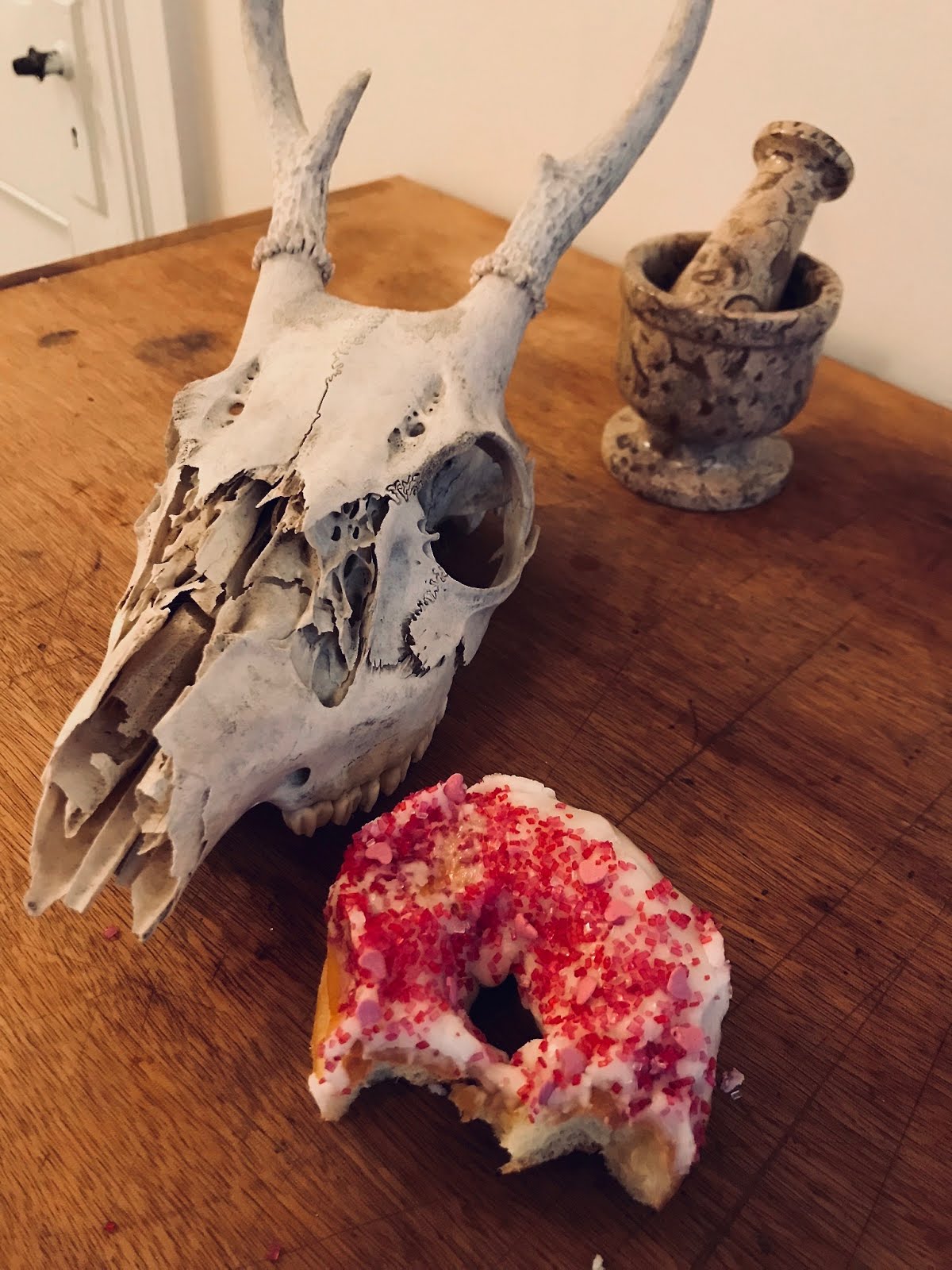


So there's the story. It sounds like a folktale to me, but some people claim it was true. The sailor eventually returned to Truro, and over a century later his grandson told the story to a reporter from The Boston Herald, where it appeared in the February 6, 1919 issue. The Harvard historian George Lyman Kittredge (author of 1929's Witchcraft in Old and New England) said he heard the same story from an old Truro native in the late 19th century. It is also included in Elizabeth Renard's book 1934 book The Narrow Land

The doughnut angle is unusual, but like so many folktales about witches it is mainly intended to educate the hearer about how to fight back against witchcraft. The point is not that the sailor stole doughnuts, but that he was bewitched and defeated the witch. It's an education in defensive magic (use a silver bullet!), not a morality tale. 

Still, I find the conclusion of this story troubling. Let's face it, the sailor committed a crime. I understand why the witch was so unhappy. I don't want anyone stealing my food, do you? Perhaps she should have gone to the local constable and pressed charges, but that might have raised some uncomfortable questions. ("Did you see the sailor steal your doughnuts ma'am?" "No, but my black goat familiar did...") Instead she took matters into her own hands. Perhaps the whole situation could have been defused if the sailor simply apologized or paid restitution. 

Also, like a lot of New England witch stories there is an uncomfortable gender-dynamic at play. The nighttime witch-riding feels like it has a sexual subtext, and is something that is always used by female witches against male victims. But is the sailor really a victim in this story, or a perpetrator who needs to be punished?

*****
Special thanks to Tony for the doughnut photo shoot!

February 18, 2019

More From Copp's Hill: A Smuggling Patriot and A Masonic Grand Master

I wanted to follow up on my recent post about Copp's Hill Burying Ground in Boston. Although the really famous patriots are buried in the Granary Burial Ground, there are also some interesting Revolutionary War era people buried at Copp's Hill. 

One of them is Captain Daniel Malcolm (1725 - 1769). Malcolm's grave is marked with a large and impressive stone engraved with a traditional death's head, but as you can see from the photos there are unusual round indentations in the stone. They could be natural wear and tear, but according to tradition these holes were made by musket balls. In other words, someone shot at Malcolm's gravestone. 


Daniel Malcolm was a patriot and took great joy in smuggling wine and tea into Boston without paying taxes to the British. He once allegedly brought sixty casks of wine into Boston without the British finding out - or collecting taxes on the black market cargo. As the inscription on his grave reads,

A true son of Liberty
A friend of the Publick
An enemy to oppression
And one of the foremost
In opposing the Revenue Acts on America 

The British had great hatred for Captain Malcolm. They knew he was a smuggler but were never able to catch him in the act. He always managed to outsmart them. He knew the British hated him, so he left instructions in his will that he should be be buried in a stone grave ten feet deep. He didn't want the British soldiers to mutilate his body. 


Frustrated that he had escaped them even in death, the British soldiers took out their anger on Malcom's gravestone, firing their rifles at it repeatedly. This is supposedly what caused those round marks - soldiers using Malcolm's gravestone for target practice. Is this story true? I don't know. It sounds plausible to me, but I'm not an 18th century ballistics expert.

Near Daniel Macolm's grave is this impressive monument, which marks the resting spot of Prince Hall (1735? - 1807), one of 18th century Boston's most prominent African-American citizens. Boston had a sizable black population in the 1700s, and of the 10, 000 people buried at Copp’s Hill around 1,000 were of African descent. 


The details of Hall's early life are vague, but it appears that he began his life as a slave and became a free man by the 1770. He was literate and owned his own business (a leather shop). And he wanted to become a Freemason. 

In the 18th century the Freemasons were a really important organization for men, particularly businessmen like Hall. Masonic Lodges were places where they could network, make business connections, and learn important news. Many of the local patriots, like Paul Revere and John Hancock, were Masons. Hall knew he was missing out on a significant opportunity so he applied to join the Boston lodge. They turned him down because he was black. 

Undeterred, Hall went to Boston's other Masonic lodge - the one run by the British and their sympathizers. They accepted him as a member and he eventually became a Masonic Grand Master. Some other local black men followed his lead, and together they eventually founded the Masonic African Lodge, which became the founding lodge of all black freemasonry existing today.

Why were the British willing to initiate black members into the Masons when the Americans weren't? It's possible they were less racist than the locals, but the British also knew they couldn't afford to turn away any possible supporters in a hostile town. Once the Revolutionary Way erupted the British actively urged blacks in America to join the British army, promising them they would get their freedom and equality when the war ended. 

Prince Hall didn't sign up. Instead, he urged blacks to fight against the British, arguing that if black people were involved in the founding of the new nation they would get their freedom. It is believed that Prince Hall served in the Continental Army fighting the British during the Revolution, but it is hard to know for sure. There were six me named Prince Hall enlisted from Massachusetts. Historians tend to think one of them was the Prince Hall of Copp's Hill.

After the war in 1783 ended Hall continued to be involved in community organizing, Masonry, and the abolition movement. He died in 1807, and the African Lodges were renamed Prince Hall Lodges in his honor. In 1784, Massachusetts became the first state to abolish slavery. 

February 03, 2019

Copp's Hill Burying Ground: Grave Art, Witch Hunters, and Spectral Evidence

I have been a little under the weather this week, but last weekend I did stroll to Boston's North End to visit Copp's Hill Burying Ground. It's the second oldest cemetery in the city and has a lot of really interesting history attached to it.

A folk story claims that the cemetery gets its name from the word "corpse" and was originally called "corpse hill." I suppose if you say "corpse" with a heavy Boston accent it does kind of sound like "copps." Try it and you'll see what I mean. Sadly, this story doesn't seem to be true. The burial ground  was actually named after the Copp family who lived nearby in the 1600s.


The first interments happened in 1659; the final ones sometime in the 1850s. An estimated 10,000 people were buried there over those two centuries, although there are only 1,200 gravestones. In the 19th century urban planners wanted to give Copp's Hill a more parklike feeling so they laid out pedestrian paths and arranged the gravestones in neat, orderly rows. They didn't bother to move the bodies though. These facts mean two things. One, there are a lot of unmarked burials at Copp's Hill. Two, many of the burials are probably mis-marked. When you walk there you're probably stepping on someone but you'll never know who.

Copp's Hill Burying Ground is on a high elevation overlooking the harbor, and I think because of this there is some serious decay among the older gravestones. Still, there are some nice examples of New England funerary art here. The oldest gravestones are decorated with the classic winged death's head motif. The Puritans weren't big on sugar-coating bad news.


In the mid-1700s, a different motif began to appear on New England gravestone's: cherub's heads. These are slightly more cheerful than the death's heads and perhaps reflect a gentler strain of religious thought that began to appear in the area at that time.


The third motif appeared in the late 1700s. Some historians speculate that the willow and urn motif represents a more abstract and philosophical approach to death, while others argue that this and all the other motifs are simply just fashions unrelated to religion or philosophy.


Whenever I visit Copp's Hill I always stop by the Mather family tomb. This is the resting place of three of Boston's most famous Puritan ministers: Increase Mather and his sons Cotton and Samuel. For such an important family their tomb is surprisingly low-key.

The Mathers are mostly remembered now for the roles Increase and Cotton played in the Salem witch trials, but during their lives they did a lot of good things for Boston and New England. Increase Mather (1639 - 1723) served as president of Harvard College for 20 years, wrote numerous books and articles about New England history and politics, and successfully got a new charter for Massachusetts Bay Colony from King William III after the initial one was revoked. All this while serving as a minister until his death.


His son Cotton (1663 - 1728) was also a very influential person in early New England. Cotton was very interested in science and conducted experiments with plant hybridization. He also supported the first smallpox vaccination campaign in Boston. Cotton Mather published more than 400 books and pamphlets on a variety of topics during his life.

Unfortunately, Cotton was also a fervent believer in the literal reality of witchcraft. He thought that witches lived in Massachusetts and were subverting God's plan for a Puritan society in New England. In 1689 he published Memorable Providences Relating to Witchcraft and Possessions which described the trial and execution for witchcraft of Goody Glover, an Irish washerwoman from Boston. The book also describes the strange behavior of several children supposedly afflicted by Goody Glover. Memorable Providences is now believed to have laid the groundwork for the larger Salem witch trials that came three years later.

Although he lived in Boston Cotton Mather was active in the Salem trials. He attended several executions, including that of fellow Puritan minister William Burroughs. When Burroughs successfully recited the Lord's Prayer, something it was believed a witch could not do, Mather supposedly intervened and said that even the Devil sometimes could take the form of an angel. The execution went forward and Burroughs was hanged. Mather also wrote about the trials while they were occurring and they helped to glorify God.

During the Salem trials the court turned to the ministerial community for guidance in how to deal with spectral evidence. It was believed at the time that witches had the ability to send their souls (or specters) out of their bodies to afflict their enemies. Often only the person being afflicted would see the witch's specter. The judges wanted to know if this really happened and if they should accept accounts of it as evidence.


To answer the judges Increase Mather published a book called Cases of Conscience Concerning Evil Spirits Impersonating Men. In it he clearly stated that the judges should ignore spectral evidence for many reasons, most importantly because demons could take the form of innocent people and afflict someone. He was about to publish it when he was asked by his son Cotton to add a chapter defending the trials and the judges.

You see, Cotton had been asked by the colony's governor to write a defense of the Salem trials. It was called Wonders of the Invisible World and although in it he too dismissed spectral evidence he also claimed the other evidence was strong enough for the trials to continue. Because he didn't want Increases's book to contradict his own he asked his father to add a chapter supporting the trials to Cases of Conscience. Increase agreed, even though it muddied the main argument of Cases. When the judges read it they thought Cases of Conscience supported what they were doing and continued to accept spectral evidence. The Salem witch trials only stopped when Governor William Phips declared that spectral evidence could no longer be accepted.

That's all pretty bad, but to make things worse Increase and Cotton Mather never apologized or said they were wrong about the trials. They continued to maintain they were right, even after the Salem trials ended and many of the judges publicly acknowledged they had done something horrible. Even after some of the key witnesses admitted they had lied. Even after public opinion turned against them the two ministers refused to admit any wrongdoing. Over time they slowly lost their political influence and today are often seen as villains of the Salem witch trials. Certainly there is a lesson to be learned here about pride and accepting blame.

Well, that's a lot to chew on. Next week I'll write about some less grim stories from Copp's Hill Burying Ground.

January 21, 2019

Two Encounters with Pukwudgies in Lawrence, Massachusetts

One of the nice things about writing this blog is that sometimes people share strange stories with me. Last week someone I'll call Miss S. wrote and told me about some unusual things that happened to her family thirty years ago. She said I could share them so here they are.

The first incident happened to Miss S.'s brother Bob. He was just a child at the time (maybe seven or eight years old) and was watching TV with some cousins at his grandparent's house in Lawrence, Massachusetts. They were sitting on the couch, which faced the TV but had its back towards a doorway into another room.

As they sat there watching TV Bob felt someone pull on the back of his hair. He thought it was his cousin Sandra and he told her to stop. Sandra denied pulling his hair. A few seconds later he felt it again. Again he yelled at his cousin, who still said she didn't do it. A few more seconds passed and Bob once again felt someone tug on his air.

He turned around angrily, expecting to see one his cousins hiding behind the couch. But his anger turned to surprise when he saw who was there. Instead of a cousin, he saw a little old lady with long white hair. And when I write little, I mean quite small - she was only two or three feet tall. When she saw Bob looking at her she quickly started to run towards the front door of the house. She disappeared into thin air before she reached it.

Bob was understandably surprised by this, but when he blurted out what he had seen his grandmother told him not to worry about it. "Don't worry," she said. "They're friendly.'

The second incident occurred one day when Bob's mother took him and his cousins, including Sandra, out to the movies. After the movie was over they returned to their grandparents' house. The door was locked. No one was supposed to be home so they were surprised to see through the window that a lamp was on in the living room. Sandra peered through the window to see if she could see her grandparents. She jumped back from the window and screamed "I am getting the f***k out of here!"

Bob's mother stepped up to the window and looked inside. She saw a very short old man with long white hair run out of the living room. She gathered the kids together and they quickly left.


Miss S. says that her brother and mother still talk about these two incidents. They say that in retrospect they should have known something odd was happening in the grandparents' home. They would sometimes find the tin of coffee opened and spilled onto the floor, and bottles of Coke stored in the attic opened and half drunk. When asked about these things the grandparents would just shrug and say they had rats, but can rats take the metal caps off glass bottles?

In her email Miss S. wrote that she thought these were encounters with pukwudgies, the magical little people from local Native American lore. The beings her family members saw were short, fast and had very long hair, which certainly matches some of the descriptions from local Algonquin lore. That lore also describes them as being mischievous but shy, which matches these two encounters.

It's important to note that historically Native American lore from New England includes a wide variety of little people known by many names. It was only in the late 20th and early 21st century that pukwudgie, a word of Ojibwa origin, has become widely used to describe them. I use it because it is a convenient term that people are familiar with.

I think it's also important to point out that Miss S.'s grandparents, mother, and brother are of Mi'kmaq heritage. The Mi'kmaq are a Native American group originally from Canada's Maritime provinces and parts of Maine. Mi'kmaq legends tell of small beings called the wiklatmuj or pukulatmuj. They enjoy playing tricks, including tying knots in people's hair. Was this what the old woman was trying to do to  Bob? 

It seems possible that since the grandparents were Mi'kmaq they weren't worried about having the little people in their house. They understood that they were just part of life. A family of European descent unfamiliar with these beings would probably have called an exorcist!

Most local Native American groups tried to foster good relationships with the pukwudgies. Like any neighbor, they could be malicious when treated poorly and helpful when treated right. Miss S. says she has never seen the little people herself, but when she moves to a new house she always does something her mother taught her. She leaves a small spice cake on the back steps the first night she moves in. She says her house is peaceful and her garden very productive.

It may seem strange that pukwudgies would appear in someone's house since they are usually associated with woods and forests. The grandparents' house was in an urban part of Lawrence, so it was definitely not a rural environment. However, I have found at least two other cases where a small, fairy-type being has appeared in someone's home. In one case, a house in Somerville was allegedly haunted by a troll. I've also read about a house in Weymouth that might have been inhabited by a mischievous pukwudgie. Are some accounts of haunted houses actually caused by pukwudgies instead of ghosts? That's probably an unanswerable question.

January 14, 2019

Super Blood Wolf Moon: Science, Folklore, And A French-Canadian Werewolf

This month New England will experience the super blood wolf moon. 

Say it out loud: "Super blood wolf moon."

Howl it to the cold night sky: "Super Blood Wolf Moon!"

It sounds like the name of a metal band from the early 2000s, doesn't it? "Hey bro, I hear that Lustmord is opening for Super Blood Wolf Moon at the TD Garden. I need to get my tickets." It also sounds like dialogue from a horror movie. "If you kids know what's good for you, you won't go to the witch's grave during the super blood wolf moon!" Too bad no one ever listens to old geezers in horror movies...


Well, the super blood wolf moon is a real thing. It starts on January 20 at 9:35 p.m. Eastern Time and ends on January 21 at 2:50 a.m., and it shows you how amazing life is when science and folklore come together. It's as  amazing as heavy metal and horror movies combined but quieter and with a lot less gore. 

The super blood wolf moon is the official name for the full moon in January. I'll break the name down piece by piece:

1. SUPER: A full moon is called a super moon when the Moon is at its closest point to to the Earth. It appears larger than normal in the sky. There are often 3 or 4 super moons in any given calendar year. The most recent one was on December 22.

2. BLOOD: A super moon sounds kind of fun, but a blood moon sounds ominous. Don't worry though. It's not as bad as it sounds! Although the Moon will turn blood red on January 20 - 21, it is not an omen of doom. It is actually just a lunar eclipse caused by the Moon passing through the shadow cast by the Earth. "Blood moon" is a piece of folk terminology; astronomers just use the term "lunar eclipse." 


3. WOLF: The Moon has a different folk name each month. For example, November is the Beaver Moon, December is the Cold Moon, and January is the Wolf Moon. Here is the complete list of names used by The Old Farmers Almanac:

Wolf Moon (January)
Snow Moon (February)
Worm Moon (March)
Pink Moon (April)
Flower Moon (May)
Strawberry Moon  (June)
Buck Moon (July)
Sturgeon Moon (August)
Corn Moon (September)
Hunter Moon (October)
Beaver Moon (November)
Cold Moon (December)

These names are supposedly derived from those originally used by the Algonquin tribes of the Northeastern United States. Different naming systems are used around the world, but this seems to be the most common one in the U.S. and has roots here in New England. Each name refers to what happens in the natural world during that month. Worms become active in March, flowers bloom in May, and in January the hungry wolf howls. Game is scarce at this time of year, and the Algonquins could hear wolves howling outside their encampments in the icy woods. 

So there you have it - Super Blood Wolf Moon! Hopefully it seems less ominous to you now, although I find the idea of hungry wolves more than a little spooky. Which brings me to my special bonus story this week - a tale about a loup-garou, the French-Canadian werewolf. 

There aren't many werewolf stories from New England. It was said the local Algonquin shamans could send out their souls in the shape of animals, but they didn't specialize in wolf forms. The same was true of the witches in local Puritan folklore. They could assume the shape of birds, dogs, cats and even horses to torment their victims but they didn't usually turn into wolves. 

Still from The Howling (1981)
However in the late 19th century many French-Canadians moved to New England to work in the region's textile mills. They brought their folklore with them, including the following story of a loup-garou, or werewolf. It comes from Rowland Robinson's 1894 book Danvis Folks, which while fiction incorporates folklore that he heard in Vermont. Happy Super Wolf Moon!

*****

Many years ago on a dark snowy night a man left his warm house and hitched the horse to his sleigh. His wife was ill, and maybe close to death, so he was going to get the local Catholic priest.

As he rode down the forest road, all he heard was the hiss of the sleigh's runners and the thudding of the horse's hooves. The snow was good for sleighing and soon he was near the church.

Suddenly, the horse slowed down and the sleigh barely moved forward. The man whipped the horse, but to no avail. It was as if the sleigh was suddenly burdened with a two ton load.

Looking back, the man saw a large black wolf standing on its hind legs. It had its front paws on the rear of the sleigh and was preventing it from from moving forward. The wolf's yellow eyes burned bright in the darkness.

Fear gripped the man's heart. No ordinary wolf was strong enough to stop a sleigh. This was something far worse! It was a loup-garou, a man who had sold himself to the Devil in return for the power to transform into a wolf. Sometimes the loup-garous just ate corpses, but sometimes they liked their meat to be fresher. 

The creature jumped fully onto the sleigh, and the sleigh shot forward as the horse pulled harder than ever. The loup-garou walked to the front of the sleigh and put its front paws on the driver's shoulders. The monster was so heavy the man thought he would be crushed.

In a panic he searched his pockets for his knife. If he could cut the loup-garou its devilish magic would be dispelled and it would turn back into a human. But in the dark night, distracted by the monster's hot breath on his face, he couldn't find his blade. Death seemed imminent.

At this point the sleigh reached the church. Hearing the commotion the priest opened the front door. When he saw what was happening, he said a brief prayer. Instantly the monstrous wolf turned back into a man, who fled into the forest with a whimper.

Luckily the priest had a good supply of whiskey to calm the man's nerves. The priest returned to the man's house and prayed over his wife, who recovered soon afterwards.