Showing posts with label silver bullet. Show all posts

December 05, 2022

Bewitched in the Woods: Old Rif and the Rabbit

A few weeks ago I went to the Boston Athenaeum and found lots of old witch stories in various in old New Hampshire history books. A few weeks ago I wrote about Mother Carr from Weare, New Hampshire. Here's another witch story I found, this time from the town of Windham. As the days grow shorter I find myself drawn more and more to these stories!

Many years ago, an enslaved Black man named Old Rif and a man named George Simpson were out hunting in the woods near Windham. After hunting for a while they became lost.

The sun was sinking behind the western hills, and they came to a halt. At that moment they saw a rabbit standing upon its hind legs, looking at them; they tried to frighten it away, but it would not away at their bidding. Old Rif knew that the rabbit was bewitched, and he had heard that to shoot silver sleeve-buttons at a rabbit would destroy the witch. So he loaded his gun, putting in his silver sleeve-buttons, and shot the rabbit. The witch was instantly killed, their minds immediately became clear, the ground at once became familiar, the pathway was plain before them, and they readily and quickly found their way home. He (Old Rif) was said to be the last slave in New Hampshire, and died not far from 1842 (L.A. Morrison, History of Windham in New Hampshire, 1719 - 1883 (1883))

There are lots of interesting things about this story. First of all, there's Old Rif. He's a reminder that there was slavery in New England. I am not an expert on the history of New England slavery, but it seems that although the New Hampshire legislature banned slavery in 1789, it was not completely abolished until the 1850s. Was Old Rif really the last slave in New Hampshire? I will leave that to a better historian than me to determine. Regardless, Old Rif is clearly the hero of this story. He knows that he and George Simpson are bewitched, and he knows how to end it.

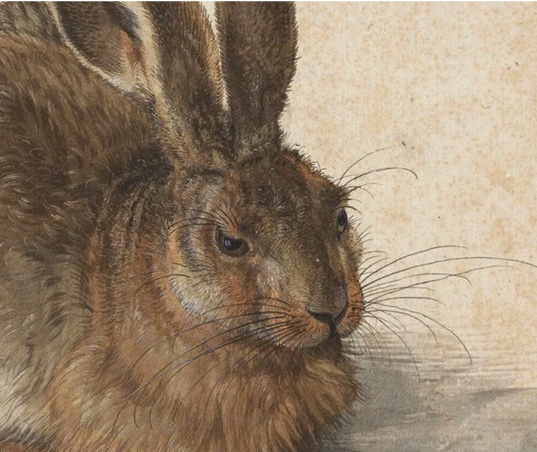
Young Hare, by Albrecht Durer

He ends the witch's spell in a traditional way - by shooting a silver button at an animal that is actually a witch in bestial form. Silver bullets are familiar to modern readers from Hollywood werewolf movies, but any silver object would do the trick. If you don't have a bullet, use a button. 

Maybe the most famous story of a witch being shot with a silver button is the one about Peg Wesson from Gloucester, Massachusetts, who had taken the form of a crow to harass a group of soldiers. It's unclear in either story if the witch is possessing an actual animal, or if the witch has merely sent out their soul in the shape of an animal. Either way, the result of the silver button/bullet is the same - the animal is injured or killed, as is the witch. 

In the Peg Wesson story, Peg is only injured after a soldier shoots the crow with a silver button. But in this story about Old Rif, the witch dies as soon as the rabbit is shot. I wish there was more information about the witch in this story. Who were they? Did they just keel right over in their house? Did anyone find a silver button embedded in their corpse? I suppose we'll never know.

It's a little strange that the witch is never identified in Old Rif's story, but the witch is almost never the main character in these stories. These stories are instructional tales, intended to tell the listener or reader how to fight witchcraft. The witch's identity didn't really matter to the person in Windham who first told this story. What did matter was instructing people how to stop a witch.

I will end with a couple disclaimers. One, your neighbors are not evil witches hexing you. Two, please don't go around shooting random animals if you get lost in the woods. That little bunny just wants to eat some grass in peace. 

February 25, 2019

The Witch's Doughnuts: A Cape Cod Witch Story

It's a well-known fact that people in New England really like doughnuts, and our region is blessed with an abundance of doughnut stores. Maybe it's even an overabundance. Locals often joke about how many there, particularly Dunkin Donuts. There are in fact two Dunkin Donuts within a quarter mile of my house. Two! There's another one a half-mile away.

This is not something recent. Doughnuts have been popular here for centuries. As Keith Stavely and Kathleen Fitzgerald discuss in their 2015 book America's Founding Food, early New Englanders ate doughnuts at almost any meal. They were particularly popular served with cheese and bread and butter during the break on Sunday church services. There's nothing like some fried sugary dough to get you through the next hour-long Calvinist sermon.

Of course, good church-going folks weren't the only people who loved doughnuts. They were popular with more disreputable people like sailors (many ships had doughnut making equipment in their galleys) and even witches. 


That's right. Even witches liked doughnuts. And as the following Cape Cod legend demonstrates, witches became very unhappy when someone stole their doughnuts. 

Way back in 1780, a sailor was walking through the dunes of Truro to reach a ship whose crew he was joining. It was a long hard walk through the sand and his stomach was beginning to rumble with hunger. As he passed by a small rundown house he smelled the rich aroma of freshly-made doughnuts wafting from within.

Unable to resist the smell he knocked on the door. No one answered. The door was unlocked so he opened it and stepped inside. 

No one was home. Well, no one except a small black goat that sat by the fireplace. The sailor thought this was odd but he ignored the animal. His attention was captured by a tray of hot doughnuts cooling on the table. He couldn't resist. He grabbed the tray and ran out the door. 


As he hurried away through the dunes he ate one doughnut and then another. They were the best doughnuts he had ever eaten.


By the time he reached the ship he had eaten all of them. Sure, he felt a little guilty for stealing someone's doughnuts, but they were only doughnuts, right? As the ship sailed away from the Cape he thought he would never be caught. He thought he had gotten away with the perfect doughnut crime. 

He hadn't. That night as the sailor slept an old woman appeared to him. Angrily and without speaking a word she threw a horse's bridle over his head. The witch rode him up and down the Cape as he slept, digging her heels into his sides violently whenever he slowed his gait. In the morning his torso was covered in bruises shaped like a woman's shoe. 

She appeared to him again the next night, and the next. He tried to hide the witch's nightly visitations from the other crew members. He knew that sailors were superstitious and wouldn't want someone cursed by a witch onboard. They'd call him a "Jonah" and try to throw him into the sea. 

Unfortunately the witch's curse radiated out from him and everything he touched went wrong. After he was asked to pump the ship's drinking water it became brackish. When he was told to work in the ship's galley all the flour became moldy. He was exhausted, his body ached, and he was jinxed. 

The crew began to mutter about him, and the ship's captain pulled him aside. "Tell me the truth," the captain said. "Are you bewitched?" The sailor told the captain everything: how he had stolen the doughnuts, how he was being ridden every night, and how he was now cursed.  

When the sailor was done with his story the captain grabbed a musket and then pulled a silver button off his coat. He loaded the button into the musket and handed it to the sailor. 

"Use this tonight when she comes for you," the captain said. 

At midnight the crew was awakened by the sound of a single musket-shot. The next morning the sailor came up on the deck looking fresh and rested. The curse was lifted and the ship completed a successful voyage.


So there's the story. It sounds like a folktale to me, but some people claim it was true. The sailor eventually returned to Truro, and over a century later his grandson told the story to a reporter from The Boston Herald, where it appeared in the February 6, 1919 issue. The Harvard historian George Lyman Kittredge (author of 1929's Witchcraft in Old and New England) said he heard the same story from an old Truro native in the late 19th century. It is also included in Elizabeth Renard's book 1934 book The Narrow Land

The doughnut angle is unusual, but like so many folktales about witches it is mainly intended to educate the hearer about how to fight back against witchcraft. The point is not that the sailor stole doughnuts, but that he was bewitched and defeated the witch. It's an education in defensive magic (use a silver bullet!), not a morality tale. 

Still, I find the conclusion of this story troubling. Let's face it, the sailor committed a crime. I understand why the witch was so unhappy. I don't want anyone stealing my food, do you? Perhaps she should have gone to the local constable and pressed charges, but that might have raised some uncomfortable questions. ("Did you see the sailor steal your doughnuts ma'am?" "No, but my black goat familiar did...") Instead she took matters into her own hands. Perhaps the whole situation could have been defused if the sailor simply apologized or paid restitution. 

Also, like a lot of New England witch stories there is an uncomfortable gender-dynamic at play. The nighttime witch-riding feels like it has a sexual subtext, and is something that is always used by female witches against male victims. But is the sailor really a victim in this story, or a perpetrator who needs to be punished?

*****
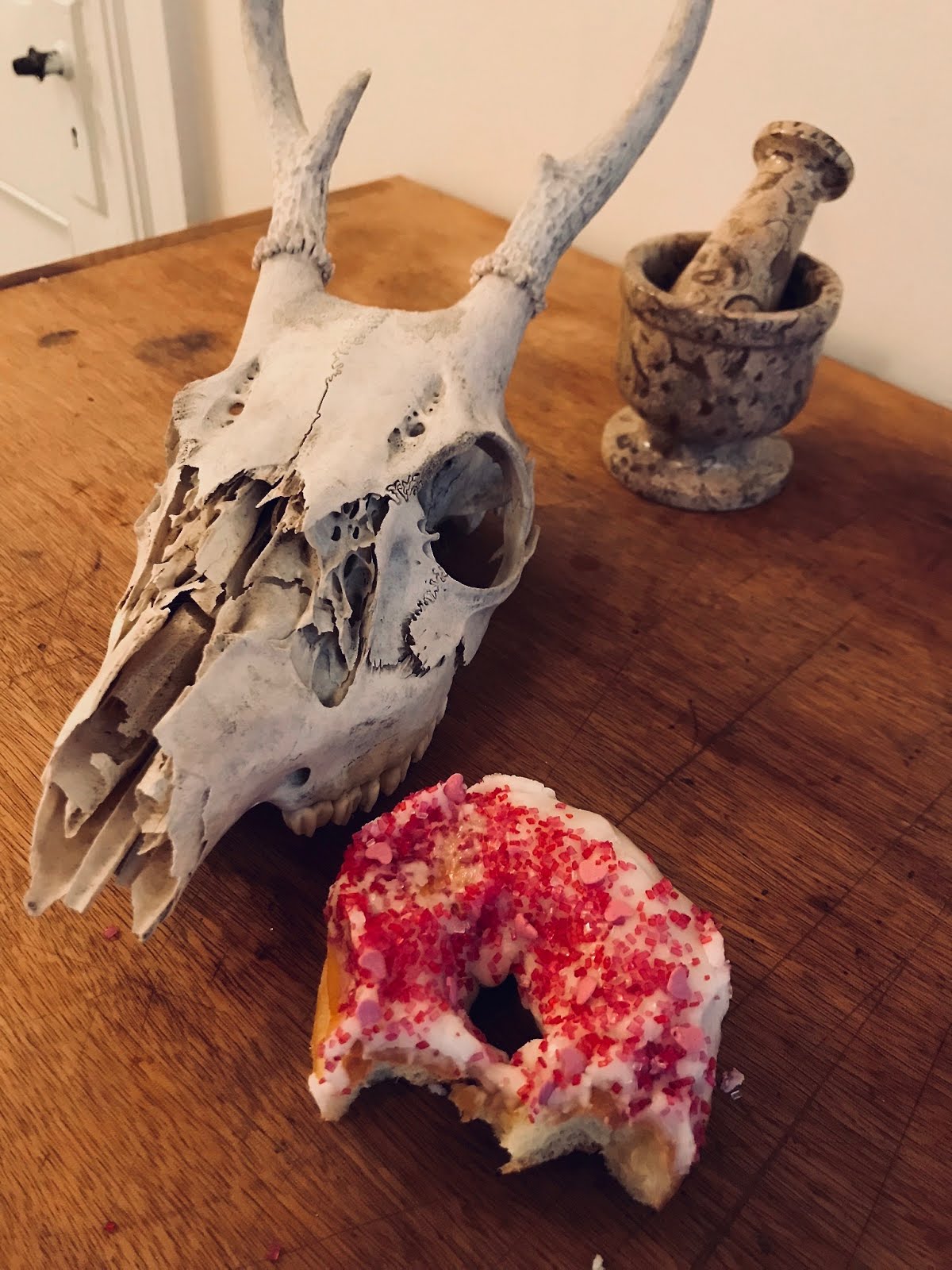
Special thanks to Tony for the doughnut photo shoot!

May 21, 2017

Sex, Whales and Witchcraft: The Legend of Ichabod Paddock

I've lived in New England my whole life, but I have only been to Nantucket once. It was a memorable trip. The island is full of beautiful historic old homes and lots of upscale amenities. It's a great spot for a posh summer vacation.

This was not always the case. Once it was a desolate isolated island. Herman Melville describes it in Moby Dick (1851):

Nantucket! Take out your map and look at it. See what a real corner of the world it occupies; how it stands there, away off shore, more lonely than the Eddystone lighthouse. Look at it — a mere hillock, and elbow of sand; all beach, without a background. There is more sand there than you would use in twenty years as a substitute for blotting paper. Some gamesome wights will tell you that they have to plant weeds there, they don’t grow naturally; that they import Canada thistles; that they have to send beyond seas for a spile to stop a leak in an oil cask; that pieces of wood in Nantucket are carried about like bits of the true cross in Rome; that people there plant toadstools before their houses, to get under the shade in summer time; that one blade of grass makes an oasis, three blades in a day’s walk a prairie...  
This does not sound like the summer playground of millionaires. It was not, but it was the whaling capital of the world. Melville himself sailed on the Charles and Henry, a Nantucket whaling ship, in 1842, which was one of the inspirations for Moby Dick.

Although the Wampanoag who originally lived on Nantucket may have occasionally killed whales, whaling as an industry only began there in 1690 when Ichabod Paddock arrived from Cape Cod. Paddock was a Quaker, an accomplished whaler, and a semi-legendary figure.

Image from here.

There are several legends about Paddock. For example, one claims that while he was in the Pacific he threw his favorite harpoon into a whale. The harpoon reached its mark, but the whale escaped. Thirteen years later, he was once again in the Pacific. His ship sighted a whale, which the crew successfully captured and killed. While they were cutting it up they found a harpoon embedded deep in its flesh. It had the initials "I.P." on it. It was the same whale Paddock had harpooned thirteen years ago.

One of the weirder legends tells how Paddock's ship was pursuing a whale named Crookjaw. No matter how hard Paddock's crew threw their harpoons they just bounced off Crookjaw. Even Ichabod himself could not harpoon the whale. Frustrated and unwilling to admit defeat, Ichabod put a knife between his teeth and dove into the ocean. As his terrified crew watched he swam right towards Crookjaw.

Crookjaw opened his mouth and swallowed Paddock whole.

Much to his surprise, Paddock did not die inside the darkness of a whale's stomach. Instead, he found himself inside a comfortable ship's cabin. Lanterns hung from the ceiling, and a large feather bed sat against one wall. A table filled the center of the room, and two people were playing cards at it. One was a beautiful blonde woman who had a shining green fish tail instead of legs. The other was a dark-clad man who smelled of fire and brimstone.

When the card players saw Paddock the dark man threw down his cards in anger and disappeared. The blonde woman (mermaid? witch?) smiled at Paddock.

"What were you wagering on?" he asked her.

"Why you, of course." She smiled again.


Meanwhile, the crew of Paddock's ship waited for some sign of their captain. After swallowing him Crookjaw just sat immobile, floating silently as the waves splashed against him. The crew didn't know what else to do. Their harpoons and knives were useless against the whale.

After several hours, Crookjaw opened his mouth and Paddock swam out on a torrent of water. He climbed back aboard his ship. "Boys," he said with a big grin, "We need to come back here tomorrow. I've got more work to do!"

Paddock and his crew came back the next day, and once again Paddock swam into the whale's mouth. His crew waited for hours while Crookjaw floated passively in the water until their captain emerged from the whale. Then they came back the next day. And the day after that.

This went on for quite a while. Rumors began to circulate around Nantucket that Paddock had been seduced by a devilish woman who lived in a whale, and they eventually reached the ears of his wife. Mrs. Paddock was young, beautiful, and unwilling to cede her husband to a witchy mermaid. She developed a plan.

One day as Paddock was about to set sail his wife ran down the wharf to his ship. "Husband!" she cried, "Husband! I have brought you a gift."

In her hands she held a glistening new harpoon. It's sharp tip shone brightly in the sun. Paddock thanked her and set sail for his assignation with her gift in his hand. Mrs. Paddock smiled a cold smile as the ship left the wharf.

When the ship found Crookjaw in his usual spot Paddock prepared to dive into the sea, but one of his crew stopped him. "Captain," he said, "Don't you think you should try that new harpoon your wife gave you? It's mighty fine. Maybe it can pierce the monster's skin."

Grudgingly, Paddock took up the harpoon. He knew it couldn't harm the enchanted whale, and he was eager to see his marine mistress. Still, he needed to keep up some level of appearance. He drew back his arm and threw the shining harpoon at Crookjaw.

The harpoon easily pierced the whale's hide, and with a hideous groan Crookjaw rolled over on his back. He was dead. Mrs. Paddock had asked a local blacksmith to forge a harpoon with a silver tip, and silver is one metal that always defeats witchcraft.

The crew didn't find a ship's cabin inside the whale when they cut open its stomach, just bile and half-digested fish. Paddock searched desperately through the offal for some sign of his lover, but all he found was long yellow seaweed and a few seashells.

*****
This story appears in quite a few places and with several variations. In some versions the seductress is clearly a witch, and in others a mermaid. I found this version in Nathaniel Philbrick's Away Off Shore: Nantucket Island and Its People, 1602 - 1890. Philbrick notes that Paddock was eventually kicked out of the Quakers after he "sailed about in a vessel where dancing was performed and he a partaker therein." The story about Crookjaw may be a legend but it seems to say something true about Paddock's personality.

Witches and sailors have a fraught (and often sexual) relationship in New England folklore. For example, Captain Sylvanus Rich was seduced by a witch who gave him the "sweet milk of Satan," while Skipper Ireson was ridden like a stallion at night by a witch as punishment. The Paddock legend is more elaborate but clearly fits in this genre.
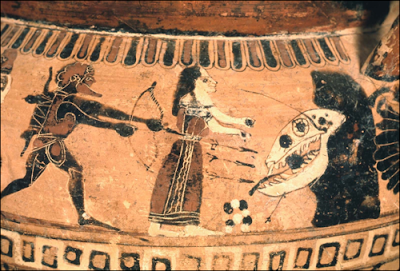
Hercules, Hesione, and the Sea Monster, from the Museum of Fine Arts
Heroes have been swallowed by giant sea monsters throughout history. For example, Hercules was swallowed by a sea monster that came to eat the Trojan princess Hesione. He emerged alive several days later after killing the monster from the inside, but not before losing all his hair due to the acid in the monster's stomach. Two lessons to learn: Hercules is invulnerable but his hair isn't, and sea monster acid is nature's depilatory.

Jonah and the Whale, Pieter Lastman, 1620
The most famous person to emerge from a whale's stomach is of course the Biblical prophet Jonah. Jonah was told by God to preach in Nineveh, but didn't want to because he was afraid of the hostile reception he'd get there. He booked passage on a ship going in the opposite direction, but the crew threw him overboard after God besieged the ship with a storm. A whale swallowed Jonah, swam to Nineveh, and vomited him up on the shore. Jonah got the message and started preaching. 

In the movie Pinocchio, Gepetto is swallowed by a whale, and Pinocchio eventually goes inside to save him. This act of sacrifice turns the puppet Pinocchio into a real boy. 

Hercules, Jonah and Pinocchio find heroism, destiny and redemption inside their respective whales. Ichabod Paddock finds witchcraft, secret sex and the Devil. But after all, this is New England.

August 24, 2014

The Witch of Mashpee, and a Book Release Party

I'm having a party to celebrate the release of my book Legends and Lore of the North Shore. Here are the details:

When: Tuesday, September 9, from 6 - 8:00 pm

Where: Club Cafe, 209 Columbus Avenue, Boston

What: Appetizers, cash bar, and me signing books!

Who: You're invited! I hope you can attend!


Now that the obligatory marketing is over, on to the witchcraft.

*****

Last week the murderous Hannah Screecham was the star of this blog. This week her sister Sarah gets a turn in the spotlight.

While Hannah partnered with pirates to bury their treasure and kill anyone who might reveal its whereabouts, Sarah headed to Mashpee and built herself a cottage on the shores of a small pond. The pond is now called Witch Pond, so you can guess what type of work Sarah pursued.

The pond was in the middle of a very dense forest, so dense that even when the moon was full no light could shine through its trees. Most people avoided the place, fearful of the witch's magic, but when times where lean members of the Mashpee tribe would venture into Sarah's domain in search of game.

Sarah was very protective of the forest and the animals that lived in it. If she saw a hunter she cursed them will ill luck, preventing them from killing any game. She could appear and disappear at will in the woods, traveling unseen, though after she disappeared hunters often saw a beautiful young doe or huge black mare running through the trees. Both animals were impervious to arrows and bullets.

One day Sarah saw a particularly handsome Mashpee man hunting near her home. Even in her witch's heart there was room for love, and she fell in love hard. She pursued the man, begging him to be her lover, but he was terrified and refused her. Sarah was persistent, however, and eventually the man relented. They could meet, but he had one condition - she must come to his home outside the forest.


Blinded by love, Sarah agreed. She visited the man, and as the sun set she turned herself into the huge black mare. Playfully she scampered around the man's house, and playfully she let herself be tied to a tree. Once she was securely tied the Mashpee man's smile dropped away, and he pulled out a hammer and four horseshoes. The black mare didn't make a sound as he nailed in the first three, which were made of iron, but the horse neighed in terror and pain when he nailed in the final one, which was silver. When the man was done he ran to get his neighbors so they could see how he had hobbled the witch.

The black horse had vanished by the time they came back, so they went to Sarah's cottage. They found her inside, screaming in pain with a silver horseshoe nailed to her hand.

Once she recovered Sarah returned to her witchy ways, cursing hunters and transforming herself into animals. She gave up on love. The hunters once again avoided her forest, until many years later a particularly grim winter hit the Cape. No game could be found anywhere, and the Mashpee people were starving. In desperation one hunter finally set out for Witch Pond. He was armed with a rifle, and because he remembered the story about the horseshoe he carried with him one silver bullet.

The forest was strangely silent, even for a winter day, and the hunter didn't see any animals as he trekked through the deep snow. As he neared the pond a beautiful young doe leapt out of the woods. It stared at him fearlessly, as if if was taunting him. He fired his silver bullet, and struck the doe in the hear. It disappeared. The hunter made his way to Sarah's cottage, where he found an old woman dead with a silver bullet in her heart.

*****

I find this story sad. Poor Sarah! Lots of witch stories involve death by silver bullet, but the silver horseshoe incident is quite cruel. She was just lonely and looking for some male companionship. Even witches need some love. That part of the story reminded me of the recent movie Maleficent. It's unsettling how misogynist some of these stories are.

Sarah's story is included in William Simmons's Spirit of the New England Tribes, and if you approach it from the Mashpee perspective Sarah's not quite so sympathetic. Historically the Mashpee people had most of their land taken by English settlers, saw their numbers reduced by European diseases, and saw their way of life vanish. I see a woman looking for love and protecting animals in this story, but from a Mashpee perspective Sarah, a white woman preventing the tribe from pursuing their traditional hunt, is probably symbolic of white domination. We know the Mashpee weren't able to displace the whites, but at least in this story they can symbolically kill their oppressor.

The story also conveys metaphysical information about witches, and if you're a historian you can try to figure out whether Sarah really existed. There really is a Witch Pond in Mashpee - was there really a witch? So much to consider in one short (and sad) story.