Showing posts with label night hag. Show all posts

February 25, 2019

The Witch's Doughnuts: A Cape Cod Witch Story

It's a well-known fact that people in New England really like doughnuts, and our region is blessed with an abundance of doughnut stores. Maybe it's even an overabundance. Locals often joke about how many there, particularly Dunkin Donuts. There are in fact two Dunkin Donuts within a quarter mile of my house. Two! There's another one a half-mile away.

This is not something recent. Doughnuts have been popular here for centuries. As Keith Stavely and Kathleen Fitzgerald discuss in their 2015 book America's Founding Food, early New Englanders ate doughnuts at almost any meal. They were particularly popular served with cheese and bread and butter during the break on Sunday church services. There's nothing like some fried sugary dough to get you through the next hour-long Calvinist sermon.

Of course, good church-going folks weren't the only people who loved doughnuts. They were popular with more disreputable people like sailors (many ships had doughnut making equipment in their galleys) and even witches. 


That's right. Even witches liked doughnuts. And as the following Cape Cod legend demonstrates, witches became very unhappy when someone stole their doughnuts. 

Way back in 1780, a sailor was walking through the dunes of Truro to reach a ship whose crew he was joining. It was a long hard walk through the sand and his stomach was beginning to rumble with hunger. As he passed by a small rundown house he smelled the rich aroma of freshly-made doughnuts wafting from within.

Unable to resist the smell he knocked on the door. No one answered. The door was unlocked so he opened it and stepped inside. 

No one was home. Well, no one except a small black goat that sat by the fireplace. The sailor thought this was odd but he ignored the animal. His attention was captured by a tray of hot doughnuts cooling on the table. He couldn't resist. He grabbed the tray and ran out the door. 


As he hurried away through the dunes he ate one doughnut and then another. They were the best doughnuts he had ever eaten.


By the time he reached the ship he had eaten all of them. Sure, he felt a little guilty for stealing someone's doughnuts, but they were only doughnuts, right? As the ship sailed away from the Cape he thought he would never be caught. He thought he had gotten away with the perfect doughnut crime. 

He hadn't. That night as the sailor slept an old woman appeared to him. Angrily and without speaking a word she threw a horse's bridle over his head. The witch rode him up and down the Cape as he slept, digging her heels into his sides violently whenever he slowed his gait. In the morning his torso was covered in bruises shaped like a woman's shoe. 

She appeared to him again the next night, and the next. He tried to hide the witch's nightly visitations from the other crew members. He knew that sailors were superstitious and wouldn't want someone cursed by a witch onboard. They'd call him a "Jonah" and try to throw him into the sea. 

Unfortunately the witch's curse radiated out from him and everything he touched went wrong. After he was asked to pump the ship's drinking water it became brackish. When he was told to work in the ship's galley all the flour became moldy. He was exhausted, his body ached, and he was jinxed. 

The crew began to mutter about him, and the ship's captain pulled him aside. "Tell me the truth," the captain said. "Are you bewitched?" The sailor told the captain everything: how he had stolen the doughnuts, how he was being ridden every night, and how he was now cursed.  

When the sailor was done with his story the captain grabbed a musket and then pulled a silver button off his coat. He loaded the button into the musket and handed it to the sailor. 

"Use this tonight when she comes for you," the captain said. 

At midnight the crew was awakened by the sound of a single musket-shot. The next morning the sailor came up on the deck looking fresh and rested. The curse was lifted and the ship completed a successful voyage.
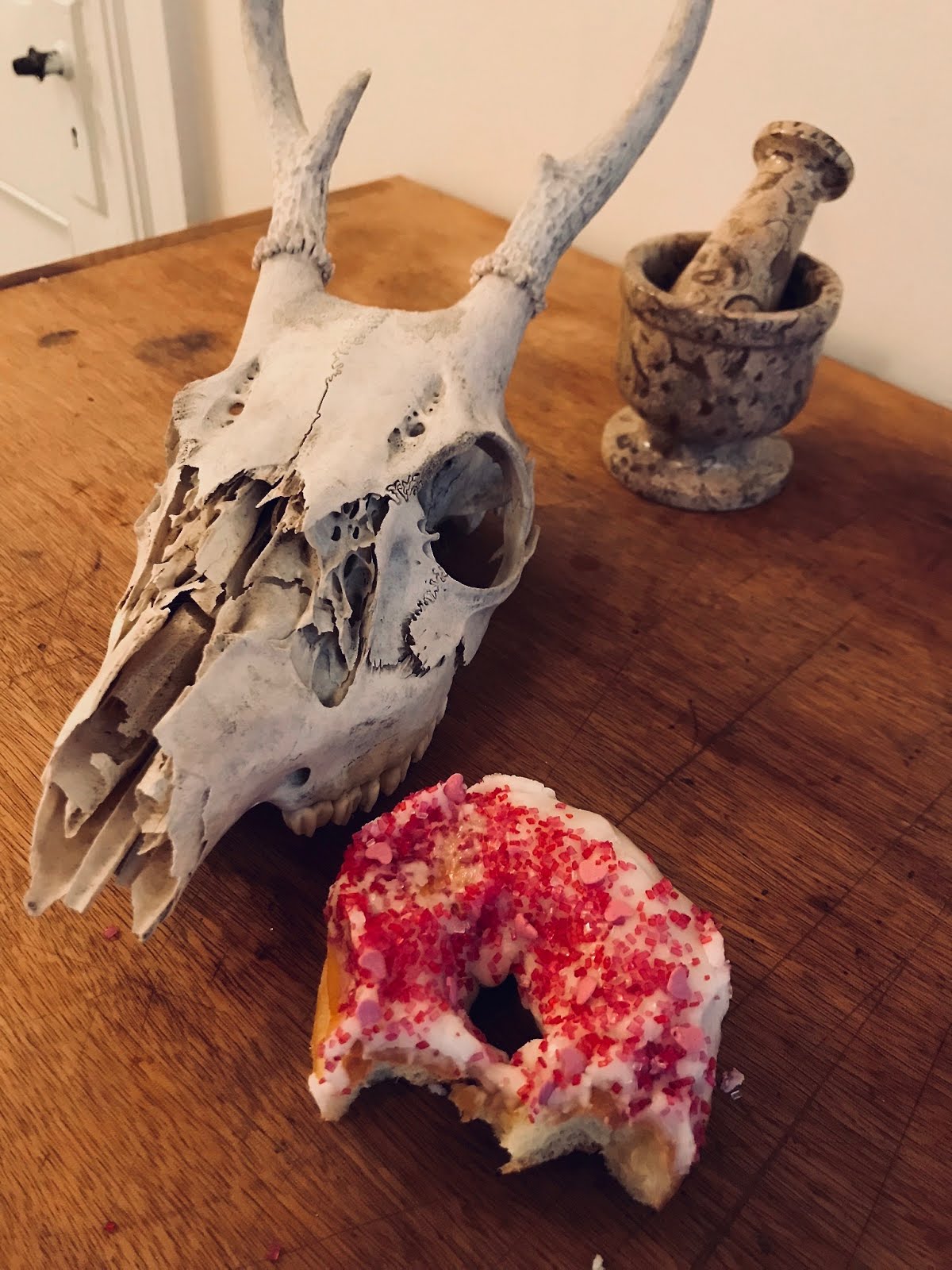


So there's the story. It sounds like a folktale to me, but some people claim it was true. The sailor eventually returned to Truro, and over a century later his grandson told the story to a reporter from The Boston Herald, where it appeared in the February 6, 1919 issue. The Harvard historian George Lyman Kittredge (author of 1929's Witchcraft in Old and New England) said he heard the same story from an old Truro native in the late 19th century. It is also included in Elizabeth Renard's book 1934 book The Narrow Land

The doughnut angle is unusual, but like so many folktales about witches it is mainly intended to educate the hearer about how to fight back against witchcraft. The point is not that the sailor stole doughnuts, but that he was bewitched and defeated the witch. It's an education in defensive magic (use a silver bullet!), not a morality tale. 

Still, I find the conclusion of this story troubling. Let's face it, the sailor committed a crime. I understand why the witch was so unhappy. I don't want anyone stealing my food, do you? Perhaps she should have gone to the local constable and pressed charges, but that might have raised some uncomfortable questions. ("Did you see the sailor steal your doughnuts ma'am?" "No, but my black goat familiar did...") Instead she took matters into her own hands. Perhaps the whole situation could have been defused if the sailor simply apologized or paid restitution. 

Also, like a lot of New England witch stories there is an uncomfortable gender-dynamic at play. The nighttime witch-riding feels like it has a sexual subtext, and is something that is always used by female witches against male victims. But is the sailor really a victim in this story, or a perpetrator who needs to be punished?

*****
Special thanks to Tony for the doughnut photo shoot!

January 31, 2017

"I Will Make You Afraid": Sleep Paralysis and Witchcraft

Are you ever afraid of the dark? I will admit that sometimes I still am. Now and then when I go to bed after watching a horror film I have this brief moment where I wonder if someone is standing in the corner of my bedroom. Luckily no one ever has been, but I am all too aware of how vulnerable I am when I'm asleep.

I dream quite vividly and there have been occasions where I have dreamed that someone is in my bedroom with me. Once, in a very memorable dream, someone in a black hooded shirt stood behind me and whispered in my ear while I was unable to move. It was not just memorable - it was also a little freaky.

I think dreams like that are common, but some people experience something even more extreme called sleep paralysis. Here's how Wikipedia defines it:

Sleep paralysis is a phenomenon in which an individual, either during falling asleep or awakening, briefly experiences an inability to move, speak, or react. It is a transitional state between wakefulness and sleep. It is often accompanied by terrifying hallucinations to which one is unable to react due to paralysis, and physical experiences (such as strong current running through the upper body). These hallucinations often involve a person or supernatural creature suffocating or terrifying the individual, accompanied by a feeling of pressure on one's chest and difficulty breathing. 

It sounds terrifying, doesn't it? During the various New England witch trials, many witnesses testified that witches or demonic spirits entered their rooms at night to sit on their chests, causing them harm and great fear. Were these demonic visitations simply sleep paralysis?

Here is a particularly vivid example given as testimony by one Mary Hale against Katherine Harrison of Wethersfield, Connecticut, who was accused of witchcraft.

That about the latter end of November, being the 29th day, 1668, the said Mary Hale lying in her bed, a good fire giving such light that one might see all over that room where the said Mary then was, the said Mary heard a noise, & presently something fell on her legs with such violence that she feared it would have broken her legs, and then it came upon her stomach and oppressed her so as if it would have pressed the breath out of her body. Then appeared an ugly shaped thing like a dog, having a head such that I clearly and distinctly knew to be the head of Katherine Harrison, who was lately imprisoned upon suspicion of witchcraft... (quoted in John Taylor's 1908 book The Witchcraft Delusion in Connecticut, 1647 - 1697)

Hale also testified that although her parents were sleeping in the same room they were unable to hear her shouts for help.

A week later, the entity appeared again. This time the room was dark, but Hale was able to feel the entity's face and could tell that it was a woman. Her parents again did not hear her cry out, even as the oppressive entity hurt her fingers.

It appeared again on a windy December night. This time it spoke to Hale in a threatening manner, using Katherine Harrison's voice:

Entity: "You said that I would not come again, but are you not afraid of me."

May Hale: "No."

Entity: "I will make you afraid before I have done with you."

(quoted in John Taylor's 1908 book The Witchcraft Delusion in Connecticut, 1647 - 1697)

After saying this Hale felt a crushing weight on her body, which made her scream in pain. Her parents slept on and did not awaken. The entity said, "Though you do call they shall not hear till I am gone." It also promised to never come again if Hale agreed to keep its visitations a secret, which she refused to do.

Image from this informative BuzzFeed article about sleep paralysis.

It's really tempting to say that this is just a simple case of sleep paralysis. The nighttime visitation, the crushing weight, the inability to move or be heard - all these are the hallmarks of sleep paralysis. However, I think the situation is more complex than that. Certainly, it sounds like Mary Hale was familiar with sleep paralysis, either through personal experience or by hearing about it from neighbors. But she was also using the experience of sleep paralysis to accuse someone of witchcraft.

The interpretation of sleep paralysis is conditioned by culture. People in different societies explain it in different ways. Modern American sufferers may see humanoid beings, which are sometimes interpreted as extraterrestrials, in their bedrooms during an attack but they don't see people they know. However, in Cambodian culture sleep paralysis is said to be caused by the ghosts of dead relatives. In Italian folklore, it is sometimes said to be cause by a catlike monster.

Alien visitors, deceased relatives, and cat-monsters weren't how the Puritans explained sleep paralysis. Instead they explained it as witchcraft. Unfortunately, unlike some of those other explanations, witchcraft requires a witch. Extraterrestrials aren't human, deceased ancestors are already dead, and Italian cat-monsters can't be arrested and punished. In early New England, though, witches were real people who could be arrested and punished.

Usually they were unpopular neighbors, which was the case with Katherine Harrison. Harrison had originally been a servant girl in Wethersfield and reportedly did not get along well with others in town. Harrison also dabbled in fortune-telling, which made her neighbors look at her with suspicion. Her neighbor's feelings of enmity only grew when she married a successful local farmer, and enmity later turned into outright hostility when Harrison's husband died and she inherited his estate. An unpopular, lower-class woman had suddenly become one of Wethersfield's wealthiest citizens. How could this happen to someone so reviled? Clearly, something supernatural was involved...

More than 30 people testified against Harrison, who was found guilty in May of 1669 and sentenced to death. Luckily, her case was referred to John Winthrop, Jr., the governor of Connecticut. Although Winthrop practiced alchemy and other forms of magic he was very skeptical about witchcraft. He demanded stricter forms of evidence than the lower courts did and as a result her conviction was overturned. Although Harrison was banished from Wethersfield she escaped with her life.

I think the story of Mary Hale and Katherine Harrison is a cautionary one. Many of us will experience some strange phenomena in our life: sleep paralysis, an uncanny dream, or maybe even an unusual entity. These type of things have been happening throughout human history and will probably happen until humans go extinct. They're just part of our life.

Our interpretation of these strange experiences is important. We can use them to accuse our neighbors of witchcraft, or we can accept them as something strange and wondrous that shows us a hidden side of existence. Personally I'm voting for the second choice, and I hope you do too.

*****
In addition to Taylor's book, I found information for this post at the Wethersfield Historical Society.