December 17, 2023

Spooky Holiday Reading: Merry Christmas, or Scary Christmas?

I'm sure you've heard the 1963 song, "It's the Most Wonderful Time of the Year." Andy Williams croons in his soothing voice,"...there'll be scary ghost stories, and tales of the glory of Christmases long, long ago." Although modern Americans tend to associate ghosts with Halloween, in Victorian England ghosts were associated with Christmas. I suppose this makes sense in some ways. After all, Christmas occurs at the darkest point of the year, which seems like a good time for ghosts to be out haunting. 

In the spirit of a spooky Christmas, here are four things you can read to get you in the holiday spirit. Two of them are even available free online, if you're feeling cash-strapped after holiday shopping. 

1. The Fright Before Christmas: Surviving Krampus and Other Yuletide Monsters by Jeff Belanger

This is the latest book by Jeff Belanger, a local author, paranormal investigator, and host of the New England Legends podcast and TV show on PBS and Amazon Prime. Full confession: the publisher sent me a copy of this book to review, and I've appeared on Jeff's podcast in the past. This is a great book for anyone interested in learning about the spooky folklore of Christmas. 

Me holding my copy of Fright Before Christmas!

I think by now most people are familiar with Krampus, the horned Austrian monster who terrorizes folks at this time of year, but Jeff also writes about many other strange Christmas creatures that are less well-known. For example, have you heard of Hans Von Trapp, the Cannibal Christmas Scarecrow of Alsace, France? Merry Christmas - but sleep with the lights on.

2. NOS4A2 by Joe Hill

The protagonist of this novel by Joe Hill (Stephen King's son) is Vic McQueen, a psychic, ass-kicking, biker mama who grows up in Haverhill, Massachusetts (my hometown). The villain is a creepy vampire named Charles Talent Manx III. Imbecilic yet cunning, child-like yet predatory, Manx travels around the country in an old Rolls Royce. 

Armed with gingerbread-scented laughing gas, Manx abducts small children and brings them to Christmasland, a creepy holiday-themed amusement park that exists just beyond the border of our reality. He and Vic battle it out in this book that will make you gasp out "Merry Christmas..." as you slip into a vampiric, gingerbread slumber.

3."The Festival" by H.P. Lovecraft (free online)

One of my favorite stories by this Rhode Island master of weird horror.  A young man visits his family's ancestral Massachusetts hometown to participate in its traditional winter solstice celebration for the first time. Although he's charmed by the town's Colonial-era architecture, he's unnerved by its residents' silent, expressionless demeanors. 

He's even more unnerved when he follows a crowd of celebrants into a church, then into its crypt, then down ancient stone steps deep into the earth... Is he really entering a subterranean realm, or just his own fetid subconscious? Either way, he discovers a fungus-filled, maggoty hellscape. You'll scream "Merry Christmas!" before losing your sanity. 

4. The Collected Ghost Stories of M.R. James by M.R. James (free online)

If "The Festival" sounds too lurid for you, may I suggest the ghost stories of M.R. James? James was an Englishman and Anglican priest who wrote ghost stories every Christmas to entertain his friends. His stories often feature bookish academics or lonely clergymen visiting old historic sites and encountering supernatural evil. 

It's all very proper and British. But while his stories are subtle and heavy on the atmosphere, they often end with shocking violence and death. Nothing says "Merry Christmas!" like an undead Satanic nobleman devouring your face. 

Enjoy your holidays, and I hope all your horrors are confined to the printed page this December.  

December 03, 2023

Haunted by the Nantucket Mermaid

This post is about a mermaid who has fascinated, and possibly haunted, people for centuries. But I want to start by talking about a human man: Ichabod Paddock. 

Ichabod Paddock was born around 1661 in Yarmouth, Massachusetts, and died around 1750. He's buried in Middleborough, Massachusetts. Paddock is remembered today for two things: his pioneering role in the Nantucket whaling industry, and his alleged extramarital affair with a mermaid. As a whaling pioneer, Ichabod came with his two brothers to Nantucket in 1690 and taught the islanders how to hunt whales. Their actions were instrumental in making Nantucket into the whaling capital of the world. 

Oddly, we have more details about his alleged (and probably legendary) affair with the mermaid than we do about his actual life as a whaler. The legend goes something like this. Once while on a whaling voyage, Ichabod was swallowed alive by a large, seemingly invulnerable whale nicknamed Crookjaw. The local whalers thought Crookjaw was somehow magical, and this was confirmed by what Ichabod found inside the creature's stomach. Rather than digestive fluids and half-eaten fish, Paddock found a cozy ship's cabin with lit lanterns, a luxurious featherbed, and a table. Two people - a beautiful, golden-haired mermaid and the Devil himself - were playing cards at the table when Ichabod arrived. 

Engraving from 1817 by John Paas

The mermaid won the game, and the Devil angrily disappeared in a flash of sulfurous smoke. "What were you playing for?" Ichabod asked. "We were playing for you," the mermaid said, "and I'm glad I won." She took Ichabod by the hand and led him to the bed, where they made passionate love for hours. 

Ichabod eventually emerged from Crookjaw's mouth and swam back to his ship, but the next day he again commanded the crew to sail to the magical whale so he could enjoy more of the mermaid's loving embraces. After several hours he emerged from the whale and returned to his ship, only to sail back to Crookjaw and the mermaid the next day, and the next after that. Ichabod's passion for the beautiful mermaid was insatiable. 

Eventually, news of Ichabod's strange extramarital affair reached his wife, Joanna. Ichabod was a formidable whaler, but Joanna was equally formidable in her own way. Since both Crookjaw and the mermaid were magical creatures, Joanna asked a local silversmith to craft a silver-tipped harpoon. At the time, silver was believed to have the power to harm magical creatures like witches, mermaids, and even invulnerable whales like Crookjaw. Vestiges of this belief still remain today, with the idea that werewolves and vampires can be killed with silver bullets. 

Joanna presented the silver-tipped harpoon to Ichabod as a gift. He accepted it, and although he was a formidable whale-killer and mermaid-lover, he apparently wasn't bright enough to realize that silver  could kill enchanted whales and the lustful mermaids who live in them. At the urging of his crew, Ichabod hurled the silver-tipped harpoon at Crookjaw, expecting it to bounce off the whale's impenetrable hide. Instead, it sunk deep into the body of Crookjaw, who died with a groan and a geyser of blood. 

Ichabod screamed in horror, incredulous at what he had done. What had happened to his beloved mermaid? When the crew butchered the whale's body, nothing was found inside its stomach except some long yellow seaweed that reminded them of a woman's hair. The beautiful mermaid was gone. 

In 1710 Ichabod and his wife left Nantucket and returned to mainland Massachusetts, eventually having nine children. According to author Nathaniel Philbrick, little else is really known about the life of Ichabod Paddock. His legendary encounter with the mermaid has lived on, though, and is still surprisingly resonant with some people today. 

For example, the book The Ghosts of Nantucket: 23 True Accounts (1984) contains the following story which a Nantucket woman told author Blue Balliett. The woman came from an old Nantucket family, and went to visit the Nantucket Whaling Museum with her sister who was visiting the island. While touring the museum, the woman became entranced by a painting of a young man. She had the strange feeling that she somehow knew him, and had been in an intimate relationship with him, similar to a marriage. She said:

"I was held by a magnetism of some kind that was so strong I couldn't move. It wasn't that I was objectively interested in him, or thought I saw a family resemblance of some kind. It was rather that he had an iron grip on me." (Blue Balliett, The Ghosts of Nantucket: 23 True Accounts, (1984), p.62)

The woman remained staring at the painting, immobilized, until her sister came and shook her arm, asking if something was wrong. This ended the trance.

 A mermaid illustration from 1687

The woman later went to visit her minister, and told him about her strange encounter with the painting. The minister explained that it was a portrait of Ichabod Paddock, who had fallen in love with a mermaid who was killed by a silver harpoon. The woman felt dizzy as she heard the story, because ever since she was a young child she'd had a weird "recurrent memory" that popped into her head like a daydream:

"It goes like this: I remember being in pitch darkness and having an excruciating pain in my side as I swim back and forth, back and forth, in black water. I also remember phosphorescence around me, the kind you see in the ocean on a dark night. I always thought it was peculiar, and I used to tell myself that maybe it was a memory of being inside the womb or something." (Blue Balliett, The Ghosts of Nantucket: 23 True Accounts, (1984), p.62)

Her encounter with Ichabod's portrait seemed eerily meaningful to her as she listened to the minister talk. Were these daydreams memories of a past life? Was she somehow the mermaid, reincarnated in 20th century Nantucket? She wasn't sure, but for months afterward she had a craving (which she resisted) to revisit the museum to see the portrait, and would wake up in the middle of the night seeing Ichabod Paddock's face floating above her bed. 

Perhaps it was just coincidence that this woman's unusual, recurring dream fit so well with the mermaid legend. That's what I thought, until I received an email from a young woman who is a member of the Paddock family, which still exists today. Like the woman in The Ghosts of Nantucket, she also feels a strange connection to the legendary mermaid, writing that "In my mythos, I am the mermaid who was given the opportunity to reincarnate because of winning half of Ichabod's soul." 

About two years later, I received an email from a man who was also a Paddock, telling me that his daughter felt a powerful connection to the mermaid legend, that she had a large mermaid tattoo on her back, and that she often dreamt of being a mermaid. I arranged to talk with him and his daughter, who it turned out was the young woman who had already emailed me. We had a nice conversation over Zoom, and I learned a lot about their family history and connection to the mermaid story. I didn't get the impression that either the young woman or her father literally believed she was the reincarnated mermaid, but rather that the mermaid was a source of family pride and artistic inspiration. 

Unlike the woman quoted in Ghosts of Nantucket, this young woman didn't feel upset or scared by the legend. Neither did her father. They thought the the legend was an interesting part of their family's genealogy. I don't blame them. Many people descended from old New England families have witches in their family tree, but only a few have a mermaid.

Mermaids aren't just cute cartoons, like Ariel in The Little Mermaid, or sexy fantasy figures, like you might see online. Mermaids are the modern iteration of ancient ocean spirits. They are elemental beings personifying the vast and unknowable waters that cover most of our planet. The ancient Greeks knew them as nereids and oceanids, the nymphs who lived in the seas and ocean. Nymphs were powerful godlike beings who were feared and petitioned for their blessings. Mermaids may also partly have their origin in stories about the Sirens, seductive female monsters that lured sailors to their doom. The seductive and possible devilish Nantucket mermaid certainly seems to share some traits with the Sirens. 

You may not believe in mermaids, just like you may not believe in invulnerable magic whales like Crookjaw. But you can't deny the hold mermaids still have on our imagination. They may not be seen in the ocean as often as they once were, but they still haunt our dreams and subconscious. 

November 20, 2023

Fowl or Fair: Thanksgiving Weather Magic

Thanksgiving is fast approaching. It's the holiday most closely associated with New England, having its origin in the old Puritan tradition of celebrating thanksgiving days. Many of the foods we associate with the holiday, like cranberries, pumpkins, and turkey, are also foods indigenous to New England. 

This is a New England-centric blog, and I like to post something about Thanksgiving each year. So here, from 19th century Massachusetts, are some ways to predict on Thanksgiving what the weather will be during the upcoming winter:

Method #1 - Examine the feathers of your chickens. Do they seem particularly thick? If so, a hard winter is on its way.

Method #2 - Examine the breastbones of your chickens (after you have cooked and eaten them, sadly). Do they seem particularly light in color? If so, you can expect a lot of snow. If they are dark, you won't get much snow at all.

Method #3 - Look at the breastbone of your goose (again, after you have cooked and eaten them). Is it particularly dark? Yes? You can expect more rain than snow.

James Audubon, Wild Turkey, 1825

On the surface, method #1 appears to be the most "scientific." It seems logical that chickens will grow heavier feathers if a cold winter is coming. But do chickens' bodies somehow intuit what the weather will be like in the future, and then grow extra feathers in response to it? Do they actually grow heavier feathers if the next few months will be cold? I don't know think that's true. Chickens do tend to molt in the fall, but I don't think their feathers grown back heavier if the future weather will be cold. 

Method #2 seems more magical, and relies on similarity in color:  white breastbone = white snow. Method #3 also relies on magical color similarity, but doesn't predict if heavy snow is coming, only the proportion of rain to snow. I guess this is because of the goose's affinity for water? I suppose eating both chicken and goose would give you the most accurate forecast, telling you if you'll get more snow than rain, and also how heavy the snow will be.  

I found these methods of predicting the weather in Clifton Johnson's 1897 book What They Say in New England. Interestingly, there's no weather prognostication centered on turkey bones. Turkeys have long been the centerpiece of the Thanksgiving feast, but the magic associated with turkeys is focused on the wishbone. 

There are other forms of folk magic based on fowl. For example, Fanny Bergren's 1896 book Current Superstitions contains this unusual piece of advice from Winn, Maine:

"Swallow a chicken's heart whole, and the first man you kiss afterwards will be your future husband." 

Chicken hearts apparently had a lot of magical power, because elsewhere in the book Bergren notes the following:

"Swallow a chicken's heart whole and make a wish. It will come true." 

I don't think people eat a lot of chicken hearts these days, and even if you do I don't recommend swallowing them whole. You won't get married and your wish won't come true if you choke to death on a chicken heart. Chew your food!

I'm vegetarian, so I'm not eating any of these birds next week. I couldn't find any weather magic involving pumpkins, potatoes or Tofurkey, so let know if you try any of these divinations. I want to be prepared for the winter weather! 

October 25, 2023

Black Agnes: Montpelier's Death-Cursed Statue

As I mentioned before, Tony and I recently traveled up to Montpelier, Vermont to see our old friend Brian. He showed us around Vermont's charming capital, and also showed us some of its spooky sights, including the infamous Black Agnes statue. 

When we reached Montpelier, Brian immediately took us on a tour of Green Mount Cemetery. He is a Montpelier native, and had a lot of gossip and stories about the different folks buried in Green Mount. For example, he showed us a funerary statue of a young girl called "Little Margaret." Little Margaret's family commissioned a local sculptor to carve the statue after she died (apparently of spinal meningitis), but refused to pay because one of the statue's shoes only had five buttons instead of six. The sculptor was about to apologize when he looked again at the photo of Little Margaret the family had given him to work from. One of her shoes was missing a button in the photo. The sculptor stormed back to Little Margaret's family, showed them the photo, and angrily collected his payment.  

Brian also told us that the road leading to Green Mount Cemetery has been the site of many deadly auto accidents. "When I was young, this road was routinely covered in human viscera," he said, morbidly joking. At least I hope he was joking. 

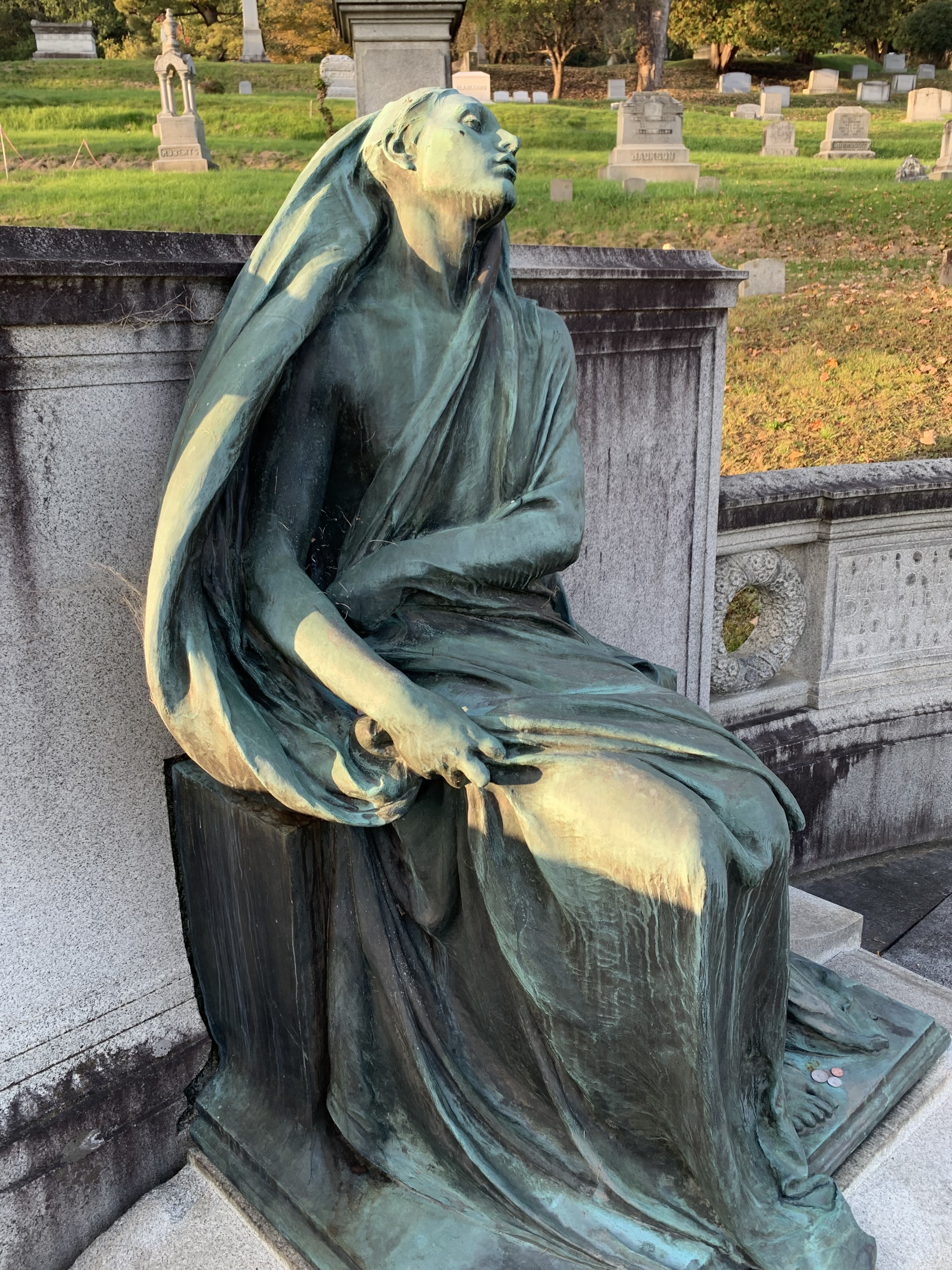
The Black Agnes statue

Towards the end of the tour, we reached the grave of John Erastus Hubbard (1847 - 1899), a wealthy Vermont businessman. Hubbard's grave features a spectacular bronze sculpture of a robed figure titled Thanatos. This statue is more popularly known as Black Agnes. 

According to legend, terrible luck comes to anyone who sits on Black Agnes's lap. Accounts differ as to what form the bad luck will take. Some say three unlucky things will occur to the person who sits on her lap, others say it will be an uncountable amount of bad luck. That doesn't sound good. Still another legend claims that anyone who sits on Black Agnes's lap will die within seven days, which is perhaps the worst luck of all. 

Many years ago, three teenage boys went to Green Mount Cemetery during a full moon. They dared each other to sit on the statue's lap. Not wanting to look cowardly, each boy took a turn sitting on Black Agnes. They all laughed. It was just a dumb statue, after all. Nothing to be afraid of. But within a week, one fell and broke his arm, one was in a serious car accident, and the third boy drowned while canoeing on the Winooski River. Some people said these misfortunes were just coincidences, but others said it was the curse of Black Agnes. 

Well, at least that's one legend. All the legends vary slightly, with some saying, for example, that you only suffer Black Agnes's wrath if you sit on her when the moon is full. Personally, I say why take the risk? Just don't sit on the statue, regardless of the moon phase. I don't recommend sitting or climbing on any cemetery statue. It is disrespectful to the dead, even if there isn't a death curse. 

Brian told us that the Black Agnes legend didn't exist when he was a kid, and that it must be relatively recent. That could very well be the case - new legends arise and old ones disappear all the time. There are in fact other allegedly cursed statues named Black Agnes around the United States. There is one in Washington, DC, which was originally a grave marker in Baltimore for a dead Civil War general in the Union Army named Felix Angus. It was apparently moved from Baltimore because too many fraternity and sorority pledges kept sitting on it as part of their rush process, daring each other to risk the death curse. It seems likely the Black Agnes legend traveled from the DC area to Montpelier, but I'm not sure how. 

Some folks, apparently in an attempt to debunk the Montpelier version of the legend, have pointed out that the statue is clearly of a male, so therefore the legend cannot be true. This argument doesn't hold up for me. It's 2023, and we all know that gender is a social construct. A statue of a male can easily be named Black Agnes. 

John Erastus Hubbard (1847 - 1899)

John Erastus Hubbard, upon whose grave Black Agnes sits, generated some controversy while he was alive. Hubbard came from a prominent Vermont family, and his wealthy aunt left a significant amount of money in her will to the city of Montpelier to build a library. Hubbard was unhappy about this, and managed to get his aunt's will overturned and inherit the money himself. Montpelier officials took him to court, and he eventually agreed to pay for the library. Upon his death, he left the majority of his fortune to Montpelier as well. However, this late generosity did not necessarily win him many fans among the city's citizens, some of whom noted that a terrible thunderstorm raged through Montpelier the night Hubbard died, which they took as an omen indicating the state of his soul. 

October 15, 2023

The Devil's Washbowl: Home of the Pigman?

Tony and I recently took a weekend trip up to Vermont. Our final destination was Montpelier to see an old friend, but we made a few stops along the way. Some people visit Vermont to see fall foliage and quaint towns. We wanted to see the Pigman!

The Pigman is the resident monster of Northfield, Vermont, a cute little town best known as the home of Norwich University, the oldest private military college in the United States. But if you journey outside the charming downtown and into the dense woods, according to legend you might encounter the half-human, half-porcine horror known as the Pigman. He's said to lurk most frequently in an area known as the Devil's Washbowl, a densely wooded, rocky, and remote area. 

Way back in 1971, a Northfield farmer's twenty-year old son disappeared from home. Perhaps he had run away to the big city, the police suggested. He was never found, but shortly after his disappearance various animals went missing around town as well: mostly dogs and cats. Were these things connected? 

One night a farmer heard something rummaging through his garbage cans. Thinking it was a raccoon, the farmer flicked on his outside light. It wasn't a raccoon. It was a naked man. His body was covered in short white hair, and he had the face of a pig. The man - creature? - ran off into the darkness. 

A few weeks later, during a high-school dance, four students were smoking and drinking in a sand pit behind the school. As they talked, they saw something move towards them in the night. It was a naked man with the hideous face of a pig. Terrified, the four students ran into the school gymnasium and told their friends what they had seen. A group of students ran out to see the creature, but it had vanished, leaving behind only beaten-down undergrowth as proof it had been there. 

Jeff Hatch was one of the students that rushed out to find the Pigman, and many years later he told Vermont author Joseph Citro about the creature. Citro included the legend in his book Green Mountains, Dark Tales, and in subsequent books, like Weird New England and The Vermont Monster Guide. According to Hatch, locals at first suspected the Pigman was living at a nearby pig farm (which makes sense), but many motorists that year reported seeing a strange white creature near the Devil's Washbowl, a stony hillside depression that a stream runs through. A young couple that had parked their car near the Devil's Washbowl for a romantic interlude also claimed the Pigman had attacked them, and the young man had the claw marks on his body to prove it. 

Small piles of bones and piles of hay, which seemed to have been used as bedding, were found in caves near the Devil's Washbowl, further lending credence to the idea it was the Pigman's lair. Jeff Hatch claims the police went to investigate, but never found anything. 

Some people want to see the Eiffel Tower or the Pyramids. Ever since reading this story, I've wanted to see the Devil's Washbowl, so we made it a stop on our Vermont trip. Devil's Washbowl Road is easy to find on Google maps, but when we visited it was not marked by any street signs. (It looked like they had been stolen by vandals.) It's a dirt road that wends its way along a steep, wooded hillside. There are a few houses and farms along the road, but mostly you're in the woods. Devil's Washbowl Road is pretty, but it also reminded me of the beginning of a horror movie, particularly as we were two city boys out of our element. 


I had asked Joseph Citro how to find the Washbowl itself, and he told me I would see it when the road passed over a culvert. After mistakenly thinking a small stream was it, we came to the actual Devil's Washbowl. Many geologic features in New England bear the Devil's name, often because they are rough and vaguely inhospitable to humans. This is one of them. A stream runs down a rocky hillside, empties into a rocky basin, and then disappears into the woods. I haven't found a specific legend explaining the origin of the Washbowl's name, but it does look like someplace where the Devil would wash his hands after committing a nefarious deed. 

Would you go down there? We did not...

We pulled over and got out of the car to take some photos. Other than the sound of rushing water, it was very quiet. I debated climbing down into the Washbowl itself to find one of the caves, but I (wisely) decided not to. My main concerns: breaking a leg, getting Lyme disease, touching poison ivy, getting eaten by the Pigman. Four good reasons to stay near the car. And then Tony noticed a good reason to get back in the car: a big piece of animal scat, relatively fresh. Was it from a bear, or maybe a coyote? Or perhaps it was from a half-man, half-pig, humanoid monster? We didn't stick around to find out. 


Jeff Hatch seemed to think the Pigman was actually the farmer's son who went missing in 1971, who somehow devolved after living in the woods. That's the original theory, and there are a few other theories circulating these days about the creature's origin. One suggests that he is the unholy offspring of a lonely farmer and a much beloved swine. I won't comment on that one, other than to say I don't think that's how biology works.  

Another, more detailed story about the Pigman's origins seems to have appeared online around 2013. This story claims he was originally a teenager known as Sam Harris. On October 30, 1951, Sam went out to cause mischief in Northfield. The night before Halloween was called Picket Night in Northfield, and it was the designated night for kids to wax windows, egg cars, and throw toilet paper in trees. Sam left home that night but didn't return... until three years later. Sam appeared on his parents' front porch one night in 1954, naked, squealing and tossing bloody pig innards on the porch floor. The sight supposedly drove his mother to suicide (she threw herself into a pen full of ravenous hogs), and a teacher who tried to debunk the legend was found dead with the words "PICKET NIGHT" carved on her body. 

Still not going down there...

In 2014, another addition to the legend appeared online, this time from horror author William Dalphin, who grew up in Northfield. Dalphin claims that in the 1980s, a group of teenagers camping near the Devil's Washbowl encountered the Pigman, who clubbed one boy on the head and dragged him off into the woods. The boy was never seen again, except possibly by one local man who said he had seen the teenager rummaging through his trash, wearing just a pair of torn jeans. His body was covered with short white hair and his eyes had a hollow expression. Dalphin intended his story as fiction, but it has since been cited as part of the actual legend. 

Northfield is not the only place in the United States that is supposedly terrorized by a pigman. A bridge in Denton, Texas, is said to be the home of a pig-headed madman who menaces teenagers. He is either a local hunter transformed into a were-pig after being bitten by a feral hog, or he is the disfigured victim of gangsters who cut off his nose and sliced open his cheeks. Also haunting bridges are the the Pigman of Hawkinsville, Georgia, the Pigman of Angola, New York, and the Pigman of Shelby County, Tennessee, who is said to appear near the bridge at night if you shout, "Pigman" three times. A similar legend is told about Pig Lady Road in Hillsborough, New Jersey, where a monstrous Pig Lady appears if you say her name three times. 

I enjoyed my trip to the Devil's Washbowl, even if it was a little creepy. Perhaps next year I could road-trip across the country, visiting assorted haunted Pig People locations? I suppose I could, but maybe that would be pushing my luck. I should probably count myself lucky I didn't see the Pigman on our trip to Northfield.