Showing posts with label werewolves. Show all posts

January 17, 2022

A Werewolf in Natick? A Story for the Wolf Moon

On Monday, January 17, the Full Wolf Moon will rise at 4:13 pm and cast its lupine light across New England. Get out there and howl, folks! We're supposed to have a lot of rain here in Boston, so the moon may not be visible, but it will still be up in the sky even if you can't see it. 

In honor of the Wolf Moon, here is a story about a possible werewolf I found on Phantoms and Monsters. Phantoms and Monsters is a great site if you enjoy reading about paranormal encounters - check it out if you like weird tales.

The story goes something like this. In the spring of 2006, a group of friends from Natick decided to go camping. Rather than drive up to New Hampshire or out to western Massachusetts, they decided to camp closer to home. They chose a patch of woods behind some apartment buildings near an old, abandoned factory.
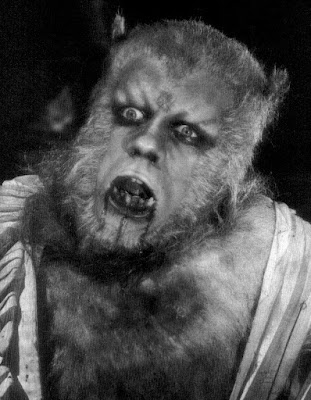
Oliver Reed in The Curse of the Werewolf (1961)

My first thought on reading this was, "That's probably not an official camp site." My second thought was, "Camping near an abandoned factory sounds like it would be spooky." My second thought was definitely correct.

The person who submitted the story wrote:

Now before I go further I must say that my area has experienced very weird sounds. Although in my opinion, they are very un-wolf like. They sound like a woman screaming crossed with long dog barks. A very indescribable and terrible sound. They come from various directions, though usually from the apartment area. (Phantoms and Monsters)

Coyotes? Maybe, or maybe not. But strange sounds in the woods just add to the spooky vibe.

The friends set up their tents and settled in for the night. After everyone had fallen asleep, one of the campers left her tent to urinate. She felt like she was being watched, though, so she woke up her boyfriend and asked him to come with her. He also felt they were being watched as they stepped away from the tents. 

As he stood watch, the boyfriend saw something moving through the trees away from the tents. It was tall, grey, and covered in fur:

He could see it through the brush... a large (approximately 6.5-7 foot in height) man-shaped figure, covered in grayish fur, sporting wolf-like features and a bushy tail swaying behind it. He was shocked and ran into the tent, leaving his girlfriend who came running in a moment later, after hearing the rustling of the creature.

They spent the rest of the night awake in their tent, occasionally hearing strange cries in the woods. They and the other campers quickly left the woods once the morning came.  

That's the end of the story. Like most monster stories, it's pretty simple. People see monster, people freak out, monster leaves. It's as if the monster just wants to be seen and acknowledged. Maybe the monster just wants to remind us that there are still weird things lurking out there in the world, even in a patch of woods near an abandoned factory.

An abandoned factory in the woods behind some apartments sounds like a liminal space to me. A liminal space is someplace that isn't quite one thing or another, a zone between one place and another. Liminal spaces are thresholds. 

It makes sense that the campers would see a werewolf in a liminal space. A werewolf is part human and part animal. It's both these things, and yet neither. The campsite was forested but formerly industrial, it was suburban and yet wild. It's the type of place where teenagers go to do forbidden things, and where campers would see uncanny creatures. It makes sense.

Did they really see a werewolf? I can hear some of you asking that question. I am a little skeptical that there are large, physical monsters roaming around our woods. (Of course, I don't go into the woods late at night!) I don't think that means the campers made this story up, though. There are lots of middle positions between hardcore skepticism and total belief. Maybe the campers inadvertently conjured up something from deep inside their psyches, or maybe they glimpsed the spirit of that land, what the ancient Romans would call a genius loci.

Happy Wolf Moon everyone!

August 01, 2020

A Werewolf in Pawtucket, Rhode Island

Many, many years ago when I was a small child I saw Abbot and Costello Meet Frankenstein (1948) on some local TV station. Although this movie is a very broad comedy, I was still really scared by the monsters in it, particularly by the Wolfman. I was probably five years old so maybe this is understandable, or maybe I was just a really cowardly kid. Regardless, the Wolfman was portrayed by Lon Chaney Jr., and his transformation from a mild-mannered human to a hirsute and ferocious monster terrified me. 

Lon Chaney Jr. in Abbot and Costello Meet Frankenstein

He was also the most sympathetic of the movie's monsters, though, so I was also fascinated. Once I got over my fear of werewolves I learned to love stories about them. Sabine Baring Gould's The Book of Werewolves (1865) is a good source for European legends, as is Montague Summers's The Werewolf in Legend and Lore (1933). Both of those are easily available, but sadly, there isn't too much written about New England werewolves. Maybe that's because we don't have a lot of werewolves here, which could be a good thing depending on how you feel about ravening monsters.

The word werewolf comes from an Old English term, werwulf, or man-wolf, and refers to a human who can transform into a wolf. The reasons for this ability vary in old legends and include things like curses, deals with the Devil, or witchcraft. The idea that someone can become a werewolf after being bitten or scratched by one is a more recent pop culture innovation. Lycanthropy (the fancy term for werewolfism) was originally considered a moral condition, not an infectious disease. 

There are lots of New England legends about people transforming into animals, but they're usually about witches, and witches don't like to change into wolves. Witches prefer to transform into more discrete animals like birds, cats, and even horses. It's easier to cause mischief that way. No one suspects an innocent-looking bird but people are pretty suspicious when a wolf shows up. Still, during the Salem witch trials Tituba confessed to seeing cats, birds and wolves in the company of witches, implying that these were either demons or witches in animal form. 

That's not the only local connection between witches and wolves. There is also an obscure legend that one of Cape Ann's Dogtown witches, Daffy Archer, may have been a werewolf or had one at her command. You can read more about the Dogtown werewolf here. 

Some of New England's other werewolf legends come from French-Canadian immigrants, who brought stories of the loup-garou with them from Quebec. A loup-garou is someone, usually male, who has signed a deal with the Devil and can transform into a wolf. They are scary and dangerous, but happily can be repelled by prayer and religious symbols, as this tale from Vermont shows. 


Those stories are over a hundred years old, but I just read another werewolf account, and it's relatively recent. It appears in Albert Rosales book Humanoid Encounters: 2000 - 2009. According to Rosales, on December 16, 2008, four students in Pawtucket, Rhode Island decided to take a walk in the woods after finishing their exams. They followed an old waterway deeper and deeper into the woods. As they walked it became increasingly quiet. 

Noticeably quiet. No birds. No squirrels. No breeze.

Scarily quiet.

The students suddenly became aware that they were not alone. Someone - or rather something - was in the woods with them. The creature was about six feet tall. It stood upright like a man, but had the head of a wolf. The students stood still in terror, petrified that the creature would approach them. 

The wolf creature looked around, sensing it was not alone, but did not see the students. Finally it ran off further into the trees and was lost to sight. After waiting to make sure it was really gone the students left the woods. One of the witnesses was convinced the creature was a werewolf. 

What did the others think it was if not a werewolf? Rosales's book doesn't say. It also doesn't include some details that would be useful, like how old the students were or their names. Still, I'm happy to find another local werewolf story to add to my collection. This reads like a classic paranormal encounter: the journey out of consensus reality into the woods, the eerie expectant stillness, the advent of a strange entity, and the return back to the normal world. 

The moral aspects of older werewolf stories are missing here. There's no witchcraft or deal with the Devil. Instead, we just have some young folks who have an encounter with a monstrous being in the woods. The lesson is not a moral one, but rather an ontological one: there are still monsters lurking out in the trees. 

October 03, 2016

A Terrible Critter with Eyes Like Fire Coals: Revisiting the Dogtown Werewolf

A few years ago I blogged about the Dogtown werewolf, but it seems like a good time to revisit this topic. I was just recently researching this topic for my friend Sam Baltrusis's upcoming book about haunted crime scenes, and a producer from a paranormal show had also asked me what I knew about the topic. But most importantly, I really like werewolves!

New England folklore is filled with stories about witches, ghosts and the Devil himself, but there aren't very many about werewolves. Although the French Canadians of Vermont and Maine tell some tales about the loup-garou you don't find many werewolf stories in southern New England. One of the few comes from Dogtown on Massachusetts's Cape Ann.

Dogtown Common is a large park situated between the cities of Gloucester and Rockport. Once a thriving Colonial village, today Dogtown is 3,000 acres of forest, swamps and boulders. The ruins of the old village can be still be seen among the trees, along with boulders that wealthy Gloucester financier Roger Babson carved with motivational slogans. It's a weird landscape that has inspired artists and poets, and is haunted by legends of witches and strange disappearances.

Dogtown may also be home to a werewolf, at least according to the late author Robert Ellis Cahill (b.1934 - d. 2005). Cahill is an interesting figure in New England folklore. Before becoming a writer Cahill had worked as a Massachusetts politician and spent four years as Essex County sheriff, operating out of nearby Salem in that latter job until he suffered a major cardiac arrest in 1978. Heart attacks had long been a professional hazard of Salem's sheriffs, a problem supposedly dating back to the witch trials of 1692. During those trials accused wizard Giles Corey supposedly cursed Sheriff George Corwin, who died of a painful heart attack at a young age. Many of his successors suffered from heart attacks as well. The curse only ended after the sheriff's office was moved from Salem to nearby Middleton.

Robert Ellis Cahill (from Wikipedia).
Perhaps his encounter with a folkloric curse led Cahill to the next phase of his career, which was writing books about New England's weird and spooky history. He published more than thirty short books which had titles like New England's Cruel and Unusual Punishments, New England's Mountain Madness, and Haunted Ships of the North Atlantic. It was in one of these books (New England's Things That Go Bump in The Night) that he discussed the Dogtown werewolf.

On the evening of March 17, 1984 a Boston man named David Myska saw a large, mysterious animal loping along the cliffs near Crane Beach in Ipswich. Myska thought it might be a mountain lion, but those felines have been extinct in Massachusetts for centuries. Myksa claimed it was too large to be a coyote. So what was it? The creature was also seen in nearby Rowley, and four days later a dead deer was found near Crane Beach. Its throat had been slashed and large tooth marks were found around its neck and chest. Oddly, none of the deer's flesh had been eaten.

Ipswich and Rowley are not Dogtown, but they are located just a few miles away across the Annisquam River. Could the animal seen in those towns been the same one sighted a few days later by two teens running down Raynard Street in Gloucester? They described it as “gray monstrous dog-like animal… It had big teeth and was foaming at the mouth.” Yikes. Raynard Steet leads directly into Dogtown.

According to Cahill, the history of Dogtown is littered with hints about werewolves. For example, he claims that the Indians who originally inhabited Cape Ann said they were descended from a race of dog-headed men. He claims they also believed that anyone who ate the wolfbane plant would revert to their ancestral form: hairy, fanged, clawed, and lupine. I haven't seen this folklore anywhere except in Cahill's book, so take it with a grain of salt. And whatever you do, don't eat wolfbane, which is highly poisonous, with or without salt.

Dogtown is famous for the witches who lived there in the 18th and early 19th century, and Cahill notes that one of these witches, Daffy Archer, wore a wolf's tooth around her neck as a pendant. Witches are famous shape-shifters, so I suppose it's not much of a leap to connect witches with werewolves. If Peg Wesson, an infamous Gloucester witch, could send out her soul in the shape of a crow perhaps some other witch could transform into a wolf.

Me in Dogtown. I didn't see a werewolf that day (that I know...)

Cahill also interprets a famous incident from Dogtown's history as a possible werewolf attack. On September 10, 1892, a Gloucester sailor named James Merry drunkenly decided to wrestle a bull pastured in Dogtown. The previous year Merry, inspired by toreadors he had seen in Spain, had successfully wrestled the same bull to the ground, so why not try it again? In his drunken stupor Merry forgot that bulls grow quickly, and the bull was much, much larger than it had been twelve months earlier. It won the rematch and gored Merry to death. The sailor's lifeless body was found the next morning in the pasture.

That's the official story, but Cahill claims that the moon was full the night of September 10, and that Merry was found with his throat torn out, something no bull would do. Cahill asks: could Merry have been killed by a werewolf?

I would say this is all pretty slender evidence for a werewolf, but Cahill does cite one story that makes me hesitate in saying he concocted the whole thing. In her 1879 book Reminiscences of a Nonagenarian, Sarah Emery tells the following tale about Amos Pillsbury, a man who lived in Dogtown and worked for her Emery's father as a laborer. One night Pillsbury was walking home from work, a route that took him through thick woods. As he traveled this dark road he encountered a "terrible critter":

"A terrible critter? What was it like Pillsbury?" father inquired.

"Oh, Mr. Smith, it was a terrible big critter, as big as Brindle's calf; its eyes were like fire coals, and it ran past me through the bushes, about a rod from the road, with every hair whistling like a bell. It must have been the wolverine."

"The what, Pillsbury?"

"The wolverine. My old granny used to keep us young 'uns quiet with stories about the wolverine out beyond in the woods. I used to be afeared to stir ten yards from the door o' nights; but, as I had never seen the critter afore, I had begun to think it was one of granny's stories, but I seed him last night, sartin sure ; and his eyes were like fire coals, and every hair whistled like a bell." 

Pillsbury here is using the word wolverine to refer to a wolfish creature, not to the Hugh Jackman character from the X-men movies or the large burrowing animal found in Alaska. It was something his grandmother had told him about since childhood, and he was so obviously scared by seeing it that local men hunted for the creature for two days. They didn't find any sign of it.

So does this all add up to a bona fide werewolf? I'd like to think so, but it might just be wishful thinking on my part. If it is, I'm not the only one who feels that way. A couple years ago we went to a performance/haunted house in Salem called Gallow's Hill, which re-enacts legends from the North Shore's past. According to the performers at Gallow's Hill, the Dogtown witches used werewolves to guard their houses. So, whether it's true or not, the legend of the Dogtown werewolf lives on.