Showing posts with label ghost. Show all posts

December 14, 2025

The Spirit of Paw Wah Pond

Paw Wah Pond is an eight-acre saltwater pond located in Orleans on Cape Cod. It’s not an ordinary pond – a local legend says it is watched over by a spirit that lives in its depths. 

Even the town historical society used to acknowledge this legend. Near the pond once stood a historical marker upon which was written: “Pau Wah Pond, named for Pau Wah, Chief of the Potonamequoits who drowned herein after Chief Quanset refused marriage to his daughter Wild Dove. Fable says - Cast a pinch of tobacco in the pond and Pau Wah gives you good fishing.” Unfortunately, the marker was destroyed in a storm and was never replaced. 

Photo by Richard Burlton, courtesy of Unsplash.

The name "Paw Wah" can be spelled several different ways, and there are a couple variations of the legend as well. The writer Elizabeth Reynard included one in her book The Narrow Land: Folk Chronicles of Old Cape Cod (1934). According to Reynard, many centuries ago a local Indian chieftain named Pau Wah fell in love with Wild Dove, the daughter of Quansett, who was chief of another local tribe. One cold winter day Pau Wah went to Quansett with offerings of furs, wampum shells, and other valuables and asked to marry Wild Dove. 

Quansett looked at the offerings. He looked at Pau Wah. Then he refused the offer, saying his daughter was worth more than anything Pau Wah could ever give him. Pau Wah stormed off, angry and humiliated. 

Days later he returned to Quansett’s village, this time with a band of warriors, intent on stealing Wild Dove by force. Pau Wah and his warriors fought fiercely, but they were defeated by Quansett and the men in his tribe. 

Pau Wah fled alone into the snowy woods, accompanied only by his faithful dog. He had been humiliated in battle and knew that he was now a pariah. No one would come to help him. He ran for hours, until he came at last to an isolated frozen pond. Here, he thought, he would be safe from his enemies.

Pau Wah built a wigwam on the frozen pond, and then cut a hole in the ice to fish. Unfortunately, in his duress he forgot one crucial thing. He neglected to give an offering to Niba-nahbeezik, the spirit who controls lakes, rivers, and ponds, as one should always do. Niba-nahbeezik was offended by Pau Wah’s oversight, and vengefully made the ice under his wigwam collapse. Pau Wah, his wigwam, and his dog all sank instantly to the bottom of the cold, icy pond. 

Pau Wah sank too quickly to realize what happened – and apparently too quickly to die. He and his dog are supposedly still alive, and they live in their wigwam at the bottom of the pond. Pau Wah spends his days controlling the pond’s fish, and wishing he had some tobacco to smoke. Therefore, if anyone goes fishing at Paw Wah pond, they should throw some tobacco into it as a gift and say “Pau Wah, Pau Wah, Pau Wah, give me fish and I give you tobacco.”

The name Pau Wah (or Paw Wah) is probably a variant of the Algonquian word powwow, which means shaman or sorcerer. (Powwow is also used these days to refer to a Native American gathering with ceremonial dances.) If Pau Wah was actually a powwow, his magical prowess might explain why he is still alive under the pond. It might also explain why Niba-nahbeezik was so offended. As a shaman, Pau Wah should have known not to forget an offering. It might have seemed like a deliberate snub to the spirit. 

A local historian named W. Sears Nickerson offered up a slightly different version of the legend. According to Nickerson, Pau Wah was actually a powwow named Pompmo, who was the son of Pekswat, a well-known chieftain. Pompmo never tried to abduct Wild Dove and did not flee into the woods. Instead, he successfully wooed and married an unnamed woman, had children, and lived to an old age. 

Pompmo met his death the same way, though. He and wife lived on the shores of a saltwater pond. One cold winter, Pompmo and his wife moved their wigwam onto its frozen surface so they could fish through the ice. According to Nickerson: 

“…Cape Cod salt water ice has a reputation for being treacherous, and one stormy night with a sweeping, high tide accompanied by a warm rain, a regular January thaw set in and caught him napping. When morning broke, every vestige of ice was gone from the pond, and old Pompmo, his wigwam, and his wife were nevermore to be seen in this life” (Delores Bird Carpenter, Early Encounters: Native Americans and Europeans in New England. From the Papers of W. Sears Nickerson, 1994).

Pompmo’s spirit became restless and bored in the afterlife, so he came back to the pond where he lived so much of his life. If you want to catch any fish in his pond, you should toss some tobacco into the water and say, “Paw Waw, Paw Waw, I give you tobacco. You give me some fish?”

Are either of these stories true? Is it even an authentic Native American legend, or was it made up by white folks? There are a lot of fake Native American legends out there, unfortunately, and this could be one of them. Still, I do like the story, particularly as we've had a lot of cold weather recently. 

I’m not sure if the legend is true, but if you go fishing at Paw Wah pond you may want to bring some tobacco, just in case. Don’t throw in a cigarette or cigar, which might kill the fish. Just a tiny pinch of plain, organic, untreated tobacco will do. Maybe Pau Wah, or Pompmo, or even Niba-nahbeezik himself will accept your offering and send you some fish.

*********

A special thank-you for my friend David Goudsward for sharing the Nickerson information with me!


October 26, 2025

Does A Witch's Ghost Haunt This Cemetery?

I love visiting cemeteries, as long-time readers of this blog know. They're beautiful, peaceful, and relaxing spaces filled with sculpture and art. As an added bonus many of them have strange legends attached to them. Recently, Tony and I visited Lowell Cemetery in Lowell, Massachusetts. It's a gorgeous cemetery, and there's a weird legend attached to it. And the weird legend is connected to Halloween!

Lowell Cemetery opened in 1841 as a private, non-sectarian cemetery. Its layout and design was inspired by Mount Auburn Cemetery in Cambridge, which was the first "garden cemetery" in the United States. 

Before Mount Auburn, cemeteries were primarily functional. They were places to bury and memorialize the dead, but they weren't designed with aesthetics in mind. Old cemeteries are basically just rows of graves; newer garden cemeteries usually have beautiful plantings, gently curving paths, and landscape features like chapels, ponds, and fountains. 

Lowell Cemetery is definitely a garden cemetery. According to the cemetery's website, Lowell did not have any public parks in 1841, so the cemetery filled that role for many years. People would come to stroll, watch birds, and absorb the sylvan atmosphere. It still fills that role, even today. There were definitely a few families strolling around when Tony and I visited. 

"That's all great, but tell me about the spooky stuff," I can hear you say. Well, here it is. According to a local legend, a witch is buried in the cemetery, and she comes alive every year around Halloween. 

The witch is supposedly buried under this monument:

It's called the Clara Bonny monument, and here are some facts about Clara Bonney. She was born on June 19, 1855 to a prominent local judge. She married Charle Sumner Lilley, a lawyer and protege of her father. She died on July 19, 1894, possibly from sepsis caused by the birth of her daughter. 

Clara's family was extremely distraught by her death, so they commissioned a spectacular monument for her. It included a bronze sculpture titled "New Life" by Frank Elwell, the head of the sculpture department at the Metropolitan Museum. Her mother, father, and husband would all eventually be buried there as well.

The sculpture is very dramatic and quite unusual, because the breasts of the woman depicted are almost exposed. It's a really low-cut dress, particularly for a cemetery. Strange-looking monuments often have legends attached to them, and that's the case here. 


I told you the facts about Clara Bonney, but a local legend says Clara Bonney was executed for witchcraft. Every year in October, the statue's dress drops lower and lower each day, until on Halloween night her breasts are exposed. And then... 

Well, I'm not really sure what happens. One online source said that after her breasts are exposed, Witch Bonney's ghost stalks the streets of Lowell, wreaking vengeance on the descendants of the people who executed her. Other sources say her spirit is free to wander through the cemetery on Halloween night, but leave out the vengeance part. In general, the focus is on the dress creeping lower and Witch Bonney's spirit emerging from the grave. What the ghost does once it's free is less important. 

There's a large stone lion near Clara Bonney's monument, and according to some people the lion guard's Clara's grave. Does the lion keep the living safe from her, or her safe from the living? I'm not sure, but the lion is the gravestone for James Ayer, a 19th century medicine manufacturer. 

No one has been executed for witchcraft in Massachusetts since 1692, so it should be obvious that Clara Bonny wasn't really executed as a witch. This is one of many spurious witch legends in Massachusetts, but I think that's okay. Stories like this help people remember the 17th century witchcraft trials, and help them feel connected to their home town. I don't think there's anything wrong with a witchy legend, particularly at Halloween, as long as people don't take it too seriously.

Speaking of witchy things, visitors to Clara Bonney's grave often leave little offerings for her, like coins, rocks, or flowers. I forgot to bring a coin, so I just poured out some water on the ground. Hopefully it was acceptable. 

I didn't notice anything strange or creepy at Lowell Cemetery, until just as we were about to leave. As I took one last photo of Clara Bonney's grave, my iPhone's camera malfunctioned. The photo showed nothing but a gray light (see above). Maybe it was just because my phone is old, or maybe it was something more? This has only happened to me a few times before, usually at places with a reputation for being haunted...

Happy Halloween!

April 01, 2025

Brookline's Haunted Schoolhouse: Stalked by an Angry Ghost

A few weeks ago, Tony and I paid a visit to Larz Anderson Park in Brookline, Massachusetts. Although it's a popular place for dog walkers, and well-known for its Auto Museum, we went there for a different reason. We wanted to see a schoolhouse that was once haunted by a vengeful ghost.

Built in 1768, the schoolhouse in question is a charming, one-room building known as the Putterham School, and originally stood at the intersection of Grove Street and Newton Street. In addition to being a school, the building may also have served as a synagogue and a Catholic church after World War II. It was moved to Larz Anderson Park in 1966, where it now serves as a museum. 

I love a historic building, but I love a historic building with a ghost story even more. According to Ken Liss, president of the Brookline Historical Society, the Putterham School was allegedly haunted for seven years by an angry ghost. Well, at least according to a local legend, that is.  

Here's how the school supposedly became haunted. Sometime after the Revolutionary War, a young man named Samuel Frothingham fell in love with the Putterham School's teacher. Unfortunately for him, she loved another man, and rejected Samuel's advances. 

Samuel did not accept rejection lightly. He became so distraught that he stopped eating, growing ever more emaciated. He eventually starved to death, but not before he wrote a message on the chalkboard, "berating the teacher for her betrayal and saying the note would appear every year until she died"(Brookline Tab, October 25, 2018, "Spooky Brookline: ghost stories").

True to his word, the angry message appeared on the blackboard every year for seven years, until the teacher eventually died. I don't think her death was connected to being haunted, but I'm sure the ghostly messages didn't help her mental health. As far as I know, Samuel Frothingham's ghost never haunted the schoolhouse after her death. 

To use a modern term, Samuel Frothingham seems a little bit like a stalker, doesn't he? The schoolteacher wanted another man, but rather than move on, Samuel starved himself to death and then sent her nasty messages from beyond the grave. This doesn't seem like a very mature reaction. Even though she was haunted for seven years, I think the teacher made the right choice. If Samuel was that creepy while dead, think how bad he would have been while alive?

February 21, 2025

The Deadly Ghost of Harvard College: Killed by a Prank

I'm giving a tour of Harvard Square for a group of friends this weekend, and have been trying to find good ghost stories I can tell. Cambridge is an old city and Harvard is America's oldest college, so there must be ghost stories, right? 

No surprise, there are a lot of ghost stories about Harvard Square, including this one from a 2012 Boston.com article titled "Nine ghost stories in haunted Cambridge." The author of the article heard it on a Harvard Square ghost tour:

... an incident that happened at the Porcellian Club, one of the oldest, secretive final clubs at the school. A group of men wanted to trick a skeptical man into believing ghosts were real. 

A man dressed as a ghost and woke the other man up, who then swallowed his tongue and died. The man now allegedly haunts the hall as a warning. 

I like a good Scooby Doo story (you know, one where the ghost is fake at the end), but in this one, the fake ghost results in a real ghost. It's an added twist. If it's true I feel bad for the poor skeptic, forced to spend eternity as the very thing he didn't believe in! 

I was curious about where this story came from, since it's so good. When did it happen, and to whom? I did a little browsing in my library and found some clues. My friend Sam Baltrusis had written about it in his 2013 book Ghosts of Cambridge, and happily Sam cites the source, an 1846 book by Felix Octavius Carr Darley. 

But Sam doesn't say the dead skeptic haunts the Porcellian Club, and neither does Darley. In fact, the title of Darley's book is Ghost Stories; Collected with a Particular View to Counteract the Vulgar Belief in Ghosts and Apparitions. Yes, you read that title right. Darley's book is a collection of ghosts stories aimed at counteracting the belief in ghosts. Darley doesn't believe in ghosts, and doesn't want you to either. It's an entire book of Scooby Doo stories.

"It's not your undead mother, it's just a dog."

Every ghost Darley writes about is revealed to have a logical, non-supernatural explanation. That undead noblewoman haunting a French chateau? It's really just a dog that sneaks into the bedroom at night. That demonic figure seen in an old German town? Just a local priest in disguise scaring people away so he can have some peace and quiet. That pale wet hand a sleeper on his face feels at midnight? Just someone trying to see if his sister has rented out his bed to a lodger. 

The Harvard ghost story was told to Darley by Washington Allston, a prominent 19th century painter. He's not particularly well-known today, but he was very popular in his time. He was so popular, in fact, Boston named one of its neighborhoods after him. Allston graduated from Harvard in 1800, and claims the ghost story happened while he was a student there. It goes something like this...

Washington Allston, Self-Portrait, 1805. He's projecting "Timothee Chalamet
chaotic twink" energy. 

One night a group of Harvard students were telling each other ghost stories, but one student was skeptical ghosts existed:

The thing was too absurd in itself to gain his belief. He would never believe in ghosts till he should see one with his own eyes. As for fearing them, "he would like to see the ghost that could frighten him"(Darley, Ghost Stories, p. 13).

Upon hearing this, one of the other students decided to test the skeptic's bravery and disbelief. He didn't necessarily believe in ghosts either, but he didn't like the skeptic's attitude and wanted to play a trick on him. 

The next night, he dressed up in a white sheet and snuck into the skeptical student's bedroom. The skeptical student reached under his bed, pulled out a pistol, and fired at the 'ghost.'

Happily, the trickster knew the skeptic kept a loaded gun under his bed, and had secretly removed the bullets earlier (but not the gunpowder). The skeptic didn't know this and thought the gun had fired after the gunpowder went off. Upon seeing the ghost was unharmed after being shot, the skeptic panicked. 

Instantaneously the appalling belief came over the mind of the unhappy beholder that he was actually in the presence of a spirit from the other world. All his preconceived opinions - all his habits of thought, all his vaunted courage vanished at once. His whole being was changed; and he instantly fell into the most frightful convulsions (Darley, Ghost Stories, p. 14).

Uh-oh. The prank had gone too far. The student continued to convulse. The fake ghost and some other students tried to help him, but were unable to revive him.

Convulsion succeeded convulsion; and the unfortunate youth never recovered sufficient consciousness to be made aware of the trick that had been played upon him, until the melancholy scene was closed by his untimely death (Darley, Ghost Storiesp. 14).

The moral of this story is, obviously, don't pretend to be a ghost. Reading it reminded me of something that happened when I was a freshman in college. A friend and I were jogging around the track one night when another friend of ours, a notorious prankster, jumped out from under the bleachers wearing a hockey mask and waving some kind of weapon. My friend and I briefly panicked, thinking we were about to be attacked by a homicidal killer, but we soon realized it was just our friend and the weapon was just a hockey stick. Lucky for him we didn't go into deadly convulsions! Still, it's interesting that college student behavior hadn't changed much over 200 years.

It's also interesting to see how different the story in Boston.com is from the original version. For one thing, the Boston.com story is more specific than the original. Washington Allston doesn't say it happened at the Porcellian Club, but I suppose it could have, since he was a member. He also doesn't say the student choked on his own tongue, just that he died of convulsions. But most importantly, he doesn't say the student came back as a ghost. 

The whole point of Darley's book, including Allston's story, is that ghosts aren't real. Darley wants to convince people ghosts don't exist. If the student came back as a ghost, it would defeat the whole purpose of the book. But I suppose that wouldn't make it a good story for a ghost tour. Someone obviously read Allston's story and decided to embellish it for the tour. 

Personally, I'm a little skeptical that even Washington Allston's original story is true. Wouldn't it be better known that some Harvard students scared another student to death? Wouldn't they have been arrested? Or was there some conspiracy of silence? It sounds like the premise for a good horror movie, particularly if the dead student's brother started murdering the other students while disguised as a ghost. I Know What You Did Last Summer of 1799! And of course it would have a sequel, I Still Know What You Did Last Summer of 1799


March 28, 2024

Walnut Cemetery: A Ghost, A Crossroads, and A Poetic Tragedy

I was chatting with someone a while ago, and they asked if I had ever visited Walnut Cemetery in Haverhill, Massachusetts. I was born and raised in Haverhill, but had surprisingly never been to this particular cemetery. After they told me it was haunted, I decided it was finally time to pay a visit. It's an interesting place, and I have lots of thoughts. 


Walnut Cemetery is located in one of the more rural areas of Haverhill. I couldn't find what year the cemetery was started, but it's quite old, with a few gravestones dating back to the 1700s. It's still active today, with newer burials and monuments being added. The newer section is well-maintained, but the older section is a little rough looking. It looks, in fact, like a haunted cemetery. There are a lot of tall weeds. Tree branches have fallen on the graves. Some of the oldest monuments are covered in lichen. We went in the winter, so it may just have been between scheduled maintenance. The older section of the cemetery is also on a rocky hill, so perhaps it is harder to cut the grass there. But whatever the reason, the old part of Walnut Cemetery looks a little spooky. I can understand why someone might think it's haunted. 


The cemetery is said to be haunted by a ghost known as the Woman in White, who roams through it at night. You don't even need to go inside the cemetery to see her - the Woman in White has also been seen by motorists just driving by. Some people say she's terrifying, but others say she is simply eerie and mysterious. As with so many things, I think your mindset might influence what you see. If you go expecting something scary, that's what you'll probably encounter. 

When we visited, I noticed that Walnut Cemetery is located within a triangular crossroads. There's a lot of interesting folklore associated with crossroads, so perhaps it's not surprising there are legends associated with this particular cemetery. The ancient Greeks and Romans believed that crossroads were sacred to Hecate, the goddess of witches, and to Hermes, the divine messenger who guided the dead to the underworld. In England, Scotland and Ireland, people who died by suicide were buried at crossroads, often with stake in their heart. Something similar happened more locally in 1680 in Hampton, New Hampshire, when the citizens of that town buried accused witch Eunice Cole at a crossroads with a stake in her heart. For good measure, they placed a horseshoe on her chest to keep her in her unhallowed grave. And in the American south, legends say that if you want to sell your soul to the Devil, you can find him at a crossroads at midnight. 


Speaking of triangular shapes, paranormal investigator Fiona Broome thinks Walnut Cemetery could be linked to a ley line triangle connecting several weird, legendary places in New England. Ley lines are straight lines that connect important locations on a map, and some people believe these lines conduct mystical energy across the landscape. I can't say if that's true or not, but it's another interesting idea to consider when thinking about Walnut Cemetery. Ghosts plus a  crossroads plus ley lines must all add up to something, right? Well, it may not, but it's still fun to think about. 

Broome and several other ghost hunters investigated Walnut Cemetery back in 2009. They perceived several spirits, including a woman in black, an undefined male spirit, and possibly the restless spirit of a small child. They did not encounter the Woman in White, however. 


Who exactly is the Woman in White? Some people think she is the ghost of Lydia Ayer, the most famous person buried in the cemetery. Ayer was immortalized by the Haverhill poet John Greenleaf Whittier in his 1868 poem "In School-days." In this autobiographical poem, Whittier recalls an incident from his childhood, when he lost a spelling bee to a girl in his class. The girl was Lydia Ayer. Rather than revel in her victory, Ayer instead felt sorry for Whittier.

'I'm sorry that I spelt the word: 

I hate to go above you, 

Because,’ - the brown eyes lower fell, - 

'Because, you see, I love you! ' 


Still memory to a gray-haired man 

That sweet child-face is showing. 

Dear girl! the grasses on her grave 

Have forty years been growing!

He lives to learn, in life's hard school,
How few who pass above him
Lament their triumph and his loss,
Like her, - because they love him.

It's a melancholy poem, and justifiably so, because Ayer died in 1827 when she was just fourteen years old. It's clear that her death made a big impact on Whittier. The poem itself also made a big impact. "In School-days" was one of Whittier's most popular poems, and is often still taught to students today. 

Death is the great equalizer, but Lydia Ayer is the star attraction for living visitors to Walnut Cemetery. A wooden sign points towards her grave, which is marked with a large, handsome memorial that was put up in 1937 by a local civic organization. But is her spirit the Woman in White? 


I'm not sure. Ayer died when she was just a young teenager, and the Woman in White is usually described as a woman, not a young girl. Maybe people only see that the ghost is female, and can't really discern her age, and think she is a full-grown woman. Or maybe Ayer's ghost actually looks older than fourteen. After all, she's over two-hundred years old. Or maybe it's not her ghost at all. And of course, this could all just be a legend. There may not be a ghost at all. 

Women in white are a classic form that ghosts appear in, and stories about them can be found all over the world. In a sense, a Woman in White transcends the story of an individual and partakes in a greater, archetypal identity. In his book Daimonic Reality (2003), Patrick Harpur says the following about "white ladies":

"A ghost? Possibly. But it is a distinguishing characteristic of white lady apparitions they are not individually identifiable. They have deeper resonances than the shade of a historical personage. The time and location are suggestive... an hour and place of transition, of in-between. "

He goes on to say: 
"... white ladies do not speak. But their silence is eloquent. Their appearance itself is the message: enigmatic, often sinister, pointing towards the unknown."


December 03, 2023

Haunted by the Nantucket Mermaid

This post is about a mermaid who has fascinated, and possibly haunted, people for centuries. But I want to start by talking about a human man: Ichabod Paddock. 

Ichabod Paddock was born around 1661 in Yarmouth, Massachusetts, and died around 1750. He's buried in Middleborough, Massachusetts. Paddock is remembered today for two things: his pioneering role in the Nantucket whaling industry, and his alleged extramarital affair with a mermaid. As a whaling pioneer, Ichabod came with his two brothers to Nantucket in 1690 and taught the islanders how to hunt whales. Their actions were instrumental in making Nantucket into the whaling capital of the world. 

Oddly, we have more details about his alleged (and probably legendary) affair with the mermaid than we do about his actual life as a whaler. The legend goes something like this. Once while on a whaling voyage, Ichabod was swallowed alive by a large, seemingly invulnerable whale nicknamed Crookjaw. The local whalers thought Crookjaw was somehow magical, and this was confirmed by what Ichabod found inside the creature's stomach. Rather than digestive fluids and half-eaten fish, Paddock found a cozy ship's cabin with lit lanterns, a luxurious featherbed, and a table. Two people - a beautiful, golden-haired mermaid and the Devil himself - were playing cards at the table when Ichabod arrived. 

Engraving from 1817 by John Paas

The mermaid won the game, and the Devil angrily disappeared in a flash of sulfurous smoke. "What were you playing for?" Ichabod asked. "We were playing for you," the mermaid said, "and I'm glad I won." She took Ichabod by the hand and led him to the bed, where they made passionate love for hours. 

Ichabod eventually emerged from Crookjaw's mouth and swam back to his ship, but the next day he again commanded the crew to sail to the magical whale so he could enjoy more of the mermaid's loving embraces. After several hours he emerged from the whale and returned to his ship, only to sail back to Crookjaw and the mermaid the next day, and the next after that. Ichabod's passion for the beautiful mermaid was insatiable. 

Eventually, news of Ichabod's strange extramarital affair reached his wife, Joanna. Ichabod was a formidable whaler, but Joanna was equally formidable in her own way. Since both Crookjaw and the mermaid were magical creatures, Joanna asked a local silversmith to craft a silver-tipped harpoon. At the time, silver was believed to have the power to harm magical creatures like witches, mermaids, and even invulnerable whales like Crookjaw. Vestiges of this belief still remain today, with the idea that werewolves and vampires can be killed with silver bullets. 

Joanna presented the silver-tipped harpoon to Ichabod as a gift. He accepted it, and although he was a formidable whale-killer and mermaid-lover, he apparently wasn't bright enough to realize that silver  could kill enchanted whales and the lustful mermaids who live in them. At the urging of his crew, Ichabod hurled the silver-tipped harpoon at Crookjaw, expecting it to bounce off the whale's impenetrable hide. Instead, it sunk deep into the body of Crookjaw, who died with a groan and a geyser of blood. 

Ichabod screamed in horror, incredulous at what he had done. What had happened to his beloved mermaid? When the crew butchered the whale's body, nothing was found inside its stomach except some long yellow seaweed that reminded them of a woman's hair. The beautiful mermaid was gone. 

In 1710 Ichabod and his wife left Nantucket and returned to mainland Massachusetts, eventually having nine children. According to author Nathaniel Philbrick, little else is really known about the life of Ichabod Paddock. His legendary encounter with the mermaid has lived on, though, and is still surprisingly resonant with some people today. 

For example, the book The Ghosts of Nantucket: 23 True Accounts (1984) contains the following story which a Nantucket woman told author Blue Balliett. The woman came from an old Nantucket family, and went to visit the Nantucket Whaling Museum with her sister who was visiting the island. While touring the museum, the woman became entranced by a painting of a young man. She had the strange feeling that she somehow knew him, and had been in an intimate relationship with him, similar to a marriage. She said:

"I was held by a magnetism of some kind that was so strong I couldn't move. It wasn't that I was objectively interested in him, or thought I saw a family resemblance of some kind. It was rather that he had an iron grip on me." (Blue Balliett, The Ghosts of Nantucket: 23 True Accounts(1984), p.62)

The woman remained staring at the painting, immobilized, until her sister came and shook her arm, asking if something was wrong. This ended the trance.

 A mermaid illustration from 1687

The woman later went to visit her minister, and told him about her strange encounter with the painting. The minister explained that it was a portrait of Ichabod Paddock, who had fallen in love with a mermaid who was killed by a silver harpoon. The woman felt dizzy as she heard the story, because ever since she was a young child she'd had a weird "recurrent memory" that popped into her head like a daydream:

"It goes like this: I remember being in pitch darkness and having an excruciating pain in my side as I swim back and forth, back and forth, in black water. I also remember phosphorescence around me, the kind you see in the ocean on a dark night. I always thought it was peculiar, and I used to tell myself that maybe it was a memory of being inside the womb or something." (Blue Balliett, The Ghosts of Nantucket: 23 True Accounts(1984), p.62)

Her encounter with Ichabod's portrait seemed eerily meaningful to her as she listened to the minister talk. Were these daydreams memories of a past life? Was she somehow the mermaid, reincarnated in 20th century Nantucket? She wasn't sure, but for months afterward she had a craving (which she resisted) to revisit the museum to see the portrait, and would wake up in the middle of the night seeing Ichabod Paddock's face floating above her bed. 

Perhaps it was just coincidence that this woman's unusual, recurring dream fit so well with the mermaid legend. That's what I thought, until I received an email from a young woman who is a member of the Paddock family, which still exists today. Like the woman in The Ghosts of Nantucket, she also feels a strange connection to the legendary mermaid, writing that "In my mythos, I am the mermaid who was given the opportunity to reincarnate because of winning half of Ichabod's soul." 

About two years later, I received an email from a man who was also a Paddock, telling me that his daughter felt a powerful connection to the mermaid legend, that she had a large mermaid tattoo on her back, and that she often dreamt of being a mermaid. I arranged to talk with him and his daughter, who it turned out was the young woman who had already emailed me. We had a nice conversation over Zoom, and I learned a lot about their family history and connection to the mermaid story. I didn't get the impression that either the young woman or her father literally believed she was the reincarnated mermaid, but rather that the mermaid was a source of family pride and artistic inspiration. 

Unlike the woman quoted in Ghosts of Nantucket, this young woman didn't feel upset or scared by the legend. Neither did her father. They thought the the legend was an interesting part of their family's genealogy. I don't blame them. Many people descended from old New England families have witches in their family tree, but only a few have a mermaid.

Mermaids aren't just cute cartoons, like Ariel in The Little Mermaid, or sexy fantasy figures, like you might see online. Mermaids are the modern iteration of ancient ocean spirits. They are elemental beings personifying the vast and unknowable waters that cover most of our planet. The ancient Greeks knew them as nereids and oceanids, the nymphs who lived in the seas and ocean. Nymphs were powerful godlike beings who were feared and petitioned for their blessings. Mermaids may also partly have their origin in stories about the Sirens, seductive female monsters that lured sailors to their doom. The seductive and possible devilish Nantucket mermaid certainly seems to share some traits with the Sirens. 

You may not believe in mermaids, just like you may not believe in invulnerable magic whales like Crookjaw. But you can't deny the hold mermaids still have on our imagination. They may not be seen in the ocean as often as they once were, but they still haunt our dreams and subconscious. 

August 20, 2023

Beyond Skinwalker Ranch: Orbs, Pukwudgies, and Sacred Chants

I don't watch a lot of paranormal TV shows, but I felt compelled to watch Beyond Skinwalker Ranch when I heard they filmed an episode here in Massachusetts. Pukwudgies, glowing orbs, and people wandering around a bleak wintry New England swamp? Count me in.

First, a little background. Skinwalker Ranch is a ranch in Utah where people have supposedly witnessed many strange phenomena over the years, like UFOs, Bigfoot, cattle mutilations, glowing orbs, and electromagnetic disturbances. The ranch is named after a type of legendary shape-shifting Navaho shaman, the skinwalker. Skinwalker Ranch has been the subject of books, movies and TV shows, including the History Channel's Secrets of Skinwalker Ranch. Beyond Skinwalker Ranch is a spin-off of that show, where paranormal investigators visit places that are not Skinwalker Ranch.

An illustration of a pukwudgie from Beyond Skinwalker Ranch

On July 18, Beyond Skinwalker Ranch aired an episode where two investigators, Andy Bustamente and Paul Beban, visit the Bridgewater Triangle in Massachusetts to find similarities between the weird phenomena there and what goes on at Skinwalker Ranch. The Bridgewater Triangle is an area in southeastern Massachusetts where a lot of strange phenomena have been reported, and was given its name by cryptozoologist Loren Coleman in the 1970s. I'm not sure when they filmed the episode, but Bustamente and Beban wear winter coats and you can see their breath, so I'm guessing sometime last winter or fall? I'm a sucker for anything filmed in the New England woods, particularly when the leaves are down, so I was hooked. 

Bustamente and Beban first visit three locations in the Triangle. The first is Skim Milk Bridge, an old Colonial-era stone bridge in West Bridgewater. The bridge was once part of a busy commercial route, but roads were rerouted and now it's part of a hiking trail in the woods. In 1916, a young woman went missing while canoeing, and her body was found under the bridge. There have been rumors since that time that the bridge may be haunted, but blogger Kristen Evans contacted me after reading this post and said the body may have actually been discovered at another bridge. 

Location number two is Anawan Rock, a large rock where Chief Anawan was captured by English colonists in 1676 during King Philip's War. Anawan was executed shortly thereafter. Much like Skim Milk Bridge, Anawan Rock is also said to be haunted. 

Finally, Bustamente and Beban wander into the Hockomock Swamp looking for pukwudgies, the small, hairy, magical humanoids that are said to lurk in the swamps and woods of New England. But before they head into the swamp, they talk with Raynham resident Bill Russo about his famous 1990 encounter with a pukwudgie. This is one of my favorite pukwudgie stories and is very creepy to hear. 

Andy Bustamente in Beyond Skinwalker Ranch

Do the Beyond Skinwalker crew actually find anything? They don't find a pukwudgie, but while walking around the swamp at night they do find an animal den which their infrared equipment shows to be very warm. They also hear something walking around and snapping branches. The investigators say this is strange, but maybe it was just a fox or a raccoon walking back to its cozy den? All of Bustamente and Beban's equipment also malfunctions at one point, leaving them with no recorded data. "No data is data," someone says at the end of the show. 

At another point, their equipment shows high levels of background radiation and their compasses all indicate that north is in different directions. I thought this was interesting, but a local resident who is with the two investigators expresses some concern about the high radiation. He raises a good point. Should people who live nearby be worried about radiation? No one answers the question, so I'm assuming they don't? 

The highlight of the episode is that they see two glowing objects in the sky. UFOs? UAPs? Call them what you will. They see the first one at Anawan Rock. Bustamente and Beban discuss playing some kind of Algonquin chant to summon the spirits haunting the rock, but since they don't have one handy they instead play a recording of a Hebrew religious chant that was used in an earlier episode. As the chant plays, a glowing object flies above them through the night sky. They insist it is not a plane, and although I suppose it could be a drone I was willing to suspend my disbelief. The weirdness of the situation was very appealing to me. Playing a Hebrew chant at a rock haunted by Algonquin ghosts to summon a UFO? It doesn't quite make any sense but seems very appropriate somehow for 21st century America. 

They see the other glowing object when they're out looking for pukwudgies. Again, it flies above them through the night sky, and this time one of the Beyond Skinwalker crew says the FAA shows no planes flying near them. This glowing object appears spontaneously without any Hebrew chanting. The crew doesn't get a pukwudgie, but does get another UFO, which is a good consolation prize. 

Overall, I enjoyed the episode. It was great to see some local people and locations on the show, and I liked seeing the UFOs, whatever they were. Did Beyond Skinwalker Ranch find any definite evidence of weird paranormal phenomena? Not really, and I doubt anyone ever will. By it's very nature, the paranormal can't be pinned down, categorized, or satisfactorily explained. That would just make it normal, not paranormal. It's the little hints at an answer, and the mystery itself, that keeps us watching these shows, and lures us into the New England swamps and woods.

August 08, 2023

A Nantucket Ghost Story: The Man with the Long Chin

Nantucket is a playground for the very wealthy these days, but that has not always been the case. In the past, the island has been home to Native Americans, Puritans, Quakers, whalers, and an assortment of artists and eccentrics. Nantucket has a very long history, and a long history usually means ghost stories. 

After the whaling industry collapsed in the mid-19th century, Nantucket became sparsely populated. There wasn't a lot of economic development on the island, which meant that very few of the old historic houses were torn down to make room for new ones. Those old houses are now mostly vacation homes for the wealthy, but there may be some unexpected guests stopping by to visit, as the following story indicates. 

The oldest house in Nantucket. 

It comes from Blue Balliett's 1984 book, The Ghosts of Nantucket: 23 True Accounts. I bought this at a used bookstore a few years ago, and really enjoy it. It's full of old-fashioned ghost stories, and also has some charming line drawings of old Nantucket houses. 

Back in July of 1981, a seven-year old girl named Jesse and her parents were invited to a dinner party at an old house on India Street in Nantucket. The adults were having a great time at the party, but Jesse was the only child there and quickly became bored. To keep her entertained, one of the hosts suggested she take a tally of interesting items in the house: candlesticks, mirrors, brass doorknobs, etc. 

The adults could hear her counting in a nearby room counting as they talked and ate dinner. But their dinner conversation was suddenly interrupted when Jesse ran into the dining room, terrified and exclaiming that she had seen a strange man in the house. Her parents and the hosts followed the frightened child into the room where she said she had seen the man, but there was no one there. 

Jesse said the man had a very large chin and was wearing a strange, dark blue suit. He had tipped his hat to her and then vanished into thin air. Although she had been scared, Jesse said he seemed friendly. She emphasized repeatedly that he had a long face and very large chin. Since Jesse was safe and unhurt, the adults at the party didn't take her story very seriously. After all, children do have active imaginations. 

Vintage photo from Ebay

A few weeks went by, and Jesse and her parents had mostly forgotten about her strange experience. One afternoon they were invited back to the old house on India Street, and the owners showed them something they had found in the attic. It was a line drawing that showed people attending a garden party at the house, probably from the 1940s or 1950s. 

When Jesse saw the drawing she said, "That's him! The man with the long chin." One of the people in the drawing was indeed a man with an unusually long chin. Some text on the back of the drawing identified everyone in it. The long-chinned man was William Hunt, a previous owner of the old house. 

After doing a little research, the current owners of the house learned that William Hunt had committed suicide in 1961, twenty years before he tipped his hat to Jesse. 

*****

This is a very satisfying ghost story to me. It has an old house, someone encountering the supernatural, and proof at the end that the encounter was real. That proof is often a major aspect of classic ghost stories. For example, think of phantom hitchhiker stories. Someone always has to independently verify and identify the hitch-hiking ghost. "That girl hitchhiking was my daughter, and she died on this night twenty years ago on the way to her prom. You saw her ghost!" Or this story, from Cape Cod: "That seaweed you found only grows on the bodies of people who drowned. You saw the sailor's ghost!" 

In these older, classic ghost stories, someone who did not witness the paranormal encounter has to confirm it was authentic, or someone finds a piece of outside evidence (a piece of seaweed, a drawing, etc.) that confirms the encounter. It's what makes these stories satisfying. If this story just ended with Jesse telling everyone she had seen a long-chinned man it wouldn't quite feel the same. 

February 26, 2023

Visiting the Gates of Hell in Newburyport

A couple weeks ago Tony and I drove up to Newburyport. It's always a pleasure to visit Newburyport - so charming! so historic! - but we weren't looking for charm or history. We were looking for the GATES OF HELL. Cue the ominous music...

The gateway to Hell?

The gates of Hell are supposedly located in Maudslay State Park, 450 acres of woods, meadows and gardens situated on the banks of the winding Merrimack River. The park used to be the private estate of the Moseley family, and takes its name from the family's ancestral home in England. The grounds once included two mansions, a castle, greenhouses, stables, and other buildings. Most of these structures are now long gone. 

The Moselelys sold their estate for $5 million dollars in 1985 to the state of Massachusetts, and the state turned it into a park. I've wandered through a lot of parks in eastern Massachusetts, and Maudslay is quite different than most. Most parks around here are woodsy and often quite rocky. That's not the case with Maudslay. Although parts of it are heavily wooded, the landscape is more manicured, with open fields and some ornamental gardens that are still maintained. We could definitely tell it used to be an estate. There are also some ruins scattered around as well. 

It was a very pleasant park, even on a cold windy day. But according to local legends the gateway to Hell is said to be located there. I'm not sure why this is. There aren't any shocking scandals surrounding the Moseley family - no murders, no rumors of witchcraft, nothing. Nothing really creepy seems to have happened in the park either to caused these legends.  

Two structures in Maudslay State Park are alleged to be the gate into Hell. The first is the formal gate that once led into the estate. This is located right on Curzon Mill Road, just past the parking area if you drive towards the river. People who pass by this gate at night report seeing severed heads stuck on the spikes. Yikes. I've heard that adventurous young folks will park by the gate late at night, hoping (dreading?) to see the apparitions. Not being young or adventurous, we went there during the daytime. Happily we did not see any ghostly heads. Some people also report seeing the ghosts of small children playing in the park. 

Or is this the gateway to Hell?


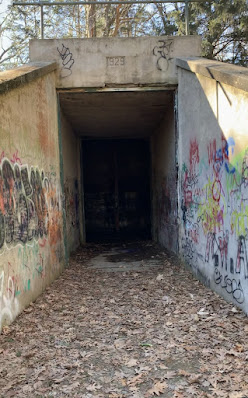
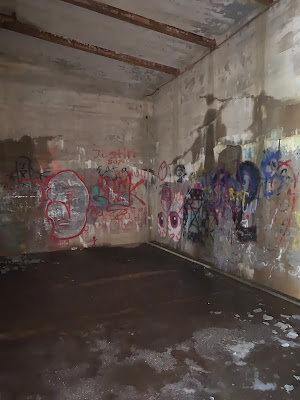
The second structure that may be the gates of hell is a little spookier. Buried in the side of a small hillside is some kind of large underground room that was built in 1929. Was it a garage, perhaps? A large storage bunker? I don't know, but it's big, dark, and filled with graffiti. A large doorway, perhaps 15 - 20' high, leads into the underground room from the outside. It's definitely impressive, and maybe a little creepy. It was really dark inside, and very slippery since the floor was covered in ice. Again, happily we did not see any ghosts. 

I'm not sure why either of these gates are the gates of Hell, instead of just being haunted gates. Do they lead to the underworld? Do demons come out at night? Or maybe the ghosts hang around before heading through the gates to the underworld? I just don't know. The legend is a little vague.

The legend about the gates of Hell seems to be pretty recent. The estate only became a park in 1985, so I'm guessing it only appeared since then. That's just speculation on my part. If you have any information about the history of this legend please share it. 

I have noticed that anomalous or weird structures often attract equally strange legends. A house that looks like its sinking into the earth? Maybe it's because of Satanic rituals. A large iron cage around a grave? It must be intended to imprison a restless ghost. A cemetery gate that looks like spiders? Surely the cemetery must be haunted. I'll note that the Spider Gates cemetery may also contain a gateway to hell, so there are several convenient paths to Hell if you live in Massachusetts.

You get the idea. There are rational explanations for all these things, just as there are rational explanations for the two gates in Maudslay. With the estate long gone, the formal gates and the giant underground chamber now seem a little weird, though. Their original purpose has been forgotten, so people make up new legends to explain why they're there. At least I hope that's what's happening. Otherwise, we've got two gates to Hell in one small park, and that's not good. 

January 30, 2023

Haunted Houses and Terrifying Specters: Ghost (?) Stories from Weare, New Hampshire

There are a lot of ghost stories from New England, and one of my favorite types is what I call the "Scooby-Doo" ghost story. In these stories, the ghost is rationally explained away at the end. There is nothing supernatural in these stories, although people in them initially think there is. I call them Scooby-Doo stories because each episode of the Scooby-Doo ended with the ghostly terror being revealed as someone impersonating a ghost, not something supernatural. These stories are similar, but without all the greedy real estate developers and smugglers.

You can find these Scooby-Doo ghost stories in a lot of the local town history books which were written in the 19th century. I found a bunch of them recently in William Little's The History of Weare, New Hampshire, 1735 - 1888 (1888). In one story, an early settler named John Hodgdon was riding home to Weare on horseback one night when he saw something creepy in his cornfield. As the hair on his neck stood up, he saw a large white object appear on a small knoll in the field. It disappeared with an uncanny sound, only to reappear again. Hodgdon dismounted and walked through the dark field to the knoll, determined to discover what this ghostly object (or entity) was. He learned it was not a ghost, but was instead a large basket some of his workers had left in the cornfield. When the wind blew it rolled up the hill, and when the wind subsided it rolled back down. Mystery solved!

William Little, author of The History of Weare, New Hampshire

In another tale, David and Betsy Purington lived in an old shanty, and "one winter were terribly troubled with ghosts." David Purington thought it was the spirit of his deceased father-in-law. One night, a neighbor came to visit the Puringtons. As they sat talking a strange rapping sound was heard from the attic loft above them. It grew louder and louder and louder. David screamed out for the ghost to desist, but the infernal rapping grew louder! Their neighbor was the only one brave enough to climb into the attic to confront the ghost. After climbing the rickety ladder, she saw a chicken whose legs and been frozen by the cold. It was unable to walk, and made a rapping sound as it tried to stand. "The hen was carried to the room below, and the ghost was laid." Mystery solved! Hopefully the hen recovered from being frozen. 

In East Weare, there was another house that was supposedly haunted. A minister had once lived there, but after he moved away the house stood abandoned. People reported hearing strange noises and even seeing strange lights at night. Some brave schoolboys once approached the house during the day, but fled when they heard an eerie noise and heard the doorknob rattle. Eventually the apparitions stopped. When someone finally went into the haunted house, they saw a dead cat lying on the middle of the floor. Apparently the minister had left it behind when he moved and it had caused all the noise. Mystery solved! 

Or is it? A cat doesn't create ghostly lights. And clearly people didn't take very good care of their animals then...

William Little does include at least one ghost story in The History of Weare that's slightly ambiguous. A man name Mr. Eaton was out hunting raccoons one misty autumn night with some friends. Mr. Eaton paused to rest, when out of the mists emerged a terrifying ghost. "He could see the sunken eye-balls, the worm-eaten face, the shriveled hands, and he shook with terror." One of his friend arrived and Mr. Eaton explained what he had seen. The ghost was not visible to the friend. Many people in Weare believed Mr. Eaton had truly seen a ghost, but others suspected that he had just been drunk. So that mystery was perhaps not completely solved. 

There are a lot of books like The History of Weare out there, histories of New England towns written in the mid-to-late 19th century by people who lived in these places. New England had become a modern industrial area by this time, and you can sense the pride the authors feel in the progress their towns had made. At the same time, they're fascinated by the earlier, pre-industrialized way of life that is vanishing and the supernatural worldview that went with it. Maybe these rationalized ghost stories are the authors' way of straddling both worlds, of indulging the wonders and terrors of the past but also explaining them away with the light of reason. 

January 02, 2023

Eli Wing's Ghostly Arm

 Eli Wing was born in Wayne, Maine sometime in the early 19th century. In the fall of 1837, Eli took a job at a sawmill in Chesterville. He had recently graduated from a nearby Methodist seminary and wanted to earn some money to attend law school. Unfortunately, fate had other plans for Eli.

One day the owner of the mill, Captain Bachelder, asked Eli to go down and clean the water wheel that powered the sawmill. It had been clogged by weeds and was slowing down the mill's work. Always eager to please, Eli did as he was asked. Since he was new at the job, Eli tried to clean the wheel as it was turning, which was a big mistake. His hand got caught in the turning wheel, and the powerful motion of the wheel tore his arm completely off.

Bachelder and the others rushed to the trap door in the floor. Below them they saw Eli lying face down in a pool of bloody water; his arm was going around and around the wheel, spattering the mill with blood. (Helen Caldwell Cushman, Along Thirty Mile River, 2016)

For a while it seemed like Eli would die, but he was taken to a physician and survived. He worked briefly as a portrait painter, and eventually did attend law school and become a lawyer. Despite only having one arm, he lived to the ripe old age of ninety and is buried in the Wing Family Cemetery in Wayne. 

Eli's severed arm was not taken to the physician on that gruesome fall day. Instead, Captain Bachelder buried it by the river bank that after Eli had been carried off. While Eli went on to become a reputable member of the community, his arm did not. Instead, it became a disruptive spectral force. 

A few days after Eli's accident, two of the Bachelder children went to the river to fetch water. They came back in tears, telling their parents that long white arm had emerged from the river and tried to pull them in. Captain Bachelder was skeptical.

But soon other people saw the arm near the river, including a man who said it poured cold water on him as he was trying to drink from the river. Business began to drop off at the sawmill because people were afraid of the ghostly arm, so Captain Bachelder dug it up and buried it in a stone wall, hoping to lay the arm to rest. 

It didn't work. People across the area began to see the ghostly arm. It knocked on windows in the middle of the night, locked people in outhouses (and occasionally tipped them over), rang church bells, and knocked people's hats off their heads. Although some people even believe the arm had strangled a local woman, many others doubted this, and said the Eli's ghostly arm sometimes did good deeds, like punishing a farmer who stole gravestones or helping people who were outcasts. 

Although the arm was allegedly taken from the wall and buried with Eli Wing after he died, there are some people who say it still haunts the woods and backroads. 

*****

I found this story in Helen Caldwell Cushman's book Along Thirty Mile River: Maine Campfire Tales of the Strange and Supernatural (2016). Caldwell Cushman lived most of her life in Maine, and collected local legends for newspaper articles and radio shows. She passed away in 1986. I first learned about her from Chris Packard, author of Mythical Creatures of Maine (2021).

I really like the idea of someone's ghostly arm flying around causing trouble (and possibly doing some good deeds). It's just such a weird and compelling image! I tried to find more information about Eli Wing, but couldn't find any. Caldwell Cushman claims he was buried in the Wing Family Cemetery, but Find-A-Grave does not list an Eli Wing being buried there. Of course, their listing may not be complete, or perhaps Eli was just a nickname and he's buried under a different name. 

In some ways this reads just like a ghost story, but I also wonder if there was a local tradition of blaming pranks on the arm. If some teenagers tipped over an outhouse, did they deflect blame onto the arm? If someone knocked off someone's hat, did they claim the arm did it? It may have been a joke that local people understood, even if they didn't like it.