Showing posts with label folklore. Show all posts

June 15, 2025

H.P. Lovecraft, Rhode Island Witches, and Weather Magic

H.P. Lovecraft (1890 - 1937) is one of America's best-known horror writers. Born in Providence, Rhode Island, he wrote dozens of stories which appeared in the pulp magazines of the 1920s and 1930s. He was very popular with pulp readers, but didn't make much money from his writing, and died in poverty at the age of forty-seven from stomach cancer. 

His work became better-known after his death, particularly when it started appearing in cheap paperback editions in the 1960s, and he's now quite famous. Novelist Stephen King and director Guillermo del Toro both cite him as an influence, and his stories have been turned into many movies, games, and toys in the years since his death. 

H.P. Lovecraft in 1934

Lovecraft was a big fan of New England folklore, and often incorporated it into his fiction. For example, stories like "The Dunwich Horror," "Dreams in the Witch House," and "The Case of Charles Dexter Ward" all include concepts and imagery borrowed from traditional New England witch-lore. Lovecraft also wrote about New England witch legends in the many letters he wrote. And when I say many letters, I do mean many. It's estimated he wrote 87,000 letters to friends, colleagues, and fans. Around 10,000 of those letters still exist today. 

Recently, I've been reading a collection of some of those letters: A Means to Freedom: The Letters of H.P. Lovecraft and Robert E. Howard: 1930 - 1932. Robert E. Howard, the creator of Conan the Barbarian, was another well-known pulp writer, and A Means to Freedom collects the correspondence he and Lovecraft shared. Most of their letters are about history and politics, but Lovecraft does mention witchcraft in some of them. 

Arnold Schwarzenegger in CONAN THE DESTROYER (1984)

For example, in a letter from October 4, 1930, he discusses witch legends from North Kingstown, Rhode Island. First, he lists several that were allegedly gathering places for witches, including "Hell Hollow, Park Hill, Indian Corner, Kettle Hole, and Goose Neck Spring." At Indian Corner, a large rock supposedly oozed blood when the moonlight shined on it. 

Then Lovecraft tells the following story:

Witch Rock, near Hopkins Hill, is the site of a cabin where a monstrous old witch dwelt in the 1600s, and the ground around it is so accursed that it is impossible to plough it. If anyone traces a furrow, the ploughshare is mysteriously deflected. The old witch, incidentally, still skulks nearby in the form of a black crow or black cat - her present abode being an underground burrow (A Means to Freedom, p. 66). 

That's a nice, spooky New England witch story, and Lovecraft appears excited to share it with Howard, who lived in Texas, where they sadly lack centuries-old witchcraft legends. 

Lovecraft probably found that story in Charles Skinner's 1896 book, Myths and Legends of Our Own Land, where it appears on page 32 of volume two. In turn, Skinner took it from a story that appeared in newspapers around the country in 1886. It's not clear if there ever really was a suspected witch at Hopkins Hill in the 1600s, or if the legend was just created for the newspapers. 

My copy of Myths and Legends, which I bought years ago before it was available online.

Lovecraft also probably found the list of witches' gathering places in Skinner's Myths and Legends, where it appears on page 30 of volume two. Somewhere along the way, though, a few typos were made, either by Lovecraft or the person who transcribed his handwritten letters for publication, because Skinner lists Pork Hill and Goose-Nest Spring, not Park Hill and Goose Neck Spring.  

Lovecraft also tells Robert E. Howard some witch-lore that he heard from a friend. Lovecraft writes:

Rumors and and whispers directed against eccentric characters were common all through the 18th and into the 19th century, and are hardly extinct today in decadent Western Massachusetts. I know an old lady in Wilbraham whose grandmother, about a century ago, was said to be able to raise a wind by muttering at the sky (A Means to Freedom, p.74).

An editor's note in A Means to Freedom indicates the "old lady" was the journalist and author Edith Miniter, who was Lovecraft's good friend. ("The Dunwich Horror" was at least partly inspired by time he spent visiting her in Wilbraham.) When the letter was written, Miniter would have been around 63 years old. I don't know who her weather-witching grandmother was, but that might be a good research project for a Lovecraft fan who is into genealogy. 

Also, please email me if you know how to raise a wind by muttering at the sky. Summer's coming, and it would be a nice skill to have on a hot, humid day. 

March 28, 2024

Walnut Cemetery: A Ghost, A Crossroads, and A Poetic Tragedy

I was chatting with someone a while ago, and they asked if I had ever visited Walnut Cemetery in Haverhill, Massachusetts. I was born and raised in Haverhill, but had surprisingly never been to this particular cemetery. After they told me it was haunted, I decided it was finally time to pay a visit. It's an interesting place, and I have lots of thoughts. 


Walnut Cemetery is located in one of the more rural areas of Haverhill. I couldn't find what year the cemetery was started, but it's quite old, with a few gravestones dating back to the 1700s. It's still active today, with newer burials and monuments being added. The newer section is well-maintained, but the older section is a little rough looking. It looks, in fact, like a haunted cemetery. There are a lot of tall weeds. Tree branches have fallen on the graves. Some of the oldest monuments are covered in lichen. We went in the winter, so it may just have been between scheduled maintenance. The older section of the cemetery is also on a rocky hill, so perhaps it is harder to cut the grass there. But whatever the reason, the old part of Walnut Cemetery looks a little spooky. I can understand why someone might think it's haunted. 


The cemetery is said to be haunted by a ghost known as the Woman in White, who roams through it at night. You don't even need to go inside the cemetery to see her - the Woman in White has also been seen by motorists just driving by. Some people say she's terrifying, but others say she is simply eerie and mysterious. As with so many things, I think your mindset might influence what you see. If you go expecting something scary, that's what you'll probably encounter. 

When we visited, I noticed that Walnut Cemetery is located within a triangular crossroads. There's a lot of interesting folklore associated with crossroads, so perhaps it's not surprising there are legends associated with this particular cemetery. The ancient Greeks and Romans believed that crossroads were sacred to Hecate, the goddess of witches, and to Hermes, the divine messenger who guided the dead to the underworld. In England, Scotland and Ireland, people who died by suicide were buried at crossroads, often with stake in their heart. Something similar happened more locally in 1680 in Hampton, New Hampshire, when the citizens of that town buried accused witch Eunice Cole at a crossroads with a stake in her heart. For good measure, they placed a horseshoe on her chest to keep her in her unhallowed grave. And in the American south, legends say that if you want to sell your soul to the Devil, you can find him at a crossroads at midnight. 


Speaking of triangular shapes, paranormal investigator Fiona Broome thinks Walnut Cemetery could be linked to a ley line triangle connecting several weird, legendary places in New England. Ley lines are straight lines that connect important locations on a map, and some people believe these lines conduct mystical energy across the landscape. I can't say if that's true or not, but it's another interesting idea to consider when thinking about Walnut Cemetery. Ghosts plus a  crossroads plus ley lines must all add up to something, right? Well, it may not, but it's still fun to think about. 

Broome and several other ghost hunters investigated Walnut Cemetery back in 2009. They perceived several spirits, including a woman in black, an undefined male spirit, and possibly the restless spirit of a small child. They did not encounter the Woman in White, however. 


Who exactly is the Woman in White? Some people think she is the ghost of Lydia Ayer, the most famous person buried in the cemetery. Ayer was immortalized by the Haverhill poet John Greenleaf Whittier in his 1868 poem "In School-days." In this autobiographical poem, Whittier recalls an incident from his childhood, when he lost a spelling bee to a girl in his class. The girl was Lydia Ayer. Rather than revel in her victory, Ayer instead felt sorry for Whittier.

'I'm sorry that I spelt the word: 

I hate to go above you, 

Because,’ - the brown eyes lower fell, - 

'Because, you see, I love you! ' 


Still memory to a gray-haired man 

That sweet child-face is showing. 

Dear girl! the grasses on her grave 

Have forty years been growing!

He lives to learn, in life's hard school,
How few who pass above him
Lament their triumph and his loss,
Like her, - because they love him.

It's a melancholy poem, and justifiably so, because Ayer died in 1827 when she was just fourteen years old. It's clear that her death made a big impact on Whittier. The poem itself also made a big impact. "In School-days" was one of Whittier's most popular poems, and is often still taught to students today. 

Death is the great equalizer, but Lydia Ayer is the star attraction for living visitors to Walnut Cemetery. A wooden sign points towards her grave, which is marked with a large, handsome memorial that was put up in 1937 by a local civic organization. But is her spirit the Woman in White? 


I'm not sure. Ayer died when she was just a young teenager, and the Woman in White is usually described as a woman, not a young girl. Maybe people only see that the ghost is female, and can't really discern her age, and think she is a full-grown woman. Or maybe Ayer's ghost actually looks older than fourteen. After all, she's over two-hundred years old. Or maybe it's not her ghost at all. And of course, this could all just be a legend. There may not be a ghost at all. 

Women in white are a classic form that ghosts appear in, and stories about them can be found all over the world. In a sense, a Woman in White transcends the story of an individual and partakes in a greater, archetypal identity. In his book Daimonic Reality (2003), Patrick Harpur says the following about "white ladies":

"A ghost? Possibly. But it is a distinguishing characteristic of white lady apparitions they are not individually identifiable. They have deeper resonances than the shade of a historical personage. The time and location are suggestive... an hour and place of transition, of in-between. "

He goes on to say: 
"... white ladies do not speak. But their silence is eloquent. Their appearance itself is the message: enigmatic, often sinister, pointing towards the unknown."


December 17, 2023

Spooky Holiday Reading: Merry Christmas, or Scary Christmas?

I'm sure you've heard the 1963 song, "It's the Most Wonderful Time of the Year." Andy Williams croons in his soothing voice,"...there'll be scary ghost stories, and tales of the glory of Christmases long, long ago." Although modern Americans tend to associate ghosts with Halloween, in Victorian England ghosts were associated with Christmas. I suppose this makes sense in some ways. After all, Christmas occurs at the darkest point of the year, which seems like a good time for ghosts to be out haunting. 

In the spirit of a spooky Christmas, here are four things you can read to get you in the holiday spirit. Two of them are even available free online, if you're feeling cash-strapped after holiday shopping. 

1. The Fright Before Christmas: Surviving Krampus and Other Yuletide Monsters by Jeff Belanger

This is the latest book by Jeff Belanger, a local author, paranormal investigator, and host of the New England Legends podcast and TV show on PBS and Amazon Prime. Full confession: the publisher sent me a copy of this book to review, and I've appeared on Jeff's podcast in the past. This is a great book for anyone interested in learning about the spooky folklore of Christmas. 

Me holding my copy of Fright Before Christmas!

I think by now most people are familiar with Krampus, the horned Austrian monster who terrorizes folks at this time of year, but Jeff also writes about many other strange Christmas creatures that are less well-known. For example, have you heard of Hans Von Trapp, the Cannibal Christmas Scarecrow of Alsace, France? Merry Christmas - but sleep with the lights on.

2. NOS4A2 by Joe Hill

The protagonist of this novel by Joe Hill (Stephen King's son) is Vic McQueen, a psychic, ass-kicking, biker mama who grows up in Haverhill, Massachusetts (my hometown). The villain is a creepy vampire named Charles Talent Manx III. Imbecilic yet cunning, child-like yet predatory, Manx travels around the country in an old Rolls Royce. 

Armed with gingerbread-scented laughing gas, Manx abducts small children and brings them to Christmasland, a creepy holiday-themed amusement park that exists just beyond the border of our reality. He and Vic battle it out in this book that will make you gasp out "Merry Christmas..." as you slip into a vampiric, gingerbread slumber.

3."The Festival" by H.P. Lovecraft (free online)

One of my favorite stories by this Rhode Island master of weird horror.  A young man visits his family's ancestral Massachusetts hometown to participate in its traditional winter solstice celebration for the first time. Although he's charmed by the town's Colonial-era architecture, he's unnerved by its residents' silent, expressionless demeanors. 

He's even more unnerved when he follows a crowd of celebrants into a church, then into its crypt, then down ancient stone steps deep into the earth... Is he really entering a subterranean realm, or just his own fetid subconscious? Either way, he discovers a fungus-filled, maggoty hellscape. You'll scream "Merry Christmas!" before losing your sanity. 

4. The Collected Ghost Stories of M.R. James by M.R. James (free online)

If "The Festival" sounds too lurid for you, may I suggest the ghost stories of M.R. James? James was an Englishman and Anglican priest who wrote ghost stories every Christmas to entertain his friends. His stories often feature bookish academics or lonely clergymen visiting old historic sites and encountering supernatural evil. 

It's all very proper and British. But while his stories are subtle and heavy on the atmosphere, they often end with shocking violence and death. Nothing says "Merry Christmas!" like an undead Satanic nobleman devouring your face. 

Enjoy your holidays, and I hope all your horrors are confined to the printed page this December.  

December 03, 2023

Haunted by the Nantucket Mermaid

This post is about a mermaid who has fascinated, and possibly haunted, people for centuries. But I want to start by talking about a human man: Ichabod Paddock. 

Ichabod Paddock was born around 1661 in Yarmouth, Massachusetts, and died around 1750. He's buried in Middleborough, Massachusetts. Paddock is remembered today for two things: his pioneering role in the Nantucket whaling industry, and his alleged extramarital affair with a mermaid. As a whaling pioneer, Ichabod came with his two brothers to Nantucket in 1690 and taught the islanders how to hunt whales. Their actions were instrumental in making Nantucket into the whaling capital of the world. 

Oddly, we have more details about his alleged (and probably legendary) affair with the mermaid than we do about his actual life as a whaler. The legend goes something like this. Once while on a whaling voyage, Ichabod was swallowed alive by a large, seemingly invulnerable whale nicknamed Crookjaw. The local whalers thought Crookjaw was somehow magical, and this was confirmed by what Ichabod found inside the creature's stomach. Rather than digestive fluids and half-eaten fish, Paddock found a cozy ship's cabin with lit lanterns, a luxurious featherbed, and a table. Two people - a beautiful, golden-haired mermaid and the Devil himself - were playing cards at the table when Ichabod arrived. 

Engraving from 1817 by John Paas

The mermaid won the game, and the Devil angrily disappeared in a flash of sulfurous smoke. "What were you playing for?" Ichabod asked. "We were playing for you," the mermaid said, "and I'm glad I won." She took Ichabod by the hand and led him to the bed, where they made passionate love for hours. 

Ichabod eventually emerged from Crookjaw's mouth and swam back to his ship, but the next day he again commanded the crew to sail to the magical whale so he could enjoy more of the mermaid's loving embraces. After several hours he emerged from the whale and returned to his ship, only to sail back to Crookjaw and the mermaid the next day, and the next after that. Ichabod's passion for the beautiful mermaid was insatiable. 

Eventually, news of Ichabod's strange extramarital affair reached his wife, Joanna. Ichabod was a formidable whaler, but Joanna was equally formidable in her own way. Since both Crookjaw and the mermaid were magical creatures, Joanna asked a local silversmith to craft a silver-tipped harpoon. At the time, silver was believed to have the power to harm magical creatures like witches, mermaids, and even invulnerable whales like Crookjaw. Vestiges of this belief still remain today, with the idea that werewolves and vampires can be killed with silver bullets. 

Joanna presented the silver-tipped harpoon to Ichabod as a gift. He accepted it, and although he was a formidable whale-killer and mermaid-lover, he apparently wasn't bright enough to realize that silver  could kill enchanted whales and the lustful mermaids who live in them. At the urging of his crew, Ichabod hurled the silver-tipped harpoon at Crookjaw, expecting it to bounce off the whale's impenetrable hide. Instead, it sunk deep into the body of Crookjaw, who died with a groan and a geyser of blood. 

Ichabod screamed in horror, incredulous at what he had done. What had happened to his beloved mermaid? When the crew butchered the whale's body, nothing was found inside its stomach except some long yellow seaweed that reminded them of a woman's hair. The beautiful mermaid was gone. 

In 1710 Ichabod and his wife left Nantucket and returned to mainland Massachusetts, eventually having nine children. According to author Nathaniel Philbrick, little else is really known about the life of Ichabod Paddock. His legendary encounter with the mermaid has lived on, though, and is still surprisingly resonant with some people today. 

For example, the book The Ghosts of Nantucket: 23 True Accounts (1984) contains the following story which a Nantucket woman told author Blue Balliett. The woman came from an old Nantucket family, and went to visit the Nantucket Whaling Museum with her sister who was visiting the island. While touring the museum, the woman became entranced by a painting of a young man. She had the strange feeling that she somehow knew him, and had been in an intimate relationship with him, similar to a marriage. She said:

"I was held by a magnetism of some kind that was so strong I couldn't move. It wasn't that I was objectively interested in him, or thought I saw a family resemblance of some kind. It was rather that he had an iron grip on me." (Blue Balliett, The Ghosts of Nantucket: 23 True Accounts(1984), p.62)

The woman remained staring at the painting, immobilized, until her sister came and shook her arm, asking if something was wrong. This ended the trance.

 A mermaid illustration from 1687

The woman later went to visit her minister, and told him about her strange encounter with the painting. The minister explained that it was a portrait of Ichabod Paddock, who had fallen in love with a mermaid who was killed by a silver harpoon. The woman felt dizzy as she heard the story, because ever since she was a young child she'd had a weird "recurrent memory" that popped into her head like a daydream:

"It goes like this: I remember being in pitch darkness and having an excruciating pain in my side as I swim back and forth, back and forth, in black water. I also remember phosphorescence around me, the kind you see in the ocean on a dark night. I always thought it was peculiar, and I used to tell myself that maybe it was a memory of being inside the womb or something." (Blue Balliett, The Ghosts of Nantucket: 23 True Accounts(1984), p.62)

Her encounter with Ichabod's portrait seemed eerily meaningful to her as she listened to the minister talk. Were these daydreams memories of a past life? Was she somehow the mermaid, reincarnated in 20th century Nantucket? She wasn't sure, but for months afterward she had a craving (which she resisted) to revisit the museum to see the portrait, and would wake up in the middle of the night seeing Ichabod Paddock's face floating above her bed. 

Perhaps it was just coincidence that this woman's unusual, recurring dream fit so well with the mermaid legend. That's what I thought, until I received an email from a young woman who is a member of the Paddock family, which still exists today. Like the woman in The Ghosts of Nantucket, she also feels a strange connection to the legendary mermaid, writing that "In my mythos, I am the mermaid who was given the opportunity to reincarnate because of winning half of Ichabod's soul." 

About two years later, I received an email from a man who was also a Paddock, telling me that his daughter felt a powerful connection to the mermaid legend, that she had a large mermaid tattoo on her back, and that she often dreamt of being a mermaid. I arranged to talk with him and his daughter, who it turned out was the young woman who had already emailed me. We had a nice conversation over Zoom, and I learned a lot about their family history and connection to the mermaid story. I didn't get the impression that either the young woman or her father literally believed she was the reincarnated mermaid, but rather that the mermaid was a source of family pride and artistic inspiration. 

Unlike the woman quoted in Ghosts of Nantucket, this young woman didn't feel upset or scared by the legend. Neither did her father. They thought the the legend was an interesting part of their family's genealogy. I don't blame them. Many people descended from old New England families have witches in their family tree, but only a few have a mermaid.

Mermaids aren't just cute cartoons, like Ariel in The Little Mermaid, or sexy fantasy figures, like you might see online. Mermaids are the modern iteration of ancient ocean spirits. They are elemental beings personifying the vast and unknowable waters that cover most of our planet. The ancient Greeks knew them as nereids and oceanids, the nymphs who lived in the seas and ocean. Nymphs were powerful godlike beings who were feared and petitioned for their blessings. Mermaids may also partly have their origin in stories about the Sirens, seductive female monsters that lured sailors to their doom. The seductive and possible devilish Nantucket mermaid certainly seems to share some traits with the Sirens. 

You may not believe in mermaids, just like you may not believe in invulnerable magic whales like Crookjaw. But you can't deny the hold mermaids still have on our imagination. They may not be seen in the ocean as often as they once were, but they still haunt our dreams and subconscious. 

July 09, 2023

The Glocester Ghoul: A Monster and A Pirate in Rhode Island

A while ago I was poking around on the Internet and saw articles about a monster called the Glocester Ghoul. I had never heard of this terrifying creature before, and of course wanted to find out more. This is what I learned...

The monster supposedly lurks in the woods and swamps of Glocester, Rhode Island, a small town in the northwestern part of the state. Here's a fun fact about Glocester. Its name used to be spelled "Gloucester," like the town in Massachusetts, but in 1806 its citizens decided to change the spelling to "Glocester" to avoid confusion with the Massachusetts port. The two towns are different in other ways, as well. Gloucester, MA is haunted by witches and sea-serpents. Glocester, RI, is haunted by a large scaly monster that roams through the woods: the Glocester Ghoul. 

Image from TeePublic 

One of the earliest accounts of the monster was an article that appeared in various newspapers (including The Boston Globe) in January and February of 1896. Titled "Monster, Cow, or Ghost?," the article claims a Glocester man named Neil Hopkins encountered a monster while walking home from work one night:

"It seemed to be all a-fire; it had a hot breath," Hopkins told his neighbors. "There was a metallic sound, like the clanking of steel against steel... I could hear the dead branches and twigs crackling under the heavy tramp."

Unfortunately Hopkins only caught a brief glimpse of the creature before it ran off into the woods, but he said "it was as big as an elephant, and that he is certain it had no tail." 

The article goes on to suggest the creature may have been the same one seen seen in 1839 by Albert Hicks and three other local men. They believed Captain Kidd had buried some of his treasure on a Glocester farm and were digging to find it, but their efforts were interrupted by the appearance of a monster. Hicks described the following:

"It was a large animal, with staring eyes as big as pewter bowls. The eyes looked like balls of fire. When it breathed as it went by flames came out of its mouth and nostrils... It was as big as a cow, with dark wings on each side like a bat's. It had spiral horns like a ram's, as big around as a stovepipe. Its feet were formed like a duck's... The body was covered with scales as big as clam shells, which made a rattling noise as the beast moved along..."

That's an impressive monster, even if it's only as big as a cow, and not an elephant, like Neil Hopkins said. It sounds like some kind of dragon, doesn't it? 

Beyond the scaly monster, there are a few other interesting things about this story:

1. Treasure-digging was a common activity in the 18th and 19th centuries. People thought New England was full of buried treasure, and would get together with friends to try to find it. They never seemed to succeed, though, often saying they had been on the verge of finding the gold only to be scared off by a monstrous guardian of some kind, like demonic dogs, sinister black cats, and maybe even the Devil himself. Digging for Captain Kidd's treasure and encountering a monster would have been a familiar theme to a 19th century newspaper's readers.

2. Albert Hicks, who was digging with his friends for pirate treasure, ironically later became one of the last people in the United States to be executed as a pirate. Hicks was born in 1820 in Foster, Rhode Island, and was executed in New York in 1860 after killing three men on a small boat to steal their money. He dictated a confessional biography before his execution. In it, he claimed to have killed dozens (if not hundreds) of people as a pirate and highway robber. Hicks had a reputation as a teller of tall tales, so he may have exaggerated his victim count. 

Drawing of Albert Hicks from an 1860 newspaper (via Wikipedia).

3. Despite being fond of tall tales, there's one thing not found in Hicks's biography, The Life, Trial, Confession and Execution of Albert Hicks, and that's a large scaly monster. Hicks does mention digging for treasure when he was young, but says nothing about encountering a monster. If he had encountered a monster I'm sure it would have been in there. So perhaps this story was created by someone else?

According to folklorist Stephen Olbrys Gencarella, the story was written by a reporter for a New York newspaper, The New York World, where it was published on January 12, 1896. That reporter based their story on an earlier one that had appeared in The Providence Journal on May 5, 1889, which was titled "Glocester Gold Digging." The Journal article contains various Glocester legends, including one about six men who went digging for Captain Kidd's treasure on November 13, 1833. One of the men was indeed Albert Hicks, and the six men saw a creature that looked exactly like the one in The New York World article. The big difference between the two articles are that the men also see a meteor strike the earth before they see the monster, and it is other men who describe the monster, not Albert Hicks. Hicks only played a minor role, but The New York World reporter probably played it up to capitalize on Hick's notoriety. 

One note about that meteor: the six men took the meteor as a good omen, and didn't seem to connect it with the appearance of the monster. 

The story about the Glocester monster appeared in various newspapers in 1896, but then more or less disappeared for over a century. The story reappeared on the blog Strange New England in 2019, where the monster was given the catchy name "The Glocester Ghoul." The name seems to have stuck, and I've seen the Glocester Ghoul mentioned a few places online. You can now even buy a Glocester Ghoul tee-shirt online:

From TeePublic

I feel like every state deserves a good monster, so hopefully knowledge of the Glocester Ghoul will spread. Is there really a large, scaly creature lurking in the woods and swamps of Glocester? Probably not, but I write that from the safety of my home on a sunny summer day. I might have a different opinion if I were out in the woods at night. I don't think anyone's allegedly seen the creature since the 1800s, but if you have drop a note in the comments. I'd be curious - and a little scared - to know more...
*****

I got a lot of my information from Stephen Olbrys Gencarella's article "Lovecraft and the Folklore of Glocester's Dark Swamp," which appeared in Lovecraft Annual, No. 16 (2022), pp. 90 -127. 

March 15, 2023

HP Lovecraft and the Witch's Familiar

In 1648, the healer Margaret Jones became the first person executed for witchcraft in Massachusetts. She was accused of various things, like making her clients sick just so they would buy her medicine, but also of having a small demonic spirit that did her bidding. This demon, or familiar spirit, took the form of a small child. Her accusers said they saw it around her Charlestown home, and in her jail cell after she had been arrested. The familiar spirit supposedly suckled on Jones's blood for nourishment, a grotesque parody of the mother/child relationship. 

The Devil also allegedly gave many other New Englanders accused of witchcraft familiar spirits (or familiars, for short). John Godfrey, who was accused of witchcraft four times between 1658 and 1669, was said to have a mysterious teat under his tongue, which he used to suckle his familiar spirit, which appeared large black bird. The testimony from the 1692 Salem witch trials is full of accounts of familiars in a bewildering variety of shapes: wolves, yellow birds, cats. Some were more monstrous, like the creature with a monkey's body, rooster's feet and human face that crept into John Louder's bedroom while he slept, or the three-foot tall humanoid ("all over hairy, all the face hairy") that supposedly did Sarah Osborn's bidding. Even in the late 19th century, people in Truro, Massachusetts told stories of a dune-dwelling witch who cursed local sailors and was attended to by a small black goat. 

Brown Jenkin, from Dreams in the Witch House (2005)

There's something particularly nightmarish about the idea of the familiar spirit. Local witchcraft accounts and legends are full of horrific imagery, but to me there's something extra spooky about these small demons. In animal form, they possess a demonic intelligence and malevolence at odds with their mundane, or even cute, appearance. As monstrous hybrids, they're the type of thing that makes you wake up screaming. Familiars are like something from a horror movie or story. 

At least one local horror writer wrote about witches' familiars. Rhode Island native H.P. Lovecraft (1890 - 1937) often drew on New England folklore for his weird tales. Witches make appearances in several of his stories, and a very nasty familiar spirit appears in his 1932 story "The Dreams in the Witch House." The story describes what happens to hapless graduate student Walter Gilman when he moves into a house once inhabited by Keziah Mason, a 17th century witch. Keziah supposedly was served by a familiar named Brown Jenkin: 

Witnesses said it had long hair and the shape of a rat, but that its sharp-toothed, bearded face was evilly human while its paws were like tiny human hands. It took messages betwixt old Keziah and the devil, and was nursed on the witch’s blood—which it sucked like a vampire. Its voice was a kind of loathsome titter, and it could speak all languages. Of all the bizarre monstrosities in Gilman’s dreams, nothing filled him with greater panic and nausea than this blasphemous and diminutive hybrid...

Brown Jenkin is a weird and ambiguous creature. Lovecraft is clearly using the classic image of the familiar from the 17th century witch trials, but he takes the concept much further. In the story, witchcraft is a form of advanced science. Keziah can travel through space and time via a hyperspace wormhole, and she wants to bring Walter Gilman with her to the center of the universe to meet Azathoth, the daemonic ruler of the world. The story is strange and unsettling mix of science fiction and folk horror. Sure, you can use the wormhole to visit alien planets, but there are also witches and books signed in human blood. So what is Brown Jenkin - an emissary from an alien world, or a servant of evil? Or maybe both? Even though Gilman manages to escape Keziah's clutches, Brown Jenkin manages to get the last laugh (or loathsome titter, to be more accurate). 

In addition to horror stories, Lovecraft also wrote poetry, much of it as scary as his fiction. Some if might even be scarier, like this poem simply called "The Familiars," from his sonnet collection Fungi from Yuggoth

XXVI. The Familiars

John Whateley lived about a mile from town,
Up where the hills began to huddle thick;
We never thought his wits were very quick,
Seeing the way he let his farm run down.
He used to waste his time on some queer books
He’d found around the attic of his place,
Till funny lines got creased into his face,
And folks all said they didn’t like his looks.

When he began those night-howls we declared
He’d better be locked up away from harm,
So three men from the Aylesbury town farm
Went for him—but came back alone and scared.
They’d found him talking to two crouching things
That at their step flew off on great black wings.

That's a pretty creepy poem, and the ending packs quite a wallop. Everyone thought John Whateley was insane, but (surprise!) he wasn't. In that poem and "The Dreams in the Witch House," Lovecraft imagines the witch's familiar in the modern world, where they're even more anomalous and frightening. Winged demons and human-faced rats belong in the semi-mythical past, not in industrialized New England.

A 16th century illustration of a witch and her familiars

If you believe in familiar spirits, you might wonder what happens to them after their witch dies. Do they go back to some infernal realm, or do they linger here in the physical realm? Here's another Lovecraft poem from Fungi which might be about that very topic:

XII. The Howler

They told me not to take the Briggs’ Hill path
That used to be the highroad through to Zoar,
For Goody Watkins, hanged in seventeen-four,
Had left a certain monstrous aftermath.
Yet when I disobeyed, and had in view
The vine-hung cottage by the great rock slope,
I could not think of elms or hempen rope,
But wondered why the house still seemed so new.

Stopping a while to watch the fading day,
I heard faint howls, as from a room upstairs,
When through the ivied panes one sunset ray
Struck in, and caught the howler unawares.
I glimpsed—and ran in frenzy from the place,
And from a four-pawed thing with human face.

So what's scarier, Lovecraft's familiars or the familiars from local folklore and trial documents? It's hard for me to decide. I suppose the scariest thing is that people once took this all very literally and executed people for supposedly working with familiar spirits. I enjoy reading Lovecraft and learning about local witch legends, but am happy to be living in an era where familiar spirits remain fictional. 

February 26, 2023

Visiting the Gates of Hell in Newburyport

A couple weeks ago Tony and I drove up to Newburyport. It's always a pleasure to visit Newburyport - so charming! so historic! - but we weren't looking for charm or history. We were looking for the GATES OF HELL. Cue the ominous music...

The gateway to Hell?

The gates of Hell are supposedly located in Maudslay State Park, 450 acres of woods, meadows and gardens situated on the banks of the winding Merrimack River. The park used to be the private estate of the Moseley family, and takes its name from the family's ancestral home in England. The grounds once included two mansions, a castle, greenhouses, stables, and other buildings. Most of these structures are now long gone. 

The Moselelys sold their estate for $5 million dollars in 1985 to the state of Massachusetts, and the state turned it into a park. I've wandered through a lot of parks in eastern Massachusetts, and Maudslay is quite different than most. Most parks around here are woodsy and often quite rocky. That's not the case with Maudslay. Although parts of it are heavily wooded, the landscape is more manicured, with open fields and some ornamental gardens that are still maintained. We could definitely tell it used to be an estate. There are also some ruins scattered around as well. 

It was a very pleasant park, even on a cold windy day. But according to local legends the gateway to Hell is said to be located there. I'm not sure why this is. There aren't any shocking scandals surrounding the Moseley family - no murders, no rumors of witchcraft, nothing. Nothing really creepy seems to have happened in the park either to caused these legends.  
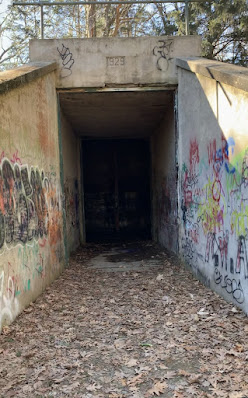
Two structures in Maudslay State Park are alleged to be the gate into Hell. The first is the formal gate that once led into the estate. This is located right on Curzon Mill Road, just past the parking area if you drive towards the river. People who pass by this gate at night report seeing severed heads stuck on the spikes. Yikes. I've heard that adventurous young folks will park by the gate late at night, hoping (dreading?) to see the apparitions. Not being young or adventurous, we went there during the daytime. Happily we did not see any ghostly heads. Some people also report seeing the ghosts of small children playing in the park. 

Or is this the gateway to Hell?


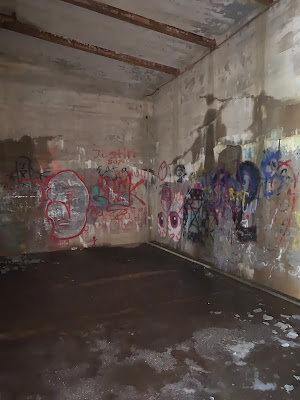
The second structure that may be the gates of hell is a little spookier. Buried in the side of a small hillside is some kind of large underground room that was built in 1929. Was it a garage, perhaps? A large storage bunker? I don't know, but it's big, dark, and filled with graffiti. A large doorway, perhaps 15 - 20' high, leads into the underground room from the outside. It's definitely impressive, and maybe a little creepy. It was really dark inside, and very slippery since the floor was covered in ice. Again, happily we did not see any ghosts. 

I'm not sure why either of these gates are the gates of Hell, instead of just being haunted gates. Do they lead to the underworld? Do demons come out at night? Or maybe the ghosts hang around before heading through the gates to the underworld? I just don't know. The legend is a little vague.

The legend about the gates of Hell seems to be pretty recent. The estate only became a park in 1985, so I'm guessing it only appeared since then. That's just speculation on my part. If you have any information about the history of this legend please share it. 

I have noticed that anomalous or weird structures often attract equally strange legends. A house that looks like its sinking into the earth? Maybe it's because of Satanic rituals. A large iron cage around a grave? It must be intended to imprison a restless ghost. A cemetery gate that looks like spiders? Surely the cemetery must be haunted. I'll note that the Spider Gates cemetery may also contain a gateway to hell, so there are several convenient paths to Hell if you live in Massachusetts.

You get the idea. There are rational explanations for all these things, just as there are rational explanations for the two gates in Maudslay. With the estate long gone, the formal gates and the giant underground chamber now seem a little weird, though. Their original purpose has been forgotten, so people make up new legends to explain why they're there. At least I hope that's what's happening. Otherwise, we've got two gates to Hell in one small park, and that's not good. 

January 30, 2023

Haunted Houses and Terrifying Specters: Ghost (?) Stories from Weare, New Hampshire

There are a lot of ghost stories from New England, and one of my favorite types is what I call the "Scooby-Doo" ghost story. In these stories, the ghost is rationally explained away at the end. There is nothing supernatural in these stories, although people in them initially think there is. I call them Scooby-Doo stories because each episode of the Scooby-Doo ended with the ghostly terror being revealed as someone impersonating a ghost, not something supernatural. These stories are similar, but without all the greedy real estate developers and smugglers.

You can find these Scooby-Doo ghost stories in a lot of the local town history books which were written in the 19th century. I found a bunch of them recently in William Little's The History of Weare, New Hampshire, 1735 - 1888 (1888). In one story, an early settler named John Hodgdon was riding home to Weare on horseback one night when he saw something creepy in his cornfield. As the hair on his neck stood up, he saw a large white object appear on a small knoll in the field. It disappeared with an uncanny sound, only to reappear again. Hodgdon dismounted and walked through the dark field to the knoll, determined to discover what this ghostly object (or entity) was. He learned it was not a ghost, but was instead a large basket some of his workers had left in the cornfield. When the wind blew it rolled up the hill, and when the wind subsided it rolled back down. Mystery solved!

William Little, author of The History of Weare, New Hampshire

In another tale, David and Betsy Purington lived in an old shanty, and "one winter were terribly troubled with ghosts." David Purington thought it was the spirit of his deceased father-in-law. One night, a neighbor came to visit the Puringtons. As they sat talking a strange rapping sound was heard from the attic loft above them. It grew louder and louder and louder. David screamed out for the ghost to desist, but the infernal rapping grew louder! Their neighbor was the only one brave enough to climb into the attic to confront the ghost. After climbing the rickety ladder, she saw a chicken whose legs and been frozen by the cold. It was unable to walk, and made a rapping sound as it tried to stand. "The hen was carried to the room below, and the ghost was laid." Mystery solved! Hopefully the hen recovered from being frozen. 

In East Weare, there was another house that was supposedly haunted. A minister had once lived there, but after he moved away the house stood abandoned. People reported hearing strange noises and even seeing strange lights at night. Some brave schoolboys once approached the house during the day, but fled when they heard an eerie noise and heard the doorknob rattle. Eventually the apparitions stopped. When someone finally went into the haunted house, they saw a dead cat lying on the middle of the floor. Apparently the minister had left it behind when he moved and it had caused all the noise. Mystery solved! 

Or is it? A cat doesn't create ghostly lights. And clearly people didn't take very good care of their animals then...

William Little does include at least one ghost story in The History of Weare that's slightly ambiguous. A man name Mr. Eaton was out hunting raccoons one misty autumn night with some friends. Mr. Eaton paused to rest, when out of the mists emerged a terrifying ghost. "He could see the sunken eye-balls, the worm-eaten face, the shriveled hands, and he shook with terror." One of his friend arrived and Mr. Eaton explained what he had seen. The ghost was not visible to the friend. Many people in Weare believed Mr. Eaton had truly seen a ghost, but others suspected that he had just been drunk. So that mystery was perhaps not completely solved. 

There are a lot of books like The History of Weare out there, histories of New England towns written in the mid-to-late 19th century by people who lived in these places. New England had become a modern industrial area by this time, and you can sense the pride the authors feel in the progress their towns had made. At the same time, they're fascinated by the earlier, pre-industrialized way of life that is vanishing and the supernatural worldview that went with it. Maybe these rationalized ghost stories are the authors' way of straddling both worlds, of indulging the wonders and terrors of the past but also explaining them away with the light of reason. 

October 03, 2022

Dreams in the Witch House: Lore, Familiars, and the Devil's Book

This week I've been reading "The Dreams in the Witch House," H.P. Lovecraft's classic 1932 tale of witches, creepy little monsters, and non-Euclidean calculus. This is one of those Lovecraft stories I come back to repeatedly, and re-reading it this time I was struck by how Lovecraft incorporates real New England folklore and history into it. Much of the story is focused on how one becomes a witch, something that was central to the 17th century Puritan witch trials. There is also a particularly creepy familiar spirit in it. 

Here's a basic plot summary, but you can also read the story yourself here. Walter Gilman is a college student at Miskatonic University in Arkham, Massachusetts, where he is studying mathematics and folklore. Gilman is convinced there is a connection between advanced mathematics and the old New England witch stories, and his research leads him to rent a room in a squalid boarding house that was built in 1600s known as the Witch House.

Gilman's room was once the abode of Keziah Mason, who was arrested for witchcraft during the Salem witch trials. Under questioning, Mason told Judge John Hathorne that certain lines and angles could be used to move "through the walls of space to other spaces beyond," and then later disappeared from her locked jail cell. Strange geometric curves and angles were found drawn on the cell's walls with "some red, sticky fluid." Centuries later, Keziah Mason is said to haunt the Witch House where she once lived, appearing there at night with Brown Jenkin, a human-faced rat that serves as her familiar spirit. 
Gilman thinks Mason knew the secret of traveling through other dimensions. Soon in his sleep he dreams that he can too, inspired by his study of mathematics and the strange angles of the walls and ceiling in his room. In his dreams, he flies through "limitless abysses of inexplicably coloured twilight and bafflingly disordered sound; abysses whose material and gravitational properties, and whose relation to his own entity, he could not even begin to explain." He dreams that he visits other planets, including a world whose heavy gravity almost crushes him, and one where he sees a vast city and strange non-humanoid beings. In his journeys he also sees Keziah Mason and Brown Jenkin, who seem to be following him around the universe in his dreams. 

Spoiler alert: Walter Gilman is not dreaming. He really is traveling through the universe and other dimensions, and Mason and Brown Jenkin really are following him. Since he has intuitively and unconsciously mastered the art of extra-dimensional travel, they recognize him as a fellow witch, and want him to be fully initiated into the dark mysteries of witchcraft: 
He must meet the Black Man, and go with them all to the throne of Azathoth at the centre of ultimate Chaos. That was what she said. He must sign in his own blood the book of Azathoth and take a new secret name now that his independent delvings had gone so far. What kept him from going with her and Brown Jenkin and the other to the throne of Chaos where the thin flutes pipe mindlessly was the fact that he had seen the name “Azathoth” in the Necronomicon, and knew it stood for a primal evil too horrible for description.
Oh, and they want him to sacrifice a human infant as well. I won't give away the ending, but it's one of the gorier and gruesome endings to a Lovecraft story. 

H.P. Lovecraft loved New England and its history, and incorporates lots of local references into "The Dreams in the Witch House." John Hathorne (mentioned above) was a real Salem witch trials judge and an ancestor of Nathaniel Hawthorne; the infamous Cotton Mather is mentioned as well. Walter Gilman's hometown is Haverhill, Massachusetts, the same as me! One of his mathematics instructors at Miskatonic University is Professor Upham, a name possibly inspired by Charles Upham, the historian who wrote Salem Witchcraft (1867), one of the first important studies of the Salem trials. And there actually are several buildings in Massachusetts called the Witch House, including the most famous one in Salem

Original 1933 illustration from Weird Tales

The crux of the story is whether Gilman will become fully initiated into witchcraft. Will he sign his name into the Black Man's book using his own blood? Lovecraft pulled this concept directly from records of the New England witchcraft trials. The Black Man was a Puritan term for the Devil, and he and his book were mentioned in many witchcraft trials. The book was a Satanic parody of the Bible and of the covenants that Puritans signed when they joined churches. According to the Puritans, signing your name in the Black Man's book made you a witch. Lovecraft made up the part about sacrificing an infant, though. That does not appear in any New England witch trials, although certainly witches were accused of harming babies and children. The Puritans also believed that the Devil would baptize his witches after they signed the book, which doesn't appear in Lovecraft's story. It's probably just too tame for a horror story. 

Brown Jenkin, Keziah Mason's familiar spirit, is very similar to the familiars found in New England witch trials. The Puritan's claimed that the Devil gave witches small demons, called familiar spirits, to do their bidding. In return, the witches just had to feed them with their blood. The trials of the Salem witch trials mention familiar spirits who appeared in a variety of forms, including birds, cats, and wolves. Like Brown Jenkin, some appeared as monstrous hybrids. For example, Bridget Bishop was accused of having a familiar that looked like a monkey with rooster feet and a human face, and Sarah Osborne's familiar was supposedly a small humanoid covered in hair. Lovecraft's Brown Jenkin would fit right in with these two.

One interesting thing I noticed on re-reading "The Dreams in the Witch House" is that Keziah Mason and Brown Jenkin are trying to help and protect Walter Gilman during his trips through space and time, even though he doesn't realize it. For example, when he finds himself on a planet with heavy gravity they show him how to travel back to Earth. It's only when he refuses to sign the book that they become hostile towards him. He's not acting the way a witch should!

"The Dreams in the Witch House" has been filmed at least three times, once in 2005 as part of the Masters of Horror anthology TV series, and also as a low-budget movie earlier this year, at last according to Amazon Prime. A version of "The Dreams in the Witch House" will also air later this month as an episode of Guillermo del Toro's new anthology Netflix show Cabinet of Curiosities. I hope they include all the weird New England witch references in it!

*****

If you want to read more about New England witches, please check out my book, Witches and Warlocks of Massachusetts. It's available wherever books are sold online and is perfect October reading!


August 18, 2022

Vampires, Punk Rock and Local Legends in The Pallbearers Club

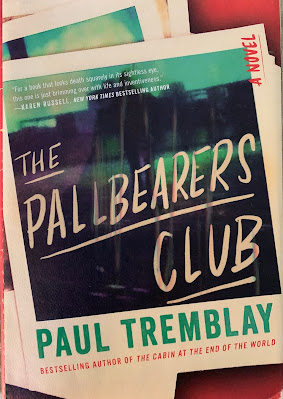
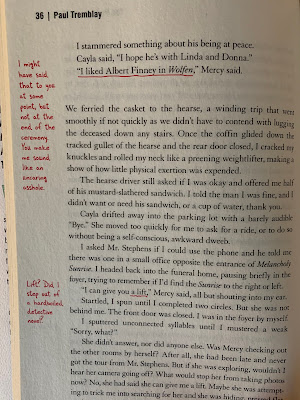
I don't often review novels here, but Paul Tremblay's new book The Pallbearers Club is based on an important piece of New England folklore. Tony gave it to me, thinking I might like it. He was right! It's creepy and very steeped in weird local history. 

The Pallbearer's Club tells the story of Art Barbara, a local rock musician, and his friendship with a mysterious woman named Mercy Brown. Art and Mercy first meet when Art is a high school student in Beverly, Massachusetts. He's tall, skinny, acne-ridden, and has a serious case of scoliosis. He's not the most popular kid in school and doesn't participate in any extracurricular activities. In order to beef up his college applications, he starts the Pallbearers Club, a group that attends funerals of people who don't have anyone to mourn them. Other than Art, only two other Beverly High students are members.  

And then Mercy joins. She's older than Art and is a student at Salem State. She introduces him to punk rock and alternative music. She has her own car. She helps him write a paper for a class on local history. The topic: the famous Rhode Island vampire Mercy Brown. 

Wait, what? The Pallbearers Club is presented as a memoir by "Art Barbara," but Art admits that this is a pseudonym. It's not his real name. "Mercy Brown" is not really his friend's name either. Art gives her that name in his memoir because... well, because he suspects she's a New England vampire.  

I've written about New England vampires before, and they're not like the vampires you see in pop culture. In the 19th century, tuberculosis was rampant across this area. No one knew what caused the disease, which was called 'consumption' at the time because it consumed people's lives and health. It often killed entire families, slowly and one person at a time. Some New Englanders believed the disease was actually caused by a dead family member feeding from the grave on the life force of their loved ones.

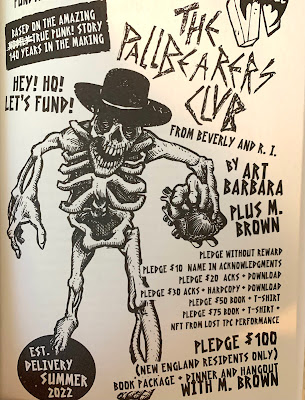
Artwork from The Pallbearers Club

Mercy Brown is the best-known of the alleged New England vampires. Beginning in the 1880s, consumption began killing multiple members of the Brown family of Exeter, Rhode Island. The family's mother, Eliza, was the first to die, followed by her daughters Mary and Mercy. When young son Edwin grew ill, neighbors convinced his father George Brown to exhume their corpses to see if any showed signs of life in the grave. Mercy's corpse was undecayed and had blood in its hearts, which according to local folklore indicated she was feeding on Edwin. Her heart and liver were burned to ashes and mixed with water, which was given to young Edwin to drink. This was supposed to prevent Mercy's vampirism and save Edwin's life, but he died two months later. (Michael Bell's book Food for the Dead is the best non-fiction book about New England vampires.)

Is "Mercy Brown" in The Pallbearers Club really a vampire? Art certainly seems to think so and blames her for some unfortunate and unusual events in his life. Mercy vehemently disagrees. The Pallbearers Club is full of notes from Mercy in red pen, offering her perspective on events. Maybe, she suggests, Art is really a drug addict and incapable of moving on from the past. 

Who is right, Art or Mercy? I won't tell you. The Pallbearers Club is a creepy slow burn and keeps you guessing until the last page (and maybe even after). It doesn't have a lot of gore or violence, so when the weird stuff happens it's all the more effective. There are some nice twists, and I definitely was surprised by the ending. This is also very much a New England novel, set almost entirely in Providence, Rhode Island and Beverly. Tremblay lives north of Boston, and his love and knowledge of the region really shines through. If you like New England, weird folklore, and a twisty plot, add this to your reading list.