Showing posts with label witch. Show all posts

October 26, 2025

Does A Witch's Ghost Haunt This Cemetery?

I love visiting cemeteries, as long-time readers of this blog know. They're beautiful, peaceful, and relaxing spaces filled with sculpture and art. As an added bonus many of them have strange legends attached to them. Recently, Tony and I visited Lowell Cemetery in Lowell, Massachusetts. It's a gorgeous cemetery, and there's a weird legend attached to it. And the weird legend is connected to Halloween!

Lowell Cemetery opened in 1841 as a private, non-sectarian cemetery. Its layout and design was inspired by Mount Auburn Cemetery in Cambridge, which was the first "garden cemetery" in the United States. 

Before Mount Auburn, cemeteries were primarily functional. They were places to bury and memorialize the dead, but they weren't designed with aesthetics in mind. Old cemeteries are basically just rows of graves; newer garden cemeteries usually have beautiful plantings, gently curving paths, and landscape features like chapels, ponds, and fountains. 

Lowell Cemetery is definitely a garden cemetery. According to the cemetery's website, Lowell did not have any public parks in 1841, so the cemetery filled that role for many years. People would come to stroll, watch birds, and absorb the sylvan atmosphere. It still fills that role, even today. There were definitely a few families strolling around when Tony and I visited. 

"That's all great, but tell me about the spooky stuff," I can hear you say. Well, here it is. According to a local legend, a witch is buried in the cemetery, and she comes alive every year around Halloween. 

The witch is supposedly buried under this monument:

It's called the Clara Bonny monument, and here are some facts about Clara Bonney. She was born on June 19, 1855 to a prominent local judge. She married Charle Sumner Lilley, a lawyer and protege of her father. She died on July 19, 1894, possibly from sepsis caused by the birth of her daughter. 

Clara's family was extremely distraught by her death, so they commissioned a spectacular monument for her. It included a bronze sculpture titled "New Life" by Frank Elwell, the head of the sculpture department at the Metropolitan Museum. Her mother, father, and husband would all eventually be buried there as well.

The sculpture is very dramatic and quite unusual, because the breasts of the woman depicted are almost exposed. It's a really low-cut dress, particularly for a cemetery. Strange-looking monuments often have legends attached to them, and that's the case here. 


I told you the facts about Clara Bonney, but a local legend says Clara Bonney was executed for witchcraft. Every year in October, the statue's dress drops lower and lower each day, until on Halloween night her breasts are exposed. And then... 

Well, I'm not really sure what happens. One online source said that after her breasts are exposed, Witch Bonney's ghost stalks the streets of Lowell, wreaking vengeance on the descendants of the people who executed her. Other sources say her spirit is free to wander through the cemetery on Halloween night, but leave out the vengeance part. In general, the focus is on the dress creeping lower and Witch Bonney's spirit emerging from the grave. What the ghost does once it's free is less important. 

There's a large stone lion near Clara Bonney's monument, and according to some people the lion guard's Clara's grave. Does the lion keep the living safe from her, or her safe from the living? I'm not sure, but the lion is the gravestone for James Ayer, a 19th century medicine manufacturer. 

No one has been executed for witchcraft in Massachusetts since 1692, so it should be obvious that Clara Bonny wasn't really executed as a witch. This is one of many spurious witch legends in Massachusetts, but I think that's okay. Stories like this help people remember the 17th century witchcraft trials, and help them feel connected to their home town. I don't think there's anything wrong with a witchy legend, particularly at Halloween, as long as people don't take it too seriously.

Speaking of witchy things, visitors to Clara Bonney's grave often leave little offerings for her, like coins, rocks, or flowers. I forgot to bring a coin, so I just poured out some water on the ground. Hopefully it was acceptable. 

I didn't notice anything strange or creepy at Lowell Cemetery, until just as we were about to leave. As I took one last photo of Clara Bonney's grave, my iPhone's camera malfunctioned. The photo showed nothing but a gray light (see above). Maybe it was just because my phone is old, or maybe it was something more? This has only happened to me a few times before, usually at places with a reputation for being haunted...

Happy Halloween!

June 15, 2025

H.P. Lovecraft, Rhode Island Witches, and Weather Magic

H.P. Lovecraft (1890 - 1937) is one of America's best-known horror writers. Born in Providence, Rhode Island, he wrote dozens of stories which appeared in the pulp magazines of the 1920s and 1930s. He was very popular with pulp readers, but didn't make much money from his writing, and died in poverty at the age of forty-seven from stomach cancer. 

His work became better-known after his death, particularly when it started appearing in cheap paperback editions in the 1960s, and he's now quite famous. Novelist Stephen King and director Guillermo del Toro both cite him as an influence, and his stories have been turned into many movies, games, and toys in the years since his death. 

H.P. Lovecraft in 1934

Lovecraft was a big fan of New England folklore, and often incorporated it into his fiction. For example, stories like "The Dunwich Horror," "Dreams in the Witch House," and "The Case of Charles Dexter Ward" all include concepts and imagery borrowed from traditional New England witch-lore. Lovecraft also wrote about New England witch legends in the many letters he wrote. And when I say many letters, I do mean many. It's estimated he wrote 87,000 letters to friends, colleagues, and fans. Around 10,000 of those letters still exist today. 

Recently, I've been reading a collection of some of those letters: A Means to Freedom: The Letters of H.P. Lovecraft and Robert E. Howard: 1930 - 1932. Robert E. Howard, the creator of Conan the Barbarian, was another well-known pulp writer, and A Means to Freedom collects the correspondence he and Lovecraft shared. Most of their letters are about history and politics, but Lovecraft does mention witchcraft in some of them. 

Arnold Schwarzenegger in CONAN THE DESTROYER (1984)

For example, in a letter from October 4, 1930, he discusses witch legends from North Kingstown, Rhode Island. First, he lists several that were allegedly gathering places for witches, including "Hell Hollow, Park Hill, Indian Corner, Kettle Hole, and Goose Neck Spring." At Indian Corner, a large rock supposedly oozed blood when the moonlight shined on it. 

Then Lovecraft tells the following story:

Witch Rock, near Hopkins Hill, is the site of a cabin where a monstrous old witch dwelt in the 1600s, and the ground around it is so accursed that it is impossible to plough it. If anyone traces a furrow, the ploughshare is mysteriously deflected. The old witch, incidentally, still skulks nearby in the form of a black crow or black cat - her present abode being an underground burrow (A Means to Freedom, p. 66). 

That's a nice, spooky New England witch story, and Lovecraft appears excited to share it with Howard, who lived in Texas, where they sadly lack centuries-old witchcraft legends. 

Lovecraft probably found that story in Charles Skinner's 1896 book, Myths and Legends of Our Own Land, where it appears on page 32 of volume two. In turn, Skinner took it from a story that appeared in newspapers around the country in 1886. It's not clear if there ever really was a suspected witch at Hopkins Hill in the 1600s, or if the legend was just created for the newspapers. 

My copy of Myths and Legends, which I bought years ago before it was available online.

Lovecraft also probably found the list of witches' gathering places in Skinner's Myths and Legends, where it appears on page 30 of volume two. Somewhere along the way, though, a few typos were made, either by Lovecraft or the person who transcribed his handwritten letters for publication, because Skinner lists Pork Hill and Goose-Nest Spring, not Park Hill and Goose Neck Spring.  

Lovecraft also tells Robert E. Howard some witch-lore that he heard from a friend. Lovecraft writes:

Rumors and and whispers directed against eccentric characters were common all through the 18th and into the 19th century, and are hardly extinct today in decadent Western Massachusetts. I know an old lady in Wilbraham whose grandmother, about a century ago, was said to be able to raise a wind by muttering at the sky (A Means to Freedom, p.74).

An editor's note in A Means to Freedom indicates the "old lady" was the journalist and author Edith Miniter, who was Lovecraft's good friend. ("The Dunwich Horror" was at least partly inspired by time he spent visiting her in Wilbraham.) When the letter was written, Miniter would have been around 63 years old. I don't know who her weather-witching grandmother was, but that might be a good research project for a Lovecraft fan who is into genealogy. 

Also, please email me if you know how to raise a wind by muttering at the sky. Summer's coming, and it would be a nice skill to have on a hot, humid day. 

February 29, 2024

Cotton Mather and the Connecticut Triton

Many of you are probably familiar with Cotton Mather, the 17th century Puritan minister. Mather was born in Boston in 1663, and was the son of Increase Mather, the city’s leading minister. Cotton attended Harvard, entering at age eleven and a half, making him the youngest person to attend the university. (Thanks for that tidbit, Wikipedia!) Clearly, he was a smart person. After graduating, he followed in his father’s footsteps and became a minister, serving with him as co-pastor of Boston’s most prominent church. 

During the 1692 Salem witch trials, the colony’s political leaders asked Cotton Mather for his opinion on witchcraft. They wanted some guidance on what types of evidence were acceptable, and to know if witchcraft was even real. Mather replied that witchcraft was indeed real, and that execution was an appropriate punishment for the most dangerous witches. He did tell the judges to proceed with caution and be careful with the types of evidence they accepted, but he otherwise said the Salem trials were valid. He maintained this position even after most other people in Massachusetts realized no witches were being executed, just innocent people. 

Ultimately, nineteen people were executed during the Salem trials, one man was crushed to death during questioning, and several people died in jail. Some, or maybe many, of those deaths might have been avoided if Cotton Mather had given the magistrates a different opinion.

Cotton Mather was twenty-nine in 1692. I had a lot to learn about life when I was twenty-nine, and it's pretty obvious that Cotton Mather did too. Luckily, no one was asking me to make life-or-death decisions, or maybe I would have screwed up like he did. Mather's misjudgment about the Salem trials tainted his reputation for the rest of his life. He expected to become president of Harvard, like his father was, but that didn't happen. A shadow hung over him until he died, and still hangs over our memory of him today. 

Despite Mather’s superstitious and ignorant beliefs about witches, he was also one of the best-educated people in Massachusetts and was very interested in science. In 1721, he even helped to start an inoculation campaign in Boston against smallpox, one of the first in the Western world. Most of Boston's physicians violently opposed the campaign, but it turned out to be a resounding success. It's odd to think of Mather as the voice of scientific reason, but in that situation he was.

Mather also wrote dozens of letters to the Royal Society, England’s national academy of sciences, describing interesting phenomena in New England. Some of his letters discussed topics that today we might think of as appropriately scientific, like local New England wildlife (snakes, muskrats, moose), people suffering from unusual medical conditions, and earthquakes. Other letters covered somewhat stranger topics, such as prophetic dreams, ghosts, and a calf born with a human face. The boundaries between science, religion, and magic were poorly delineated at the time, and Cotton Mather was not alone in mixing these topics together. 


One letter, which he wrote in July of 1716, describes a triton, or what we might call a merman. In the letter, Mather writes that he doubted the existence of merfolks until learning about three men who had seen a triton off the coast of Connecticut. On February 22, 1716, the men had been sailing from Milford to Branford when they saw a “creature that seemed a man, lying on the top of a rock” close to the Branford shore. 

“… his head, and face, and neck, and shoulders, and arms, and elbows, and breast and back, all of a human shape, only his arms were little more than half the length of a man’s. He wanted not for hair, which was of a grayish color. However – desinit in piscem (Latin – “it ends in a fish”); his lower parts were those of a fish, and colored like a mackerel. His tail was forked, and he had two fins about a half foot above the tail. The whole animal was about five or six feet in length.” 

That's a very vivid and specific description. Was this a hoax played on Cotton Mather, or did the men actually see something strange on that rock? Or maybe they misidentified a large seal or some other creature? My mind tries to find a rational explanation, but here in the 21st century we're more skeptical about the existence of mermen and mermaids. People were still learning how the physical world worked back in the 17th century and were more willing to believe strange, half-human creatures lurked in the ocean.

It’s interesting that Cotton Mather considered the triton an animal, rather than a mythical being, a monster, or some kind of sea-demon. I suppose he was trying to be scientific, and not superstitious. I’m sure he would have liked to study the triton, but he did not get the opportunity. The men who saw the triton attempted to capture it, but it jumped off the rock and quickly swam away. 

The truth about the Connecticut triton will never be known. Was there a scientific explanation, or a supernatural one? It's fun to speculate there might supernatural creatures like tritons. That type of speculation is less fun when those "supernatural" creatures are innocent people being accused of witchcraft. 

December 03, 2023

Haunted by the Nantucket Mermaid

This post is about a mermaid who has fascinated, and possibly haunted, people for centuries. But I want to start by talking about a human man: Ichabod Paddock. 

Ichabod Paddock was born around 1661 in Yarmouth, Massachusetts, and died around 1750. He's buried in Middleborough, Massachusetts. Paddock is remembered today for two things: his pioneering role in the Nantucket whaling industry, and his alleged extramarital affair with a mermaid. As a whaling pioneer, Ichabod came with his two brothers to Nantucket in 1690 and taught the islanders how to hunt whales. Their actions were instrumental in making Nantucket into the whaling capital of the world. 

Oddly, we have more details about his alleged (and probably legendary) affair with the mermaid than we do about his actual life as a whaler. The legend goes something like this. Once while on a whaling voyage, Ichabod was swallowed alive by a large, seemingly invulnerable whale nicknamed Crookjaw. The local whalers thought Crookjaw was somehow magical, and this was confirmed by what Ichabod found inside the creature's stomach. Rather than digestive fluids and half-eaten fish, Paddock found a cozy ship's cabin with lit lanterns, a luxurious featherbed, and a table. Two people - a beautiful, golden-haired mermaid and the Devil himself - were playing cards at the table when Ichabod arrived. 

Engraving from 1817 by John Paas

The mermaid won the game, and the Devil angrily disappeared in a flash of sulfurous smoke. "What were you playing for?" Ichabod asked. "We were playing for you," the mermaid said, "and I'm glad I won." She took Ichabod by the hand and led him to the bed, where they made passionate love for hours. 

Ichabod eventually emerged from Crookjaw's mouth and swam back to his ship, but the next day he again commanded the crew to sail to the magical whale so he could enjoy more of the mermaid's loving embraces. After several hours he emerged from the whale and returned to his ship, only to sail back to Crookjaw and the mermaid the next day, and the next after that. Ichabod's passion for the beautiful mermaid was insatiable. 

Eventually, news of Ichabod's strange extramarital affair reached his wife, Joanna. Ichabod was a formidable whaler, but Joanna was equally formidable in her own way. Since both Crookjaw and the mermaid were magical creatures, Joanna asked a local silversmith to craft a silver-tipped harpoon. At the time, silver was believed to have the power to harm magical creatures like witches, mermaids, and even invulnerable whales like Crookjaw. Vestiges of this belief still remain today, with the idea that werewolves and vampires can be killed with silver bullets. 

Joanna presented the silver-tipped harpoon to Ichabod as a gift. He accepted it, and although he was a formidable whale-killer and mermaid-lover, he apparently wasn't bright enough to realize that silver  could kill enchanted whales and the lustful mermaids who live in them. At the urging of his crew, Ichabod hurled the silver-tipped harpoon at Crookjaw, expecting it to bounce off the whale's impenetrable hide. Instead, it sunk deep into the body of Crookjaw, who died with a groan and a geyser of blood. 

Ichabod screamed in horror, incredulous at what he had done. What had happened to his beloved mermaid? When the crew butchered the whale's body, nothing was found inside its stomach except some long yellow seaweed that reminded them of a woman's hair. The beautiful mermaid was gone. 

In 1710 Ichabod and his wife left Nantucket and returned to mainland Massachusetts, eventually having nine children. According to author Nathaniel Philbrick, little else is really known about the life of Ichabod Paddock. His legendary encounter with the mermaid has lived on, though, and is still surprisingly resonant with some people today. 

For example, the book The Ghosts of Nantucket: 23 True Accounts (1984) contains the following story which a Nantucket woman told author Blue Balliett. The woman came from an old Nantucket family, and went to visit the Nantucket Whaling Museum with her sister who was visiting the island. While touring the museum, the woman became entranced by a painting of a young man. She had the strange feeling that she somehow knew him, and had been in an intimate relationship with him, similar to a marriage. She said:

"I was held by a magnetism of some kind that was so strong I couldn't move. It wasn't that I was objectively interested in him, or thought I saw a family resemblance of some kind. It was rather that he had an iron grip on me." (Blue Balliett, The Ghosts of Nantucket: 23 True Accounts(1984), p.62)

The woman remained staring at the painting, immobilized, until her sister came and shook her arm, asking if something was wrong. This ended the trance.

 A mermaid illustration from 1687

The woman later went to visit her minister, and told him about her strange encounter with the painting. The minister explained that it was a portrait of Ichabod Paddock, who had fallen in love with a mermaid who was killed by a silver harpoon. The woman felt dizzy as she heard the story, because ever since she was a young child she'd had a weird "recurrent memory" that popped into her head like a daydream:

"It goes like this: I remember being in pitch darkness and having an excruciating pain in my side as I swim back and forth, back and forth, in black water. I also remember phosphorescence around me, the kind you see in the ocean on a dark night. I always thought it was peculiar, and I used to tell myself that maybe it was a memory of being inside the womb or something." (Blue Balliett, The Ghosts of Nantucket: 23 True Accounts(1984), p.62)

Her encounter with Ichabod's portrait seemed eerily meaningful to her as she listened to the minister talk. Were these daydreams memories of a past life? Was she somehow the mermaid, reincarnated in 20th century Nantucket? She wasn't sure, but for months afterward she had a craving (which she resisted) to revisit the museum to see the portrait, and would wake up in the middle of the night seeing Ichabod Paddock's face floating above her bed. 

Perhaps it was just coincidence that this woman's unusual, recurring dream fit so well with the mermaid legend. That's what I thought, until I received an email from a young woman who is a member of the Paddock family, which still exists today. Like the woman in The Ghosts of Nantucket, she also feels a strange connection to the legendary mermaid, writing that "In my mythos, I am the mermaid who was given the opportunity to reincarnate because of winning half of Ichabod's soul." 

About two years later, I received an email from a man who was also a Paddock, telling me that his daughter felt a powerful connection to the mermaid legend, that she had a large mermaid tattoo on her back, and that she often dreamt of being a mermaid. I arranged to talk with him and his daughter, who it turned out was the young woman who had already emailed me. We had a nice conversation over Zoom, and I learned a lot about their family history and connection to the mermaid story. I didn't get the impression that either the young woman or her father literally believed she was the reincarnated mermaid, but rather that the mermaid was a source of family pride and artistic inspiration. 

Unlike the woman quoted in Ghosts of Nantucket, this young woman didn't feel upset or scared by the legend. Neither did her father. They thought the the legend was an interesting part of their family's genealogy. I don't blame them. Many people descended from old New England families have witches in their family tree, but only a few have a mermaid.

Mermaids aren't just cute cartoons, like Ariel in The Little Mermaid, or sexy fantasy figures, like you might see online. Mermaids are the modern iteration of ancient ocean spirits. They are elemental beings personifying the vast and unknowable waters that cover most of our planet. The ancient Greeks knew them as nereids and oceanids, the nymphs who lived in the seas and ocean. Nymphs were powerful godlike beings who were feared and petitioned for their blessings. Mermaids may also partly have their origin in stories about the Sirens, seductive female monsters that lured sailors to their doom. The seductive and possible devilish Nantucket mermaid certainly seems to share some traits with the Sirens. 

You may not believe in mermaids, just like you may not believe in invulnerable magic whales like Crookjaw. But you can't deny the hold mermaids still have on our imagination. They may not be seen in the ocean as often as they once were, but they still haunt our dreams and subconscious. 

March 15, 2023

HP Lovecraft and the Witch's Familiar

In 1648, the healer Margaret Jones became the first person executed for witchcraft in Massachusetts. She was accused of various things, like making her clients sick just so they would buy her medicine, but also of having a small demonic spirit that did her bidding. This demon, or familiar spirit, took the form of a small child. Her accusers said they saw it around her Charlestown home, and in her jail cell after she had been arrested. The familiar spirit supposedly suckled on Jones's blood for nourishment, a grotesque parody of the mother/child relationship. 

The Devil also allegedly gave many other New Englanders accused of witchcraft familiar spirits (or familiars, for short). John Godfrey, who was accused of witchcraft four times between 1658 and 1669, was said to have a mysterious teat under his tongue, which he used to suckle his familiar spirit, which appeared large black bird. The testimony from the 1692 Salem witch trials is full of accounts of familiars in a bewildering variety of shapes: wolves, yellow birds, cats. Some were more monstrous, like the creature with a monkey's body, rooster's feet and human face that crept into John Louder's bedroom while he slept, or the three-foot tall humanoid ("all over hairy, all the face hairy") that supposedly did Sarah Osborn's bidding. Even in the late 19th century, people in Truro, Massachusetts told stories of a dune-dwelling witch who cursed local sailors and was attended to by a small black goat. 

Brown Jenkin, from Dreams in the Witch House (2005)

There's something particularly nightmarish about the idea of the familiar spirit. Local witchcraft accounts and legends are full of horrific imagery, but to me there's something extra spooky about these small demons. In animal form, they possess a demonic intelligence and malevolence at odds with their mundane, or even cute, appearance. As monstrous hybrids, they're the type of thing that makes you wake up screaming. Familiars are like something from a horror movie or story. 

At least one local horror writer wrote about witches' familiars. Rhode Island native H.P. Lovecraft (1890 - 1937) often drew on New England folklore for his weird tales. Witches make appearances in several of his stories, and a very nasty familiar spirit appears in his 1932 story "The Dreams in the Witch House." The story describes what happens to hapless graduate student Walter Gilman when he moves into a house once inhabited by Keziah Mason, a 17th century witch. Keziah supposedly was served by a familiar named Brown Jenkin: 

Witnesses said it had long hair and the shape of a rat, but that its sharp-toothed, bearded face was evilly human while its paws were like tiny human hands. It took messages betwixt old Keziah and the devil, and was nursed on the witch’s blood—which it sucked like a vampire. Its voice was a kind of loathsome titter, and it could speak all languages. Of all the bizarre monstrosities in Gilman’s dreams, nothing filled him with greater panic and nausea than this blasphemous and diminutive hybrid...

Brown Jenkin is a weird and ambiguous creature. Lovecraft is clearly using the classic image of the familiar from the 17th century witch trials, but he takes the concept much further. In the story, witchcraft is a form of advanced science. Keziah can travel through space and time via a hyperspace wormhole, and she wants to bring Walter Gilman with her to the center of the universe to meet Azathoth, the daemonic ruler of the world. The story is strange and unsettling mix of science fiction and folk horror. Sure, you can use the wormhole to visit alien planets, but there are also witches and books signed in human blood. So what is Brown Jenkin - an emissary from an alien world, or a servant of evil? Or maybe both? Even though Gilman manages to escape Keziah's clutches, Brown Jenkin manages to get the last laugh (or loathsome titter, to be more accurate). 

In addition to horror stories, Lovecraft also wrote poetry, much of it as scary as his fiction. Some if might even be scarier, like this poem simply called "The Familiars," from his sonnet collection Fungi from Yuggoth

XXVI. The Familiars

John Whateley lived about a mile from town,
Up where the hills began to huddle thick;
We never thought his wits were very quick,
Seeing the way he let his farm run down.
He used to waste his time on some queer books
He’d found around the attic of his place,
Till funny lines got creased into his face,
And folks all said they didn’t like his looks.

When he began those night-howls we declared
He’d better be locked up away from harm,
So three men from the Aylesbury town farm
Went for him—but came back alone and scared.
They’d found him talking to two crouching things
That at their step flew off on great black wings.

That's a pretty creepy poem, and the ending packs quite a wallop. Everyone thought John Whateley was insane, but (surprise!) he wasn't. In that poem and "The Dreams in the Witch House," Lovecraft imagines the witch's familiar in the modern world, where they're even more anomalous and frightening. Winged demons and human-faced rats belong in the semi-mythical past, not in industrialized New England.

A 16th century illustration of a witch and her familiars

If you believe in familiar spirits, you might wonder what happens to them after their witch dies. Do they go back to some infernal realm, or do they linger here in the physical realm? Here's another Lovecraft poem from Fungi which might be about that very topic:

XII. The Howler

They told me not to take the Briggs’ Hill path
That used to be the highroad through to Zoar,
For Goody Watkins, hanged in seventeen-four,
Had left a certain monstrous aftermath.
Yet when I disobeyed, and had in view
The vine-hung cottage by the great rock slope,
I could not think of elms or hempen rope,
But wondered why the house still seemed so new.

Stopping a while to watch the fading day,
I heard faint howls, as from a room upstairs,
When through the ivied panes one sunset ray
Struck in, and caught the howler unawares.
I glimpsed—and ran in frenzy from the place,
And from a four-pawed thing with human face.

So what's scarier, Lovecraft's familiars or the familiars from local folklore and trial documents? It's hard for me to decide. I suppose the scariest thing is that people once took this all very literally and executed people for supposedly working with familiar spirits. I enjoy reading Lovecraft and learning about local witch legends, but am happy to be living in an era where familiar spirits remain fictional. 

December 05, 2022

Bewitched in the Woods: Old Rif and the Rabbit

A few weeks ago I went to the Boston Athenaeum and found lots of old witch stories in various in old New Hampshire history books. A few weeks ago I wrote about Mother Carr from Weare, New Hampshire. Here's another witch story I found, this time from the town of Windham. As the days grow shorter I find myself drawn more and more to these stories!

Many years ago, an enslaved Black man named Old Rif and a man named George Simpson were out hunting in the woods near Windham. After hunting for a while they became lost.

The sun was sinking behind the western hills, and they came to a halt. At that moment they saw a rabbit standing upon its hind legs, looking at them; they tried to frighten it away, but it would not away at their bidding. Old Rif knew that the rabbit was bewitched, and he had heard that to shoot silver sleeve-buttons at a rabbit would destroy the witch. So he loaded his gun, putting in his silver sleeve-buttons, and shot the rabbit. The witch was instantly killed, their minds immediately became clear, the ground at once became familiar, the pathway was plain before them, and they readily and quickly found their way home. He (Old Rif) was said to be the last slave in New Hampshire, and died not far from 1842 (L.A. Morrison, History of Windham in New Hampshire, 1719 - 1883 (1883))

There are lots of interesting things about this story. First of all, there's Old Rif. He's a reminder that there was slavery in New England. I am not an expert on the history of New England slavery, but it seems that although the New Hampshire legislature banned slavery in 1789, it was not completely abolished until the 1850s. Was Old Rif really the last slave in New Hampshire? I will leave that to a better historian than me to determine. Regardless, Old Rif is clearly the hero of this story. He knows that he and George Simpson are bewitched, and he knows how to end it.

Young Hare, by Albrecht Durer

He ends the witch's spell in a traditional way - by shooting a silver button at an animal that is actually a witch in bestial form. Silver bullets are familiar to modern readers from Hollywood werewolf movies, but any silver object would do the trick. If you don't have a bullet, use a button. 

Maybe the most famous story of a witch being shot with a silver button is the one about Peg Wesson from Gloucester, Massachusetts, who had taken the form of a crow to harass a group of soldiers. It's unclear in either story if the witch is possessing an actual animal, or if the witch has merely sent out their soul in the shape of an animal. Either way, the result of the silver button/bullet is the same - the animal is injured or killed, as is the witch. 

In the Peg Wesson story, Peg is only injured after a soldier shoots the crow with a silver button. But in this story about Old Rif, the witch dies as soon as the rabbit is shot. I wish there was more information about the witch in this story. Who were they? Did they just keel right over in their house? Did anyone find a silver button embedded in their corpse? I suppose we'll never know.

It's a little strange that the witch is never identified in Old Rif's story, but the witch is almost never the main character in these stories. These stories are instructional tales, intended to tell the listener or reader how to fight witchcraft. The witch's identity didn't really matter to the person in Windham who first told this story. What did matter was instructing people how to stop a witch.

I will end with a couple disclaimers. One, your neighbors are not evil witches hexing you. Two, please don't go around shooting random animals if you get lost in the woods. That little bunny just wants to eat some grass in peace. 

July 31, 2022

Hiding Shoes to Bring Luck and Avert Evil

I’m always excited when some local folklore appears in the news, as it did this week. Several Boston-area news outlets reported that archaeologists working at the historic Tilden House in Canton, Massachusetts unearthed some shoes buried underneath the kitchen floor. Why all the excitement over some shoes? Because they could possibly be a form of protective magic. 

The Tilden House was built in 1725 by David and Abigail Tilden in what was then part of Dorchester, Massachusetts. That part of Dorchester ultimately became a separate town, Canton, in 1797. A strange and interesting fact: it was named Canton because Elijah Dunbar, one of the town’s leading citizens, thought it was on the exact opposite side of the planet from Canton, China. This is not the case, but the name stuck. 

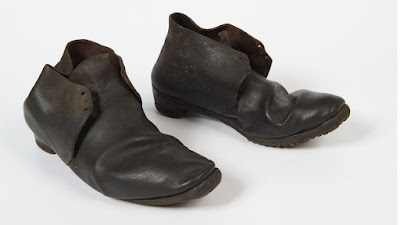
A photo of hidden shoes from England. 

For those of you not from the Boston area, please note the names of the two cities are not pronounced the same. The town in Massachusetts is said CANT-in, or more often CAN’-in, with some kind of glottal stop instead of the “t”. The city in China is often pronounced can-TAWN, but it’s true Chinese name is Guangzhou. It’s also important to note that Cantonese cuisine originates from Guangzhou, not the Massachusetts town. 

The Tilden House is currently owned by the town of Canton, and leased to the Canton Historical Society, who are restoring and modernizing it so it can be used as a history center. After archaeologists removed the kitchen floor, they found several pairs of shoes, along with bottles, plates, and other items, all of which seemed to date from the mid-19th century. All these items could just be trash that past residents discarded, but it’s also possible the shoes were placed there to protect the house from witches or evil spirits. 

Hidden shoes are often found in the walls, ceilings, or under the floors of old buildings in England and North America, and historians suspect it was a form of protective magic. For example, back in 2013 archeologists found shoes hidden under the floor of the Old Colony House in Newport, Rhode Island. But why did our New England ancestors think hiding shoes would defend against evil magic? Historians  Matthew Cochran and Jeanne Ward explain it this way:

This well-documented practice dates from the l5th to the early 20th century. The underlying premise of using concealed shoes as a means of personal or household protection lies both in the shoe’s shape as well as the personal qualities imbued in a shoe by the wearer. Shoes take on the literal shape of the wearer and therefore can act as a form of proxy for the wearer. If a malicious entity is presumed to be haunting you, the concealment of the shoe in a relatively inaccessible space, such as the cellar or the attic, may draw the malicious entity to the shoe instead of you. And, if luck holds, the malicious entity may become trapped in the shoe (from the Maryland Archeology Newsletter, quoted here.)

This explanation makes sense to me, since it matches another important type of protective magic in New England: the witch bottle. I've written about witch bottles before. When someone thought they were being cursed by a witch, they would fill a bottle with their own urine, and then add nails, broken glass, and other sharp items to it. The urine acted as a substitute or proxy for the victim. The witch's evil magic would be drawn to the urine, which came from their victim, rather than to the actual intended target. To make things worse for the witch, the sharps objects would send pain and physical harm back to the witch. 

I suppose you should always have some old shoes, a bottle and some nails on hand just in case things start getting weird? It's like a supernatural form of recycling. But please, don't go around accusing your neighbors of witchcraft.

June 26, 2022

Don't Mess with Thankful Buck: Witchcraft, Black Cats, and A Punished Husband

In my last post, I wrote about Nathan Selee, an alleged wizard who lived in Easton, Massachusetts in the 18th century. People in New England believed that witchcraft ran in families, so it's not surprising one of his sisters was also considered a witch. Her name was Thankful Selee Buck.

Once again, I get my information about the Selee family from William L. Chaffin’s History of the Town of Easton (1886). The stories about Thankful are not as outrageous as those told about her brother. There are no demonic imps running sawmills, or mysterious strangers presenting books of evil magic. Instead, we mostly have classic New England tales of witchcraft.

For example, Chaffin writes that "Loads of hay were sometimes stopped in front of her house, and could not move until she gave the signal, when a black cat was seen to come out from under the hay and glide away." This type of legend is associated with many other witches across New England, although not always with a black cat involved. And just what (or who?) was that mysterious feline? 

A neighbor was said to have caught a black cat doing some mischief, and to have given her a severe beating on the head; the next day it was observed that Thankful Buck had lost an eye. (Chaffin, History of Easton)

Stories about mysterious animals and injured witches have been told in New England for hundreds of years, starting with the Puritans. It was widely believed that witches could project their souls out of their bodies in the shape of animals. These animals were still subject to physical harm, though, so if someone hurt the animal the injury would appear on the witch's human body. Ouch! In some stories, the animals are even killed, which causes the witch to die.

Photo courtesy Library of Congress

Chaffin does tell two stories about Thankful Buck that are more unusual. They both relate to her family. First, he writes that she was "said to have performed her incantations at midnight with her daughters, one of whom inherited her name and reputation, by pouring water from one pan into another." As I mentioned, New Englanders believed witchcraft ran in families, so it makes sense people in Easton thought at least one of Thankful's daughters was a witch. The detail about using two pans of water is an interesting one, and I don't think I've seen that one before. If anyone tries this at midnight, let me know the result!

Finally, Chaffin writes that Thankful once sent her husband to buy her a particular type of wool fabric. He returned home empty-handed, and was unable to enter the house due to an angry Thankful's magic. Only when he came home with the fabric was he able to get into the house. This story makes me laugh - do not make a witch angry! - but it also points out how often these stories about the fear of powerful women. Clearly, she was the one in charge of the Buck household. 

William Chaffin claims that even when he was writing in 1886, some of his Easton neighbors still believed these stories were true. Chaffin is skeptical; he wonders, for example, why Thankful Buck didn't use her magic to save her eye, or if perhaps Thankful and her brother Nathan deliberately cultivated reputations as witches to instill fear in their neighbors. 

I suppose that's possible - see for example the Dogtown witches - but I think it's more likely the Selees and Bucks were just unpopular with their neighbors. Perhaps they were demanding, or maybe they were rude and ill-mannered. It didn't take much to get accused of witchcraft in these small New England town. Happily, they lived after the witchcraft trials ended, so they were not brought to court or executed. I appreciate these old witchcraft legends, but I always try to remember they were about real people, not magical witches. 

April 09, 2022

Wilmot Redd, the Witch of Marblehead

This is my second post about Marblehead. As I mentioned in my last one, Marblehead is incredibly charming and beautiful. It's the archetypal old New England seaside town. And as we all know, old New England towns often have some weird legends attached to them...

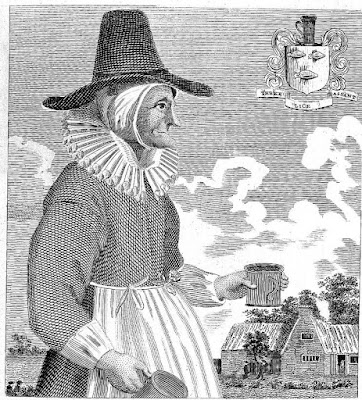
Engraving of a witch by James Caulfield, courtesy the Wellcome Collection

In Marblehead, that weird legend is about Mammy Redd, a fearsome witch who lived in the 17th century. According to various 19th century sources, Mammy Redd was a hideous old woman who terrorized the people of Marblehead. In New England Legends and Folklore (1883), Samuel Adams Drake wrote the following about her:

This woman was believed to possess the power of malignant touch and sight, and she was able, so it was whispered, to cast a spell over those whom she might in her malevolence wish to injure. To some she sent sickness and death, by merely wishing that a 'bloody cleaver' might be found in the cradle of their infant children.

A popular rhyme about Mammy Redd from the 19th century described another of her evil powers:

Old Mammy Redd

Of Marblehead

Sweet milk could turn

To mould in churn

Other versions of the rhyme specify that the mold looked like "blue wool," which sounds pretty gross. Ruining dairy products (milk, cream, or butter) is a classic New England witch's hex. 

Photo by my friend Onix Marrero

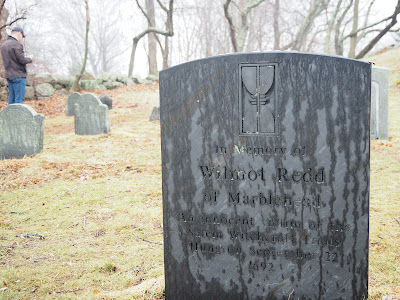
The legend of Mammy Redd is based, quite loosely, on Wilmot Redd (or Read, depending on the source), a Marblehead woman who was executed during the Salem witch trials. She was the wife of a fisherman and, like many of the woman accused of witchcraft by the Puritans, was older and cantankerous. Some sources describe her as "grouty," which means rude or ill-tempered. She was not a witch, but was simply unpopular. 

Most records from her trial are lost, but those that remain describe an argument Redd had with a neighbor, Mrs. Syms. Syms believed Redd's maid had stolen some bed linens, and  exchanged harsh words with Redd. At the end of the argument, Redd supposedly cursed Syms, telling her she would never defecate or urinate again. Soon after, Syms began to suffer from constipation and had difficulty urinating. These problems only ended once she moved away from Marblehead. 

This is an absurd thing to be executed for, but the Salem judges accepted even the most ridiculous accusations at face value. During her questioning, the afflicted Salem girls (the driving force behind the witch hunt) claimed they saw Wilmot Redd's spirit offering them the Devil's black book to sign. This alleged vision sent the girls into convulsions. While most people in the courtroom took them seriously, Wilmot Redd did not. When a judge asked her opinion of the girls' convulsions, she said "My opinion is they are in a sad condition." Grouty to the end, Wilmot Redd was hanged on September 22, 1692 at Gallows Hill in Salem. 

Photo by Onix Marrero

Like everyone executed for witchcraft in Salem, Redd's body was discarded in an unmarked grave somewhere near Gallow's Hill. Perhaps her family retrieved it and secretly reburied her, perhaps not. Many years later, the town of Marblehead erected a monument to her in Old Burial Hill graveyard. As you can see from the photo, people leave coins at her grave to honor her memory. 

The town also named this small behind pond behind Old Burial Hill Redd's Pond in her honor. She and her husband lived next to the pond in the 17th century, and although her house is long gone her memory and legend still survives to this day. 

Photo of Redd's Pond by Onix Marrero

*****

If you like witch legends and the history behind them, you might like my newest book, Witches and Warlocks of Massachusetts, which is available wherever you buy books online. 


January 02, 2022

Two Phantom Houses Adrift in Time

I was browsing through my library of New England books and came upon two interesting stories. Both are supposedly true, and although they occurred more than 100 years apart they are very similar. They're about phantom houses that seem to travel through time. 

The first story comes from Footsteps in the Attic (2002), a book by paranormal investigator Paul Eno. In the summer of 1975, Eno was vacationing in Vermont when he met two local surveyors, Clement Ridley and Bud Harper. They told Eno about something strange they had seen. 

The previous summer, Ridley and Harper had been hired to survey a farmer's land in Johnson, Vermont. As they looked over the property they noticed an old wooden farmhouse that was not shown on any maps. The house was rundown but there was fresh laundry drying on the clothes line and smoke coming from the chimney. Someone was clearly living there. Oddly, there weren't any cars parked in the yard or any electrical or phone lines. 

The John Balch House, Beverly Massachusetts

Ridley and Harper saw a man in the yard. He carried an axe over one shoulder and wore an old-fashioned wide-brimmed hat. They called out to him, wanting more information on the property, but the man didn't hear or see them. They called out again and walked closer to the house. This time the axe-wielding man seemed to see hear something, but didn't see the surveyors even though they were only fifty feet away. 

Ridley and Harper got a little spooked. Why couldn't the man see or hear them? And should they be concerned he was carrying an axe?They decided to leave the area. 

They returned a few days later to continue surveying the land, but when they arrived they were surprised to find there was no old wooden house. Instead, they just found an overgrown cellar hole. Some of the stones looked blackened, as if they had been scorched in a fire long ago. 

Ridley and Harper were even more spooked than they had been when they encountered the man with the axe. A few days later, they learned from someone at Johnson's town hall that there had once been a house in that location - but it burned down in 1910.

Cue the spooky music.... 

Here's a very similar story, but from the 1840s. Caroline Howard King, a wealthy young woman from Salem, was vacationing in Beverly, Massachusetts with her family when she too encountered a house seemingly adrift in time. 

On a warm summer day King went for a walk in the woods with her cousin Nony and their maid Lucy Anne. People in Beverly called the woods Witches Woods, and said they were haunted. King and her companions didn't think anything strange would happen to them on a sunny afternoon, but they were wrong. 

After walking for only a short while they realized they were lost. It seemed as if the path they had followed into the woods had vanished. They wandered around for what seemed like hours until they finally came upon the ruins of an old farmhouse. King knew this was what the locals called the Homestead, and it was said to be haunted. Very little remained of the farmhouse – just a foundation, a chimney, and a stone stoop. An enormous lilac tree grew next to it. The trio explored the Homestead but there wasn’t much to see.

They soon located a path that climbed up a nearby hill. When they reached the top they could see a farmhouse below them where the ruined Homestead should have been, but this one was not in ruins. It was well-kept and smoke rose from its chimney. A small lilac shrub grew in front of it. As they watched a woman emerged and fed a flock of chickens in the yard from the stone stoop. Lucy Anne ran down to ask the farmwife for directions while King and her cousin waited at the top of the hill. 

Lucy Anne was dejected and confused when she returned. She couldn’t find the cozy little farmhouse anywhere, just the ruined Homestead and “hateful solemn old pine trees.” But now that she was back on the hill she once again could see the well-kept farmhouse with its smoking chimney. It was as if King, Lucy Anne, and Nony were looking backwards in time to a moment in history before the Homestead became a ruin. 

The threesome became even more eager to find their way home after they had this frightening realization. Luckily, they found a dry stream bed and after following it towards the ocean they emerged from the woods near their vacation house.  

Caroline Howard King includes that story in her memoir When I Lived In Salem (1822 - 1866), and I also include it in my new book Witches and Warlocks of Massachusetts. The similarities to Paul Eno's story are pretty obvious. One difference is that people in Beverly knew there was something weird about the Homestead, but no one in Johnson, Vermont seemed aware of the phantom house in their town. Also, the Homestead can only be seen in its original state from a distance, not up close, unlike the Johnson house.

I'm not really sure what to make of these stories. Neither one provides an explanation of why these houses seem to slip through time (if that's even what's happening). Or are the people who see them looking through some kind of window to the past? It's not clear.

If there's any lesson, it's that the past is not really gone and is here all around us. We live in one of the oldest parts of the US, with a rich history of strange phenomena. Maybe that history sometimes literally shows itself to the lucky few. And who knows, maybe 200 years from now someone will see a phantom McMansion appear along with its ghostly owner on a riding lawnmower. We too will become part of New England's weird and wonderful past. 

December 22, 2021

In 1692, Invisible Witches Danced in Boston on Christmas Day

Christmas fast approaches, bringing with it Santa Claus, presents, eggnog and... dancing witches? 

As I mentioned in a recent post, the Puritans who colonized New England really hated Christmas. They believed it had no basis in the Bible, and disapproved of how it was celebrated with drunken carousing and public disorder. In 1659, the Puritan leaders of the Massachusetts Bay Colony even enacted a law called "Penalty for Keeping Christmas," which fined anyone who celebrated the holiday. 

The law was repealed in 1681 under pressure from the British king, but the Puritans still did not embrace Christmas. They thought it was a holiday for heretics (like Catholics and Anglicans) and for witches, who apparently, liked to celebrate Christmas with dancing. 

We know this fact about witches from A Brand Pluck'd Out of the Burning (1693), the Reverend Cotton Mather's account of the torments of Mercy Short. Short was an orphaned Boston serving girl who became tormented by invisible witches after mocking Sarah Good, an accused Salem witch being held in Boston's jail. After seeing Sarah Good and making fun of her, Short was stabbed by invisible pins, burned by unseen flames, and at times made deaf and blind. She also shouted profanities and claimed to see the Devil and witches hovering around her. Her torments lasted for many months. 

Merry Christmas?

Reverend Mather treated Short's afflictions with prayer and Bible readings, with mixed results. Groups of people would often join Mather in Short's room to witness her torments and to pray over her. No one except Short ever saw the spectral witches that allegedly assaulted her, but on Christmas Day, 1692, the following occurred:

On the twenty-fifth of December it was, that Mercy said, They (the invisible witches) were going to have a Dance; and immediately those that were attending her, most plainly Heard and Felt a Dance, as of Barefooted People, upon the Floor; whereof they are willing to make oath before any Lawful Authority. 

If I should now venture to suppose, That the Witches do sometimes come in person to do their Mischiefs, and yet have the horrible skill of clothing themselves with Invisbilities, it would seem Romantic. And yet I am inclinable to think it...

It probably seems strange to a modern reader that anyone believed evil invisible witches danced around an afflicted teenaged girl on Christmas Day, but this incident just demonstrates how much the Puritans hated Christmas. In their minds, it was literally a Satanic holiday. 

Some details about Mercy Short's life can provide more context. Prior to living in Boston, Short had lived in New Hampshire with her parents and siblings. In 1690 their family was attacked by indigenous Wabanki warriors. Short's parents and several siblings died in the raid, and Short was sold into captivity in Quebec. She was eventually freed and made her way to Boston, where she found work as a servant. 

Significantly, Mercy Short claimed the Devil looked much like a Wabanaki man. Modern psychologists who have studied her case suspect she suffered from Post Traumatic Stress Disorder (PTSD), which was caused by seeing her family killed. Concepts like PTSD didn't exist in 17th century Massachusetts, so she processed her anguish using the concepts she did have: Puritan theology, witchcraft, and the Devil. 

I don't want to end this on a grim note, since it's almost Christmas. So here are the positive aspects of Mercy Short's alleged witchcraft affliction. First, although she claimed some neighbors were among the invisible witches, no one was formally accused of witchcraft and no one was executed. Cotton Mather thought demons could easily impersonate a living person and therefore felt neither he nor Short could be sure if any neighbors really were afflicting her. 

Second, Short said a radiant bright spirit told her that her torments would end on March 16, 1693. And you know what? They did. Her afflictions ended as suddenly as they began. She was free from pain.

Finally, it is socially acceptable to celebrate Christmas here in New England. So take off your shoes and dance like a barefoot witch on December 25 if you want!

December 05, 2021

Meeting the Devil on Christmas Day

Ho ho ho! It's December, and Christmas madness is once again upon us. We just decorated our tree, I've had my first glass of eggnog, and I made fruitcake yesterday. Bring on the holidays. 

Christmas is so widely celebrated in modern New England that you might not believe it was once viewed as a dangerous and possibly even Satanic holiday. But it's true! The following post (which I first published in 2017) explains more...

*****

In 1662, Rebecca Greensmith of Hartford, Connecticut was arrested and charged with witchcraft. She confessed to meeting the Devil, but she denied having signed a contract with him. Well, at least she hadn't signed one at the time of her arrest. Rebecca and the Devil were waiting for a special day to sign it: Christmas.

The Reverend John Whiting of Hartford wrote the following in a letter:
But that the devil told her, that at Christmas they would have a merry meeting, and then the covenant should be drawn and subscribed. ... Mr. Stone (being then in court) with much weight and earnestness laid forth the exceeding heinousness and hazard of that dreadful sin, and therewith solemnly took notice (upon the occasion given) of the devil's loving Christmas. (quoted in David Hall's Witch-Hunting in Seventeenth-Century New England.)
That sounds a little strange to modern readers. Why would the Devil love Christmas? Isn't it a holiday about hope, love and charity?

Merry Christmas?

Four-hundred years ago, Christmas was a very different holiday than it is today. It wasn't focused on family, gift-giving, and children. Instead, it was characterized by heavy drinking and public rituals that inverted the social order. Europe and its colonies were agricultural societies then, and food and alcohol were most plentiful during the late autumn and early winter. Crops had been harvested, herd animals slaughtered, and beer brewed. There was no more farm-work to be done.

In short, it was a great time to have a huge party. Wealthy people would feast themselves and their friends at home. People from the lower social classes, usually groups of young men, roamed around at night in disguise. The young men (called mummers) would usually target the homes of the wealthy, where they would perform a skit or song in return for food or beer. This is the origin of the wandering Christmas carolers so often portrayed in Christmas stories or movies. If they were denied entry or not given gifts for their performance, the mummers would retaliate with violence or by vandalizing property.


Some hints of this older-style Christmas can still be heard in the lyrics of Christmas carols. For example, "The  Gloucestershire Wassail" describes men threatening a butler to give them good strong beer and demanding entry to a wealthy person's home:
Come butler, come fill us a bowl of the best
Then we hope that your soul in heaven may rest
But if you do draw us a bowl of the small
Then down shall go butler, bowl and all. 
Be here any maids? I suppose here be some;
Sure they will not let young men stand on the cold stone!
Sing hey O, maids! come trole back the pin,
And the fairest maid in the house let us all in.
The lyrics of "We Wish You A Merry Christmas" describe something similar:
Oh, bring us a figgy pudding;
Oh, bring us a figgy pudding and a cup of good cheer
We won't go until we get some;
We won't go until we get some, so bring some out here
Christmas was raucous, drunken, socially disruptive, and occasionally violent. The Puritans valued order, sobriety, and hard work. They didn't want anything to do with Christmas.

During their brief tenure ruling old England the Puritans tried to suppress Christmas celebrations. The Puritans who colonized New England did the same. It was even illegal to celebrate Christmas in Massachusetts between 1659 and 1681. Anyone found doing so could be fined five shillings.

Puritan ministers in New England wrote sermons against Christmas. The Reverend Increase Mather wrote the following, equating Christmas with pagan deities and Satan:
The Feast of Christ's nativity is attended with such profaneness, as that it deserve the name of Saturn's Mass, or of Bacchus his Mass, or if you will, the Devil's Mass, rather than have the holy name of Christ put upon it. (A Testimony Against Several Prophane and Superstitious Customs, Now Practiced by Some in New-England, 1687).
Mather mentions Saturn for a very specific reason. The Bible doesn't provide a date for Christ's birth, and the early Christian church fathers decided to place it on December 25 to coincide with pagan Roman winter holidays like Saturnalia, which venerated the harvest god Saturn. This compromise between Christianity and paganism was another argument the Puritans used for hating Christmas. 

So there you have it. That's why the Puritans thought the Devil loved Christmas. Their efforts to suppress Christmas were modestly successful. Christmas wasn't widely celebrated in New England until the mid-nineteenth century. Christmas is now the biggest holiday in the United States. The Puritans would have blamed Satan, but I think it's just because people like to have fun.

*****

My favorite source for information about Puritans and Christmas is Stephen Nissenbaums's fantastic book The Battle for Christmas. It's great for anyone who wants to really understand the weird history of Christmas in America.

If you want to read more about witches, check out my new book Witches and Warlocks of Massachusetts, which is available wherever you buy books online.